CMS Hospice Payment Rate FY 2025 Proposal

CMS

By Kristin Rowan, Editor

On March 28, CMS issued a new proposed rule to update Medicare hospice payments. Here’s what we know.

The new proposed rule:

  • Would change the existing hospice wage index
  • Clarifies current policy related to the hospice “eletion statement” and the “ntoice of election”
  • Adds clarifying language around hospice certification
  • Includes a request for information to get comments on implementing a separate payment mechanism for high-intensity palliative care services
  • Proposes that Hospice Quality Reporting Program (HQRP) measures be collected through the Hospice Outcomes and Patient Evaluation (HOPE), adding two new measures
  • Also proposes changes to the Consumer Assessment of Healthcare Providers and Systems (CAHPS) Hospice Survey

The new proposed rule includes a net 2.6% increase in payments over FY 2024. This includes a 3% market-based update, and a 0.4% cut for productivity. Submitting quality data is a requirement of the net pay. Hospices that do not submit quality data will be penalized 4%, netting a 1.4% decrease in payments. The propsed rule for 2025 is .5% lower than the 2024 hospice payment increase.

The National Hospice and Palliative Care Organization (NHPCO) says the rate increase is good, but not high enough. NHPCO COO and Interim CEO, Ben Marcantonio said, “To continue providing the high level of care our patients and their families deserve, hospices require a payment rate that accurately reflects the current economic challenges. We know that hospice care has demonstrated $3.5 billion in annual savings for Medicare, which underscores the critical importance of investing in hospice to ensure continued beneficiary access to quality end-of-life care.”

Palliative Care

CMS is interested in feedback and proposals from hospice agencies for providing complex palliative treatments and high-intensity hospice care when that care negatively impacts hospices financially. CMS aims to care for high-cost patients through palliative care rather than acute care. The NHPCO agrees with the CMS proposal to fund palliative care separately from standard hospice or acute care. CMS will take feedback and proposals through May 28, 2024. Comments can be submitted electronically at http://www.regulations.gov, by following the “Submit a Comment” instructions. Comments can also be sent by regular or express mail. Addresses can be found in the full proposed rule. Follow the search instructions at http://www.regulations.gov to see all submitted comments.

The proposed rule can be viewed starting April 4, 2024 at the Federal Register at https://www.federalregister.gov/public-inspection.

# # #

Kristin Rowan

Kristin Rowan has been working at Healthcare at Home: The Rowan Report since 2008. She has a master’s degree in business administration and marketing and runs Girard Marketing Group, a multi-faceted boutique marketing firm specializing in event planning, sales, and marketing strategy. She has recently taken on the role of Editor of The Rowan Report and will add her voice to current Home Care topics as well as marketing tips for home care agencies. Connect with Kristin directly kristin@girardmarketinggroup.com or www.girardmarketinggroup.com

©2024 by The Rowan Report, Peoria, AZ. All rights reserved. This article originally appeared in Healthcare at Home: The Rowan Report. One copy may be printed for personal use: further reproduction by permission only. editor@therowanreport.com

HealthRev Partners Launches Velocity as a SAAS, Transforming Revenue Cycle Management for the Home Health and Hospice Industry

Partner News

For Immediate Release

Contact Information:
HealthRev Partners
866-780-3554
connect@healthrevpartners.com

HealthRev Partners Launches Velocity as a SAAS, Transforming Revenue Cycle Management for the Home Health and Hospice Industry

Velocity SaaSMeta: Discover how HealthRev Partners’ innovative SAAS solution, Velocity, is transforming revenue cycle management in the healthcare industry. Gain insights into its key advantages, AI capabilities, and data exchange interface engine feature set. Learn how Velocity empowers agencies with transparency, efficiency, scalability, and security to enhance profitability and operational excellence. Contact HealthRev Partners for a demo and revolutionize your revenue cycle management today.

Ozark, MO – April 1st, 2024 – HealthRev Partners, a leading innovator in healthcare technology, has announced the launch of Velocity as a Software as a Service (SAAS), revolutionizing revenue cycle management in the home health, hospice, and palliative care industries. This game-changing solution is designed to transform revenue cycle management (RCM) for multi-site agencies. In an era where the aging population in America increasingly desires to age in place, mergers and acquisitions in the home health space are driving the necessity for centralized data and operational processes. The trend of overseas hiring to reduce costs has created gaps in insights, emphasizing the critical need for real-time data to impact care promptly.

Michael Greenlee, Founder and CEO of HealthRev Partners, expressed his enthusiasm about the launch, stating, “Velocity as a SAAS represents a significant leap forward in revenue cycle management technology. By offering agencies unprecedented insights into their operations and empowering them with tools for optimization and growth, HealthRev Partners is setting a new standard in RCM solutions.”

Empowering Multi-Site Agencies and Enhancing Management Insights

As multi-site agencies navigate the complexities of managing diverse locations and teams, the demand for comprehensive insights and seamless integration becomes critical. HealthRev Partners recognizes this challenge and introduces Velocity as a SAAS to address the evolving needs of growing agencies. With a focus on providing real-time analytics and enhancing operational efficiency, Velocity bridges the gap between disparate locations and centralizes data for streamlined management.

Seamless Integration with Any EHR System

A key component of Velocity is the data exchange interface engine feature set. The ability to connect, integrate, translate, and import financial, claims, coding, clinical, operational, EHR, clearinghouse, and diverse data sets is vital for any organization. Velocity uses its proprietary interface technology engine along with robotic processing technology (RPA) to connect all disparate data sets within Velocity resulting in actionable data at your fingertips.  

AI Capabilities to Increase Coding Accuracy

Velocity harnesses AI capabilities to automatically assign charts to coding professionals, enhancing efficiency and accuracy. By leveraging artificial intelligence, it streamlines the ICD-10 coding process and provides intelligent suggestions for selecting codes at the highest level of specificity to maximize reimbursement. Additionally, it utilizes advanced algorithms to analyze data and offer insights into PDGM-approved primary codes and comorbidity adjustment categories. Furthermore, Velocity’s AI-driven system assists in risk and comorbidity adjustments by recommending compatible code combinations and presenting primary and secondary code sets to facilitate precise coding decisions.

Key Advantages of Velocity:

  • Increased Transparency and Visibility: Real-time insights into all aspects of the revenue cycle across multiple sites. Identify bottlenecks, track productivity, and optimize operations seamlessly.
  • Enhanced Efficiency and Accuracy: Streamlined processes and standardized procedures that ensure consistency across all locations. Improve accuracy in coding, claim submission, and reimbursement.
  • Improved Communication and Collaboration: Facilitate real-time data sharing between clinical, financial, and operational teams at different sites. Enhance collaboration and decision-making.
  • Scalability and Security: Easily scale operations to accommodate growth needs while maintaining top-tier data security standards. Ensure compliance with regulatory requirements across all locations.

Michelle Mullins, MHA, BSN, RN – Partner & Chief Operating Officer of HealthRev Partners, highlighted the transformative impact of Velocity by stating, “Velocity illuminates your RCM’s path to predictable revenue. It empowers agencies with granular insights, customizable control, streamlined operations, and trustworthy security. This tool is not just a solution; it’s a revolution in revenue cycle management.”

The launch of Velocity as a SAAS marks a pivotal moment for agencies seeking to optimize their revenue cycle processes. With its focus on transparency, efficiency, communication, scalability, and security features, Velocity is poised to reshape how agencies manage their RCM operations.

# # #

For more information about Velocity as a SAAS or to schedule a demo, visit HealthRev Partners’ website.https://healthrevpartners.com/ 

Is the Covid Boost for Telehealth Over?

Clinical

by Tim Rowan, Editor Emeritus

In 2020, doctors flooded telehealth companies with requests for help caring for patients reluctant to leave home to come to their appointments. Following suit, many Home Health agencies that had never considered investing in home telehealth before, opened up their wallets to acquire equipment, from simple wearables to high-end, HIPAA-compliant video systems.

In addition to the need to provide care at a safe distance, many HHA leaders knew the added service would attract the attention of hospitals desperate to discharge recovering Covid victims as well as non-Covid patients. Some HHAs established relationships with hospitals they had not had before, given the chance to demonstration Home Health’s unique advantages over extended hospital stays and discharges to institutions such as SNFs that had become virtual death sentences during the height of the pandemic.

All Things Must Pass

With the introduction and widespread free availability of Covid mRNA vaccines, the death rate graph line began to tilt downward. Then came the discovery that the SARS-CoV-2 and its variants are transmitted through the air and not through unwashed surfaces. People stopped disinfecting their counter tops after unloading groceries. And they started in-person doctor visits again. Patients returned to allowing nurses into their homes.

In regions where vaccination and booster rates were high, hospitals found themselves with more and more empty beds. They took down tented treatment centers in their parking lots and sent refrigerated trailers back to trucking companies. Desperation referrals to Home Health tapered off, as did the need for virtual visits.

Isaac Newton said every action has an equal and opposite reaction. If that holds true in the healthcare business as it does in physics, the reaction to Covid easing is seen in Remote Patient Monitoring tech companies. According to Fierce Healthcare, the New York Stock Exchange told one RPM company, Amwell, formerly known as “American Well,” to raise its stock price or be delisted. Fierce added detail about the company’s woes:

“Despite decimating its workforce at the end of 2023 to cut expenses, the company still projects a 2024 loss between $160 million and $155 million amid incremental revenue growth. The company’s market cap was a stone’s throw from $6 billion at the height of its valuation, when shares were trading for more than $42 each. Amwell shares were trading at $0.72 as of market close on April 5, giving the company a current market cap of about $208.6 million.

Another market leader fared no better, Fierce Healthcare found. “Telehealth giant Teledoc, which has been in operation for 20 years, has struggled in the stock market and is facing headwinds as the virtual care market has become crowded with digital health players. Shares dropped 22 percent in February as the company missed fourth-quarter revenue estimates and offered a downbeat forecast for the rest of the year.”

Teledoc’s 15-year CEO, Jason Gorevic, resigned last week after the company reported a net loss of $220 million for 2023, following 2022’s historic loss of $13.7 billion, mostly from a write-off related to the plummeting value of its ill-advised Livongo acquisition. According to Fierce Healthcare, Teladoc shelled out $18.5 billion for the digital chronic condition management company, a record in digital health.

Gorevic’s rationale that the telehealth field has become too crowded may not be far off. Last July, Becker’s Hospital Review published an industry survey titled “280+ Telehealth Companies to Know.” The list included a half dozen names we recognized from past Home Health conferences, including Health Recovery Solutions, AMC, Vivify, and FoneMed.

Do Hospital Woes Translate Down to Home Health?

Making comparisons between telemedicine companies that focus on hospitals and physicians and those who focus on post-acute providers is hampered by the fact that few in our sector are publicly traded and do not share their numbers. UnitedHealth, which acquired Vivify in 2019 and assigned it to its Optum division, does not separately report Vivify revenue.

Health Recovery Solutions, one of the best-known names in post-acute RPM, is privately held by its founding CEO and seven investors. Its most recent influx of $800,000 occurred in January, 2022, making it impossible to determine whether it was motivated by investor confidence or the need for cash as Covid began its decline.

Analysis

This publication has promoted the advantages of remote patient monitoring for its entire 25-year existence. We have covered startups and established tech companies offering every technology from PERS to Zo monitors to automated phone calls, in-home cameras and microphones. We have followed the evolution of two-way communications and vital sign detectors from tabletop devices to tablets and smartphones. We have even tested a few robots. We have seen HHAs experience great success, and we have seen devices collecting dust on shelves.

Throughout, we have maintained that, when selected, implemented, and deployed properly, monitoring patients 24/7 instead of once or twice a week can improve patient outcomes, boost agency reputation, and, more often than not, produce a healthy ROI. The end of the latest pandemic may mean the end of demand for Remote Patient Monitoring systems, but that would be unfortunate.

Tim Rowan, Editor EmeritusTim Rowan is a 30-year home care technology consultant who co-founded and served as Editor and principal writer of this publication for 25 years. He continues to occasionally contribute news and analysis articles under The Rowan Report’s new ownership. He also continues to work part-time as a Home Care recruiting and retention consultant. More information: RowanResources.com or Tim@RowanResources.com

©2024 by The Rowan Report, Peoria, AZ. All rights reserved. This article originally appeared in Healthcare at Home: The Rowan Report. One copy may be printed for personal use: further reproduction by permission only. editor@therowanreport.com

HOPE is on the Way: Part 1 – Outcome Measures

Clinical

By Beth Noyce, RN, BSJMC, HCS-C, BCHH-C, COQS
Home health & hospice consultant

The Hospice Outcome Patient Evaluation is a step closer to implementation.

After four years of considering options, the Technical Expert Panel (TEP) has finished its work that will inform future Hospice Quality Reporting Program results. The TEP considered quality measures to include in hospice’s future assessment tool and best choices for risk adjustment and exclusion.

The panel convened in 2019 “[we are] committed to improving the quality of care given to hospice patients,” says the 2022-2023 TEP Summary Report: Hospice Quality Reporting Program. The panel aimed to ensure that hospice quality measures are meaningful for hospice beneficiaries, transparent to hospice providers, and useful to consumers. They considered quality measures from both HOPE and claims data.

“From day one it was very clear Medicare wanted to make this a very different experience for hospice teams and make it a more valuable thing for consumers,” says Dr. Jeff McNally, Hospice Medical Director at Utah’s Intermountain Hospice,” describing his participation on the HQRP TEP. “I was actually encouraged and inspired by it,” he says. “It was the first time I had first-hand experience working with any kind of CMS entity.

“The reality is some clinicians in the field and leaders don’t have the best things to say about CMS,” he explains, but “whatever we were considering we always circled back to whether it would be burdensome to the clinical team and would it be valuable to consumers.”

The panel initially planned to meet multiple times in person, with two meetings per year and potential virtual meetings as needed. “Then COVID hit,” Dr. McNally says. “It slowed the process considerably. We never did meet again in person.”

The HQRP TEP met eight times over four years, virtually after the initial meeting. McNally described participants as coming to each meeting prepared with data and proposals for HOPE measures for which they would request input from panelists.”

From TEP recommendations early in their work, Abt Associates developed two outcome measures and two process measures in harmony with hospice’s central tenet to manage symptoms:

  • Process measures:
    • Timely Reassessment of Pain Impact
    • Timely Reassessment of Non-Pain Symptom Impact
  • Outcome measures:
    • Timely Reduction of Pain Symptom Impact
    • Timely Reduction of Non-Pain Symptom Impact

“The most important [recommendations] were some of the outcome measures about symptom management,” McNally explains. “What should we be helping agencies show that they’re doing well? And how do we do that? Deciding which ones, and how many symptom management measures to use and the most valuable way to show it in a fair way.”

During the past two years, TEP members prioritized which of the risk-adjustment factors suggested by Abt. Associates should apply to outcome measures and which exclusions should apply to both outcome and process measures.

The report describes risk adjustment as using statistics to exclude “confounding factors,” or elements that are outside of a hospice’s control, from calculations that could make a hospice’s performance appear either better or worse than it is. In essence, risk adjustment increases the fairness in outcome-measure calculations while exclusions do the same for both outcome and process measures.

For the outcome measures being considered, the report says that the “TEP broadly agreed that risk adjustment is very important because it accounts for external factors outside hospices’ control and more accurately reflects the quality of care provided.”

Judi Lund Person, Principal of LundPerson & Associates, LLC, agrees. “The discussion of risk-adjustment factors is vitally important to the success of upcoming process measure implementation,” says Lund Person.

Determining which risk-adjustment factors to bring to the table was not easy. “There were some nuance things that we hashed out to try and decide how to weigh some factors in risk adjustment” for outcome measures, McNally explains.

Exhibit 5 (below) summarizes the TEP’s rankings of risk adjustors suggested.
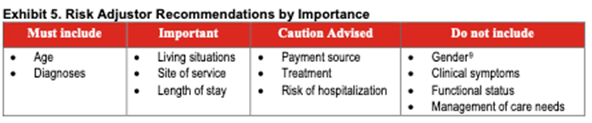
While the TEP’s priorities seem clear, the discussion concerning each risk adjustor was more complex. The TEP broadly agreed that the most important risk-adjustment factors are age and diagnosis. Some diseases are more difficult to manage than others, and patient condition tends to decline with age regardless of provider activity. Therefore, the TEP recommended that CMS adjust for these factors to ensure that common external factors do not adversely affect reported hospice care quality.

Here’s part of the nuance – the TEP also raised concerns that how well other patients with certain diseases or of certain age groups are treated might be valuable to some patients and their families seeking care for someone of the same age group or condition. Panelists fretted over possibly obscuring that information for consumers seeking hospice care by adjusting for those risk factors.

Living situation as a risk adjustor ranked as important to TEP members because hospices have no control over what level of assistance is available to patients. Similarly, site of service ranked high as a risk adjustor because, said some panelists, care is delivered very differently across settings, and patients and/or caregivers tend to provide higher hospice satisfaction ratings for hospices in home settings than for those in facilities,” according to the report.

Lund Person, who is also former Vice President of Regulatory and Compliance at the National Hospice and Palliative Care Organization (NHPCO), notes that the TEP recognized living situation and site of service as “important” risk adjustment recommendations.

“Identifying site of service will help to distinguish between care at home and care in a facility,” she says. Also vital, she continues, “is the recommendation from the TEP to consider length-of-stay as a risk-adjustment factor, including the differences between a 4-day length of stay and a 6-month length of stay.”

One TEP member cautioned that using payment sources, IV therapy, and risk of hospitalization as risk adjustors might tempt some hospices to use them to distort a hospices’ apparent care quality.

TEP members did not recommend using as risk adjustors gender, clinical symptoms, functional status and management of care needs. They did not discuss why they rejected gender, but several agreed that using clinical symptoms would not be of value because of their high correlation with diagnoses. Because hospice providers typically see hospice patients decline in ADL and IADL abilities, and hospice goals are focused on comfort rather than functional improvement, functional status was on the TEP’s “Do Not Include” as a risk adjustor list. And finally, one TEP member strongly opposed adjusting for patients’ medication management, supervision or safety assistance needs (management of care needs), explaining that “the public and CMS should hold hospices accountable for planning around oral medication, injectable medication management, and supervision and safety assistance,” the report says.

The TEP did suggest that using some risk adjustment factors as part of the HQRP could assist hospices internally with quality improvement while others would be more valuable to patients and families. For example, Patients and families would benefit from more straightforward risk adjustment that helps them select a hospice,” the report says, “including factors such as diagnosis. For publicly reported data used to select a hospice, the TEP suggested using demographic factors (including age but excluding gender), socioeconomic factors, living situation, and diagnoses.”

Dr. McNally hopes eventually to use HPRP data to promote Intermountain Hospice’s care. Intermountain Hospice is part of Intermountain Health, a health care provider with presence in multiple states. “You can’t take the current metrics to doctors’ offices and families to show anything meaningful,” he says. “It’d be great to have metrics we could take to our neurology docs and other docs,” he says. “I really think we provide better care and more options when patients stay within our system.

This article is the first in a series about implementation of HOPE. Next week, Beth Noyce shares details from the panel as it evaluated process measures.

# # #

©2024 by The Rowan Report, Peoria, AZ. All rights reserved. This article originally appeared in Healthcare at Home: The Rowan Report. One copy may be printed for personal use: further reproduction by permission only. editor@therowanreport.com


HOPE is on the Way: Part 3

CMS

By Beth Noyce, RN, BSJMC, BCHH-C, COQS
CHAP-certified home health & hospice consultant

This is part 3 of the 3 in the series, outlining the discussions and implications in adopting new outcome and process measures for Hospice care. The final segment addresses future process and outcome measures that the board discussed, but did not yet implement. Read Part 1 on Outcome Measures and Part 2 on Process Measures.

The TEP discussed potential future process and outcome measure concepts that Abt Associates presented to the panel as well.

The process measures included:

  • Education for Medication Management
  • Wound Management Addressed in Plan of Care
  • Transfer of Health Information to Subsequent Provider
  • Transfer of Health Information to Patient/Family Caregiver

Hope-based outcome measures were:

  • Patient Preferences Followed throughout Hospice Stay
  • Hospitalization of Persons with Do-Not-Hospitalize Order

Developing education for medication management as a process measure was a popular concept, and the top priority of the recommended measures with the TEP as they “broadly agreed that CMS should develop this measure,” the report says, citing “a significant need for training in medication management for patients and their caregivers.” They recommended that the measure weigh more heavily when care is provided in a home setting than in a facility setting because hospices are unable to control facility training and hiring practices. One panelist commented that including the phrase “during today’s visit” in the measure is important.

Whether CMS should further develop the process measure addressing wound management in the plan of care was less straight-forward, as panelists provided varied feedback. They generally agreed that this measure is important, as having a record of wound management addressed in the plan of care can hold the staff accountable for treating the wounds. But some members recommended measuring wound management with outcome measures rather than process measures. One panelist cited potential problems from patients’ deterioration over time and another noted that the time frame of this measure is important, and encouraged recording the process of getting care in place once a wound is identified.  The panel agreed CMS should carefully define the measure’s specifications.

Because standard practice for most agencies is, when a patient is discharged live, to transfer health information to the subsequent provider and to the patient and family or caregiver, TEP members expressed that the two measures were likely to “top out,” meaning they would almost always be marked “Yes,” making them of no value in differentiating between hospice providers. The group generally discouraged developing these process measures.

The group strongly rejected any merit in developing two outcome measures concerning Patient Preferences Followed Throughout Hospice Stay and Hospitalization of Persons with Do-Not-

Hospitalize Order. The report says “Multiple TEP members described situations in which patients who had preferred not to be hospitalized changed their minds when a crisis occurred. Patients’ preferences and unexpected crises are usually out of the hospice’s control. Although it is still important for hospices to ask patients about their preferences as part of patient-centered care, the TEP did not believe these two items would be practical measures of a hospice’s care quality.”

Dr. McNally expects that Abt. Associates will apply the HQEP TEP’s suggestions to the HOPE tool.

“Oh yeah, they did it,” he says. “Abt would come to a specific meeting with information, data, suggestions, and specific information about how these things would be measured. We’d give feedback. Then they’d come back to the next meeting having incorporated our suggestions,” he explains. “All of us felt very much heard and responded to. It didn’t feel in the least bit perfunctory.”

Whatever specific measures are eventually included in the HOPE tool, Lund Person sees value in its implementation. “Hospice providers have had a woeful lack of outcome measures for hospice patients, which has made the evaluation of quality hospice care based only on process measures and the family’s evaluation of hospice care in the CAHPS® Hospice Survey, she explains. “Implementing HOPE will begin to identify outcome measures that can be compared between providers.”

Lund Person warns of potential challenges as well. “The selection of risk adjustment and stratification must be carefully done to minimize bias and maximize effectiveness of measures,” she says. “In addition, hospice providers have been awaiting the release of the HOPE tool with significant anxiety about content and administrative burden.”

Dr. McNally is confident the HOPE tool will be a healthy change for hospices.

“A lot of my role as a medical director and hospice physician is supporting our nurses,” he says. “They do 95% of the work. I really would like to see this not be burdensome for our hospice nurses. I’m looking forward to seeing what the [HOPE tool] beta testing translates to in our own hospice world.” He added “What I would hope to see is that the tool feels user-friendly to the hospice team, the people who have to use it, and that it also provides useful information to patients and families.”

NAHC’s Wehri says that standardizing processes through the HOPE tool is the key foundational element for the hospice industry. “High quality care is driven by reducing variance through standardized processes, Wehri writes. “Also, CMS will have a better idea of how the type of population a hospice serves impacts some of the clinical care.” This small glimpse into hospice variances that CMS does not currently have could be very helpful in future policy and payment decisions, according to Wehri. “What CMS finds in terms of differences between hospices and their care for patients may be a bit of a surprise to CMS,” she says.  “I hope they are pleasantly surprised with the overall quality of care that is revealed.”

# # #

Beth Noyce provides education, consulting, mentoring, compliance assessments and auditing services to home health and hospice agencies and their clinicians in several states. She also now provides patient and family guidance concerning hospice and home health services. Beth loves teaching and helping others succeed. She also makes available recordings of much of her education for her clients’ convenience.

©2024 by The Rowan Report, Peoria, AZ. All rights reserved. This article originally appeared in Healthcare at Home: The Rowan Report. One copy may be printed for personal use: further reproduction by permission only. editor@therowanreport.com


Understanding Differences in Medicare Policy and Conditions of Participation

Admin

by Johnathan Eaves, Senior Director of Communications, Axxess

Treating Medicare patients comes with a level of nuance that is important to understand to ensure that organizations remain compliant and patients receive appropriate care. Standards for quality care and payment can sometimes be dictated by Medicare’s payment policies and at other times be decided by the Conditions of Participation. There is an important difference between these two governing principles that providers should understand to ensure compliance.

Care at home industry veteran and Axxess Senior Vice President of Clinical Services Arlene Maxim RN, HCS-C, offered insights into the differences between Medicare’s policy and its Conditions of Participation during a recent webinar.

Explaining the DifferenceMedicare Policies

Maxim pointed out that the differences between policy and the conditional requirements comes down to what can be billed and what are the quality standards for the services provided.

“The Conditions of Participation are dealing primarily with quality, whereas Medicare policy is related to payment,” said Maxim. And while there is a difference, that doesn’t mean both aren’t important and must always be followed.

“If Medicare policies are not followed, you are audited and if you do not have documentation to support those policies, you’re not going to get paid,” said Maxim “Oftentimes, with PDGM, staff members are not getting past that first 30 days. They’re not understanding what they need to do to keep that patient who continues to qualify for services on for longer.”

Maxim says that the problem is often that clinicians do not understand Medicare policy. “Every piece of documentation we submit to the Medicare program for review [needs to be] as pristine as we can possibly get it,” she said.

Assessment and Documentation

Proper assessment and documentation is something Maxim feels is critical in ensuring quality care, meeting Medicare requirements, and receiving payment for services.

“Complete and detailed documentation is going to be the key for agency payment by the Medicare program,” Maxim said.

Maxim pointed out certain services covered under Medicare policy may include observation and assessment, management and evaluation of a care plan, maintenance therapy, teaching and training activities, administration of medications, wound care, ostomy care, rehab nursing, venipuncture, skilled nursing visits, and more.

She also cautioned that agencies need to be prudent with the funds they receive from Medicare, viewing them as a potential “short-term, interest-free loan” until undergoing any audit. Until their documentation is reviewed and approved, there are no guarantees.

“Medicare is an insurance and it’s not free,” said Maxim. “Medicare policy provides us with a list of covered items. If experiencing an audit, and if the documentation is not there to cover the covered service, you’re not in compliance with that Medicare policy and you will not be paid for the services.”

Communicating With Physicians

Maxim further emphasized the importance of frequent contact with physicians, adherence to care plans, and ensuring that care plans are simple with individualized plans and goals that are achievable.

“You want to make sure that you have orders that physicians are actually going to read and to determine that they make sense and they’re going to sign off on them,” said Maxim.

“Keep your plan of care simple.”

# # #

Axxess Home Health, a cloud-based home health software, streamlines operations for every department while improving patient outcomes.

© 2024 Axxess. For reprint permission, please contact The Rowan Report: kristin@therowanreport.com

Teaching Caregivers How to Help Patients Heal

Clinical

by Elizabeth E. Hogue, Esq.

Noora Health has developed a program of “health companions” in a variety of types of healthcare settings (“Teaching Patients How to Heal,” The New York Times, April 14, 2024) to help patient heal. The basis of these programs is that when medical information is properly communicated to patients and their families, complications of surgeries and illnesses are reduced. An added bonus is that acts of violence by frustrated family members against health care workers are reduced.

If patients are most comforted by their loved ones, why not involve them in the healthcare process? “We realized that caregivers get little to no guidance within the health care system,” said Shahed Alam, a co-founder of Noora Health. Many patients do not know why they are receiving care. Doctors and nurses tend repeat the same information to patient after patient.

In institutional settings, staff nurses literally take over the floors to teach patients and their family members. On cardiac floors, for example, staff nurses tell patients how to cough without stressing their hearts, how to scratch without adversely affecting their wounds, and how pacemakers work. Staff nurses also help patients sift through good and bad information. Classes frequently include how to manage side effects of medications and the importance of handwashing.

Many patients and their family members come to view the staff nurses as therapists, coaches, friends and philosophers all rolled into one. A family member who received help from a health companion described the companion as a “friend” without whom she would not have been able to care for her family member.

Although home care providers, including Medicare certified home health agencies, hospices, private duty home care agencies, and durable medical equipment (DME) companies do not necessarily have a “captive audience” like institutional providers, it is still possible to utilize health companions. Field staff can be trained to provide teaching that is similar to that provided by health companions. Teaching from health companions may also be provided to home care patients and their family members in group settings. Hospices may, for example, provide volunteers to be with patients while their caregivers attend. And, of course, virtual teachings with health companions may also prove valuable.

Providers often consider ways to differentiate their services in a competitive marketplace. Perhaps the use of health companions is one way to do so, Providers may also enhance loyalty from patients and their families, improve quality of care and prevent emergency room visits, hospitalizations and rehospitalizations. Think about it!

©2024 Elizabeth E. Hogue, Esq. All rights reserved.
No portion of this material may be reproduced in any form without the advance written permission of the author.
©2024 This article appeared in The Rowan Report. All rights reserved.

House Ways and Mean Unanimously Extends Telehealth Flexibilities

Partner News

FOR IMMEDIATE RELEASE

ATA ACTION APPLAUDS HOUSE WAYS AND MEANS COMMITTEE FOR UNANIMOUSLY ADVANCING A TWO-YEAR EXTENSION OF MANY CRITICAL TELEHEALTH FLEXIBILITIES

WASHINGTON, DC, MAY 8, 2024 – ATA Action, an affiliated trade organization of the American Telemedicine Association (ATA), applauds the House Ways and Means Committee for their proactive approach in unanimously advancing a two-year telehealth extension. This extension will maintain many of the current Medicare telehealth flexibilities through the end of calendar year 2026, demonstrating the Committee’s commitment to telehealth.

“While we prefer Medicare telehealth flexibilities be made permanent, we understand the dynamics and applaud the Committee for a two-year extension of many of the critical flexibilities without arbitrary and unnecessary guardrails such as in-person requirements,” said Kyle Zebley, Senior Vice President, Public Policy, the ATA and Executive Director, ATA Action. “This is a clear sign that our bipartisan telehealth supporters are at work, determined not to leave the American people without access to safe, effective, quality healthcare where and when they need it. But this is not over yet. There will be additional markups and other committees need to weigh in, as we continue to push for telehealth permanency.”

Specifically, ATA Action is supportive of the bill extending the following telehealth provisions:

  • Geographic and originating-site waivers
  • Ability for Federally Qualified Health Centers (FQHCs) and Rural Health Clinics (RHCs) to continue to furnish telehealth services
  • Expanded list of eligible Medicare providers, allowing Physical Therapists, Occupational Therapists, Speech Language Pathologies, and Audiologists to render telehealth services
  • Ability to offer audio-only services
  • Repeal of telemental health in-person requirement
  • Preservation of the Acute Hospital Care at Home Program through CY2029

“We hope this action by the Ways and Means Committee will push Congress to enact this legislation soon to provide certainty for patients and providers across the country and allow U.S. healthcare systems enough time to implement appropriate virtual tools, technologies, programs, and processes moving forward,” Zebley added. “We support additional telehealth priorities that have not yet been acted upon, including the remote prescribing of controlled substances, which were not included in the legislative proposal. We believe, if left omitted, this would lead to a tremendous gap in care.”

“ATA Action is available as a resource and looks forward to continuing to work with Congress to ensure that the appropriate telehealth policies are implemented in a timely manner without arbitrary and unnecessary barriers to care such as in-person, brick and mortar, or geographic requirements,” Zebley said.

About ATA Action

ATA Action recognizes that telehealth and virtual care have the potential to transform the healthcare delivery system by improving patient outcomes, enhancing the safety and effectiveness of care, addressing health disparities, and reducing costs. ATA Action is a registered 501c6 entity and an affiliated trade organization of the American Telemedicine Association (ATA).

#  #  #

CONTACT:

Gina Cella
gcella@americantelemed.org
t: 781-799-3137

© The Rowan Report. For information on publishing this or any other press release, please contact editor@therowanreport.com