by Elizabeth E. Hogue, Esq. | Nov 13, 2025 | Legal
by Elizabeth E. Hogue, Esq.
What Can Providers Give to Patients...
On May 24, 2021, the Office of Inspector General (OIG) of the U.S. Department of Health and Human Services (HHS) issued another FAQ on the Application of Administrative Enforcement Authorities to Arrangements Directly Connected to the Coronavirus Disease:
Would the offer or provision of cash, cash-equivalent, or in-kind incentives or rewards to Federal health care program beneficiaries who receive COVID-19 vaccinations during the public health emergency violate the OIG’s administrative enforcement authorities?
The OIG first addressed this question by acknowledging that a broad range of entities, including providers, are offering a wide variety of incentives and rewards to recipients who are vaccinated; such as food and beverages, cash, and tickets to concerts and sporting events. The OIG recognizes that widespread vaccine administration is crucial to the pandemic response and that incentives and rewards may promote broader access and increase the number of recipients.
The OIG also pointed out, however, that these rewards and incentives may violate the federal Anti-Kickback Statute (AKS) and the Civil Monetary Penalties Law (CMPL) governing beneficiary inducements.
The OIG then concluded that providers, in the limited context of the COVID-19 public health emergency, may give rewards or incentives to beneficiaries who receive either one or both doses of the vaccine because such incentives and rewards “would be sufficiently low risk under the Federal anti-kickback statute and Beneficiary Inducements CMP.”
Providers must, however, meet the following requirements:
The incentive or reward must be furnished in connection with receipt of a required dose of COVID-19 vaccine, including either one or two doses depending on vaccine type.
The vaccine administered is authorized or approved by the Food and Drug Administration (FDA) as a vaccine for COVID-19 and is administered in compliance with all other applicable federal and state rules and regulations, including conditions for receipt of vaccine supplies from the federal government by providers.
Incentives or rewards are not tied to or contingent upon any other arrangement or agreement offering incentives or rewards between providers and beneficiaries.
Incentives or rewards are not conditioned on recipients’ past or anticipated future use of other items or services that are reimbursable in whole or in part by federal health care programs.
Incentives or rewards are provided during the COVID-19 public health emergency.
The OIG then pointed out that the AKS and CMPL relate to items and services for which payment may be made in whole or in part under a Federal health program. According to the OIG, it is unlikely that these statutes are implicated by incentive and rewards furnished to commercially insured or uninsured individuals.
Finally, the OIG concluded by saying that it would not express any opinion on the merits or utility of particular incentives or rewards to address the goal of encouraging vaccination.
As long as the criteria above are met, providers may give incentives or rewards to beneficiaries in order to encourage them to be vaccinated.
This article is part 4 in the series. Read Part 1, Part 2, and Part 3.
Elizabeth Hogue is an attorney in private practice with extensive experience in health care. She represents clients across the U.S., including professional associations, managed care providers, hospitals, long-term care facilities, home health agencies, durable medical equipment companies, and hospices.
©2025 Elizabeth E. Hogue, Esq. All rights reserved.
No portion of this material may be reproduced in any form without the advance written permission of the author.
©2025 by The Rowan Report, Peoria, AZ. All rights reserved.
by Elizabeth E. Hogue, Esq. | Jul 18, 2025 | Admin, Legal
by Elizabeth E. Hogue, Esq.
Employee or Independent Contractor
DOL Won't Enforce Determination Standards
The U.S. Department of Labor (DOL) has announced that it will no longer enforce a rule published in 2024 that have been used to decide whether workers are employees or independent contractors. This means that while the DOL develops new standards it will no longer apply the analysis in the 2024 rule when investigating potential misclassification of workers as independent contractors instead of employees.
This decision is due, in part, to legal challenges to the rule. The classification of workers as either employees or independent contractors has been an important issue for providers of services in patients’/clients’ homes, especially for private duty or homecare providers.
Totality of Circumstances Rule
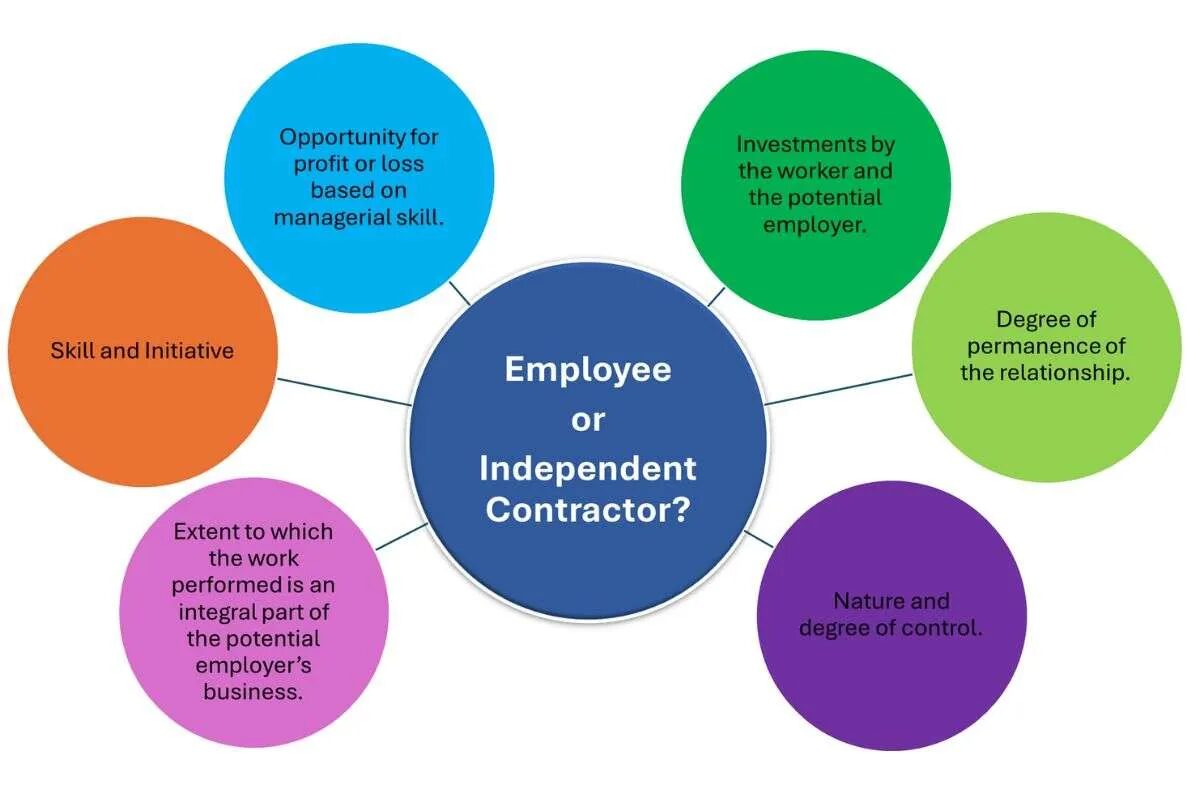
The rule that the DOL finalized in 2024 focused on the “totality of the circumstances” to determine whether workers were independent contractors or employees under the Fair Labor Standards Act. It considered factors like:
Opportunity for profit or loss based on skill level
Whether workers can:
- Negotiate charges for services provided
- Accept or decline work
- Choose the order or time when services are performed
- Engage in marketing or advertising activities
- Make decisions about hiring others, purchasing materials and/or renting space
Investment by workers vs employers
- Workers’ investments do not need to equal employer investments
- Workers’ investments should support an independent business
- If work is temporary or project-based, worker is likely a contractor
- If work is indefinite or continuous, worker is likely an employee
Nature and degree of control
- If the employer has more control, workers are likely employees
- Contractors have more control over scheduling
- Contractors have less direct supervison
- Contractors can work for multiple employers
Degree to which role is essential
- Integral roles are filled by employees
- These roles are critical, necessary, or central to employer’s principal business
- Integral roles often manage other employees
- General skill and labor positions are usually filled by employees
- The more specialized the skills, the more likely the worker can be an independent contractor
This rule certainly made it harder to classify workers as independent contractors and was difficult to apply.
Although the DOL says it will stop enforcement action, providers must be aware that the rule is still in effect. Providers should remain cautious about how workers are classified. Providers must also continue to comply with applicable state and local laws.
Classification of employees will continue to be a balancing process. Opinions, especially between business owners and regulators, will undoubtedly continue to differ. In any event, this classification of workers remains an important issue for providers of services in patients’ homes.
Elizabeth Hogue is an attorney in private practice with extensive experience in health care. She represents clients across the U.S., including professional associations, managed care providers, hospitals, long-term care facilities, home health agencies, durable medical equipment companies, and hospices.
©2025 Elizabeth E. Hogue, Esq. All rights reserved.
No portion of this material may be reproduced in any form without the advance written permission of the author.
©2025 by The Rowan Report, Peoria, AZ. All rights reserved. This article originally appeared in The Rowan Report. One copy may be printed for personal use: further reproduction by permission only. editor@therowanreport.com
by Elizabeth E. Hogue, Esq. | Mar 31, 2025 | Admin, Caring for the Caregiver, Clinical
by Elizabeth E. Hogue, Esq.
Gaslighting, According to:
Nurse Professional Liability Exposure Claim Report: 4th Edition issued by Nurses Service Organization and CNA, for the period from 2016 to 2019 nurses who prvided services to patients in their homes; including those providing home health and hospice, and palliative care; were the most vulnerable of all nursing specialities to professional liability claims.
This is the first time that nurses in home care topped the list since the reports were first compiled in 2008. Home care nurses accounted for 20.7% of claims, which represents an increase of 12.4% over the previous number reported in 2015. Adult medical/surgical nurses topped the list in past reports.
These factors may contribute to increases in claims against home care nurses:
- Lack of institutional support for home care nurses that is routinely received by nurses in hospitals and other facilities
- Growing popularity of home care
- Rising acuity of home care patients
- Lack of 24-hour oversight of patients
- Absence of equipment in patients’ homes that is readily available in institutional settings to help identify patients at high risk for negative outcomes
However, the nonprofit organization Emergency Care Research Institute (ECRI) says that eroding trust is a major threat to patient safety in 2025. ECRI ranks “gaslighting,” or dismissing concerns of patients and caregivers, as the top issue. In other words, nurses aren’t listening to patients and their caregivers! There is an old adage that says that if practitioners would just listen to their patients, patients will tell them what is wrong (i.e., the diagnosis). Perhaps, then, the best way to avoid negligence and resulting lawsuits is to listen to patients and caregivers.
Other strategies that nurses can use to protect themselves from malpractice claims include:
- Stay up to date on education and training
- Document assessments of patients in a timely and objective manner
- Go up the chain of command when concerned about the well-being of patients
- Maintain files that demonstrate character; such as letters of recommendation, notes from patients, and performance evaluations
Of course, complete, accurate and contemporaneous documentation may provide the best defense of all!
An increase in malpractice claims against home health and hospice nurses is a significant new industry development. It’s time to move risk management, with a focus on listening to patients and caregivers, higher up the list!
Elizabeth Hogue is an attorney in private practice with extensive experience in health care. She represents clients across the U.S., including professional associations, managed care providers, hospitals, long-term care facilities, home health agencies, durable medical equipment companies, and hospices.
©2025 Elizabeth E. Hogue, Esq. All rights reserved.
No portion of this material may be reproduced in any form without the advance written permission of the author.
©2025 by The Rowan Report, Peoria, AZ. All rights reserved. This article originally appeared in The Rowan Report. One copy may be printed for personal use: further reproduction by permission only. editor@therowanreport.com
by Elizabeth E. Hogue, Esq. | Sep 20, 2024 | Admin, Regulatory
by Elizabeth E. Hogue, Esq.
Bring on the Fraud Enforcers
Oh, but you do! Statements like this from providers are cringe-worthy. If you have said it before, please don’t ever say it again.
Here’s why:
First, many providers think that when fraud enforcers are required to show intent they must show that providers sat down at their desks on a Friday afternoon, for example, and decided to engage in fraud. On the contrary, enforcers can demonstrate intent by showing that there was fraudulent conduct that providers knew about or should have known about. This is a game changer! It’s not hard to imagine fraudulent conduct that providers should have known about, but have not identified and corrected.
In addition, George Will points out in his Washington Post column, “Have you committed a felony yet? Probably so.” that the volume of legal requirements has skyrocketed. Here is what Mr. Will says:
“Less than a century ago, …a single volume contained all federal statutes. By 2018, they filled 54 volumes – about 60,000 pages. In the past 10 years, Congress has enacted about 2 million to 3 million words of law each year. The average length of a bill is nine times what it was in the 1950s. Agencies publish their proposals and final rules in the Federal Register, which began at 16 pages in 1936, and now expands by an average of more than 70,000 pages annually. By 2021, the Code of Federal Regulations filled about 200 volumes. And in a recent 10-year span, federal agencies churned out approximately 13,000 guidance documents.”
Mr. Will goes on to point out that ignorance of the law is, therefore, inevitable. Congress has added an average of 56 new federal crimes each year so that there are not more than 5,000 federal statutory crimes. In addition, at least 300,000 regulations of federal agencies include criminal sanctions.
Here are some common examples:
-
- If you are a discharge planner/case manager in a hospital or skilled nursing facility you may not know about guidance from the Office of Inspector General of the U.S. Department of Health and Human Services that says you can’t accept gift cards from post-acute providers that want referrals.
- If you are a home care/private duty provider and accept payments from the Medicaid Program, you may have repeatedly violated technical requirements, such as recording the time caregivers arrive and leave patients’ homes.
- If you provide home health services and use the services of consulting physicians as Medical Directors, chances are very good that fraud enforcers will demonstrate that you violated at least one of a multitude of requirements that govern these relationships.
- Finally, hospice providers know all too well that enforcers are going to claim that their patients are not terminally ill.
Mr. Will says in his column that James Madison predicted our current situation in which laws are “so voluminous that they cannot be read, or so incoherent that they cannot be understood” and “undergo such incessant changes that no man, who knows what the law is today, can guess what it will be tomorrow.”
So, don’t even think that you have nothing to hide, much less say it!
Elizabeth Hogue is an attorney in private practice with extensive experience in health care. She represents clients across the U.S., including professional associations, managed care providers, hospitals, long-term care facilities, home health agencies, durable medical equipment companies, and hospices.
©2024 by The Rowan Report, Peoria, AZ. All rights reserved. This article originally appeared in Healthcare at Home: The Rowan Report. One copy may be printed for personal use: further reproduction by permission only. editor@therowanreport.com
©2024 Elizabeth E. Hogue, Esq. All rights reserved.
No portion of this material may be reproduced in any form without the advance written permission of the author.
by Elizabeth E. Hogue, Esq. | Mar 28, 2024 | Clinical, Regulatory
by Elizabeth E. Hogue, Esq.,
Primary caregivers – often patients’ family members – are crucial players in home care. Without them, it can be impossible to provide home care services and to keep patients in their homes. If patients cannot care for themselves, reliable caregivers are an essential prerequisite for the provision of all types of home care.
Caregivers have a very “hard row to hoe” because caregiving is physically, emotionally, intellectually, and spiritually demanding. Is it possible that enhanced assistance for caregivers can positively impact quality of care? Intuitively, the answer to this question seems to be “yes.” What additional assistance may be helpful and can providers offer it?
Here are some initial ideas for helpful assistance:
- Caregiver support groups
- More intensive education about patients’ clinical conditions, with an emphasis on signs and symptoms of changes in patients’ conditions and what to do about them
- Assistance from volunteers, especially for patients who are chronically ill
The next question is whether providers can offer additional assistance, such as the activities described above. This issue has been addressed by the Office of Inspector General (OIG) of the U.S. Department of Health and Human Services, the primary enforcer of fraud and abuse prohibitions. The OIG has clearly stated that providers may not give patients or potential patients free items or services that cost more than $15.00 at a time or more than $75.00 in aggregate per calendar year.
In Advisory Opinion No. 18-05; issued on June 18, 2018; the OIG also addressed the circumstances under which providers can establish “caregiver centers” that provide or arrange for free or reduced-cost support services to caregivers in local communities. The provider that requested this Advisory Opinion recognized the difficulties faced by primary caregivers and, consequently, established a caregiver Center.
The Center is staffed primarily by volunteers. Private donations fund the Center and none of its costs are shifted to any federal health care program.
The Center either directly or, in collaboration with local nonprofit organizations, provides free and fee-based services to caregivers. Free services include, but are not limited to, access to a resource library, various educational sessions, a short-term equipment lending program, and free on-site respite care during events sponsored by the Center and attended by caregivers. The Center offers or partners with other providers in the community to offer stress reduction workshops, low-cost ride-share programs, and additional respite care.
The provider does not specifically market the Center’s services, but information is available on its website, social media pages, and in brochures. These sources make it clear that every caregiver is eligible to use the Center’s services, regardless of healthcare provider or payor.
Center staff members do not market, promote, or make referrals for any medical items or services that are reimbursable by federal care programs and do not provide any items or services that are reimbursable by federal health care programs. Referrals for services include a comprehensive list of local service providers offering requested services, without recommending any provider over another.
In response to this request, the OIG first stated that the key question is whether these services are likely to influence caregivers to select the provider or items or services reimbursable by the Medicare or State health care programs in the future. The OIG then acknowledged that the services provided have intangible, psychological value to caregivers. Some of the services relieve caregivers of expenses they might otherwise have incurred. The OIG also noted that many of the support services take place on the provider’s premises, which might encourage selection of the provider for future services. The OIG also acknowledged that this arrangement does not fit into any safe harbor or exception under the federal anti-kickback statute.
Nonetheless, the OIG said that it would not impose sanctions on the provider because:
- The services offered at the Center primarily benefit caregivers, not patients.
- The Center’s services are available to all caregivers.
- The provider does not actively market the Center and its services.
- The Center is unlikely to increase costs to federal health care programs.
Caregivers have a tough job and need the support of home care providers. Based on this Advisory Opinion, the OIG has provided guidance about how home care providers of all types can expand their support for caregivers.
©2024 Elizabeth E. Hogue, Esq. All rights reserved.
No portion of this material may be reproduced in any form without the advance written permission of the author.
by Elizabeth E. Hogue, Esq. | Mar 13, 2024 | Regulatory
by Elizabeth E. Hogue, Esq.,
DOJ Says “Knock on Our Door Before We Knock on Yours”
On March 7, 2024, the U.S. Department of Justice (DOJ) announced a new pilot program that includes financial incentives for whistleblowers to report violations. The new pilot program will be launched later this year following a process to develop and implement the pilot, which is expected to take ninety days.
The DOJ likens this new program to “the days of ‘Wanted’ posters across the Old West” in the sense that law enforcement has historically benefited by offering rewards for tips and information. When whistleblowers help the DOJ discover significant misconduct, they may benefit financially from monies recovered.
The goals of the pilot program are to:
- Produce more evidence for successful white-collar criminal prosecutions
- Impose more significant penalties on wrongdoers
- Aid in prosecution of large-scale misconduct
Here are some details:
- The core principle is that when individuals help DOJ identify significant misconduct that is otherwise unknown to DOJ, they may qualify to receive a portion of any resulting recoupments.
- Payments to whistleblowers will be available only when:
- All victims are properly compensated before whistleblowers
- Whistleblowers provide truthful information
- Information provided by whistleblowers is not already known to the DOJ
- Whistleblowers are not involved in criminal activity
- No other relevant financial disclosure incentive exists
The DOJ says that it expects the pilot program to increase the likelihood that employees will decide to report misconduct to the DOJ without first notifying companies that employ them. This result will significantly decrease benefits to companies that decide to self-report because the benefits of self-reporting are available only when the government does not already know about the misconduct. This incentive may produce a race to the DOJ by employers and their employees reminiscent of races to the courthouse.
These incentives also underscore the importance of making it clear in Compliance Programs that employees and contractors are required to report alleged misconduct to their employers/partners first before they tell outside third-parties. Certain woe will come to companies that ignore these allegations or, God forbid, retaliate against potential whistleblowers!
The DOJ and other fraud enforcers are generally enamored with whistleblowers and the information they provide. They are perhaps even more enamored with encouraging companies to self-report.
©2024 Elizabeth E. Hogue, Esq. All rights reserved.
No portion of this material may be reproduced in any form without the advance written permission of the author.
by Elizabeth E. Hogue, Esq. | Feb 21, 2024 | Admin
By Elizabeth E. Hogue, Esq.
Case managers/discharge planners continue to come under fire from fraud enforcers for violations of the federal anti-kickback statute. This statute generally prohibits anyone from either offering to give or actually giving anything to anyone in order to induce referrals. Case managers/discharge planners who violate the anti-kickback statute may be subject to criminal prosecution that could result in prison sentences, among other consequences.
A U.S. District Judge in California sentenced an owner of a post-acute provider to eighteen months in prison for one count of conspiracy to commit health care fraud and one count of conspiracy to pay and receive health care kickbacks. From July of 2015 through April of 2019 the provider paid and directed others to pay kickbacks to multiple case managers/discharge planners for referrals of Medicare patients, including employees of health care facilities and employees’ spouses. Recipients of the kickbacks included a discharge planner/case manager at a hospital, and discharge planners at skilled nursing and assisted living facilities.
Payments of kickbacks resulted in over eight thousand claims to Medicare for patients referred to the provider. Medicare paid the provider at least two million dollars for services provided to patients referred in exchange for kickbacks. Because the provider obtained patient referrals by paying kickbacks, the provider should have not received any Medicare reimbursement. The discharge planners/case managers who received kickbacks from the provider also pled guilty and will be sentenced soon.
The Office of Inspector General (OIG) of the U.S. Department of Health and Human Services (HHS), the primary enforcer of fraud and abuse prohibitions, says that discharge planners/case managers and social workers cannot accept the following from providers who want referrals:
- Cash
- Cash equivalents, such as gift cards or gift certificates
- Non-cash items of more than nominal value
- Free discharge planning services that case managers/discharge planners and social workers are obligated to provide
Discharge planners/case managers and social workers provide extremely important services that are valued by many patients and their families, but their credibility and trustworthiness is destroyed when they make referrals based on kickbacks received.
A word to managers and all the way up the chain of command to CEOs: whether or not you know when case managers/discharge planners accept kickbacks, the OIG may also hold you responsible.
You may be responsible if you knew or should have known. The OIG has made it clear that your job is to monitor and to be vigilant. A good starting point is to put in place a policy and procedure requiring discharge planners/case managers to report in writing anything received from post-acute providers. Even better, how about a policy and procedure that prohibits all gifts?
Now a word to post-acute marketers: do not give kickbacks to discharge planners/case managers and social workers. It is simply untrue that you must give kickbacks in order to get referrals. The proverbial bottom line is: Do you like the color orange? Is an orange prison uniform your preferred fashion statement? Please stop now!
Reprinted with permission from ©2024 Elizabeth E. Hogue, Esq. All rights reserved.
No portion of this material may be reproduced in any form without the advance written permission of the author.