Fight Loss of Rural Veteran Care: An Interview with Angelo Spinola

Advocacy

by Kristin Rowan, Editor

Fight Against the Loss of Rural Veteran Care

Deep Cuts Impact All

Last November, the U.S. Department of Veterans Affairs (VA) announced the 2026 VA Fee schedule, which became effective January 1st. There were significant changes to the fee schedule compared with previous years. By far the most concerning, though, was the “rate restructuring” for Home Health Aide and Homemaker codes in Texas and New Mexico.

Rate Restructure

Prior to 2026, Texas VA had a tiered fee structure. The tiered structure applied different rates for geographical areas based on _____. The restructure for 2026 applied a single statewide rate. This gave a slight increase in rate for some urban and suburban areas. However, the change created a drastic drop in rates for rural areas. For most Texas rural areas, it is a 43% reduction for Home Health Aides. The restructing results in a 19% decrease in New Mexico.

Tiered Rates

2025 VAFS rates were as high as $67 per hour in some rural areas. The hourly rate covered the time spent in the home, greatly increased travel time compared to urban visits, and differential incentives to entice caregivers to take these shifts that are often short and spread apart. The new statewide rate is $38 per hour. For the highest paying rural areas, this is a 43% rate cut. 

Hours per Veteran

In addition to the rate cut, the number of hours per veteran has also dropped to an average 3.4 hours per shift. Some veterans are seeing their monthly hours cut by more than 30%. 

Advocating for Change

State and national associations and advocacy groups reached out to the VA. Six senators and congresspeople reached out Doug Collins, secretary of the VA, to express their concerns. The VA has largely not responded to inquiries about the validity of the rate reduction and has not provided the analysis used to decide the new rate.

Notice and Comment Period

Most rate changes like this require advanced notice for agencies to adjust as well as a comment period when interested and impacted parties can contact lawmakers to provide feedback and ask questions. The announcement about these rate changes came in December and went into effect in January. The VA provided almost no notice and did not entertain comments or questions.

Fight Against VA Rate Cuts Texas New Mexico

Collins Responds

“[The rate reductions] reflect our assessment that prior rates for these areas significantly exceeded prevailing market rates. Aligning these rates with market conditions is not expected to affect veteran care.”

Doug Collins

Secretary, U.S. Department of Veterans Affairs

Defying His Objective

When Collins accepted the role of Secretary of the VA, he thanked President Trump for the assignment and asked him, “What would you like me to do?” The President answered, “Take care of my Veterans.” In a statement to the press, Collins outlined how he would accomplish that mission. Second on his list is to “put Veterans as the center of everything VA does, focusing relentlessly on customer service and convenience.” 

Fail

Creating care deserts in rural areas and forcing veterans to travel up to an hour to get care is not convenient. Reducing home care hours and raising the probability of veterans having to move to care facilities is not service. Secretary Collins is failing in his objective and failing his directive from the President. More importantly, he is failing our veterans.

Coalition with Polsinelli

The Rowan Report spoke with Angelo Spinola and Heather Looby of Polsinelli. Polsinelli has been actively working on getting the rate changes reversed. Spinola, an employment litigator with a special interest in home care, explained the situation in more detail. According to Spinola there has been little information from the VA and what communication exists has been inconsistent. Many of the letters sent to the VA get no response at all. Spinola says there are legal remedies available, but they are challenging and expensive. In a letter to the VA, Polsinelli outlined the risks and consequences of these actions and gave the VA 30 days to respond.

Join the Fight

Next week, we will bring you real stories of agencies and veterans impacted by the changes in Texas and New Mexico. Their stories are powerful and moving. Even still, you may think this isn’t your fight because

  • A small enough percentage of your business is impacted
  • You have agencies in other states making up the difference
  • You don’t operate in Texas or New Mexico

Angelo cautions:

If they can do it in TX and NM, they can do it anywhere

“They” might be the VA changing rates that are unsubstantiated and contrary to the Administrative Procedure Act.

“They” might be CMS following suit and arbitrarily changing rates without analysis, notice, or comment.

“[Whether you are currently impacted by these changes or not,] the industry needs to get together to address this and join the fight before it’s too late; before it becomes the norm. “

Angelo Spinola

Home Health, Home Care & Hospice Chair, Polsinelli

How You Can Help

Write to your congressperson and senator and urge them to push Collins and the VA to reverse this change

Write to Collins and the VA directly with impact statements and concerns

Join the coalition with Polsinelli – PolsinelliHomeCare@polsinelli.com

Final Thoughts

We have interviews scheduled with providers and veterans to bring you real stories of how this is impacting our industry. We will also continue our discussions with Polsinelli to get additional information and keep you updated on the progress of the 30-day deadline and additional action the coalition will take. 

Honor our Veterans

It was just a few days ago that our nation celebrated Memorial Day in honor of the ultimate sacrifice made by so many. There are too many service men and women who never came home. The ones who did risked everything for you, for me, for this country, and for the ideals that make the United States what it is. They deserve to come home after that service and age with dignity and grace in their homes for as long as they can. We owe them at least that. We all have our own stories and paths that led us to care at home, but at the core of each of those stories is care. Our veterans need that care now. Reach out, write, advocate, join. Whatever you are able to do, now is the time for action.

# # #

Kristin Rowan Editor The Rowan Report

Kristin Rowan is the owner and Editor-in-chief of The Rowan Report, the industry’s most trusted source for care at home news. She is also a sought-after speaker on Artificial Intelligence, Technology Adoption and Lone Worker Safety. She is available to speak at state and national conferences as well as software user-group meetings.

Kristin also runs Girard Marketing Group, a multi-faceted boutique marketing firm specializing in content creation, social media management, and event marketing. She works with care at home software providers to create dynamic content that increases conversions for direct e-mail, social media, and websites.  Connect with Kristin directly at kristin@girardmarketinggroup.com or www.girardmarketinggroup.com

©2026 by The Rowan Report, Peoria, AZ. All rights reserved. This article originally appeared in The Rowan Report. One copy may be printed for personal use: further reproduction by permission only. editor@therowanreport.com


Alliance Responds to CMS

Advocacy

FOR IMMEDIATE RELEASE

Contact:                                                            Hannah Kristan
communications@allianceforcareathome.org
202-355-1647

The Alliance Responds to CMS’s Announcement of Nationwide Enrollment Moratoria on Hospice and Home Health Providers

Washington, D.C, May 13, 2026. On May 13, the Centers for Medicare & Medicaid Services (CMS) announced a six-month national moratorium on hospice and home health enrollment in response to program integrity concerns within the Medicare programs. While the National Alliance for Care at Home (the Alliance) strongly supports efforts to root out bad actors who exploit these essential programs, undermine confidence in care at home, and threaten the patients and families who depend on it, the Alliance has long advocated for targeted strategies that distinguish between high-fraud markets and communities where fraud is not an identified problem and patients already face shortages of providers.

Concerns

The Alliance welcomes the Administration’s focus on combatting fraud, waste, and abuse and appreciates that CMS has indicated providers will still be able to conduct face-to-face recertification visits via telehealth during the enrollment moratorium, which will help avoid unnecessary care disruptions for patients and families. However, an enrollment moratorium does not distinguish between bad actors and compliant providers and will ultimately reduce competition and slow innovation. More importantly, an enrollment moratorium raises serious access-to-care concerns in areas where patient demand is growing or existing capacity is already strained, leading to longer wait times, reduced service availability, and fewer choices for patients – particularly in rural or underserved communities.

Less Severe Recommendations

Public reports show that fraud is concentrated in specific geographies and among specific actors, signaling that targeted reforms and oversight strategies are needed to identify and remove fraudulent entities from the Medicare program. The Alliance and other national organizations have repeatedly provided CMS with recommendations that focus on preventing bad actors from entering the Medicare and Medicaid programs and better leveraging existing tools to fight fraud without creating unnecessary burden for good-faith providers who are already meeting program requirements.  

Alliance responds to CMS moratoria

From the Alliance CEO

“The majority of home health and hospice providers deliver compliant, patient-centered, and clinically appropriate care to individuals with complex needs, often in their most vulnerable moments. CMS must use data-driven, risk-based program integrity measures and focus resources on boots-on-the-ground surveys and enforcement of existing oversight mechanisms that root out the blatantly bad actors without potentially limiting patient access to care or punishing high quality providers operating in good faith.” 

Jennifer Sheets

CEO, National Alliance for Care at Home

Final Thoughts

This moratorium, effective May 13, applies only to new providers and certain changes of ownership, and may be extended if CMS deems it necessary.  

The Alliance has been and will remain a proactive, constructive partner to Congress and federal regulators on program integrity efforts. The Alliance will continue to engage with the Administration on a path forward that holds bad actors accountable while protecting patient access to the safe, high-quality care at home they need and deserve. 

# # #

About the National Alliance for Care at Home

The National Alliance for Care at Home (the Alliance) is the leading authority in transforming care in the home. As an inclusive thought leader, advocate, educator, and convener, we serve as the unifying voice for providers and recipients of home care, home health, hospice, palliative care, and Medicaid home and community-based services throughout all stages of life. Learn more at www.AllianceForCareAtHome.org. 

©2026 by the National Alliance for Care at Home. For more information or to request permission to reprint, please see contact information above.

Medicare Moratoria

Breaking News

by Kristin Rowan, Editor

Medicare Moratoria

CMS Halts All New Home Health & Hospice Agencies

As part of it’s ongoing efforts to curb Medicare waste, fraud, and abuse, the Centers for Medicare and Medicaid Services (CMS) is taking a bold step. On Wednesday, May 13, 2026, CMS announced a 6-month moratoria on home health and hospice agency enrollment. Aimed at protecting Medicare beneficiaries and taxpayer dollars, the moratoria will temporarily stop new enrollment of providers in home health and hospice, which CMS calls “high-risk” categories and key sources of fraudulent activity. CMS states this effort builds on additional fraud prevention initiatives, including enhanced screening, site visits, and expanded oversight activities across the hospice and home health sectors

Medicare Moratoria

More Investigations

Together with Vice President JD Vance’s Anti-Fraud Task Force, CMS will increase its targeted investigations of hospice and home health agencies that are suspected of fraud. CMS promises to use advanced data analytics and to accelerate the removal of fraudulent hospice and home health agencies. 

Skirting Authority

CMS investigations revealed that some agencies intent on committing fraud are closing their businesses and reopening under different names in different states to perpetrate additional fraud. The moratoria will prevent these agencies from skirting authority in this manner. Additionally, the moratoria applies to some changes in ownership, which is a common technique used to hide these “bad actors.”

What it Means for You

The moratoria do not apply to existing providers with current enrollments. You can continue to deliver services to Medicare beneficiaries as long as your enrollment is current and in good standing. 

Statement from CMS

“We’ve seen systemic and deeply troubling fraud in the hospice and home health space, with bad actors exploiting some of our most vulnerable Medicare patients and stealing money from the American taxpayer. Today we’re shutting the door on fraud—preventing new bad actors from entering Medicare while we aggressively identify, investigate, and remove those already exploiting them. This is about protecting patients, restoring integrity, and safeguarding taxpayer dollars.”

Dr. Mehmet Oz

Administrator, Centers for Medicare and Medicaid Services

More Information

The administration’s anti- fraud, waste, and abuse efforts are ongoing.

Read the CMS Press Release

Full text of the Home Health Moratorium

 Full text of the Hospice Moratorium

# # #

Kristin Rowan Editor The Rowan Report

Kristin Rowan is the owner and Editor-in-chief of The Rowan Report, the industry’s most trusted source for care at home news. She is also a sought-after speaker on Artificial Intelligence, Technology Adoption and Lone Worker Safety. She is available to speak at state and national conferences as well as software user-group meetings.

Kristin also runs Girard Marketing Group, a multi-faceted boutique marketing firm specializing in content creation, social media management, and event marketing. She works with care at home software providers to create dynamic content that increases conversions for direct e-mail, social media, and websites.  Connect with Kristin directly at kristin@girardmarketinggroup.com or www.girardmarketinggroup.com

©2026 by The Rowan Report, Peoria, AZ. All rights reserved. This article originally appeared in The Rowan Report. One copy may be printed for personal use: further reproduction by permission only. editor@therowanreport.com


Private Payors Against Fraud

Admin

by Elizabeth E. Hogue, Esq.

Private Payors Against Fraud

Join Enforcement Efforts

There seems to be a persistent myth among providers of private duty/homecare services that the federal anti-kickback statute applies to Medicare-certified providers only. On the contrary, the anti-kickback statute applies to providers who receive funds from any state or federal healthcare program; including the Medicaid Program, VA, TRICARE, etc. Private duty providers: This means many of you! Lately it has become clear that private payors have joined fraud enforcement efforts.

Guilty

In a recent case, a provider in Detroit pled guilty to conspiring to commit health care fraud. The conspiracy resulted in losses totaling $1.9 million to Medicare, Medicaid, and Blue Cross Blue Shield of Michigan. The investigation was conducted by the FBI and the Office of Inspector General of the U.S. Department of Health and Human Services, the primary enforcer of fraud and abuse prohibitions.

Ghost Services

At the plea hearing, the provider admitted to creating and operating a scheme to submit false and fraudulent claims that were medically unnecessary or not actually provided. In some instances, services billed were not ordered by physicians. The scheme continued for over five years. The provider used the proceeds of fraud for his personal use and to benefit others.

Consequences

After a presentence report is prepared, the provider faces a possible maximum sentence of ten years in prison, a fine of up to $250,000 and up to three years of supervised release following any term of imprisonment.

Private Payers Against Fraud

Federal and Private Prosecution

It is important to note that the provider was criminally prosecuted not only for fraud with regard to claims submitted to Medicare and Medicaid Programs, but also fraud committed against a private payor, Blue Cross Blue Shield.

Your Payor Could Report You

It now appears that providers who receive payments from third party payors must be concerned about fraud enforcement. Consequently, providers of private duty/home care services must develop, implement, and update Compliance Programs.

Compliance Programs

Compliance Programs are specific types of documents that routinely address issues that providers do not usually cover in internal policies and procedures. In addition, providers may not gain benefits related to fraud enforcement if there is no formal document called a Compliance Program.

More than Accreditation

Some providers think that accreditation means they are in compliance. On the contrary, providers may be accredited but fail to meet applicable compliance standards for fraud and abuse. Compliance Programs appropriately address potential fraud and abuse issues. They also include mechanisms for helping to ensure compliance, such as processes for identification and correction of potential problems that are not addressed during the certification process.

It Could Save You

Providers also need to know that developing, implementing, and updating Compliance Programs may make a considerable difference during fraud enforcement actions. If providers have Compliance Programs in place that are current and fully implemented, enforcers may be less aggressive in pursuing potential violations.

Corporate Integrity Agreement

When enforcers discover problems with fraud and abuse in organizations, providers are usually asked to develop and implement a Corporate Integrity Agreement (CIA). This type of agreement is likely to include processes for stringent monitoring on a continuous basis. These monitoring activities can be extremely burdensome to providers in terms of both time and money. Providers with valid Compliance Programs are not necessarily asked to develop and implement CIA’s.

Final Thoughts

Now is the time for all providers, including private duty/home care companies, to recognize and act upon the need to establish and maintain Compliance Programs. “Working on it” is no longer good enough.

# # #

Elizabeth E. Hogue, Esq The Rowan Report

Elizabeth Hogue is an attorney in private practice with extensive experience in health care. She represents clients across the U.S., including professional associations, managed care providers, hospitals, long-term care facilities, home health agencies, durable medical equipment companies, and hospices.

©2026 Elizabeth E. Hogue, Esq. All rights reserved.
No portion of this material may be reproduced in any form without the advance written permission of the author.

©2026 by The Rowan Report, Peoria, AZ. All rights reserved. 

Medicaid Reform

Home Health

by Kristin Rowan, Editor

Medicaid Reform

New Efforts to Stop Fraud Before it Happens

As auditors continue to investigate fraudulent activity, new initiatives through Medicare reform aim to stop fraud before it happens. The new initiative, the Combating Deceptive Practices in Assistance Programs Act adds oversight to the Medicaid program.

Preserve Medicaid through Reform

Chairman of the Joint Economic Committee and Chairman of the House Ways and Means Oversight Subcommittee, Rep. David Schweikert, announced the legislation that would tighten eligibility requirements for home health services through Medicaid. The bill requires Medicaid recipients to prove they are unable to perform three or more ADL’s without assistance.

If we seriously want to preserve Medicaid, and provide for the people most in need, we must crack down on fraud. Reaching people that need these services the most should be the top priority of these programs, not growing one of the largest jobs corps in the state. With the U.S. adding almost $87,000 per second to our national debt, making commonsense reforms can save tens of billions of dollars while protecting the truly vulnerable.”

Rep. David Schweikert

Chairman, Joint Economic Committee and House Ways and Means Oversight Subcommittee

Medicaid Waiver Programs

According to the statement from the Joint Economic Committee, the federal waiver programs that allow states to provide at home care for Medicaid beneficiaries are lacking guardrails and oversight. The state policies are “egregious” and lead to waste, fraud, and abuse.

For example, the New York State Medicaid program includes the Consumer Directed Personal Assistance Program (CDPAP) which allows beneficiaries to choose their caregiver. This broad eligibility program allows enrollees to choose friends or family members with no caregiving experience. New York’s Medicaid spending jumped from $2.5 billion in 2019 to more than $9 billion in 2023 with estimates of $12 billion in 2025.

More Information

Read H. R. 7713

Read the accompanying brief from the Joint Economic Committee: From Care to Cash: Correting Misaligned Incentives in Home Health

# # #

Kristin Rowan Editor The Rowan Report

Kristin Rowan is the owner and Editor-in-chief of The Rowan Report, the industry’s most trusted source for care at home news. She is also a sought-after speaker on Artificial Intelligence, Technology Adoption and Lone Worker Safety. She is available to speak at state and national conferences as well as software user-group meetings.

Kristin also runs Girard Marketing Group, a multi-faceted boutique marketing firm specializing in content creation, social media management, and event marketing. She works with care at home software providers to create dynamic content that increases conversions for direct e-mail, social media, and websites.  Connect with Kristin directly at kristin@girardmarketinggroup.com or www.girardmarketinggroup.com

©2026 by The Rowan Report, Peoria, AZ. All rights reserved. This article originally appeared in The Rowan Report. One copy may be printed for personal use: further reproduction by permission only. editor@therowanreport.com


Accountability and Sustainability in Medicare Advantage

CMS

by Kristin Rowan, Editor

Accountability and Sustainability

CMS Finalizes 2027 Medicare Advantage and Part D Changes

As part of its ongoing efforts to reduce unneccessary payments, CMS issued the 2027 Medicare Advantage (MA) and Part D announcement to “improve payment accuracy” in both programs. The changes aim to make MA sustainable, allow beneficiaries to choose the best health coverage for their needs with maximum value, and make Medicare coverage more affordable.

“CMS’ vision for Medicare Advantage and Part D is clear: a great choice for seniors and a smart deal for taxpayers. The Rate Announcement improves payment accuracy and strengthens competition based on quality—not on coding practices—helping put the program on a more sustainable path for the long term.”

Chris Klomp

Director of Medicare and Chief Counselor, U.S. Department of Health and Human Services

Rate Changes for MA Risk Adjustment Model

The Rate Announcement policy changes address coding differences between MA and traditional Medicare. MA is moving toward a risk adjustment system guided by:

  • Reducing administrative burdens for plans and providers
  • Equalizing competition for all MA plans regardless of size or resources
  • Achieving payments that accurately reflect health risk
  • Facilitating the efficient use of healthcare resources, enhanced program integrity, and greater accountability
CMS will continue using the 2024 risk adjustment model in pursuit of these changes. However, CMS will exclude diagnosis information from unlinked chart review records from risk score calculation. There is an exception from the exclusion for beneficiaries who switch MA providers. The exclusion does not apply to PACE organizations, which will continue to use a blend of the 2017 and 2024 risk adjustment models. CMS expects this change to lower payments to MA plans by more than $7 billion in 2027.

Part D Risk Adjustment Model

Deductible

Part D beneficiaries cover 100% of the costs of their prescriptions, except insulin and recommended vaccines, until the deductible is met.  The 2027 deductible will increase from $615 to $700.

Out-of-pocket maximum

After sunsetting the coverage gap phase in 2025, beneficiaries no long have an initial coverage limit. The initial coverage phase lasts until the annual out-of-pocket (OOP) maximum is reached. CMS is also using the API indexing method to establish the annual OOP threshold. The annual OOP will increase from $2,100 to $2,400 in 2027.

Calculation method

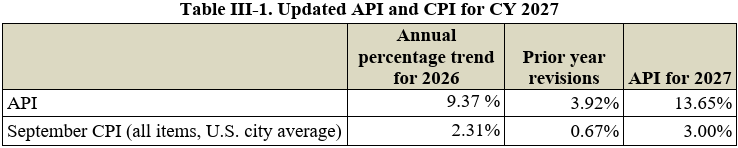
CMS can use one of two methods to update the annual deductible amount. The annual percentage increase (API) measures the average plan expenses per beneficiary. The Consumer Price Index (CPI) measures the annual percentage increase of all items across the U.S.

The 2026 API is 9.37%. The 2026 CPI is 2.31% CMS chose to use the API indexing method to set the 2027 deductible.

Accountability and Sustainability API and CPI 2027 Medicare Advantage Part D

# # #

Kristin Rowan Editor The Rowan Report

Kristin Rowan is the owner and Editor-in-chief of The Rowan Report, the industry’s most trusted source for care at home news. She is also a sought-after speaker on Artificial Intelligence, Technology Adoption and Lone Worker Safety. She is available to speak at state and national conferences as well as software user-group meetings.

Kristin also runs Girard Marketing Group, a multi-faceted boutique marketing firm specializing in content creation, social media management, and event marketing. She works with care at home software providers to create dynamic content that increases conversions for direct e-mail, social media, and websites.  Connect with Kristin directly at kristin@girardmarketinggroup.com or www.girardmarketinggroup.com

©2026 by The Rowan Report, Peoria, AZ. All rights reserved. This article originally appeared in The Rowan Report. One copy may be printed for personal use: further reproduction by permission only. editor@therowanreport.com


Hospice CARE Act

Hospice

by Kristin Rowan, Editor

Hospice CARE Act

Congress breathes new life into hospice protection

In 2024, Representative Blumenauer (D-OR) introduced the Hospice Care Accountability, Reform, and Enforcement Act. The Bill, H.R. 9803, aimed “to amend title XVIII of the Social Security Act to ensure the integrity of hospice care furnished under the Medicare program.” The House referred the act to the Committee on Ways and Means and the Committee on Energy and Commerce for consideration. The Committee on Ways and Means later referred the act to the Subcommittee on Health, where it apparently remains under consideration.

On March 18, 2026, Congresswoman Sanchez (D-CA) and Senator Warner (D-VA) introduced, or re-introduced, the Hospice Care Accountability, Reform, and Enforcement (Hospice Care) Act. According to the joint press release from its sponsors, the act will “modernize the Medicare hospice benefit, protect patients and taxpayers from fraud, and expand access to essential services and caregiver support.”

Program Integrity and Payment Reform

The two primary foci of the act are program integrity provisions and payment reforms. The hospice benefit remains largely unchanged since it began in 1982 despite significant changes in both the providers delivering and patients receiving end-of-life care. The rise in reports of fraud and abuse puts into question whether the current system can ensure both meeting the needs of patients and families and safeguard the Medicare Trust Fund.

“Hospice should provide comfort and dignity at the end of life, yet the benefit has not evolved to meet families where there is need. This bill strengthens and enhances Medicare’s hospice benefit so it provides the critical care patients and their families need – like respite care for caregivers and coverage of palliative treatments like dialysis and radiation – all while protecting the program from those trying to exploit it.”

Linda T. Sanchez

Congresswoman, D-CA

Program Integrity

According to the sponsors, the bill “creates additional safeguards to precent fraudulent providers from enrolling in Medicare and increases oversight of hospices, especially new hospices.”

Specifically, the bill:

  • Temporarily prevents new hospices from enrolling in Medicare, while allowing exceptions for instances where additional access to care is needed.
  • Requires increased transparency of hospice ownership and managing control information, ensuring CMS’s enrollment records are up to date.
  • Increases survey frequency for new hospices to ensure they meet hospice health and safety standards and prohibits payments to hospices that do not submit required quality data to the Secretary, with appropriate exceptions.
  • Reduces the potential for inappropriate financial conflicts of interest when certifying individuals’ eligibility for hospice care, while allowing nurse practitioners and physician assistants to also certify eligibility.
  • Requires CMS to conduct additional oversight activities to ensure hospices are providing holistic and comprehensive care.
  • Provides patients with an explanation of benefits within 15 days of an individual’s hospice election to increase beneficiary awareness of hospice enrollment and prevent extended periods of fraudulent billing.

Payment Reform

The bill “ensures that providers are incentivized to deliver high-quality care to individuals and their families.”

Specifically, it:

  • Revises the payment structure for routine home care to reward hospices for providing in-person care.
  • Increases payments to hospices for furnishing palliative radiation, chemotherapy, blood transfusions, and dialysis to address access barriers for individuals that require these costly treatments under a hospice election. Additionally, it creates an outlier payment policy to provide a backstop for providers delivering care to high-cost patients.
  • Adds home respite care to the Medicare hospice benefit, allowing individuals to receive respite care at home rather than in a facility, which is a key benefit for families and caregivers that are taking care of loved ones at the end-of-life.
  • Creates a new transitional inpatient respite benefit to support patients and families through their transition from a hospital into hospice care in the setting of their choice, allowing patients to move from hospital to general inpatient care to transitional respite, when appropriate. This new transitional payment seeks to eliminate the current pattern of care whereby terminally ill individuals are discharged from the hospital and inappropriately admitted to a skilled nursing facility in lieu of electing hospice care.

“Making decisions about hospice and end-of-life care is one of the most difficult moments that families can endure, yet Medicare’s hospice benefit is out-of-touch with the needs of patients and providers. I’m proud to introduce this legislation that will prioritize patient comfort at home as well as in a health care facility, and protect patients and taxpayers from bad actors attempting to steal essential resources.”

Mark Warner

Senator, D-VA

Industry Support

The Hospice CARE Act received wide-spread industry support after its introduction to Congress. 

Hospice CARE Act
American Academy of Hospice and Palliative Medicine

“Patients and families in need of the care, comfort and quality of life that hospice care provides need to trust that they are receiving the best possible services. We look forward to working with Representative Sánchez and Senator Warner on these important issues and to ensure that all patients have access to this vital care.”

– Kristina Newport, CMO for AAHPM

Center for Medicare Advocacy

“In addition to significant payment reforms and program integrity measures, this bill takes important steps towards improving access to care for individuals on hospice.”

-David Lipschutz, Co-Director for the Center for Medicare Advocacy

National Alliance for Care at Home

“Hospice care is one of the most profound services our healthcare system offers, providing patients and families with compassionate, dignified care during life’s most difficult moments. As the number of Americans turning to hospice continues to grow, it is critical that the benefit keeps pace with how care is delivered today and what patients, families, and providers actually need. The Alliance looks forward to working with Representative Sánchez and Senator Warner and their congressional colleagues on this legislation. We are committed to being a constructive partner in any effort to protect what’s working, address what isn’t, and modernize the Medicare hospice benefit in ways that serve patients, families, and the future of care in our country.”

-Jennifer Sheets, CEO for The Alliance

LeadingAge

“At its best, compassionate, high-quality, person-centered care is delivered to beneficiaries and families by ethical, forward-thinking, competent providers, in keeping with the sector’s nonprofit origins, which established a standard of quality care. Currently, however, hospice is at an inflection point. Increased scrutiny – an appropriate response to fraudulent behavior of a limited group of bad actors – highlights the need for modernization.

-Katie Smith Sloan, President and CEO for LeadingAge

National Partnership for Healthcare and Hospice Innovation

“This legislation provides an important opportunity to pursue thoughtful reforms to the Medicare hospice benefit that both preserve patient access and address ongoing concerns related to program integrity. While the bill represents meaningful progress toward modernizing the benefit and reducing incentives for fraud, waste, and abuse, NPHI believes certain provisions – particularly those related to payment reform – present opportunities for further discussion and refinement.”

– Tom Koutsoumpas, Founder and CEO of NPHI

More Information

A section-by-section analysis of the bill is available HERE
A one-pager of the bill is available HERE

Congress is on recess until the middle of April. The last few months will dictate the priorities when the next session starts, which will likely be focused on finalizing the budget and fully reopening the government. Whether the Hospice CARE Act will progress past its 2024 version is unclear. The Rowan Report will continue to monitor its progress.

# # #

Kristin Rowan Editor The Rowan Report

Kristin Rowan is the owner and Editor-in-chief of The Rowan Report, the industry’s most trusted source for care at home news. She is also a sought-after speaker on Artificial Intelligence, Technology Adoption and Lone Worker Safety. She is available to speak at state and national conferences as well as software user-group meetings.

Kristin also runs Girard Marketing Group, a multi-faceted boutique marketing firm specializing in content creation, social media management, and event marketing. She works with care at home software providers to create dynamic content that increases conversions for direct e-mail, social media, and websites.  Connect with Kristin directly at kristin@girardmarketinggroup.com or www.girardmarketinggroup.com

©2026 by The Rowan Report, Peoria, AZ. All rights reserved. This article originally appeared in The Rowan Report. One copy may be printed for personal use: further reproduction by permission only. editor@therowanreport.com

Fraud and Abuse Misunderstandings

Clinical

by Elizabeth E. Hogue, Esq.

Medicare and Medicaid Fraud and Abuse

Common Misunderstandings

Providers are generally familiar with prohibitions against fraud and abuse in the Medicare and Medicaid Programs, including Medicaid waiver programs, and other state and federal health care programs, such as the VA and TriCare. Private insurers now often enforce the same prohibitions applicable to federal and state programs. But there are at least two common misconceptions about fraud and abuse.

Intent

Enforcers must prove intent in order to show that providers engaged in fraud, but providers may not understand what the government can use to show “intent.”

Premeditation

Many providers seem to think that the only way to show intent is to prove that they sat down at their desks on a Monday morning and decided to commit fraud, but court decisions tell a very different story! They say that if enforcers can prove that providers knew or should have known of a pattern of fraudulent conduct, enforcers may conclude that providers had intent. Other court decisions say that when providers show reckless disregard for a pattern of fraudulent conduct regulators can show intent necessary to prove fraud.

When providers grasp these crucial standards, it is clear that they must become vigilant to prevent patterns of fraud and abuse. This is necessary in order to prevent government enforcers from concluding that they had intent necessary to prove fraud and/or abuse.

Personal Responsibility

Many providers also may not understand that every provider, regardless of position, is personally responsible for fraud and abuse compliance.

It Rests on You

It is extremely tempting to think that fraud and abuse compliance is management’s responsibility, or the exclusive job of the Administrator/Chief Executive Officer or the organization’s Compliance Officer. On the contrary, the Office of the Inspector General (OIG) of the U.S. Department of Health and Human Services, the primary enforcer of fraud and abuse prohibitions, is quite clear that every practitioner has personal, individual responsibility for fraud and abuse compliance. 

The problem of fraud and abuse will never be solved until every practitioner takes individual responsibility for it. Enforcement action is often taken against individual practitioners, as well as members of management and owners.

Fraud and Abuse Personal Responsibility

Complete Compliance

When providers understand these two basic points, they are well along the road to active participation in fraud and abuse compliance efforts.

Final Thoughts

Providers must remember that fraud and abuse compliance is now a permanent part of the health care landscape across the nation. Compliance is not a fad that will blow over or disappear! Providers must be prepared to actively work to prevent or correct fraud and abuse for as long as they work in the healthcare industry.

# # #

Elizabeth E. Hogue, Esq The Rowan Report

Elizabeth Hogue is an attorney in private practice with extensive experience in health care. She represents clients across the U.S., including professional associations, managed care providers, hospitals, long-term care facilities, home health agencies, durable medical equipment companies, and hospices.

©2026 Elizabeth E. Hogue, Esq. All rights reserved.
No portion of this material may be reproduced in any form without the advance written permission of the author.

©2026 by The Rowan Report, Peoria, AZ. All rights reserved. 

MedPAC Finalizes Recommendation to CMS

Advocacy

by Kristin Rowan, Editor

MedPAC Recommends 7% Cut

Vote Finalized

In December, MedPAC published a proposed recommendation for calendar year 2027 that included a 7% cut to home health reimbursement rates and no increase for hospice. Last week, MedPAC voted to finalize that recommendation and send it to CMS. 

Industry Objection

Both the proposal and final recommendation met with strong industry backlash.

“MedPAC’s dangerous and misguided recommendations to reduce the Medicare home health base payment rate by 7% for CY 2027 and eliminate the update to the 2026 Medicare base payment rate for hospice do not reflect both home health and hospice agencies’ operating realities as well as the cumulative impact of recent policy changes. For home health agencies, any cut – let alone one of such great magnitude – will threaten the ability to meet individuals’ healthcare needs. Yet again, the Commission is failing to understand the operating reality providers face and the potential patient harm that any further payment cuts pose.”

Dr. Steve Landers

CEO, National Alliance for Care at Home

Consistently Wrong

The MedPAC recommendation may not be built on solid data, use accurate calculations, consider Medicare Advantage and Medicaid rates along with Traditional Medicare FFS, consider the number of agencies that will go out of business, have any recommendations for maintaining nurse and caregiver hourly rates, or fairly distribute Medicare funds across disciplines, but, wait…where was I going with this? Oh, right! At least they’re consistent. MedPAC recommended a 7% decrease in Medicare payments for 2027, 2026, 2025, 2024, and 2023. They may be completely wrong, but they are dedicated to maintaining their wrongness.

Final Thoughts

Despite the years of 7% cut recommendations from MedPAC, the final numbers from CMS are rarely in line with those recommendations. We will, of course, know more when CMS publishes their proposal later this year. LeadingAge, National Association for Care at Home, individual and corporate HHAs and Hospices, and anyone else with a stake in the care at home industry, should contact their congressional representatives and CMS directly to voice concerns over these cuts.

# # #

Kristin Rowan Editor The Rowan Report

Kristin Rowan is the owner and Editor-in-chief of The Rowan Report, the industry’s most trusted source for care at home news. She is also a sought-after speaker on Artificial Intelligence, Technology Adoption and Lone Worker Safety. She is available to speak at state and national conferences as well as software user-group meetings.

Kristin also runs Girard Marketing Group, a multi-faceted boutique marketing firm specializing in content creation, social media management, and event marketing. She works with care at home software providers to create dynamic content that increases conversions for direct e-mail, social media, and websites.  Connect with Kristin directly at kristin@girardmarketinggroup.com or www.girardmarketinggroup.com

©2026 by The Rowan Report, Peoria, AZ. All rights reserved. This article originally appeared in The Rowan Report. One copy may be printed for personal use: further reproduction by permission only. editor@therowanreport.com


UnitedHealth Group Publicity Stunt

CMS

by Kristin Rowan, Editor

UnitedHealth Group Publicity Stunt

How to Distract the Public: 101

When customers and regulatory bodies start to complain about company practices, reputation management usually gets involved. An internal or external public relations, crisis communication, and/or reputation management specialist advises the company on how to overcome negative press.

Transparency & Action

When Dominos Pizza employees recorded a disturbing “hoax” video, the CEO went to the same medium (YouTube) to address the video, apologize, and reassure customers. This issue was handled so well that it is used as a teaching tool in PR classes.

In 1982, when a couple tampered with bottles of Tylenol in Chicago and seven people died, parent company Johnson & Johnson stopped advertising, recalled 31 million bottles across the country, switched to tamper-proof packaging, and personally communicated with 450,000 retailers.

Subterfuge, Smoke & Mirrors

Last week, when UnitedHealth Group, already under investigation for bribing nurses, wrongful death, and Medicare Advantage billing fraud, was called to testify before House committees about their record-high premiums, rising claims denials, and unneccessary waiting over prior approvals, UHG CEO prepared a written statement to read to the Energy & Commmerce Committee that included blaming hospital costs, pricing differences, frequency of testing, drug prices, and pharmaceutical advertising for higher premium rates; extolling the virtues of Medicare Advantage over Traditional Medicare, using incorrect and misleading information; and casually mentioning that they will “voluntarily eliminate and rebate our profits” for their ACA customers.

Gesture too Small to be Meaningful

The months long Congressional stand-off on healthcare premium subsidies continues. Affordable Care Act participants saw healthcare premiums jump over night when the subsidies expired. (Mine went up 400%).

In 2025, UnitedHealth recorded $12.1 billion in profit. But, that profit is spread out over nearly 3,000 wholly owned subsidiaries who take almost 30% of what UHG pays out in care costs. The company has increased its Medical Loss Ratio to 87% by hiring their own subsidiaries to engage in “quality improvement,” virtually eliminating ACA profit.

Of its 50 million subscribers, only about 1 million are ACA customers. Even if the company returns the ACA profits, it will return 1/50th of its profits and keep the rest. In their third quarter earnings call, UHG said it expected 2026 enrollment to be 1/3 of that in 2025. The 2026 outlook estimates an overall increase in profit to more than $14 billion, most of which will never find its way back to ACA participants.

The Truth Behind the Curtain

On January 27, 2026, just one week after the profit-sharing announcement, UnitedHealth Goup addressed shareholders in its Q4 and 2025 Earnings Call. During that call, newly appointed UnitedHealthcare CEO Tim Noel said:

 “Nearly all of our employer Group and fully insured pricing align with continued increases in care activity for 2026. In the Individual ACA market, we repriced nearly all states in response to higher medical trends and the elevated needs of ACA beneficiaries in 2025…. These actions should expand operating earnings margins for UnitedHealthcare by 40 basis points, and are expected to result in membership contraction of 2.3 to 2.8 million.”

Tim Noel

CEO, UnitedHealthcare

Other statements during the call reinforced the company’s drive toward profit.

They are focusing attention in markets where they have “complimentary wrap-around services” already in place. Which means they have owned subsidiaries to shift money to instead of lowering premium rates. Additionally, they have “narrowed [their] affiliated network…with the goal of having a more optimal alignment of physicians….”

New Speak

Throughout the earnings call, company spokespeople used terms like repositioned, streamlined, aligned, membership contraction, and repriced. They carefully avoided saying that they dropped physician services outside those they owned, removed plans that paid out too much, consolidated businesses to increase profits, lost millions of members due to price increases and other plan problems, and raised prices across the board, even on plans that were already profitable.

Final Thoughts

UHG CEO Hemsley made a few statements to Congress I agree with. Drug prices are too high. Hospital and Ambulance prices are too high. Pharmaceutical companies advertise too much and use the cost to offset tax liability.

There were also some statements Hemsley almost got right.

  • He said small businesses should be allowed to join AHPs with fewer restrictions. There should be no restrictions on industry or geography.
  • He said HSA thresholds should be lowered for HDHPs. HSAs should be available to everyone, regardless of plan, deductible, payer, or whether they are on a group, individual, or ACA plan.
  • Hemsley thinks broker compensation should be standardized in the ACA market. If payers want broker compensation, standardized or not, ACA or Medicare Advantage, the compensation should come from the payer and not be included in premiums.
  • He wants consumers to have expanded access to catastrophic plans and to allow the use of premium tax credits. All plans and payers should be available to everyone, everywhere. Increasing competition in plans and players will drive down costs.

I applaud Congress for bringing the large payers in to discuss exhorbitant premium rates, but I’m still waiting on them to take action based on the information they received. 

# # #

Kristin Rowan Editor The Rowan Report

Kristin Rowan is the owner and Editor-in-chief of The Rowan Report, the industry’s most trusted source for care at home news. She is also a sought-after speaker on Artificial Intelligence, Technology Adoption and Lone Worker Safety. She is available to speak at state and national conferences as well as software user-group meetings.

Kristin also runs Girard Marketing Group, a multi-faceted boutique marketing firm specializing in content creation, social media management, and event marketing. She works with care at home software providers to create dynamic content that increases conversions for direct e-mail, social media, and websites.  Connect with Kristin directly at kristin@girardmarketinggroup.com or www.girardmarketinggroup.com

©2026 by The Rowan Report, Peoria, AZ. All rights reserved. This article originally appeared in The Rowan Report. One copy may be printed for personal use: further reproduction by permission only. editor@therowanreport.com


VA Updates Community Cares Contracts

Admin

by Kristin Rowan, Editor

VA Issues RFP

Updates to Community Care Contracts

Some Veterans receive care from VA providers. Non-VA providers can still provide care for Veterans through a Community Care contract with the U.S. Department of Veterans Affairs (VA). In late 2025, the VA released a Request for Proposal (RFP) for new CC contracts. The new contracts are designed to substantively change non-VA provider care to Veterans.

According to the VA, the new contracts are intended to:

  • Increase choice through an IDIQ model that allows multiple health plans to compete to serve Veterans
  • Raise quality of care by requiring plans to follow broad standards of care adopted by major health systems
  • Improve oversight and quality of care using better data, technology, and real-time management
  • Add flexibility so the VA can issue competitive task orders and remove underperforming contractors

How Does This Impact Care at Home?

The primary contractor, and therefore the ones responsible for bidding and ensuring quality of care are the health plans. So, how does this change impact home care and home health providers? Here’s how:

  • Fast changes in network participation along with sudden shifts will inevitably come as a result of plans competing and task orders changing
  • Plans will need to align with VA targets, so expect waves of onboarding, recurring pushes for credentialing, and increased local networking
  • Because the plans will be held to quality standards, you can expect that those standards will flow through provider documentation, timeliness, claims accuracy, and EVV and FWA compliance
  • IDIQ is specifically designed to allow changes in the middle of care, which means the VA and health plans can add or change rules or portal, and make revisions to edit sets during the contract

Get Ahead of the Changes

Plan to make some changes before these new Community Care contracts come to your local health plans. In order to comply with the contract requirements, your credentialing packets need to be updated to include up-to-date CAQH, insurance, licenses, and compliance. This will help minimize the lag-time before getting paid.

Anticipate Expectations

The health plans will be competing for contracts, so they will expect you to compete as well. Awarded contracts will likely be fulfilled by agencies who have a high clean claim rate and quick response to edits and denials. Whatever you are using for coding, documentation, and rules need to be validated before the new care contracts start. Complete documentation will comply with the VAs focus on better data and real-time management. Make sure your team is executing precise reports; centralize your records, documentation, and audits to prove performance records and decrease issue resolution time.

Get Ahead of the changes

Final Thoughts

Non-VA providers who want to be considered to provide care to Veterans need to show alignment with the VA’s goals to expand choice, raise quality, and increase oversight. Planning ahead by meeting those standards early will make the transition process smoother one the new contracts roll out. We will continue to provide resources and information on these Community Care contracts as they are available.

# # #

Kristin Rowan Editor The Rowan Report

Kristin Rowan is the owner and Editor-in-chief of The Rowan Report, the industry’s most trusted source for care at home news. She is also a sought-after speaker on Artificial Intelligence, Technology Adoption and Lone Worker Safety. She is available to speak at state and national conferences as well as software user-group meetings.

Kristin also runs Girard Marketing Group, a multi-faceted boutique marketing firm specializing in content creation, social media management, and event marketing. She works with care at home software providers to create dynamic content that increases conversions for direct e-mail, social media, and websites.  Connect with Kristin directly at kristin@girardmarketinggroup.com or www.girardmarketinggroup.com

©2026 by The Rowan Report, Peoria, AZ. All rights reserved. This article originally appeared in The Rowan Report. One copy may be printed for personal use: further reproduction by permission only. editor@therowanreport.com


Home Care 100 Sneak Preview

Advocacy

by Kristin Rowan, Editor

Home Care 100 Sneak Preview

An Interview with Jeanette Lynn

In a few days, care at home leaders, influencers, educators, and solutions providers are set to descend on Scottsdale, AZ for the 2026 winter edition of the Home Care 100 Leadership Conference. I had the opportunity to speak with Managing Director Jeanette Lynn about this year’s theme, some of the events, and her outlook for 2026.

Home Care 100 Theme

The Rowan Report:

Jeanette, thank you for taking some time to chat today. I know how busy the week before an event is. Can you tell our readers about some of the agenda highlights for Home Care 100?

Jeanette Lynn:

The theme is the data imperative. The future will rely on becoming a data-centric organization. 

“We impact patients, partners, referral sources, payers, policy makers, and all stakeholders. We have to come to the table with the right data in the right way.”

Jeanette Lynn

Managing Director, Home Care 100

I’m very excited about the keynote address from a former employee of Pixar talking about storytelling. When we’re talking with policymakers, providers, payers, we have to tell a story and find the connection with the audience. There is also an opportunity to do a follow-up workshop with him.

Other Key Topics and Sessions

Other sessions to anticipate next week:

  • Panels of providers sharing case studies
  • Six round-table facilitated discussions that are specific to home care, home health, or hospice. Those topics are listed on the event website
  • A showcase on new approaches to being a CEO of a data-driven organization including tangible and practical takeaways on how to do it. Where is the data? Where can I find it and how do I use it?

State of the Industry

RR:

What is your industry outlook?

Jeanette

There is so much that is changing so fast. Look at the conversations around AI technology just in the last year or so. The technology is opening doors that didn’t previously exist. I’m reminded of what I recently heard from Judy Faulkner from EPIC. This is a company that has been ridiculed for some time for having closed systems, following regulations but sharing information as limited as possible; it has taken them awhile to be more patient and physician-friendly. A recent announcement said patients could now access all medical information in one MyChart system across the country.

This will shift interoperability – from patients to nurses to agencies. The demand to fix this is getting higher; we’ve been sitting on the excuse of not being able to influence reimbursement rates; but MA coming out and saying the rates are going to get lower requires that we increase efficiency and the data will help get you there.

One Answer is Interoperability

When you order food online, that company can tell you that Kathy picked up your food at 7:03 p.m., is riding a bicycle, has two stops before she gets to you, and show you the route she’s taking. We can certainly provide more information, more data, and better data for our patients.

We have to supplement existing Medicare product with other services, other approaches, that get the financial lever pulled a different way. The product is too defined, coded, and reimbursed; we need a bundled care product. It’s time everyone else sees that we have more data, information, and influence.

Home Care 100 Jeanette Lynn Interoperability

There are multiple opportunities and pathways. Our goal is to guide our members toward the ones that will work for each organization.

The Year Ahead

RR:

You’ve been at the helm long enough now that you’ve had a chance to get your feet wet. What have been your observations and what does that mean for Home Care 100 and Lincoln Healthcare Leadership for 2026?

Jeanette:

My biggest observations at Home Care 100 and Lincoln Healthcare Leadership: HC100 is a group of diverse leaders who can drive and influence change; there will be continued consolidation and the big players influence everyone else.

For me, the biggest win is after the conference hearing that one of our members initiated a new program, new deal, new partnership. We want that on steroids. We want to exponentially expand those wins.

The Intelligence group pairs advisors with intelligence group members to figure out how to put into action what you learned at the conference. We align experts to supercharge members. So we’ve relaunched the Intelligence Group as an offering year-round.

The subsets of members in the intelligence group are doing smaller in-person meetings covering particular topics. We’re looking for more organizations joining the group and expanding those events, not hosting more HC 100 events.

Final Thoughts

Speaking with Jeanette, it was so easy to see her passion and excitement for the industry, for the upcoming event, and for the members who benefit from the event. I am looking forward to the sessions she mentioned, seeing old friends and making new ones, and, of course, a little dancing and revelry after the hard work is done. 

# # #

Kristin Rowan Editor The Rowan Report

Kristin Rowan is the owner and Editor-in-chief of The Rowan Report, the industry’s most trusted source for care at home news. She is also a sought-after speaker on Artificial Intelligence, Technology Adoption and Lone Worker Safety. She is available to speak at state and national conferences as well as software user-group meetings.

Kristin also runs Girard Marketing Group, a multi-faceted boutique marketing firm specializing in content creation, social media management, and event marketing. She works with care at home software providers to create dynamic content that increases conversions for direct e-mail, social media, and websites.  Connect with Kristin directly at kristin@girardmarketinggroup.com or www.girardmarketinggroup.com

©2026 by The Rowan Report, Peoria, AZ. All rights reserved. This article originally appeared in The Rowan Report. One copy may be printed for personal use: further reproduction by permission only. editor@therowanreport.com


LeadingAge and Alliance Join Dr. Oz

CMS

LeadingAge and Alliance Join Dr. Oz

CMS hosts listening session in LA

On January 9, 2026, CMS Administrator Dr. Mehmet Oz hosted a listening session in Los Angeles to discuss fraud, waste, and abuse in home health and hospice. Dr. Oz was joined by CMS Director of the Center for Program Integrity Kim Brandt and Director of the Center for Medicare Chris Klomp.

Statement to Dr. Oz

Representatives from both LeadingAge and the National Alliance for Care at Home attended the session. As part of their ongoing collaboration and participation in combatting fraud, waste, and abuse, the two organizations sent a joint letter to Dr. Oz regarding recommendations to strengthen program integrity.

“We strongly support CMS’s ongoing efforts to strengthen program integrity and believe that fraud, waste, and abuse can be effectively prevented and addressed while reducing burden on legitimate providers furnishing critical services in the home. As CMS continues to refine its oversight strategies, we encourage the agency to adopt measures that are analytically rigorous, operationally feasible, and take a targeted risk-based approach, consistent with CMS’s statutory authorities.” 

LeadingAge and the Alliance

CMS Fraud Prevention

CMS has identified areas of waste fraud and abuse they are actively working to combat. In 2025, CMS imposed nearly 500 payment suspension, stopping nearly $5 billion in payments. CMS identified $2.3 billion in overpayments and implemented automated edits to guard against improper payment. They also revoked Medicare billing from 4,780 providers and denied almost 112,000 claims for unnecessary services.

The Alliance

Members of National Alliance for Care at Home (The Alliance) attended the listening session with Dr. OZ, stating that program integrity is a key priority for the organization. The alliance continues to work closely with lawmakers and regulators to ensure providers are putting patients’ needs first without unnecessary or fraudulent claims.

“The Alliance appreciates the opportunity to continue our dialogue with CMS about ensuring program integrity across these essential home-based services. We share the administration’s goal of eliminating fraud, waste, and abuse in home health and hospice care, and will continue to partner with the agency as it pursues solutions that reduce the burden on legitimate providers and protect patient access to care at home.” 

Dr. Steve Landers

President, The Alliance

LeadingAge

Members from LeadingAge also attended the listening session stating that fraud in any care setting is concerning and preventable. The organization continues to work with CMS to address fraud and strengthen regulatory safeguards.

“We thank CMS for initiating this productive meeting, and for the input from Administrator Oz, Deputy Administrator and Chief Operating Officer Kim Brandt, and Deputy Administrator and Director of Medicare Chris Klomp. We look forward to continuing collaboration on this important issue.”

Katie Smith Sloan

President and CEO, LeadingAge

Interview with LeadingAge

The Rowan Report reached out to LeadingAge for a comment on the listening session with CMS. We are scheduled to speak with Mollie Gurian, VP of Policy and Government Affairs, this afternoon. We will update this article with that information immediately following the interview.

# # #

Kristin Rowan Editor The Rowan Report

Kristin Rowan is the owner and Editor-in-chief of The Rowan Report, the industry’s most trusted source for care at home news. She is also a sought-after speaker on Artificial Intelligence, Technology Adoption and Lone Worker Safety. She is available to speak at state and national conferences as well as software user-group meetings.

Kristin also runs Girard Marketing Group, a multi-faceted boutique marketing firm specializing in content creation, social media management, and event marketing. She works with care at home software providers to create dynamic content that increases conversions for direct e-mail, social media, and websites.  Connect with Kristin directly at kristin@girardmarketinggroup.com or www.girardmarketinggroup.com

©2026 by The Rowan Report, Peoria, AZ. All rights reserved. This article originally appeared in The Rowan Report. One copy may be printed for personal use: further reproduction by permission only. editor@therowanreport.com


UnitedHealth Causes Heightened Alarm

Breaking News

by Kristin Rowan, Editor

UnitedHealth Causes Heightened Alarm

Guardian Investigation Launches Probe

In July of 2025, The Guardian reported that UnitedHealth had secretly paid nursing homes to reduce hospital transfers. The investigation revealed that UnitedHealth was placing its own medical teams inside nursing homes and pushing them to cut care expenses, delay transfers, and deny care.

Senators Push for Answers

In the weeks following The Guardian report, Senators Ron Wyden (D-OR) and Elizabeth Warren (D-MA) launched their own investigation of the insurance giant’s cost cutting measures in nursing homes. Wyden and Warren sent a letter to then UnitedHealth Group leaders requesting documents and information about the nursing home incentive program.

New Allegations

A new letter from Senators Wyden and Warren states that UHG has refused to comply with the initial request. In the months since the demand for information, UHG has provided only “brief and unsubstantial answers” to their questions.

“Because you have failed to respond adequately to our inquiry – and in light of additional recent reporting – we are renewing our inquiry with heightened alarm.”

Ron Wyden and Elizabeth Warren

United States Senators

Additional Reports

The Senators’s letter alludes to recent additional reports. They were referring to a December story, also from The Guardian, reporting allegations of wrongful deaths inside the nursing home care program. In a statement, UnitedHealth denied any allegations their practices “endanger patient safety or violate ethical standards.”

No Response is a Response

When asked about the second letter, UnitedHealth Group did not respond to reporters at The Guardian. UHG leadership said in statement that they would “continue to engage” with the senators. The company’s leadership also maintains that its nursing home program “improves outcomes” and “reduces unnecessary hospitalizations.”

Unanswered Questions

UnitedHealth attended a briefing with the senators’ offices last July. During that meeting, UnitedHealth made several claims the Senators are now questioning.

  • UHG maintained their nurses are not required to contact company representatives prior to taking a nursing home patient to the hospital, but a document provided by a whistleblower alleges the opposite 
  • UHG failed to adequately explain why hospital admission rates are part of the metrics for determining bonuses
  • UHG chose not to respond to questions about pending wrongful death lawsuits for Mary GrantCindy Deal, and an unnamed nursing home resident in New York

Deadline to Comply

Senators Wyden and Warren allege that UnitedHealth Group has withheld internal documents that directly relate to their initial request for information. The senators gave a deadline of January 28, 2026 to respond with the following information:

  • Hospitalization policies, including clinical protocols for determining when transfers are warranted, definitions of avoidable versus unavoidable hospitalizations, and whether staff must consult Optum supervisors before hospital transfers.
  • Bonus program metrics and thresholds, including how UnitedHealth determines APK limits, whether facilities are penalized for exceeding thresholds, and five years of documentation on bonus payments to nursing homes.
  • Advance directive policies, including training materials for end-of-life conversations, the mortality risk assessment tool used, and who participates in those discussions with residents.
  • Marketing and enrollment practices for I-SNP plans at contracted nursing homes.
  • Federal oversight and compliance, including any CMS sanctions or enforcement actions in the past five years.
Wyden Warren UnitedHealth Group Heightened Alarm

Failure to Respond

Without adding details, the letter states that should UnitedHealth Group fail to respond it full, they will seek answers to their questions using “all tools at the Committee’s disposal.”

This is an ongoing inquiry/investigation and story. The Rowan Report will continue to provide updates as they become available.

# # #

Kristin Rowan Editor The Rowan Report

Kristin Rowan is the owner and Editor-in-chief of The Rowan Report, the industry’s most trusted source for care at home news. She is also a sought-after speaker on Artificial Intelligence, Technology Adoption and Lone Worker Safety. She is available to speak at state and national conferences as well as software user-group meetings.

Kristin also runs Girard Marketing Group, a multi-faceted boutique marketing firm specializing in content creation, social media management, and event marketing. She works with care at home software providers to create dynamic content that increases conversions for direct e-mail, social media, and websites.  Connect with Kristin directly at kristin@girardmarketinggroup.com or www.girardmarketinggroup.com

©2026 by The Rowan Report, Peoria, AZ. All rights reserved. This article originally appeared in The Rowan Report. One copy may be printed for personal use: further reproduction by permission only. editor@therowanreport.com


House Passes Health Care Reform Bill

Regulatory

by Kristin Rowan, Editor

House to Vote on Health Care Plan

Discharge Petition Forces Vote

Since the temporary appropriations passed to reopen the government last month, the House and the Senate have been playing chicken with the health care plan for 2026. The lack of consensus threatens both Affordable Care Act (ACA) subsidies to keep health insurance rates down and the extension of the additional subsidies needed to keep the government open after January 30.

Today, four GOP members broke rank and sided with their Democrat counterparts on a discharge petition that would force a vote on the House floor on extending the subsidies. The House quickly called for an expedited vote on the Democratic-backed bill to extend the subsidies for three years without any changes.

In an uncommon move that Democrats decried as “outrageous,” House Leader Johnson closed the vote while some House members were still trying to vote. The vote against the bill passed 204-203. There are 435 voting members of the House. The subsequent vote for the Republican-backed plan passed 213-209. With 15 missing votes, the discharge petition vote may have passed.

House Speaker Johnson said it is “inevitable” that the discharge petition will come up for a vote when the House reconvenes in January.

Multiple Plans

Both Republicans and Democrats want votes on their own House bills. 

The Democratic-backed bill from Leader Hakeem Jeffries is a straight forward extension to the existing ACA subsidies with no policy changes.

The Republican-backed bill does not extend the subsidies or address them at all. Instead, it appropriates funds to pay for cost-sharing reductions that would decrease overall subsidies, lower premiums for some, and raise premiums for others.

Some moderates disagree with their own party’s leadership. Fitzpatrick (R-Pa) and Golden (D-Maine) introduced their own bill that extends the subsidies for two years and includes some eligibility changes. In addition, Gottenheimer (D- NJ) introduced a separte bill with Kiggans (R-VA) that extends the subsidies for one year and includes modest eligibility reforms. Neither petition has near enough support to force a vote.

Second Vote Today

Despite the moderates’s support of Jeffries’s bill, the House voted today on the Republican-backed bill from Miller-Meeks (R-IA). This bill also includes reform of Pharmacy Benefit Managers and provide more control for small business owners through Association Health Plans.

The vote for Lower Health Care Premiums for All Act was 213-209 (some reports say 216-211) and the bill will advance to the Senate. It is unlikely the Senate will vote on the bill before the end-of-year recess, leaving the bill undecided until the Senate returns on January 5th.

End of the Year

Both the House and the Senate will start their end-of-year recess this week. The House of Representatives is scheduled to close their session on December 18th. The Senate will conclude on December 19th. They will return to session on January 6th and January 5th, respectively.

With only two days left on the Senate calendar, they are unlikely to vote on the House bill this session. Most experts predict the bill is unlikely to pass regardless of when the vote is scheduled.

# # #

Kristin Rowan, Editor

Kristin Rowan has been working at The Rowan Report since 2008. She is the owner and Editor-in-chief of The Rowan Report, the industry’s most trusted source for care at home news, and speaker on Artificial Intelligence and Lone Worker Safety and state and national conferences.

She also runs Girard Marketing Group, a multi-faceted boutique marketing firm specializing in content creation, social media management, and event marketing.  Connect with Kristin directly kristin@girardmarketinggroup.com or www.girardmarketinggroup.com

©2025 by The Rowan Report, Peoria, AZ. All rights reserved. This article originally appeared in The Rowan Report. One copy may be printed for personal use: further reproduction by permission only. editor@therowanreport.com