Special Focus Program Ends

by Kristin Rowan, Editor

Special Focus Program Not Well Received

When the Hospice Special Focus Program (SFP) first appeared, the industry was told the program would help CMS identify and improve the performance of hospice providers that were struggling to meet quality standards. CMS developed the program to strenthen oversight, promote quality improvements, and ensure compliance for underperforming hospice agencies.

Soon after its inception and implementation in 2022, numerous concerns emerged. The National Alliance for Care at Home (then NAHC and NHPCO) voiced concerns over the program’s reliance on incomplete data as well as the potential for the program to unfairly targed providers in underserved communities.

Between February 2020 and January 2025, numerous state and national organizations have introduced Hospice Acts to Congress, given feedback to CMS on improvements to SFP, and filed lawsuits against the CMS.

Ramping Up the Opposition

In mid-2024, following the Council of States meeting, monthly opposition to the SFP became standard:

  • The McDermott Report highlighted significant flaws in the algorithm used for the program. Again, there was an objection over the use of incomplete and inconsistent data.
  • Bi-partisan Congress members sent a letter to CMS requesting revisions to SFP, criticizing outdated survey data and suggested that the quality metrics were inappropriately weighted.
  • Alliance CEO Steve Landers publicly criticized the implementation of SFP in his op-ed.
  • Representatives introduced Bill H.R. 10097 to delay SFP implementation, stating it would give CMS time to address the problems with the program and ensure fair application of standards for low-performing hospices without impacting quality programs.
  • The Texas Association for Home Care & Hospice; Indiana Association for Home & Hospice Care; Association for Home & Hospice Care of North Carolina; South Carolina Home Care & Hospice Association; and Houston Hospice filed a lawsuit challenging the SFP as unlawful and arbitrary.

CMS Backs Down

This week, CMS announced that it has paused the implementation of SFP for the calendar year 2025. The CMS statement say the pause will allow CMS to “further evaluate the program.” There is no mention of the opposition or the ongoing lawsuits.

The hospice special focus program page on the CMS website reads:

 Effective February 14, 2025, implementation of the Hospice Special Focus Program for CY 2025 has ceased so that CMS may further evaluate the program. Please contact QSOG_Hospice@cms.hhs.gov for policy questions.

All additional information about the program has been removed from the website page.

Special Focus Program gets First Positive Feedback

For the first time since 2020, industry leaders are applauding a CMS move regarding SFP. The move is halting the program altogether, but at least its positive feedback. 

“This decision is a positive move acknowledging that the current approach is not working as intended. The hospice community has long advocated for strong oversight and patient protections, but the SFP, as implemented, was deeply flawed, unlawful, and harmful to the very patients it was meant to protect.”

National Alliance for Care at Home

You can read the full statement from The Alliance in their press release.

Final Thoughts

It seems it is not often that CMS hears what the industry tells them. Reimbursement rates continue to drop, documentation is increasingly complex, and the industry has suffered from their misconceptions about what we need.  This time, at least, there was enough pressure and advocacy from Congress and from you, the people who are impacted daily by their decisions, to cause them to rethink this program. Keep up the good work and continue to advocate for yourself and for care at home. Perhaps this is not the last time CMS will listen.

# # #

Kristin Rowan, Editor

Kristin Rowan has been working at The Rowan Report since 2008. She is the owner and Editor-in-chief of The Rowan Report, the industry’s most trusted source for care at home news .She also has a master’s degree in business administration and marketing and runs Girard Marketing Group, a multi-faceted boutique marketing firm specializing in content creation, social media management, and event marketing.  Connect with Kristin directly kristin@girardmarketinggroup.com or www.girardmarketinggroup.com

©2025 by The Rowan Report, Peoria, AZ. All rights reserved. This article originally appeared in The Rowan Report. One copy may be printed for personal use: further reproduction by permission only. editor@therowanreport.com


Creditable Coverage for Medicare Part D

by Kristin Rowan, Editor

CMS 2026 Updates to Prescription Plan

The Centers for Medicare & Medicaid Services (CMS), as part of the Inflation Reduction Act of 2022 (IRA), released a draft of the calendar year 2026 redesign program instructions. The new provisions for Medicare Part D include:

  • An annual out-of-pocket maximum of $2,100, up from $2,000 in 2025
  • A selected drug subsidy program
  • The requirement that Part D plans offer enrollees the option to spread out their out-of-pocket costs over the year
  • Maximum charge of $35 for insulin regardless of deductible, co-pay, or out-of-pocket spending reached
  • No out-of-pocket costs for recommended vaccines
  • New requirements for Creditable Coverage

Current Creditable Coverage Determination

The current simplified determinations method is as follows:

  1. The plan provides coverage for brand and generic prescriptions;
  2. The plan provides reasonable access to retail providers;
  3. The plan is designed to pay on average at least 60% of participants’ prescription drug expenses; and
  4. The plan satisfies at least one of the following:
    • The coverage has no annual benefit maximum or maximum annual benefit payable by the plan of at least $25,000;
    • The coverage has an actuarial expectation that the amount payable by the plan will be at least $2,000 annually per Medicare-eligible individual; or
    • For employer plan sponsors that have integrated prescription drug and health coverage, the integrated plan has no more than a $250 deductible per year, has no annual benefit maximum or a maximum annual benefit of at least $25,000, and has no less than a $1,000,000 lifetime combined benefit maximum.

Creditable Coverage

Medicare beneficiaries must enroll in Medicare Part D, unless they have other prescription coverage. If a beneficiary goes more than 63 days without prescription coverage, they may incur a late enrollment penalty. Creditable coverage has to have a value equal to or greater than the defined coverage for Part D. This requirement is not new. Group health plans have been calculating creditable coverage since the inception of the Part D program. What is new is that CMS has determined that the simplified method of determining creditable coverage is no longer accurate. The revised method must include all of the following:

  • Provide reasonable coverage for brand name and generic prescription drugs and biological products
  • Provide reasonable access to retail pharmacies
  • Is designed to pay on average at least 72% of participants’ prescription drug expenses

Impact

Persons over the age of 65 who qualify for Medicare, but who are still employed may have an employer sponsored or paid health insurance plan. Many of these plans have combined health and drug coverage. These plans will now have to provide creditable coverage, presumably for all beneficiaries, not just those who are eligible for Medicare. 

  • The coverage has no annual benefit maximum or maximum annual benefit payable by the plan of at least $25,000;
  • The coverage has an actuarial expectation that the amount payable by the plan will be at least $2,000 annually per Medicare-eligible individual; or
  • For employer plan sponsors that have integrated prescription drug and health coverage, the integrated plan has no more than a $250 deductible per year, has no annual benefit maximum or a maximum annual benefit of at least $25,000, and has no less than a $1,000,000 lifetime combined benefit maximum.

For Additional Information

If you are currently offering an employee sponsored health plan, or need more information on Part D coverage, refer to the CMS Fact Sheet and the Program Instructions.

# # #

Kristin Rowan, Editor

Kristin Rowan has been working at The Rowan Report since 2008. She is the owner and Editor-in-chief of The Rowan Report, the industry’s most trusted source for care at home news .She also has a master’s degree in business administration and marketing and runs Girard Marketing Group, a multi-faceted boutique marketing firm specializing in content creation, social media management, and event marketing.  Connect with Kristin directly kristin@girardmarketinggroup.com or www.girardmarketinggroup.com

©2025 by The Rowan Report, Peoria, AZ. All rights reserved. This article originally appeared in The Rowan Report. One copy may be printed for personal use: further reproduction by permission only. editor@therowanreport.com

 

Is Medicaid Down for the Count?

by Kristin Rowan, Editor

Medicaid Payment System Goes Dark

On Monday, January 27, President Trump, through the Office of Management and Budget, announced a temporary freeze on federal spending while his newly designated head of the Department of Government Efficiency ensures all spending follows the executive orders the President has signed. The memo was vague and caused widespread confusion across government departments. Almost immediately after the memo was circulated, Medicaid programs could not access the Payment Management Services web portal, the entity responsible for paying Medicaid claims.

The Memo

The language used in the memo on federal spending was broad and overreaching. As such, many federal organizations were unclear as to whether the memo applied to them. The message in the memo was that the administration intended to curb any spending that does not improve the day-to-day lives of the people. Throughout the day Monday, the White House sent clarifications about what programs would not be impacted. Among them were food assistance programs like SNAP, WIC, and Meals on Wheels, and Medicaid. The medicaid payment portal went down, despite this clarification.

Exclusions

Multiple state and federal agencies reached out to the White House for clarification following the release of the memo. Explicitly excluded from the freeze are direct benefit plans like Social Security and Medicare. In addition to the programs named in the memo, clarification on additional programs that would not be impacted included Medicaid. Despite the temporary website outage, claims were still being processed and payments were still being made.

Immediate Lawsuits

Almost simultaneously with the distribution of the memo, several non-profit organizations filed suit against the federal government. They called Trump’s action an “unlawful and unconstitutional” act, even temporarily. The pause on federal spending was set to go into effect at 5 p.m. ET on Tuesday. Minutes before, U.S. District Judge Loren L. AliKhan put a pause on the pause.

Temporary Freeze on the Temporary Freeze

To allow both sides time to construct an argument, the judge stayed the funding freeze until Monday, February 3. That morning, the judge will hear arguments and consider the issue. After the stay, attorneys general from 22 states and D.C. filed their own lawsuit to permanently block the freeze and prevent any future attempts to cut off already approved federal funding.

Then Comes the Thaw

If the judge allows the freeze to move forward, Trump has given every agency until February 10 to account for and explain all spending programs within their departments. Once the accounting has been reviewed, likely the OMB and the Department of Government Efficiency will determine which federal spending programs can resume operation.

There is no indication yet as to whether Trump will extend the February 10 deadline, given the delay in the courts. By the time the judge rules on Monday, however, we hope the White House will have issued additional details and guidance to avoid additional disruption to essential services like Medicare and Medicaid.

Federal Funding Freeze

Final? Ruling

Early Monday, Judge AliKhan said she was not convinced by the argument that nonprofit groups have no case against the funding freeze since the OMB rescinded the memo. The administration argued that a brief pause on funding to align federal spending is within the law. The administration also suggests that the courts have no standing to block it. AliKhan has indicated that she will likely grant a longer temporary order to stay the funding freeze.

# # #

Kristin Rowan, Editor

Kristin Rowan has been working at The Rowan Report since 2008. She is the owner and Editor-in-chief of The Rowan Report, the industry’s most trusted source for care at home news .She also has a master’s degree in business administration and marketing and runs Girard Marketing Group, a multi-faceted boutique marketing firm specializing in content creation, social media management, and event marketing.  Connect with Kristin directly kristin@girardmarketinggroup.com or www.girardmarketinggroup.com

©2025 by The Rowan Report, Peoria, AZ. All rights reserved. This article originally appeared in The Rowan Report. One copy may be printed for personal use: further reproduction by permission only. editor@therowanreport.com

 

Urgent Plea to Safeguard Your Caregivers

by Kristin Rowan, Editor

Care at Home Worker Safety is not Optional!

I will rarely present an editorial piece that is based only on my opinions. I hold a few about care at home in general, but at least attempt to use statistics, facts, and history to support my positions. This is one area where the facts and numbers are all there, but using them is not as effective as sharing these stories. No matter where your agency is in its growth, no matter how large or small, no matter your plans for 2025, if you have not started a safety committee, created safety protocols and operating procedures, and invested in GPS-enabled emergency response systems for your staff, do so NOW, so this story doesn’t become your story.

One More Story is One Too Many

The tragic death of Joyce Grayson made headlines across the country both immediately after her death and for months after with lawsuits and new regulations in her state. This week, another avoidable incident left a home health aide in Massachusetts bedridden and temporarily unable to walk.

The aide, who asked to remain anonymous said she thought she was going to die. “I was screaming Help! Help!,” while a man in his 70s, for whom she has provided care for more than two years, attacked her with a knife. The man repeatedly stabbed, slashed, and sliced her while she kept kicking at him and thrashing her body. Despite all her attempts to escape, the man would not let her get up. 

Worker Safety

“I was tired,” she recalled, after fending off her attacker, “I’m gonna die here, I think that, but in that moment I remembered my sons, my family and giving me power. I confronted him.”

As she fled the apartment, the man followed her with a piece of wood. She ran down the hallway, where a security guard intervened. The man lost his balance during the struggle and fell. The home health aide spend two days in the hospital, receiving blood transfusions and dozens of stitches. She has decided no to return to her job, which she has held for a decade.

“He’s not going to kill me. He’s not going to pull me down.”

Home Health Aide Attacked on the Job

Worker Safety

Next Time, it Could be You

No care at home worker deserves to feel unsafe or to be attacked at work. No agency owner wants to be the headline of the next story about a home care worker who ended up in the hospital or the morgue. Don’t be the next agency that has to explain to a family how this happened to their mother, daughter, son, or uncle, or cousin. No child wants to find out that their parent isn’t coming home because they did not have the means to call for help.

Act Now, Before it's Too Late

You might be surprised, if you asked, how many of your caregivers have ever felt uneasy, unsafe, or uncomfortable during their shift. Whether is the client, a family member of the client, pets, firearms, the neighborhood, or something else, most lone workers will experience some degree of fear. While not entirely preventable, there are steps you can take to minimize the risk:

    • Ask your employees for honest feedback
    • Research the client, family members, and the neighborhood for safety issues
    • Create a committee comprising management, administrators, and caregivers, to create a safety plan
    • Invest in training for your staff to include deescalation techniques, situational awareness, self-defense, and any other classes your safety committee deams necessary
    • INVEST IN GPS-ENABLED EMERGENCY RESPONSE SYSTEMS FOR EVERY EMPLOYEE, NOW!

Recommendations

As a company that engages in software adoption consulting, we don’t often make direct recommendations, prefering instead to tailor software selection to each agency and its unique needs. This is one area where I will make the exception and continue to make the exception until every lone worker in and out of the care at home industry is equipped with a safety device.

POM Safe

POM Safe is a personal safety solution that allows lone workers to get help when needed, but was designed to incorporate prevention and de-escalation. “The best 911 call is the one that never happens.”

The device includes features such as:

    • Fake phone calls to allow the caregiver to step away from a situation
    • Check on me to alert the agency if the caregiver has not checked in after an appointment
    • Appointment Sync to give first responders precise locations in an emergency
    • One-tap text sending a pre-written text with precise GPS location
    • Incident Reports to prevent future incidents
    • Two-way calling to a dispatcher when emergency help is needed
    • Voice activation when your caregiver can’t get to the device
    • Real-time crime data by neighborhood
    • Sex offender registries
    • 24/7 emergency dispatch
    • Device or app-based

Katana Safety

The Katana safety device attaches directly to the caregiver’s phone. It has a quick-trigger activation to bypass the phone’s lock screen, and provides instant help 24/7.

This device includes features such as:

    • Audible and inaudible alerts that launch GPS signals and connect worker to call center
    • 24/7 highly trained PERS center
    • Safety text and call after an alert with immediate dispatch if caregiver does not answer
    • Walk with me feature to have a dispatcher stay in contact while the caregiver gets to safety
    • Circle of safety to alert up to seven people in case of emergency
    • Customizable safety commands that each clinician sets up with voice activation
    • Beacon backup if bluetooth fails
    • Text messaging with GPS location
    • Employee check-in with voluntary location tracking and pin drop
    • 2-year battery life
    • Options to connect by app, fob, watch, or voice

Final Thoughts

Ensuring the safety of your employees before you send them out to care for your clients is not an optional benefit, a “nice to have,” or something you can do when you “get around to it.” Providing the training and safety devices needed to make sure each and every one of your caregivers makes it home every day should be your top priority. Whether you choose one of the devices above or go with a different option, start looking for one now. If you need help starting your safety committee or writing a survey to assess the safety risks in your agency, I will help you. With all of the technology available to us, there should no longer be any stories of caregivers who were attacked and did not have the means to call for help.

# # #

Kristin Rowan, Editor

Kristin Rowan has been working at The Rowan Report since 2008. She is the owner and Editor-in-chief of The Rowan Report, the industry’s most trusted source for care at home news .She also has a master’s degree in business administration and marketing and runs Girard Marketing Group, a multi-faceted boutique marketing firm specializing in content creation, social media management, and event marketing.  Connect with Kristin directly kristin@girardmarketinggroup.com or www.girardmarketinggroup.com

©2025 by The Rowan Report, Peoria, AZ. All rights reserved. This article originally appeared in The Rowan Report. One copy may be printed for personal use: further reproduction by permission only. editor@therowanreport.com

 

Medicare Advantage Lowers Home Health Care Use

by Kristin Rowan, Editor

End-of-Life Care in Medicare Advantage vs Traditional Medicare

Using research from CMS, researchers from Mt. Sinai in New York and Brown University in Rhode Island studied the data of adults aged 66 and older who passed away and had Medicare coverage in their final year of life. Included in the study were people potentially eligible for home health care and not in a nursing facility, hospital, or hospice care setting. Data from close to 1.8 million people was analyzed. The researchers identified whether the participants received home health care and how many days of end-of-life care they received.

Home Health Higher in Traditional Medicare

Of the nearly 1.8 million participants, the average age was 82. 51.5% were female and 36.5% were enrolled in Medicare Advantage. In the final year of life, home health care use was recorded at 37.5% for MA enrollees and 41.7% for traditional Medicare.

When the researchers looked at different demographic groups within the data sets, home health care usage was higher in traditional Medicare in most groups. However, among American Indian and Alaska Native groups, Medicare Advantage had a slightly higher rate of home health use at 37.9% compared with 37.1% in Traditional Medicare.

Conversely, in the Asian or Pacific Islander demographic, home health use rate was 32.6% in MA and 41.8% in TM. Similarly, the rate of use among the Hispanic group was 33% in MA and 44% in TM. Following a similar trend, in the non-Hispanic Black group home health usage in MA was 38.8% compared with 42.9% in TM. Likewise, among the non-Hispanic White group, home health use in MA was 37.9% versus 41.5% for TM. For those of unknown race, usage was 36.1% in MA compared with 40.1% in TM.

Days of Care Lower in Medicare Advantage

Home health users across all racial and ethnic demographic groups enrolled as Medicare Advantage beneficiaries had fewer days of care in home health than those enrolled in Traditional Medicare. The stand-out group in this part of the research was those of Hispanic descent, who averaged 81.9 days in home health care in Medicare Advantage compared with 111.9 days in Traditional Medicare.

Medicare Advantage Home Health Use

Implications

The researchers indicated some limitations in the study, namely that data was pulled from pre-covid patients because of the changes in home health during covid. The study should be repeated with post-covid data. One of the researchers received personal fees while serving as a senior advisor to CMS. Another received personal fees as a section editor for UpToDate. A third researcher reported receiving personal fees from Abt and UpToDate.

Despite these limitations, the implications of the study show that end-of-life care is not the same between Medicare and Medicare Advantage patients. Medicare Advantage is largely operating on a Value-Based Purchasing Model. The fewer services the beneficiary receives, the more money the primary doctor, hospital, and payer keep. It is not surprising, therefore, that MA patients get fewer services for less time. Patients who switch from Traditional Medicare to Medicare Advantage, especially if they are your patients, should be informed that they are still eligible for home health care and hospice care, but they may have to ask for it.

# # #

Kristin Rowan, Editor

Kristin Rowan has been working at The Rowan Report since 2008. She is the owner and Editor-in-chief of The Rowan Report, the industry’s most trusted source for care at home news .She also has a master’s degree in business administration and marketing and runs Girard Marketing Group, a multi-faceted boutique marketing firm specializing in content creation, social media management, and event marketing.  Connect with Kristin directly kristin@girardmarketinggroup.com or www.girardmarketinggroup.com

©2025 by The Rowan Report, Peoria, AZ. All rights reserved. This article originally appeared in The Rowan Report. One copy may be printed for personal use: further reproduction by permission only. editor@therowanreport.com

 

Bill Dombi to Continue the Care at Home Fight in D.C.

by Kristin Rowan, Editor

Bill Dombi Key Supporter of Care at Home

The end of 2024 and the official merger of NAHC and NHPCO also brought to a close the extensive service to the care at home industry by former NAHC President Bill Dombi. Dombi served as vice president for law from 1987 to 2017. He was named interim presidnt in 2017 and president in 2018, where he served until 2024.

Bill has been instrumental in the advancement of care at home policies at the federal level, a champion for advocacy for care at home at local, state, and national conferences and organizations, and spearheaded lawsuits and challenges to CMS rulings for year. His retirement, though well-earned, was a great loss to the industry.

Back in Action

On February 4, 2025, Arnall Golden Gregory law firm, of Atlanta and Washington D.C. an Am Law 200 law firm with a client-service model of “business sensibility” announced the additional of Bill Dombi to the firm as senior counsel. With more than 40 years of experience with litigation and policy in the care at home industry, Bill will continue his fight to advance care at home in D.C.

“It’s not a stretch to say that Bill is the face of the home healthcare space and the standard-bearer for advocating on its behalf, whether in state or federal court or through his deep-rooted experience and relationships within Congress and various federal agencies. In addition to tackling major policy issues, Bill has fiercely defended providers and patients in litigation across the country. His broad perspective and exceptional legal acumen will be invaluable to our already outstanding Healthcare practice, particularly in the areas of home health, hospice, and post-acute and long-term care litigation, benefitting both our teams and the clients we serve.”

Jason E. Bring

Healthcare Litigation co-chair, Arnall Golden Gregory LLP

BIll Dombi Returns

From AGG

Bill has been actively involved with significant litigation matters affecting home health policy since 1976. Notably, he served as lead counsel in the lawsuit that resulted in the expansion of Medicare home health coverage in 1980, and he was pivotal in the creation of the Medicare hospice benefit in 1983, the institution of the Medicare Prospective Payment System (PPS) for home health in 2000, and national healthcare reform legislation in 2010. In 2017, Bill was selected as NAHC’s president and served through 2024, ultimately concluding his tenure as president emeritus and counsel of the National Alliance for Care at Home, the combined organization of NAHC and the National Hospice and Palliative Care Organization.

“To call Bill a major addition to AGG’s Healthcare practice would be an understatement,” said Sean P. Fogarty, AGG’s managing partner. “Bill has been a pillar in the home health industry for years, and I know I speak on behalf of the entire firm when I say we we’re thrilled to have him join our team.”

Bill is renowned for his commitment to advancing care at home through legal, legislative, and regulatory advocacy. His background spans all key advocacy forums, including Congress, regulatory bodies, and the courts, where he has engineered laws and regulations that directly impact home health and hospice providers. This breadth of experience empowers his private practice to offer clients with a practical framework for compliance standards and operational excellence.

“As I look to the next chapter of my career after almost 40 years at NAHC, it’s exciting to join such an impressive firm and group of professionals with a well-established and supportive culture. AGG is so unique in its earnest focus on collegiality and collaboration, and I look forward to continuing my hard work with my new colleagues on behalf of the dedicated home health providers we serve.”

Bill Dombi

Senior Counsel, AGG

A hall of famer among several home care and hospice organizations, Bill has also served as executive director for the Center of Health Care Law and Home Care and Hospice Financial Managers Association at NAHC. He continues to serve the industry as a member of the board of directors of the Research Institute for Home Care and the Hospice and Home Care Foundation of North Carolina. With Medicaid expenditures now exceeding $130 billion annually and Medicare home health services growing from $300 million to over $25 billion, Bill’s work has seen the evolution of home care from a cottage industry to a cornerstone of long-term care in the U.S.

Bill attended the University of Connecticut, where he earned his law degree, as well as a B.A. in political science.

About Arnall Golden Gregory LLP

Arnall Golden Gregory (AGG) is an Am Law 200 law firm with offices in Atlanta and Washington, D.C. Our client-service model is rooted in taking a “business sensibility” approach of fully understanding how our clients’ legal matters fit into their overall business objectives. Our transaction, litigation, regulatory, and privacy counselors serve clients in healthcare, real estate, retail, technology, fintech/payment systems, global commerce/global mobility, life sciences, logistics and transportation, government investigations, and government contracts. With our rich experience and know-how, we don’t ask “if,” we figure out “how.” Visit us at www.agg.com.

# # #

Kristin Rowan, Editor

Kristin Rowan has been working at The Rowan Report since 2008. She is the owner and Editor-in-chief of The Rowan Report, the industry’s most trusted source for care at home news .She also has a master’s degree in business administration and marketing and runs Girard Marketing Group, a multi-faceted boutique marketing firm specializing in content creation, social media management, and event marketing.  Connect with Kristin directly kristin@girardmarketinggroup.com or www.girardmarketinggroup.com

©2025 by The Rowan Report, Peoria, AZ. All rights reserved. This article originally appeared in The Rowan Report. One copy may be printed for personal use: further reproduction by permission only. editor@therowanreport.com
 

Medicare Advantage Increase for Payers, not Providers

by Kristin Rowan, Editor

CMS Announces Medicare Advantage Pay Hike

On January 13, 2025, CMS announced its plans to increase payments to Medicare Advantage plans by 4.33%. Policy changes for Medicare Advantage and Part D include changes in how the agency calculates payments to health plans. A spokesperson from CMS said that the policy change provides access to affordable, high-quality care. The changes, however, don’t increase payments to the people actually providing the care, only to the payers.

Opposition

While major health plans across the U.S. were thrilled with the announcement and saw substantial stock price hikes immediately after, not everyone is on board. The American Medical Association (AMA) outlined how physicians who treat Medicare patients are getting pay cuts from CMS for the fifth year in a row. Meanwhile, HHS OIG released a report finding that MA insurers profited $7.5 billion from risk-adjusted payments in 2023.

“It’s unbelievable they’re giving insurance companies that had record profits an increase while at the same time cutting payment to physician practices that are struggling to survive. This contrast highlights the urgent need for Congress to prioritize linking payment to physician practices to the cost of providing care.”

Bruce Scott, M.D.

President, American Medical Association

Out-of-Pocket Cost Increase

In addition to the higher payments, the advance proposal includes an increase in the Part D deductible from $590 to $615. With this proposal, the out-of-pocket maximum will increase from $2,000 to $2,100 as well. Cost sharing after the deductible is reached but before the out-of-pocket max is reached will also increase. There is no increase for beneficiaries whose income is less than 100% of the Federal Poverty Level.

Coverage Increase

The CMS advance proposal calls for coverage and policy changes. Medicare and Medicaid programs will now cover anti-obesity medications. The plan imposes stricter rules on MA policies to prevent denial of reasonable and necessary services that would be covered under Medicare Part A and B. Finally, imposed guardrails on the use of AI. The guardrails will ensure AI systems are unbiased in patient care decisions. Additionally, the guardrails will ensure they do not perpetuate existing inequity in access to and receipt of medical services. The American Hospital Association appplauded this last change.

“The AHA commends CMS for taking important steps to increase oversight of 2026 Medicare Advantage plans to help ensure enrollees have equal access to medically necessary health care services. The AHA has previously raised concerns about the negative effects of certain Medicare Advantage practices and policies…that are more restrictive than Traditional Medicare and can compromise enrollee access to Medicare-covered services.”

Ashley Thompson

Senior Vice President, American Hospital Association

Changes are not Definite

Even though CMS has announced these changes to start in January, 2026, they are not set in stone. As of January 20, 2025, we are operating under anew administration and the changes under Trump have already started. CMS intends to continue it’s three-year plan to update the MA risk adjustment model and the implementation of the Inflation Reduction Act. However, it seems likely that the Inflation Reduction Act will be replaced with a different plan for inflation.

Jeff Davis, director of health policy at McDermott+ believes it is likely that Trump’s team will throw out the updates to MA and Part D as well as Biden’s proposed staffing mandate for SNFs. In the first 24 hours of his Presidency, Trump revoked both Biden’s “Strengthening Medicaid and the Affordable Care Act” and “Continuing to Strengthen Americans’ Access to Affordable, Quality Health Coverage” executive orders. He also rescinded the Drug Pricing Model executive order that covered obesity drugs, lowered the price of some drugs, and accelerated FDA approval for drugs that address unmet medical needs.

Medicare Advantage

As Yet Unknown

As was to be expected, many of Trump’s initial 78 executive orders are already facing lawsuits from various entities. There are as of yet no definitive answers to changes in Medicare, Medicare Advantage, or other policies that impact healthcare and care at home. The Rowan Report will continue to follow these stories as they unfold.

# # #

Kristin Rowan, Editor

Kristin Rowan has been working at The Rowan Report since 2008. She is the owner and Editor-in-chief of The Rowan Report, the industry’s most trusted source for care at home news. She also has a master’s degree in business administration and marketing and runs Girard Marketing Group, a multi-faceted boutique marketing firm specializing in content creation, social media management, and event marketing.  Connect with Kristin directly kristin@girardmarketinggroup.com or www.girardmarketinggroup.com

©2025 by The Rowan Report, Peoria, AZ. All rights reserved. This article originally appeared in The Rowan Report. One copy may be printed for personal use: further reproduction by permission only. editor@therowanreport.com

 

Product Review: Plan-of-Care Documentation

by Kristin Rowan, Editor

OASIS Assessment is a Time Suck

Regulatory requirements for home health quality assurance are designed to monitor and improve quality of care. QA focuses on ensuring that patients get safe, effective, compassionate care that meets their individual needs. QA also improves patient outcomes and reduces adverse events like ER visits and rehospitalizations. OASIS includes 79 standardized medical, nursing, and rehab data elements for a comprehensive assessment. Typical OASIS assessments take 1-2 hours to complete, depending on the patient’s complexity and the assessment type. 

Artificial Intelligence in OASIS coding

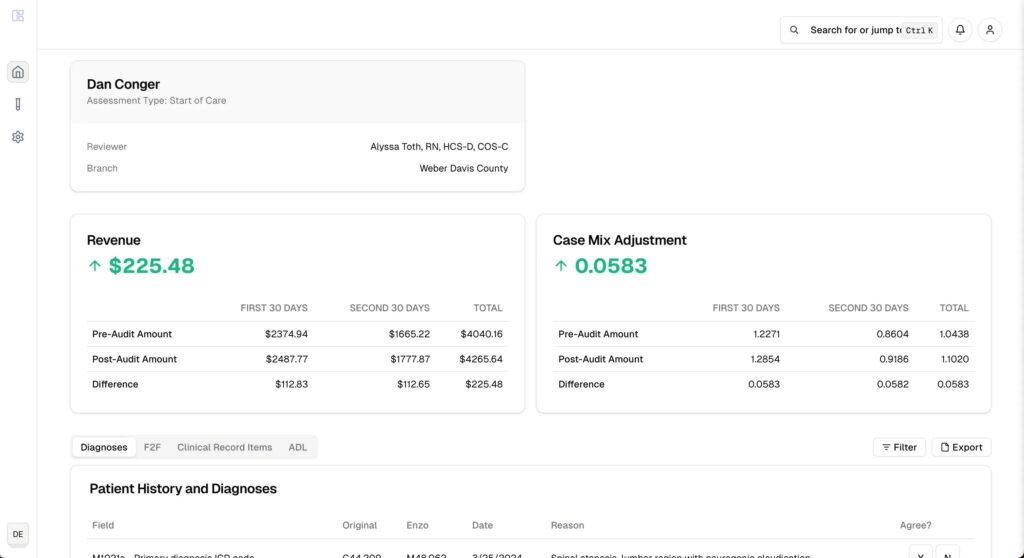
The Rowan Report recently came across a tool that addresses the complexities of OASIS coding. We sat down with Zach Newman (CEO) and Dan Conger (Founder) at Enzo Health to learn more about their AI powered QA tool with customizable workflows.

Co-pilot for Your Agency

Enzo Health is a documentation tool that automates workflows, acting as a co-pilot for your agency. Some of the workflows that Enzo Health supports include intake, OASIS, and QA reviews. Automating these processes can reduce errors and clawbacks, save your clinicians hours of paperwork, and offer cost savings to your agency.

QA Process

With the Enzo health QA tool, users upload all documents related to an episode. This will include the referral, initial visit notes, patient information, medical history, and form 485. Enzo calls out any issues it finds in the documentation.

In Face-to-Face encounters, Enzo looks for dates, signatures from qualifying clinicians, a valid primary diagnosis, and other qualifying information.

For ICD-10 Coding, Enzo assesses primary and secondary diagnoses, and adds notes with links to where the information can be found in the uploaded documentation.

Enzo then provides functional limitations and improvements that can be made. Using a team of clinicians that are trained as home health coders, Enzo provides a proxy for internal teams. These coders review charts and finalize diagnosis coding and OASIS answers.

Episode of Care

Qualification for an episode of care is required before anything else happens with a referral. Enzo’s intake automation tool reviews the referral package in advance of the initial F2F. Mirroring the agency’s internal intake process, Enzo determines whether the patient will be admitted to care, whether their insurance will cover the episode, and whether the patient’s psych history may impact the plan of care.

Enzo Health QA Automation

Clinical Assistance

The Rowan Report has often stated, and will continue to stand by this fact, that there is no substitute for face-to-face care and the expertise of the nurses and clinicians in the home. We have also seen the advancement of artificial intelligence that provides assistance and guidance at the point-of-care that can be useful. Enzo health includes a chat tool that pulls evidence-based information to provide guidance, coding instructions, and other help to nurses.

QA Tool Integration with Scribe Tool

Enzo Health has developed a talk-to-text scribe tool that integrates directly with the QA tool. The use of both products together would likely save more time as well as reduce errors. The Rowan Report will provide a thorough product review of the scribe tool at a later date. Enzo Health charges a flat fee determined by volume and offers bundle pricing for using both the QA and Scribe tools.

Final Thoughts

Costs are increasing, the workforce shortage is ongoing, nurses are suffering from burnout, and employees are stretched about as thin as they can go. Any tool that alleviates paperwork, stress, unpaid work at home to finish documentation, and the need for additional back-office staff is worth looking into. Enzo differentiates its tool from other QA software with their team of clinicians trained in home health coding to review the documentation. This end-to-end tool boasts a 95% accuracy rate and do date has no clawbacks or ADRs. 

In my conversation with Zach and Dan, their coding expertise and knowledge of the home health industry were evident. They are excited about the tools they are creating and passionate about helping agencies to provide patient care, a task they referred to as “very noble.” They continue to improve upon their software and conceive of innovative additions. If they continue as they started, Enzo Health will be one to watch.

GUIDE Model Expanding

by Kristin Rowan, Editor

GUIDE Launched with 390 Participants

On July 1, 204, CMS launched the GUIDE Model and announced that 390 organizations had signed on to participate. The Guiding an Improved Dementia Experience (GUIDE) Model is a voluntary model test amied at supporting people with dementia and their unpaid caregivers (family members).

Overview

The GUIDE Model focuses on comprehensive, coordinated dementia care to improve the quality of life for people with dementia. It also hopes to reduce the strain on family caregivers and keep patients in their homes and communities longer. Medicare payments cover the package of care coordination, care management, caregiver education and support, and respite care.

Poor-Quality Dementia Care

The GUIDE Model aims to address the key drivers of poor-quality dementia care in five ways:

    • Defining a standardized approach to dementia care delivery for model participants – this includes staffing considerations, services for people with dementia and their unpaid caregivers, and quality standards.
    • Providing an alternative payment methodology to model participants – CMS provides a monthly per-beneficiary payment to support a team-based collaborative care approach.
    • Addressing unpaid caregiver needs – the model aims to address the burden experienced by unpaid caregivers by requiring model participants to provide caregiver training and support services, including 24/7 access to a support line, as well as connections to community-based providers.
    • Respite services – CMS pays model participants for respite services, which are temporary services provided to a beneficiary in their home, at an adult day center, or at a facility that can provide 24-hour care for the purpose of giving the unpaid caregiver  temporary breaks from their caregiving responsibilities.
    • Screening for Health-Related Social Needs – model participants are required to screen beneficiaries for psychosocial needs and health-related social needs (HRSNs) and help navigate them to local, community-based organizations to address these needs.

Health Equity

Aspects of GUIDE designed to improve health equity include:

    • Requiring participating providers to implement HRSN screenings and referrals.
    • Offering financial and technical support for development of new dementia care programs targeted to underserved areas with less access to specialty dementia care.
    • Annual reporting by participants on progress towards health equity objectives, strategies, and targets.
    • Using data from the model to identify disparities and target improvement activities.
    • A health equity adjustment to the model’s monthly care management payment to provide additional resources to care for underserved beneficiaries.

Exclusive Inside Scoop

PocketRN gives patients, families, and caregivers a “nurse for life,” closing the gap between healthcare and care at home. This whole-person support allows patients and their caregivers to have access to medical care through their virtual nurse, who establishes a relationship with the patients and families.

On January 13, 2025, PocketRN announced a Strategic Partnership with Nevvon to pilot the GUIDE Model.

Nevvon is a global home and health care training tech company that certifies caregivers for continuing education. The app-based learning allows caregivers to go at their own pace, simplifying compliance, and empowering agencies to deliver exceptional care.

On January 15, 2025, PocketRN announced a Strategic Partnership with Right at Home to provide support to eligible Medicare beneficiaries with dementia.

Right at Home is a nationwide provider of in-home care and will provide care and safety assessments for eligible beneficiaries to evaluate the safety of the home environment, the ability of the patient to manage and function at home, and report back to PocketRN any other factors that might impact the patient and their family caregiver.

Later today, PocketRN will announce a National Strategic Partnership with with Assisting Hands® Home Care to test the care model. 

Assisting Hands provides in-home care to seniors, individuals with disabilities, and people recovering from illness or injury. The agency has a significant portion of their client base with a dementia diagnosis. Their franchise system has locations across the United States.


“We couldn’t be more thrilled to bring our revolutionary nurse-led care model to the millions of dementia patients and families who need it most. With PocketRN, patients and families get unwavering support from a ‘virtual nurse for life’ as they navigate the complexities of managing dementia at NO cost to them. Nurses are hands-down the best clinicians to be the ‘glue’ for patients and their families throughout their dementia journey–they’ve been doing so forever, and it’s high-time their work is valued by our system.”

Jenna Morgenstern-Gaines

CEO, PocketRN

In Their Own Words

The Rowan Report spoke with Nancy Gillette, Chief Growth Officer at PocketRN for this exclusive scoop. Nancy explained that with this program, PocketRN will be able to provide a nurse to dementia patients, provide a clinical overlay to care at home, work with care at home partners for respite benefits, and become a referral source when a home care agency has an eligible patient.

GUIDE Model PocketRN

Existing models and studies using PocketRN have shown up to a 30% reduction in urgent care visits, ER visits, and hospitalizations. The company is focusing on finding new strategic partners for a greater understanding of patient engagement from a home care agency standpoint.

Nancy gave us this inside information: 

The three recent announcements are just the beginning. Expect more announcements in the next 30-60 days and then continuing throughout the year.

PocketRN will eventually be applying the GUIDE Model in agencies, patients already using PocketRN, and direct referrals across all 50 states.

# # #

Kristin Rowan, Editor

Kristin Rowan has been working at The Rowan Report since 2008. She is the owner and Editor-in-chief of The Rowan Report, the industry’s most trusted source for care at home news .She also has a master’s degree in business administration and marketing and runs Girard Marketing Group, a multi-faceted boutique marketing firm specializing in content creation, social media management, and event marketing.  Connect with Kristin directly kristin@girardmarketinggroup.com or www.girardmarketinggroup.com

©2025 by The Rowan Report, Peoria, AZ. All rights reserved. This article originally appeared in The Rowan Report. One copy may be printed for personal use: further reproduction by permission only. editor@therowanreport.com

 

AI and Communication in Healthcare

An exerpt of “How AI is Enhancing Healthcare Communication” by Sandeep Shah, Founder and CEO, Skyscape

Edited by Kristin Rowan

How AI is Enhancing Communication

Artificial intelligence isn’t a new concept. In the healthcare industry alone, AI has been used to some degree since the 1970’s. It was first implemented to help identify blood infection treatments and showed promising results. This led to further curiosity about what it could do for healthcare professionals.

Today, AI is commonly used in several aspects of care, especially regarding radiology, screening tests, psychiatry, disease diagnosis, and predictive and preventative care. However, one lesser-known way AI tools are impacting our industry is through enhanced communication. AI is reshaping how care at home professionals interact with patients and care teams.

Challenges in Medical Communication

Electronic Health records have reduced the incidence of medical errors by improving the accuracy and clarity of medical records. However, they do not address the communication challenges today’s healthcare organizations still face. Communication channels, especially in care at home, are often fragmented, leaving gaps in patient care, follow-up, and department collaboration. Moreover, patient engagement is increasingly tricky without good communication, resulting in disruptive care plans or gaps in their treatment.

Effective communication is paramount to enhancing patient outcomes, revenue growth, and operational efficiency. Thanks to advancements in technology, AI has the potential to bridge these gaps and create a better experience for both healthcare providers and the patients they care for.

AI Communication

AI Communication Improving Patient Care

Communication within a HH agency is becoming increasingly complex. With more patients and a shortage of nurses, your team may be overwhelmed with tasks, applications, and health information. Luckily, there are several ways that you and your team can leverage artificial intelligence to better communication with patients and care teams (physicians, nurses, surgeons, lab technicians, administrative staff, etc.)

Here are some AI applications that will have the most impact on your agency:

Scheduling and Follow-ups

AI can improve both scheduling and follow-up processes, where there are often delays and miscommunications. AI software can automate appointment reminders and confirmations as well as rescheduling appointments if needed. These automated systems increase patient engagment with your agency and in their treatment. Some AI platforms can analyze patient data to give you a better look at patients who may have additional needs, which could also increase your billings.

Real-Time Support

Care at home nurses and caregivers report burnout due to increased requirements and tasks, including patient communication. AI should not replace your caregivers, but it can be helpful for simple questions, appointment reminders, and other routine tasks.

Future uses may include assistance with medical questions and creating a plan of care. AI is becoming more powerful in learning predetermined information, including scientifically reviewed medical information. Having real-time access to evidence-based, clinical information can accelerate care decisions at the point-of-care.

Less Paperwork, Less Burnout

Care at home nurses and caregivers can spend hours per day on documentation and patient communication. AI cannot and should not completely replace human interaction and communication, but it can significantly reduce the administrative burden of your employees.

Documentation, care notes, intake, and patient emails consume a significant portion of the day. A study from the University of California San Diego School of Medicine found that AI-generated emails and replies significantly reduce the mental strain on medical professionals. The study focused on communication between doctors and patients, but suggests that is can ease the workload of nurses and other healthcare professionals.

Efficient Workflows

Streamlining workflows seems to be one of the most promising applications of AI. Generative AI can interpret the information it is given to create something new. For care at home, this means the eventual use of AI for OASIS coding, plan-of-care, NTUC documentation, and more. 

Removing Language and Cultural Barriers

Language translation creates the possibility for any of your caregivers to care for any patient, regardless of the language they speak. AI translators bridge gaps in communication, especially when it comes to care plans and symptoms that are not generally part of the vocabulary taught when learning a language.

AI can also adjust communication for certain cultural backgrounds, improving patient trust and satisfaction, which can impact your star rating.

Care Collaboration

Using digital secure platforms, you can create communication channels with patients, family members, family caregivers, doctors, specialists, lab technicians, and anyone else involved in patient care. Instant updates to all the members of a patient’s care team relays critical information when it’s needed most. 

Save Time and Money

Not only do these AI applications improve patient satisfaction and reduce the workload for your nurses, AI can save you money. By automating operations like scheduling, shift fulfillment, billing, and other routine, repetitive tasks, your agency can scale without adding additional administrative personnel. With minimal profit margins, automation can help ensure your agency can continuing putting effort where it matters most, into patient care.

The Platform Matters

AI sounds great, and the applications for improving efficiency, better patient satisfaction, better employee satisfaction, and lower costs are appealing to care at home agency owners. However, spending your time, effort, and money on the wrong AI platform can be worse than doing nothing at all. 

AI platforms should enhance, not replace, any task it is designed to perform. If an AI platform promises to handle 100% of any task, run, don’t walk, in any direction. 

With so many AI applications available, you could onboard dozens of platforms and still have room for more automation. Look for AI applications that perform multiple tasks and/or integrate with other AI software companies. 

When you’re ready to let AI simplify your agency and make your staff and patients happier, it may be a good idea to find a consultant who is an expert in software and AI applications to recommend the right fit for your agency.

# # #

About Buzz

Buzz is a HIPAA-secure platform that simplifies real-time on-the-go communications between all stakeholders in an organization’s healthcare ecosystem (administrators, operations, billing, payors, providers and patients). It supports commonly used communication modalities, including texts, dictation, private calls, audio, images, reports, and video sharing. By consolidating these features into a single platform, Buzz eliminates the need for multiple communication tools, reducing confusion and burnout and enabling healthcare teams to focus on delivering exceptional patient care. 

AI Communication
AI Communication

Sandeep Shah is a pioneering technology entrepreneur, educator, and innovator, combining vision with strong technical expertise to transform healthcare delivery. Track record delivering innovative technologies to Harvard’s hospital network, and developing the first, truly usable mHealth application. Technical interests in telehealth, Clinical Communication and Collaboration (CC&C), and business leadership. Educational background in electrical engineering (B.Tech) and computer science (M.Tech), both from the Indian Institute of Technology, Bombay.

©2025 by The Rowan Report, Peoria, AZ. All rights reserved. This article originally appeared in The Rowan Report. One copy may be printed for personal use: further reproduction by permission only. editor@therowanreport.com