Related Posts
by Kristin Rowan, Editor
Comprehensive Regulations Uncover Suspicious Healthcare
CMS Proposes New Rules to Combat Medicare and Medicaid Fraud
The CRUSH proposed rule would tighten provider enrollment, expand fraud reporting, strengthen electronic visit verification oversight, and introduce new compliance requirements across federal healthcare programs. The proposed rule would implement a major overhaul to how CMS identifies, investigates, and prevents fraud.
CRUSH Fraud in Home Health, Hospice, DME, Medicare Advantage, & Medicaid
On November 16, 2026, CMS released the Comprehensive Regulations to Uncover Suspicious Healthcare (CRUSH) proposed rule, known as CMS-6098-P. The proposal introduces tougher enrollment standards, expanded reporting requirements, and stronger oversight. The proposal covers Medicare, Medicaid, the Children’s Health Insurance Program (CHIP), and the Health Insurance Marketplace.
CMS estimates that the proposed changes could generate nearly $90 billion in federal budget savings between 2027 and 2036, while imposing approximately $378.5 million in costs over the same period.
Operating Independently
Unlike the annual Medicare payment rules, CRUSH is a standalone regulatory proposal focused specifically on preventing fraud, waste, and abuse. CMS also intends to introduce similar program integrity regulations annually.
For healthcare providers, the message is clear: CMS wants greater transparency, faster reporting, and more accountability throughout the healthcare system.
Stricter Provider Enrollment Requirements
Reporting Deadline
Your content goes here. Edit or remove this text inline or in the module Content settings. You can also style every aspect of this content in the module Design settings and even apply custom CSS to this text in the module Advanced settings.
Currently, providers have 30 days to report changes, such as ownership, practice location, or adverse legal actions. Other changes may be reported within 90 days. Under CRUSH, all Medicare enrollment changes would have to be reported within 30 calendar days, regardless of the type of change or provider.

For HHAs and hospices, this would mean reviewing internal procedures to ensure that enrollment information remains accurate and current.
Organizations with multiple locations, complex ownership structures, or frequent management changes could face additional administrative responsibilities.
New Authority for CMS
CMS could take action against providers or suppliers when certain owners, managing employees, officers, or directors cannot have their identities verified. CMS could also deny or revoke enrollment when it determines that these individuals pose an undue risk of fraud, waste, or abuse.
These provisions would apply to domestic and foreign individuals and entities associated with healthcare organizations.
The changes could make ownership transparency and background verification increasingly important during acquisitions, mergers, and changes in management.
Changes for Medicare Advantage Providers
Currently, healthcare providers can generally participate in Medicare Advantage networks without enrolling in Original Medicare.
CMS wants to change that.
Under CRUSH, eligible providers and suppliers billing Medicare Advantage plans would be required to maintain approved enrollment in Original Medicare. An exception would apply to Program of All-Inclusive Care for the Elderly (PACE) plans.
Enhanced screening for MA providers
The change would allow CMS to apply its Medicare enrollment screening procedures to providers serving Medicare Advantage beneficiaries. These procedures may include identity verification, licensure reviews, site visits, and fingerprint-based background checks.
If finalized, the requirement would start the first day of the plan year, two years after publication of the rule.
For providers that currently operate exclusively within Medicare Advantage networks, the change could require substantial enrollment preparation.
Self-reporting
CMS also wants Medicare Advantage organizations and Medicare Part D plan sponsors to report suspected or substantiated fraud, waste, and abuse.
According to CMS, only 46% of Medicare Part C and Part D plan contracts voluntarily reported suspected or substantiated fraud referrals in 2025. The proposed rule would mandate reporting and expand requirements for reporting payment suspensions from credible allegations of fraud to all provider and supplier types.
EVV Scrutiny
The 21st Century Cures Act already requires states to implement EVV systems for Medicaid-funded personal care services and home health services.
However, existing federal regulations do not specifically require states to use EVV information when reviewing claims or conducting preliminary fraud investigations.
CMS proposes requiring states to incorporate EVV data into Medicaid prepayment review activities and preliminary investigations of potential fraud, waste, and abuse.
Medicaid Enrollment and Reporting Requirements
CMS is also proposing significant changes to Medicaid and CHIP provider enrollment oversight. States would be required to collect additional information about provider ownership, managing employees, and adverse legal actions.
The proposal would also expand the circumstances under which states could deny or terminate Medicaid or CHIP enrollment.
These new grounds would align Medicaid enrollment rules with existing Medicare requirements. This includes provisions involving certain felony convictions and abusive billing or prescribing practices.
The goal is to prevent providers excluded or revoked from one federal healthcare program from continuing questionable activities in another.
Provider Denial and Termination Reporting
States would also have to submit monthly reports identifying providers denied or terminated from Medicaid or CHIP.
These reports would include identifying information such as the provider’s legal business name, address, Tax Identification Number, and National Provider Identifier (NPI).
CMS also wants states to collect and consistently use NPIs for all eligible Medicaid and CHIP provider types across enrollment, claims processing, managed care oversight, and program integrity activities.
Faster Payment Suspensions
CRUSH would allow states to rely on credible-allegation determinations made by CMS or another federal agency when making their own findings.
It does not require states to adopt those determinations automatically. However, CMS also aims to limit when states could continue payments despite a credible allegation of fraud.
60-day Reporting Window
The proposed rule would establish a regulatory framework for reporting and returning self-identified Medicaid fee-for-service overpayments.
Under the proposal, identified overpayments would generally have to be reported and returned within 60 calendar days.
Risk Adjustment Audits
The Medicare Advantage Risk Adjustment Data Validation (RADV) audits examine whether diagnoses submitted by Medicare Advantage organizations are supported by medical records.
CMS wants to change how it conducts audits and calculates overpayments. The changes would apply to audits beginning with payment year 2018.
CMS estimates that this approach could allow the agency to recover approximately $9 billion in Medicare Advantage overpayments per payment year.
The proposal would also allow Medicare Advantage plans to request more time to submit medical records under extraordinary circumstances.
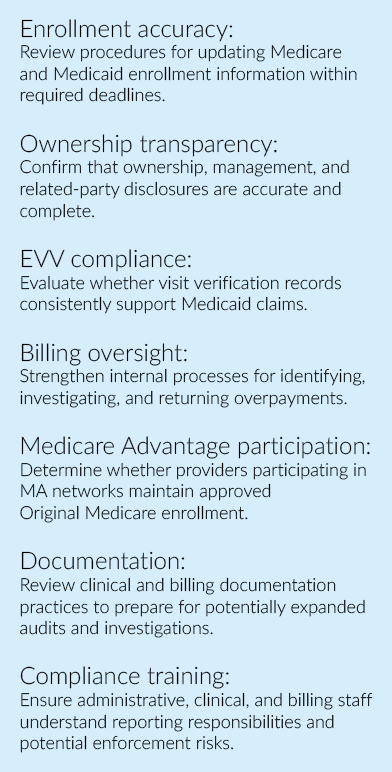
Snapshot
Medicaid Eligibility and Payment Oversight
CMS is proposing to replace the Medicaid Eligibility Quality Control program with a new federally overseen eligibility audit structure. The new approach would give CMS more direct oversight of state eligibility determinations and would be used to identify payment errors.
The proposal includes changes to corrective action plans and determining when Medicaid funds should be disallowed because of eligibility errors.
CMS believes the new framework would improve accountability while reducing some administrative burdens on states.
Weigh In
The proposed rule is in a 60-day public comment period. You can submit your comments here.
Comment deadline: January 19, 2027.
When commenting, reference CMS-6098-P.
You can also read the full proposed rule in the Federal Register
# # #


Kristin Rowan is the owner and Editor-in-chief of The Rowan Report, the industry’s most trusted source for care at home news. She is also a sought-after speaker on Artificial Intelligence, Technology Adoption and Lone Worker Safety. She is available to speak at state and national conferences as well as software user-group meetings.
Kristin also runs Girard Marketing Group, a multi-faceted boutique marketing firm specializing in content creation, social media management, and event marketing. She works with care at home software providers to create dynamic content that increases conversions for direct e-mail, social media, and websites. Connect with Kristin directly at kristin@girardmarketinggroup.com or www.girardmarketinggroup.com
©2026 by The Rowan Report, Peoria, AZ. All rights reserved. This article originally appeared in The Rowan Report. One copy may be printed for personal use: further reproduction by permission only. editor@therowanreport.com