The Alliance Responds to the Integrity and Protection Act

Advocacy

FOR IMMEDIATE RELEASE

Contact:                                                         Hannah Kristan
communications@allianceforcareathome.org
202-355-1647

The Alliance Celebrates the Introduction of the Medicare Home Health Payment Integrity and Protection Act of 2026

Alexandria, VA, August 7, 2026. Today, the Alliance applauds the introduction of the Medicare Home Health Payment Integrity and Protection Act of 2026 (S.B. 5250) by Senator Collins (R-ME) and Senator Blackburn (R-TN). This important piece of legislation will provide core payment integrity reforms by correcting the Centers for Medicare & Medicaid Services’ (CMS) flaws in calculating Medicare rate updates, while also streamlining program integrity measures to target fraud concerns early, stopping bad actors from entering the Medicare program. Critically, this legislation does not rely on sweeping enforcement strategies which risk further restricting access to care for Medicare beneficiaries and causing unintended harm to legitimate providers.  

The Medicare Home Health Payment Integrity and Protect Act seeks to restore the Medicare home health rate to what it would have been without consecutive years of compounding cuts. Those cuts were built on data entirely unrelated to the payment system adopted in 2020, along with data tainted by the inclusion of fraudulent providers in the rate analysis. This is an important step in modernizing the home health benefit, ensuring that beneficiary access is not disrupted by providing payment rates that better reflect the true cost of care. 

The program integrity reforms included in this legislation build on the industry supported bill from Representative Beth Van Duyne in the Protecting Seniors and Stopping Fraudsters Act (H.R. 8883), which gives CMS stronger tools to combat healthcare fraud without imposing unnecessary burdens on legitimate providers.

Medicare Advantage Stock Trump

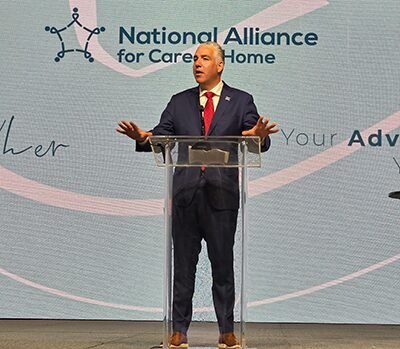
“The National Alliance for Care at Home applauds the introduction of the Medicare Home Health Payment Integrity and Protection Act of 2026 by Senator Collins. This bill corrects longstanding flaws in home health reimbursement and takes a meaningful step toward a home health benefit that is stable and built for how care is delivered today. We strongly support the bill for its payment reforms, as well as measures to protect patients and preserve the integrity of the Medicare home health benefit.”

Jennifer Sheets

CEO, National Alliance for Care at Home

Sheets continues, “Consistent with our community’s commitment to provide the highest-quality, person-centered care in the home, we support the bill’s goal to strengthen access while focusing on targeted oversight, protecting the legitimate providers who serve patients every day. We look forward to working with Senator Collins, a long-time champion of care at home, to build support for this important and timely legislation.”

“When billions of dollars are improperly siphoned from the Medicare home health program, this can undermine the integrity of the payment system used to reimburse legitimate providers and threaten care for the seniors who depend on it. I have long been a strong supporter of home health care, which allows millions of Americans to remain in the comfort, security, and privacy of their own homes, while helping to avoid unnecessary hospitalizations and nursing home admissions,” said Senator Collins. “Fraudulent home health providers harm beneficiaries and diminish reimbursements for honest agencies that are already confronting workforce shortages and rising costs. My legislation would give CMS stronger tools to stop fraud before payments are made and prevent fraudulent spending from distorting the data used to reimburse honest agencies for medically necessary care.”

The Alliance will continue to serve as a key partner to lawmakers and regulators working to reform and protect the Medicare home health benefit, ensuring that payment rates better reflect the true cost of care.

# # #

About the National Alliance for Care at Home

The National Alliance for Care at Home (the Alliance) is the leading authority in advancing care in the home. We envision an America where everyone has access to the highest quality, person-centered healthcare wherever they call home. Through advocacy, education, and convening, we connect providers and stakeholders to strengthen care delivery across the home-based care continuum — spanning home care, home health, hospice, palliative care, and Medicaid home and community-based services. Learn more at www.AllianceForCareAtHome.org

© 2026 This press release was sent to The Rowan Report from the National Alliance for Care at Home and is reprinted with permission. For more information or to request permission to use this content, see contact information above.


LeadingAge Reacts to the Integrity and Protection Act

CMS

Leading Age React to Integrity and Protection Act

FOR IMMEDIATE RELEASE

Contact:                              Lisa Sanders
lsanders@leadingage.org
202-508-9407

PACE LeadingAge MA Reform

LeadingAge Statement on the Medicare Home Health Payment Integrity and Protection Act of 2026

August 7, 2026 Washington, DC—Statement from Katie Smith Sloan, president and CEO, LeadingAge, the association of nonprofit and mission-driven providers of aging services, including home health, on the Medicare Home Health Payment Integrity and Protection Act of 2026, recently introduced by Senator Susan Collins (R-ME):

“Access to health care and services is an important benefit today, as America grows older—by 2050, adults age 65 and older will increase from 17% to nearly 25% of the population. What’s more, care at home is what people prefer and it also delivers strong patient satisfaction and quality outcomes. Yet the valuable Medicare home health benefit is under threat. Senator Collins’ bill rightly seeks to rectify two contributors to that unfortunate situation: bad actors seeking to exploit the program, and…years of reductions due to a flawed methodology. “

Katie Smith Sloan

President and CEO, LeadingAge

Sloan continued, “A longtime champion of Medicare home health, Senator Collins appreciates the shortcomings of current payment approaches; we are particularly encouraged by the bill’s recognition that the standard prospective payment amount requires a recalibration. 

The Centers for Medicare and Medicaid Services’ (CMS) patient-driven groupings model (PDGM), in place since 2020, applies permanent and temporary payment adjustments, as required by Congress, premised on isolating “assumed versus actual” behavior change. The widely recognized problem is that in practice, neither CMS nor any other stakeholder, has managed to isolate the specific behavior due to PDGM from other factors that have also changed over the same time frame: patient acuity, referral patterns, staffing markets, the shift in post-acute utilization, potential fraud, and the lasting effects of the public health emergency.  

LeadingAge Reacts to Integrity and Protection Act

Rather than continue use of the problematic behavioral adjustments methodology, it makes sense to set a rate that reflects the patients agencies actually serve, and pause further assumption-driven adjustments. Home health providers need this relief, and the older adults and families who depend on care at home need the stability and access sensible rate-setting would deliver. 

We appreciate Senator Collins’ leadership in presenting a much-needed reset of the Medicare home health payment to promote its stability and ensure access. 

In addition, we also share the desire to address fraud in this setting. LeadingAge has long expressed concern about the increase of home health providers in Los Angeles County.  

This bill’s oversight provisions are reasonable, appropriately targeted policies that would help maintain the benefit’s integrity. Those, along with the important proposed payment changes, will help to ensure support for legitimate providers—including our nonprofit and mission-driven members. We look forward to working with Senator Collins to advance this legislation.”

About Leading Age

We represent more than 5,300 nonprofit and mission-driven aging services providers serving older adults and touching millions of lives every day. From our national headquarters in Washington, DC, and in collaboration with our state partners representing members active in 50 states, the District of Columbia, and Puerto Rico, we use advocacy, education, applied research, and community-building to make America a better place to grow old. Our membership encompasses the entire continuum of aging services, including skilled nursing, assisted living, memory care, affordable housing, retirement communities, adult day programs, hospice, Programs of All-Inclusive Care for the Elderly (PACE), and home-based care. We bring together the most inventive minds in the field to lead and innovate solutions that support older adults wherever they call home. For more information, visit leadingage.org.

© 2026 This press release was sent to The Rowan Report from LeadingAge and is reprinted with permission. For more information or to request permission to use this content, see contact information above.

The Broadway Secret

Admin

by Aaron Marcum

The Home Care Back Stage

The Broadway secret every home care owner needs to know

A few years ago, I took my daughter to see “Wicked” in London’s West End.

From the moment the lights dimmed, we were transported. The performances were flawless, the choreography mesmerizing, and the vocals spine-tingling. For two and a half hours, we sat captivated by what appeared to be theatrical magic.

It looks like magic

But here’s what struck me as I watched: what we were experiencing wasn’t magic at all. It was the result of an incredibly sophisticated operation happening behind that curtain—an operation most audience members never think about.

Dan Sullivan, founder of Strategic Coach, calls this the “Front Stage” and “Back Stage” of your business. And it’s a framework that every home care owner needs to understand.

The Home Care Back Stage

What Makes Broadway, Broadway?

When you pay for a West End ticket, you’re not just paying for talented actors. You’re paying for a lighting crew coordinating hundreds of cues per show, costume designers managing dozens of quick changes, sound engineers balancing multiple wireless microphones in real-time, stage managers calling hundreds of technical cues with split-second precision, and a production team that rehearsed for months before opening night.

The Front Stage—what the audience sees—only shines because of an exceptional Back Stage.

Your home care business has the same dynamic

Front and Center

In our industry, the Front Stage is your care professional arriving at Mrs. Johnson’s home at 9 AM. It’s the smile, the gentle assistance with morning medication, the conversation during breakfast, and the compassionate help with bathing and dressing.

That’s what your clients see. That’s what their families remember. That’s how your business gets judged.

But we all know that caregiver showing up prepared, on time, and trained isn’t an accident.

Behind the Scenes

Your Back Stage makes it possible: 

  • Care Coordination ensures the right caregiver with the right skills is scheduled for the right client. When this system fails, clients feel it immediately.
  • Billing Systems that work seamlessly mean caregivers get paid accurately and on time—because nothing destroys Back Stage morale faster than payroll errors.
  • Compliance Infrastructure keeps you operating legally and safely, protecting both your clients and your business.
  • Recruitment and Hiring processes that attract quality candidates. With projections showing a national shortage of 151,000 caregivers by 2030 and 355,000 by 2040, your Back Stage recruiting determines whether you have anyone to put on the Front Stage. As a side note, I personally believe the shortages are greater than this.
  • Training Programs that don’t just check boxes but actually prepare caregivers for real situations. The 2025 Activated Insights Benchmarking Report found that agencies offering 8+ hours of orientation training had median revenue of $2.4 million compared to $2.03 million for those with 3 or fewer hours.
  • Retention Strategies because the average caregiver costs $2,600 to replace Activated Insights. Your Back Stage culture determines whether caregivers stay or leave.
Home Care Broadway Back stage
Home Care Broadway back stage

The Numbers Tell a Sobering Story

Here’s the reality: the home care industry’s turnover rate reached 79.2% in 2023 Home Health Care News—the highest it’s been in five years. Think about that. In an agency with 100 caregivers, you’re replacing nearly 80 of them every single year.

But it gets worse. Nearly four out of five caregivers leave their job within the first 100 days of employment. That means the caregivers you just spent weeks recruiting, screening, and training? Most of them won’t even make it through their first three months.

When your Back Stage is weak, these statistics become your reality.

The "Community Theater" Problem

We’ve all attended shows where you could tell the Back Stage was struggling.
Maybe you’ve seen a local production where an actor missed their entrance, the lighting was off, a scene change took too long, or the sound cut out.

You couldn’t see the Back Stage problems, but you absolutely felt them.
The same thing happens in home care.

A weak back stage

When your Back Stage is weak:

  • Caregivers show up late (or not at all) because scheduling is chaotic
  • Families receive incorrect bills because systems are disconnected
  • Care quality suffers because training is inconsistent
  • Your reputation erodes one Front Stage failure at a time

Your clients might not know your payroll system crashed or that your care coordinator called in sick for the 4th time this month, but they experience the consequences.

The Broadway Standard Question

So here’s the question every home care owner must ask:

Is your business operating at Broadway standards, or community theater? Be honest.

When you look at your Back Stage operations:

  • Can your care coordinators instantly access complete client information?
  • Do your caregivers have clear protocols for every situation they might encounter?
  • Is your billing accurate enough that families rarely question an invoice?
  • Do you have documented processes, or is everything “in someone’s head”?
  • Could your business run smoothly if your top coordinator was suddenly unavailable?

The best home care agencies—the ones with waiting lists and stellar reputations—aren’t just lucky. They’ve built Broadway-quality Back Stage operations.

They’ve invested in systems, training, and processes. They’ve documented their playbook. They’ve made the Back Stage so strong that the Front Stage can shine consistently, every single day.

Because here’s what I learned watching “Wicked”: excellence isn’t about one amazing moment. It’s about a thousand excellent decisions that happen when no one is watching. 

The question is: what's happening in your Back Stage?

Want to build your Broadway-worthy Back Stage?

Stay in the know with strategies, insights, and practical resources designed specifically for home care owners. Subscribe to receive updates, newsletters like this, and tools that will help you elevate both your Front Stage performance and Back Stage excellence. Because your caregivers—and your clients—deserve a five-star experience every single time.

# # #

Aaron Marcum Home care and Broadway

Aaron Marcum is an entrepreneur and thought leader who has dedicated his career to transforming the home care industry and nurturing business leaders.

As the founder of Home Care Pulse (now Activated Insights), he pioneered the Best of Home Care® program, revolutionizing quality standards in senior care across North America. His expertise as a Certified Blue Ocean Strategy practitioner and former Certified EOS Implementer has helped shape some of home care’s most respected brands.

© 2026 This article originally appeared in Aaron Marcum’s newsletter and is reprinted here with permission. For more information or for permission to use this material, please contact Aaron Marcum.

2027 Home Health Proposed Rule

CMS

by Kristin Rowan, Editor

2027 Home Health Proposed Rule

The Alliance Responds

On July 1, 2026, CMS released the 2027 Home Health Prospective Payment System proposed rule. The proposed rule includes updates to base pay, quality reporting system, value-based purchasing model, medicare provider enrollment, and DME policies. CMS is also considering ways to include palliative care. The comment period ends August 31, 2026.

The National Alliance for Care at Home issued a press release following the proposed rule publication.

“While the proposed rate update results in increased payments relative to last year – a reflection of our continued advocacy and a much-needed reprieve for providers under the stress of increasing costs – the Alliance remains focused on working to stop unwarranted temporary adjustments that are based on a flawed methodology with underlying data integrity issues. We will continue to partner with CMS on policies that strengthen the Medicare home health benefit. Ultimately, federal policy must preserve patient access to care at home, which remains the preferred choice of care for millions of families.”

Jennifer Sheets

CEO, the Alliance

Permanent and Temporary Rate Adjustments

CMS uses data from 2020 through 2025, actual and expected behavior changes resulting from the implementation of PDGM, and calculated overpayments from prior years to determine rate adjustments.

  • The actual CY 2025 base rate was $2,057.35 and the recalculated rate is $1,953.60; a difference of 5.043%
  • Prior permanent adjustments of -1.975% in 2025 and -1.023% in 2026 are factored in, but not directly subtracted
  • The 2024 budget-neutral rate multiplied by case-mix weights, wage index, and payment update factors yield the 2025 budget-neutral rate of $2,036.29, a difference of 1.024%
  • Estimated retroactive overpayments from CY 2020 through CY 2025 of $4,9 billion to be partially collected with a -3.0% temporary adjustment to the base pay rate.
  • Recalibrating the  case-mix weight using reporting from CY 2025, CMS calculates a budget neutrality factor for CY 2027 of +1.0045
  • Applying the market basket (wages across the U.S.), CMS proposes a 3.0% increase to the home health market basket, offset by a -1.0% productivity adjustment, yielding a 2.1% increase.
With these calculations, CMS proposes a -3.0% temporary adjustment to be applied for CY 2027.

The Alliance acknowledges and appreciates the headway made with CMS in understanding the true cost of delivering home health care and the value it provides to the millions of Americans who depend on it. However, the Alliance emphasizes that Medicare payment rates – with the 3% temporary adjustment applied – still do not align with the actual cost of providing comprehensive, high-quality care. In a recent letter to CMS, the Alliance encouraged CMS to eliminate all permanent and temporary adjustments due to problems in the data and analyses used to calculate payment rates.

Alignment of HH QRP and HHVBP

CMS is considering changes that would better align measure sets, reporting perioeds and assessment process between HH QRP and HHVBP. The considered changes are:

  • Increasing alignment in expanded HHVBP Model and HH QRP Quality of Patient Care (QoPC) Star Ratings measure sets.
  • Aligning HH QRP and expanded HHVBP Model measure reporting periods.
  • Modifying HH QRP APU and expanded HHVBP Model annual payment reporting periods.
  • Altering expanded HHVBP Model Interim Performance and HH QRP QoPC Star Rating Reports.
  • Aligning timeframe of appeals/suppression review processes for the expanded HHVBP Model and HH QRP.
  • Updating scoring methodology to incorporate HH QRP APU penalties in expanded HHVBP Model payment adjustments and factoring HH QRP Quality Assessments Only (QAO) values into QoPC Star Ratings scoring.
CMS is NOT asking for comments at this time. The Technical Expert Panel meeting in 2025 discussed this alignment.

Read the TEP Summary Report.

LUPA Updates

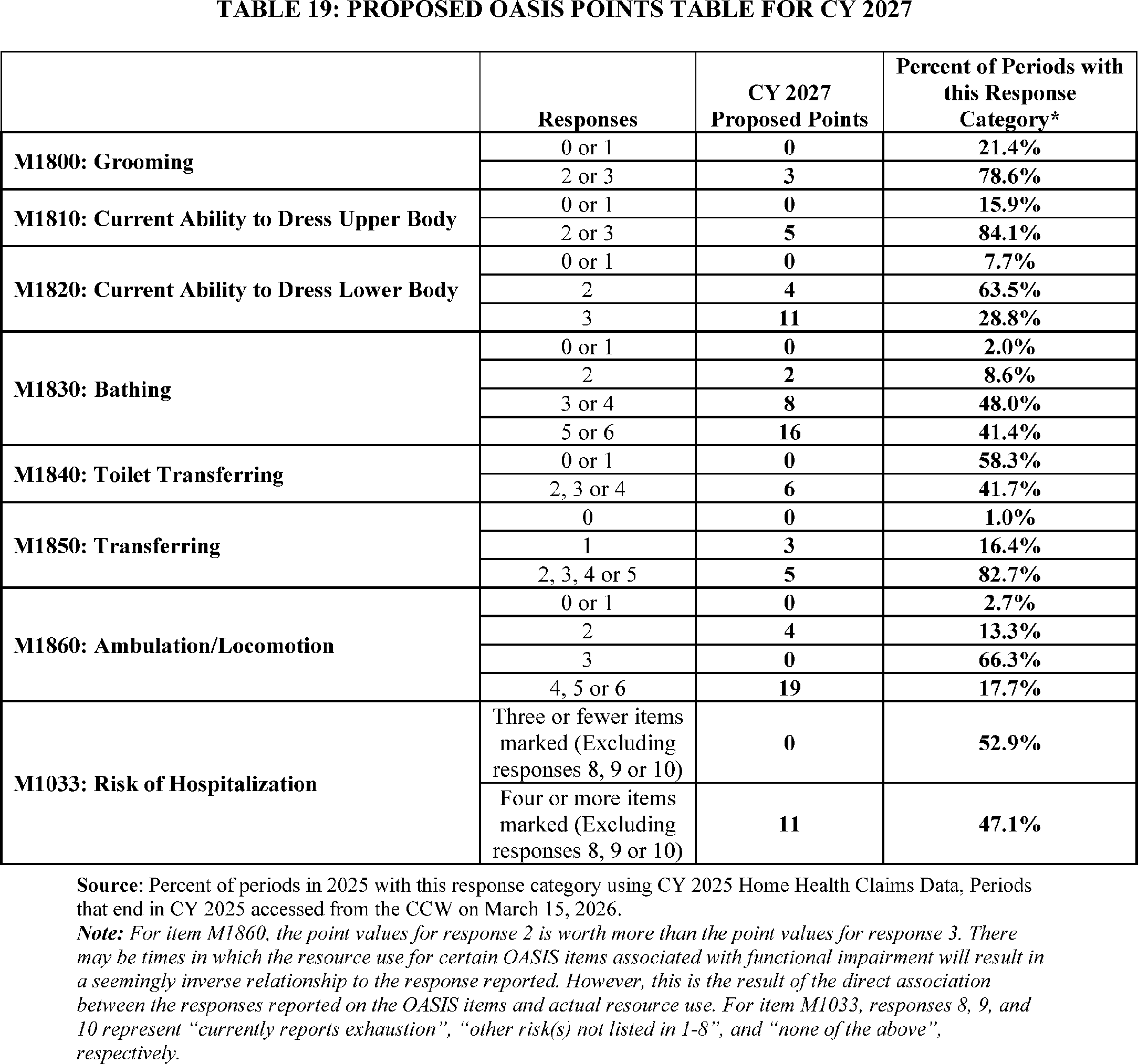
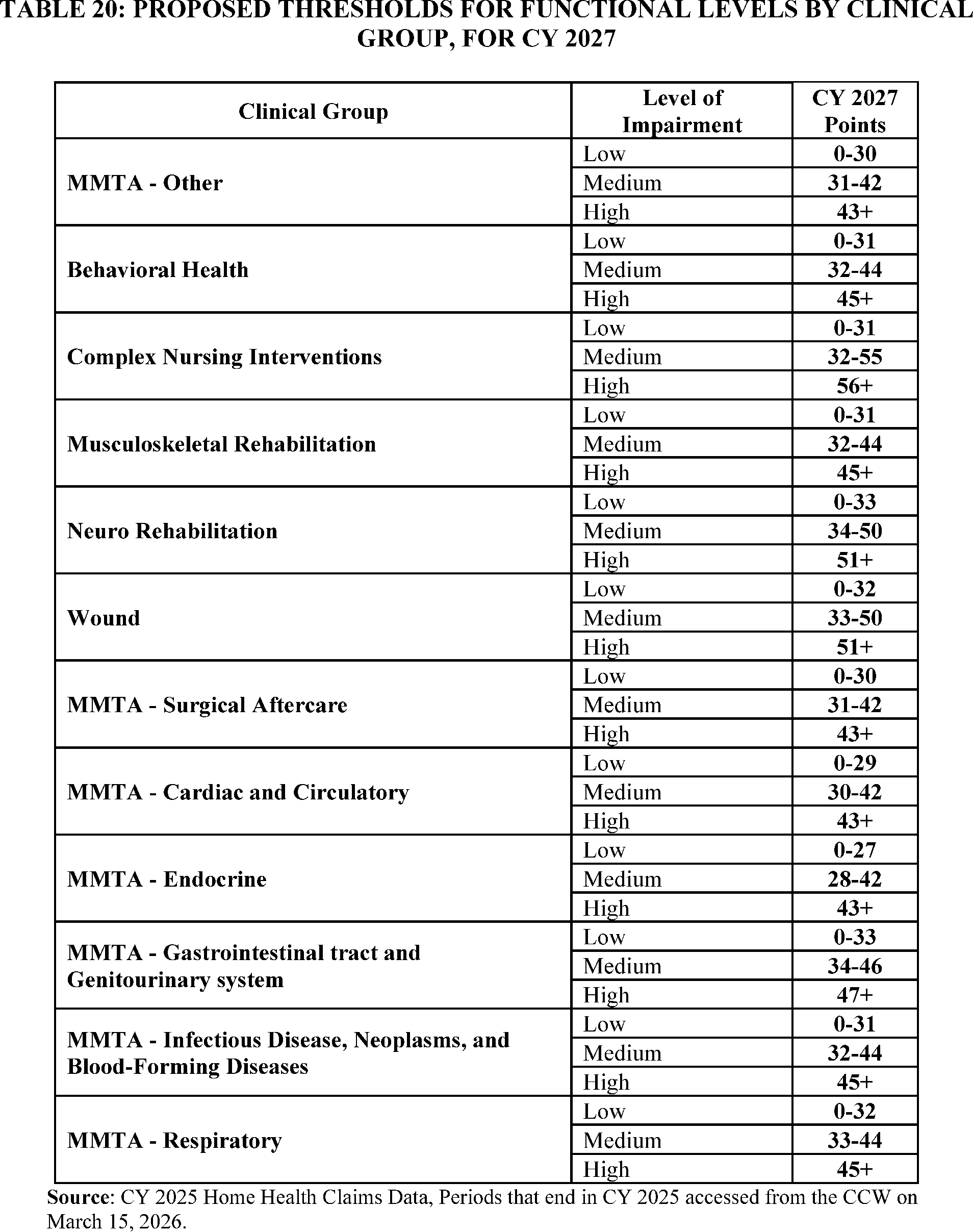
CMS proposes updates to the functional points table and the table of functional impairment levels by clinical group. The proposed updates are:

2027 HH Proposed Rule Points Table
2027 HH Proposed Rule functional level thresholds

Requests for Comment

CMS is soliciting comments on the proposal of applying a -3.0% temporary rate adjustment instead of applying a permanent adjustment.

There are proposed changes to the criteria for selecting and prioritizing HH QRP measures, identifying measurement gaps, and measures for filling those gaps. CMS is requesting input on the measure concepts as the relate to advanced care planning. 

For CY 2027, CMS is using the hospital wage index as the basis for its calculations for the home health wage index. While they believe this is the best method, they are looking for information on alternative data sources such as occupation-level wage data or other publicly available wage data. They are exploring whether such data might better reflect geographic variations in labor costs for HHAs. CMS is concurrently exploring additional wage data for hospices, SNFs, and inpatient rehab facilities.

CMS is inviting public comments on the CY 2027 proposed case-mix weights and case-mix weights budget neutrality factor.

# # #

Kristin Rowan Editor The Rowan Report

Kristin Rowan is the owner and Editor-in-chief of The Rowan Report, the industry’s most trusted source for care at home news. She is also a sought-after speaker on Artificial Intelligence, Technology Adoption and Lone Worker Safety. She is available to speak at state and national conferences as well as software user-group meetings.

Kristin also runs Girard Marketing Group, a multi-faceted boutique marketing firm specializing in content creation, social media management, and event marketing. She works with care at home software providers to create dynamic content that increases conversions for direct e-mail, social media, and websites.  Connect with Kristin directly at kristin@girardmarketinggroup.com or www.girardmarketinggroup.com

©2026 by The Rowan Report, Peoria, AZ. All rights reserved. This article originally appeared in The Rowan Report. One copy may be printed for personal use: further reproduction by permission only. editor@therowanreport.com


Healthcare Workers May be Deported

Home Care

by Tim Rowan, Editor Emeritus
Author’s note: This analysis does not address the right and wrong of  legal asylum status, but will focus only on the impact of deporting tens of thousands of healthcare workers.

Thousands of Healthcare Workers Could be Deported

Florida Will Be Hit Hardest

Denise Bellville is alarmed by looming unintended consequences of this administration’s border protection policy. The Executive Director of the Home Care Association of Florida has good reason. She estimates that 35,000 Haitians work in healthcare in her state, a full third of the U.S. total. Some are in-home caregivers; a few are home care agency owners.

As of last week, all are at risk of being sent back. Temporary Protected Status, given to asylum applicants from dangerous countries, has been canceled for immigrants from specific countries. Among them are 353,000 Haitians, along with applicants from eight other countries. The Supreme Court is yet to rule on four more nations named in the DHS removal request.

“Broward County is one of about six counties that will be hit especially hard and have already begun to feel the effects of the July 24 SCOTUS decision,” she told us. “Two [agencies] there have already closed. One determined that 85 of its 86 caregivers are vulnerable for deportation. The other said that Creole-speaking clients made up 80 percent of its business.”

When the Department of Homeland Security announced Termination of Temporary Protected Status for Haiti,” the order included a little more than 353,000 Haitian asylum applicants, more than 112,000 of whom work in the U.S. healthcare system. Industry estimates indicate one-third of these healthcare workers, roughly 35,000 Haitians, live and work in Florida.

Why So Many in Florida?

There is a large population of Haiti-born U.S. citizens in Florida. Some have been there for generations. They still speak a unique version of French and hold onto ancient Creole culture. “Caregivers from their own country, who understand both the language and the traditions of these now-elderly citizens are the only ones who can effectively care for them in all settings: home, hospital, and skilled nursing facility,” Bellville said. “When these 35,000 healthcare workers are gone, there are no others who can provide that level of care,” she asserted. “The problem will exacerbate what was already our critical in-home caregiver shortage.” She referred to a disturbing Florida reality:

  • Florida’s population is over 23.5 million
  • 22.8 percent are over 65 years of age, roughly 5.35 million residents
  • The national average is 18.9 percent
  • The state has 16 caregivers per thousand residents
  • The national average is 65 caregivers per thousand

When asked what recourse is available, Ms. Bellville said an association cannot do much. “We even talked with Hospital and LTC associations about working together,” she said. “All of them responded that, sadly, even if we work together, we do not have sufficient clout to make a difference.”

Legal Battle Background

How Asylum Became Expulsion

Thousands face deportation

The U.S. welcomed Haitians when life became dangerous in their home country. Gang violence, a problem for decades, led to the assassination of President Jovenel Moïse in 2021. In the absence of leadership, street gangs took over. Life became cheap. Good people, even if unrelated to any gang, were murdered at random. Due to the rampant violence, the U.S. State Department maintains a Level 4 “Do Not Travel” warning for Haiti. Unemployment is 15 percent; among youth, it is more 37 percent.

The Biden administration processed asylum applications by the thousands. Border Patrol accepted most claims of danger back home. For four years, hopeful applicants, including Haitians, waited for their court asylum hearings. While they were waiting, they legally sought jobs in various sectors, more than a third of them in healthcare. 

Decades into a seemingly unsolvable, unending caregiver shortage, Home Care agency owners welcomed these new arrivals, trained them, and sent them out to care for the elderly in their homes, skilled nursing facilities, and rehab hospitals. Their fluency in Creole French and familiarity with Haitian culture made them invaluable in those communities.

On June 24, 2026, the Supreme Court issued a 6-3 ruling in Mullin v. Doe, denying a challenge to the terminations of TPS for Haiti and Syria. The decision granted DHS permission to move forward with implementing the terminations of TPS for those countries and eight others. Four more countries on the DHS list are expected to follow. 

Epilogue

The $tats

The eventual loss of 112,000 healthcare workers will create a gaping hole in the availability of services. It will also have an impact on the U.S. Treasury and the overall economy. According to a report from Fwd.us, Haitian TPS holders contribute $5.9 billion to the U.S. economy annually. In Springfield, Ohio, where Haitian refugees were invited by the city to live and work, they added $91 million to that town’s economy. They pay over $1.5 billion per year in federal, payroll, state, and local taxes.

Based on DHS published estimates of the cost of deportation ($17,121 per person), sending 353,000 Haitians back to their island will require an expenditure of $6.04 billion. Some of that cost may be reduced by voluntary deportations that do not involve the cost of law enforcement.

Anyone choosing to self deport may have to hurry. Enforcement has already begun. HCAF Director Denise Bellville told us that some of her member agencies have reported ICE agents have started knocking on their doors unannounced, demanding to conduct I-9 audits.

# # #

Tim Rowan The Rowan Report
Tim Rowan is a 33-year home care technology consultant who co-founded and served as Editor and principal writer of this publication for 25 years. He continues to occasionally contribute news and analysis articles under The Rowan Report’s new ownership. He also continues to work part-time as a Home Care recruiting and retention consultant. More information: RowanResources.com
Tim@RowanResources.com

©2026 by The Rowan Report, Peoria, AZ. All rights reserved. This article originally appeared in The Rowan Report. One copy may be printed for personal use: further reproduction by permission only. editor@therowanreport.com

Private Payors Against Fraud

Admin

by Elizabeth E. Hogue, Esq.

Private Payors Against Fraud

Join Enforcement Efforts

There seems to be a persistent myth among providers of private duty/homecare services that the federal anti-kickback statute applies to Medicare-certified providers only. On the contrary, the anti-kickback statute applies to providers who receive funds from any state or federal healthcare program; including the Medicaid Program, VA, TRICARE, etc. Private duty providers: This means many of you! Lately it has become clear that private payors have joined fraud enforcement efforts.

Guilty

In a recent case, a provider in Detroit pled guilty to conspiring to commit health care fraud. The conspiracy resulted in losses totaling $1.9 million to Medicare, Medicaid, and Blue Cross Blue Shield of Michigan. The investigation was conducted by the FBI and the Office of Inspector General of the U.S. Department of Health and Human Services, the primary enforcer of fraud and abuse prohibitions.

Ghost Services

At the plea hearing, the provider admitted to creating and operating a scheme to submit false and fraudulent claims that were medically unnecessary or not actually provided. In some instances, services billed were not ordered by physicians. The scheme continued for over five years. The provider used the proceeds of fraud for his personal use and to benefit others.

Consequences

After a presentence report is prepared, the provider faces a possible maximum sentence of ten years in prison, a fine of up to $250,000 and up to three years of supervised release following any term of imprisonment.

Private Payers Against Fraud

Federal and Private Prosecution

It is important to note that the provider was criminally prosecuted not only for fraud with regard to claims submitted to Medicare and Medicaid Programs, but also fraud committed against a private payor, Blue Cross Blue Shield.

Your Payor Could Report You

It now appears that providers who receive payments from third party payors must be concerned about fraud enforcement. Consequently, providers of private duty/home care services must develop, implement, and update Compliance Programs.

Compliance Programs

Compliance Programs are specific types of documents that routinely address issues that providers do not usually cover in internal policies and procedures. In addition, providers may not gain benefits related to fraud enforcement if there is no formal document called a Compliance Program.

More than Accreditation

Some providers think that accreditation means they are in compliance. On the contrary, providers may be accredited but fail to meet applicable compliance standards for fraud and abuse. Compliance Programs appropriately address potential fraud and abuse issues. They also include mechanisms for helping to ensure compliance, such as processes for identification and correction of potential problems that are not addressed during the certification process.

It Could Save You

Providers also need to know that developing, implementing, and updating Compliance Programs may make a considerable difference during fraud enforcement actions. If providers have Compliance Programs in place that are current and fully implemented, enforcers may be less aggressive in pursuing potential violations.

Corporate Integrity Agreement

When enforcers discover problems with fraud and abuse in organizations, providers are usually asked to develop and implement a Corporate Integrity Agreement (CIA). This type of agreement is likely to include processes for stringent monitoring on a continuous basis. These monitoring activities can be extremely burdensome to providers in terms of both time and money. Providers with valid Compliance Programs are not necessarily asked to develop and implement CIA’s.

Final Thoughts

Now is the time for all providers, including private duty/home care companies, to recognize and act upon the need to establish and maintain Compliance Programs. “Working on it” is no longer good enough.

# # #

Elizabeth E. Hogue, Esq The Rowan Report

Elizabeth Hogue is an attorney in private practice with extensive experience in health care. She represents clients across the U.S., including professional associations, managed care providers, hospitals, long-term care facilities, home health agencies, durable medical equipment companies, and hospices.

©2026 Elizabeth E. Hogue, Esq. All rights reserved.
No portion of this material may be reproduced in any form without the advance written permission of the author.

©2026 by The Rowan Report, Peoria, AZ. All rights reserved. 

Medicaid Reform

Home Health

by Kristin Rowan, Editor

Medicaid Reform

New Efforts to Stop Fraud Before it Happens

As auditors continue to investigate fraudulent activity, new initiatives through Medicare reform aim to stop fraud before it happens. The new initiative, the Combating Deceptive Practices in Assistance Programs Act adds oversight to the Medicaid program.

Preserve Medicaid through Reform

Chairman of the Joint Economic Committee and Chairman of the House Ways and Means Oversight Subcommittee, Rep. David Schweikert, announced the legislation that would tighten eligibility requirements for home health services through Medicaid. The bill requires Medicaid recipients to prove they are unable to perform three or more ADL’s without assistance.

If we seriously want to preserve Medicaid, and provide for the people most in need, we must crack down on fraud. Reaching people that need these services the most should be the top priority of these programs, not growing one of the largest jobs corps in the state. With the U.S. adding almost $87,000 per second to our national debt, making commonsense reforms can save tens of billions of dollars while protecting the truly vulnerable.”

Rep. David Schweikert

Chairman, Joint Economic Committee and House Ways and Means Oversight Subcommittee

Medicaid Waiver Programs

According to the statement from the Joint Economic Committee, the federal waiver programs that allow states to provide at home care for Medicaid beneficiaries are lacking guardrails and oversight. The state policies are “egregious” and lead to waste, fraud, and abuse.

For example, the New York State Medicaid program includes the Consumer Directed Personal Assistance Program (CDPAP) which allows beneficiaries to choose their caregiver. This broad eligibility program allows enrollees to choose friends or family members with no caregiving experience. New York’s Medicaid spending jumped from $2.5 billion in 2019 to more than $9 billion in 2023 with estimates of $12 billion in 2025.

More Information

Read H. R. 7713

Read the accompanying brief from the Joint Economic Committee: From Care to Cash: Correting Misaligned Incentives in Home Health

# # #

Kristin Rowan Editor The Rowan Report

Kristin Rowan is the owner and Editor-in-chief of The Rowan Report, the industry’s most trusted source for care at home news. She is also a sought-after speaker on Artificial Intelligence, Technology Adoption and Lone Worker Safety. She is available to speak at state and national conferences as well as software user-group meetings.

Kristin also runs Girard Marketing Group, a multi-faceted boutique marketing firm specializing in content creation, social media management, and event marketing. She works with care at home software providers to create dynamic content that increases conversions for direct e-mail, social media, and websites.  Connect with Kristin directly at kristin@girardmarketinggroup.com or www.girardmarketinggroup.com

©2026 by The Rowan Report, Peoria, AZ. All rights reserved. This article originally appeared in The Rowan Report. One copy may be printed for personal use: further reproduction by permission only. editor@therowanreport.com


California Hospice Fraud

CMS

by Kristin Rowan, Editor

California Hospice Fraud

Update 04-16-2026

Reports continue of additional arrests and revoked licenses in the California Hospice Fraud investigations. The anti-fraud task force suspensions rose to 447 hospices and 23 home health agencies this week. The total estimated fraud is more than $600 million. A White House official said, “[the task force] is reviewing and pursuing every possible lead. These suspension numbers, and the dollar values saved, are only going to increase.” Dr. Oz has promised to investigate “every single hospice in California.”

Multiple Arrests and Charges

Hospice fraud has been under investigation with much scrutiny by CMS. National efforts against waste, fraud, and abuse have focused on states with high probability of defrauding the Medicare Trust Fund. On April 9, 2026, California Attorney General Rob Bonta announced charges filed against 21 suspects accused of defrauding the government of $267 million. Five people were arrested and two handguns and more than $750,000 in cash were seized.

Intent to Defraud

After a credible report of fraud, an investigation ensued. The investigation uncovered this scheme. Individuals bought personal identifying information (PII) from people not living in California. They bought the PII through the dark web. They then enrolled these “people” in Medi-Cal, the California Medicaid program. Straw owners purchased 14 hospice companies and started billing Medi-Cal for hospice services for the stolen identities without providing those services.

Location Search

As part of a separate hospice fraud investigation, agencies conducted compliance reviews at a single location in Van Nuys. The address is home to more than 125 individual businesses. Of those, only 19 are licensed by the state and eligible to bill Medi-Cal. 60 percent of the remaining 109 businesses applied for hospice licenses and were denied by the state based on the moratorium on new hospices in place in California since 2021.

The 71 Million Dollar Doctor

Dr. Rajiv Bhuva has connections to Medicare claims from 126 different hospices in California, 115 of which are in LA County. The claims are for almost 2,800 patients. The average doctor cares for 140 patients annually. Dr. Oz confirmed that CMS has revoked Dr. Bhuva’s ability to bill Medicare. Dr. Bhuva has not yet been charged with a crime. A similar case in 2024 resulted in the conviction of Dr. Domingo Barrientos on the charge of conspiracy to commit healthcare fraud. Dr. Barrientos is in federal prison.

Task Force Suspends Providers

A federal anti-fraud task force working in California is investigating both hospice and home health providers. The focus is currently on Los Angeles and LA County, where high numbers of new agencies raised suspicion. As efforts have ramped up, the task force reported suspending 70 providers last week and a staggering 221 total providers suspended so far. The task force anticipates dramatically higher numbers before they’re done. The operation has identified multiple defendants and hundreds of millions in fraudulent claims.

# # #

Kristin Rowan Editor The Rowan Report

Kristin Rowan is the owner and Editor-in-chief of The Rowan Report, the industry’s most trusted source for care at home news. She is also a sought-after speaker on Artificial Intelligence, Technology Adoption and Lone Worker Safety. She is available to speak at state and national conferences as well as software user-group meetings.

Kristin also runs Girard Marketing Group, a multi-faceted boutique marketing firm specializing in content creation, social media management, and event marketing. She works with care at home software providers to create dynamic content that increases conversions for direct e-mail, social media, and websites.  Connect with Kristin directly at kristin@girardmarketinggroup.com or www.girardmarketinggroup.com

©2026 by The Rowan Report, Peoria, AZ. All rights reserved. This article originally appeared in The Rowan Report. One copy may be printed for personal use: further reproduction by permission only. editor@therowanreport.com


BREAKING NEWS: Dr. Landers Steps Down

Advocacy

by Kristin Rowan, Editor

Dr. Landers Steps Down

National Association Announces Successor

Dr. Landers steps down from his role as CEO of the National Alliance for Care at Home (the Alliance). The Alliance published news of Dr. Landers’ resignation the morning of February 11, 2026. His successor will take the CEO role on February 17th and Dr. Landers will advise on the transition through May 10th.

Achievements

Dr. Landers’ tenure at the helm of the Association was short-lived, having served as CEO for just beyond the one year mark. He was the inaugural CEO of the Alliance, taking the role officially when the merger between NAHC and NHPCO was completed. In that time, Dr. Landers effectively led the merged associations, navigating the two organizations into a harmonious. team. 

Building Strength

During his tenure, Dr. Landers built a structure on which the Alliance will grow. He spurred that growth with the addition of COO Sherl Brand and Chief Government Affairs Officer Scott Levy. And he build reinforced the foundation of the industry by forging relationships with the Partnership for Quality Home Healthcare and the Research Institute for Home Care.

Standing Strong

Under Dr. Landers, the Alliance, with the support of industry leaders, advocacy groups, and organizations, aggressively and successfully fought against what would have been a disastrous 9% pay rate adjustment from CMS. The Alliance remains at the forefront of advocacy efforts, including meeting with Dr. Oz to help combat Medicare and Medicaid fraud.

In His Own Words

“Advancing home care and hospice should be amongst the highest public policy priorities for our country. I am deeply grateful and proud to have served as the inaugural CEO of the National Alliance for Care at Home and am eager to see all the great work I know is to come in the next chapter. I extend my deepest gratitude and admiration to the Alliance staff, Board of Directors, and all the amazing members of our community I have had the privilege of working with.”

Dr. Steve Landers

Inaugural CEO, National Alliance for Care at Home

New Leader

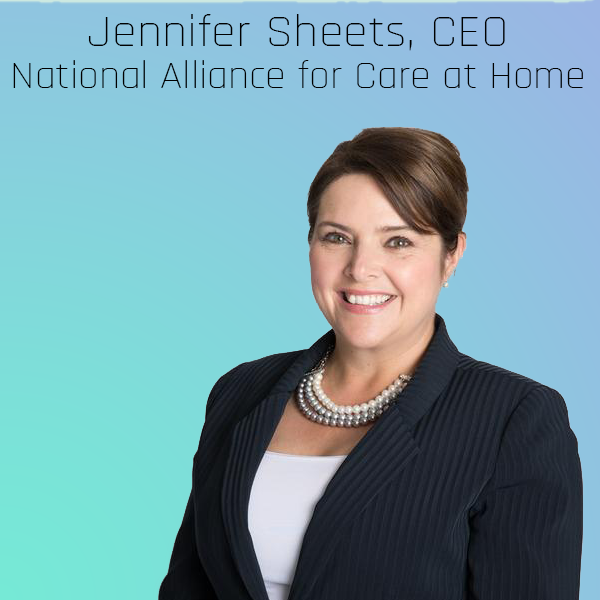
On february 17 2026, Jennifer Sheets will take the role of CEO at the Alliance. Sheets has worn multiple healthcare hats including intensive care nurse, hospital system CEO, merger & acquisition executive in private equity, senior clinical operations at Bayada, and AI technology founder. According to her LinkedIn statement, Sheets will remain at her role as Founder and CEO of her AI software company “throughout this transition.”

We have reached out to the Alliance to schedule an interview with Sheets.

Jennifer Sheets, CEO, National Alliance for Care at Home

# # #

Kristin Rowan Editor The Rowan Report

Kristin Rowan is the owner and Editor-in-chief of The Rowan Report, the industry’s most trusted source for care at home news. She is also a sought-after speaker on Artificial Intelligence, Technology Adoption and Lone Worker Safety. She is available to speak at state and national conferences as well as software user-group meetings.

Kristin also runs Girard Marketing Group, a multi-faceted boutique marketing firm specializing in content creation, social media management, and event marketing. She works with care at home software providers to create dynamic content that increases conversions for direct e-mail, social media, and websites.  Connect with Kristin directly at kristin@girardmarketinggroup.com or www.girardmarketinggroup.com

©2026 by The Rowan Report, Peoria, AZ. All rights reserved. This article originally appeared in The Rowan Report. One copy may be printed for personal use: further reproduction by permission only. editor@therowanreport.com


MedPAC Finalizes Recommendation to CMS

Advocacy

by Kristin Rowan, Editor

MedPAC Recommends 7% Cut

Vote Finalized

In December, MedPAC published a proposed recommendation for calendar year 2027 that included a 7% cut to home health reimbursement rates and no increase for hospice. Last week, MedPAC voted to finalize that recommendation and send it to CMS. 

Industry Objection

Both the proposal and final recommendation met with strong industry backlash.

“MedPAC’s dangerous and misguided recommendations to reduce the Medicare home health base payment rate by 7% for CY 2027 and eliminate the update to the 2026 Medicare base payment rate for hospice do not reflect both home health and hospice agencies’ operating realities as well as the cumulative impact of recent policy changes. For home health agencies, any cut – let alone one of such great magnitude – will threaten the ability to meet individuals’ healthcare needs. Yet again, the Commission is failing to understand the operating reality providers face and the potential patient harm that any further payment cuts pose.”

Dr. Steve Landers

CEO, National Alliance for Care at Home

Consistently Wrong

The MedPAC recommendation may not be built on solid data, use accurate calculations, consider Medicare Advantage and Medicaid rates along with Traditional Medicare FFS, consider the number of agencies that will go out of business, have any recommendations for maintaining nurse and caregiver hourly rates, or fairly distribute Medicare funds across disciplines, but, wait…where was I going with this? Oh, right! At least they’re consistent. MedPAC recommended a 7% decrease in Medicare payments for 2027, 2026, 2025, 2024, and 2023. They may be completely wrong, but they are dedicated to maintaining their wrongness.

Final Thoughts

Despite the years of 7% cut recommendations from MedPAC, the final numbers from CMS are rarely in line with those recommendations. We will, of course, know more when CMS publishes their proposal later this year. LeadingAge, National Association for Care at Home, individual and corporate HHAs and Hospices, and anyone else with a stake in the care at home industry, should contact their congressional representatives and CMS directly to voice concerns over these cuts.

# # #

Kristin Rowan Editor The Rowan Report

Kristin Rowan is the owner and Editor-in-chief of The Rowan Report, the industry’s most trusted source for care at home news. She is also a sought-after speaker on Artificial Intelligence, Technology Adoption and Lone Worker Safety. She is available to speak at state and national conferences as well as software user-group meetings.

Kristin also runs Girard Marketing Group, a multi-faceted boutique marketing firm specializing in content creation, social media management, and event marketing. She works with care at home software providers to create dynamic content that increases conversions for direct e-mail, social media, and websites.  Connect with Kristin directly at kristin@girardmarketinggroup.com or www.girardmarketinggroup.com

©2026 by The Rowan Report, Peoria, AZ. All rights reserved. This article originally appeared in The Rowan Report. One copy may be printed for personal use: further reproduction by permission only. editor@therowanreport.com


Purpose-Built AI for Care at Home

Artificial Intelligence

by Isaac Greszes, Eleos

Purpose-Built AI for Care at Home

How Care at Home leaders can move beyond AI pilots

Care at Home is increasingly turning to AI to address documentation burden, clinician burnout, and regulatory pressure. While AI has the potential to address these issues and more, practical results remain uneven, leaving agencies with a lot of experimentation, but little clarity on actual value.

Evaluating AI solutions should focus on real-world outcomes, how the solution fits into your existing workflow, whether the software is scalable, and how it handles changing regulations. You should also look for AI solutions that are built for care at home (purpose-built). This series of articles will help you make informed, risk-aware decisions about AI adoption.

AI is Coming Fast

Home health and hospice leaders are navigating a difficult balance: persistent workforce shortages, rising provider burnout, expanding documentation requirements, and increasing regulatory scrutiny — all within thin operating margins.

At the same time, AI has moved quickly from experimental to strategic. Many organizations are now evaluating AI not just for productivity, but for operational and administrative efficiency, clinician experience, compliance readiness, and financial performance.

And the stakes are high

Early results across the market have been inconsistent. Some organizations report meaningful reductions in administrative burden and a clear return on investment. However, others struggle to find value after adoption. The difference often lies not in whether AI was adopted, but how it was designed, supported, and governed.

The pilot problem

As AI adoption accelerates, many organizations find themselves caught in extended pilot cycles — testing multiple tools without committing to the operational changes required for scale. While pilots can validate technical feasibility, they rarely provide the consistency or measurement discipline needed to demonstrate sustained ROI in regulated care at home environments.

Quality over Quantity

Why the right evidence matters

In today’s AI market, product demonstrations are easy to produce. Documented outcomes are not.

Executive leaders should expect vendors to demonstrate real-world impact, supported by customer data, third-party validation, or peer-reviewed research. Credible AI partners should be able to explain how their results translate to care at home — and where limitations exist. The challenge is not the lack of information from pilots, but the lack of evidence those pilots results can be reproduced, measured, and sustained, in a care at home setting.

Purpose-built AI Eleos

Objective Evidence that Matters

When evaluating AI platforms, leaders should look for evidence related to:

  • Documentation efficiency, such as reduced time per visit or faster note completion
  • Operational ROI, including quicker billing readiness or reduced rework
  • Compliance support, such as documentation completeness or audit preparedness
  • Provider experience, including reduced perceived administrative burden
  • Care outcomes, including patient engagement and satisfaction

AI solutions can impact efficiency and burnout. But, these outcomes are highly dependent on whether the solution was built for care at home, the quality of implementation, how easily it will integrate into your workflow, and governance. If a vendor cannot explain how results were achieved and whether they are reliable and repeatable outside the pilot, the vendor and the solution should be evaluated carefully.

General Purpose AI

And inconsistent results

Many AI tools marketed to healthcare organizations rely on general-purpose language models designed for tasks like summarization, chat, or content generation — not for producing structured clinical notes aligned to regulatory and reimbursement requirements.

Home health and hospice documentation often includes:

  • Clinical observations made in non-clinical environments
  • Structured requirements tied to reimbursement and regulation
  • Risk-sensitive language related to safety, decline, or end-of-life care
  • Significant variation across disciplines, visit types, and patient contexts

Where generic AI breaks down

In these settings, AI tools based on general-purpose language models introduce risks related to accuracy, hallucinations, bias, privacy, and workflow fit — because they were not designed to operate within structured clinical, regulatory, and reimbursement frameworks.

In practice, organizations report that the additional oversight required to validate or correct AI-generated output can reduce — or even negate — anticipated efficiency gains, limiting adoption and ROI. As a result, organizations often remain stuck in pilot mode — investing time and effort in validation without achieving the scale or consistency required for meaningful return.

The right question

When evaluating an AI solution, the right question is not whether the AI tool can record a conversation and translate it into notes or whether the tool can reduce documentation, but whether it can consistently support high-quality clinical documentation at scale without increading burden or creating compliance risks.

Purpose-Built AI

What it means and why it drives operational impact

In care at home environments, purpose-built AI should be evaluated less as a point solution and more as foundational infrastructure — one designed to support regulated clinical workflows consistently over time.

Many AI platforms label themselves as “purpose-built,” but leaders must look past marketing language to truly scrutinize the way the technology is designed and deployed. In regulated clinical environments, purpose-built AI typically incorporates:

  • Domain-specific clinical intelligence, informed by real documentation patterns
  • Provider involvement in defining structure, logic, and validation criteria
  • Structured outputs aligned to required note components, in addition to free-text summaries
  • Grounding mechanisms that reduce fabricated or misattributed content
  • Privacy-conscious data handling, with explicit limits on data retention and reuse
Purpose-built AI

Research consistently shows that providers prefer AI systems that function as collaborative tools — preserving human oversight while reducing administrative load — rather than fully automated systems that completely bypass clinical judgment. These characteristics directly affect whether AI improves documentation time, supports compliance workflows, and earns provider trust — all prerequisites for driving ROI.
These design choices are what allow AI systems to move beyond experimentation and begin delivering durable efficiency, compliance support, and clinician adoption at scale.

# # #

This article is part 1 in a 4-part series. Come back next week for “Scalability, Security, and Governance.”

About Eleos

At Eleos, we believe the path to better healthcare is paved with provider-focused technology. Our purpose-built AI platform streamlines documentation, simplifies compliance and surfaces deep care insights to drive better client outcomes. Created using real-world care sessions and fine-tuned by our in-house clinical experts, our AI tools are scientifically proven to reduce documentation time by more than 70% and boost client engagement by 2x. With Eleos, providers are free to focus less on administrative tasks and more on what got them into this field in the first place: caring for their clients.

©2026 by The Rowan Report, Peoria, AZ. All rights reserved. This article originally appeared in The Rowan Report. One copy may be printed for personal use: further reproduction by permission only. editor@therowanreport.com

Fraud and Abuse Compliance

Admin

by Elizabeth E. Hogue, Esq.

Fraud and Abuse Compliance

Why All Providers Should Have One

Providers may have heard or read about the importance of Fraud and Abuse Compliance Programs in their organizations. Despite the wealth of available information about Compliance Programs, many providers continue to express uncertainty about their value. 

Coincidentally, as we are preparing to publish this article, HHS publishes this report on the compliance audit of Guardian Home Care, LLC. 

Here are some of the questions providers often ask about Compliance Programs:

Why should we have a Fraud and Abuse Compliance Program?

First

The Office of Inspector General (OIG) of the U.S. Department of Health and Human Services (HHS) has clearly stated that all providers are now required to have current Compliance Programs that are fully implemented. 

Next

As a practical matter, when providers establish and maintain Compliance Programs, it clearly discourages regulators from pursuing allegations of fraud and abuse violations. Jody Hunt, formerly of the DOJ, says providers should create robust fraud and abuse compliance programs. Then providers can argue that they shouldn’t be liable for violations because their compliance programs demonstrate that they had no intent to commit fraud.

Technically speaking, the Federal Sentencing Guidelines make it clear that establishment and implementation of Compliance Programs is considered to be a mitigating factor. That is, if accusations of criminal conduct are made, the consequences may be substantially less severe as a result of a fully implemented Compliance Program.

Additionally

Providers with Compliance Programs are more likely to avoid fraud and abuse. This is because Programs routinely establish an obligation on the part of every employee to report possible instances of fraud and abuse and include training for all employees.

Compliance Programs may also help to prevent qui tam or so-called “whistleblower” lawsuits by private individuals, rather than by government enforcers, who believe that they have identified instances of fraud and abuse. There are significant incentives to bring these legal actions since “whistleblowers” receive a share of monies recovered as a result of their efforts. Some “whistleblowers” have received millions of dollars.  Compliance Programs make it clear that employees have an obligation to bring any potential fraud and abuse issues to the attention of their employers first.

Also…

The federal Affordable Care Act (ACA) requires providers to have Compliance Programs. In short, it’s the law!

Finally

The Deficit Reduction Act (DRA) requires providers who receive more than $5 million in monies from state Medicaid Programs per year to implement policies and procedures, provide education to employees and put information in their employee handbooks about fraud and abuse compliance. These requirements can be met through implementation of Fraud and Abuse Compliance Programs.

We don't receive reimbursement from the Medicare or Medicaid Programs.

Do we still need a Compliance Program?

Statutes and regulations governing fraud and abuse also apply to providers who receive payments from any federal and state healthcare programs, including Medicaid, Medicaid waiver and other federal and state health care programs, such as Tri-Care. Many private insurers have followed the federal government’s “lead” in terms of fraud and abuse enforcement.  So private duty providers must have compliance programs, too.

Should we just use the model guidance that is applicable to us?

We hear that the OIG has provided guidance for various segments of the healthcare industry regarding Compliance Programs. Specifically, the OIG has already published guidance for clinical laboratories, hospitals, home health agencies, skilled nursing facilities (SMFs), hospices, physicians’ practices, third-party billing companies and home medical equipment companies. The OIG will publish updated guidance for all providers, It has already done so for SNFs.

The answer is “No!” Guidance from the OIG is not a model Compliance Program. Guidance from the OIG consists of general guidelines and does not constitute a valid Compliance Program. In addition, the OIG has made it clear that Programs must be customized for each organization. 

Do we have to conduct internal audits first?

We have read that, before implementing Compliance Programs, providers must conduct expensive internal audits that can take many months to complete. Is this true?

While beginning the compliance process with an extensive internal audit is certainly one way to proceed, it is not the only viable way to work toward compliance. It is equally valid to begin with Compliance Programs that are customized for the organization that includes training for all employees about fraud and abuse and Compliance Programs. Then all staff members can subsequently participate in internal compliance activities, including audits, with a process in place to handle any issues that arise as a result of the audits.

We already have policies. Why do we need a Compliance Program too?

Compliance Programs are specific types of documents that routinely address issues that providers do not usually cover in internal policies and procedures. In addition, providers may not gain benefits under the Federal Sentencing Guidelines described in the first question above if there is no formal document called a Compliance Program.

We're accredited. Doesn't that mean we are in compliance?

On the contrary, Compliance Programs appropriately address potential fraud and abuse issues. They also include mechanisms for helping to ensure compliance such as processes for identification and correction of potential problems that are not addressed during the certification process. In other words, organizations may be accredited but fail to meet applicable compliance standards for fraud and abuse.

Will it help with investigations?

Will the fact that our organization has a Compliance Program make any difference with regard to the outcome of fraud and abuse investigations and the imposition of Corporate Integrity Agreements (CIA’s)? 

Yes, it may make a considerable difference based on statements from the OIG. If providers have Compliance Programs in place that are current and fully implemented, the OIG may be less aggressive in pursuing potential violations. When the OIG actually discovers problems with fraud and abuse in organizations, providers are usually asked to develop and implement a Corporate Integrity Agreement (CIA). The OIG often requires CIA’s to include a process for stringent monitoring by the OIG on a continuous basis. These monitoring activities can be extremely burdensome to providers in terms of both time and money. Providers with valid Compliance Programs are not necessarily asked to develop and implement CIA’s. 

Fraud and Abuse Compliance

Final Thoughts

Now is the time for all providers to recognize and act upon the need to establish and maintain Compliance Programs. “Working on it” is no longer good enough.

Elizabeth E. Hogue, Esq.

Elizabeth Hogue is an attorney in private practice with extensive experience in health care. She represents clients across the U.S., including professional associations, managed care providers, hospitals, long-term care facilities, home health agencies, durable medical equipment companies, and hospices.

©2025 Elizabeth E. Hogue, Esq. All rights reserved.

No portion of this material may be reproduced in any form without the advance written permission of the author.

©2025 by The Rowan Report, Peoria, AZ. All rights reserved. 

BREAKING NEWS: Home Health Final Rule

Breaking News

by Kristin Rowan, Editor

BREAKING NEWS

Home Health Final Rule

While most of us were still recovering from our Thanksgiving feast overload, CMS quietly released the CY 2026 Home Health Prospective Payment System Final Rule (HH Final Rule). In past years, CMS published the HH Final Rule on or about November 1. The HH Final Rule was delayed this year due to the government shutdown.

Payment & Policy Updates

The payment rate for 2026 will change based on multiple factors:

  • HH payment update of +2.4%
  • The final permanent rate adjustment of -0.9%
  • The final temporary adjustment of -2.7%
  • Fixed-dollar loss ratio for outlier payments update of -0.1%

The aggregated payment update for 2026 is a net decrease of 1.3%

Read the CMS Fact Sheet

Face-to-Face

The CARES Act allows Nurse Practitioners, Certified Nurse Specialists, and Physicians Assistants to order and certify eligibility for Medicare HH and establish a plan of care. CMS has updated face-to-face encounters to now allow NPs, CNSs, PAs and physicians to perform face-to-face encounters whether or not they were the certifying practitioner or one who cared for the patient prior to home health care.

Home Health VBPM

Effective in April 2026, the HHCAHPS survey will undergo changes. CMS is removing these three survey-based measures:

  • Care of Patients
  • Communications between Providers and Patients
  • Specific Care Issues

CMS is adding four measures to them measure set. These include three measures related to bathing and dressing and the Medicare Spending per Beneficiary setting measure. These changes also prompted alterations to the weights of each measure and measure category. 

The expanded model has built-in criteria for the removal of any quality measure. CMS is adding an additional criteria to the list of factors. Factor 9 reads that CMS may remove a quality measure if it is not feasible to implement the measure specificiations.

Medicare Provider Enrollment Revocation

Currently, any provider must enroll and be approved to become a Medicare provider. CMS has the authority to both approve and revoke provider Medicare enrollment. When CMS revokes a provider’s Medicare enrollment, the revocation is effective 30 days after CMS mails notification to the provider. In certain circumstances, CMS can revoke enrollment retroactively to the first date of non-compliance and consequently collect any money paid to that provider back to the retroactive date. CMS is adding to the allowable grounds for retroactive revocation.

  • If an enrolled physician or practitioner has not ordered or certified services for 12 consective months
  • If a beneficiary attests that a provider did not actually perform the services they billed

Additional Changes

CMS is recalibrating case-mix weights under PDGM and LUPA thresholds.

DMEPOS accreditation regulations will now require suppliers to be resurveyed and reaccredited annually. Additionally, CMS is increasing the amount and frequency of data accrediting organizations (AOs) submit, expanding their ability to monitor AOs, and strengthening their ability to address poorly performing AOs.

The DMEPOS Competitive Bidding Program will change, but we are still waiting for the finalized improvements. CMS will begin paying for all continuous glucose monitors and insulin infusion pumps.

Read the Final Rule and additional Documents

Final Thoughts

A decrease in pay of any amount is unfortunate. However, we applaud CMS for listening to the feedback. CMS stated, “…commenters raised concers that behavior change after CY 2022 might [attribute] to factors unrelated to…PDGM.” Changes since 2020 include the introduction of OASIS-E, the expansion of value-based purchasing, and the large increase in the percentage of Medicare Advantage enrollees.

Whatever the reason, The Rowan Report joins the National Alliance for Care at Home in commending CMS for adjusting its payment calculations. The permanent pay adjustment for 2026 is listed as the final adjustment, a positive for HH moving forward. The proposed rule issued mid-year had a net -6.4% decrease in payments for a net decrease of more than $1 billion dollars. The final rule payment adjustment has a net decrease of $220 million. Still a decrease, but much more palatable.

CMS will continue to assess the need for temporary payment adjustments for several more years. Additional adjustments (read decreases) to the payment rate will impact patient access to care. The Alliance will continue to advocate and educate members of Congress and HHS to lower or eliminate they reductions. Your advocacy and support is needed to ensure the future of Care at Home. The Rowan Report will continue to support the Alliance and other advocacy groups and share with you opportunities for advovacy.

# # #

Kristin Rowan, Editor

Kristin Rowan has been working at The Rowan Report since 2008. She is the owner and Editor-in-chief of The Rowan Report, the industry’s most trusted source for care at home news, and speaker on Artificial Intelligence and Lone Worker Safety and state and national conferences.

She also runs Girard Marketing Group, a multi-faceted boutique marketing firm specializing in content creation, social media management, and event marketing.  Connect with Kristin directly kristin@girardmarketinggroup.com or www.girardmarketinggroup.com

©2025 by The Rowan Report, Peoria, AZ. All rights reserved. This article originally appeared in The Rowan Report. One copy may be printed for personal use: further reproduction by permission only. editor@therowanreport.com


Dr. Steve Landers: an Interview

Advocacy

by Kristin Rowan, Editor

Dr. Steve Landers

An Interview from the Alliance Annual Meeting

On the heels of the inaugural National Alliance for Care at Home Annual Meeting & Expo, I sat down with Alliance CEO Dr. Steve Landers to talk about his feelings on the event, the current state of the industry, and the future of the Alliance.

In His Own Words

The Rowan Report:

We’re just about at the end of the first annual meeting since the merger of NHPCO and NAHC. What are your thoughts on how the event was received?

Dr. Steve Landers:

Yeah, it’s been great. You know, we have, we’ve had great attendance, and the energy has been good, and we’ve got diverse participation from people all throughout the care at home community from all over the country, and I think people learned a lot and got to spend time with friends and colleagues and do business. I’m feeling good about it.

RR: I assume you’ve learned alot and we’ll see some changes next year. Where will we be in 2026?

Steve: We’ll be in Washington, D.C. next fall. Also, our summer financial summit is still on the agenda. So, we’ll be in Boston and we’re hoping to see as many people out as possible.

Alliance Annual Meeting Review Steve Landers

Alliance Outlook 2026

RR: And your new board members, who start in January, were announced earlier. Sounds like you have some great people incoming next year. What is the focus for the organization in 2026?

Steve:

We are continuing to position ourselves as strong advocates in Washington for the issues that our members are facing. The whole board and team will be very much dug in and committed to putting the best possible effort forward on the big things that our members are facing from an advocacy standpoint. Of course, we want to continue to strengthen the member programming and the educational offerings. We are going to try to build on our partnership with the research institute for home care to try and add more research activities to the to the programming.

There are some things that we’re still not sure about how next year is going to look, because on the public policy front, we still have some kind of pending issues that we’re hoping get ironed out in a positive way. Depending on how the year wraps up, we could be very much still in a bit of a firefight, whether that’s the Medicare Home Health payment system, face to face certification access for hospice and home health services, or depending on if any type of Medicare Advantage legislation comes up. So there’s still a lot unknown about how the early year looks from an advocacy standpoint, but definitely, you know, with the existing board members and new board members and our team will be leading the way on those fronts.

Medicare Home Health Proposal

RR:

There are a lot of unknowns right now with the shutdown, the hospice carve out, and other issues we’re not really seeing any movement on. Is there any one unknown that is more challenging than others?

Steve: I think the most front and center issue is the Medicare Home Health payment proposal, because it was a terrible, misguided proposal that’s going to hurt lots of people, probably cost lives, cost the system more money, and so that’s definitely so visible and acute because it’s right with us.

If we see any more movement on this issue of hospice and Medicare Advantage that will certainly become more of an acute issue. We’re already taking it very seriously and are very actively and aggressively trying to push back that bad idea. 

And, of course, the longer this government shutdown, the more harm there is with things like access to telehealth, so that’s high on our mind. There are a lot of other issues we’re concerned about with the future of Medicaid HCBS and the business environment for private duty home care as well. So, the list is long.

Advocacy

RR: Very long, indeed. During the opening keynote you mentioned a call for advocacy from everyone in attendance. Specifically, you mentioned presenting “one voice.” Are there current issues that has the industry divided?

Steve: I think we’re doing a good job of keeping people together. I think there’s always a risk when people get passionate and are wanting to solve problems. If we accidentally are publicly going in different directions, that’s not productive. I wouldn’t highlit any specifics, but I think, in general, the more we can come togehter on various issues because our goals are the same. None of us want to see care at home get cut back and over regulated. Everyone involved in these issues care about the same things. But, in Washington, when attention spans are very short, you only have so much political capital so we make sure we’re pushing for the same things in those advocacy efforts.

RR: Have you gotten any indication of where CMS is landing on the final payment rule? Last I heard, they had thousands of comments and feedback on the major cut.

Final Rule

CMS home health final rule

Steve: They have received an incredible amount of comments. here have been meetings at all levels of the administration on these issues. We have outlined all of the aspects of this, from the access challenges to how cutting back home health is only going to lead to lead to higher overall expenses. We’ve given them a clear outline of the methodological flaws that they made in doing their calculations and their budget neutrality calculations. We’ve been very clear as well on where they have likely baked in data from pockets of fraud that are creating disadvantages for legitimate care providers in the way that the rate system comes out, So they have everything that they should need to reset these payments to where they should be based on the law. But, it’s a scary moment because they made this proposal in the first place, and at some point, somebody thought it was a good idea.

Keep Fighting

RR: What is the next step if the cuts happen?

Steve: If we don’t get what we’re hoping for, which is a real reset of these methodologies, then, the amount of teamwork and intense advocacy that’s going to have to happen to try to get Congress to fix this mistake is going to be enormous. And every one of us is going to have to put in whatever we can. Because, letting ourselves fall off of this type of cliff, letting patients and families fall off this kind of cliff, is just… it’s not… we’re gonna have to fight it every every step of the way. It’s just not right.

Commentary

The interview paused here. It was barely perceptible and nearly impossible to describe on paper. The depth of emotion conveyed in Dr. Landers’ words was palpable, sincere, and honest. In these few seconds, I was given the gift of insight on how completely Dr. Landers commits to this cause and how strong are his convictions. It was a powerful moment that I hope you all have the opportunity to witness.

Home Health Stabilization Act

RR: Both you and your predecessor, Bill Dombi, have talked about how devastating these cuts will be. Estimates of 50% of home health agencies closing, reduced access to care, loss of jobs for caregivers, and especially devastating to the patients. What if this doesn’t change? Obviously, it’s going to take everybody working together. But what’s the first step? Is there a plan?

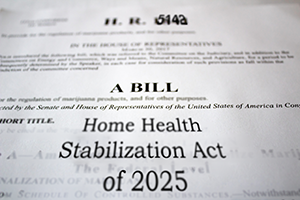
Steve: Oh, yeah, we’ve already been working with champions in Congress to introduce H.R. 5142 the Home Health Stabilization Act of 2025. If passed into law, would halt these cuts for 2026 and 2027 and allow time to work with Congress and the administration on more comprehensive, long term fix to this total mess that’s been developed by these flawed methods and give time to really work on comprehensive solutions to some of the fraud and abuse issues and potentially other reforms that could help. Now, anytime you’re trying to get an act of Congress passed, especially with a Congress that’s not open right now, with only so many days left in the legislative calendar, that’s no guarantee either, but that is the contingency that we’ve been developing.

Dr Steve Landers Interview

If they don’t fix their proposal, they’re going to march forward on January 1 with another set of cuts that are going to lead to more delays in care and more people getting referred and not getting care and more rural and high poverty communities not haveing access to care and more people going back to the hospital and costing the system more. There are life and death issues. Not just an inconvenience or a cost. People can die. It’s a big deal.

RR: I think the industry as a whole feels like CMS is only looking at the financial numbers and not the consequences of what theyre doing. There are real people who are being damaged by these decisions.

Steve: Yeah, the proposed rule did not seem to take these things into account and it was not a patient- or family-centered proposal. It’s not a final rule yet. Their final action is pending and they need to address those issues. They have a responsibility, I believe, as public servants. I believe there’s a moral obligation here to revisit what was done and get it right.

RR: And, we do have some advocates at the congressional level, correct?

Steve: Yeah, we’ve been working with members of Congress to get them to weigh in with the administration, to tell them “get your final rule right.” We have been working on a contigency that if the rule is not done correctly that Congress would force them through legislation to stop the cuts. We’re not there yet, but we could be any day now. We’ve done that work with Congress to make that progress. That amount of advocacy will require teamwork. This is one of the reasons I was trying to emphaze the importance of unity if we end up with a very short calendar and a really hard problem to solve. It’s going to be pretty intense.

RR: And we’ll be right there with you if that happens, saying “how can we help?” I know this is the most pressing issue right now, but is there anything else industry-wise that you’re looking forward to and excited about?

Future Outlook

Steve: You know, I think it’s been fun and exciting and in some ways inspiring to see this alliance community grow and build. Whether it’s all these new and innovative AI solutions that our members are getting excited about, how they can improve workflows and efficiences, or whether it’s the attention for the storytelling around the issues that our members care about on social media and earned media. There are a lot of reasons to be excited and enthusiastic about the future.

I think the AI advancements have been really exciting and interesting for the industry, because there’s so much that can be done. And certainly, regardless of how big the cuts are, any cuts are going to be difficult for home health, and especially on top of what we’ve already had, yeah, but, you know, you being able to use these AI solutions to kind of cut some of the costs and things and offset that is, is at least a silver lining in some of it, and improve the worker experience, maybe in ways that make it a little less burdensome, and you can maybe keep more people in the
workforce.

RR: Well, I want to congratulate you. You’ve made it through your firstfull year in thisposition. I think there was a sense of this event being the test, the “How did the two organizations really come together and produce this huge thing,” and, it seems likethe blending of the home health with the hospice has worked really. Attendance is high and the vibe seems to be very positive.

Steve: You know, there’s a test every day. We have to keep trying to serve our community, and it’s a journey. We’ve got a great board, and a great team. They’re focused on the mission. The team came together nicely after the merger. Now that it’s settling down, we’re just going to keep working towards a bright future. Just keep at it.

RR: I think you’ve handled it all really well and the success of this event is a testament to that, as well as the other education and advocacy you’ve accomplished in the last year. I appreciate you taking the time to talk to me today. Keep fighting the good fight. 

Steve: Absolutely. Thank you.

# # #

Kristin Rowan, Editor

Kristin Rowan has been working at The Rowan Report since 2008. She is the owner and Editor-in-chief of The Rowan Report, the industry’s most trusted source for care at home news, and speaker on Artificial Intelligence and Lone Worker Safety and state and national conferences.

She also runs Girard Marketing Group, a multi-faceted boutique marketing firm specializing in content creation, social media management, and event marketing.  Connect with Kristin directly kristin@girardmarketinggroup.com or www.girardmarketinggroup.com

©2025 by The Rowan Report, Peoria, AZ. All rights reserved. This article originally appeared in The Rowan Report. One copy may be printed for personal use: further reproduction by permission only. editor@therowanreport.com


Alliance to Congress: STOP CUTS

Advocacy

by Kristin Rowan, Editor

9% Cut Proposed

CMS proposed home health rule for 2026 includes disastrous cuts. A 3.2% market basket increase, a 0.8% productivity cut, a 5% reduction to recoup prior overpayments, and a 4.1% permanent reduction to prevent further overpayments. CMS proposed an additional 0.5% cut to account for high-risk outliers. In other words, CMS wants to pay less for all patients to make up for the small percentage of patients who need more care.

Deadline Looming

The mandatory comment period ended on August 29. Next, CMS reviews the submitted comments, responds to those comments (generally explaining why they are not going to listen), and then finalizes the 2026 rule. The final rule is due November 1, 2025. Although, that falls on a Saturday, so the deadline may extend to Monday. A good many of us will be in New Orleans for the Alliance annual conference and expo by then.

Group Effort

The National Alliance for Care at Home (Alliance) joined 150+ provider, patient, community, and advocacy groups to write a letter to Congress urging them to prevent the CMS proposed cut.

“The proposed payment reductions for home health pose a serious threat to the health and safety of Medicare beneficiaries and to the broader integrity of our healthcare system. With the 2026 payment rule under review and due by November 1, we urge you to promptly intervene and press CMS to stop the cuts and realign payments.”

Pattern of Payment Reduction

The letter, addressed to Senate Majority Leader John Thune, Senate Minority Leader Chuck Schumer, Speaker Mike Johnson, and House Minority Leader Hakeem Jeffries, asks Congress to look at the consecutive years of pay reductions and how they have impacted home health. Because of the cuts, agencies have gone out of business or downsized, leaving rural areas without care.

Home Health Costs Less

The letter also explains that cutting medicare payments actually costs more. When more patients have access to home health, CMS spends less on unplanned hospital visits and ER trips. Patients have fewer falls and accidents. Risk factors are identified earlier and preventative treatments are used before a patient’s condition requires hospitalization. Home health patients stay home years longer than those not receiving home health before entering a skilled nursing or assisted living facility. 

What's at Risk

The Medicare Trust Fund, funded partially by payroll taxes, includes hospital insurance that pays for hospital (Medicare Part A) services. When these costs increase, the trust fund is at risk being insolvent and taxes are increased to put money back into the fund. Lowering home health payment rates and cutting off millions of people who depend on home health will impact tax payers as well.

CMS home health payment cuts
“The cuts currently proposed to Medicare’s home health benefit are unsustainable and would be deeply harmful to those who depend on care at home. The Alliance will continue to work with policymakers and our stakeholder allies to oppose these harmful cuts and protect access to home health services for millions of older adults, individuals with disabilities, and their families.”
Dr. Steve Landers

CEO, National Alliance for Care at Home

The Alliance issued a press release with the highlights from the letter. You can read the full letter here.

# # #

Kristin Rowan, Editor
Kristin Rowan has been working at The Rowan Report since 2008. She is the owner and Editor-in-chief of The Rowan Report, the industry’s most trusted source for care at home news, and speaker on Artificial Intelligence and Lone Worker Safety and state and national conferences.

She also runs Girard Marketing Group, a multi-faceted boutique marketing firm specializing in content creation, social media management, and event marketing.  Connect with Kristin directly kristin@girardmarketinggroup.com or www.girardmarketinggroup.com

©2025 by The Rowan Report, Peoria, AZ. All rights reserved. This article originally appeared in The Rowan Report. One copy may be printed for personal use: further reproduction by permission only. editor@therowanreport.com