Workplace Violence in Home Health

Caregiver Safety

by Kristin Rowan, Editor

Workplace Violence and Policy Impact

Study of home health workers

A group of researchers from the University of Cincinnati, Ohio published a recent study¹ on the frequency and reporting procedures of workplace violence (WPV) in home healthcare. The study specifically addressed WPV in home healthcare, stating limited understanding of WPV in the home care setting. Most existing studies on WPV were hospital-based.

Frequency of Workplace Violence

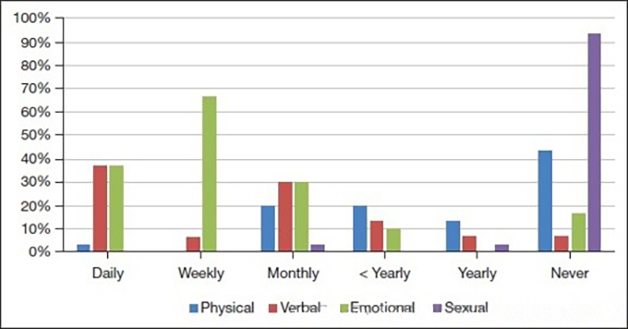
Of the home health care workers (HHCW) surveyed, almost 37% responded that they experience both verbal and emotional violence in the workplace daily. More than 80% reported experiencing verbal aggression at some point. Physical violence is less prominent. 20% of respondants said they experience physical violence monthly. However, 56.6% said they have experienced physical violence at some point in their current agency. 76.6% of the time, the perpetrators of the violence are the patients of the HHCW.

Workplace Violence

Fig. 1 Frequency of occurrence of physical, verbal, emotional, and sexual abuse as a function of time: daily, weekly, monthly, <yearly, yearly, and never.

Reporting Workplace Violence

All of the study participants indicated they had knowledge of workplace violence reporting procedures in their agencies, but 26.7% were unsure if the policies are contained in the employee handbook. 46.7% were uncertain as to whether the agency offered WPV or de-escalation training and 66% said prevention and de-escalation training was not mandatory. Unfortunately, 40% said their management did not encourage reporting and 33% said they were not comfortable approaching management about WPV. Despite the frequency of WPV among the respondents, none of the participants reported these incidents to management

Thoughts

According to this, and other research studies on workplace violence in home healthcare, the problem is prevalent and persistent. Most HHCWs have experienced some sort of aggression, violence, or abuse in the course of performing their jobs. Of those who have, most do not report the incidents to management. Most HHCWs have not been trained in prevention or de-escalation. Even with training, HHCWs need a way to get immediate help. Unfortunately, most do not have an emergency alert system on their person during home visits.

    Solution

    Care at Home agencies, including non-medical supportive care, home health, hospice, and any other lone workers who are visiting patients in their homes, need safety policies and procedures. Agencies must include the same in the employee handbook, explain during orientation, and make available to HHCWs digitally. 

      Policies and procedures should include:

      • A safety committee comprised of management, back office staff, and field workers
      • A clearly written policy regarding physical, emotional, verbal, and sexual abuse
        • Against a patient or their family/friends by a HHCW
        • Against a HHCW by a patient or their family/friends
        • Against a HHCW by a colleague or manager
        • Against a HHCW by the environment in which they work (i.e. aggressive pets, weapons, cigarette smoking indoors, etc.)
      • A digital reporting system that employees can use without having to approach management individually
      • A clearly written policy on the management response to violence reporting
      • A clearly written policy forbidding any retaliation or discrimination against a reporting employee
      • Required research about new patients including
        • Background/History of violence and/or mental instability
        • Neighborhood safety rating
        • Family members likely to be in the home and their history of violence and/or mental instability

      Additional Tools for HHCWs

      • Training in
        • Violence prevention
        • De-escalation
        • Situational Awareness
        • Self-defense
      • A mandatory, GPS-enabled, multi-function safety device and platform to proactively manage caregiver safety and respond to incidents
      • Optional escort service for new patients
      • Mandatory escort service for new patients with a history of violence, mental issues, or incarceration

      Workplace violence against HHCWs is not “if,” but “when.” It is the responsibility of the agencies to lower the risk, lower the percentage of “whens,” and encourage reporting. If you’re not sure how to begin, hire a consultant to help you build your safety committee and write your policies. It doesn’t matter how you start implementing safety protocols, as long as you follow through and protect your employees.

      # # #

      Kristin Rowan, Editor, The Rowan Report
      Kristin Rowan, Editor

      Kristin Rowan has been working at The Rowan Report since 2008. She is the owner and Editor-in-chief of The Rowan Report, the industry’s most trusted source for care at home news, and speaker on Artificial Intelligence and Lone Worker Safety and state and national conferences.

      She also runs Girard Marketing Group, a multi-faceted boutique marketing firm specializing in content creation, social media management, and event marketing.  Connect with Kristin directly kristin@girardmarketinggroup.com or www.girardmarketinggroup.com

      ©2025 by The Rowan Report, Peoria, AZ. All rights reserved. This article originally appeared in The Rowan Report. One copy may be printed for personal use: further reproduction by permission only. editor@therowanreport.com

       

      1. Obariase, E.; Bellacov, R.; Gillespie, G.; Davis, K. (2025). Assessing Workplace Violence and Policy Impact: A Cross-sectional Study of Home Healthcare Workers. Home Healthcare Now, 43(3), 150-156. doi: 10.1097/NHH.0000000000001345

      Painting Pictures

      Admin

      by Elizabeth E. Hogue, Esq.

      "Painting Pictures" of Patients

      Painting Pictures in clinical documentation to achieve positive audit results. As the fight against “fraud, abuse and waste” continues, responding to audits has become an ongoing burden for many providers. Providers have repeatedly been urged to “paint a picture” of patients in clinical documentation in order to help achieve positive results. “Painting a picture” of the patient, however, may have become more difficult as the use of electronic health records (EHRs) has increased. That is, it’s difficult to adequately describe patients’ conditions when there are so many boxes to check and blanks to fill in.

      Copy, Paste, Repeat

      When it comes to narrative descriptions of patients’ conditions, it is extremely tempting to “copy and paste,” “cut and paste” and/or “copy forward” previous documentation in the EHR. The copy and paste feature allows users to use the content of another entry and to select information from an original or previous source to reproduce in another location. The copy forward capability replicates all or some information from a previous note to a current note, while the cut and paste feature removes documentation from the original location and places it in another location. In addition to the obvious potential problems for quality of care related to the use of these functions, auditors are understandably skeptical of documentation that repeats itself throughout patients’ medical records.

      Painting Pictures of Fraud

      Auditors are especially likely to deny claims that include documentation that was obviously copied using the above functions, when the information copied “sticks out like a sore thumb.” If hospice staff document, for example, that “the patient eats a lot of Mexican food” over and over in clinicians’ visit notes, auditors are understandably skeptical about whether services were necessary for a hospice patient who seems to have a continuous robust appetite or whether services were, in fact, rendered.

      How to Paint the Picture

      What does it mean to “paint a picture?” If a home health patient needs wound care or injections of medications, for example, the “picture” must account for why patients or their caregivers are not performing these activities themselves. Clinicians need to describe the following in a “picture” of the patient:

      • Does the patient live alone or have caregivers?
      • Why can’t patients do wound care or self-inject medications
      • Why can’t caregivers perform these activities?
      • What attempts did clinicians make to assist patients and caregivers to provide wound care and injections?
      • Why were these attempts unsuccessful?
      • What attempts were made to find other caregivers – either paid or voluntary – who might provide these types of care?
      • What were the results of these attempts to find other caregivers?
      • Despite the initial inability of patients and caregivers to render this care themselves, what efforts did clinicians make to help ensure that they became able to do so?
      Painting Pictures

      Get the Picture?

      It’s difficult, if not impossible, to paint the above picture using only the boxes and blanks of forms in EHRs. More is needed if providers are serious about positive audit results.

      # # #

      Elizabeth E. Hogue, Esq.
      Elizabeth E. Hogue, Esq.

      Elizabeth Hogue is an attorney in private practice with extensive experience in health care. She represents clients across the U.S., including professional associations, managed care providers, hospitals, long-term care facilities, home health agencies, durable medical equipment companies, and hospices.

      ©2025 Elizabeth E. Hogue, Esq. All rights reserved.

      No portion of this material may be reproduced in any form without the advance written permission of the author.

      ©2025 by The Rowan Report, Peoria, AZ. All rights reserved. This article originally appeared in The Rowan Report. One copy may be printed for personal use: further reproduction by permission only. editor@therowanreport.com

      AI in Home Care

      Artificial Intelligence

      by Laurie Orlov, Founder, Aging and Health Technology Watch

      The Future of AI in Home Care

      New Research Report

      Wed, 06/04/2025

      PORT SAINT LUCIE, FL, UNITED STATES, June 4, 2025 /EINPresswire.com/ — The home care industry is facing a crisis. Driven by demographic shifts, longer life expectancy, and rising rates of chronic illness and cognitive decline, the demand for in-home personal care and home health care is surging. This will accelerate as the baby boomers age into their later years – in January, the oldest of the 76 million baby boomers will turn 80. At the same time, the care industries will face a critical shortage of all categories of care delivery, with millions of additional workers needed over the next decade. Against this backdrop, AI technology has emerged to help older adults in multiple ways. In a 2023 report, The Future of AI and Older Adults, AI was already able to produce insights about a person’s health needs and offer a chatbot to help with post-hospital care. In a subsequent 2023 report, AI and the Future of Care Work, it was apparent that AI could help generate an appropriate care plan and that an ‘AI Caregiver’ role was emerging to supplement in-person care delivery. In the 2024 report, The Future of AI in Senior Living and Care, AI was being used to analyze hospital discharge information to compare patient needs to nursing home capacity. 

      Today there are many more initiatives and new possibilities for addressing multiple aspects of both private duty home care and home health operations, including assistance with recruiting and onboarding workers, using data to create and update care-related documents, and introducing AI agents that can be assigned to complete specific tasks. As current industry leaders note, AI tech is playing a role in care oversight and enabling the creating of hybrid models – an increasingly likely combination of in-person care supplemented with AI.

      This report draws insights from experts across home care, home health care, plus software and device providers, and healthcare sectors to examine how AI is currently being used and suggest what lies ahead within the next five years.

      The report can be found at this link: https://www.ageinplacetech.com/page/future-ai-home-care

      # # #

      Laurie Orlov The Future of AI in Home Care
      Laurie Orlov The Future of AI in Home Care

      Laurie M. Orlov, a tech industry veteran, writer, speaker, elder care advocate, is the founder of Aging and Health Technology Watch  market research, trends, blogs and reports that provide thought leadership, analysis and guidance about health and aging-related technologies and services that enable boomers and seniors to sustain and improve their quality of life. In her previous career, Laurie spent many years in the technology industry, including 9 years at analyst firm Forrester Research. She has spoken regularly and delivered keynote speeches at forums, industry consortia, conferences, and symposia, most recently on the business of technology for boomers and seniors. She advises large organizations as well as non-profits and entrepreneurs about trends and opportunities in the age-related technology market.  Her perspectives have been quoted in the Wall Street Journal, the New York Times, Vox, Senior Housing News, CNN Health, AARP Bulletin and Consumer Reports. She has a graduate certification in Geriatric Care Management from the University of Florida and a BA in Music from the University of Rochester. Laurie has provided testimony about technology at a Senate Aging Committee hearing and has consulted to AARP.  Advisory clients have included AARP, AOL, Argentum, Bose, Calix, CDW, Microsoft, Novartis, and Philips. Her reports include: The Market Overview Technology for Aging 2025The Future of AI in Senior Living and CareThe User Experience Needs An Upgrade 2024The Future of AI and Older and Older Adults 2023The Future of Care Work and Older Adults 2023The Future of Sensors and Older Adults 2022Beyond DIY: The Future of Smart Homes and Older Adults 2021, and The Future of Wearables and Older Adults 2021. Laurie has been named one of the Women Leaders in VoiceTop 50 Influencers in Aging by Next Avenue and one of the Women leading global innovation on AgeTech. 

      ©2025 by Aging and Health Technology Watch. All rights reserved. This introduction and link are printed with permission from the author. For more information or to request usage rights, please contact Laurie Orlov

      BREAKING NEWS: Intrepid USA Files Bankruptcy

      Breaking News

      by Kristin Rowan, Editor

      *Editor’s note: This article has been updated to remove inaccurate information from the Intrepid USA website.

      Intrepid USA Files Bankruptcy

      Intrepid USA, once among the largest providers of home health and hospice services, files bankruptcy in Texas. With more than $90 million in revenue in 2023, Intrepid operated more than 60 home health and hospice locations in 17 states. The Chapter 7 filing leaves no road to recovery. Chapter 7 allows the company to liquidate assets and distribute the proceeds. According to the Texas Southern Bankruptcy Court, Intrepid USA filed a voluntary petition for Chapter 7 bankruptcy on May 29, 2025.

      Troubled History Plagues Company

      Intrepid USA has a troubled past that it seems may have caught up with them. The U.S. Department of Justice (DoJ) alleges that between 2016 and 2021, Intrepid home healthcare agencies engaged in fraud. In violation of the False Claims Act, Intrepid filed Medicare claims for patients who did not qualify for home health, services that were not medically necessary, services provided by untrained staff, and services that were never provided. In August, 2024, Intrepid agreed to pay $3.85 million to resolve the allegations. The allegations were brought to the DoJ by two former employees of Intrepid under whistleblower provisions.

      This is not the first DoJ lawsuit against Intrepid USA. In 2006, when Intrepid owned 150 agencies across the country, the company entered into an $8 million settlement agreement to resolve similar allegations. The DoJ alleged that from 1997 to 2004 Intrepid violated the False Claims Act by billing Medicare and TRICARE for services not provided by a qualified person, failing to maintain complete documentation for its claims, and other violations of Medicare regulations. Additionally, the DoJ alleged that Intrepid, in 2002 and 2003, fraudulently billed Medicaid for home care services provided to patients who were hospitalized at the time of the supposed care.

      Private Equity Backing

      Sometime around Q3 of 2006, Intrepid USA received financial backing from Patriarch Partners, led by Lynn Tilton. In August of 2020, Patriarch filed a notice of removal with the Supreme Court of New York. In 2021, Intrepid announced it was gearing up for rapid growth fueled by new private equity investors. Then CEO John Kunysz indicated the infusion of capital would fund opportunities for growth through acquisition.

      Divest, not Acquire

      Despite the influx of capital and the plan to grow through acquisition, by 2024, Intrepid was selling its assets. In August of 2024, Humana acquired 30 Intrepid branch locations and rebranded them under the CenterWell Home Health brand. The sale was part of Patriarch Partners’s Zohar Funds bankruptcy case. In November of 2024, New Day Healthcare acquired Intrepid’s hospice locations in Missouri and Texas.

      $0 Revenue; 0 Value

      The bankruptcy filing shows that Intrepid USA had $90 million in revenue in 2023, $50 million in revenue in 2024, and $0 in revenue so far in 2025. Chapter 7 bankruptcy is usually supervised by the court, allowing the filing company to sell assets without having to use the revenue generated by the sale to pay off debts. Intrepid listed $1 to $10 million in assets and $88 million in debts at the time of the filing. 

      Intrepid USA files bankruptcy
      Intrepid USA Files Chapter 7 Bankruptcy

      Who will take the loss?

      The Intrepid USA website still lists 55 active home health and hospice locations in 11 states. However, 30 of those locations are now listed on the CenterWell website and at least 5 other locations were part of the sale to New Day Healthcare. It is unknown if Intrepid has any locations still in operation. The company did not respond to our request for a statement.

      The website also has a list of partners and investors. The Rowan Report reached out to the partners with whom we are familiar for more information. We will provide updates from them once we reach them.

      Final Thoughts

      The recent divestiture of home health and hospice locations to New Day and CenterWell will hopefully minimize the number of patients who are losing their home health or hospice provider. Millions of dollars in future fraudulent claims will remain in the Medicare, TRICARE, and Medicaid coffers. Conversely, the partners and investors in Intrepid USA may face some loss. We will provide any important updates and comments from the impacted companies as available.

      # # #

      Kristin Rowan, Editor
      Kristin Rowan, Editor

      Kristin Rowan has been working at The Rowan Report since 2008. She is the owner and Editor-in-chief of The Rowan Report, the industry’s most trusted source for care at home news, and speaker on Artificial Intelligence and Lone Worker Safety and state and national conferences.

      She also runs Girard Marketing Group, a multi-faceted boutique marketing firm specializing in content creation, social media management, and event marketing.  Connect with Kristin directly kristin@girardmarketinggroup.com or www.girardmarketinggroup.com

      ©2025 by The Rowan Report, Peoria, AZ. All rights reserved. This article originally appeared in The Rowan Report. One copy may be printed for personal use: further reproduction by permission only. editor@therowanreport.com