Fractional Home Care

by Tim Rowan, Editor Emeritus

Solve Nagging Problems; Raise Revenue

Along with the rest of the Private Pay sector, Jessica Nobles’ Eastern Tennessee agency was struggling with caregiver recruitment and retention. Finding good people is less than half the battle. To keep them, you have to pay a competitive wage and provide enough hours to ensure that wage translates into an attractive and predictable monthly income. We spoke with Jennifer, Founder of Home Care Ops, last week to learn one of her solutions.

Fractional Home Care

What Nobles calls “Fractional Home Care” is providing services in a senior living community with one or more caregivers stationed on site. Residents pay a membership fee or pre-purchase a package of hours. The agency is thus guaranteed a small revenue base and clients are free to request services for a few minutes or a few hours on an as-needed basis.

“Our caregivers love this arrangement because it virtually guarantees them full-time pay. They remain on site at the facility for a contracted shift, which can be their choice of daytime or night hours. If demand warrants it, we will assign more than one caregiver at a time.”

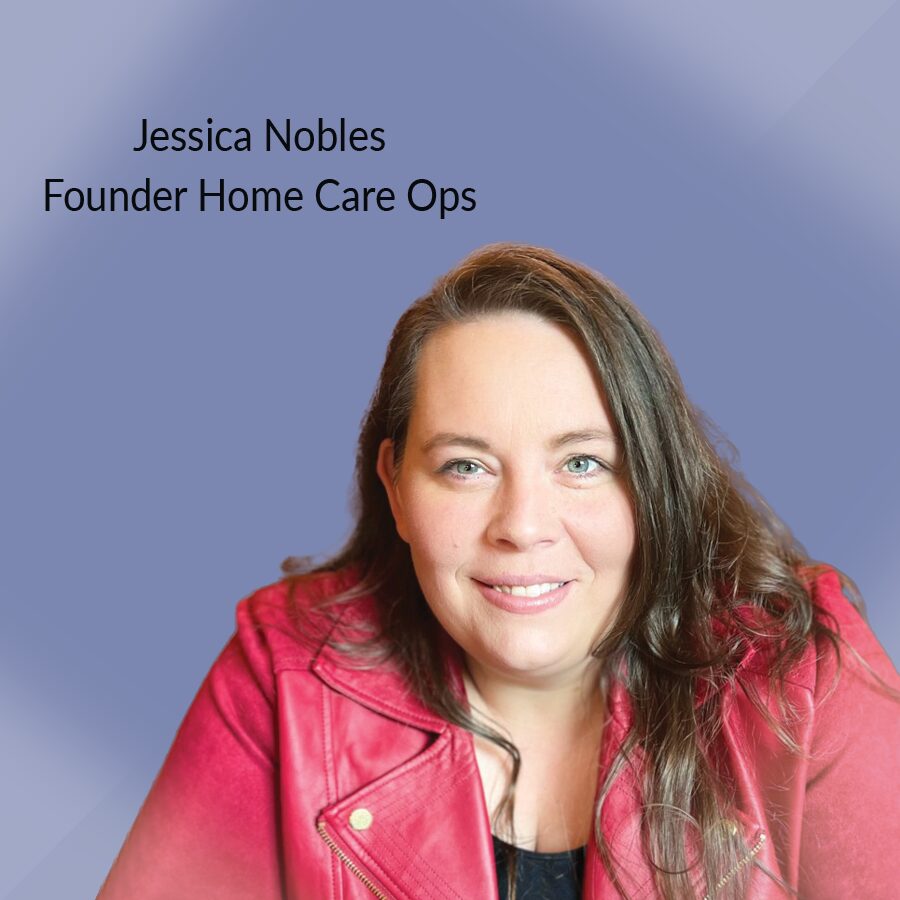
Jessica Nobles

Founder, Home Care Ops

She added that the advantage to the agency is that nearly all of a caregiver’s day is paid hours. There are no mileage reimbursements and no paying for travel time or idle time. “Think of it as a co-op,” she continued. Ten clients can share one caregiver. They get all the care they need and our caregivers are earning for their entire day.”

The benefit accrues to independent living communities as well. Their arrangement with an outside Home Care agency means they no longer have the burden of hiring and retaining a caregiving staff of their own and their residents get better care. The residents pay for the services, not the facility, and they have the option of using the on-site caregivers as needed or through the pre-purchase plan of a block of ten or twenty 15-minute units.

A Typical Scenario

Jessica offered an example of how Fractional Home Care often works. An Assisted Living Facility resident lives independently but occasionally needs help with showers, or help getting to and from the community center, etc. In a typical home care setting, that person would have to bring in a caregiver for four, six, or eight hours, though less than an hour is needed. The family speaks with the onsite agency to arrange for the specific help needed, whether it is a few minutes

Fractional Home Care ALF

every other day or an hour every day. The agency offers a membership at flat fee and both parties get exactly what they need. The caregiver is available to add other residents to his or her schedule, making it possible to achieve a 40-hour work week.

“Some patients might need traditional daily care as they might get from any other agency,” Jessica explained. “They can contract for that for around $1,600 per month. Our caregiver can come multiple times a day since there are no drive time concerns.” She said that not every client needs a membership program. Some prefer pre-sold units, perhaps buying five 15-minute visits in advance. “They never have to pay for down time. Our caregivers never sit idle should their work be done before their shift is up.” 

Jessica Nobles Fractional Home Care

Fractional Home Care Improves Agency Reputation

Jessica has found that her agencies have earned a reputation for such excellent care that they have occasionally replaced franchise home care organizations locally that have national contracts with national ALFs. Some of these facilities have been dissatisfied with the care they were getting with their national organization’s contracted agency. When this happens, they seek a local agency to replace them. Jessica has seen this several times when the franchise was not staying on site.

“We explain our fractional model, with someone on site at specified times when at least three residents have signed on, and one caregiver per 10 clients. The more clients who sign up, the more caregivers we station at the facility. This leads to an additional benefit for the ALF. This level of service delays the day the family decides to move Mom from their community to a nursing facility.”

Fractional Home Care has been so successful, the word spread to other residential communities. Nobles’ company had had to turn some away. When that happened, she and her partner and husband began to teach the system to other agencies.

There was one obstacle, she admits. There were no Agency Management Software systems that could be adapted to the fractional way of providing care. She and her team finally created their own…right before she found one on the market that met their needs. Jessica introduced us to Tim and Gina Murray, co-founders of Cinch CCM. Jessica recommends Cinch CCM to fractional home care agencies. We have scheduled a demo and will have a review in the near future.

# # #

About Jessica Nobles

With over a decade of Private Duty Home Care leadership and knowledge, Jessica Nobles worked her way up through every position from Caregiver, Operations Coordinator, Franchise Developer, and Independent Agency Owner. As the founder and operator of Nobility Care Solutions, she grew her revenue to six figures within the first year of business through grassroots marketing, creative community engagements, and referral partnerships. She is also the Executive Administrator for Home Care Ops where she coaches, consults, and empowers other home care owners and operators to create operational systems and strategies that build lasting business success and consistently increases revenue.

Tim Rowan, Editor Emeritus

Tim Rowan is a 30-year home care technology consultant who co-founded and served as Editor and principal writer of this publication for 25 years. He continues to occasionally contribute news and analysis articles under The Rowan Report’s new ownership. He also continues to work part-time as a Home Care recruiting and retention consultant. More information: RowanResources.com
Tim@RowanResources.com

©2024 by The Rowan Report, Peoria, AZ. All rights reserved. This article originally appeared in Healthcare at Home: The Rowan Report. One copy may be printed for personal use: further reproduction by permission only. editor@therowanreport.com

Federal Regulations for Adult Protective Services

by Elizabeth E. Hogue, Esq.

Dept of Health & Human Services Final Rule

On May 7, 2024, the U.S. Department of Health and Human Services (HHS) issued a final rule establishing the first federal regulations for Adult Protective Services (APS). The regulations took effect on June 7, 2024. The entire rule is at https://acl.gov/apsrule.

One goal of the new regulations is to promote high quality APS that better meet the needs of adults who experience or are at risk of maltreatment and self-neglect. Another goal is to improve consistency in services among the states. 

APS services have historically been funded by state and local governments. There has been wide variation in APS services and practices between and even within states. New regulations, along with recent funding from HHS to state APS programs, now make it possible to improve consistency.

Adult Protective Services

The APS final rule:

    • Establishes a set of national minimum standards for the operation of APS programs that all state APS systems meet
    • Requires APS systems to ensure that planning and delivery of all services respect the fundamental right of adults to make their own life choices and that services are driven by the person receiving them
    • Establishes stronger protections for clients subject to, or at risk of, guardianship. Specifically, APS must consider guardianship only when there are not alternatives.
    • Requires responses within 24 hours of screening cases that are life-threatening or likely to cause irreparable harm or significant loss of income, assets, or resources
    • Requires APS to provide at least two ways, at least one of which must be online, to report maltreatment or self-neglect 24 hours per day, seven days per week
    • Requires robust conflict of interest policies to support ethical APS practice
    • Establishes definitions for key APS terms to improve information sharing, data collection, and program standardization
    • Promotes coordination and collaboration with state Medicaid agencies, long-term care ombudsmen, tribal APS, law enforcement, and other partners.

The Need for Adult Protective Services

Adult Protective Services

HHS points out that at least one in ten older adults who live in communities experience some form of maltreatment each year.

All providers have been involved in situations in which adult protective services are needed. Case managers/discharge planners in hospitals and long-term care facilities are especially likely to encounter and to be expected to assist with situations involving APS.

Providers of services to patients in their homes; including home health agencies, hospices, home medical equipment (HME) companies, and home care or private duty companies; are on the “front lines” with regard to identifying situations in which APS is needed. At least anecdotally, however, providers have received very little assistance and support from APS in situations of abuse and neglect.

Hopefully, providers can look forward to greater assistance in view of enhanced funding and standards.

# # #

Elizabeth E. Hogue, Esq.

Elizabeth Hogue is an attorney in private practice with extensive experience in health care. She represents clients across the U.S., including professional associations, managed care providers, hospitals, long-term care facilities, home health agencies, durable medical equipment companies, and hospices.

©2024 Elizabeth E. Hogue, Esq. All rights reserved.

No portion of this material may be reproduced in any form without the advance written permission of the author.