Update: CMS Response to Arizona Hospice

by Tim Rowan, Editor Emeritus

Update: CMS Sides with NGS in Arizona Hospice Case

Letter Says "Typos Count"

We are sad to have to report that CMS has rejected the evidence that a hospice’s report of change of ownership was due to a typo. The consultant retained to help with their appeal received this letter.

The CMS Letter

Thank you for your email. Based on our review, we do not see any issues with the revocation decision. The provider did file a reconsideration, and on May 6, 2026, we issued a decision upholding the 42 C.F.R. § 424.535(a)(8)(ii) revocation. Their main argument is that there was no change in ownership and, as a result, they should not have been subject to PPEO. However, the applications submitted by the provider clearly reflected 100% changes in ownership. In addition, the provider had an 80% PPEO claim denial rate, and none of these denials were overturned on claim appeal. Please note that the provider filed an appeal with the ALJ on June 18th. Given that the case is pending, we should not take any other action until the appeal has concluded.

Best Regards,

Anaga Nmagu, JD.
Director, Division of Provider Enrollment Appeals
Provider Enrollment & Oversight Group
Center for Program Integrity
Centers for Medicare & Medicaid Services
Office: (410) 786-4690
Email: anaga.nmagu1@cms.hhs.gov

Hospice Arizona NGS

Home Health and Hospice Respond

The more stories we can collect about CMS contractors overstepping their authority, improperly denying claims, up to and including putting honest providers out of business, the more convincing we will be when we confront the perpetrators. We urge you to tell us your stories. We will never publish your name.

If you, a client, or someone you know has stories about CMS contractors, please reach out to editor@therowanreport.com or tim@rowanresources.com

# # #

Tim Rowan The Rowan Report

Tim Rowan is a 33-year home care technology consultant who co-founded and served as Editor and principal writer of this publication for 25 years. He continues to occasionally contribute news and analysis articles under The Rowan Report’s new ownership. He also continues to work part-time as a Home Care recruiting and retention consultant. More information: RowanResources.com
Tim@RowanResources.com

©2026 by The Rowan Report, Peoria, AZ. All rights reserved. This article originally appeared in The Rowan Report. One copy may be printed for personal use: further reproduction by permission only. editor@therowanreport.com


Healthcare Workers May be Deported

by Tim Rowan, Editor Emeritus
Author’s note: This analysis does not address the right and wrong of  legal asylum status, but will focus only on the impact of deporting tens of thousands of healthcare workers.

Thousands of Healthcare Workers Could be Deported

Florida Will Be Hit Hardest

Denise Bellville is alarmed by looming unintended consequences of this administration’s border protection policy. The Executive Director of the Home Care Association of Florida has good reason. She estimates that 35,000 Haitians work in healthcare in her state, a full third of the U.S. total. Some are in-home caregivers; a few are home care agency owners.

As of last week, all are at risk of being sent back. Temporary Protected Status, given to asylum applicants from dangerous countries, has been canceled for immigrants from specific countries. Among them are 353,000 Haitians, along with applicants from eight other countries. The Supreme Court is yet to rule on four more nations named in the DHS removal request.

“Broward County is one of about six counties that will be hit especially hard and have already begun to feel the effects of the July 24 SCOTUS decision,” she told us. “Two [agencies] there have already closed. One determined that 85 of its 86 caregivers are vulnerable for deportation. The other said that Creole-speaking clients made up 80 percent of its business.”

When the Department of Homeland Security announced Termination of Temporary Protected Status for Haiti,” the order included a little more than 353,000 Haitian asylum applicants, more than 112,000 of whom work in the U.S. healthcare system. Industry estimates indicate one-third of these healthcare workers, roughly 35,000 Haitians, live and work in Florida.

Why So Many in Florida?

There is a large population of Haiti-born U.S. citizens in Florida. Some have been there for generations. They still speak a unique version of French and hold onto ancient Creole culture. “Caregivers from their own country, who understand both the language and the traditions of these now-elderly citizens are the only ones who can effectively care for them in all settings: home, hospital, and skilled nursing facility,” Bellville said. “When these 35,000 healthcare workers are gone, there are no others who can provide that level of care,” she asserted. “The problem will exacerbate what was already our critical in-home caregiver shortage.” She referred to a disturbing Florida reality:

  • Florida’s population is over 23.5 million
  • 22.8 percent are over 65 years of age, roughly 5.35 million residents
  • The national average is 18.9 percent
  • The state has 16 caregivers per thousand residents
  • The national average is 65 caregivers per thousand

When asked what recourse is available, Ms. Bellville said an association cannot do much. “We even talked with Hospital and LTC associations about working together,” she said. “All of them responded that, sadly, even if we work together, we do not have sufficient clout to make a difference.”

Legal Battle Background

How Asylum Became Expulsion

Thousands face deportation

The U.S. welcomed Haitians when life became dangerous in their home country. Gang violence, a problem for decades, led to the assassination of President Jovenel Moïse in 2021. In the absence of leadership, street gangs took over. Life became cheap. Good people, even if unrelated to any gang, were murdered at random. Due to the rampant violence, the U.S. State Department maintains a Level 4 “Do Not Travel” warning for Haiti. Unemployment is 15 percent; among youth, it is more 37 percent.

The Biden administration processed asylum applications by the thousands. Border Patrol accepted most claims of danger back home. For four years, hopeful applicants, including Haitians, waited for their court asylum hearings. While they were waiting, they legally sought jobs in various sectors, more than a third of them in healthcare. 

Decades into a seemingly unsolvable, unending caregiver shortage, Home Care agency owners welcomed these new arrivals, trained them, and sent them out to care for the elderly in their homes, skilled nursing facilities, and rehab hospitals. Their fluency in Creole French and familiarity with Haitian culture made them invaluable in those communities.

On June 24, 2026, the Supreme Court issued a 6-3 ruling in Mullin v. Doe, denying a challenge to the terminations of TPS for Haiti and Syria. The decision granted DHS permission to move forward with implementing the terminations of TPS for those countries and eight others. Four more countries on the DHS list are expected to follow. 

Epilogue

The $tats

The eventual loss of 112,000 healthcare workers will create a gaping hole in the availability of services. It will also have an impact on the U.S. Treasury and the overall economy. According to a report from Fwd.us, Haitian TPS holders contribute $5.9 billion to the U.S. economy annually. In Springfield, Ohio, where Haitian refugees were invited by the city to live and work, they added $91 million to that town’s economy. They pay over $1.5 billion per year in federal, payroll, state, and local taxes.

Based on DHS published estimates of the cost of deportation ($17,121 per person), sending 353,000 Haitians back to their island will require an expenditure of $6.04 billion. Some of that cost may be reduced by voluntary deportations that do not involve the cost of law enforcement.

Anyone choosing to self deport may have to hurry. Enforcement has already begun. HCAF Director Denise Bellville told us that some of her member agencies have reported ICE agents have started knocking on their doors unannounced, demanding to conduct I-9 audits.

# # #

Tim Rowan The Rowan Report
Tim Rowan is a 33-year home care technology consultant who co-founded and served as Editor and principal writer of this publication for 25 years. He continues to occasionally contribute news and analysis articles under The Rowan Report’s new ownership. He also continues to work part-time as a Home Care recruiting and retention consultant. More information: RowanResources.com
Tim@RowanResources.com

©2026 by The Rowan Report, Peoria, AZ. All rights reserved. This article originally appeared in The Rowan Report. One copy may be printed for personal use: further reproduction by permission only. editor@therowanreport.com

Formal NGS Complaint Submitted to OIG

by Tim Rowan, Editor Emeritus

Formal NGS Complaint Submitted to OIG

Hospice Wrongly Subjected to PPEO Fights Back

Two weeks ago, we reported on an Arizona hospice that found itself in the middle of a revalidation survey when its Medicare Administration Contractor incorrectly classified it as a new provider. NGS placed the hospice under Provisional Period of Enhanced Oversight (PPEO) and promptly terminated its owners following a separate, 10-claim audit. (See “NGS Shutters Valid Hospice” – July 17)

According to this hospice’s PECOS file, no change of ownership — or any other triggering event that would justify reclassification — ever occurred. The error led to a clinical review of a handful of claims, a determination of fraudulent billing, and a 10-year ban against the owners.

On Monday, July 27, the hospice submitted a formal complaint to the Office of the Inspector General at HHS regarding NGS practices. According to the Medicare consultant retained by the hospice, the formal referral became necessary after a letter to CMS Administrator Dr. Mehmet Oz, describing multiple missteps by NGS, went unanswered. A subsequent video meeting with low-level CMS staff resulted only in a defense of the contractor. 

Executive Summary

The hospice allowed us to publish a general summary of the complaint, provided we do not share its name at this stage. The OIG referral documents specific instances that the complainant asserts are representative of a “systemic pattern of misconduct by Medicare contractors.”

The complaint says that such misconduct “enriches contractors at the expense of providers and the Medicare Trust Fund.” It further notes that offending contractors continue to operate with CMS trust while the Center’s leadership remains focused only on a limited number of fraudulent providers. 

Demand for Restitution and Reform

Dr. Mehmet Oz shifted uncomfortably in his chair, a look that signaled something between frustration and distress clouding his famous face. The new CMS Administrator removed his reading glasses, laid the Medicare consultant’s letter on his desk, thanked his aide for handing it to him, and asked her to close the door behind her as she left. Who he may have called next is anyone’s guess, but he did have a staffer tell the letter-writer, “We called the MAC; they said they didn’t do it.”

The complaint calls for meaningful reform that restores fairness to providers whose practices have been terminated. It demands restitution for owners who have been placed on the Preclusion List for ten years, often based on improper classifications.

The OIG referral specifically requests that:

  • CMS take immediate investigative action
  • All affected providers receive restitution with interest, and
  • CMS subject the entire contractor model to a thorough audit, similar in rigor to prior OIG reviews that uncovered widespread errors in contractor processes, some going back decades.

The complaint emphasizes that, while effective detection and elimination of actual fraud is essential, it must not come at the expense of compliant providers.

Oz Issues medicare moratoria

Strength in Numbers: Protect Your Agency

As we did in our first report of this series, we are opening our doors, well, our contact information anyway, to all Home Health and Hospice providers in the Medicare program. CMS may be able to ignore evidence from one or two providers, but a larger volume of consistent reports is harder to ignore. Write to us at editor@therowanreport.com, or Tim@RowanResources.com. If putting your story in writing makes you nervous, call me at 719-499-8902. You have seen how I protect the identity of the two providers outlined in this story. I will do the same for you.

We also have ways to help you find assistance to write your own OIG complaint. Once we get 100 or more complaints submitted, we will have status to demand Congressional hearings. You can be part of the solution.

# # #

Tim Rowan The Rowan Report

Tim Rowan is a 33-year home care technology consultant who co-founded and served as Editor and principal writer of this publication for 25 years. He continues to occasionally contribute news and analysis articles under The Rowan Report’s new ownership. He also continues to work part-time as a Home Care recruiting and retention consultant. More information: RowanResources.com
Tim@RowanResources.com

©2026 by The Rowan Report, Peoria, AZ. All rights reserved. This article originally appeared in The Rowan Report. One copy may be printed for personal use: further reproduction by permission only. editor@therowanreport.com

NGS Shutters Valid Hospice

Will a Typo Shut Down Your Agency?

by Tim Rowan, Editor Emeritus

This is the first of a multi-part, investigative report about fraud, waste, and abuse by federal contractors. A Medicare consultant’s in-depth research found that some MACs may be guilty of worse fraud than the providers Dr. Oz talks about.


July 24 Update

The story below is evolving almost on a daily basis. On Monday, the hospice described in last week’s story will submit a formal complaint against NGS to the Office of the Inspector General in the Department of Health and Human Services. This move is in response to the apparent choice by CMS not to pursue accusations of impropriety by the victim hospice. We will publish the full details as soon as the OIG receives the complaint. In the meantime, we are gathering similar stories from other providers who may have experienced the same abuse by their MAC. Our contact information is at the end of this story.

It Was Supposed to be Routine

Every year, hospices submit revalidation paperwork to keep their Medicare enrollment current. For one unlucky Hospice in Phoenix, however, a paperwork glitch during that process triggered something far more sinister: classification as a “new provider” under the Provisional Period of Enhanced Oversight (PPEO) rules.

No ownership change

There was just one problem. Ownership had not changed since June 2019, as the PECOS enrollment record proved. On November 24 and 25, 2025, the hospice’s authorized officials sent NGS (their Medicare Administrative Contractor) clearly stated emails with an organizational chart attached. It showed that, as of July 13, 2026, official ownership records established in 2019 remained unchanged.
Even more telling: A CMS representative personally instructed the agency to write “Not a new agency” with its established date on the cover sheets of every Additional Documentation Request (ADR) form returned to NGS. NGS’s own auditors received forms bearing that exact, handwritten notation.

NGS received the message…and ignored it.

What is PPEO Fraud Prevention?

The consultant working with the Arizona hospice explained, “PPEO exists for one narrow purpose: enhanced prepayment review of claims from genuinely new providers, or those with qualifying ownership changes. It is not a post-payment cudgel to be applied retroactively to an established hospice’s existing charts to manufacture a “pattern or practice of abusive billing” under 42 C.F.R. § 424.535(a)(8).”

Yet that is exactly what happened, he told us.

NGS abandoned what the record suggests was a far more robust 54-chart review and instead conducted a lightning-fast, 10-chart PPEO “snapshot” over a mere 30-day period. Next, they denied eight claims, on a Post-payment rather than the PPEO standard Pre-payment review, looking back four months to November 2025. The denied claims totaled $54,568.42.

Grounds for denial bordered on the frivolous:

  • “missing” addendum forms, which are not required
  • hyper-technical formatting nitpicks
  • outright misrepresentations of the hospice’s medical record.
The consultant did not fail to notice NGS’s deceptions. Still falsely claiming there was a change of ownership, the MAC selected claims from a previous month before the non-existent ownership change.

The Clinical Reality NGS Ignored

Each of the eight patients had valid election statements. Addenda were either timely furnished via DocuSign (with irrefutable certificates of completion) or expressly declined by the beneficiary on the election form itself. Physician Certifications of Terminal Illness contained detailed narratives tying primary diagnoses — end-stage heart failure (NYHA Class IV), sarcopenia, senile degeneration of brain, end-stage MDS, advanced COPD — to synergistic comorbidities.

Objective prognostic indicators far exceeded LCD L33393 thresholds: PPS scores of 40–50%, 5/6 to 6/6 ADL dependence, MUAC measurements of 22–27 cm confirming severe malnutrition, serial weight loss, FAST progression to stage 6e–7A, incontinence, recurrent infections, oxygen or transfusion dependence (hemoglobin as low as 5).

NGS Shutters Hospice

Deadly consequences

In at least two cases, the beneficiary died within days or weeks of the service period — one during the benefit period itself, another just 37 days later. This is not “abusive billing.” This is hospice care for patients whose prognoses were tragically accurate.

Yet NGS’s initial denials were bare codes (commonly 55H1L or similar) with zero explanation — violating the regulatory requirement that determinations be written so a beneficiary can understand the reasons. At redetermination, new and contradictory theories emerged: one claim denied after NGS invented a “151-pound weight loss” when the chart showed a radically different number of pounds; another claimed “good appetite” while records documented clear decline.

These shifting rationales, and the refusal to engage the provider’s detailed page-by-page roadmaps mapping every regulatory element to the actual medical record pages, directly violate MLN Matters SE1521 and 42 C.F.R. §§ 405.921, 405.956, and 405.976.

Widely Known, Ongoing Issue

This case is not unique but is representative of the dilemma Medicare providers have faced since the early years of this century. The OIG has already issued reports documenting NGS’s systemic failures. Inspectors reopen cost reports after finding “obvious errors” by NGS, They have uncovered hundreds of thousands in net overpayment accusations, as well as 100% error rates in some desk-reviewed cost reports.

It does not speak well of the entire Medicare program that a contractor this error-prone in its accounting work was somehow trusted to make life-or-death clinical judgments and ownership determinations. Worse, the Milwaukee-based insurance company with the MAC contract rarely admits errors but instead doubles down, aggressively pursuing termination when caught in the act.

When the consultant fighting for the hospice could not shake loose satisfactory responses from NGS, he escalated. He managed to arrange a video conference with member of Dr. Oz’s staff. The conversation centered around hundreds of pages of documented contractor misconduct, including the “Not a new agency” notations NGS itself had accepted. Their response?

“We called the MAC and they said they didn’t do that.”

The case has now moved beyond Maximus QIC reconsideration. A master supplemental submission was filed this week (July 13–14, 2026) demanding reversal of all eight denials and a declaration that the PPEO was unlawful from day one. Protective ALJ hearings have been filed. A DAB appeal on the related enrollment revocation is pending. Federal court is the next stop if necessary.

This entire 2025-26 incident does not signal new behavior, but has been going on nearly 20 years. It is the exact pattern the Medicare Appeals Council condemned in Quality Home Health Services, Inc. v. Trust Solutions, LLC (DAB, Sept. 14, 2009) — a case in which NGS itself was the intermediary whose “very brief and conclusory,” “stock phrase,” non-individualized denials were rejected wholesale.

Sound Familiar?

As this is written, the Arizona hospice’s saga progresses toward a federal trial or a pre-trial settlement. We will stay on top of developments for future reports.

Administrator Oz, and the HHS OIG, may respond to NGS behavior by initiating measures to curb contractor fraud, or he may continue to stand before TV cameras to keep his focus on bad actors on the provider side. Neither consultants nor the press hold the power to influence CMS one way or the other.

United front

That will be up to the provider community. It will be up to you, dear reader. If anything like the Arizona experience happened to your agency at the hands of your MAC, please tell us. We will share your stories, anonymously if requested. The more stories we can deliver about insurance companies with CMS contracts that engage in lawbreaking, the more difficult it will be for top officials to ignore it. The most powerful evidence is first-person stories about improper MAC determinations that result in harm to a patient. Send your stories to editor@therowanreport.com.

More to Come

We are still receiving additional information on this breaking news story. We are communicating with the consultant involved and will have more information next week. Some of what we have learned game changing. Stay tuned.

# # #

Tim Rowan The Rowan Report
Tim Rowan is a 30-year home care technology consultant who co-founded and served as Editor and principal writer of this publication for 25 years. He continues to occasionally contribute news and analysis articles under The Rowan Report’s new ownership. He is also the creator of the new Home Care Technology Buyer’s Guide,” which will be released in the 4th quarter this year. More information: RowanResources.com
Tim@RowanResources.com

©2026 by The Rowan Report, Peoria, AZ. All rights reserved. This article originally appeared in The Rowan Report. One copy may be printed for personal use: further reproduction by permission only. editor@therowanreport.com

OASIS, OASIS Everywhere!

by Tim Rowan, Editor Emeritus

OASIS, OASIS, Everywhere

At this year’s annual meeting of The National Alliance for Care at Home, one could not attend a general or breakout session or walk an aisle in the exhibit hall without hearing about artificial intelligence. After 27 years covering Home Health, Home Care, and Hospice technology, I have seen buzzwords come and go. Declared game-changers have evolved from Windows to the iPad, to smartphones, to telehealth, to Big Data, to the Internet itself.

Interestingly enough, the “game” never changed. Patients/clients, nurses/CNAs, claims, payroll, and A/R have always, and will always, keep owners, administrators, and managers sprinting. AI will bring massive changes, but not to these constants.

AI is a Supplement, not a Replacement

There is much concern, and a plethora of articles, about how easily AI can be abused, even with the most noble intentions. We have detected serious concern about a movement to allow AI to make clinical decisions. We concur that this is inappropriate. Advising clinical decisions, providing background on previous patients with similar symptoms, or quickly accumulating data on the history of a chronic condition, can benefit our patients and clients in ways no other technology has been able to do. Making clinical decisions is different in both kind and degree.

This is why we were impressed with the focus on supplementing over replacing that we witnessed in New Orleans.

Ambient Listening for OASIS

When WellSky acquired Kinnser, everyone wondered whether the Home Health EMR would improve or merely be maintained for its customer base. Longtime friend of The Rowan Report, and WellSky and former Fazzi consultant Cindy Campbell, RN, convinced us with her uncharacteristic effusiveness to take another look at the latest WellSky feature.

AI OASIS

How it works

During the OASIS visit, the nurse in the home logs into an app and places it between him/her and the patient. As the normal OASIS conversation takes place, the AI-enabled app not only hears but interprets every nuance of the chat. By the time the OASIS visit is over, the agency’s EMR has been fully populated. Every OASIS question has been answered, and every numerical rating field has been accurately completed.

Human touch

Wisely, WellSky allows no AI OASIS assessment to be saved or signed without review by a human. This is going to become standard practice as AI evolves, or at least it should be, the WellSky rep told us. Machine assistance is far removed from machine perfection. Nevertheless, she asserted, few changes are required by the reviewer, usually a QA nurse.

Beyond OASIS

In addition to streamlining the OASIS assessment visit, the new app gives voice reminders to each nurse of their daily and weekly schedule, and background information about each patient’s visit history, current condition, and goals.

But Wait, There's More

Our AI tour did not end at the WellSky booth. We lost count of the number of smaller companies that were demonstrating the exact same AI-assisted OASIS assessment. It was as though some unknown force ordered, “OK, everyone. It’s 2025. Roll out your Home Health AI functions.”

One of many

Roger is the name of one of the more evolved such apps, from the aptly named Roger Healthcare. We had interviewed co-founder Yunus Ansari several months ago and were impressed by the product’s progress since then. Like WellSky and the others, Roger claims 15-minute OASIS visits, 5-minutes routine visit notes, 2-minutes EMR syncing, and larger per-nurse patient caseloads without additional work time.

Where Do We Go From Here?

Clearly, AI is not a fad. It has already permeated Amazon, Facebook, and most gas and electric vehicles. In Home Health, Home Care, and Hospice, it promises to accelerate research, education, paperwork, and revenue cycle management. Here is the red line in the sand. When used to enhance the efficiency and working knowledge of a nurse, CNA, or non-medical caregiver, it will go a long way toward helping in-home care to keep up with budget cuts, reimbursement reductions, inflation, and nurse/caregiver shortages.

When used to replace the clinical expertise of physicians, nurses, CNAs, and even personal care assistants, it smacks of HAL, the renegade computer of 2001: A Space Odyssey. What we need to do as AI infiltrates more and more aspects of our lives, is constantly remind ourselves that it is only a tool, not a master.

# # #

Tim Rowan The Rowan Report
Tim Rowan is a 30-year home care technology consultant who co-founded and served as Editor and principal writer of this publication for 25 years. He continues to occasionally contribute news and analysis articles under The Rowan Report’s new ownership. He also continues to work part-time as a Home Care recruiting and retention consultant. More information: RowanResources.com
Tim@RowanResources.com

©2025 by The Rowan Report, Peoria, AZ. All rights reserved. This article originally appeared in The Rowan Report. One copy may be printed for personal use: further reproduction by permission only. editor@therowanreport.com

Can This New Software Eliminate Fraud and Billing Errors?

by Tim Rowan, Editor Emeritus

Software Eliminates Fraud and Errors

Like so many Home Care providers, Aspen Home Care in Kansas City, Missouri was drowning in paper. Two hundred caregivers turned in weekly timesheets every Friday. A large office staff had to go through them, looking for errors, omissions, and unauthorized visits and shifts. Submitting erroneous claims, of course, leads to payment denials, even fines. When an agency submits too many bad claims every week over a long period, a surveyor will soon be knocking at their door.

The Hurdles

On a good week, Aspen completed all necessary payroll and billing tasks and had bills ready to submit by end of business on the following Thursday. Slowing down the process were the usual errors — forgotten check-outs, more hours worked than authorized, and late timesheet submission. Caregivers grew weary of the weekly phone calls asking for clarification, even when the error was their fault. Aspen did have a basic billing system, but paper timesheets fed it too. Electronic Visit Verification was possible, but only via a patient’s landline, using punched-in identification codes.

Then... the call came

“After years of software design, we have completed our replacement for your billing and EVV system. We would like you to switch from the basic system we sold you a few years ago and beta test our better one.”

– Henry (Hank) Schwab, Owner, Compliance Plus

Beta testing is a risky venture, but both owner Ahmed Jara and Office Manager Mohammed Mohammed* trusted Hank and agreed to give it a try. After all, the agency was drowning in paper, they reminded each other.

Dramatic Process Improvements

We took part in a demo of the Compliance Plus system before speaking with Mohammed and hearing Aspen’s experience. We saw a comprehensive, user-friendly system, with a color-coded user interface, that includes scheduling, EVV, and billing for Medicaid, Managed Care, and all other payers an agency contracts with.

Time Tracking

Caregivers clock in and out with an app that is GPS-enabled down to exact longitude and latitude coordinates. Should a patient live in an internet dead zone, caregivers can use their landline. If there is no landline, Aspen will install a “smart fob” in the home. Aspen does not require specific visit start times, but once a check-in is recorded, the app knows the patient’s authorized hours and automatically alerts the caregiver when it is time to clock out.

Verification

Mistakes do happen, of course, but fixing them is not difficult. When the Compliance Plus back end sees a 14-hour visit, it assumes the caregiver forgot to check out. The visit flashes red on the screen, indicating it is not ready to bill, and displays the difference between authorized and recorded hours. The office employee managing exceptions simply calls the caregiver for verification and then manually edits the end time, and compliance is maintained.

Caregiver Feedback

Mohammed told us his caregiving staff is thrilled with the app, though he did say the transition was hard at first. “They learn to use it in about 30 minutes,” he said. “Check-in and check-in take a few seconds and now they are happy to be done with paper forever, not to mention no longer having to deliver paper timesheets to the office.” He added that fake check-ins from the car on the way to a patient’s home have been completely eliminated.

Most importantly, the three-person office staff now completes payroll and billing for 200 caregivers by midday on Tuesday instead of late on Thursday.

The "Plus" of Compliance Plus

Certainly, procedural efficiencies are important, and many scheduling and EVV systems force caregivers to check in and check out in the presence of the patient and alert office staff when a caregiver arrives late or is a no-show. What we saw during our demo, however, we have not seen elsewhere. Compliance Plus automates the tedious task of rooting out EVV, billing, and payroll errors so efficiently, payment denials, aggregator rejections, and incorrect paychecks are virtually eliminated.

Denials are Rare

Mohammed confirmed what we saw in the demo. The file that includes hours, authorizations, patient demographics, and pre-arranged pay rates is prepared and perfected in advance. Then, the system uploads the same corrected file to the aggregator and to state and other payers. “If we need to fix hours or a bill, we do it before uploading to all entities,” he said. “We rarely get rejections from the aggregator or denials from payers.”

Aggregated Data

One of the requirements of payers and EVV aggregators is that all patient and caregiver names and other information must be in their respective databases in advance. Compliance Plus finds missing data and removes a bill from the file before it is uploaded, notifying the user with a red flag. Mohammed added, “We have to make sure all patient data is in system, but that is easy to do.”

Implementation and Training

In every home care agency, there is always a measure of trepidation among the staff when switching from familiar paper to automation. Aspen Home Care was no different when owner Ahmed Jara announced that he had accepted Hank’s invitation to join a beta test. Mohammed told us that his staff’s time from implementation to software expertise took a little less than three months. Compliance Plus customer relationship manager Sara Moore conducted online training of key office staff, a service that is included in Aspen’s monthly fee. Mohammed and a couple others trained the rest of the staff on the full system and then caregivers on the use of the app.

“After a short while, the new system became our normal workflow,” Mohammed commented. “The only speed bump is when they upload new features. We need to spend a little time learning them, but ultimately, the new features improve our workflow. Our caregivers pick up the app in about 30 minutes, including new hires.”

Favorite Features

He added that his 200 caregivers like checking in and out on the app better than the legacy ANI system, which used the patient’s landline for automatic number identification. “English is a second language for some of our caregivers, and they sometimes had trouble with the ANI prompts spoken by the computerized voice,” he explained. “GPS verification is the best feature. If a caregiver checks in from too far away, we see their distance from the patient’s home on a map, and we gently ‘re-educated’ them and it does not happen again. In the past, they would sometimes get away with asking a family member to check in for them from the patient’s landline. Those days are gone.”

He also told us that Aspen does not insist on specific start times. What matters is that visit length matches authorized hours over a billing period. This is especially helpful for waiver and HCBS plans when the caregiver lives in the home. In those arrangements, checking in or out used to be easily forgotten. “I take care of her all day, how do I know when I start and stop?” The Compliance Plus app rings its cell phone loudly to remind visiting and live-in caregivers to check in and then to check out after the authorized number of hours have been reached.

Simplifying Complex Billing

Presently, Aspen exclusively serves Medicaid beneficiaries, though that can mean several managed care payers. With varying reimbursement rates from payers, combined with different caregiver hourly rates, getting a bill to match an authorization used to be a challenge for Office Manager Mohammed and his team.

It's Complicated

In the case of an agency employed family caregiver, there are often days when the family member will spend one hour toileting and feeding, the next hour doing reimbursable homemaking chores, and the third hour running care-related errands. Not only might those tasks be paid at different rates, but they can, and often are, reimbursed by different payers.

Patient Profiles

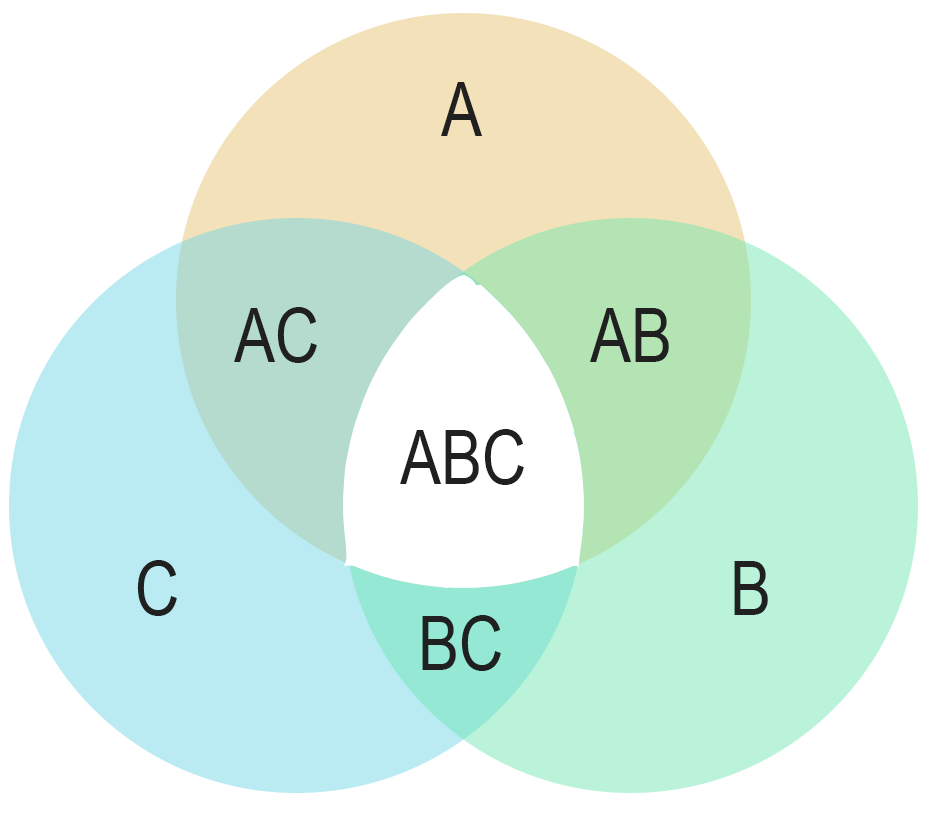
Mohammed emphasized that the way Compliance Plus handles these situations saves considerable time and reduces payer and aggregator rejections. Like in a Venn diagram, every combination of patient, payer, task type, and caregiver creates a “patient profile.” The user created most profiles in advance, based on known payer rates, etc. Occasionally, a patient’s profile is unique, but a user can easily enter the specifics into the system manually. Once a profile is built, the system calculates all of the billing accurately without additional user supervision.

Compliance Plus

Task Rates

If a payer’s rate for a task changes, Mohammed or another office staffer makes the change one time for all affected patients. In that scenario where the live-in caregiver performs three different tasks in one day, he or she checks in and out only once, before the first task and after the last, and designates each task performed. Compliance Plus does the rest.

Company Prospects

Hank Schwab told us that he is confident, after 100 successful beta customers, that Compliance Plus is ready for general release. At $10 to $12 per patient per month, he believes that supplementing word-of-mouth with a modest marketing effort will help him replace paper and strengthen the bottom line for many Medicaid and Personal Care agencies. Hank’s plan is to begin that effort as soon as he identifies an investor or two and hires a marketing director. “I already manage a team of coders and personally pay all the bills,” he laughed. “I’m ready for someone else to take on a few of my jobs.”
https://complianceplus.com/

*No, that is not a typo. We also enjoyed Mohammed Mohammed’s sense of humor. He tells people his parents were too cheap to give him a first name, so they just copied his last name.

# # #

Tim Rowan The Rowan Report
Tim Rowan is a 30-year home care technology consultant who co-founded and served as Editor and principal writer of this publication for 25 years. He continues to occasionally contribute news and analysis articles under The Rowan Report’s new ownership. He also continues to work part-time as a Home Care recruiting and retention consultant. More information: RowanResources.com
Tim@RowanResources.com

©2025 by The Rowan Report, Peoria, AZ. All rights reserved. This article originally appeared in The Rowan Report. One copy may be printed for personal use: further reproduction by permission only. editor@therowanreport.com

Impact of H.R. 1: The Homebound and Overlooked

Analysis by Tim Rowan, Editor Emeritus

The Impact of H.R. 1

Homebound and Overlooked

In early 2025, the Republican-led Congress introduced its proposed budget for FY2026 and beyond, a sweeping legislative effort aimed at curbing federal expenditures and restructuring entitlement programs. Medicaid, one of the largest healthcare safety nets in the United States, faces major revisions under this bill. Central to the proposed changes is the shift toward block grants or per-capita caps on federal funding. The legislation also rolls back incentives enacted into law by the Affordable Care act, including those that supported Medicaid expansion. The reconciliation bill, signed into law on July 4, also eliminates financial support for optional services such as home and community-based services (HCBS). A new set of work requirements in the new law will expand the paperwork burden for beneficiaries.

Risks for Home- and Community-Based Care

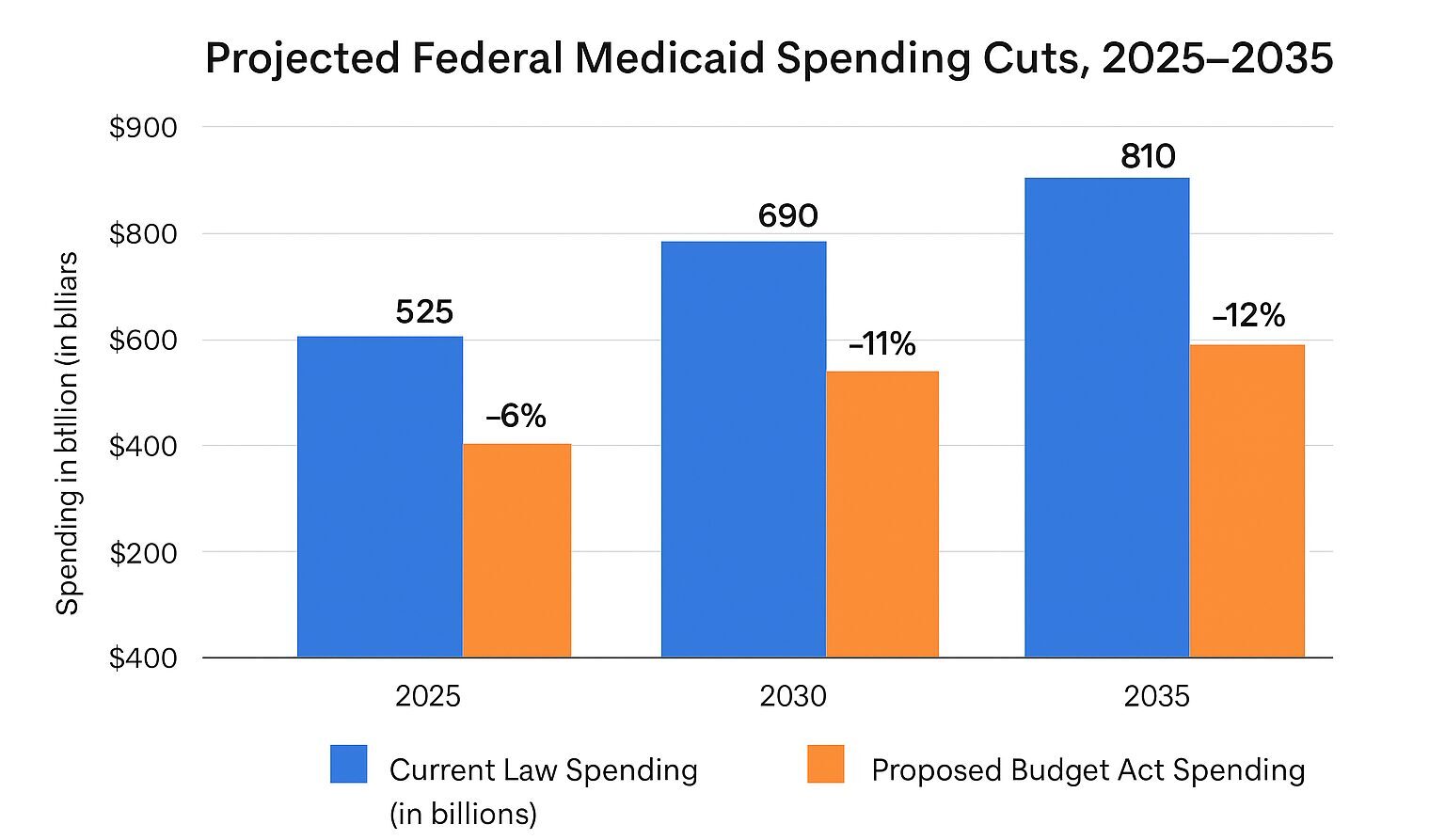
The figure below presents a visual from the Commonwealth Fund showing their projection of over $100 billion in cumulative federal Medicaid cuts by 2035. These reductions are expected to disproportionately affect non-mandated programs like HCBS, which are many times more economical than residential care. With diminished federal support, states will face pressure to reallocate limited resources, often at the expense of these optional, yet critical, programs. ¹

For nearly eight million elderly Americans, Medicaid-funded HCBS has helped reduce hospital admissions, extend independence, and relieve stress on long-term care facilities. However, the new budget cuts destabilize these programs. Barbara Merrill, CEO of ANCOR, expressed concern, stating, “When you cut federal Medicaid dollars, even for optional services, states have to make tough decisions about who gets care and when.”² Experts anticipate that approval delays, extended waitlists, and even termination of services could follow as states struggle to maintain existing infrastructure.

Bar chart of Medicaid spending.

Comparing the 2005 Budget Bill to the Affordable Care Act

Compared to the Affordable Care Act (ACA), the Republican budget bill marks a significant policy reversal. The ACA expanded Medicaid eligibility and incentivized states to develop non-institutional care models. It emphasized preventive care and home-based treatment options, helping shift care away from costly institutional settings. By contrast, the new bill eliminates such incentives and introduces fiscal and operational barriers. According to data from Medicaid.gov and the Kaiser Family Foundation, Medicaid enrollment, which rose steadily during the ACA years, is projected to drop by 10% nationwide once the budget bill is implemented³. This decline reflects both tightening eligibility and retreat from HCBS programs.

Healthcare providers will need to brace for substantial ripple effects. With fewer patients accessing home care, hospitals and emergency departments may see an uptick in acute episodes related to unmanaged chronic conditions. Providers may also encounter staffing shortages and reduced reimbursements, undermining service quality and sustainability. Richard Edwards, policy director at Amivie Home Health, warned, “If states cut home care services, many patients have no other choice but to enter a skilled nursing facility. That’s not just a shift in care—it’s often a worse outcome at a higher cost.” ⁴ These operational challenges could exacerbate pressure on an already strained healthcare workforce.

Scope and Severity of Coming Changes

Today, over eight million seniors rely on Medicaid-funded HCBS, with an average annual cost per recipient of $29,000. Thirty-three states use HCBS waivers to administer these services, yet the average state waitlist already exceeds 3,000 applicants. Institutional care costs remain 57% higher than home care, making HCBS not only more humane but more fiscally prudent. Despite that, projected federal cuts of $100 billion by 2035 threaten to replace HCBS with nursing home care. Meanwhile, a national enrollment drop of 10% would leave millions at risk of losing coverage and care.

Richard Edwards, policy director at Amivie Home Health, explains, “If states cut home care services, many patients have no other choice but to enter a skilled nursing facility. That’s not just a shift in care—it’s often a worse healthcare and social outcome at a higher cost.” ⁴

  • 8 million elderly rely on Medicaid HCBS
  • $29,000/year average cost per Medicaid home care recipient
  • 33 states use HCBS waivers
  • Average state waitlist for HCBS exceeds 3,000 applicants
  • Institutional care costs 57% more than home care
  • Estimated federal Medicaid cuts by 2035: $100 billion
  • Projected national enrollment drop: 10%

Implications for Care at Home: Next Steps

To mitigate these risks, policy experts are advocating for pragmatic alternatives, knowing that implementation depends entirely on the direction in which political winds blow. Federal stabilization grants could offer targeted relief to states with high HCBS enrollment, preserving continuity of care. Streamlining waiver approvals would reduce bureaucratic delays and ease access for both providers and patients. Retaining key ACA incentives could help maintain momentum in home-based care innovation. States would also benefit from flexible financing rules, including reformed provider tax policies, to better manage Medicaid funds under new constraints. 

Final Thoughts

Ultimately, the new budget, passed with no Democratic votes, may reshape eldercare delivery for years to come. With states facing hard choices, the healthcare community must prepare for transitions that could disrupt care and deepen inequities. Advocacy for vulnerable populations, investment in alternatives, and ongoing engagement in policy reform will be essential to ensure seniors receive the care they deserve in the setting they prefer.

# # #

____________________________________________

¹ Congressional Budget Office, Federal Healthcare Outlook 2025–2035
² Barbara Merrill, ANCOR Policy Brief, March 2025
³ Kaiser Family Foundation, Medicaid Enrollment Tracker, April 2025
⁴ Amivie Health, Testimony to House Budget Committee, June 2025

Tim Rowan The Rowan Report

Tim Rowan is a 30-year home care technology consultant who co-founded and served as Editor and principal writer of this publication for 25 years. He continues to occasionally contribute news and analysis articles under The Rowan Report’s new ownership. He also continues to work part-time as a Home Care recruiting and retention consultant. More information: RowanResources.com
Tim@RowanResources.com

©2025 by The Rowan Report, Peoria, AZ. All rights reserved. This article originally appeared in The Rowan Report. One copy may be printed for personal use: further reproduction by permission only. editor@therowanreport.com
Bill Cuts Medicaid Directly, Medicare Indirectly

by Tim Rowan, Editor Emeritus

Bill Cuts Medicaid Directly, Medicare Indirectly

This is what online publishers call a “living article.” With the House and Senate passing different bills, progress toward the President’s desk changes by the hour. What follows is everything we knew to be true on Tuesday evening, July 1. However, this bill will impact Home Health, Home Care, and Hospice. To keep readers informed, we will continuously update this article as need through the weekend. We will not send our usual emails to subscribers with every update, so we urge you to return here from time to time for updates to this breaking news item. We will add the date and time to each update.

July 3: Bill Passes, The Alliance Responds

Nearly as soon as House Republicans began their celebration, Alliance President Dr. Steve Landers issued a response from the National Alliance for Care at Home. We reprinted the complete statement from The Alliance here.

“As these Medicaid provisions become law, the Alliance will work tirelessly to monitor their implementation and advocate for the protection of Medicaid enrollees, families, and providers nationwide. We will continue to champion the delivery of HCBS – proven services that are preferred by beneficiaries and save the system money.” 

Dr. Steve Landers

CEO, The National Alliance for Care at Home

Final House Vote: July 3

In spite of a couple of Republican holdouts, H.R. 1 passed the House on a 2018-2014 vote on Thursday afternoon. All of the Senate’s changes were approved, meaning the bill does not have to go back to Senate for re-approval. Now begin final assessments of the impact on Medicaid and SNAP. Changes made in the Senate, approved by the House, increased the size of spending cuts for those two programs. As analysts inside and away from our home care community weigh in, we will post them here.

As of the end of the day, July 1

It appears as though the stalemate, if there is to be one, will center around Medicaid and SNAP cuts. There are some House Republicans who are upset that the Senate increased their H.R. 1 proposed cuts to nearly $1 Trillion. Contrarily, other House Republicans threaten to vote no because cuts are not deep enough. They point to the predicted $3.3 trillion addition to the national debt over ten years. As of the evening of July 1, the House Rules Committee continues the debate. We will update this page as often as possible for you.

As of the morning of July 1

Early Tuesday morning, the Senate passed its version of Donald Trump’s bill. Among its changes are increased cuts to Medicaid. The Congressional Budget Office calculated that the House version would have resulted in $700 billion in spending reductions. It would also have removed health insurance from 10.9 million people over 10 years. The version the Senate sent back to the House Tuesday, according to the CBO, increases those cuts to $930 billion and 11.8 million people.

Senate passes bill

June 29th

The Senate reconciliation bill would cut gross federal Medicaid and Children’s Health Insurance Program (CHIP) spending by $1.02 trillion over the next ten years.  These cuts are $156.1 billion (18%) larger than even the House-passed bill’s draconian cuts of $863.4 billion over ten years.

  • These larger gross Medicaid and CHIP cuts are driven by changes to the House-passed bill that would:

    • further restrict state use of provider taxes to finance Medicaid
    • eliminate eligibility for many lawfully present immigrants
    • cut federal funding for payments to hospitals furnishing emergency Medicaid services
    • further reduce certain supplemental payments to hospitals and other providers (known as state-directed payments)
  • The spending effect of these additional cuts is modestly offset by increased Medicaid and CHIP spending from provisions not in the House-passed bill

    • a rural health transformation program
    • increased federal Medicaid funding for Alaska and Hawaii (Already ruled out by the parliamentarian)
    • expanded waiver authority for home- and community-based services
  • Overall, the Senate Republican reconciliation bill’s Medicaid, CHIP, Affordable Care Act marketplace, and Medicare provisions would increase the number of uninsured by 11.8 million in 2034, relative to current law

    • In comparison, the House-passed bill would increase the number of uninsured by 10.9 million in 2034.
    • More detailed CBO estimates of the specific Medicaid health coverage effects under the Senate Republican reconciliation bill are not yet available
    • CBO estimates the House-passed bill’s Medicaid and CHIP provisions would cut Medicaid enrollment by 10.5 million by 2034 and by themselves, increase the number of uninsured by 7.8 million by 2034

How the Senate Pushed the Bill Through

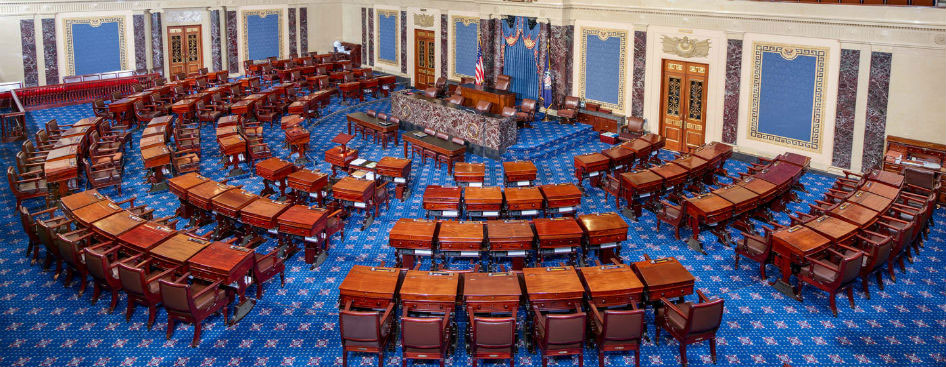
Majority leader Thune could only afford to lose three Republican votes. With GOP Senators Thom Tillis (N.C.), Rand Paul (Ky.) and Susan Collins (Maine) voting against the measure, along with every Democrat, centrist Lisa Murkowski of Alaska became the sole target of Republican pressure. The tactic used to get the vote close enough for VP Vance to cast the deciding vote is disturbing. 

First, leadership wrote an amendment that would have exempted Alaska from Medicaid and SNAP cuts. The parliamentarian killed that idea, saying it violated the Senate’s “Byrd Rule.” Next, marathon negotiations brought Murkowski and Parliamentarian MacDonough together to appease both. The compromise became exceptions to Medicaid and SNAP cuts that had less of an appearance of a bribe. They devised a formula that delayed cuts to states with a history of high error rates in calculating who is entitled to benefits. The CBO said that would cover as many as 10 states. The parliamentarian decided this did not violate Senate rules because it did not specifically benefit one state. They also increased the federal subsidy for rural hospitals that will be harmed by the bill from $25 billion to $50 billion.

In agreeing to vote ‘yes,’ Murkowski essentially declared that she knows the cuts will be bad for most states but will be good for her state. With the Alaska Senator’s vote secured, the final count was 50-50, leaving the final decision up to the vice president.

# # #

Tim Rowan The Rowan Report

Tim Rowan is a 30-year home care technology consultant who co-founded and served as Editor and principal writer of this publication for 25 years. He continues to occasionally contribute news and analysis articles under The Rowan Report’s new ownership. He also continues to work part-time as a Home Care recruiting and retention consultant. More information: RowanResources.com
Tim@RowanResources.com

©2025 by The Rowan Report, Peoria, AZ. All rights reserved. This article originally appeared in The Rowan Report. One copy may be printed for personal use: further reproduction by permission only. editor@therowanreport.com
Medicaid Cuts Update: Meet the Senate Parliamentarian

by Tim Rowan, Editor Emeritus

Medicaid Cuts Update

Senate Parliamentarian Elizabeth MacDonough

The ongoing negotiations in Congress will impact Medicaid and Medicare. There has been little movement from the Senate since we reported on this last week, but here’s what we know now:

When H.R. 1 was passed by the House of Representatives and forwarded to the Senate, it was immediately subjected to scrutiny by the Senate Parliamentarian, Elizabeth MacDonough. The job of the parliamentarian is to ensure that every proposed bill complies with Senate rules. The story of Ms. MacDonough taking her scissors to the “One Big Beautiful Bill” requires more than a little unpacking, but it is a good story.

Problem with Medicaid Cuts: "One Bill"

It appears that the idea to put all of the President’s legislative agenda into a single bill is acceptable in the House, but the Senate has different rules. The Senate forces itself to live under the filibuster system. When the filibuster is evoked, a bill must receive 60 votes to pass, but there is an exception. “Budget Reconciliation” is a rule that allows expedited passage of certain specific budget-related bills with only a simple majority, 51 votes.

The problem of the week is that H.R. 1 includes dozens of provisions that have nothing to do with spending. The Senate parliamentarian took her scissors to parts of the bill that:

  • change environmental regulations to pave the way to sell public lands
  • reduce the ability of federal judges to block Presidential orders1
  • dissolve the Consumer Financial Protection Bureau
  • change the rules about who can be excluded from receiving Medicare benefits, even after contributing through FICA taxes
Medicaid Cuts

Cutting Medicaid Cuts

Parliamentarian MacDonough has also applied her scissors to the portion of the bill that would reduce Medicaid spending by nearly $800 billion over ten years. Writing for The Hill, Alexander Bolton reported on June 26:

“The Senate’s referee rejected a plan to cap states’ use of health care provider taxes to collect more federal Medicaid funding, a proposal that would have generated hundreds of billions of dollars in savings… The decision could force Senate Majority Leader John Thune (R-S.D.) to reconsider his plan to bring the Senate bill up for a vote this week.”

Alexander Bolton

Journalist, The Hill

The provision, which would have forced states to take over substantially more Medicaid costs, came under strong bipartisan opposition. Sen. Josh Hawley (R-Mo.), Susan Collins (R-Maine), Lisa Murkowski (R-Alaska) and Jerry Moran (R-Kan.) warned deep cuts to federal Medicaid spending could cause dozens of rural hospitals in their states to close. Senate Democrats, led by Jeff Merkley (D-Ore.), the ranking Democratic on the Senate Budget Committee, praised MacDonough’s exclusions.

The Hill reported, “Democrats are fighting back against Republicans’ plans to gut Medicaid, dismantle the Affordable Care Act, and kick kids, veterans, seniors, and folks with disabilities off of their health insurance – all to fund tax breaks for billionaires,” Merkley said in a statement.

The President pushed back against the parliamentarian’s rulings in a June 24 social media post:

“To my friends in the Senate, lock yourself in a room if you must, don’t go home, and GET THE DEAL DONE THIS WEEK. Work with the House so they can pick it up, and pass it, IMMEDIATELY. NO ONE GOES ON VACATION UNTIL IT’S DONE.”

Donald Trump

President of the United States

Sorting out the Complex Immigration Question

If the above seems complicated, it becomes rudimentary compared to the background that sets the stage for the parliamentarian’s next cut. Except for emergencies, most often crisis pregnancies, persons in the country illegally cannot, and do not, receive Medicaid-reimbursed healthcare. According to a study by Kaiser Family Foundation, however, fourteen states plus the District of Columbia use state taxpayer money, not federal funds, to cover children regardless of immigration status, Seven of those fourteen, and D.C., also cover some adults with state funds regardless of immigration status.

In the bill was a provision to punish these fourteen states and D.C. by reducing their federal Medicaid payments from 90 percent to 80 percent. Though there is no accusation in the bill that these states are guilty of improper use of federal funds, the states will lose some of those funds because of the way they have chosen to use their own funds. Parliamentarian MacDonough said that is not a budget line item but an attempt by the federal government to force states to change their own healthcare policies.

Medicare Restrictions also Scrapped

Almost as a postscript, a House restriction on Medicare eligibility also fell victim to the Senate Parliamentarian’s scissors. Non-citizens who work in W-2 wage jobs pay FICA taxes, many of them for 30 years or more. When these workers turn 65, they are eligible for Medicare benefits due to their contributions, regardless of their status. Though H.R. 1, the House version, would eliminate that eligibility, Ms. MacDonough said, “Nope, this is not a budget reconciliation issue.”

Although the White House is pressuring Senators to vote quickly — so that a joint House/Senate negotiating committee can hammer out differences and send their compromise version to the President’s desk by July 4 — that self-imposed deadline is up in the air at the moment. Both President Trump and House Speaker Johnson are adamant that every spending and every non-budgetary policy change they want must be enacted in one big bill. In spite of Ms. MacDonough’s cuts, the Senate it not exactly handcuffed either. Because it makes its own rules, Senators could simply decide, with a 51-49 party-line vote, to ignore the parliamentarian.

The power, as well as the future health of Medicaid, falls into the hands of the four dissenting Republican Senators. Home Health and Home Care folks in Missouri, Maine, Alaska and Kansas take note.

____________________________________

1  From White House correspondent Bart Jansen, writing for USA Today:

  • Currently, judges have discretion to set bonds on plaintiffs who file civil suits. Legal experts say judges often waive bonds in lawsuits against the government because the disputes are typically over policy rather than money.
  • A provision in the House-passed version of the bill would remove that discretion from federal judges and require litigants to post a bond when the issue under consideration is whether to block a Trump policy.
  • So far, judges have blocked Trump policies in 180 cases. All of them would have to be reviewed for bonds if the Senate approves the House provision and Trump signs it into law.
  • The law would effectively kill most of the limitations on Trump policies because bond amounts are determined by the dollar amount of the contested policy. In federal cases involving massive policy changes, those bonds can amount to hundreds of billions.

# # #

Tim Rowan The Rowan Report

Tim Rowan is a 30-year home care technology consultant who co-founded and served as Editor and principal writer of this publication for 25 years. He continues to occasionally contribute news and analysis articles under The Rowan Report’s new ownership. He also continues to work part-time as a Home Care recruiting and retention consultant. More information: RowanResources.com
Tim@RowanResources.com

©2025 by The Rowan Report, Peoria, AZ. All rights reserved. This article originally appeared in The Rowan Report. One copy may be printed for personal use: further reproduction by permission only. editor@therowanreport.com
Medicaid Cuts Still Looming

by Tim Rowan, Editor Emeritus

Medicaid Cuts Looming

Terminal Prognosis

Let me tell you about my brother. In his early 30’s, Tom was diagnosed with a rare disorder, one of the 25 versions of Ataxia. A disorder that is sometimes genetic, sometimes of unknown cause. It damages the part of the brain stem that controls balance, eye-hand coordination, and speech. He was supposed to be confined to a wheelchair by age 45 and not make it to 60.

Medicaid to the Rescue

Tom will celebrate his 71st birthday next week. Some years back, an experimental drug appeared that happened to be effective with his variation of Ataxia. That medication, administered intravenously in his home, is ridiculously expensive. If not for Medicare and Medicaid, those early prognoses would have come true. With the treatments, the disorder does still progress, though much more slowly. During my visits to his home — yes, he still manages on his own for now — he and I talk about the Assisted Living or Skilled Nursing Facility that looms in his future. Always with his head low and a sigh, he says he knows that day will come.

One in 71 Million

The 20 percent of American citizens who qualify for Medicaid are as nervous as Tom is about a bill making its way through Congress. As of May 22, 2025, H.R. 1 passed the House of Representatives by one vote. Today, it is still under debate in the Senate, where several amendments are being considered.

Medicaid Pays More than Medicare

In a February report, the Kaiser Family Foundation explained it this way:

Medicaid road sign "cuts ahead"

Four in ten adults incorrectly believe that Medicare is the primary source of coverage for low-income people. For those who need nursing or home care, Medicaid is the primary payer. Medicaid covered two-thirds of all home care spending in the United States in 2022. With House Republicans considering $2.3 trillion in Medicaid cuts over 10 years, the availability of home care could be affected in future years. Home care cannot afford the loss of almost one-third of the entire Medicaid budget.

Medicaid Cuts Impact

The February report indicates that H.R 1 could fundamentally change how Medicaid financing works. This would consequently impact enrollees’ access to care. The authors assert that “cuts of this magnitude would put states at financial risk, forcing them to raise new revenues or reduce Medicaid spending by eliminating coverage for some people, covering fewer services, and/or cutting rates paid to home care workers and other providers.”

“Such difficult choices would have implications for home care because over half of Medicaid spending finances care for people ages 65 and older and those with disabilities, the enrollees most likely to use home care and related services.”

Mohamed, A.; Burns, A.; O'Malley Watts, M.

Authors, What is Medicaid Home Care (HCBS)?

Medicaid Cuts Proposals

The Center on Budget and Policy Priorities has been listening to Senate debates and reading proposed amendments. In a news release this week, CBPP offered a dismal assessment.

“The health provisions in the Senate Republican leaders’ plan are, alarmingly, even harsher and more damaging than the health provisions in [H.R. 1]. Under both plans, tens of millions of people would face substantially higher health care costs and millions would lose access to life-saving treatments, routine care, and medications they need.”

Medicaid Cuts

Higher Costs, Less Access

Home Care and the Work Requirement

There is much talk in Congress and in social media about able-bodied Medicaid beneficiaries who sit at home and play video games all day. Not only does this indicate a confusion between healthcare and welfare (you can’t eat or sleep in Medicaid), but it also tends to exaggerate the scope of this fraud/waste/abuse target. 

As KFF points out, most Medicaid adults under age 65 are already working but are paid low enough that they still qualify. Many who are not working (12%) serve as caregivers for a family members. If they are removed from the home to go to a job, someone else would have to take over caregiving duties, probably a home care agency. Thus, there would be a net loss to the system. 

Net Loss

The Congressional Budget Office found when examining the House version that work requirements would decrease federal spending by reducing the number of uninsured. However, in the same report, the CBO notes that there would be no increase in employment numbers.

On top of the uncertain benefit of the work requirement, the bill as it stands today would greatly increase reporting requirements. In place of “once qualified, always qualified,” Medicaid eligibility will require regular reporting to prove employment and annual re-qualification paperwork. The new red tape burdens will be especially difficult on seasonal workers or those who frequently change jobs.

Medicaid Cuts and Rural Hospitals

No one is quite sure what the impact on home care will be when Medicaid cuts force rural hospitals to close, as the CBO predicts. Longer journeys to receive hospital care and doctor visits may push more beneficiaries to home care while home care will be struggling to find caregiving staff.

Before the bill becomes law, rural hospitals are already in trouble. The American Hospital Association says that 48 percent of rural hospitals operated at a loss in 2023 and 92 closed their doors over the past 10 years. There are 16.1 million Medicaid beneficiaries living in rural communities, including 65 percent of nursing home residents. Can home care cover the losses if a portion of the estimated $800 billion in Medicaid cuts over 10 years hit home care just as hard?  

Medicaid Support in Congress

There are home care champions on the Republican side of the House and Senate. Some of them have already expressed their doubts about whether cutting home care would decrease or increase overall spending. In the “strange bedfellow” category, conservative icon Josh Hawley of Missouri swore he would “tank any bill that cuts Medicaid benefits.”

Senate Republicans can afford to lose only three votes to get this bill passed and sent back to the House. Today would be the time for all of them to hear from the care at home industry. Call your Senator. All phone numbers start with 202-224-

# # #

Tim Rowan The Rowan Report

Tim Rowan is a 30-year home care technology consultant who co-founded and served as Editor and principal writer of this publication for 25 years. He continues to occasionally contribute news and analysis articles under The Rowan Report’s new ownership. He also continues to work part-time as a Home Care recruiting and retention consultant. More information: RowanResources.com
Tim@RowanResources.com

©2025 by The Rowan Report, Peoria, AZ. All rights reserved. This article originally appeared in The Rowan Report. One copy may be printed for personal use: further reproduction by permission only. editor@therowanreport.com