Meaningful AI

by Scott Green, Care Dimensions at Netsmart

Meaningful AI in Post-Acute

Elevating Care and Efficiency with Integrated AI

Meaningful AI is more than plugging your questions into ChatGPT. It goes beyond Artificial Intelligence into Augmented Intelligence. 

After a long day of caring for patients, a home health nurse pulls into their driveway, bracing for the familiar evening grind — hours of documentation. They take a deep breath, one of relief. They’re not mentally preparing for hours at their laptop, documenting every visit, trying to recall every detail while fatigue tugs at their focus. Tonight is different.

Tonight, they step through the door, greeted by their kids clamoring to show off their school projects. Dinner is already on the table, and for the first time in weeks, they sit with their family—truly present. There’s no need to pull out the laptop after dessert, no late-night race against deadlines. Their documentation? Done. Completed during patient visits, thanks to an integrated AI workflow that not only captured essential details of their patient but also highlighted critical care needs in near real-time.

This isn’t just a glimpse of what’s possible—it’s the reality Meaningful Augmented Intelligence (AI) creates for home care & hospice providers. With AI-assisted documentation tools, caregivers are freed from after-hours work. Repetitive tasks are automated, and accurate, compliant records are captured during visits. As a result, clinicians can focus on what matters most: delivering care to their patients during the day and being present for their families at night.

Meaningful Integrated AI in Care at Home: How it Works and Why It Matters

Integrated AI doesn’t just automate tasks—it enhances every part of the care process. By embedding AI directly into existing workflows, solutions empower clinicians and administrators to work smarter, not harder. Predictive analytics, real-time documentation and automated data entry reduce repetitive tasks and administrative burden, clearing staff to focus on patient care.

Unlike generic AI tools, Meaningful AI supports clinicians at the point of care. It captures essential details during visits, highlights critical needs as they arise, and offers real-time guidance. This isn’t just about making work faster—it’s about making it more human. Integrated AI simplifies workflows and strengthens decision-making, whether it’s anticipating a patient’s end-of-life needs, identifying compliance risks, or supporting proactive billing.

The AI Trifecta

AI isn’t just about automation—it’s about Meaningful AI that directly addresses the needs of community-based providers. With our AI Trifecta, every aspect of care delivery is reimagined to optimize processes, empower staff, and simplify reimbursement.

Optimize Processes

Integrated AI helps organizations operate more efficiently by taking over time-intensive, repetitive tasks, allowing staff to focus on patient care. For example, guided assist tools integrated with clinical workflows proactively coach staff through complex tasks like completing the OASIS assessment or interdisciplinary start of care documentation.

Imagine a clinician documenting care after a patient visit. With AI-powered assistance, charting can pre-fill fields based on visit details, flag potential inconsistencies in near real-time and suggest changes to align with regulatory requirements for a supervisor to review. This reduces errors and speeds up documentation, freeing clinicians to focus on patients rather than administrative tasks.

Predictive analytics empower organizations to anticipate and address challenges early, supporting clinical benefits of Hospice Visits in the Last Days of Life (HVLDL) such as symptom management, reduced patient distress and honoring the patient’s end-of-life wishes.

Empower Staff

The backbone of any agency is its staff. Integrated AI tools relieve the pressures of excessive documentation and administrative burdens. These tools aren’t just about doing tasks faster—they help create a more sustainable work-life balance by addressing challenges like burnout and turnover.

Staff can also benefit from smart task prioritization. Meaningful AI tools can include the ability to log in and instantly see a clear list of priorities based on patient needs and compliance deadlines. This reduces time spent figuring out “what’s next” so that every action directly contributes to better patient outcomes.

Meaningful AI

Simplify Reimbursement

Some AI tools monitor claims for potential issues before submission. Imagine if your system could identify a missing modifier or mismatch in coding then flag the problem and provide actionable suggestions to correct it. This not only increases first-pass acceptance rates but also reduces the exhausting back-and-forth that often accompanies denied claims.

Beyond preventing errors, predictive tools assess patterns in denial risks and reimbursement trends, enabling organizations to adjust strategies proactively. Leaders can use these insights to negotiate better contracts or refine documentation practices, ensuring steady cash flow and financial health and upstream process improvement. This empowers organizations to invest resources where they matter most: improving patient outcomes.

About Netsmart myUnity® NX

With Meaningful AI at the heart of myUnity NX, every part of the healthcare process—from care delivery to financial health—works smarter, not harder. These innovations support not just operational efficiency but also the well-being of care teams. By embedding intelligent workflows, providers have the time and space to focus on what matters most—delivering exceptional, person-centered care. Learn more about Netsmart myUnity® NX

# # #

Scott Green Meaningful AI

Scott Green leads the Care Dimensions business unit at Netsmart. In his role, he leads a team focused on building out a comprehensive suite of solutions designed to support organizations as they digitize their operations beyond the EHR. Green has been with Netsmart for 10 years and has held many roles during that time including leading the Human Services business unit.

Prior to joining Netsmart, he spent 13 years with Pfizer where he focused on building relationships and clinical initiatives with Integrated Delivery Networks.

Scott holds a bachelor’s degree in industrial psychology from Kansas State University and a graduate certificate in healthcare leadership from Park University.

©2025 by The Rowan Report, Peoria, AZ. All rights reserved. This article originally appeared on the Netsmart blog and is reprinted here with permission. For more information or to request permission to print, please contact Netsmart. 
Product Review: AI Comes to Data Analytics

by Kristin Rowan, Editor

Artificial Intelligence has existed in basic forms for many years and has recently advanced to include augmented intelligence and generative intelligence. The Rowan Report has provided several examples of quality AI usage and even more examples of AI applications that are fraudulent, improperly applied, and/or poorly executed. As we continue our journey of AI discovery, we are seeing more companies researching how to effectively use AI to enhance existing software solutions as well as new solutions entirely based on AI. We’ve reviewed AI software for point of referral, talk to text documentation, employee recruitment and retention, and now data analytics.

The Rowan Report recently met the founder of a data analytics AI software solution, Skyra.ai. “Our goal is to advance the industry to be technology forward,” said Skyra founder Mickel Mirchandani, “we imagined a future were technology empowers home care agencies to focus on what matters – serving patients.”

Data Analytics: From What to Why

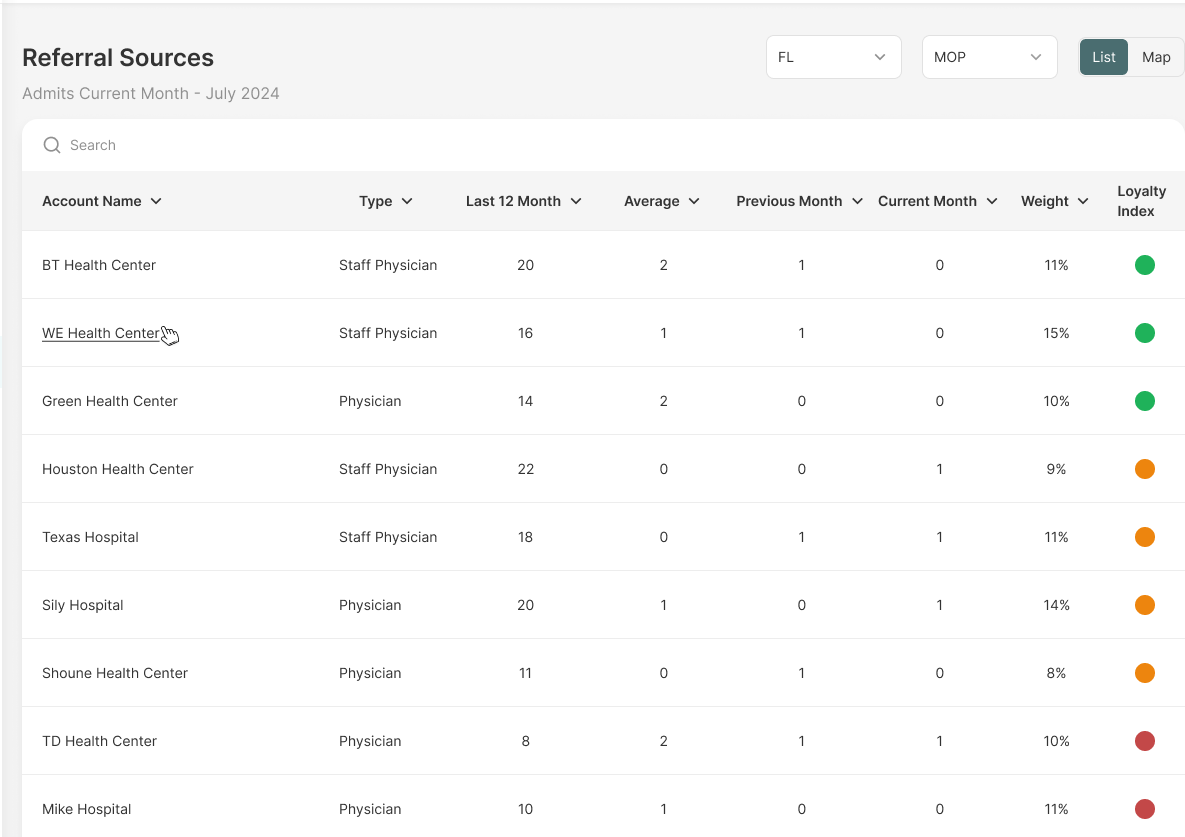
Care at Home agencies have no shortage of access to reports through various tech solutions. Hours worked and earnings from payroll reporting, average length of visit and number of patients per week from EMR and EVV reports, average daily census, employee turnover rate, and the list goes on. These reports are useful in telling us what is happening within our agency, with our staff, and with our partners. Once you have this information, what do you do with it? Does it tell you why your top clinician saw five fewer clients last week? Does it explain the decrease in referrals from area hospitals and physicians? Can the reports tell you whether the recent trends will continue? Why are these things happening in your agency? And what’s more, how do I fix them?

Give Your Home Health Agency a Much-Needed Tune-Up

Like the warning light on your dashboard, data is meaningless until it is diagnosed. That warning light that tells you your referral numbers dropped last week might indicate new competition in your area, a drop in confidence in your agency by hospitals and physicians, too many NTUCs on your scorecard, or simply a glitch in paperwork or your website. The data tells you the numbers have dropped. Skyra.ai tells you why.

Skyra AI Data Analytics

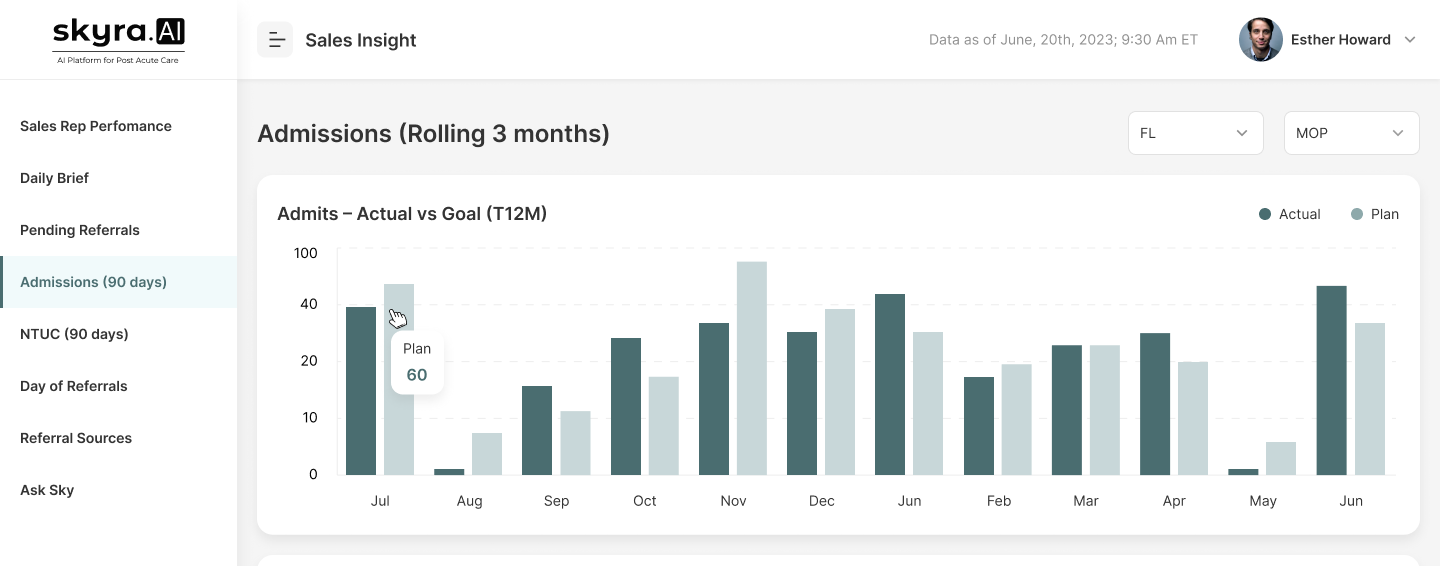
Skyra is a data analytics solution that connects to your EMR, payroll, accounts payable, scheduling, and quite literally almost any other piece of your tech stack that has useful data you want to see.

With a standard dashboard containing the most relevant and popular queries, and the ability to create custom insights, Skyra makes understanding the volumes of data collected simple and easy. Once you understand the “why” behind the numbers, you can make adjustments in your operating, scheduling, ordering, and operations to improve the overall health of your agency.

Features

  • Standard Dashboard
  • Insights for each Team (Sales, Executive, Clinical)
  • Two-Month Data Trends
  • Custom Insights Page
  • Pinned Query that refreshes itself daily
  • Understands multiple languages
  • Zero Percent Hallucination
  • HIPAA Compliant with multiple security layers applied vertically and horizontally
Skyra AI Data Analytics
  • “Ask Sky” – the Generative AI assistant you can tap into for custom insights into your agency
  • Compliance Monitor to avoid payment penalties by ensuring accuracy and timeliness of submissions
  • Control Tower for key metrics and alerts

Platform Agnostic

Data analytics is difficult enough without using multiple tech solutions. Even worse is when you’ve decided that a particular solution no longer works for your agency and you find yourself shopping for a new payroll, scheduling, or EMR solution. How do you preserve the years of data from your legacy systems without interruption?

Skyra.ai’s unique process stores all your data as though it comes from the same source, in the same language. Switching from solution to solution is a seamless process that keeps your data intact and reduces the opportunity cost of changing systems.

Future Plans

The team at Skyra is not content with one of the most advanced AI applications in the space. With a recently redesigned website, and new partners, Skyra is now looking to the future. Look for a two-way communication solution over a secured system with encrypted messages. The messaging system will connect caregivers to patients, patients to care teams, and caregivers, to care teams. The solution will reduce triage costs, reduce rehospitalizations rates, assist with marketing efforts, and increase CHAP scores. Skra Connect will launch sometime in 2025.

But, first, Skyra is focusing its development efforts on an application for sales teams and marketers. An alternative to a traditional CRM that requires large amounts of useless data input and doesn’t help close a deal, Skyra’s sales solution will provide a CRM solution that sales people actually want to use and will free up their time to spend on customer-facing activities. 

The Rowan Report will provide a separate review of each of these new products as they become available. 

Overall Impression

A Familiar Problem

Skyra.ai found Mickel tells a familiar story about the idea for his solution. Familiar, at least, to those of us who grew up in the 80s. When our favorite band released new songs, we ran to the nearest music retail store to buy a cassette tape. If your favorite song on the tape was track 3, you know the pains of fast forwarding and rewinding to get the tape to the perfect spot at the beginning of the song, only to have to do it all over again when the song ends. Today, we ask “Alexa” or “Siri” or “Google” to play our favorite song and it starts at exactly the right second every time. Mickel strove to make accessing and understand data as easy as asking Alexa to play your favorite song. Ask Sky removes the fast forward and rewind buttons and lets you understand your data faster. 

A Consolidated Solution

As a small business, and even as an individual, I know how many applications I have to log in to daily to see my business analytics and personal information. Skyra houses all of your business information in one place for easy access and provides an open-ended query so each agency gets the information they need most to help the agency operate at its fullest potential. The possibilities that will exist as the AI technology advances is near endless.

As we have mentioned before, there are a lot of misuses for artificial intelligence, and a lot of misunderstanding. Now, it seems, we have found at least one more company doing AI well.

# # #

Kristin Rowan, Editor

Kristin Rowan has been working at Healthcare at Home: The Rowan Report since 2008. She has a master’s degree in business administration and marketing and runs Girard Marketing Group, a multi-faceted boutique marketing firm specializing in event planning, sales, and marketing strategy. She has recently taken on the role of Editor of The Rowan Report and will add her voice to current Home Care topics as well as marketing tips for home care agencies. Connect with Kristin directly kristin@girardmarketinggroup.com or www.girardmarketinggroup.com

©2024 by The Rowan Report, Peoria, AZ. All rights reserved. This article originally appeared in Healthcare at Home: The Rowan Report. One copy may be printed for personal use: further reproduction by permission only. editor@therowanreport.com

AI before AI

by Tom Herzog, COO of Netsmart

Navigating the Next Era of Tech-Enabled Healthcare

While the talk is about Artificial Intelligence, the immediate opportunity is Augmented Intelligence.

Some thoughts from Tom Herzog and Matthew Arnheiter 

We are living through one of the most exhilarating times in healthcare, a journey made possible by significant milestones over recent decades. As healthcare technologists deeply committed to the cause + communities we serve, we’re excited by the promise of the upcoming era of technological empowerment. This phase is set to showcase and expand upon the extensive work done in digitizing healthcare, highlighting the relentless pursuit of innovation that has characterized our field. In conversations with colleagues and clients, we have recognized the need to explore these developments as we progress collectively. Matthew and I thought a series of reflections on these conversations would be helpful for all of us, providing insights into technology’s transformative impact on healthcare and the critical initiatives currently underway. We envision this dialogue as a series of posts throughout the year, sparking discussion and reflection as we navigate forward.

Back to the Future

In 2015, we envisioned a future where the concept of navigation as we know it would be obsolete, advocating for a universal search that is nearly autonomous, informed by the known context specific to every role. By 2019, we were discussing workflow automation, using the example of Lane Departure Warning systems in automobiles as a metaphor for technology that enhances outcomes through precision responses. The pace at which these technologies are evolving is astounding, moving beyond mere speed of thought to how we can iterate at the speed of innovation itself. Before we achieve the aspirations of true Artificial Intelligence, we must start with Augmented Intelligence, which may very well be the most significant technological innovation in my lifetime.

The Gentle Guidance of Technology: Augmented Intelligence in Healthcare

Artificial Intelligence (AI) and Augmented Intelligence stand as beacon forces driving innovation forward in this fast-evolving technology landscape. Drawing an analogy to driver assistance systems in modern vehicles, we explore the nuanced differences between these concepts, simplifying their understanding and underscoring the distinct roles in enhancing human capabilities.

Artificial Intelligence: The Autonomous Navigator

Imagine AI as the driving force behind fully autonomous vehicles, adeptly navigating complex terrains without human intervention. This epitomizes the grand aspiration of AI: to emulate or even transcend human Intelligence in specific tasks, thus granting machines the ability to function independently. It’s a prospect that is as exhilarating as it is intimidating, reminiscent of scenarios depicted in futuristic films. Such advancements bring to light profound questions about the limits of technology and the ethical considerations it entails. While we marvel at the potential, apprehension about the unknown shadows our enthusiasm. As we venture into this era, it’s imperative that we tread thoughtfully, balancing our ambitions with caution, as we unlock new realms of possibilities. Together, we must navigate this journey towards outcomes that are not only innovative but also meaningful and ethically sound.

Augmented Intelligence: The Co-Pilot’s Nudge

Conversely, Augmented Intelligence mirrors the driver assistance systems in vehicles – providing “nudges” or guidance while ensuring the driver remains in control. These systems bolster safety and efficiency, complementing human Intelligence with technological support. This partnership epitomizes the collaborative synergy between technology and human skills for a safer and more efficient driving experience.

The American Medical Association (AMA) aligns with this vision, emphasizing Augmented Intelligence’s role in enhancing human Intelligence rather than replacing it. The AMA advocates for the use of AI in healthcare as a means to augment the capabilities of medical professionals, not to substitute their critical thinking or clinical judgment.

Augmented Intelligence in Healthcare: Enhancing the User’s Ability

Reflecting on the transition from conceptual frameworks to tangible applications, we’ve initiated the Augmented Intelligence family. These solutions are meticulously designed to support clinical, operational, and financial workflows across all healthcare roles. Aimed at simplifying user experiences, these tools provide the best available context and automate information for validation and use as needed. This initiative marks a significant step in harnessing the potential of augmented Intelligence, enabling transformative shifts in healthcare practices and outcomes.

Michelle Donelan MP, reflecting on the U.K.’s commitment to AI in healthcare, highlights the transformative impact of augmented Intelligence, “AI will revolutionize the way we live, including our healthcare system. That is why we’re backing the U.K.’s fantastic innovators to save lives by boosting the frontline of our NHS and tackling the major health challenges of our time”. Donelan’s statement emphasizes the government’s support for utilizing AI to enhance healthcare delivery and address pressing health issues.

Augmented Intelligence promises to extend the partnership between human capabilities and technological advancement to medical professionals. Vincent Liu, MD, from Kaiser Permanente, elucidates this synergy, stating,

There is a stage at which regulations can stifle some of the innovation [that AI might advance] … There is a role for providing a safe harbor [from certain regulations] so that we can use our best data to improve our patients’ care.

This perspective underscores the potential of augmented Intelligence to enrich patient care by integrating comprehensive data analysis within the regulatory framework.

From the inception of conversations at our annual user conferences in the early 2000s to the present, we’ve witnessed the evolving landscape of healthcare technology. The decades-long journey of healthcare digitization has set the stage for today’s advancements, where Artificial Intelligence and Augmented Intelligence solutions leverage data to significantly improve care and operational efficiency.

Navigating Ethical Considerations

The integration of Augmented Intelligence in healthcare navigates through a maze of ethical considerations. Upholding the sanctity of the caregiver-patient relationship, ensuring patient privacy, and addressing potential biases in AI algorithms are paramount. The objective is to leverage Augmented Intelligence in a manner that respects these ethical boundaries while enhancing patient benefits.

A Future of Collaborative Care

Looking ahead, the promise of healthcare augmented by Intelligence offers a landscape where clinicians are equipped with unprecedented tools and information. This era does not diminish the essence of human judgment or the significance of the human touch in medicine but serves as a potent ally to these irreplaceable elements of care.

A Journey of Human-Machine Collaboration

Augmented Intelligence in healthcare symbolizes the collaboration between human Intelligence and artificial capabilities. This collaboration is not about relinquishing control but about enriching human expertise to tackle modern healthcare challenges. As we continue to integrate this technology, it heralds a future where healthcare is more personalized, predictive, and precise. The path forward, illuminated by the gentle guidance of Augmented Intelligence, promises a realm of endless potential for improved health outcomes for all.

Our immediate focus is three-fold 1) providing the communities we serve with the benefits of  Augmented Intelligence, 2) ensuring we achieve Meaningful AI for every role, and 3) doing so through incremental progress so that AI now is a reality.

Final Thoughts

If you are reading this, you are likely one of the pioneers helping forge the path we are on today. If it were not for the initial efforts to digitize the ecosystem, we would not be talking about this today. Thank you for making this happen, for your perseverance and tenacity to find a way. Now we are at the transition from AI as a futuristic concept to its current role in shaping healthcare practices marks a remarkable chapter in the ongoing story of innovation in healthcare. It reaffirms the importance of digitization as the foundation upon which AI and other emerging technologies are built, enabling a future where healthcare is more informed, more empowered, and, ultimately, more human.

# # #

Augmented intelligence Tom HerzogTom Herzog is responsible for leading solution and technology strategies focused on person-centric design to optimize workflow, efficiencies and outcomes. His teams work in collaboration with both clients and partners to deliver comprehensive solutions for the human services and post-acute care communities.
Tom oversees multiple business units, including Netsmart consulting organization, solutions, development, engineering, technology, innovation, product development, IT, support, human resources, legal and operational functions.

Tom’s additional experience includes leading teams to automate systems and integrate financial, document management and information systems. He has been recognized for his ability to create innovative approaches and strategies that deliver results through vision and building strong teams.

Tom earned a bachelor’s degree in business management and human relations from Mid-America Nazarene University. He serves on the boards of the Overland Park Chamber of Commerce and the United Community Services of Johnson County.