by Rowan Report | Aug 9, 2024 | Admin, Caring for the Caregiver, Clinical
This article is part two of a two-part series. You can read part one here.
by Todd Austin and Sasha Erickson
3 Steps Towards Creating a Culture of Love that Retains Employees
In a study done on the “Culture of Companionate Love and Employee and Client Outcomes in a Long-Term Care Setting,” researchers found displaying warmth, affection, and connection had a tangible impact on employee turnover, resident outcomes, and family satisfaction.
Employees who felt they worked in a loving, caring work environment reported higher levels of satisfaction, increased teamwork, and showed up to work more regularly. But the effects of a companionate culture aren’t just felt by your employees.
Research shows that employees who work in a culture of love companionate culture directly related to client outcomes such as improved patient mood, quality of life, satisfaction, and fewer trips to the ER.
A culture like this is only made possible through a conscious effort from leadership to make their employees feel cared for and appreciated. To see similar results in your own business, start creating a culture of love.
Be an advocate for your employees' mental health
Contrary to popular opinion, an employee doesn’t leave their emotions at the door when they come into work. Especially if they work in a service-based industry like long-term and post-acute care.
The emotions an employee feels while caring on the job affects performance, customer and employee satisfaction, and care outcomes.
For example, if an employee is feeling stressed, frustrated, or disgruntled, they will either appear so as they’re caring for their residents and patients or be forced to put up a positive front on the outside while bottling up negative emotions on the inside. Whether these types of negative emotions are revealed in the open or held within, either outcome leads to low satisfaction and high employee turnover.
Instead, be an advocate for your employees’ wellbeing and mental health. Provide resources for mental health support and regularly check-in with your staff at important milestones. Offering competitive benefits, flexible hours, and paid time off encourages employees to tend to their own needs as well as others.
Broaden your company’s definition of culture
Culture is more than a staff break room with a foosball table. Your company’s culture will create itself, whether you’re in control of it or not.
Creating a healthy company culture requires deliberate and consistent actions from your leadership team. It is your goal to ensure that when your employees think about work on a Sunday night, they feel positive about coming to work every Monday morning. At Activated Insights, our approach centers on understanding and enhancing the employee experience through several key strategies:
-
-
Culture and Engagement Assessments
- We regularly administer assessments to identify strengths and areas needing improvement to help us stay attuned to the evolving needs and perceptions of our employees.
-
Employee Focus Groups and Culture Audits
- We have started administering focus groups and culture audits to gain real insights and solutions directly from our employees. These sessions create open lines of communication where employees can express their thoughts and ideas.
-
Prioritizing Employee Wellness
- We offer unlimited PTO with mandatory minimums, including one mental health day off each quarter and a minimum of two weeks off per year with at least one period of five consecutive days off. This policy underscores our commitment to employee well-being, ensuring that they can balance work with personal life effectively.
-
Effective Communication and Leadership
- Continuously communicating, modeling, and reinforcing the company’s vision, values, mission, and guiding principles is crucial. Leaders play a significant role in setting the tone and maintaining a positive culture by leading with transparency, empathy, and consistency.
-
Team Building and Collaboration
- At Activated Insights our teams are often comprised of both in-office and remote employees. We encourage teams to get together at least annually. It’s imperative that companies are deliberate in providing opportunities for their teams to collaborate, build trust, and break down silos. We find that this improves overall job satisfaction and productivity.
-
Building Trust and Accountability
- Trusting employees and treating them like adults to manage their work and personal demands is essential. By creating an environment of trust and accountability, we encourage employees to take ownership of their roles and contribute meaningfully to the organization’s success.
By focusing on these strategies, we ensure that our employees look forward to coming to work, feel valued and supported, and are motivated to contribute to a positive company culture.
Learn to speak your employees’ professional “love language”
If you don’t speak two languages, you won’t connect with your employees to make them want to stay.
While everyone communicates in their own way, if you don’t know the language your caregivers will listen to, your recognition efforts are going to waste.
But this isn’t the type of language Duolingo can teach you. Rather, every provider in the long-term and post-acute care industry should become fluent in appreciating their employees.
The Value of Communication
In 1992, Dr. Gary Chapman noticed a pattern of miscommunication after practicing couples’ counselling for years. He discovered that individuals often misunderstand one another’s needs by communicating how they would personally like to receive recognition, without taking the others’ needs into consideration. He concluded that how we respond to appreciation boils down to one of the following categories.
Learn how to speak your caregivers’ language of appreciation to increase caregiver retention, refine your leadership skills, and foster a culture of recognition:
Professional Love Languages
- Words of Affirmation
- Care employees ranked verbal recognition by a supervisor as their number one preferred form of recognition—and lack of communication from their employer as their top complaint. Actively seek out reasons you can praise your caregivers to boost company morale and foster a culture of gratitude:
- Send handwritten thank you cards
- Give your caregivers a shoutout in company newsletters or on social media
- Recognize top performers using an employee of the month program to give everyone a chance to be in the spotlight
-
Receiving Gifts
- While a raise may be outside of the company budget, 20.4% of caregivers mentioned smaller forms of monetary recognition as their chosen form of acknowledgement. Small bonuses for top performers, extra vacation time, or gift cards are simple forms of appreciation:
- Give gift cards or free movie tickets
- Give company branded clothing
- Offer paid vacation time
-
Acts of Service
- A care employee’s occupation is to literally provide service to those in need—but have you ever thought of ways to serve your care staff? Although it may seem counterintuitive to serve in a workplace where employees are paid, you can offer your staff the relief that they need by helping to shoulder some of their responsibilities:
- Gather feedback and listen to how you can make their daily tasks or commute a little easier
- Go the extra mile to make them smile by hosting random appreciation events where you can offer the company donuts, coffee, or even turkeys on Thanksgiving
- Quality Time: Caregiving can be a very isolating job where they receive little social interaction with people other than their clients. Consciously create opportunities to spend quality time with your caregivers:
-
- Hold group training events to create an environment where caregivers can ask questions and learn from fellow coworkers.
- Schedule one-on-one meetings or lunches to build individual relationships with your caregivers and check in on how they are doing.
- Support their learning and professional development by discussing your caregivers’ goals and needs
So, What Does Love Have to Do With It?
In short: everything.
Your ability to create a companionate culture of recognition for your care staff will be the difference that pulls you out of the revolving doors of recruitment and retention.
The quality of your leadership within your company directly impacts your quality of care for the long-term and post-acute care industry.
In 2024, spend more time consciously creating a companionate culture and start to see your employee retention and client satisfaction skyrocket.
As a highly accomplished executive, Todd Austin, COO & President of Activated Insights, is recognized as a leading voice in the rapidly-growing care industry. With over a decade of experience in executive leadership roles, Todd brings a wealth of knowledge and expertise to his current position as a key member of the Activated Insights team.
With a background in sales, marketing, management, operations, and finance, Todd is a true Renaissance executive with a rare combination of strategic and tactical skills. His expertise in developing and implementing growth strategies, optimizing operations, and driving profitability has made him a sought-after advisor to many organizations.
Sasha Erickson is the Director of Talent at Activated Insights, formerly HCP. With over 10 years of experience in human resources across a variety of industries, Sasha has worked with organizations ranging from small businesses to Fortune 500 companies. She graduated Summa Cum Laude from Utah State University with a degree in Business Administration and minors in Human Resource Management, Marketing, and Finance.
Sasha’s career history includes roles at Avant Guard Monitoring Centers, Goldman Sachs, Schreiber Foods, JBS and Pilgrim’s Pride Corporation, RR Donnelley, and Denver Public Schools. Her expertise spans talent acquisition, employee engagement, culture development, HCM software implementation, and strategic HR management.
©2024 by The Rowan Report, Peoria, AZ. All rights reserved. This article originally appeared in Healthcare at Home: The Rowan Report. One copy may be printed for personal use: further reproduction by permission only. editor@therowanreport.com
by Rowan Report | Aug 1, 2024 | Admin, Caring for the Caregiver, Clinical
This article is part one of a two-part series from Activated Insights, formerly Home Care Pulse. Come back next week for the continuing story. Read more about Caring for the Caregiver here.
by Todd Austin and Sasha Erickson
How to Create a Culture that Keeps Your Employees from Breaking Up with You
Healthcare employees admit that the 3 main factors contributing to the most stress at work are:
-
- Concerns about being trainied for the required workload
- Worries about job security
- Finding the time to balance work and personal life
As a result, almost 60% of those working in the healthcare space reported their self-assessed level of burnout to be between moderate and very high—which can be attributed to the high-level emotional investment required for the job.
While the long-term and post-acute care is one of the fastest growing industries in the nation, it also ranks in the top 5 workforces with the highest turnover.
Fortunately, the care employee burnout crisis is fixable.
The cure?
Treating our staff, and ourselves, with a little more conscious compassion.
The Long-Term Effects of Unappreciation
For most other industries, employee turnover peaks at one year.
But for the long-term and post-acute care industry, 40% of turnover occurs within an employee’s first 100 days.
Which isn’t leaving much room for providers to retain their staff. According to the 2024 Activated Insights Benchmarking Report, annual care staff turnover increased by 14% within the last two years, averaging a total of 79.2%.
But there is hope in the data.
What if we told you that simply thanking your care staff more could get them to stay longer than 3 months?
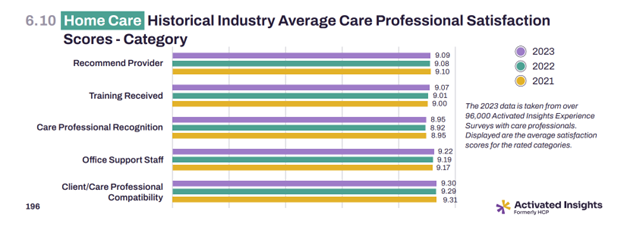
According to the Benchmarking Report, recognition received the lowest satisfaction score from employees. Care staff are most dissatisfied with the appreciation they’re receiving after a job well done, followed by feeling inadequately prepared for the field.
Not only are feelings of unappreciation causing turnover rates to skyrocket, it’s also having a detrimental impact on the state of the industry.
As a result of not feeling appreciated or recognized for the work they do, your employees may be showing warning signs of impaired grief processing:
-
- Irritability or anger
- oddly negative behaviors or attitudes that are uncharacteristic for the employee
- Obsessive thoughts
- rumination over certain patients or issues that is constantly brought up and seems to never be resolves
- Hyper alertness or overreactive behaviors
- intense, erratic behaviors or excessive attention to work that is unwarranted or outside of the normal response
- Self-harming behaviors
- gravitation to overworked, exhaustive behaviors e.g. refusing to take breaks, taking on added tasks unnecessarily
- Apathy or numbness
- lack of reaction to items that would normally cause a response, decrease in emotions, or refusal to address difficult emotions
Contrary to popular opinion, an employee doesn’t leave their emotions at the door when they come into work. Especially if they work in a service-based industry like long-term and post-acute care.
The emotions an employee feels while caring on the job affects performance, customer and employee satisfaction, and care outcomes.
For example, if an employee is feeling stressed, frustrated, or disgruntled, they will either appear as they’re caring for their residents and patients or be forced to put up a positive front on the outside while bottling up negative emotions on the inside. Whether these types of negative emotions are revealed in the open or held within, either outcome leads to low satisfaction and high employee turnover.
Instead, be an advocate for your employees’ wellbeing and mental health. Provide resources for mental health support and regularly check-in with your staff at important milestones. Offering competitive benefits, flexible hours, and paid time off encourages employees to tend to their own needs as well as others.
As a highly accomplished executive, Todd Austin, COO & President of Activated Insights, is recognized as a leading voice in the rapidly-growing care industry. With over a decade of experience in executive leadership roles, Todd brings a wealth of knowledge and expertise to his current position as a key member of the Activated Insights team.
With a background in sales, marketing, management, operations, and finance, Todd is a true Renaissance executive with a rare combination of strategic and tactical skills. His expertise in developing and implementing growth strategies, optimizing operations, and driving profitability has made him a sought-after advisor to many organizations.
Sasha Erickson is the Director of Talent at Activated Insights, formerly HCP. With over 10 years of experience in human resources across a variety of industries, Sasha has worked with organizations ranging from small businesses to Fortune 500 companies. She graduated Summa Cum Laude from Utah State University with a degree in Business Administration and minors in Human Resource Management, Marketing, and Finance.
Sasha’s career history includes roles at Avant Guard Monitoring Centers, Goldman Sachs, Schreiber Foods, JBS and Pilgrim’s Pride Corporation, RR Donnelley, and Denver Public Schools. Her expertise spans talent acquisition, employee engagement, culture development, HCM software implementation, and strategic HR management.
©2024 by The Rowan Report, Peoria, AZ. All rights reserved. This article originally appeared in The Rowan Report. One copy may be printed for personal use: further reproduction by permission only. editor@therowanreport.com
by Rowan Report | Jul 12, 2024 | Partner News
by Bud Meadows, CEO, Activated Insight
I am thrilled to announce that we are now consolidating our growth under one unified name: Activated Insights. This new name clearly reflects our dedication to serving the long-term and post-acute care market, and it better represents our diverse range of unique capabilities.
As we transition to Activated Insights over the coming months, you’ll benefit from our integrated capabilities designed to empower employees to deliver the very best care, and make clients feel like they’re receiving just that. And we’re committed to doing our part by:
-
Providing you with the data to help recruit and retain employees.
-
Educating and supporting your clinical and care staff.
-
Enabling you to improve the experience of the people in your care through our unique analytics, workflow, and benchmarking.
-
Informing and enhancing internal processes so you can demonstrate your commitment to those you hire and serve.
Although we are adopting a new name, the heart and mission of who we are remains the same. We are dedicated to helping you make the most of every interaction for your employees, clients, and beyond.
Our goal is to keep you well-informed and ensure your experience with us remains seamless throughout this transition. You can expect to see updated branded materials in the coming months.
Bud Meadows
Chief Executive Officer, Activated Insights, Formerly HCP
by Elizabeth E. Hogue, Esq. | Apr 11, 2024 | Clinical, Regulatory
By Elizabeth E. Hogue, Esq.
A key purpose of the Health Insurance Portability and Accountability Act (HIPAA) is certainly to protect patient information. Another is to help ensure that patients have access to their health information. In fact, the Office of Civil Rights (OCR) of the U.S. Department of Health and Human Services, the primary enforcer of HIPAA, has focused on enforcement actions against providers that do not make information available to patients on a timely basis. OCR launched a right to access enforcement initiative in 2019 that is continuing.
Providers must give medical information to patients and their representatives within thirty days of requests. When they fail to do so, they may be subject to enforcement action by OCR. Following are two examples of recent enforcement actions.
OCR announced on April 1, 2024, that Essex Residential Care in New Jersey will pay a civil money penalty of $100,000 to resolve violation of HIPAA’s right of access standard. This is the 48th settlement reached under the right of access initiative. OCR received a complaint in May of 2020 from the personal representative of the estate of a patient who passed away. Following an investigation by OCR, the personal representative, who was the son of the patient, received the records in November of 2020. The provider did not contest the fine.
In another recent case, the daughter of a patient who passed away was appointed as the personal representative of her mother’s estate. She made multiple requests to Phoenix Healthcare for a copy of her mother’s medical records. She finally received the records one year after her initial request. Phoenix Healthcare initially received a civil money penalty of $250,000 for failure to provide timely access.
The provider appealed. An administrative law judge (ALJ) upheld the violation and ordered Phoenix to pay a civil money penalty of $75,000. The Departmental Appeals Board affirmed the ALJ’s decision. Then Phoenix agreed to settle for $35,000 and waived the right to further appeals. While it may seem in this case that the provider’s appeals significantly lowered its costs, it is important to note that the provider also undoubtedly expended significant resources on two appeals of OCR’s enforcement action.
Providers have placed a great deal of time and effort into the protection of healthcare information in compliance with HIPAA. Rightfully so, but providers seem to have lost sight of the fact that HIPAA is also about ensuring that patients and their representatives have timely access to their records. Now is the time for providers to conduct intensive education of staff members about HIPAA’s requirements regarding access in order to avoid enforcement actions like those described above.
©2024 Elizabeth E. Hogue, Esq. All rights reserved. No portion of this material may be reproduced in any form without the advance written permission of the author. For more information on how to get access to this or any other article, please contact The Rowan Report.
by Tim Rowan | Apr 11, 2024 | Clinical, Editorial, Telehealth
by Tim Rowan, Editor Emeritus
In 2020, doctors flooded telehealth companies with requests for help caring for patients reluctant to leave home to come to their appointments. Following suit, many Home Health agencies that had never considered investing in home telehealth before, opened up their wallets to acquire equipment, from simple wearables to high-end, HIPAA-compliant video systems.
In addition to the need to provide care at a safe distance, many HHA leaders knew the added service would attract the attention of hospitals desperate to discharge recovering Covid victims as well as non-Covid patients. Some HHAs established relationships with hospitals they had not had before, given the chance to demonstration Home Health’s unique advantages over extended hospital stays and discharges to institutions such as SNFs that had become virtual death sentences during the height of the pandemic.
All Things Must Pass
 With the introduction and widespread free availability of Covid mRNA vaccines, the death rate graph line began to tilt downward. Then came the discovery that the SARS-CoV-2 and its variants are transmitted through the air and not through unwashed surfaces. People stopped disinfecting their counter tops after unloading groceries. And they started in-person doctor visits again. Patients returned to allowing nurses into their homes.
In regions where vaccination and booster rates were high, hospitals found themselves with more and more empty beds. They took down tented treatment centers in their parking lots and sent refrigerated trailers back to trucking companies. Desperation referrals to Home Health tapered off, as did the need for virtual visits.
Isaac Newton said every action has an equal and opposite reaction. If that holds true in the healthcare business as it does in physics, the reaction to Covid easing is seen in Remote Patient Monitoring tech companies. According to Fierce Healthcare, the New York Stock Exchange told one RPM company, Amwell, formerly known as “American Well,” to raise its stock price or be delisted. Fierce added detail about the company’s woes:
“Despite decimating its workforce at the end of 2023 to cut expenses, the company still projects a 2024 loss between $160 million and $155 million amid incremental revenue growth. The company’s market cap was a stone’s throw from $6 billion at the height of its valuation, when shares were trading for more than $42 each. Amwell shares were trading at $0.72 as of market close on April 5, giving the company a current market cap of about $208.6 million.
Another market leader fared no better, Fierce Healthcare found. “Telehealth giant Teledoc, which has been in operation for 20 years, has struggled in the stock market and is facing headwinds as the virtual care market has become crowded with digital health players. Shares dropped 22 percent in February as the company missed fourth-quarter revenue estimates and offered a downbeat forecast for the rest of the year.”
Teledoc’s 15-year CEO, Jason Gorevic, resigned last week after the company reported a net loss of $220 million for 2023, following 2022’s historic loss of $13.7 billion, mostly from a write-off related to the plummeting value of its ill-advised Livongo acquisition. According to Fierce Healthcare, Teladoc shelled out $18.5 billion for the digital chronic condition management company, a record in digital health.
Gorevic’s rationale that the telehealth field has become too crowded may not be far off. Last July, Becker’s Hospital Review published an industry survey titled “280+ Telehealth Companies to Know.” The list included a half dozen names we recognized from past Home Health conferences, including Health Recovery Solutions, AMC, Vivify, and FoneMed.
Do Hospital Woes Translate Down to Home Health?
 Making comparisons between telemedicine companies that focus on hospitals and physicians and those who focus on post-acute providers is hampered by the fact that few in our sector are publicly traded and do not share their numbers. UnitedHealth, which acquired Vivify in 2019 and assigned it to its Optum division, does not separately report Vivify revenue.
Health Recovery Solutions, one of the best-known names in post-acute RPM, is privately held by its founding CEO and seven investors. Its most recent influx of $800,000 occurred in January, 2022, making it impossible to determine whether it was motivated by investor confidence or the need for cash as Covid began its decline.
Analysis
This publication has promoted the advantages of remote patient monitoring for its entire 25-year existence. We have covered startups and established tech companies offering every technology from PERS to Zo monitors to automated phone calls, in-home cameras and microphones. We have followed the evolution of two-way communications and vital sign detectors from tabletop devices to tablets and smartphones. We have even tested a few robots. We have seen HHAs experience great success, and we have seen devices collecting dust on shelves.
Throughout, we have maintained that, when selected, implemented, and deployed properly, monitoring patients 24/7 instead of once or twice a week can improve patient outcomes, boost agency reputation, and, more often than not, produce a healthy ROI. The end of the latest pandemic may mean the end of demand for Remote Patient Monitoring systems, but that would be unfortunate.
 Tim Rowan is a 30-year home care technology consultant who co-founded and served as Editor and principal writer of this publication for 25 years. He continues to occasionally contribute news and analysis articles under The Rowan Report’s new ownership. He also continues to work part-time as a Home Care recruiting and retention consultant. More information: RowanResources.com or Tim@RowanResources.com
©2024 by The Rowan Report, Peoria, AZ. All rights reserved. This article originally appeared in Healthcare at Home: The Rowan Report. One copy may be printed for personal use: further reproduction by permission only. editor@therowanreport.com