Product Review: Plan-of-Care Documentation

by Kristin Rowan, Editor

OASIS Assessment is a Time Suck

Regulatory requirements for home health quality assurance are designed to monitor and improve quality of care. QA focuses on ensuring that patients get safe, effective, compassionate care that meets their individual needs. QA also improves patient outcomes and reduces adverse events like ER visits and rehospitalizations. OASIS includes 79 standardized medical, nursing, and rehab data elements for a comprehensive assessment. Typical OASIS assessments take 1-2 hours to complete, depending on the patient’s complexity and the assessment type. 

Artificial Intelligence in OASIS coding

The Rowan Report recently came across a tool that addresses the complexities of OASIS coding. We sat down with Zach Newman (CEO) and Dan Conger (Founder) at Enzo Health to learn more about their AI powered QA tool with customizable workflows.

Co-pilot for Your Agency

Enzo Health is a documentation tool that automates workflows, acting as a co-pilot for your agency. Some of the workflows that Enzo Health supports include intake, OASIS, and QA reviews. Automating these processes can reduce errors and clawbacks, save your clinicians hours of paperwork, and offer cost savings to your agency.

QA Process

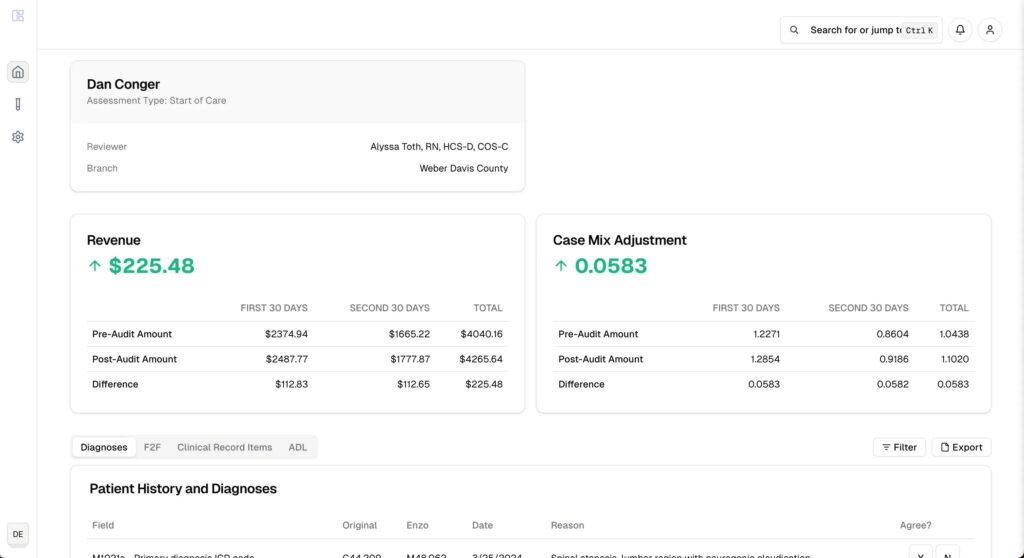
With the Enzo health QA tool, users upload all documents related to an episode. This will include the referral, initial visit notes, patient information, medical history, and form 485. Enzo calls out any issues it finds in the documentation.

In Face-to-Face encounters, Enzo looks for dates, signatures from qualifying clinicians, a valid primary diagnosis, and other qualifying information.

For ICD-10 Coding, Enzo assesses primary and secondary diagnoses, and adds notes with links to where the information can be found in the uploaded documentation.

Enzo then provides functional limitations and improvements that can be made. Using a team of clinicians that are trained as home health coders, Enzo provides a proxy for internal teams. These coders review charts and finalize diagnosis coding and OASIS answers.

Episode of Care

Qualification for an episode of care is required before anything else happens with a referral. Enzo’s intake automation tool reviews the referral package in advance of the initial F2F. Mirroring the agency’s internal intake process, Enzo determines whether the patient will be admitted to care, whether their insurance will cover the episode, and whether the patient’s psych history may impact the plan of care.
Enzo Health QA Automation

Clinical Assistance

The Rowan Report has often stated, and will continue to stand by this fact, that there is no substitute for face-to-face care and the expertise of the nurses and clinicians in the home. We have also seen the advancement of artificial intelligence that provides assistance and guidance at the point-of-care that can be useful. Enzo health includes a chat tool that pulls evidence-based information to provide guidance, coding instructions, and other help to nurses.

QA Tool Integration with Scribe Tool

Enzo Health has developed a talk-to-text scribe tool that integrates directly with the QA tool. The use of both products together would likely save more time as well as reduce errors. The Rowan Report will provide a thorough product review of the scribe tool at a later date. Enzo Health charges a flat fee determined by volume and offers bundle pricing for using both the QA and Scribe tools.

Final Thoughts

Costs are increasing, the workforce shortage is ongoing, nurses are suffering from burnout, and employees are stretched about as thin as they can go. Any tool that alleviates paperwork, stress, unpaid work at home to finish documentation, and the need for additional back-office staff is worth looking into. Enzo differentiates its tool from other QA software with their team of clinicians trained in home health coding to review the documentation. This end-to-end tool boasts a 95% accuracy rate and do date has no clawbacks or ADRs. 

In my conversation with Zach and Dan, their coding expertise and knowledge of the home health industry were evident. They are excited about the tools they are creating and passionate about helping agencies to provide patient care, a task they referred to as “very noble.” They continue to improve upon their software and conceive of innovative additions. If they continue as they started, Enzo Health will be one to watch.

Creating a Culture that Retains Employees

This article is part two of a two-part series. You can read part one here.

by Todd Austin and Sasha Erickson

3 Steps Towards Creating a Culture of Love that Retains Employees

In a study done on the “Culture of Companionate Love and Employee and Client Outcomes in a Long-Term Care Setting,” researchers found displaying warmth, affection, and connection had a tangible impact on employee turnover, resident outcomes, and family satisfaction.

Employees who felt they worked in a loving, caring work environment reported higher levels of satisfaction, increased teamwork, and showed up to work more regularly. But the effects of a companionate culture aren’t just felt by your employees.

Research shows that employees who work in a culture of love companionate culture directly related to client outcomes such as improved patient mood, quality of life, satisfaction, and fewer trips to the ER.

A culture like this is only made possible through a conscious effort from leadership to make their employees feel cared for and appreciated. To see similar results in your own business, start creating a culture of love.

Be an advocate for your employees' mental health

Contrary to popular opinion, an employee doesn’t leave their emotions at the door when they come into work. Especially if they work in a service-based industry like long-term and post-acute care.

The emotions an employee feels while caring on the job affects performance, customer and employee satisfaction, and care outcomes.

For example, if an employee is feeling stressed, frustrated, or disgruntled, they will either appear so as they’re caring for their residents and patients or be forced to put up a positive front on the outside while bottling up negative emotions on the inside. Whether these types of negative emotions are revealed in the open or held within, either outcome leads to low satisfaction and high employee turnover.

Instead, be an advocate for your employees’ wellbeing and mental health. Provide resources for mental health support and regularly check-in with your staff at important milestones. Offering competitive benefits, flexible hours, and paid time off encourages employees to tend to their own needs as well as others.

Broaden your company’s definition of culture

Culture is more than a staff break room with a foosball table. Your company’s culture will create itself, whether you’re in control of it or not.

Creating a healthy company culture requires deliberate and consistent actions from your leadership team. It is your goal to ensure that when your employees think about work on a Sunday night, they feel positive about coming to work every Monday morning. At Activated Insights, our approach centers on understanding and enhancing the employee experience through several key strategies:

    • Culture and Engagement Assessments
      • We regularly administer assessments to identify strengths and areas needing improvement to help us stay attuned to the evolving needs and perceptions of our employees.
    • Employee Focus Groups and Culture Audits
      • We have started administering focus groups and culture audits to gain real insights and solutions directly from our employees. These sessions create open lines of communication where employees can express their thoughts and ideas.
    • Prioritizing Employee Wellness
      • We offer unlimited PTO with mandatory minimums, including one mental health day off each quarter and a minimum of two weeks off per year with at least one period of five consecutive days off. This policy underscores our commitment to employee well-being, ensuring that they can balance work with personal life effectively.
    • Effective Communication and Leadership
      • Continuously communicating, modeling, and reinforcing the company’s vision, values, mission, and guiding principles is crucial. Leaders play a significant role in setting the tone and maintaining a positive culture by leading with transparency, empathy, and consistency.
    • Team Building and Collaboration
      • At Activated Insights our teams are often comprised of both in-office and remote employees. We encourage teams to get together at least annually. It’s imperative that companies are deliberate in providing opportunities for their teams to collaborate, build trust, and break down silos. We find that this improves overall job satisfaction and productivity.
    • Building Trust and Accountability
      • Trusting employees and treating them like adults to manage their work and personal demands is essential. By creating an environment of trust and accountability, we encourage employees to take ownership of their roles and contribute meaningfully to the organization’s success.

By focusing on these strategies, we ensure that our employees look forward to coming to work, feel valued and supported, and are motivated to contribute to a positive company culture.

Learn to speak your employees’ professional “love language”

If you don’t speak two languages, you won’t connect with your employees to make them want to stay.

While everyone communicates in their own way, if you don’t know the language your caregivers will listen to, your recognition efforts are going to waste.

But this isn’t the type of language Duolingo can teach you. Rather, every provider in the long-term and post-acute care industry should become fluent in appreciating their employees.

The Value of Communication

In 1992, Dr. Gary Chapman noticed a pattern of miscommunication after practicing couples’ counselling for years. He discovered that individuals often misunderstand one another’s needs by communicating how they would personally like to receive recognition, without taking the others’ needs into consideration. He concluded that how we respond to appreciation boils down to one of the following categories.

Learn how to speak your caregivers’ language of appreciation to increase caregiver retention, refine your leadership skills, and foster a culture of recognition:

Professional Love Languages

  • Words of Affirmation
    • Care employees ranked verbal recognition by a supervisor as their number one preferred form of recognition—and lack of communication from their employer as their top complaint. Actively seek out reasons you can praise your caregivers to boost company morale and foster a culture of gratitude:
      • Send handwritten thank you cards
      • Give your caregivers a shoutout in company newsletters or on social media
      • Recognize top performers using an employee of the month program to give everyone a chance to be in the spotlight
  • Receiving Gifts
    • While a raise may be outside of the company budget, 20.4% of caregivers mentioned smaller forms of monetary recognition as their chosen form of acknowledgement. Small bonuses for top performers, extra vacation time, or gift cards are simple forms of appreciation:
      • Give gift cards or free movie tickets
      • Give company branded clothing
      • Offer paid vacation time
  • Acts of Service
    • A care employee’s occupation is to literally provide service to those in need—but have you ever thought of ways to serve your care staff? Although it may seem counterintuitive to serve in a workplace where employees are paid, you can offer your staff the relief that they need by helping to shoulder some of their responsibilities:
      • Gather feedback and listen to how you can make their daily tasks or commute a little easier
      • Go the extra mile to make them smile by hosting random appreciation events where you can offer the company donuts, coffee, or even turkeys on Thanksgiving
  • Quality Time: Caregiving can be a very isolating job where they receive little social interaction with people other than their clients. Consciously create opportunities to spend quality time with your caregivers:
      • Hold group training events to create an environment where caregivers can ask questions and learn from fellow coworkers.
      • Schedule one-on-one meetings or lunches to build individual relationships with your caregivers and check in on how they are doing.
      • Support their learning and professional development by discussing your caregivers’ goals and needs

So, What Does Love Have to Do With It?

In short: everything.

Your ability to create a companionate culture of recognition for your care staff will be the difference that pulls you out of the revolving doors of recruitment and retention.

The quality of your leadership within your company directly impacts your quality of care for the long-term and post-acute care industry.

In 2024, spend more time consciously creating a companionate culture and start to see your employee retention and client satisfaction skyrocket.

# # #

Kristin Rowan, Editor

As a highly accomplished executive, Todd Austin, COO & President of Activated Insights, is recognized as a leading voice in the rapidly-growing care industry. With over a decade of experience in executive leadership roles, Todd brings a wealth of knowledge and expertise to his current position as a key member of the Activated Insights team.

With a background in sales, marketing, management, operations, and finance, Todd is a true Renaissance executive with a rare combination of strategic and tactical skills. His expertise in developing and implementing growth strategies, optimizing operations, and driving profitability has made him a sought-after advisor to many organizations.

Sasha Erickson is the Director of Talent at Activated Insights, formerly HCP. With over 10 years of experience in human resources across a variety of industries, Sasha has worked with organizations ranging from small businesses to Fortune 500 companies. She graduated Summa Cum Laude from Utah State University with a degree in Business Administration and minors in Human Resource Management, Marketing, and Finance.

Sasha’s career history includes roles at Avant Guard Monitoring Centers, Goldman Sachs, Schreiber Foods, JBS and Pilgrim’s Pride Corporation, RR Donnelley, and Denver Public Schools. Her expertise spans talent acquisition, employee engagement, culture development, HCM software implementation, and strategic HR management.

©2024 by The Rowan Report, Peoria, AZ. All rights reserved. This article originally appeared in Healthcare at Home: The Rowan Report. One copy may be printed for personal use: further reproduction by permission only. editor@therowanreport.com

What’s Love Got to Do with It?

This article is part one of a two-part series from Activated Insights, formerly Home Care Pulse. Come back next week for the continuing story. Read more about Caring for the Caregiver here

by Todd Austin and Sasha Erickson

How to Create a Culture that Keeps Your Employees from Breaking Up with You

Healthcare employees admit that the 3 main factors contributing to the most stress at work are:

    • Concerns about being trainied for the required workload
    • Worries about job security
    • Finding the time to balance work and personal life

As a result, almost 60% of those working in the healthcare space reported their self-assessed level of burnout to be between moderate and very high—which can be attributed to the high-level emotional investment required for the job.

Post-Acute Turnover

While the long-term and post-acute care is one of the fastest growing industries in the nation, it also ranks in the top 5 workforces with the highest turnover.

Fortunately, the care employee burnout crisis is fixable.

The cure?

Treating our staff, and ourselves, with a little more conscious compassion.

It's Not You, It's Me

The Long-Term Effects of Unappreciation

For most other industries, employee turnover peaks at one year.

But for the long-term and post-acute care industry, 40% of turnover occurs within an employee’s first 100 days.

Which isn’t leaving much room for providers to retain their staff. According to the 2024 Activated Insights Benchmarking Report, annual care staff turnover increased by 14% within the last two years, averaging a total of 79.2%.

But there is hope in the data.

What if we told you that simply thanking your care staff more could get them to stay longer than 3 months?

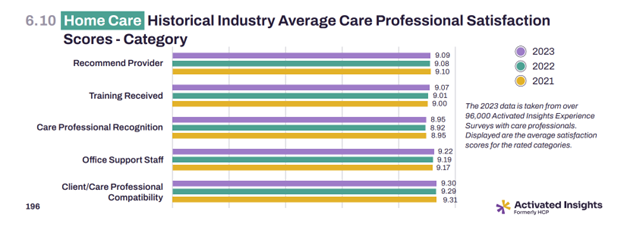
According to the Benchmarking Report, recognition received the lowest satisfaction score from employees. Care staff are most dissatisfied with the appreciation they’re receiving after a job well done, followed by feeling inadequately prepared for the field.

Activated Insights Culture

Not only are feelings of unappreciation causing turnover rates to skyrocket, it’s also having a detrimental impact on the state of the industry.

As a result of not feeling appreciated or recognized for the work they do, your employees may be showing warning signs of impaired grief processing:  

    • Irritability or anger
      • oddly negative behaviors or attitudes that are uncharacteristic for the employee
    • Obsessive thoughts
      • rumination over certain patients or issues that is constantly brought up and seems to never be resolves
    • Hyper alertness or overreactive behaviors
      • intense, erratic behaviors or excessive attention to work that is unwarranted or outside of the normal response
    • Self-harming behaviors
      • gravitation to overworked, exhaustive behaviors e.g. refusing to take breaks, taking on added tasks unnecessarily
    • Apathy or numbness
      • lack of reaction to items that would normally cause a response, decrease in emotions, or refusal to address difficult emotions

Contrary to popular opinion, an employee doesn’t leave their emotions at the door when they come into work. Especially if they work in a service-based industry like long-term and post-acute care.

The emotions an employee feels while caring on the job affects performance, customer and employee satisfaction, and care outcomes.

For example, if an employee is feeling stressed, frustrated, or disgruntled, they will either appear as they’re caring for their residents and patients or be forced to put up a positive front on the outside while bottling up negative emotions on the inside. Whether these types of negative emotions are revealed in the open or held within, either outcome leads to low satisfaction and high employee turnover.

Instead, be an advocate for your employees’ wellbeing and mental health. Provide resources for mental health support and regularly check-in with your staff at important milestones. Offering competitive benefits, flexible hours, and paid time off encourages employees to tend to their own needs as well as others.

# # #

Todd Austin Culture

As a highly accomplished executive, Todd Austin, COO & President of Activated Insights, is recognized as a leading voice in the rapidly-growing care industry. With over a decade of experience in executive leadership roles, Todd brings a wealth of knowledge and expertise to his current position as a key member of the Activated Insights team.

With a background in sales, marketing, management, operations, and finance, Todd is a true Renaissance executive with a rare combination of strategic and tactical skills. His expertise in developing and implementing growth strategies, optimizing operations, and driving profitability has made him a sought-after advisor to many organizations.

Sasha Erickson is the Director of Talent at Activated Insights, formerly HCP. With over 10 years of experience in human resources across a variety of industries, Sasha has worked with organizations ranging from small businesses to Fortune 500 companies. She graduated Summa Cum Laude from Utah State University with a degree in Business Administration and minors in Human Resource Management, Marketing, and Finance.

Sasha’s career history includes roles at Avant Guard Monitoring Centers, Goldman Sachs, Schreiber Foods, JBS and Pilgrim’s Pride Corporation, RR Donnelley, and Denver Public Schools. Her expertise spans talent acquisition, employee engagement, culture development, HCM software implementation, and strategic HR management.

©2024 by The Rowan Report, Peoria, AZ. All rights reserved. This article originally appeared in The Rowan Report. One copy may be printed for personal use: further reproduction by permission only. editor@therowanreport.com

Sasha erickson Culture

Recruitment, Retention, and Reward: Product Review

by Kristin Rowan, Editor

Caregiver Recruitment, Retention, & Reward

The workforce shortage, caregiver burnout, after effects of the pandemic, and the advent of “quiet quitting” have impacted home care agencies’s ability to fully staff and care for their patients. Hiring new caregivers is not always an options. Agencies must put time and effort into recognizing, rewarding, and retaining their existing caregivers and clinicians.

The Rowan Report recently came across a company that is helping agencies do just that and we had an opportunity to sit down with their founder.

How it Started

Victor Hunt’s grandmother was a career nurse who started her own home care agency. However, the operation was too hard for her to handle on her own. She made the difficult decision to close the agency and go back to shift work. Victor realized that we need more home care agencies. But, he knew there had to be a way to help the people who have “home care heart” and can provide great care. There had to be an easier way.

Home Care Immersion

Before Victor and his team could address the difficulties faced by home care agency owners, they first had to understand them. With his co-founder Dan, Victor embedded himself into home care agencies. They took shifts, followed schedulers and recruiters, and experienced the problems up close. During this process, they got to know one agency in particular and one caregiver who was a rockstar. She picked up shifts, did training, contributed the company culture, visited patients in the hospital, and had referred more than 100 caregivers to the agency. In short, she was the home care clinician all agency owners want.

Her Name was Ava

Using this rockstart clinician, Victor and Dan set out to create a system that could turn every caregiver into an “Ava” and make every agency one that caregivers like Ava would want to work for. The mission of Victor’s and Dan’s company is to “make home care agencies destination employers.”

The Problem Statement

Home care agencies suffer from high turnover rates and performance challenges. THere is a lot of legwork that needs to be done to fill in the gaps and fix what isn’t done well. According to Victor, it comes down to a challenge of engagement and morale. Being a home care clinician is a lonely and thankless task. Caregivers can feel stuck in their career track unless they are actively pursuing higher credentials. The problem home care agency owners face is:

“How do we engage employees so their work feels recognized and meaningful?”

The Solution is Ava

The Ava team surmised that in order for caregivers to feel valued and appreciated, something had to give. The question, they wondered, was whether it would be margins or administrative overhead. AI was at the center of these conversations. But, traditional EMRs limit the implementation of AI solutions.

Recognition and Rewards

Because EMRs limit AI applications, Ava is an app but is also a stand-alone system that operates in a mobile browser. No download is required for use, yielding an 85-90% adoption rate within agencies offering Ava.

Ava connects to the existing EMR first to import data. Then, agency owners create their own rule sets. This offers incentives and engagement around specific metrics the agency wants to see. Examples include attendance, timeliness, number of hours, documentation, and completed training. 

Ava will then assign, track, and reward milestones based on the rules set for the agency. Clinicians earn points that can be redeemed directly from the Ava store with more than 100 participating vendors. Agencies can also add internal rewards like branded merchandise, PTO, and raffle tickets. Rewards can be redeemed in $5 increments. 

Recruitment, retention, and reward AVA

Communication

Ava includes automated messaging to recognize employees without taking valuable time away from administrators. The app sends recognition texts to all staff to congratulate clinicians for reaching certain benchmarks. Announcements can be sent by email or SMS to all employees at once. Additionally, Ava includes HIPAA compliant two-way communication between agency and staff.

Additionally, administrators can create groups within the system to send mass reminders to specific people. For example, you may create a group that includes all employees whose driver’s license will expire in the next 60 days. Within that group, reminders are sent to ensure updated information is added to the employee file. The system updates automatically each week, adding and removing employees from the group based on the criteria created. 

Surveys are a great way to keep a pulse on the level of commitment and satisfaction your employees have. Studies suggest that engagement is a large factor in why employees leave their workplace. Ava includes pre-built survey templates but also allows you to crete a survey using an AI query. The survey questions and answers are customizable, can be “required”, set to “read only”, and can include a comment box to gain additional insights. Administators can filter survey responses to only see a certain type of answer.

Marketing

Recruitment, retention, and reward AVA

Referrals from employees is not a new concept. However, it is not always a visible part of your recruiting strategies. Ava has a referral bonus program with automated milestones. The bonus program spreads the referral bonus out across multiple agency milestones. 

Ava also allows for manual tracking of Google Reviews or any other event or milestone where clinicians can be measured, tracked, and rewarded. 

Customizable on Multiple Fronts

In addition to the custom survey questions and benchmarks, Ava includes custom naming conventions to track clinicians. One agency uses the term “activity tag” to categorize achievements. If your agency already uses different terminology, that can be added to the system. 

Currently, Ava operates and switches between seven different languages. Additional languages can be added to the system and Ava can support those as well. 

Recruitment processes are also customizable. Agencies can give candidates access to the system during the hiring process and they can earn points for attending the interview, completing onboarding paperwork, finishing the first training shift, or other measures. This allows the agency to reward a new employee with, for example, a coffee gift card by the end of their first day. 

Track and Reward Your Top Employees

When your agency finds an exemplary employee, the unicorn, the “Ava”, keeping them becomes a top priority. Finding and training new employees is costly and time consuming. It is far easier and less expensive to reward your current high-achievers.

Badges

In addition to daily, weekly, and monthly goals, Ava has a tier system called “Badges.” Badges are long-term drivers of engagement, satisfaction, and success. The current badges are Orange (Avas brand), Silver, and Gold. There are points multipliers at each level. 

Once an employee reaches a badge level, they have to maintain a consistent 90% goal completion rate in daily, weekly, and monthly goals in order to maintain their badge level. Loss aversion to lowering back down a level encourages a high completion rate of other tasks. 

Training

Caregivers and clinicians should be constantly learning to stay ahead of the newest trends and technologies in the industry. Ava includes learning management system (LMS) integrations with several of the top training companies in the industry. Clinicians can access learning modules through the app or browser and can earn rewards by completing training modules based on individual agency settings. 

Reporting

Reports within the system go beyond badges and benchmarks. The system consolidates reporting from various data sources and allows you to see your business health at a glance. These reports can help catch burnouts before they happen, focus performance improvement plans, and automate process than can save an agency hundreds of thousands, if not millions, of dollars per year.

Limitations

Like most software solutions, the first iteration of a usable system is never the last version. Ava has already integrated with WellSky and can access several other EMRs. As they continue onboarding customers, the team at Ava is very open to the suggestions of their users and will continue adding features.

Some current limitations we noticed in our intial demo:

The badge system has only three levels. Longer term employees may want to see higher badge levels to maintain motivation. Victor noted that AI systems can help add account-specific customizations.

The app is designed for caregivers and clinicians. There is not currently a model for back-office administrators and support staff. While some customization could make the app usable for the back-office, it is not designed with them in mind.

Mass messaging through email or SMS is limited to one-way, read-only communication. There is an option to add “likes,” but currently there is no option for a group or individual to respond, even privately to a company-wide announcement.

The two-way communication is limited to internal staff. Employees cannot communicate with patients from the app to advise them of their arrival time, reschedule an appointment, or ask questions before an appointment.

The manual tracking of Google reviews is not scalable.

When The Rowan Report sat down with the team at Ava, we asked about some of these limitations and additional ideas for future iterations of the program. Victor and his team have already hired at least one person to focus on new feature requests.

Final Thoughts

Gamification is not a new concept in many industries. In fact, most of us probably have a memory of a teacher or parent with an activity board to earn stars for tasks completed. We’ve been unknowingly using gamification for many years. 

Smart phones, advancing technologies, and AI have increased the adoption of gamification and is infiltrating the care at home world quickly. The ongoing workforce shortage will make implementing these types of gamified systems even more important for an agency’s financial well-being. 

Ava may not be the first of its kind, but it has shown innovation and ingenuity in it application. If your agency is looking for ways to reward employees, needs to stand out among rival employers, is looking to reduce administrative costs, or needs a simpler way to see reports and statistics from multiple sources, Ava may be a viable solution. 

We see great things coming with future iterations of the app and the software and I’m sure this is not the last we will here of Ava. For more information, visit joinava.com.

# # #

Kristin Rowan, Editor

Kristin Rowan has been working at Healthcare at Home: The Rowan Report since 2008. She has a master’s degree in business administration and marketing and runs Girard Marketing Group, a multi-faceted boutique marketing firm specializing in event planning, sales, and marketing strategy. She has recently taken on the role of Editor of The Rowan Report and will add her voice to current Home Care topics as well as marketing tips for home care agencies. Connect with Kristin directly kristin@girardmarketinggroup.com or www.girardmarketinggroup.com

©2024 by The Rowan Report, Peoria, AZ. All rights reserved. This article originally appeared in Healthcare at Home: The Rowan Report. One copy may be printed for personal use: further reproduction by permission only. editor@therowanreport.com