Hospice Carve-In is Out

FOR IMMEDIATE RELEASE

Contact:                                                                   Hannah Kristan
communications@allianceforcareathome.org
202-355-1647

Sen. Marshall and Sen. Whitehouse Issue Letter to Senate Leadership Expressing Bipartisan Support for Policies that Preserve Medicare’s Hospice Benefit Under Original Medicare

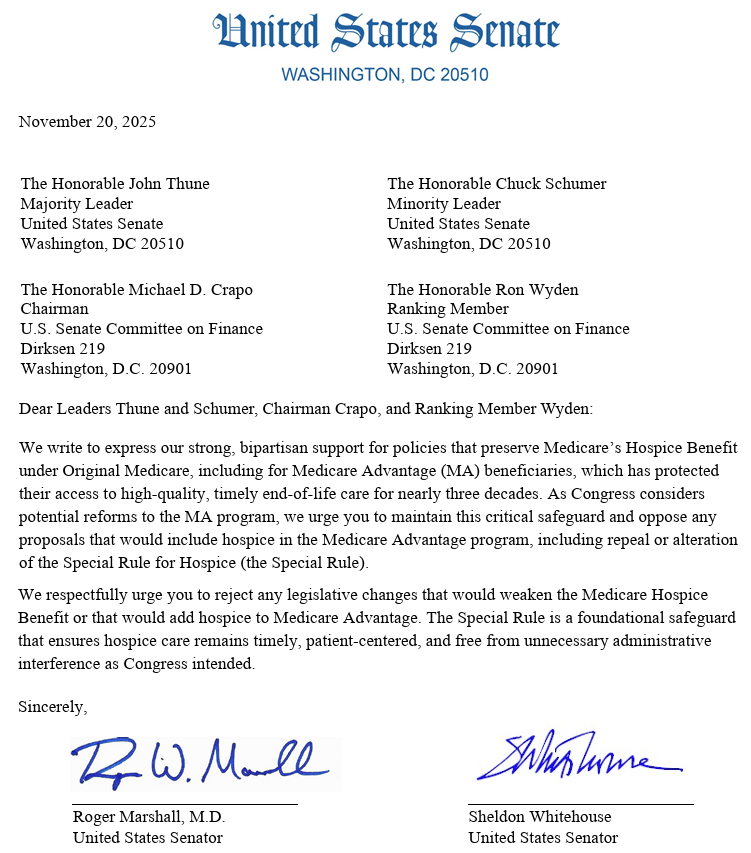
Alexandria, VA and Washington, D.C., November 24, 2025. On November 20, Senator Roger Marshall (R-KS) and Senator Sheldon Whitehouse (D-RI) sent a letter to Senate leadership expressing strong bipartisan support for policies that preserve the Medicare Hospice Benefit under Original Medicare, including for Medicare Advantage (MA) beneficiaries, which has protected their access to high-quality, timely end-of-life care for nearly three decades. 

Repeal Special Rule

As Congress considers potential reforms to the MA program, the letter urges Senate leadership to maintain this critical safeguard and oppose any proposals that would include hospice in the Medicare Advantage program, including repeal or alteration of the Special Rule for Hospice (the Special Rule), also known as hospice carve-in.  

Hopice in MA

Despite years of attempts from Congress, the Alliance strongly opposes efforts to integrate hospice into Medicare Advantage (MA). Past attempts have revealed challenges such as administrative burdens, difficulty creating networks, and delayed payments for claims. Bringing hospice under Medicare Advantage would undermine patient choice, adversely impact timely access to care, and fragment the hospice experience for patients and families at a highly vulnerable time.

View the full letter here. 
Leave Hospice Carve-In Out

Excerpt

“MA enrollees who elect hospice currently retain the freedom to choose any Medicare-certified hospice provider, free from network limitations or prior authorization requirements. More than half of hospice beneficiaries pass away within 14 days of election, making delays in care both harmful and unacceptable. Integrating the hospice benefit into MA plan design would jeopardize this access by layering additional managed care terms (or policies) on top of an already managed and coordinated benefit.” 

Marshall and Whitehouse

U.S. Senators

Your content goes here. Edit or remove this text inline or in the module Content settings. You can also style every aspect of this content in the module Design settings and even apply custom CSS to this text in the module Advanced settings.

“The Alliance thanks Sen. Marshall and Sen. Whitehouse for listening to the concerns of the care at home community and taking action to protect our nation’s most vulnerable patient population by defending the Hospice Benefit under original Medicare,” said Scott Levy, Chief Government Affairs Officer at the Alliance. “The Alliance will continue to lead on this important public policy priority for hospice providers nationwide by advocating to preserve this sacred promise established by Congress and kept on behalf of the American people for over four decades.” 

# # #

About the National Alliance for Care at Home

The National Alliance for Care at Home (the Alliance) is the leading authority in transforming care in the home. As an inclusive thought leader, advocate, educator, and convener, we serve as the unifying voice for providers and recipients of home care, home health, hospice, palliative care, and Medicaid home and community-based services throughout all stages of life. Learn more at www.AllianceForCareAtHome.org.  

© 2026. This press release originally appeared on the National Alliance for Care at Home Website and is published with permission. For additional information or for permission to print, please see press contact above.
Medicare Advantage Excess Payments

by Kristin Rowan, Editor

Medicare Advantage Excess Payments

Investigational Study

Researchers from the Department of Health Services, Policy and Practice at Brown Universchool of Public Health and the Department of Geriatrics and Palliative Medicine at Icahn School of Medicine published an original investigative study on spending versus payments in Medicare Advantage under the hospice carve-out model.

Carve-out to VBID to Carve-out

In 2021, CMS started a Value-Based Insurance Design (VBID) to test the impact of adding hospice services to Medicare Advantage benefits. By December of 2024, CMS ended the program due to widespread upset. CMS returned to the hospice carve-out model. Under this model, when an MA beneficiary chooses hospice, any health care expenses related to the terminal illness is paid on a fee-for-service (FFS) basis. MA no longer receives inpatient and outpatient payments, but continues to receive premiu, and rebate payments.

Carve-out Hospice Benefit

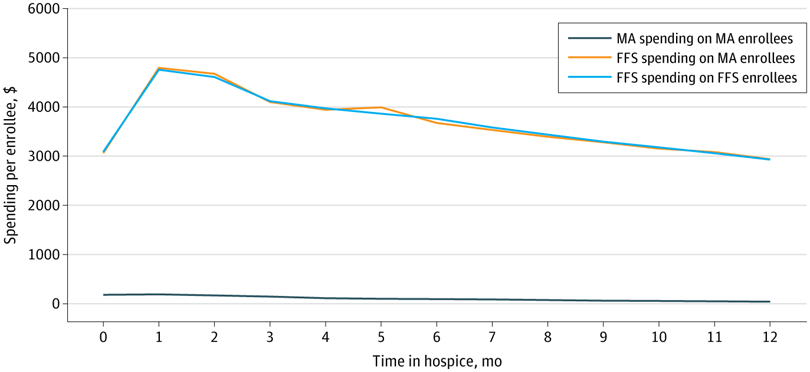
Once an MA enrollee enrolls in hospice, MA is no longer responsible for payments. Under the carve-out model, hospice services are paid by Medicare. MA plans are still responsible for paying for services that are not related to hospice care. These services can include inpatient, outpatient, physician, skilled nursing facility, home health care, and prescription drug expenses. 

Medicare Advantage Spending and Payments

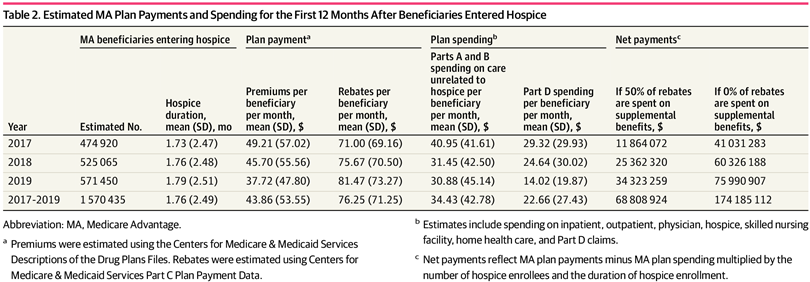
The study spanned 12 months and looked at 314,087 MA beneficiaries. In that period, 80.5% of enrollees had no spneding unrelated to their terminal illness. MA was not responsible for any healthcare related payments, but continued to receive $120 per enrollee per month. Estimated spending from MA on hospice enrollees was $57-70 per month. 

Medicare Advantage Excess Payments

In the 12 months following an enrollee electing hospice, MA plans netted $50-60 per month per enrollee. If half of the rebate payments received pay for supplemental benefits, MA receives excess payments to the tune of $68,808,924 over three years. If no rebate payments go toward supplemental benefits, MA receives $174,185,112 in excess payments over three years. The care a hospice enrollee receives uses the fee-for-service model. Medicare Advantage providers are seemingly paid on a fee-for-no-service model. 

Medicare Advantage plans do not currently report the actual amount of rebate payments used to pay supplemental benefits.

Study Conclusion

The researchers conclude that MA receives excess payments under the hospice carve-0ut model. They also note that there is no accountability for spending after hospice election from MA plans to CMS. The researchers suggest that CMS could require MA plans to report actual spending on supplemental services after hospice election and pay premiums and rebates only to cover the amount spent. 

I have a different recommendation….MA plans should not receive any additional premium payments or rebates following hospice election. MA plans should be required to report total payments and spending from enrollment date to election date. The balance, less the same 8% average margin of home and health and hospice agencies, should be used to pay for hospice services from election to passing. Any remaining balance after the patient’s passing should be returned to the beneficiary’s family.

# # #

Kristin Rowan, Editor

Kristin Rowan has been working at The Rowan Report since 2008. She is the owner and Editor-in-chief of The Rowan Report, the industry’s most trusted source for care at home news, and speaker on Artificial Intelligence and Lone Worker Safety and state and national conferences.

She also runs Girard Marketing Group, a multi-faceted boutique marketing firm specializing in content creation, social media management, and event marketing.  Connect with Kristin directly kristin@girardmarketinggroup.com or www.girardmarketinggroup.com

©2025 by The Rowan Report, Peoria, AZ. All rights reserved. This article originally appeared in The Rowan Report. One copy may be printed for personal use: further reproduction by permission only. editor@therowanreport.com