Delay HOPE Tool

by Kristin Rowan, Editor

Advocacy Groups to CMS:

Delay HOPE Tool Implementation

“Delay HOPE Tool Implementation,” say multiple hospice advocacy groups. LeadingAge, the National Alliance for Care at Home (The Alliance), and the National Partnership for Healthcare and Hospice Innovation (NPHI) are urging CMS to delay the transition from HIS to HOPE. The three groups sent a joint letter to Dr. Mehmet Oz, CMS Administrator, earlier this week.

“Our associations remain fully committed to the [Hospice Quality Reporting Program (HQRP)], including the payment penalties for non-compliance, and recognize the critical importance of accurate, timely data submission to inform the delivery of high-quality hospice care. However, we have serious concerns about the potential for successful implementation of the HOPE tool.”

LeadingAge, The Alliance, NPHI

Hospice Advocacy

The concerns over agency readiness to implement the new tool center on the new reporting platform. Hospice agencies state they don’t have all the necessary information to develop a workable tool for submission. Therefore, the agencies have asked CMS to delay the implementation of the HOPE tool. They have called on CMS to wait until six months after agencies have access to education, training, and final validation specifications.

Hospice Rule Penalty

The hospice program through CMS requires substantial reporting for payment. Hospices that do not submit the required 90% of records, they receive an annual payment penalty of 4%. Combined with lower than sustainable payment increases, the 4% penalty results in a lower reimbursement rate over prior years. The associations worry that the lack of information and education will lead to lower reporting. In turn, the lower reporting lowers reimbursement rates. For hospices that are already struggling to survive, the penalty is devastating. The letter to CMS asked to waive the timeliness requirement for two quarters after implementation.

HOPE Tool Lacks Validation

CMS will have a Validation Utility Tool that agencies will need to use in order to ensure their software can successfully submit their data. CMS has not released the tool and indicates they may not until sometime in September. The HOPE tool is scheduled for implementation in October. There is not enough time between release of the validity tool and implementation of the HOPE tool for proper testing.

Hospice Agencies Lack Validation

In addition to validating data submission, hospice agencies have to enroll in the new submission portal, iQUIES. Enrollment requires a privacy security official and other staff. Additionally, it requires an application to access the system, background checks, and other actions. Thus far, hospice agencies do not have access to begin this process and there is no indication of how long it will take. The associations are concerned that the process may also involve significant financial cost to hospice agencies.

Resources

CMS released the Hospice Outcomes and Patient Evaluation (HOPE) Guidance Manual v1.01, a 138 page PDF, available here. The manual includes links to other resources for hospice agencies. Namely, a webpage with information on HOPE Data Submission Specifications has a “final” version of data specs available for download. Additionally, there are links to the Main Page here and technical information and updates here. The document urges vendors to register to get updates and important announcements.

Final Thoughts

There is no information yet as to a response to the letter from CMS. Thus far, CMS is still planning on keeping the October 1, 2025 HOPE implementation date. We will continue to report on updates from CMS and the advocacy groups.

# # #

Kristin Rowan, Editor

Kristin Rowan has been working at The Rowan Report since 2008. She is the owner and Editor-in-chief of The Rowan Report, the industry’s most trusted source for care at home news, and speaker on Artificial Intelligence and Lone Worker Safety and state and national conferences.

She also runs Girard Marketing Group, a multi-faceted boutique marketing firm specializing in content creation, social media management, and event marketing.  Connect with Kristin directly kristin@girardmarketinggroup.com or www.girardmarketinggroup.com

©2025 by The Rowan Report, Peoria, AZ. All rights reserved. This article originally appeared in The Rowan Report. One copy may be printed for personal use: further reproduction by permission only. editor@therowanreport.com

 

HIS to HOPE

by Vicki Goodman, CRO at Curantis Solutions

HIS to HOPE Transition in Hospice Care

What You Need to Know

As a hospice nurse, I am excited to share pivotal news that will significantly impact our field starting October 1st. In case you have been living under a rock, we are transitioning from the Hospice Item Set (HIS) to the Hospice Outcomes and Patient Evaluation (HOPE). This change is not just a modification in terminology; it represents a transformative shift towards a more patient-centered and holistic approach to hospice care. In this article, we will explore what this transition entails, its benefits, and how it will affect our daily practices.

Understanding the Transition from HIS to HOPE

The move from HIS to HOPE signifies an essential evolution in our approach to patient care. While HIS primarily focused on data collection and compliance with regulations, HOPE emphasizes measuring patient outcomes, quality of care, and overall patient experience. This transition encourages us to engage more deeply with our patients and their families, ensuring that their unique needs and preferences are at the forefront of the care we provide.

What is HOPE?

HOPE stands for Hospice Outcomes and Patient Evaluation. This new framework highlights several core principles:

  • Patient-Centered Care
    • Focusing on individual patien needs and preferences
  • Quality of Care Assessment
    • Evaluation how well we meet those needs
  • Holistic Approach
    • Considering emotional, spiritual, and psychological factors in addition to physical health

Benefits of HOPE in Hospice Care

The adoption of the HOPE framework offers numerous advantages for both patients and healthcare providers:

  • Improved Patient Engagement
    • By prioritizing patient preferences, we can foster stronger relationships and enhance the overall care experience
  • Enhanced Quality of Care
    • Focused outcomes assessment allows us to identify areas for improvement and implement best practices
  • Recognition of Care Quality
    • HOPE enables us to demonstrate the effectiveness of our care, leading to greater recognition of our contributions in hospice settings

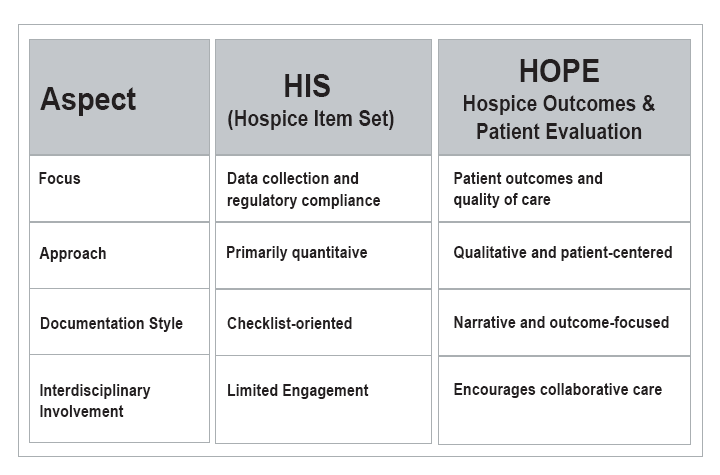
HIS to HOPE Key Differences

Understanding the distinctions between HIS and HOPE can help clarify the shift in our practices. Here are some key differences

HIS to HOPE Vicki Goodman Curantis Solutions

The Role of Hospice Nurses in the HOPE Framework

As hospice nurses, our role in implementing HOPE will require a significant mindset shift. Here’s how we can adapt our practice:

  • Engage With Patients and Families
    • Actively involve them in care planning and decision-making
  • Assess Holistically
    • Look beyond clinical data to include emotional and spiritual assessments
  • Collaborate with Interdisciplinary Teams
    • Work closely with all caregivers to ensure a comprehensive approach to patient care

By integrating these principles into our daily practice, we can enhance patient experiences and outcomes, ultimately providing the compassionate care that is the hallmark of hospice services.

Acknowledging Our Impact

As we transition to the HOPE framework, it’s essential to take a moment to give ourselves credit for the incredible work we already do. For most of us, patient-centered care has been at the heart of our practice long before HOPE was introduced. This new framework serves as validation, providing a structured approach to highlight the compassionate, individualized care we consistently offer.

Getting Prepared

The transition from HIS to HOPE marks an important chapter in the hospice care journey. Prepare for the transition with partners who understand the complexities and challenges that come with such significant changes. Specifically, work with a software and service company designed to ensure that your hospice team can seamlessly adapt to the HOPE framwork without sacrificing the quality of care. 

About Curantis Solutions

From comprehensive training to state-of-the-art data management systems, we provide everything needed to make this transition as smooth and effective as possible. With Curantis Solutions, you can be confident that no matter how the standards evolve, you will always be at the cutting edge, providing compassionate, patient-centered care. t Curantis, we understand the unique challenges faced by hospice and palliative care organizations. Our commitment to providing exceptional support ensures that you can focus on what matters most—delivering compassionate care to your patients. We pride ourselves on our quick response times, we deeply listen to our clients, and are easy to get ahold of when you need us. When partnering with Curantis Solutions, we guarantee we have support you can depend on.

# # #

Vicki Goodman
Vicki Goodman

Vicki Goodman, RN, BSN, MHA is an accomplished healthcare professional with a strong background in post-acute care, SaaS sales. With a proven track record of driving revenue growth, Vicki has successfully orchestrated sales strategies and marketing initiatives with over 30 years of experience in the home health and hospice EHR industry. Prior to joining Curantis Solutions, Vicki was VP, Enterprise Sales at Matrix Care.

She is an RN and BSN graduated of East Carolina University and received her MHA from University of North Carolina at Chapel Hill. She credits a lot of her success to collaborating with product and marketing teams creating an unstoppable engine. We are thrilled to have her join the Curantis Solutions family and look forward to the continued growth under her leadership.

©2024 by The Rowan Report, Peoria, AZ. All rights reserved. This article originally appeared in Healthcare at Home: The Rowan Report. One copy may be printed for personal use: further reproduction by permission only. editor@therowanreport.com