National Alliance for Care at Home: An Interview with Dr. Steve Landers Part 1

by Kristin Rowan, Editor

Alliance CEO Landers

For more than a year now, The Rowan Report has been providing updates on the merger between the National Hospice and Palliative Care Organization (NHPCO) and the National Association for Home Care & Hospice (NAHC). This week, we attended the first National Alliance for Care at Home (The Alliance) Annual Home Care and Hospice Conference and Expo. We had the opportunity to sit down with Dr. Steve Landers, inaugural Chief Executive Officer of The Alliance.

Dr. Steven "Steve" Landers

Dr. Steven Landers brings his almost 20 years of experience to The Alliance as its first CEO. Dr. Landers is a board-certified physician in family medicine, geriatric medicine, and hospice and palliative medicine. He has dedicated his career to seeking home- and community-based solution to traditional healthcare. His focus is on providing compassionate, dignified, and cost-effective care to patients.

Dr. Landers graduated from Case Western Reserve University School of Medicine, where he completed a geriatric medicine fellowship at the Cleveland Clinic.

Dr. Landers is no stranger to NAHC and NHPCO, having previously served on the board of directors for NAHC.  He has met with Congress, state legislatures, CMS, and PAC officials, providing testimonies, discussing home care policy and regulation, and advocating for care at home.

Steve lives in Little Silver, New Jersey, with his wife, Allison, and their three sons. His hobbies include golfing, fishing, hiking, traveling, enjoying good food and watching horse racing. When he is not taking part in these activities, you can find him cheering on his sports teams — the Browns, Cavaliers, Guardians and Indiana Hoosiers.


The Alliance Landers

Dr. Steven Landers: On the Record

The Alliance Landers
The Rowan Report:

What do you know about the status of the ongoing lawsuits, going back to the 2024 final rule?

Dr. Steven Landers:

One, we should probably bring Bill [Dombi] into it because he’s truly a technical expert on it and I’m still getting up to speed on it. My understanding is there is no active lawsuit at the moment. We were asked to go back and take some additional administrative steps, which we’re doing. Then we’ll be able to evaluate what further legal paths are possible.

RR: 

That leads me to, not a question, but an observation I’d like you to comment on, Steve. For 45 years, the organization has been run by attorneys and the emphasis in lobbying and advocacy has been ‘you need to stop this cut because it’s hurting businesses and also it’s hurting patients.’ The way you’re talking, you emphasize as you begin with how it’s hurting patients. And so I’m wondering if the organization being run by a physician and not an attorney indicates that different emphasis going forward.

Steve: 

I certainly am going to do everything I can to tell the story of how policies impact patients and families. That will be part of what I try to do every single day using my experiences as a physician to do that.

RR:

Would it be exaggerating to say “new day, new emphasis” at The Alliance?

Steve:

Well, The Alliance is new in and of itself, so The Alliance is a new day for the industry, a hundred percent. We brought together two legacy organizations. The opportunity to have a stronger voice is very real and certainly I am going to bring a clinical perspective. I’m also a family caregiver. I have my own personal experiences with home care and hospice that have instructed how I think about these things.

And there is every opportunity here to get stronger, to try to make a bigger impact. I would not diminish the truly heroic work that’s been done by advocates within our associations in the past. There’s a lot of love and care that’s happening out in our country because of the leadership that’s been in place. But as you can see by some of the things that we’re talking about, we need to do better. We need to find another way to tell these stories to somehow get somebody to listen.

The Alliance
RR:

You recently released a statement about your position as CEO of The Alliance and your vision going forward. There was a commitment attached to that. Can you speak to that?


Steve: 

Yeah, so that’s one of the things that I’m really happy we’re doing very early in our work with the Alliance. For membership, whether to join or to renew membership, we are requiring an attestation from our members around their commitment to quality and to compliance. We’re requiring any provider member to attest to having a program in place for quality and compliance. And we’re requiring that they attest that they monitor the OIG exclusion list and don’t take referrals for employees that are people that are on that list. Also for home health and hospice providers, we’re asking that they attest that they do their level best to participate in the Medicare Home Health and the Medicare Hospice Quality Reporting program.

In order to make a difference on behalf of our members and make a difference on behalf of the people that need care at home, we have to have as credible and high integrity of a voice as possible. And so this is just one simple step of additional things that we’ll consider going forward. We want to make sure that our alliance, our coalition is high integrity and has a deep commitment to quality and compliance.

RR:

It’s one thing to ask people to sign an attestation. It’s another to find the bad players and help CMS to get rid of them.

Steve:

And we’re right there as a partner in that. I think you’ll see more announcements from us in the future about what we’re doing to help with that. I mean, on one hand, we’ve made many proposals around fighting fraud and hospice in particular. If you followed the hospice policymaking, both Legacy NAHC and Legacy NHPCO over the last year have made many policy recommendations. And you’ll definitely see us both advocating for anti-fraud measures as well as having resources within our association to focus on those topics.

The Alliance Landers
Interviewer 1:

Just to clarify, did either of the legacy organizations have this same kind of attestation?

Steve:

No, this is new. The impact of the legacy organizations cannot be questioned. It’s been amazing. But, it’s a new day and we are looking at ways to increase our impact. So, this is a new part of our membership process that we feel strongly about to just take another step to ensure that our coalition, our membership, is of the highest integrity possible. We are walking the walk and talking the talk with respect to quality and compliance.

RR:

Thank you, Dr. Landers

This article is part 1 of 2 interviewing Dr. Steven Landers. Read the rest of the interview here.

# # #

Kristin Rowan, Editor

Kristin Rowan has been working at Healthcare at Home: The Rowan Report since 2008. She has a master’s degree in business administration and marketing and runs Girard Marketing Group, a multi-faceted boutique marketing firm specializing in event planning, sales, and marketing strategy. She has recently taken on the role of Editor of The Rowan Report and will add her voice to current Home Care topics as well as marketing tips for home care agencies. Connect with Kristin directly kristin@girardmarketinggroup.com or www.girardmarketinggroup.com

©2024 by The Rowan Report, Peoria, AZ. All rights reserved. This article originally appeared in Healthcare at Home: The Rowan Report. One copy may be printed for personal use: further reproduction by permission only. editor@therowanreport.com

Vendor Watch: VitalCaring Cognitive Care Pilot

FOR IMMEDIATE RELEASE

Contacts:                                          Nancy Lecroy
VP, Marketing & Communications
VitalCaring
O 469.839.3777
Nancy.lecroy@vitalcaring.com

Kelly Faville
FourSeventeen Communications
On behalf of Constant Therapy Health
M 978-621-6667
kelly@constanttherapy.com

VitalCaring’s AI-driven Cognitive Care Pilot Shows Promising Results

National leader in home health and hospice care to extend AI-enabled speech, language, and cognitive therapy initiative across its network

DALLAS and LEXINGTON, Mass., September 12, 2024 – VitalCaring, a leading national home health and hospice care provider, has unveiled the results of a seven-month AI-driven cognitive care pilot program that delivered enhanced personalized therapy to patients living with cognitive disorders. Through the pilot, VitalCaring deployed Constant Therapy’s digital speech, language, and cognitive therapy platform as part of its home-based services for select patients.

Significant Cognitive Gains

Patients in the program showed statistically significant cognitive improvements, including:

• A 35% increase in Montreal Cognitive Assessment (MoCA)* (average score)
• A 33% increase in Saint Louis University Mental Status (SLUMS)*(average score)
• Improvement by at least one cognitive level (55% of patients)
• Achievement of normal cognitive functional score by discharge (35% of patients)

“This pilot program was tailored to fast-track our patients’ journey to regaining independence safely in their homes. Adding innovative tools like the Constant Therapy platform to our existing care plans for cognitive issues and neurological disorders extends the exceptional work of our therapists.”

Janice Riggins

Chief Clinical Officer, VitalCaring

A valuable complement to clinician-supervised therapy

Patients’ ability to independently access Constant Therapy’s therapeutic exercises at home has proven to be a valuable and meaningful complement to clinician-supervised therapy. The aim of the VitalCaring Cognitive Care pilot program was to determine how additional therapy tools could accelerate recovery and maximize cognitive functioning for VitalCaring patients with dementia-related diseases or those recovering from stroke or other brain injuries. On average, each patient in the pilot program was able to access an additional 11 hours of digital therapy on their own. Due to the success of this pilot, VitalCaring will explore opportunities to extend the initiative across its network.

“VitalCaring stands at the forefront of home healthcare innovation, transforming patient experiences and outcomes with advanced technological and analytical approaches,” said Veera Anantha, Founder and CEO of Constant Therapy Health. Our platform supports their practice of providing outstanding, individualized treatment to patients affected by neurological conditions or brain injuries.”

What Caregivers and Family are Saying

  • “Thanks to the AI therapy, my uncle regained his motor skills. He can now operate mobile phones and stay connected with loved ones.” The patient’s MoCA score improved from 14 to 26 – moderate cognitive impairment to normal cognitive ability.
  • “My mother’s ability to hold conversations with friends and family improved significantly after using the AI-driven tools.” The patient’s MoCA score rose from 16 to 27 – moderate cognitive impairment to normal cognitive ability.
  • “Our family noticed remarkable cognitive improvements in my grandfather. He’s better at following events and recalling important information.” The patient’s MoCA score jumped from 17 to 25 – moderate to mild cognitive impairment.
VitalCaring Pilot

# # #

About the VitalCaring Cognitive Care Pilot Program

The pilot program ran from October 2023 through May 2024 and included 52 patients aged 54 to 92, with an average age of 77.45. Patients had various primary diagnoses, including cerebral infarction, brain tumors, dementia (including Alzheimer’s disease), Parkinson’s disease, encephalitis, encephalopathy, and mild cognitive impairment (MCI). Patients’ performance was measured by: the Montreal Cognitive Assessment/MoCA and the Saint Louis University Mental Status/SLUMS cognitive screening.

About Contant Therapy Health

Constant Therapy Health is a next-generation digital health company whose technology is clinically proven to improve the efficacy of cognitive, speech, and language therapy, as well as increase access to and reduce the cost of therapy. Constant Therapy, an award-winning mobile program, uses patented AI technology to deliver personalized exercises that rebuild cognitive and speech function for individuals recovering from stroke or traumatic brain injury (TBI) or living with aphasia, dementia, and other neurological conditions. Built by a team of top neuroscientists at Boston University, Constant Therapy is used by tens of thousands of patients as prescribed by their clinicians, helping to create the world’s largest brain rehabilitation database, and providing insights that can improve the effectiveness and efficiency of brain rehabilitation.

About VitalCaring

VitalCaring delivers compassionate, high-quality home-based healthcare to patients in the comfort of their own homes. By bringing together like-minded people who are called to care and supported by a positive organizational culture, VitalCaring is positioned to deliver an exceptional patient experience at every encounter. VitalCaring is a national leader in the home health and hospice industry, serving patients throughout the Southern United States, including Texas, Oklahoma, Louisiana, Mississippi, Alabama, and Florida. From its base in the South, VitalCaring is expanding to serve even more communities nationwide.

This press release was originally published by VitalCaring and is reprinted with permission. For more information or to request permission to reprint, please reach out to the media contacts listed above.

Vendor Watch: HealthRev Partners and Trella Health Announce Partnership

FOR IMMEDIATE RELEASE

Media Contacts:

HealthRev Partners: Hannah Vale
hvale@healthrevpartners.com

Trella Health: Lauren Corcoran
press@trellahealth.com

HealthRev Partners and Trella Health Announce Partnership to Empower Home Health and Hospice Agencies

Driving financial health and strategic growth with complementary solutions in revenue cycle management and market intelligence.

OZARK, Mo. and ATLANTAOct. 17, 2024 /PRNewswire/ — HealthRev Partners, the leading revenue cycle management partner specializing in innovative, tech-driven solutions for home health and hospice agencies, and Trella Health, the leading provider of market intelligence and Customer Relationship Management (CRM) solutions for the post-acute care industry, have announced a new partnership.

HealthRev Partners and Trella Health will collaborate to help agencies reach their full potential by cultivating stronger relationships with referral sources and optimizing their revenue cycle through complementary solutions.

This collaboration brings together HealthRev Partners’ financial expertise and revenue cycle management solutions — helping agencies maximize reimbursements, streamline operations, and drive predictable revenue — with Trella Health’s integrated market intelligence and CRM solutions, which enable agencies to enhance growth strategies, improve referral relationships, and gain valuable insights into their market and competitive landscape.

In Their Own Words

Together, we can equip agencies to achieve better financial health and improve their competitive positioning.

HealthRev Partners Trella Health

“Our collaboration with Trella Health represents a significant leap forward for home health and hospice agencies. By combining our financial expertise and revenue cycle management solutions with access to Trella’s market insights and CRM platform, we are providing agencies with a powerful toolkit to optimize their financial performance, drive growth, and ultimately deliver better patient care,” said Michael J. Greenlee, founder and CEO of HealthRev Partners.

Jess Chew, GM, PAC Provider Growth at Trella Health, added, “The partnership underscores both companies’ commitment to supporting providers by delivering industry expertise and advanced technology to address the unique challenges facing home health and hospice agencies today. By combining our strengths, we can equip agencies to achieve better financial health and improve their competitive positioning.”

By leveraging their combined expertise, this partnership will help home health and hospice agencies uncover financial opportunities and optimize efficiencies — from referral growth to revenue management.

# # #

About HealthRev Partners

HealthRev Partners is a leading provider of revenue cycle management solutions for home health and hospice agencies, dedicated to improving financial performance and operational efficiency in the post-acute care sector.

About Trella Health

Trella Health’s unmatched market intelligence and purpose-built CRM allow post-acute providers, HME, and Infusion organizations to drive more effective performance and growth. Trella’s solutions allow post-acute, HME, and Infusion organizations to identify the highest-potential referral targets, evaluate new market opportunities, and monitor performance metrics. Paired with CRM and EHR integrations, business development teams can better manage referral relationships to advance their organizations with certainty by improving their sales and marketing strategy.

This press release was originally printed by Trella Health and is reprinted with permission. For more information or to reprint this content, please contact one of the media contacts listed above.

Patient Preference by Race or Nationality

This article provides updated information about a discrimination case filed against a home care agency by the EEOC. The Rowan Report published the initial press release and article last year.

by Elizabeth E. Hogue, Esq.

What to do When Patients Don't Want Caregivers of Certain Races or Nationalities

The Equal Employment Opportunity Commission (EEOC) sued ACARE HHC, Inc.; doing business as Four Seasons Licensed Home Health Care Agency in Brooklyn, New York. The EEOC claimed that the Agency removed home health aides from work assignments based on their race and national origin to accommodate clients’ preferences in violation of the Civil Rights Act of 1964 [EEOC v. ACARE HHC d/b/a/ Four Seasons Licensed Home Health Care, 23-cv-5760 (U.S. District Court for the Eastern District of New York)]. 

This case recently settled, and Four Seasons will pay a whopping $400,000 in monetary relief to affected home health aides! The Agency must also update its internal policies and training processes related to requirements of the Civil Rights Act, stop assigning home health aides based on clients’ racial or nationality preferences, and provide semi-annual reports to the EEOC about any reports or complaints received about discrimination.

Aides Removed from Assignments

According to the EEOC, Four Seasons routinely responded to patients’ preferences by removing African American and Latino home health aides based on clients’ preferences regarding race and national origin. Aides removed from their assignments would be transferred to new assignments, if available, or, if no other assignments were available, would lose their employment altogether. The lawsuit asked for both compensatory and punitive damages, and for an injunction to prevent future discrimination based on race and national origin. The EEOC says that “Making work assignment decisions based on an employee’s race or national origin is against the law, including when these decisions are grounded in preferences of the employer’s clients.”

Patient Preference Race Nationality

As many providers know, patients’ preferences for certain types of caregivers are common. Experienced managers have been asked by patients not to provide caregivers who are, for example, “foreign.” Such requests should generally be rejected, especially when they involve discrimination based upon race, national origin, religion, or any other basis commonly used to treat groups of people differently. Legally and ethically, providers should not engage in such practices.

Exception to the Rule

There is one exception to this general rule that occurs when patients ask for caregivers of the same sex as the patient based upon concerns about bodily privacy. It is then acceptable to assign only same-sex caregivers to patients who have made such requests.

Risk Management

In addition to concerns about discrimination, providers must also be concerned about risk management when they honor such requests. Especially in view of increasing staff shortages, limitations on available caregivers may mean that patients’ needs cannot be met by staff members who are acceptable to patients. In view of staffing shortages, the fewer caregivers who are permitted to care for certain patients, the more likely it is that patients’ needs will go unmet. Unmet patient needs are, in turn, likely to significantly enhance the risk associated with providing care to patients.

Preferences at Home

Perhaps the pressure to honor patients’ requests is at its greatest when patients receive services at home. Patients who will accept any caregiver assigned to them in institutional settings somehow feel that they have the right to decide who may provide services in their homes. On the contrary, with the exception noted above, staff assignments should be made without regard to client preferences for services rendered at home, just as assignments are made in institutional settings.

Agency Response

How should managers respond when patients tell them not to assign any “foreign” nurses to them? First, they should explain that the organization does not discriminate and that to avoid assignments based on cultural or racial background may constitute unlawful discrimination. Then staff should explain that if limitations on caregivers were acceptable, the provider may be unable to render services to the patient at all because they may not have enough staff. The bottom line is that staff will be assigned without regard to patient preferences in order to prevent discrimination and to help ensure quality of care.  

Patients’ requests and managers’ responses must be specifically documented in patients’ charts. Documentation that says patients expressed preferences for certain caregivers or rejected certain types of caregivers is too general. Specific requests and responses of management must be documented. 

Monitoring the Patient

After patients have expressed what may amount to prejudice against certain groups of caregivers, managers must follow up and monitor for inappropriate behavior by patients directed at caregivers who are not preferred. Managers should be alert to the potential for this problem and should follow up with patients and caregivers to help ensure that caregivers are receiving the respect they deserve. Follow-up activities and on-going monitoring should also be specifically documented.

From the EEOC

“Employers cannot make job assignment decisions based on a client’s preference for a worker of a particular race or national origin. It is imperative for employers to have policies, training and other safeguards in place that help prevent a client’s prejudices from influencing their employment decisions.”

-EEOC Representative

Final Thoughts

Caregivers are a scarce commodity. Providers cannot afford to lose or alienate a single caregiver based upon discrimination or inappropriate behavior by patients.


# # #

Elizabeth E. Hogue, Esq.

Elizabeth Hogue is an attorney in private practice with extensive experience in health care. She represents clients across the U.S., including professional associations, managed care providers, hospitals, long-term care facilities, home health agencies, durable medical equipment companies, and hospices.

©2024 by The Rowan Report, Peoria, AZ. All rights reserved. This article originally appeared in Healthcare at Home: The Rowan Report. One copy may be printed for personal use: further reproduction by permission only. editor@therowanreport.com

©2024 Elizabeth E. Hogue, Esq. All rights reserved.

No portion of this material may be reproduced in any form without the advance written permission of the author.

Home Care Patient Dies in Care: Aide Arrested

by Kristin Rowan, Editor

Elderly Patient Needs 24-hour Care

In Polk County, FL, an 86-year old man, identified only as Mr. Anderson, was hopsitalized and diagnosed with congestive heart failure. In addition to receiving care from Good Shepherd Hospice, his family hired round-the-clock care through Assisting Hands. The home health aides were caring for Mr. Anderson in 12-hour shifts. 

Night Shift

Beatrice Taylor arrived for her night shift at 9 p.m. She noted that Mr. Anderson and his wife were already in bed, but not sleeping. Shortly after the day aide left, Taylor fell asleep on the couch in the living room of the patient’s home. Company policy states she was responsible for the patient’s care and should not have been sleeping.

An Avoidable Tragedy

Taylor was awakened by a “thump” coming from the bedroom. She entered the bedroom to investigate and found Mr. Anderson lying on his side, on the floor, with his head wedged between the nightstand and the bed. Taylor told investigators that she tried to help him back into the bed. He told her not to touch him, so she left him there and went back to sleep on the couch. She did not call 911, as was the policy of Assisting Hands in the event of an emergency. Nor did she call her agency or anyone else to assist. 

Four Hours Later

Taylor woke up somewhere between 3:45 a.m. and 4:53 a.m. that morning. At some point, she called her parents and had a 36 minute conversation. During that conversation, she decided to check on the patient and found him still on the floor, but now unresponsive. It was her parents who suggested she call 911.

Contrary to both her parents’ urging and her employer’s policy, Taylor still did not call 911. Instead, she called Assisting Hands and left a message through the company portal. Taylor finally called 911 at 5:37 a.m., more than four and a half hours after Mr. Anderson fell.

The implanted pacemaker found during autopsy showed that Mr. Anderson was still allive at 1:oo a.m. when Taylor initially found him. The autopsy also concluded that he would have survived if Taylor had called 911 right away. His official cause of death was positional asphyxia with pre-existing health conditions listed as contributory causes.

Home Health Aide Arrested

Not actual image from story

Company Policies Broken

During the course of their investigation, detectives reviewed the Assisting Hands employee policies. That investigation uncovered several policies that Taylor violated:

  • If a patient falls, home aides are required to seek help which may entail calling 9-1-1. Home aides must notify the company as soon as the patient is safe
  • Home aides are not permitted to sleep during their assigned shift unless it is a “live in” shift
  • Home aides are required to submit care notes using the company portal throughout their shift to ensure assigned services are being followed appropriately.

The 911 call that Taylor placed at 5:37 a.m. should have been placed at 1:00 a.m.
Assisting Hands confirmed to detectives that this was not a “live in” shift
No information was provided as to whether Taylor submitted care notes during the shift.

Arrested Development

Taylor worked for Assisting Hands for eight months, but did not show up for her shift following the incident with Mr. Anderson. Assisting Hands has since terminated her employment. She was a licensed home health aide, but does not have a medical license, nor is she a nurse. 

Taylor was arrested by detectives and made several statements about her innocence. She insisted she had done nothing wrong saying she, “didn’t kill that man.” A paramedic who responded to her 911 call overheard Taylor on the phone say, “he was old anyway so what does it matter.” Taylor remains in custody at the Polk County Jail and is being held without bond.

Polk County Sheriff

The complete disregard for Mr. Anderson’s life by the person who was employed by his family is completely outrageous, and egregious. I believe someone who was not even being paid to look after this elderly man would have immediately dialed 9-1-1 under these circumstances. Her behavior and attitude are simply deplorable. Mr. Anderson’s family members are in our prayers.”

Grady Judd

Sheriff, Polk County Sheriff's Office

Risk Fall

In 2021, more than 38,000 older adults died from falls. This is the leading cause of injury death for adults aged 65 and older. The death rate increased 41% between 2012 and 2021. You can read more about the risk of falling and what one company is doing to help prevent falls in our accompanying article this week, an interview with Dr. Ann Wells of InnovAge.

# # #

Kristin Rowan, Editor

Kristin Rowan has been working at Healthcare at Home: The Rowan Report since 2008. She has a master’s degree in business administration and marketing and runs Girard Marketing Group, a multi-faceted boutique marketing firm specializing in event planning, sales, and marketing strategy. She has recently taken on the role of Editor of The Rowan Report and will add her voice to current Home Care topics as well as marketing tips for home care agencies. Connect with Kristin directly kristin@girardmarketinggroup.com or www.girardmarketinggroup.com

©2024 by The Rowan Report, Peoria, AZ. All rights reserved. This article originally appeared in Healthcare at Home: The Rowan Report. One copy may be printed for personal use: further reproduction by permission only. editor@therowanreport.com

BREAKING NEWS – HHAeXchange Acquires Sandata

HHAeXchange Acquires Sandata

FOR IMMEDIATE RELEASE

Contact:                                       Michelle Rand
Alloy on behalf of HHAeXchange
855-300-8209
hhaexchange@alloycrew.com

HHAeXchange Acquires Sandata Technologies, Enhancing Ability to Serve Homecare Providers, Payers, and Caregivers Nationwide

Best positioned to deliver transformative technology that accelerates the industry’s evolution and its ability to improve health outcomes

NEW YORK and PORT WASHINGTON, N.Y., Oct. 03, 2024  — HHAeXchange, a leader in homecare management solutions for providers, caregivers, managed care organizations (MCOs), and state Medicaid programs, today announced that it has acquired Sandata Technologies. With four decades of experience, Sandata provides solutions that serve the homecare industry. Together, HHAeXchange and Sandata are well-positioned to meet the growing need for home and community-based services (HCBS), with demand for personal care aides expected to rise by 43% between 2020 and 2035.

From HHAeXchange

We are excited to join forces with Sandata, who shares our commitment to enabling homecare stakeholders to deliver the highest quality of care to their members,” said Paul Joiner, Chief Executive Officer of HHAeXchange. “This acquisition further demonstrates our commitment to investing in and raising the bar for our customers, while leading the transformation of an industry that deserves best-in-class technology and a superior experience. We will leverage our expanded platform by innovating with states and health plans to enable providers and better health outcomes. By doing so, we will further empower the devoted caregivers who are at the heart of our industry.”

“Now is the time to harness the power of advanced technology to truly support providers and payers with their billing needs and compliance requirements – and ultimately, deliver on the promise of our industry.”

Paul Joiner

Chief Executive Officer, HHAeXchange

From Sandata

“For decades, Sandata has been dedicated to ensuring providers and payers can seamlessly work together to increase compliance, improve efficiency, and deliver high-quality care,” said Sandata’s Chief Executive Officer, Emmet O’Gara. “Joining HHAeXchange strengthens our commitment and represents an exciting new chapter for Sandata, positioning the new combined company for continued growth and innovation by enhancing the value we can deliver to our customers.” 

HHAeXchange Acquires Sandata

HHAeXchange’s transaction with Sandata builds on the company’s recent strategic acquisitions of Cashé and Generations. These investments collectively support HHAeXchange’s ongoing advancement of its mission to enable caregivers, families, providers, and payers to deliver the best care in the home. Paul Joiner, HHAeXchange’s CEO, will lead the combined business moving forward.

Financial terms of the transaction were not disclosed.

# # #

About Sandata

Sandata, now part of HHAeXchange, is the pioneering force in home and community-based care, consistently leading the way with innovative technology solutions. As a trusted leader, Sandata is deeply committed to addressing critical challenges in the sector by expertly connecting the homecare ecosystem. This commitment creates a positive and lasting impact on payers, providers, caregivers, and those who receive care.

Sandata’s industry-leading software, systems, and services optimize billing and claims processing for payers, streamline administrative processes for providers, and facilitate better experiences for caregivers and those who receive care. Sandata’s vision and commitment to transforming the industry continue to shape the future of care at home and in our communities, ensuring better outcomes for all involved.

About HHAeXchange

Founded in 2008, HHAeXchange is the leading technology platform for homecare and self-direction program management. Developed specifically for Medicaid home and community-based services (HCBS), HHAeXchange connects state agencies, managed care organizations, providers, and caregivers through its intuitive web-based platform, enabling unparalleled communication, transparency, efficiency, and compliance. For more information, visit hhaexchange.com or follow the company on TwitterLinkedIn and Facebook.

This information originally appeared on the HHAeXchange website and it reprinted with permission.

Telehealth Grant to Address Disparities

FOR IMMEDIATE RELEASE

CONTACT:                                          Gina Cella
gcella@americantelemed.org
781-799-3137

AMERICAN TELEMEDICINE ASSOCIATION RECEIVES GRANT FROM PETERSON HEALTH TECHNOLOGY INSTITUTE TO ENHANCE WORK IN USING TELEHEALTH TO ADDRESS DISPARITIES

WASHINGTON, DC, SEPTEMBER 24, 2024 – The American Telemedicine Association (ATA) today announced the organization has received a grant from the Peterson Health Technology Institute (PHTI) to enhance its US Digital Infrastructure Disparities Score (DIS) and heat map tools with additional data sets and visualization tools, to highlight key infrastructure gaps and identify specific interventions that support actionable, measurable, and accountable deployment.

The Disparities Score and heat map tools, developed by the ATA CEO’s Advisory Group on Using Telehealth to Eliminate Healthcare Disparities and Inequities, will enable data-informed decisions and targeted allocation of resources to improve access to digital services and reduce disparities. The score is a composite measure and can be viewed at a ZIP code or county level. The premise of the map is to highlight key infrastructure gaps and support stakeholders in understanding how and where to invest scarce resources to improve access to digital services.

“Beyond the ability to just view broadband connectivity in a region, our Disparities Score and heat map tools are materially different, with composite representation of broadband access, plus connection speeds, connection modalities, and data affordability,” said Ann Mond Johnson, CEO of the ATA.

“This critical funding will be used to enhance these tools by incorporating additional data sets, developing enhanced data visualization tools, and improving the design interface and user experience.

Teleheatlh Grant to Address Disparities

We are grateful to the Peterson Health Technology Institute for their generous support of our work, to enable data-informed decisions pertaining to the allocation of resources to reduce disparities.”

The Disparities Advisory Group is co-chaired by Kristi Henderson, DNP, Yasmine Winkler and Ron Wyatt, MD, and facilitated by David Smith, CEO of Third Horizon Strategies.

# # #

About the Peterson Health Technology Institute

The Peterson Health Technology Institute (PHTI) provides independent evaluations of innovative healthcare technologies to improve health and lower costs. Through its rigorous, evidence-based research, PHTI analyzes the clinical benefits and economic impact of digital health solutions, as well as their effects on health equity, privacy, and security. These evaluations inform decisions for providers, patients, payers, and investors, accelerating the adoption of high-value technology in healthcare. PHTI was founded in 2023 by the Peterson Center on Healthcare. For more information, please visit PHTI.org.

About the ATA

As the only organization completely focused on advancing telehealth, the American Telemedicine Association is committed to ensuring that everyone has access to safe, affordable, and appropriate care when and where they need it, enabling the system to do more good for more people. The ATA represents a broad and inclusive member network of leading healthcare delivery systems, academic institutions, technology solution providers and payers, as well as partner organizations and alliances, working to advance industry adoption of telehealth, promote responsible policy, advocate for government and market normalization, and provide education and resources to help integrate virtual care into emerging value-based delivery models. 

Managed Care Support

Axxess<br />

FOR IMMEDIATE RELEASE

Contact:                  Christine Stein
(214) 435-6731
cstein@axxess.com

Axxess Partners with strategic health care to offer Managed care support to clients

DALLAS, September 26, 2024 – Axxess, the leading global technology innovator for healthcare at home, has partnered with Strategic Health Care, a leading provider of managed care solutions, to offer Axxess clients managed care support, helping them enhance profitability and drive business optimization.

Through this collaboration Axxess clients have access to services provided by Strategic Health Care, including managed care contracting and credentialing, value-based reimbursement, revenue optimization and network development.

“Through this partnership we are providing our clients with the tools needed to thrive in the ever-evolving managed care landscape,” said Chris Taylor, senior vice president of channel partnerships at Axxess. “These services are designed to provide Axxess clients the support needed to succeed in managed care, helping them navigate industry challenges and enabling them to focus on care delivery.”

Strategic Health Care<br />

Strategic Health Care and Axxess are focused on helping clients scale their business and increase profits.

“Even the best care at home providers are struggling to make managed care work,” said Joe Russell, vice president of network management and contracting at Strategic Health Care. “We want to show providers that there’s a world where providers can win and win big. That’s why we’re so excited for the partnership with Axxess. When Axxess clients have managed care related issues, we want them to know they have partner they can rely on where it matters most.”

# # #

About Axxess

Axxess is the leading global technology innovator for healthcare at home, focused on solving the most complex industry challenges. Trusted by more than 9,000 organizations that serve more than 5 million patients worldwide, Axxess offers a complete suite of easy-to-use software solutions that empower home health, home care, hospice, and palliative providers to make healthcare in the home human again. Multiple independent certifications have confirmed that Axxess has the most secure and industry-compliant software available for providers. The company’s collaborative culture focused on innovation and excellence is recognized nationally as a “Best Place to Work.”

About Strategic Health Care

For over twenty-five years, Strategic Health Care has earned a reputation in the health plan industry as a knowledgeable and fair representative for provider clients. The highly experienced team of contracting experts at Strategic Health Care ensure providers have access to the reimbursement they need to continue to provide quality patient care.

Hospice CARE Act Fact Sheet

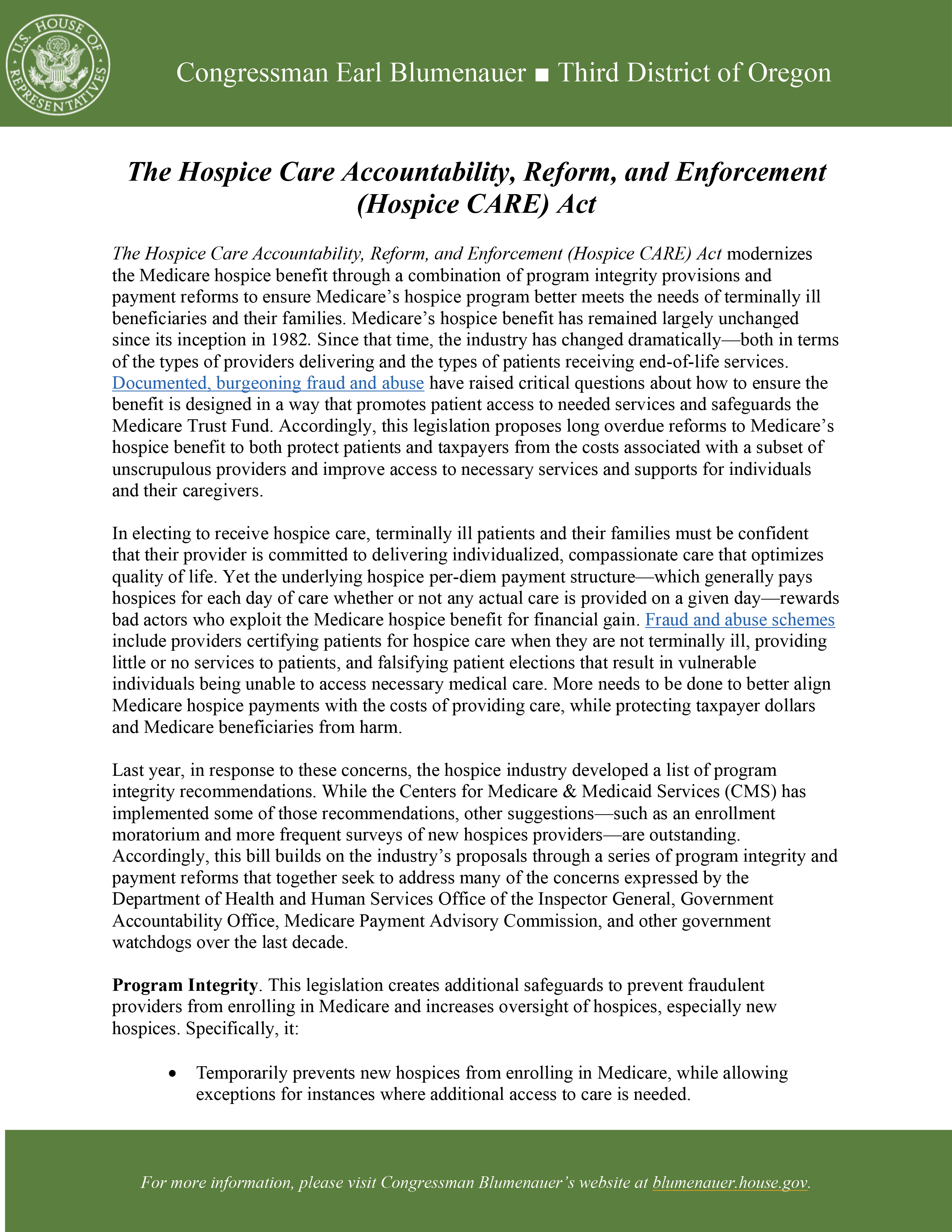
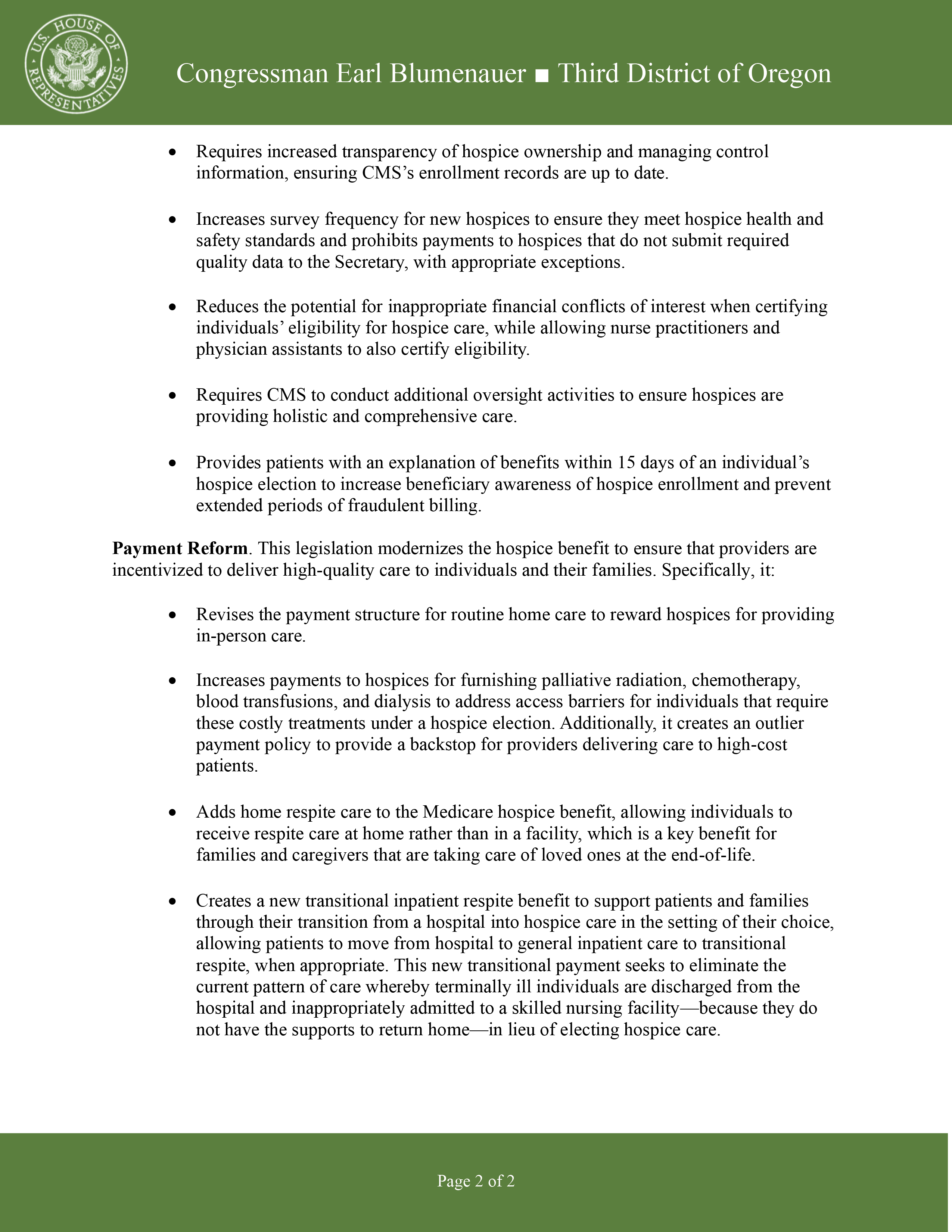
The Hospice CARE Act was proposed September 26, 2024 by Representative Blumenauer (D-OR) after “egregious” reports of continuing fraud and abuse. The original fact sheet can be found here.

Hospice CARE ACT
Hospice CARE Act

Read the Press Release from Rep. Blumenauer’s office here.

Read the full text of the Bill here.

BREAKING NEWS: Blumenauer Proposes Hospice Overhaul

FOR IMMEDIATE RELEASE

Contact:      Portland District Office
503-231-2300

blumenauer proposes overhaul to hospice benefit

If enacted, the legislation would be the single most significant update to the hospice benefit and payment structure since its inception in 1982

WASHINGTON, D.C., SEPTEMBER 26, 2024 – Today, Congressman Earl Blumenauer (D-OR), a senior member of the Ways and Means Committee, introduced the Hospice Care Accountability, Reform and Enforcement Act (Hospice CARE Act) to modernize Medicare’s hospice benefit, which has remained largely unchanged since its inception in 1982. The proposal comes as egregious reports of fraud and abuse within the benefit persist, despite action from Centers for Medicare & Medicaid Services (CMS). The legislation is the product of years of collaboration between stakeholders, lawmakers, and industry leaders. It builds on Blumenauer’s decades-long commitment to ensure the federal government supports families at a time of great stress and vulnerability: the end of life. 

“The United States spends significantly more on health care than other developed nations for worse outcomes. Nowhere is this more egregious than in the hospice industry,” said Congressman Earl Blumenauer. “Patients and families deserve better. We need a reset. It is past time for Congress to act to end the fraud, waste, and abuse within the hospice benefit and bring it into the 21st century.”

To protect patients and taxpayers, the Hospice CARE Act would institute a number of long overdue reforms to crackdown on fraud while incentivizing high-quality care. Critically, it would:

    • Reform the payment structure: The underlying hospice per-diem payment structure—which generally pays hospices for each day of care regardless of if care is provided on a given day—rewards bad actors who exploit the benefit for financial gain. The legislation revises the payment structure to ensure that providers are incentivized to deliver high-quality care and meet the current needs of individuals and their families.
    • Bolster program integrity: Additional safeguards and oversight is needed to prevent fraudulent providers from enrolling in Medicare, especially for new hospices. That includes temporarily preventing new hospices from enrolling in Medicare, with exceptions where additional access to care is needed, increasing survey frequency, and increasing ownership transparency

A one-page fact sheet can be found here. Bill text here

“The hospice benefit, while unique, is ripe for change. This legislation is a first-of-its-kind opportunity to improve it,” said Katie Smith Sloan, president and CEO, LeadingAge, the association of nonprofit providers of aging services, including hospice, on the Hospice Care Accountability, Reform and Enforcement (CARE) Act of 2024. “Revising a benefit that has not been altered significantly since its creation in 1982 is a formidable undertaking – but a necessary one. Done right, changes will expand the benefit to support the realities of modern-day hospice care and address vulnerabilities that are currently being exploited.  There is more work to do and we look forward to continuing our productive partnership to ensure this bill achieves these goals.” 

 “The National Partnership for Healthcare and Hospice Innovation (NPHI) is thankful for the work of Congressman Blumenauer, his staff, and the Ways and Means Committee staff who worked with the hospice and advanced illness community to put forward the Hospice Care Accountability, Reform, and Enforcement (CARE) Act. This legislation is an encouraging and unique opportunity to consider reforms that would strengthen the Medicare hospice benefit by ensuring it continues to support patients, families, and the non-profit providers who were the original foundation of hospice care,” said Tom Koutsoumpas, CEO and founder of NPHI. “We look forward to continuing to work closely with Congress and relevant stakeholders on efforts to modernize the hospice benefit and improve care of those at the end-of-life.

“The Coalition to Transform Advanced Care (C-TAC), truly appreciates the introduction of the Hospice Care Accountability, Reform, and Enforcement (Hospice CARE) Act. We commend Representative Earl Blumenauer (D-OR-3rd) for this important work and for his decades of support for compassionate end-of-life care and for bringing policies to the national stage with bi-partisan support,” stated Jon Broyles, C-TAC CEO.  “We have had the privilege to work with the Congressman, his staff, Ways & Means Committee staff and other advocates on this bill and it is an important starting point for ideas that will lead to modernizing the hospice program and improving the lives of people with serious illness and their family caregivers.”

# # #

This press release was issued by the office of U.S. Congressman Earl Blumenauer, representing the 3rd district of Oregon. The original press release can be found here. The Rowan Report has reached out to The Alliance for Care at Home for comment.