Subsidies Undecided

by Kristin Rowan, Editor

Subsidies Undecided

Senate cannot agree

The record-breaking government shutdown centered around one issue: extending the COVID-era Affordable Care Act supplemental subsidies. The subsidies were an additional discount for Americans within a certain income bracket. They helped make healthcare insurance through the ACA marketplace more affordable during and after COVID. The subsidies have been extended multiple times and expire at the end of the year. Senate Republicans are not willing to extend them again. Senate Democrats won’t vote in favor of any health care proposal that doesn’t include them.

Time is Running Out

Not only do the subsidies expire at the end of the year, but anyone enrolling in a marketplace plan has to apply by December 15th, leaving precious few days to find a way forward. Senate Democrats proposed a straight three-year extension of the subsidies, which failed. Senate Republicans proposed using the subsidy money to contribute to HSAs for bronze or “catastrophic” plans. That proposal also failed.

A hybrid compromise is in the works. Details have not been released but it will likely include income caps and eligibility restrictions on the subsidies as well as some HSA flexibility. Without an extension on the subsidies, premiums are expected to increase an average of 26% in 2026, although some analyses suggest premiums could go up by 73-90%.

Another Shutdown?

The 43-day shutdown that ended in November did not finalize the 2026 budget. It merely passed enough appropriations to temporarily fund some departments through January 30, 2026 and a few essential departments for longer. If the Senate and House cannot agree on the subsidy issue, we face another shutdown in February. Every shutdown impacts Medicare & Medicaid payments, approvals, and renewals.  

Experts indicate nearly 50% of people buying marketplace plans are ages 50-64. Most, if not all of them, are looking at lower cost (and lower benefit) plans or dropping insurance altogether in 2026. If insurance costs remain high, this group of 

Subsidies undecided

people will enter Medicare with poorer health, which will cost the Medicare program and tax payers more in the long run. It will cause a vicious circle of higher Medicare costs, leading to higher taxes, lower subsidies, higher premiums, fewer people being covered, and finally higher Medicare costs again.

This is an ongoing story and The Rowan Report will continue to bring you the latest news on the subsidies and the impending expiration of the temporary government funding as we head into 2026.

# # #

Kristin Rowan, Editor

Kristin Rowan has been working at The Rowan Report since 2008. She is the owner and Editor-in-chief of The Rowan Report, the industry’s most trusted source for care at home news, and speaker on Artificial Intelligence and Lone Worker Safety and state and national conferences.

She also runs Girard Marketing Group, a multi-faceted boutique marketing firm specializing in content creation, social media management, and event marketing.  Connect with Kristin directly kristin@girardmarketinggroup.com or www.girardmarketinggroup.com

©2025 by The Rowan Report, Peoria, AZ. All rights reserved. This article originally appeared in The Rowan Report. One copy may be printed for personal use: further reproduction by permission only. editor@therowanreport.com

 

Medicaid Cuts Update: Meet the Senate Parliamentarian

by Tim Rowan, Editor Emeritus

Medicaid Cuts Update

Senate Parliamentarian Elizabeth MacDonough

The ongoing negotiations in Congress will impact Medicaid and Medicare. There has been little movement from the Senate since we reported on this last week, but here’s what we know now:

When H.R. 1 was passed by the House of Representatives and forwarded to the Senate, it was immediately subjected to scrutiny by the Senate Parliamentarian, Elizabeth MacDonough. The job of the parliamentarian is to ensure that every proposed bill complies with Senate rules. The story of Ms. MacDonough taking her scissors to the “One Big Beautiful Bill” requires more than a little unpacking, but it is a good story.

Problem with Medicaid Cuts: "One Bill"

It appears that the idea to put all of the President’s legislative agenda into a single bill is acceptable in the House, but the Senate has different rules. The Senate forces itself to live under the filibuster system. When the filibuster is evoked, a bill must receive 60 votes to pass, but there is an exception. “Budget Reconciliation” is a rule that allows expedited passage of certain specific budget-related bills with only a simple majority, 51 votes.

The problem of the week is that H.R. 1 includes dozens of provisions that have nothing to do with spending. The Senate parliamentarian took her scissors to parts of the bill that:

  • change environmental regulations to pave the way to sell public lands
  • reduce the ability of federal judges to block Presidential orders1
  • dissolve the Consumer Financial Protection Bureau
  • change the rules about who can be excluded from receiving Medicare benefits, even after contributing through FICA taxes
Medicaid Cuts

Cutting Medicaid Cuts

Parliamentarian MacDonough has also applied her scissors to the portion of the bill that would reduce Medicaid spending by nearly $800 billion over ten years. Writing for The Hill, Alexander Bolton reported on June 26:

“The Senate’s referee rejected a plan to cap states’ use of health care provider taxes to collect more federal Medicaid funding, a proposal that would have generated hundreds of billions of dollars in savings… The decision could force Senate Majority Leader John Thune (R-S.D.) to reconsider his plan to bring the Senate bill up for a vote this week.”

Alexander Bolton

Journalist, The Hill

The provision, which would have forced states to take over substantially more Medicaid costs, came under strong bipartisan opposition. Sen. Josh Hawley (R-Mo.), Susan Collins (R-Maine), Lisa Murkowski (R-Alaska) and Jerry Moran (R-Kan.) warned deep cuts to federal Medicaid spending could cause dozens of rural hospitals in their states to close. Senate Democrats, led by Jeff Merkley (D-Ore.), the ranking Democratic on the Senate Budget Committee, praised MacDonough’s exclusions.

The Hill reported, “Democrats are fighting back against Republicans’ plans to gut Medicaid, dismantle the Affordable Care Act, and kick kids, veterans, seniors, and folks with disabilities off of their health insurance – all to fund tax breaks for billionaires,” Merkley said in a statement.

The President pushed back against the parliamentarian’s rulings in a June 24 social media post:

“To my friends in the Senate, lock yourself in a room if you must, don’t go home, and GET THE DEAL DONE THIS WEEK. Work with the House so they can pick it up, and pass it, IMMEDIATELY. NO ONE GOES ON VACATION UNTIL IT’S DONE.”

Donald Trump

President of the United States

Sorting out the Complex Immigration Question

If the above seems complicated, it becomes rudimentary compared to the background that sets the stage for the parliamentarian’s next cut. Except for emergencies, most often crisis pregnancies, persons in the country illegally cannot, and do not, receive Medicaid-reimbursed healthcare. According to a study by Kaiser Family Foundation, however, fourteen states plus the District of Columbia use state taxpayer money, not federal funds, to cover children regardless of immigration status, Seven of those fourteen, and D.C., also cover some adults with state funds regardless of immigration status.

In the bill was a provision to punish these fourteen states and D.C. by reducing their federal Medicaid payments from 90 percent to 80 percent. Though there is no accusation in the bill that these states are guilty of improper use of federal funds, the states will lose some of those funds because of the way they have chosen to use their own funds. Parliamentarian MacDonough said that is not a budget line item but an attempt by the federal government to force states to change their own healthcare policies.

Medicare Restrictions also Scrapped

Almost as a postscript, a House restriction on Medicare eligibility also fell victim to the Senate Parliamentarian’s scissors. Non-citizens who work in W-2 wage jobs pay FICA taxes, many of them for 30 years or more. When these workers turn 65, they are eligible for Medicare benefits due to their contributions, regardless of their status. Though H.R. 1, the House version, would eliminate that eligibility, Ms. MacDonough said, “Nope, this is not a budget reconciliation issue.”

Although the White House is pressuring Senators to vote quickly — so that a joint House/Senate negotiating committee can hammer out differences and send their compromise version to the President’s desk by July 4 — that self-imposed deadline is up in the air at the moment. Both President Trump and House Speaker Johnson are adamant that every spending and every non-budgetary policy change they want must be enacted in one big bill. In spite of Ms. MacDonough’s cuts, the Senate it not exactly handcuffed either. Because it makes its own rules, Senators could simply decide, with a 51-49 party-line vote, to ignore the parliamentarian.

The power, as well as the future health of Medicaid, falls into the hands of the four dissenting Republican Senators. Home Health and Home Care folks in Missouri, Maine, Alaska and Kansas take note.

____________________________________

1  From White House correspondent Bart Jansen, writing for USA Today:

  • Currently, judges have discretion to set bonds on plaintiffs who file civil suits. Legal experts say judges often waive bonds in lawsuits against the government because the disputes are typically over policy rather than money.
  • A provision in the House-passed version of the bill would remove that discretion from federal judges and require litigants to post a bond when the issue under consideration is whether to block a Trump policy.
  • So far, judges have blocked Trump policies in 180 cases. All of them would have to be reviewed for bonds if the Senate approves the House provision and Trump signs it into law.
  • The law would effectively kill most of the limitations on Trump policies because bond amounts are determined by the dollar amount of the contested policy. In federal cases involving massive policy changes, those bonds can amount to hundreds of billions.

# # #

Tim Rowan The Rowan Report

Tim Rowan is a 30-year home care technology consultant who co-founded and served as Editor and principal writer of this publication for 25 years. He continues to occasionally contribute news and analysis articles under The Rowan Report’s new ownership. He also continues to work part-time as a Home Care recruiting and retention consultant. More information: RowanResources.com
Tim@RowanResources.com

©2025 by The Rowan Report, Peoria, AZ. All rights reserved. This article originally appeared in The Rowan Report. One copy may be printed for personal use: further reproduction by permission only. editor@therowanreport.com

Medicare Advantage Stock Prices After Trump Elected

by Kristin Rowan, Editor

Will the Change in Leadership Usher in a Change in Reimbursement Rates?

As in any election year, we have been bombarded with promises, predictions, and pandering from senate and house hopefuls as well as presidential candidates from every party. Each of them found platform issues that resonated with their followers. In turn, they have accused their opponents of all manner of sin. 

Now that the election has passed and the lame duck session of congress has begun, analysts have started looking to January and how election results may impact different industries. Analysts believe Trump, along with congressional Republicans, will aggressively push Medicare Advantage. One researcher predicts that traditional Medicare will “wither on the vine.” 

Privatization

Opposition to our current health care and insurance system often advocate for a single-payer system that is seen in places like England and Canada. Naysayers refer to this as the “socialization” of medicine, referring to socialist and communist governments. Privatization, on the other hand, moves healthcare out of the hands of the government and into the hands of privately held, usually for-profit, health insurance companies. Medicare Advantage has quietly moved more than 50% of all Medicare eligible patients to a privatized system. Senior policy analyst at Paragon Health Institute, Joe Alabanese believes that the Trump administration and a republican Congress would be “more friendly” to the idea of privatized health care. 

Insurer Stock Prices

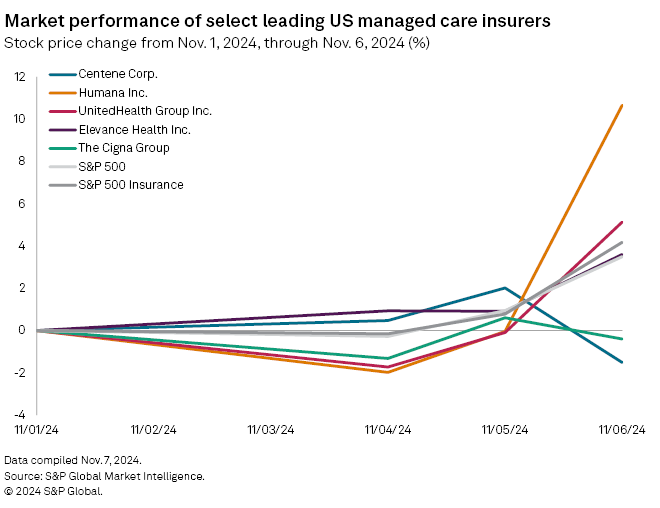
Whether the stock prices just before and after election day are predictive of things to come remains to be seen. For now, the information before us is this:

    • Between Nov 1 and Nov 7, Humana Inc. had the largest increase in stock prices at 10.7%
    • UnitedHealth Group Inc. rose 5.1% in the same time period
    • Both companies had greater stock increases than the average across S&P
    • Elevance Health was in keeping with the rest of the S&P with an increase of 3.6%
    • Molina Healthcare, Inc. and The Cigna Group dropped 0.2% and 0.4%, respectively
Medicare Advantage Stock Trump

Analysts say the jumps are in keeping with expectations that Republican control in Congress and in the White House will be beneficial for Medicare Advantage

Medicare Advantage Stock Trump<br />

Final Thoughts

It’s no secret that The Rowan Report is not a fan of Medicare Advantage. Specifically, the sales tactics used on the elderly and infirmed are predatory and the denial rate is criminal. The more eligible patients sign up for Medicare Advantage the less they will receive the care they need. Further, the more Medicaid has to supplement the cost of Medicare Advantage, the more home care agencies will suffer. Nationally, the more CMS regulates payment rates, pre-authorizations, and denial rates by privatizing Medicaid, the worse off our entire healthcare system will be.

With the state and national associations, we will continue to advocate on behalf of care at home agencies and their patients. And we hope you will too, regardless of who is in office. We have support at the federal level and we will continue to fight the good fight.

# # #

Kristin Rowan, Editor

Kristin Rowan has been working at Healthcare at Home: The Rowan Report since 2008. She has a master’s degree in business administration and marketing and runs Girard Marketing Group, a multi-faceted boutique marketing firm specializing in event planning, sales, and marketing strategy. She has recently taken on the role of Editor of The Rowan Report and will add her voice to current Home Care topics as well as marketing tips for home care agencies. Connect with Kristin directly kristin@girardmarketinggroup.com or www.girardmarketinggroup.com

©2024 by The Rowan Report, Peoria, AZ. All rights reserved. This article originally appeared in Healthcare at Home: The Rowan Report. One copy may be printed for personal use: further reproduction by permission only. editor@therowanreport.com