People who work in home‑based care, whether licensed home health clinicians or trained home care aides, do something unusual in the healthcare world. They walk into a stranger’s home and step into the middle of that person’s daily life. Their role is to try to help them stay, or get, healthy, stable, safe, and dignified. All this happens in someone else’s environment. That fact impacts the hiring and retention challenge for agencies.
While somewhat overlapping, home health and home care are different fields. Home health visits are shorter, clinically focused, and built around medical goals. Home care shifts are longer, non‑medical by law, and often revolve around companionship, safety, and daily living support. But the shared denominator, the home environment, creates a common reality. Agencies must find and keep people who can handle the emotional, practical, and interpersonal demands of working inside a client’s private world.
Long-term retention depends significantly on the caregiver’s ability to adapt with a chameleon-like mindset.
The Home Environment Changes Everything
A hospital or clinic has structure; a home does not. Workers deal with cluttered living rooms, anxious adult children, and unpredictable pets. They see clients who may be having a good day, a bad day, or something in between. They have to be able to read the situation, adjust their tone, and figure out how to help without dominating.
This is not a skill you can measure with a résumé alone. Agencies that hire well look beyond credentials. They look for temperament — calmness, respect, patience, and the ability to stay professional even when the environment may be anything but.
Retention starts with hiring people who can work in this setting.
Why Turnover Hits Home Based Care Harder
Turnover in this field isn’t just inconvenient. It’s disruptive in ways that office‑based healthcare rarely experiences.
When a home health clinician leaves, cases get reshuffled, documentation gets delayed, and continuity of care suffers. When a home care aide leaves, long‑standing client relationships can collapse overnight. The Patient is most aware. Families notice. Referral partners notice.
Workers leave for predictable reasons:
Home health clinicians may feel isolated or overwhelmed by documentation and case complexity.
Home care aides may feel undervalued or stuck in roles with no visible progression.
Both groups may struggle with inconsistent schedules, long drive times, or emotionally draining cases.
Retention improves when agencies acknowledge these realities instead of treating turnover as “just part of the industry.”
Creating a Support System That Actually Works
The best retention strategies aren’t flashy. They’re consistent, practical, and rooted in what workers experience every day.
Home health clinicians need clinical leadership that is reachable. Not a voicemail box. Not a once‑a‑week check‑in. They need someone who answers the phone when a wound looks worse, when a medication list doesn’t match the chart, or when a family is spiraling. Caregivers knowing they have that backup reduces burnout more than any bonus ever will.
Home care aides need respect and inclusion. They may not have medical licenses, but they are the ones who see the client’s real daily life. Agencies that treat aides as essential contributors, not interchangeable labor, see stronger loyalty and longer tenure.
Across both groups, communication is the glue. Workers stay when they feel connected to a team that listens and responds.
Logical Rewards
Incentives That Make Sense in the Field
Many agencies try bonuses, gift cards, or occasional “thank you” events. Those gestures are fine, but they rarely change long‑term behavior. Logical rewards do.
These incentives tie directly to the realities of home‑based work:
Readiness bonuses for workers who reliably take short‑notice visits.
Incentives for on‑time arrival, complete documentation, or strong client feedback.
Skill‑tier pay ladders that reward additional certifications or specialized training.
Continuity bonuses for maintaining long‑term client relationships without disruption.
These rewards reinforce the behaviors that stabilize the agency. They’re not random. They’re strategic.
Onboarding and Training:
The First Impression That Never Goes Away
Retention begins the moment a new worker walks through your door. A chaotic onboarding process sends a message that “this agency is disorganized.” A clear, supportive onboarding process sends the opposite message that “we know what we’re doing, and we want you to succeed.”
Home health clinicians need onboarding that covers real‑world clinical scenarios, documentation expectations, and the unpredictable nature of home visits. Home care aides need onboarding that prepares them for communication challenges, safety issues, and the emotional realities of working with seniors.
Ongoing training matters just as much. Workers stay when they see a path forward, something to grow into, not just a job to survive.
Retention Is Not HR, It is Strategy
Agencies that retain their workers don’t just solve staffing problems. They build a competitive advantage. Families trust agencies whose workers stay. Referral partners prefer agencies that don’t constantly reshuffle cases. Regulators appreciate agencies with consistent documentation and stable clinical outcomes.
Retention is not a side project. It is a core business function.
# # #
Roger McManus is the author of several books on entrepreneurship, including “Entrepreneurial Insanity in the Home Care Business,” which he co-wrote with Tim Rowan. He advises Home Care owners and HR professionals on techniques for recruiting, retaining, and rewarding caregivers.
Viventium acquires Apploi to create a leading nationally scaled, healthcare-exclusive human capital management platform
Acquisition supports the full employee lifecycle, ensuring a better experience for caregivers and more stability for the organizations they serve
BERKELEY HEIGHTS, N.J., Feb. 4, 2026. Viventium today announced the strategic acquisition of Apploi, creating a category-leading human capital management (HCM) provider purpose-built for the post-acute market. This move establishes a new industry standard: a unified system of record that combines recruiting, credentialing, onboarding, payroll, and workforce management, including scheduling and time and attendance, with a foundation in healthcare compliance.
Tackling the Labor Shortage
Post-acute and long-term care providers currently face persistent labor shortages and a complex regulatory environment. Until now, the industry has relied on a fragmented mix of generalist software and disconnected point solutions that create data silos and administrative friction. The combination of Viventium and Apploi solves these challenges by providing a single, verticalized platform that manages the entire care staff journey across all 50 states.
From Viventium
“Healthcare leaders are tired of fighting with fractured systems that weren’t built for their specific needs. By acquiring Apploi, we are creating the only scaled, healthcare-native platform that unifies everything from the first job application to the final paycheck. We are providing thousands of providers with the visibility and operational speed they need to manage their entire workforce, from clinical staff in the field to administrative teams in the office.”
Navin Gupta
CEO,Viventium
From Apploi
Adam Lewis, CEO of Apploi, added, “Our mission has always been to solve the staffing crisis in healthcare. Joining Viventium allows us to take that mission further than ever before. We are moving beyond just hiring to support the full employee lifecycle, ensuring a better experience for caregivers and more stability for the organizations they serve.”
Integration
The unified platform touches thousands of healthcare providers and hundreds of thousands of employees nationwide. By integrating Apploi’s recruiting and credentialing tools with Viventium’s premier payroll, HR, and workforce management engine, the company offers an unparalleled level of verticalized scale and compliance.
The acquisition officially closed on January 30, 2026. Goodwin Proctor LLP represented Viventium in connection with the transaction, while Houlihan Lokey served as financial advisor and Dentons served as legal advisor for Apploi. Financial terms of the deal are not being disclosed.
# # #
About Viventium
Viventium is the category-leading human capital management provider for the post-acute market. Built exclusively for healthcare, Viventium’s unified platform combines payroll, HR, recruiting, onboarding, and workforce management—including scheduling and time and attendance—into a single system of record. Serving clients in all 50 states and supporting nearly 800,000 healthcare employees, Viventium enables healthcare organizations to focus on what matters most: providing compassionate care.
About Apploi
Apploi helps healthcare facilities stabilize their workforce and increase occupancy in the midst of a labor shortage with an all-in-one platform built to hire, onboard, and schedule top healthcare talent.
Working with over 9,000 healthcare organizations across the United States, the NYC-based tech company helps leaders solve the industry’s most pressing problem: how to provide superb care with few workers and more turnover. With the Apploi platform, facilities can manage the staff experience from job post through shift fulfillment—empowering teams to fill roles quicker, lessen agency dependence, and increase occupancy rates.
I’m sure many of you remember the days before automated processes. Hand-written notes, paper forms, and paychecks that were filled in on a typewriter. Those days are behind us (mostly) in care at home with the alphabet soup of technology we have today: EMR, EVV, EHR, PECOS, API, EDI, UB-04, ADP
Technology evolves in unpredictable paths and patterns. And the best developers adjust to that evolution. That is the story of a software provider that we recently interviewed. What started as a general payroll and HR software evolved and steered the developers toward health care. Now, that payroll company is built for care at home and includes so much more than standard payroll. Introducing…Viventium
Home Health and Home Care Enhancements
When the Viventium team started their software, it was not industry specific. But some key clients put home care on their radar six years ago and the software development shifted to meet the unique needs of care at home agencies. Today, Viventium is a workforce management system that is built for care at home and includes features not found in general payroll software. Some of Viventium’s capabilities include:
Applicant tracking
Job board integration
Hiring data and talent recognition
Recruitment insights and analysis
Onboarding
Tax filing
Employee self-help section
Integration with Tapcheck
Time and Attendance approval
Time off requests
Scheduling and Open Shift management
Continuing education tracking
Benefits management
ACA compliance tracking and reporting
Automated blended rate payroll
Integrations and Automations
Viventium is already working with a handful of EMRs for direct integration. The system is also integrated with TapCheck for on-demand pay and with Nevvon for CEUs. For EMRs that are not fully integrated, they offer pre-built exports that can handle different export formats. Viventium can import information from virtually any patient record system.
Once the payroll system is set up for your agency, or agencies, many of the workflows are automated, relieving time and stress on your staff and saving you money on recruitment, retention, FTEs and missed visits. The staff responsible for new hires will experience such automations as pre-filling demographic information everywhere once it is entered once, customizable CEU requirement task assignment and reminders, tax preparation and filing, sharing job listings across multiple job boards, and payroll generation from EVV import.
Industry Differentiators
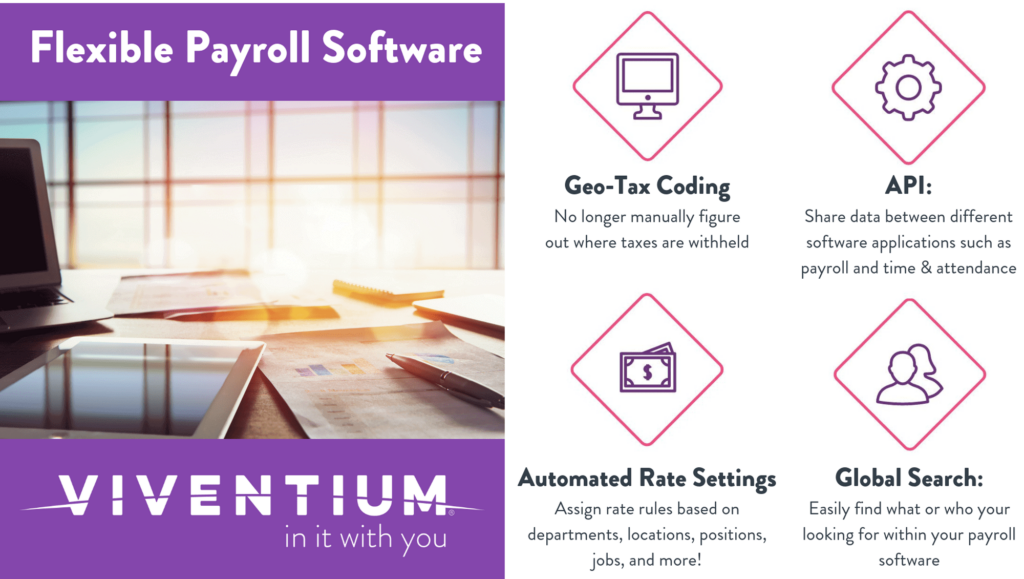
Standard payroll companies and software are perfectly capable of running weekly time cards and calculating state and federal taxes. Most of them automate direct deposit. Very few have the built-in capability to change hourly rates during a shift. Viventium allows agencies to customize visit types, names, and rates, allowing an employee to clock in at the start of a shift and adjust their job code as needed throughout the day. Even fewer calculate overtime, benefits eligibility, sick leave accrual, and daily overtime for per visit employees automatically. And Viventium is the first payroll software I’ve come across that is piece-rate compliant, calculating rest pay and non-productive time.
Customizations
HHAs are not “one size fits all” and neither is Viventium. The list of available customizations keeps growing. Agencies can apply custom parameters to:
CEU requirements based on license type, expertise, PiPs, etc.
Benefit information
Reminders for expirations and deadlines on performance reviews, licenses, certifications, and CEUs
Workflows for digital onboarding documents, progress tracking, and completion
Re-hire eligibility
Payroll and overtime calculations for one employee working across agency locations
Reporting, analytics, data, in addition to the static analytics dashboard
User Reviews
As a small business with very little need for robust HR systems, payroll software is not really on my “must have” list. Still, I’d be remiss if I didn’t consider using a system with this many “extras”. But, don’t take my word for it. Here is what Viventium customers have to say:
Hospital System with 11-50 Employees
“I enjoy the software and it beats most if not all payroll systems out there for attractiveness to use and navigate through. Very user friendly. When they update the product they always have a training associated with it. It easy to use for our employees as well.”
Home Care Agency with 51-200 Employees
“Viventium has really helped my company by providing payroll services. As a new and small business owner, the “V” team has been patient, helpful and always a pleasure to work with. In our first 2 years, the service has been very helpful and timely. I am very happy I decided to go with the “V” team. Highly recommend for payroll services.”
∼ Carlos, SYNERGY HomeCare in Palm Bay.
Health and Wellness with 1,001-5,000 Employees
“It’s not just another payroll or HR tool, it feels thoughtfully built for real people, especially those of us in healthcare….
Plus, having everything from benefits administration to compliance tracking in one place has saved me countless hours. It’s helped our team stay organized and focused on what really matters: supporting our staff and growing our business.”
Review
In the care at home industry, Viventium is relatively new in comparison with other systems. Outside of care at home, Viventium is trusted by more than 3,000 companies and has the experience and expertise to support more than just payroll, but all workforce management.
The user interface is pleasant and visually pleasing enhancing its very user-friendly, easy to use platform. 3rd party tools are fully integrated, keeping every feature under a single sign-on. Also included is an Android and iOS app for your staff to track and view hours, pay rates, benefits, and education all in one place.
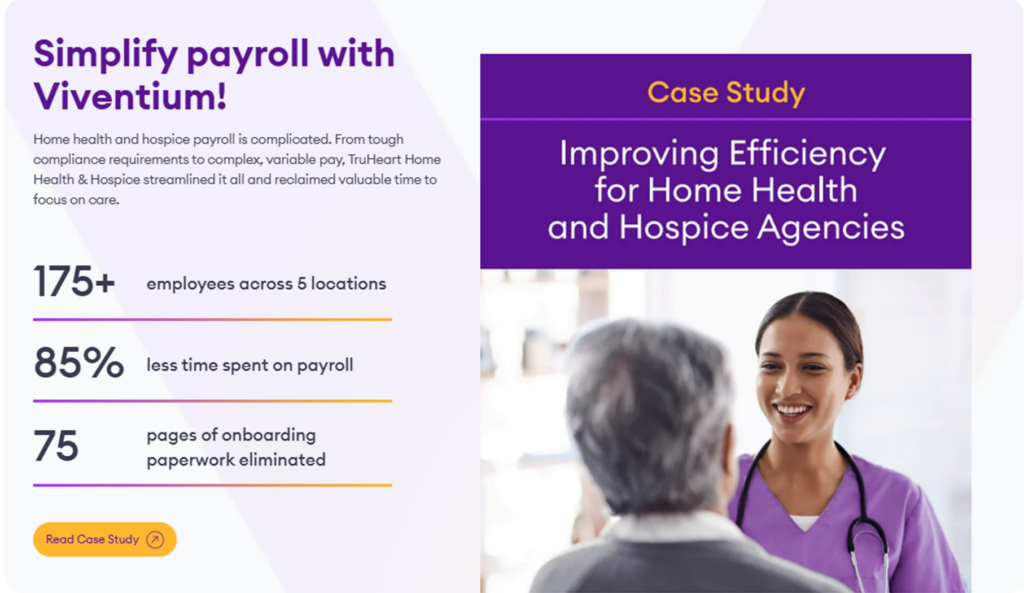
The automation and customization reduces payroll prep time, improves compliance and accuracy, strengthens retention and recruitment, eliminates physical paperwork for onboarding, and much more. This part is not my opinion, but is based on this efficiency study.
Final Thoughts
If you’re not using Viventium, it is worth exploring. The potential to eliminate multiple software systems and logins is real. The savings in time, retention, and reduced errors are measurable. Viventium is the best kept secret in care at home and based on my conversations with their team, we haven’t heard the last of Viventium’s innovation and industry-specific features.
# # #
Kristin Rowan has been working at The Rowan Report since 2008. She is the owner and Editor-in-chief of The Rowan Report, the industry’s most trusted source for care at home news, and speaker on Artificial Intelligence and Lone Worker Safety and state and national conferences.
She also runs Girard Marketing Group, a multi-faceted boutique marketing firm specializing in content creation, social media management, and event marketing. Connect with Kristin directly kristin@girardmarketinggroup.com or www.girardmarketinggroup.com
Viventium Releases its 2024 Caregiver Onboarding Experience Report, Demonstrating a Need to Raise the Bar for Onboarding in the Post-Acute Care Industry
BERKELEY HEIGHTS, N.J., April 02, 2024 (GLOBE NEWSWIRE) — Viventium, the leading SaaS-based human capital management platform serving the post-acute care industry, released its 2024 Caregiver Onboarding Experience Report, a comprehensive research study analyzing survey responses from 175 post-acute care administrators and 220 caregivers. The report finds a shockingly low bar for what passes as a “good” onboarding experience in home-based and facility/community-based care, with strong indications that raising that bar could correlate to higher retention rates.
“Staffing shortages and high turnover rates within post-acute care are recurring issues in need of solutions,” said Navin Gupta, Viventium CEO. “Our research illuminates a crucial pathway towards addressing these persistent challenges, and it begins with onboarding.”
Findings point to post-acute care managers and administrators having a major impact on the steps their organization can take to better engage, motivate, and retain its caregiving staff.
“The study significantly advances our knowledge of what it takes to recruit and retain caregivers in today’s highly competitive workforce market. The onboarding process is fully within the control of the employer, and the study shows that doing it right pays dividends. Most notably, many of the elements of successful onboarding are simple improvements in the process that bring a real return on investment. I would encourage all of home care to learn from this study.”
About Viventium
Viventium provides a SaaS-based human capital management solution that is focused on the post-acute care industry. The company’s mission is to enrich the lives of caregivers through technology so they love going to work every day. By providing specialized software and expert guidance, Viventium helps its clients throughout the lifecycle of each caregiver. The company has clients in all 50 states and supports over 420,000 client employees each year.