by Kristin Rowan | Jun 6, 2025 | Breaking News, Home Health, Hospice, Legal, M&A, Medicaid, Medicare
*Editor’s note: This article has been updated to remove inaccurate information from the Intrepid USA website.
Intrepid USA Files Bankruptcy
Intrepid USA, once among the largest providers of home health and hospice services, files bankruptcy in Texas. With more than $90 million in revenue in 2023, Intrepid operated more than 60 home health and hospice locations in 17 states. The Chapter 7 filing leaves no road to recovery. Chapter 7 allows the company to liquidate assets and distribute the proceeds. According to the Texas Southern Bankruptcy Court, Intrepid USA filed a voluntary petition for Chapter 7 bankruptcy on May 29, 2025.
Troubled History Plagues Company
Intrepid USA has a troubled past that it seems may have caught up with them. The U.S. Department of Justice (DoJ) alleges that between 2016 and 2021, Intrepid home healthcare agencies engaged in fraud. In violation of the False Claims Act, Intrepid filed Medicare claims for patients who did not qualify for home health, services that were not medically necessary, services provided by untrained staff, and services that were never provided. In August, 2024, Intrepid agreed to pay $3.85 million to resolve the allegations. The allegations were brought to the DoJ by two former employees of Intrepid under whistleblower provisions.
This is not the first DoJ lawsuit against Intrepid USA. In 2006, when Intrepid owned 150 agencies across the country, the company entered into an $8 million settlement agreement to resolve similar allegations. The DoJ alleged that from 1997 to 2004 Intrepid violated the False Claims Act by billing Medicare and TRICARE for services not provided by a qualified person, failing to maintain complete documentation for its claims, and other violations of Medicare regulations. Additionally, the DoJ alleged that Intrepid, in 2002 and 2003, fraudulently billed Medicaid for home care services provided to patients who were hospitalized at the time of the supposed care.
Sometime around Q3 of 2006, Intrepid USA received financial backing from Patriarch Partners, led by Lynn Tilton. In August of 2020, Patriarch filed a notice of removal with the Supreme Court of New York. In 2021, Intrepid announced it was gearing up for rapid growth fueled by new private equity investors. Then CEO John Kunysz indicated the infusion of capital would fund opportunities for growth through acquisition.
Despite the influx of capital and the plan to grow through acquisition, by 2024, Intrepid was selling its assets. In August of 2024, Humana acquired 30 Intrepid branch locations and rebranded them under the CenterWell Home Health brand. The sale was part of Patriarch Partners’s Zohar Funds bankruptcy case. In November of 2024, New Day Healthcare acquired Intrepid’s hospice locations in Missouri and Texas.
The bankruptcy filing shows that Intrepid USA had $90 million in revenue in 2023, $50 million in revenue in 2024, and $0 in revenue so far in 2025. Chapter 7 bankruptcy is usually supervised by the court, allowing the filing company to sell assets without having to use the revenue generated by the sale to pay off debts. Intrepid listed $1 to $10 million in assets and $88 million in debts at the time of the filing.
The Intrepid USA website still lists 55 active home health and hospice locations in 11 states. However, 30 of those locations are now listed on the CenterWell website and at least 5 other locations were part of the sale to New Day Healthcare. It is unknown if Intrepid has any locations still in operation. The company did not respond to our request for a statement.
The website also has a list of partners and investors. The Rowan Report reached out to the partners with whom we are familiar for more information. We will provide updates from them once we reach them.
The recent divestiture of home health and hospice locations to New Day and CenterWell will hopefully minimize the number of patients who are losing their home health or hospice provider. Millions of dollars in future fraudulent claims will remain in the Medicare, TRICARE, and Medicaid coffers. Conversely, the partners and investors in Intrepid USA may face some loss. We will provide any important updates and comments from the impacted companies as available.
Kristin Rowan has been working at The Rowan Report since 2008. She is the owner and Editor-in-chief of The Rowan Report, the industry’s most trusted source for care at home news, and speaker on Artificial Intelligence and Lone Worker Safety and state and national conferences.
She also runs Girard Marketing Group, a multi-faceted boutique marketing firm specializing in content creation, social media management, and event marketing. Connect with Kristin directly kristin@girardmarketinggroup.com or www.girardmarketinggroup.com
©2025 by The Rowan Report, Peoria, AZ. All rights reserved. This article originally appeared in The Rowan Report. One copy may be printed for personal use: further reproduction by permission only. editor@therowanreport.com
by Kristin Rowan | Mar 7, 2025 | Clinical, Hospice, Medicare Advantage, Regulatory
Palliative Care for Medicare Advantage Members
Cancer is one of the highest leading causes of death in the United States, second only to heart disease. The challenges for cancer patients are not only physical, but emotional and financial as well. The consequences of these challenges are often devastating to the patient and their families. Providing additional care, support, and pharmaceutical interventions through value-based care can improve patient outcomes and reduce out-of-pocket costs.
Thyme Care is a Nashville-based cancer treatment center that operates in seven states. The centers provide not just treatment, but cancer care navigation, designed to work within the value-based framework, keeping the patient at the center of care. Thyme Care includes an oncology care team, a patient app with multiple resources and 24/7 access to support. Patient surveys track symptoms and reduce barriers to care. This approach combines cancer treatment and palliative care for whole-person cancer care support.
Palliative care works alongside medical care to improve the quality of life for the patient, addressing physical, emotional, and spirtual needs. Strictly speaking, it is not medical care, and not specifically covered by most insurance plans. The out-of-pocket costs for palliative care can be extremely high, making this kind of care an inaccessible amenity for most patients.
Value-based care reimburses care providers partially based on patient outcomes and patient satisfaction. Providers also share the financial risk of care with health insurance companies. Care providers who can both improve outcomes and patient satisfaction can be reimbursed more through health insurance plans, which can cover the costs of palliative care, even when it is not explicitly covered by the plan.
Humana is a payer with plans for Medicare, Medicaid, and Individual/Family beneficiaries. The Medicare Advantage value-based care plans allow Humana to disperse payments for covered services in partnership with care provider teams across a patient’s care journey. The better the outcome and satisfaction, the more Humana can pay a provider for care. Better outcomes often means reduced hospital visits, a longer time at home before requiring skilled nursing facilities, and lower costs.
Humana Thyme Palliative Care Collaboration
The recently announced partnership between payer and provider will give eligible patients access to palliative care support as part of the whole-person cancer care navigation provided by Thyme. Humana patients can also receive, as needed, 24/7 virtual care, medication guidance, symptom management, chronic condition management, community-based resources, financial assistance, transportation, food assistance, and/or access to stable housing.
Kristin Rowan has been working at The Rowan Report since 2008. She is the owner and Editor-in-chief of The Rowan Report, the industry’s most trusted source for care at home news. She also has a master’s degree in business administration and marketing and runs Girard Marketing Group, a multi-faceted boutique marketing firm specializing in content creation, social media management, and event marketing. Connect with Kristin directly kristin@girardmarketinggroup.com or www.girardmarketinggroup.com
©2025 by The Rowan Report, Peoria, AZ. All rights reserved. This article originally appeared in The Rowan Report. One copy may be printed for personal use: further reproduction by permission only. editor@therowanreport.com
by Kristin Rowan | Sep 20, 2024 | CMS, Medicare Advantage, Regulatory
Essentia Drops Medicare Advantage
Essentia Health is an integrated health system with locations in Minnesota, North Dakota and Wisconsin. The health system offers 285 different services across more than 1,700 locations. They employ more than 2,700 doctors. Essentia also includes 14 hospitals, emergency care, same-day care for mental health crises, and multiple specialties.
This is all to say that Essentia Health is not a small player. They contract with the largest payers in the industry.
Recently, the health system began re-evaluating its participation in some Medicare Advantage plans. According to the chief medical officer for population health at Essentia, Cathy Cantor, M.D., M.B.A., too often deny or delay care. Cantor said in a statement:
“This was not a decision we made lightly. The frequent denials and associated delays negatively impact our ability to provide the timely and appropriate care our patients deserve. This is the right thing to do for the people we are honored to serve.”
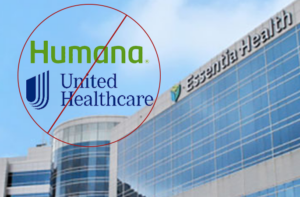
Essentia informed patients that they will no longer be an in-network provider for MA plans through UnitedHealthcare (UHC) or Humana beginning January 1, 2025. The health system claims that UHC and Humana delay and deny approval of care at more than twice the rate of other Medicare Advantage plans. They are encouraging its patients to choose a different plan during open enrollment that is in-network with Essentia.
UnitedHealthcare responded to the press release that Essentia issued. According to their statement, the two parties extended their contract just this past July. Negotiations included a number of items on which they agreed to collaborate, but Medicare Advantage was not specified among them.
“Essentia Health didn’t raise concerns regarding its participation in our Medicare Advantage network until last week. We have since met with Essentia on Sept. 9 and are committed to working with the health system to explore solutions with the goal of renewing our relationship. We hope Essentia shares our commitment toward reaching an agreement.”
Essentia’s departure from Medicare Advantage is just one in a recent mass exodus.
Sanford Health of South Dakota ended its Humana MA participation due to “ongoing challenges and concerns that negatively effect patients including ongoing denials of coverage and delays in accessing care.”
HealthPartners out of Minnesota announced over the summer that “UnitedHealthcare delays and denies approval of payment for MA claims at an exceptionally high rate…up to 10 times higher than other insurers…. After over a year of being unable to persuade UnitedHealthcare to change their practices, we’ve determined that we can no longer participate in the UnitedHealthcare Medicare Advantage network.”
Mercy, the official medical provider of the St. Louis Cardinals, announced its year-end departure from the Anthem Blue Cross Blue Shield network. This includes all Medicare Advantage, ACA marketplace, and managed Medicaid plans. They cited administrative tasks that create a barrier to timely, appropriate patient care. Mercy also complained that Anthem has raised its rates for patients and employers, increased its profits, and still has not raised reimbursement rates to providers. Like Essentia, Mercy is encouraging its patients to consider whether the health care plan they choose during open enrollment will list Mercy as one of its in-network providers.
CMS reimbursement rates, Medicare Advantage denials, payment delays, and other interruptions are impeding patient care. As Tim mentions in his editorial this week, we are in an election year and we urge you to research how each party might impact our industry.
If more providers and payors continue to drop Medicare Advantage from their offerings, will we see more patients returning to traditional Medicare plans with an affordable Medicare Supplement or MediGap coverage? One can only hope!
Kristin Rowan has been working at Healthcare at Home: The Rowan Report since 2008. She has a master’s degree in business administration and marketing and runs Girard Marketing Group, a multi-faceted boutique marketing firm specializing in event planning, sales, and marketing strategy. She has recently taken on the role of Editor of The Rowan Report and will add her voice to current Home Care topics as well as marketing tips for home care agencies. Connect with Kristin directly kristin@girardmarketinggroup.com or www.girardmarketinggroup.com
©2024 by The Rowan Report, Peoria, AZ. All rights reserved. This article originally appeared in Healthcare at Home: The Rowan Report. One copy may be printed for personal use: further reproduction by permission only. editor@therowanreport.com
by Kristin Rowan | Feb 7, 2024 | Regulatory
by Kristin Rowan, Editor,
On Wednesday, January 31, Cigna and HCSC signed an agreement to sell all of Cigna’s Medicare business — including traditional Medicare, supplemental benefits, Medicare Part D offerings, and CareAllies, a value-based care management subsidiary. — to HCSC, a Blue Cross / Blue Shield partner with operations in Illinois, Texas, New Mexico, Oklahoma and Montana. The $3.3 billion deal will quadruple the size of HCSC’s Medicare Advantage population, which numbered 217,623 as of this month.
Medicare Advantage had not been a significant business for Cigna. CEO David Cordani explained that it required resources disproportionate to its size in the company. With 19 million insurance customers, Cigna had a little over a half million in its MA business, a little under a half million Medicare supplement members, and 2.5 million in Part D.
It had previously been reported that Cigna believed divesting its Medicare business would make its merger with Humana more acceptable to regulators. The company completed its HCSC deal even though negotiations with Humana had already broken down. Though inked today, the deal is not expected to close until the first quarter of 2025.
# # #
 Kristin Rowan has been working at Healthcare at Home: The Rowan Report since 2008. She has a master’s degree in business administration and marketing and runs Girard Marketing Group, a multi-faceted boutique marketing firm specializing in event planning, sales, and marketing strategy. She has recently taken on the role of Editor of The Rowan Report and will add her voice to current Home Care topics as well as marketing tips for home care agencies. Connect with Kristin directly kristin@girardmarketinggroup.com or www.girardmarketinggroup.com
©2024 by The Rowan Report, Peoria, AZ. All rights reserved. This article originally appeared in Healthcare at Home: The Rowan Report.homecaretechreport.com One copy may be printed for personal use: further reproduction by permission only. editor@homecaretechreport.com
by Tim Rowan | Dec 6, 2023 | CMS, Regulatory
by Tim Rowan, Editor Emeritus
MA Plans Continue to Exaggerate Patient Conditions for Profit

As we reported in October (More MA Plans Caught Inflating Patient Assessments, 10/11/23), insurance companies operating Medicare Advantage plans routinely pad the patient assessments that set their monthly revenue from the Medicare Trust Fund. Worse, CMS bowed to industry pressure earlier this year and agreed not to extrapolate the amount of the fraudulent payments, as it does with Home Health and Hospice overpayments (Government Lets Health Plans That Ripped Off Medicare Keep the Money, 2/22/23).
Now, we hear that the HHS OIG has totaled its 2023 audits and announced it found over $213 million in padded Medicare Advantage overpayments so far this year. In its latest semiannual report, covering fraudulent patient assessments between April and September, the OIG said it recovered $82.7 million. Total recoveries would have been higher except for that CMS ruling that prevents the agency from extrapolating payments before contract year 2018.
Will SEC Allow Cigna/Humana Marriage?
Early last month, Bloomberg broke the news that Cigna was in talks to sell its Medicare Advantage business to Health Care Service Corporation, the parent company of BCBS in Illinois, Texas, New Mexico, Montana and Oklahoma. Should that sale be approved, it would remove an obstacle to Cigna’s rumored desire to merge with Humana.
Though approval is uncertain — the SEC has squashed more than one similar attempt under both the current and former Presidents — it would create what Axios called “another Titan” that would rival UnitedHealth Group and CVS Health in size. CVS acquired Aetna in 2018. It would also combine two Pharmacy Benefit Managers, giving the new entity control of a third of the market, which would be equal to the market share owned today by CVS.
In 2017, a proposed merger between Cigna and Elevance Health, formerly Anthem, was struck down in court. A proposed merger between Humana and Aetna was also canceled in a federal court the same year. Large, powerful insurers, and the PBMs they own, have come under increased scrutiny from federal regulators.
The Biden administration has already launched a warning shot, indicating it will be scrutinizing private equity acquisitions in health care. In September, the Federal Trade Commission sued private equity firm Welsh, Carson, Anderson & Stowe after it bought up nearly all of the anesthesiology practices in Texas and then, with competition removed, began to jack up prices. FTC chair Lina Khan made it clear the suit was intended to send a message to all consolidation attempts that might harm patients.
United to Change Prior Authorization Policy
According to a November 27 policy update from UnitedHealthcare (UHC), the payer is updating its Home Health prior authorization and concurrent review process for services that are delegated to Home & Community Care, the payer’s home care division.
The updated policy, which are set to take effect January 1, will affect United’s Medicare Advantage and Dual Special Needs plans in 37 states, a UnitedHealthcare news release stated.
In Summary
- Start of care visits still do not require prior authorization.
- Providers must notify Home & Community Care of the initiation of home care services. UHC encourages providing notice within five days after the start of a care visit to help avoid potential payment delays.
- Before the 30th day, providers must request prior authorization for days 30 to 60, by discipline, and provide documentation to Home & Community Care.
- For each subsequent 60-day period, providers must request prior authorization, by discipline, and provide documentation to Home & Community Care during the 56- to 60-day recertification window.
UHC says it will respond to questions about the prior authorization approval process at HHinfo@optum.com
In related news, in its annual investor conference call, the company projected “revenues of $400 billion to $403 billion, net earnings of $26.20 to $26.70 per share and adjusted net earnings of $27.50 to $28.00 per share” for 2024. Cash flows from operations are expected to range from $30 billion to $31 billion.
 Tim Rowan is a 30-year home care technology consultant who co-founded and served as Editor and principal writer of this publication for 25 years. He continues to occasionally contribute news and analysis articles under The Rowan Report’s new ownership. He also continues to work part-time as a Home Care recruiting and retention consultant. More information: RowanResources.com
Tim@RowanResources.com
©2023 by The Rowan Report, Peoria, AZ. All rights reserved. This article originally appeared in Healthcare at Home: The Rowan Report. homecaretechreport.com One copy may be printed for personal use: further reproduction by permission only. editor@homecaretechreport.com