by Rowan Report | Mar 28, 2024 | Partner News
FOR IMMEDIATE RELEASE
INNOVATION TAKING CENTER STAGE AT ATA NEXUS 2024: 12 FINALISTS PRESENTING LIVE AT ATA TELEHEALTH INNOVATORS CHALLENGE
ATA Nexus Annual Conference, May 5-7, Phoenix, AZ
WASHINGTON, DC, MARCH 28, 2024 – The American Telemedicine Association (ATA) today announced the 12 finalists who will be presenting live at the Telehealth Innovators Challenge, where the future of healthcare meets creativity and innovation, at ATA Nexus 2024, May 5-7 in Phoenix, AZ. The ATA Telehealth Innovators Challenge is an exclusive opportunity for early-stage virtual care developers to showcase their novel solutions in front of key stakeholders, investors and decision-makers driving the future of healthcare.
The 12 innovators presenting in the final round of the Telehealth Innovators Challenge will highlight the latest digital health innovations to help eliminate gaps in access to care:
Femtech and Women’s Health:
- Leva Pelvic Health System – Axena Health
- Nest Collaborative
- The Future of Maternal Care – Bloomlife
In-patient Care Solutions:
- Oshi Health Virtual GI Center of Excellence
- ThinkAndor – Andor Health
- DermEngine AI-Powered Care Coordination – MetaOptima Technology, Inc.
The Patient Experience:
- Vori Health
- The TeleDentists
- ThriveLink (formerly Nutrible)
Tools That Deliver Care:
- CardioSignal
- Alio Remote Monitoring Platform
- Strados Labs RESP Biosensor
Meet the Innovators Challenge Judges:
Samir Batra, BAHA Enterprises; HIP; ATA Advisor (Emcee)
Kiran Avancha, PhD, HonorHealth Innovations
Amit Aysola, Create Health Ventures
Joe Brennan, TytoCare
Christine Brocato, CommonSpirit Health
Adam Dakin, Medivation Advisors
Tracy Dooley MD, Avestria Ventures
Charlotte Gabet, Parkview Health
Jon Gabriel, Foley & Lardner
Nancy Green, The SAA Group, LLC
Rick Hall, PhD, Mayo Clinic/ASU MedTech Accelerator
Saira Haque, PhD, Pfizer Medical Affairs
Jennifer Joe, MD, AstraZeneca
Aditi U. Joshi, MD, Digital Health Consultant
Connor McDermott, A1 Health Ventures
Kate Merton, PhD, ChicagoArc
Matt Miller, PhD, Headwater Ventures
Yuriy Oinyskiv, Orlando Health Ventures
Maxim Owen, Wavemaker Three-Sixty Health
Rakesh Patel, MD, Good Samaritan Hospital
Julia Monfrini Peev, PACE Healthcare Capital
Shravan Rai, Teladoc Health
Lygeia Ricciardi, AdaRose
Julianne Roseman, Plug and Play
Matthew Sakumoto, MD, Sutter Health-West Bay Region
Mayank Taneja, OSF Healthcare
Kristen Valdes, b.well
Elliott Wilson, Flying Pig Consulting
Keith Winter, Teal Ventures
Emily Zhen, Zeal Capital Partners
Anthony Zlaket, Tampa General Hospital
Jeff Zucker, Digital Health Entrepreneur/Investor
ATA Nexus features three full days of dynamic content, including new programming formats and interactive sessions that will explore The Next Chapter in Virtual Care, including interactive sessions, collaborative workshops, a bustling exhibit floor and networking and social events that will spark curiosity, foster learning, and ignite transformative discussions, including:
- Four Deep Dive sessions on the hottest topics in virtual care, plus NEW! Telehealth 101 Bootcamp
- Over 80 Oral and Poster Research Presentations with CME
- NEW! System Spotlights featuring leading hospital systems on the forefront
- NEW! Curbside Consult sessions, engaging and informal “consults” with clinicians and industry experts
- Annual Telehealth Innovators Challenge live pitch competition
- NEW! Meet the Experts lounge in the ATA Hub
- NEW! Insights Workshop on Virtual Nursing for senior nursing leaders
- Plus over 300 speakers, hundreds of sponsors and exhibitors, and an audience packed with telehealth and virtual care stakeholders
GENERAL REGISTRATION: For more information or to register, please visit the ATA Nexus 2024 website for details and easy online registration.
MEDIA REGISTRATION: Register to attend ATA Nexus 2024 here and use comp code ATA24PRMEDIA to receive complimentary press credentials. Or contact Gina Cella at gcella@americantelemed.org.
About the ATA
As the only organization completely focused on advancing telehealth, the American Telemedicine Association is committed to ensuring that everyone has access to safe, affordable, and appropriate care when and where they need it, enabling the system to do more good for more people. The ATA represents a broad and inclusive member network of leading healthcare delivery systems, academic institutions, technology solution providers and payers, as well as partner organizations and alliances, working to advance industry adoption of telehealth, promote responsible policy, advocate for government and market normalization, and provide education and resources to help integrate virtual care into emerging value-based delivery models.
# # #
CONTACT:
Gina Cella
gcella@americantelemed.org
t: 781-799-3137
Get your free subscription to The Rowan Report today
by Kristin Rowan | Feb 7, 2024 | Uncategorized
By Kristin Rowan, Editor
Last month, we published an article in partnership with Bob Roth of Cypress HomeCare Solutions in Scottsdale, AZ about paying for long-term care at home. Since then, I have come across some interesting information as we continue to tackle the issue of paying for care that is not reimbursed by the current Medicare/Medicaid system.
Medicare and Medicare Advantage have set pay rates for home health and hospice care. Home Health Value-Based Purchasing (HHVBP), implemented by CMS, was designed to incentivize agencies by paying more for quality care rather than a higher number of services provided. This is similar to giving advances and pay raises based on performance rather than longevity in a job, which I’m all for. However, the HHVBP overlooked palliative care altogether and neither the fee-for-service model nor the HHVBP model includes supportive (read private duty) care at home. Since these services are not reimbursed, there is no incentive to provide them nor way to get paid for them if the patient cannot pay out-of-pocket.
This causes two problems:
1. Home Health and Hospice Agencies are reluctant to provide unreimbursed care, with good reason, so the overall patient experience is less than ideal, rehospitalization rates increase, star-ratings and scores decrease, bonuses go away, and the agencies make less money than before.
2. Patients can’t get the care they need and want. Palliative care patients may receive Hospice care too early, or they may not receive care at all because they fall between home health and hospice. Patients who need supportive care at home can’t afford it so they either go without, causing increased complications or they rely on friends and family members who burn out under the stress of being a full-time caregiver.
Innovative care strategies can overcome the obstacles faced by agencies and patients alike. There may not yet be a perfect solution, but there are some innovative ideas out there and something has to disrupt the current pay model.
Palliative Care Partners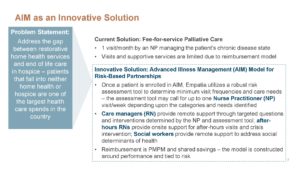
Medicare Advantage organizations and primary physician groups receive a “cost of care” analysis for the duration of the patient care. The organization takes on the risk of that patient costing more than what the MA plan will pay, but can make more money if patient care costs less than anticipated. Palliative care at home costs less. David Causby, President and CEO of Gentiva, a Hospice organization that operates in 35 states across the U.S. and has an average daily census of 26,000, has implemented a plan of care in cooperation with these organizations in what he calls Advanced Illness Management (AIM) Model for Risk-Based Partnerships. Designed for palliative care, Gentiva creates a plan of care that includes visit frequency and care needs and employs nurse practitioners, care managers, after hours RNs and social workers. The hospital pays Gentiva on a PMPM model with shared savings. The hospital still gets paid the full amount from MA but uses fewer resources, has lower costs, and sees reduced rehospitalizations, saving more than what they pay out. According to Gentiva, this partnership “provides value to contracted organizations by decreasing the overall end-of-life spend on this high-risk patient population.”
Supportive Care at Home Innovations
Supportive Care at Home (Private Duty Home Care, Private Pay, Non-medical home care) is not covered by Medicare, Medicare Advantage, or most health insurance plans. Limited Medicaid grants, VA plans, and long-term health insurance pay for some supportive care at home. Without one of these plans, patients and family members pay out-of-pocket for supportive care at home, averaging $22-$27 per hour with a 4-hour minimum. In some states it can cost up to $50 per hour. At $80 per day, that’s around $20,000 per year.
One software company we recently spoke with is upending the home care model with fee-for-service model that charges by the minute, rather than by the hour, making care more affordable for more people. You can see our product review of Caring on Demand here. By reducing the cost for customers and reducing the time for caregivers, agencies can onboard more customers without hiring more caregivers. The system is being used in facilities where these services are not provided, which allows a caregiver to visit several people in one stop. The agency and the caregiver can see the same income in the same time, spread out across multiple private payers.
Combining Innovation for a Win-Win-Win
I heard about Caring on Demand and spoke with its founder in August of 2023. I spoke with one Home Care agency owner who recently started working with Caring on Demand. “Times have changed,” the agency owner said. With fewer caregivers joining the workforce, increased levels of burnout since 2020, and CMS changes that overlook palliative and non-medical care, maybe there’s another way…
- Partnerships with organizations and physician groups that have Medicare, MA, and traditional health insurance patients, non-medical home care agencies, and palliative care providers.
- Localized groups of patients in limited areas like retirement villages, planned communities, neighborhoods, or small towns.
- Cost sharing and care coordination that includes in-home palliative care visits, supportive care, communication with primary care providers and specialists
- Preventative intercessions to avoid unnecessary ER visits and hospitalizations
- Shorter visits per caregiver with multiple visits to a community each day
- Cost sharing among patients splitting a 4-hour minimum visit among 4-8 patients
- Shared savings from reduced hospital stays, shorter durations of hospice care, and nursing visits that are supplemented by supportive care
Gentiva has experienced some success already in using shared savings as a payment model. Can costs be decreased even more by adding supportive home care to this plan? Is there enough shared savings for three payees instead of two? I don’t have the answers to these questions, but I do believe providers of supportive care and palliative care have been in the background, overlooked by CMS and MedPAC for long enough. If they aren’t going to recognize the positive impact and cost savings of home care and palliative care and include them in the reimbursement model, we may have to do it for them.
We’d love to hear your feedback on this and other innovative ways to combat the crisis of paying for care at home.
# # #
Kristin Rowan has been working at Healthcare at Home: The Rowan Report since 2008. She has a master’s degree in business administration and marketing and runs Girard Marketing Group, a multi-faceted boutique marketing firm specializing in event planning, sales, and marketing strategy. She has recently taken on the role of Editor of The Rowan Report and will add her voice to current Home Care topics as well as marketing tips for home care agencies. Connect with Kristin directly kristin@girardmarketinggroup.com or www.girardmarketinggroup.com
©2024 by The Rowan Report, Peoria, AZ. All rights reserved. This article originally appeared in Healthcare at Home: The Rowan Report.homecaretechreport.com One copy may be printed for personal use: further reproduction by permission only. editor@homecaretechreport.com