End of an Era

by Kristin Rowan, Editor

NAHC President Bill Dombi Retires

Earlier this year, with the announcement of the merging of NAHC and NHPCO, Bill Dombi announced his retirement from his position as President of the Association. Shortly after that announcement, The Rowan Report interviewed Bill and asked about the ongoing litigation against CMS as well as his thoughts on his tenure at NAHC. At the time, Bill was not prepared to speak about his upcoming retirement.

Remembering the Past

This week, at his final Annual Convention & Expo as association President, Bill shared his vision for the future of home health and hospice. Bill shared the story of the first time he faced an adversary…way back in kindergarten. He met his first bully and it took only a day for him to stand up to his nemesis and fight back. His bully walked away with a broken nose and Bill spent time with his nose in a corner.

“I was smiling the entire time,” Dombi shared, “and learning that’s not the way to do it. You’ve got to go to law school instead.”

How it Began

A young litigator, bright-eyed and ready to take on the world, Bill was initially hired to tackle a lawsuit against the Medicare program for denying care that should have been offered. He walked into the office that day and found boxes upon boxes with thousands of patient records and denied claims. Bill had to comb through each of these to select the 12 best plaintiffs to be named in the case. The amount of information was overwhelming, he recalled. It got a little easier when he was able to add members of Congress to the plaintiff list.

Nearly 40 years have passed since that day. “That day that I said yes was the beginning of a stunning opportunity that I had to be a part of an incredible team of people,” Bill reminisced.

First Steps Forward

That day will live in NAHC history as the first day of Bill’s tenure with the association. He promised his wife and children they’d be in Washinton D.C. for “just three or four years.” They stayed for 37. This day led to his first case against Medicare, Duggan v. Bowen. A case that rewrote the Medicare home health benefit. “It’s not perfect, but it was a monumental move forward,” Bill stated.

A Career Marked by Achievements

While is Bill is often hesitant to take full credit for what he has accomplished, and regularly credits his team for the strides made for home health and hospice patients, there is no doubt that he has been a driving force behind NAHC’s momentum and a key player in its advances at state and federal levels. 

Among Bill’s many accomplishments are:

  • Creating the Medicare Hospice Benefit. Today, one out of every two decedents have used hospice in the last 12 months of their life, which is an enormous increase since its launch.
  • The growth of the Medicaid program. The program went from having no home services in 1965, to being the largest home health program in the world.
  • Increasing access of care for pediatric patients, those receiving private duty nursing, the severely disabled and the elderly.
  • The transition of making hospital-at-home care permanent in Medicare.
  • Ever-growing technologies and improving the focus on in-home care.
  • Several lawsuits that Dombi led at NAHC against private insurers and others, to ensure that specific patients—including several with amyotrophic lateral sclerosis (ALS)—weren’t arbitrarily denied the coverage they needed.
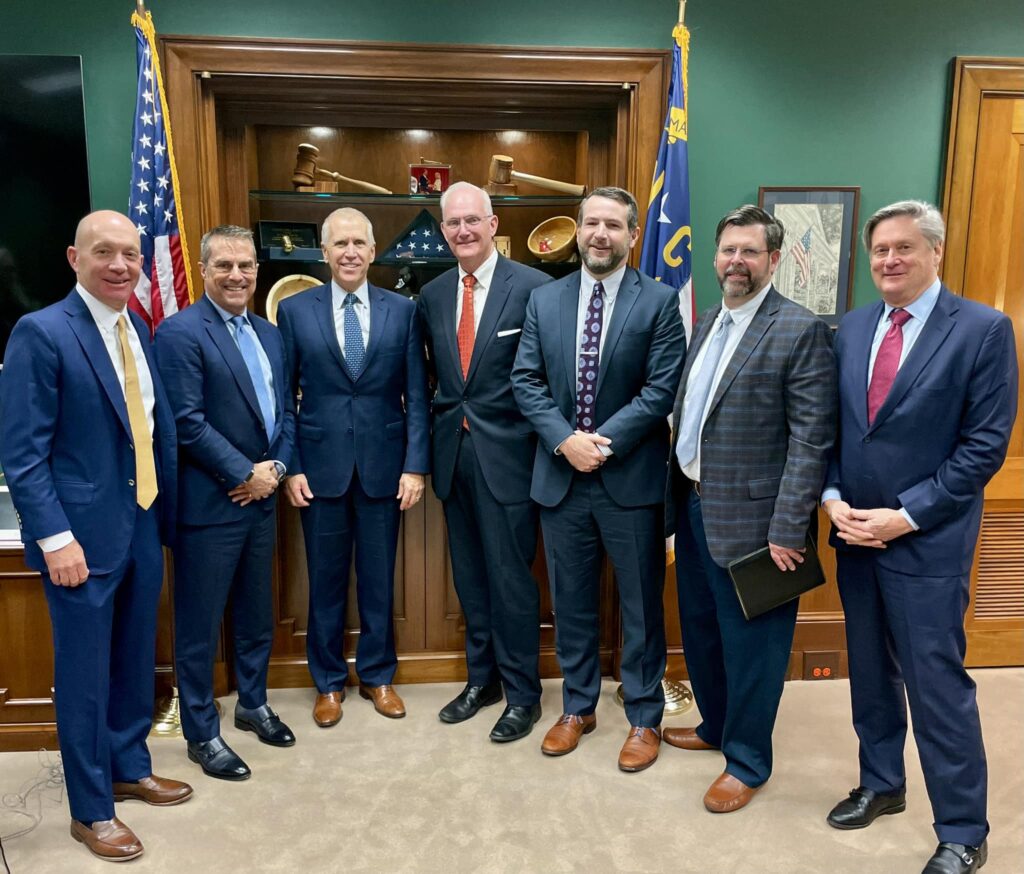
NAHC President Bill Dombi Retires

“That’s where my heart, my soul is; that’s where my aggressiveness is born, representing those very vulnerable people.”

Bill Dombi

President Emeritus, National Association for Home Care & Hospice

Where it's Going

As Bill wrapped up his final appearance on stage as NAHC President, he made some predictions and shared his hopes for the future of care at home. “I see a future where we see a whole transformation of health care. A future where the minds, hearts, operations, payments, and everything else are focused arund a home care direction,” he shared, “Not everyone can or should receive care at home, but it would be the ideal default before someone is hospitalized or moved to a nursing facility.”

Bill’s more specific hopes for the future of care at home include:

  • Nursing school curricula specific to care at home
  • Physician education including care at home
  • The leaders of CMS and/or DHHS have backgrounds in or a deep understanding of care at home
  • Technology visionaries working on tech solutions for care at home
  • Every state of the union and Presidential debate includes a discussion on care at home

Dream Big

Bill openly admits that his “wish list” for care at home may be fantastical, but he will continue to encourage all those who work in the care at home industry to continue to fight to move in that direction.

“We have to stand ready and be capable of working in all forms to defend ourselves against being bullied around,” he said. In typical fashion, Bill’s statements brought the crowd to its feet. He fittingly exited the stage to a standing ovation with Tom Petty’s “I Won’t Back Down” echoing through the hall. 

As the music faded on Bill’s tenure, The Alliance CEO Steve Landers offered, “Bill, we won’t back down. Just so you know, we’re not going anywhere.”

The Legacy Lives On

Bill may be retiring from his post as President of NAHC, but his accomplishments, his passion for care at home, and his legacy will live on. National Alliance for Care at Home has established The William A. Dombi Scholarship Fund at his alma mater, the University of Connecticut. Bill’s contributions to care at home can hardly be overlooked when the scholarship fund has nearly doubled its initial goal of $50,000. 

Incoming and continuing students at UCONN who are majoring in political science can apply for the scholarship. The scholarship prioritizes awarding money to students focused on public policy and/or health care policy. Contributions to the scholarship fund can be made here

On a Personal Note

I spoke with Bill briefly during this week’s national convention & expo. I couldn’t let the event pass without acknowledging his contributions personally. When I started working in the care at home industry nearly 16 years ago, I saw Bill speak at a convention. Most of what he said was beyond my limited knowledge of care at home at the time. But, when I introduced myself afterward, he was gracious and offered any assistance he could offer in the future. Since then, as I have delved deeper into the world of care at home, Bill has been a voice of reason, of passion, of resilience, and of steadfast commitment to advocating for the current and future recipients of care at home. He has impacted countless lives. For his guidance, for his character, and for his relentless pursuit of reform for care at home, I can only echo the sentiments of my colleagues and friends:

“Thank you, Bill, for everything.”

# # #

Kristin Rowan, Editor

Kristin Rowan has been working at Healthcare at Home: The Rowan Report since 2008. She has a master’s degree in business administration and marketing and runs Girard Marketing Group, a multi-faceted boutique marketing firm specializing in event planning, sales, and marketing strategy. She has recently taken on the role of Editor of The Rowan Report and will add her voice to current Home Care topics as well as marketing tips for home care agencies. Connect with Kristin directly kristin@girardmarketinggroup.com or www.girardmarketinggroup.com

©2024 by The Rowan Report, Peoria, AZ. All rights reserved. This article originally appeared in Healthcare at Home: The Rowan Report. One copy may be printed for personal use: further reproduction by permission only. editor@therowanreport.com


UnitedHealth Study: Is Medicare Advantage Killing Seniors

by Tim Rowan, Editor Emeritus

Is Medicare Advantage Killing Us?

Dr. Steve Landers has long been eloquent in his speaking and writing about the importance of Home Health over the years. Though I was already impressed, I gained a new level of respect this week. Simultaneously with his debut as CEO of the new Alliance, Dr. Landers released an article about a recent study on the impact of Medicare Advantage on Medicare beneficiaries.

It is an article that everyone in our healthcare sector should read.

In “Home Health Cuts and Barriers are Life and Death Issues for Medicare Beneficiaries,” Dr. Landers points readers toward a study conducted by Dr. Elan Gada of UnitedHealthcare’s Optum Group. The results are disturbing. That the findings were released by a Medicare Advantage company is surprising.

Yes, Virginia, Home Healthcare Really Does Save Lives

Landers cited the study’s primary finding. “Medicare Advantage beneficiaries in their plan who did not receive needed home health care after hospitalization were 42% more likely to die in the 30 days following a hospital stay than those who received the prescribed care.” If a drug proved to be as effective as post-discharge home healthcare in saving lives, Landers wrote, “it would dominate the news, restricting access would be considered immoral, and health officials would be pushing its adoption.”

Medicare Advantage Enrollees Go Without

There are a number of reasons a hospital discharged patient might not receive home healthcare, including system issues and patient refusal. However, Dr. Gada’s study also discovered that MA customers go without post-discharge home health at a higher rate than traditional Medicare beneficiaries. Traditional Medicare beneficiaries go without in-home care about 25% of the time. Medicare Advantage beneficiaries 38% of the time. Landers notes that this data is a few years old and that the denial rate for MA customers is likely higher today.

Stop the Killing

We know the life-saving impact of post-hospital home healthcare. The question becomes: how does our little corner of the U.S. healthcare system help regulators and payers to know it as well as we do? At this week’s inaugural conference of the National Alliance for Care at Home, at least three education sessions discussed Medicare Advantage. All three offered strategies for negotiating with insurance companies and surviving under their oppressive rate structures and their frequent care denials.

UnitedHealth Group Medicare Advantage Landers

These Are Bandages, Not Cures

In previous opinion pieces, I have quoted revelations in government lawsuits against MA divisions of insurance companies. These prove the program that was originally launched to extend the lifespan of the Medicare Trust Fund actually costs CMS 118 percent of what traditional Medicare costs. At the same time, insurance company reports to shareholders proudly point out that their MA division is their most profitable.

One of last week’s most read stories was the report from UnitedHealth Group on their astounding Q3 growth.

In the Long Run

Learning to cope with MA care denials and below-cost visit payments is fine for those focused on making next month’s payroll. An entirely different tactic is needed for those focused on the care needs of their elderly parents or who are approaching age 65 themselves. The question must be asked, “Why does Medicare Advantage exist?”

Medicare Advantage Lobbyists

AHIP is the insurance company lobby. It put extreme pressure on Congress in 2009 when the Affordable Care Act was being written. That pressure resulted in then-President Obama removing a core plank from his bill. Obama struck the public option healthcare insurance plan in order to win enough votes to get the bill to his desk.

More $ Makes More $

That lobbying effort continues today precisely because MA is so profitable. How does it bring in so much cash? One after another, all of the large insurance companies have been caught padding patient assessments, the very fraud Home Health is so often accused of. Their monthly checks are determined by how much care they predict their covered lives will need, and they exaggerate it. Later, when it comes time to treat these same customers, MA plans deny care that would have been covered by traditional Medicare. They book profits at both ends, and they gladly pay the minimal fines when the practice is exposed.

The Reality of Medicare Advantage Fraud

To make each covered life more profitable, MA plans have begun calling customers to offer “free” nurse visits. These are essentially re-assessments where the MA staffer is rewarded for “finding” additional illnesses. This is not theoretical. My brother was offered a $50 gift certificate to CVS if he would allow his wife’s MA plan representative to drop in and chat with her, to “make sure she was getting all the benefits she was entitled to.”

Dr. Steven Landers: Call for Advocacy

In his article and in his speeches this week, Dr. Landers made it quite clear what must be done. EVERY person whose livelihood depends on the Medicare Trust Fund must make their voice heard. Letters and phone calls to Congress, to the Senate, to CMS, and to the Secretary of Health and Human Services, telling them you do not want to happen to your community what happened in Maine. After years of negative profit margins, in a state where MA adoption is at two-thirds, Andwell Health Partners ceased business in a wide swath of the northern regions of the state. Andwell was the only Home Health provider there.

The combined advocacy strength of NAHC and NHPCO is not enough to tip the scales. Your input is crucial.

Here's How it Works:

  1. Your letter explaining the damage coming from shrinking CMS reimbursement and MA care denials will be opened by a Congressional staffer.
  2. The staffer will read only enough of your letter to see its topic and which side of that topic you are on.
  3. No need to be lengthy or eloquent
  4. Put your topic and your position in your first paragraph
  5. The staffer will add a checkmark in the pro or con side of their Home Health ledger.
  6. The Congressperson, Senator, HHS Secretary will see a one-page summary of the numbers.
  7. When the numbers are small, the summary goes into a file
  8. When the numbers are large, the elected or appointed official will pay attention
  9. In rare cases, you may even get a phone call
UnitedHealth Group Advocacy Medicare Advantage

Dr. Landers, in His Own Words

The article Dr. Landers wrote detailing all of these includes wording suggestions for your message in your letter and/or call. For convenience, I have included one paragraph below,* but I urge you to spend three minutes reading the entire inspiring and frightening piece. In person, he explained all this in an emotional appeal. He said he cannot emphasize enough the importance of universal participation in our new organization’s advocacy effort. Based on what we have learned about post-hospital nursing care in the home, your letters and phone calls are a matter of life and death.

Excerpt

*To save lives and avoid unnecessary suffering, Medicare officials must reverse their plans to cut Traditional Medicare home health payments for 2025 and ensure payments are stable after adjusting for the dramatically increased healthcare labor cost inflation experienced over the past 5 years. Additionally, Medicare officials and lawmakers must study and address the possibility of the disproportionate administrative and financial barriers to home health in Medicare Advantage.

We are fortunate to have leaders in Congress like Senator Debbie Stabenow, Senator Susan Collins, Representative Terri Sewell, and Representative Adrian Smith who are working to champion a comprehensive bi-partisan legislative fix. Our leaders in Washington must act swiftly, before the end of the year, to save lives and avoid further destabilizing home health services for Medicare beneficiaries.

# # #

Tim Rowan, Editor Emeritus

Tim Rowan is a 30-year home care technology consultant who co-founded and served as Editor and principal writer of this publication for 25 years. He continues to occasionally contribute news and analysis articles under The Rowan Report’s new ownership. He also continues to work part-time as a Home Care recruiting and retention consultant. More information: RowanResources.com
Tim@RowanResources.com

©2024 by The Rowan Report, Peoria, AZ. All rights reserved. This article originally appeared in Healthcare at Home: The Rowan Report.homecaretechreport.com One copy may be printed for personal use: further reproduction by permission only. editor@homecaretechreport.com