Urgent Plea to Safeguard Your Caregivers
by Kristin Rowan, Editor
Care at Home Worker Safety is not Optional!
I will rarely present an editorial piece that is based only on my opinions. I hold a few about care at home in general, but at least attempt to use statistics, facts, and history to support my positions. This is one area where the facts and numbers are all there, but using them is not as effective as sharing these stories. No matter where your agency is in its growth, no matter how large or small, no matter your plans for 2025, if you have not started a safety committee, created safety protocols and operating procedures, and invested in GPS-enabled emergency response systems for your staff, do so NOW, so this story doesn’t become your story.
One More Story is One Too Many
The tragic death of Joyce Grayson made headlines across the country both immediately after her death and for months after with lawsuits and new regulations in her state. This week, another avoidable incident left a home health aide in Massachusetts bedridden and temporarily unable to walk.
The aide, who asked to remain anonymous said she thought she was going to die. “I was screaming Help! Help!,” while a man in his 70s, for whom she has provided care for more than two years, attacked her with a knife. The man repeatedly stabbed, slashed, and sliced her while she kept kicking at him and thrashing her body. Despite all her attempts to escape, the man would not let her get up.

“I was tired,” she recalled, after fending off her attacker, “I’m gonna die here, I think that, but in that moment I remembered my sons, my family and giving me power. I confronted him.”
As she fled the apartment, the man followed her with a piece of wood. She ran down the hallway, where a security guard intervened. The man lost his balance during the struggle and fell. The home health aide spend two days in the hospital, receiving blood transfusions and dozens of stitches. She has decided no to return to her job, which she has held for a decade.
“He’s not going to kill me. He’s not going to pull me down.”

Next Time, it Could be You
No care at home worker deserves to feel unsafe or to be attacked at work. No agency owner wants to be the headline of the next story about a home care worker who ended up in the hospital or the morgue. Don’t be the next agency that has to explain to a family how this happened to their mother, daughter, son, or uncle, or cousin. No child wants to find out that their parent isn’t coming home because they did not have the means to call for help.
Act Now, Before it's Too Late
You might be surprised, if you asked, how many of your caregivers have ever felt uneasy, unsafe, or uncomfortable during their shift. Whether is the client, a family member of the client, pets, firearms, the neighborhood, or something else, most lone workers will experience some degree of fear. While not entirely preventable, there are steps you can take to minimize the risk:
-
- Ask your employees for honest feedback
- Research the client, family members, and the neighborhood for safety issues
- Create a committee comprising management, administrators, and caregivers, to create a safety plan
- Invest in training for your staff to include deescalation techniques, situational awareness, self-defense, and any other classes your safety committee deams necessary
- INVEST IN GPS-ENABLED EMERGENCY RESPONSE SYSTEMS FOR EVERY EMPLOYEE, NOW!
Recommendations
As a company that engages in software adoption consulting, we don’t often make direct recommendations, prefering instead to tailor software selection to each agency and its unique needs. This is one area where I will make the exception and continue to make the exception until every lone worker in and out of the care at home industry is equipped with a safety device.
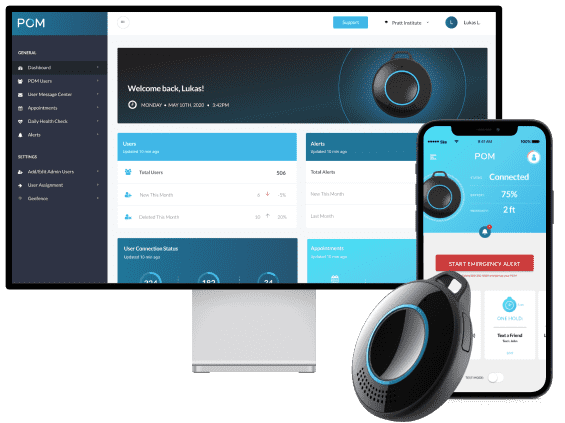
POM Safe
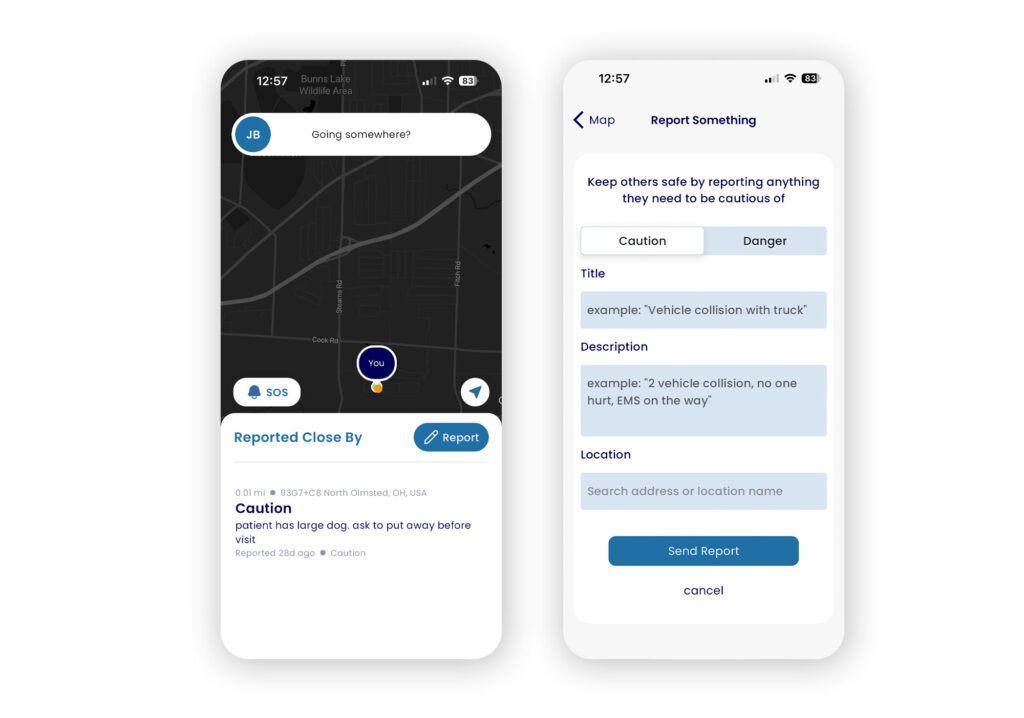
POM Safe is a personal safety solution that allows lone workers to get help when needed, but was designed to incorporate prevention and de-escalation. “The best 911 call is the one that never happens.”
The device includes features such as:
-
- Fake phone calls to allow the caregiver to step away from a situation
- Check on me to alert the agency if the caregiver has not checked in after an appointment
- Appointment Sync to give first responders precise locations in an emergency
- One-tap text sending a pre-written text with precise GPS location
- Incident Reports to prevent future incidents
- Two-way calling to a dispatcher when emergency help is needed
- Voice activation when your caregiver can’t get to the device
- Real-time crime data by neighborhood
- Sex offender registries
- 24/7 emergency dispatch
- Device or app-based
Katana Safety
The Katana safety device attaches directly to the caregiver’s phone. It has a quick-trigger activation to bypass the phone’s lock screen, and provides instant help 24/7.
This device includes features such as:
-
- Audible and inaudible alerts that launch GPS signals and connect worker to call center
- 24/7 highly trained PERS center
- Safety text and call after an alert with immediate dispatch if caregiver does not answer
- Walk with me feature to have a dispatcher stay in contact while the caregiver gets to safety
- Circle of safety to alert up to seven people in case of emergency
- Customizable safety commands that each clinician sets up with voice activation
- Beacon backup if bluetooth fails
- Text messaging with GPS location
- Employee check-in with voluntary location tracking and pin drop
- 2-year battery life
- Options to connect by app, fob, watch, or voice
Final Thoughts
Ensuring the safety of your employees before you send them out to care for your clients is not an optional benefit, a “nice to have,” or something you can do when you “get around to it.” Providing the training and safety devices needed to make sure each and every one of your caregivers makes it home every day should be your top priority. Whether you choose one of the devices above or go with a different option, start looking for one now. If you need help starting your safety committee or writing a survey to assess the safety risks in your agency, I will help you. With all of the technology available to us, there should no longer be any stories of caregivers who were attacked and did not have the means to call for help.
# # #


Kristin Rowan has been working at The Rowan Report since 2008. She is the owner and Editor-in-chief of The Rowan Report, the industry’s most trusted source for care at home news .She also has a master’s degree in business administration and marketing and runs Girard Marketing Group, a multi-faceted boutique marketing firm specializing in content creation, social media management, and event marketing. Connect with Kristin directly kristin@girardmarketinggroup.com or www.girardmarketinggroup.com
©2025 by The Rowan Report, Peoria, AZ. All rights reserved. This article originally appeared in The Rowan Report. One copy may be printed for personal use: further reproduction by permission only. editor@therowanreport.com