BREAKING NEWS – HHAeXchange Acquires Sandata

HHAeXchange Acquires Sandata

FOR IMMEDIATE RELEASE

Contact:                                       Michelle Rand
Alloy on behalf of HHAeXchange
855-300-8209
hhaexchange@alloycrew.com

HHAeXchange Acquires Sandata Technologies, Enhancing Ability to Serve Homecare Providers, Payers, and Caregivers Nationwide

Best positioned to deliver transformative technology that accelerates the industry’s evolution and its ability to improve health outcomes

NEW YORK and PORT WASHINGTON, N.Y., Oct. 03, 2024  — HHAeXchange, a leader in homecare management solutions for providers, caregivers, managed care organizations (MCOs), and state Medicaid programs, today announced that it has acquired Sandata Technologies. With four decades of experience, Sandata provides solutions that serve the homecare industry. Together, HHAeXchange and Sandata are well-positioned to meet the growing need for home and community-based services (HCBS), with demand for personal care aides expected to rise by 43% between 2020 and 2035.

From HHAeXchange

We are excited to join forces with Sandata, who shares our commitment to enabling homecare stakeholders to deliver the highest quality of care to their members,” said Paul Joiner, Chief Executive Officer of HHAeXchange. “This acquisition further demonstrates our commitment to investing in and raising the bar for our customers, while leading the transformation of an industry that deserves best-in-class technology and a superior experience. We will leverage our expanded platform by innovating with states and health plans to enable providers and better health outcomes. By doing so, we will further empower the devoted caregivers who are at the heart of our industry.”

“Now is the time to harness the power of advanced technology to truly support providers and payers with their billing needs and compliance requirements – and ultimately, deliver on the promise of our industry.”

Paul Joiner

Chief Executive Officer, HHAeXchange

From Sandata

“For decades, Sandata has been dedicated to ensuring providers and payers can seamlessly work together to increase compliance, improve efficiency, and deliver high-quality care,” said Sandata’s Chief Executive Officer, Emmet O’Gara. “Joining HHAeXchange strengthens our commitment and represents an exciting new chapter for Sandata, positioning the new combined company for continued growth and innovation by enhancing the value we can deliver to our customers.” 

HHAeXchange Acquires Sandata

HHAeXchange’s transaction with Sandata builds on the company’s recent strategic acquisitions of Cashé and Generations. These investments collectively support HHAeXchange’s ongoing advancement of its mission to enable caregivers, families, providers, and payers to deliver the best care in the home. Paul Joiner, HHAeXchange’s CEO, will lead the combined business moving forward.

Financial terms of the transaction were not disclosed.

# # #

About Sandata

Sandata, now part of HHAeXchange, is the pioneering force in home and community-based care, consistently leading the way with innovative technology solutions. As a trusted leader, Sandata is deeply committed to addressing critical challenges in the sector by expertly connecting the homecare ecosystem. This commitment creates a positive and lasting impact on payers, providers, caregivers, and those who receive care.

Sandata’s industry-leading software, systems, and services optimize billing and claims processing for payers, streamline administrative processes for providers, and facilitate better experiences for caregivers and those who receive care. Sandata’s vision and commitment to transforming the industry continue to shape the future of care at home and in our communities, ensuring better outcomes for all involved.

About HHAeXchange

Founded in 2008, HHAeXchange is the leading technology platform for homecare and self-direction program management. Developed specifically for Medicaid home and community-based services (HCBS), HHAeXchange connects state agencies, managed care organizations, providers, and caregivers through its intuitive web-based platform, enabling unparalleled communication, transparency, efficiency, and compliance. For more information, visit hhaexchange.com or follow the company on TwitterLinkedIn and Facebook.

This information originally appeared on the HHAeXchange website and it reprinted with permission.


Telehealth Grant to Address Disparities

FOR IMMEDIATE RELEASE

CONTACT:                                          Gina Cella
gcella@americantelemed.org
781-799-3137

AMERICAN TELEMEDICINE ASSOCIATION RECEIVES GRANT FROM PETERSON HEALTH TECHNOLOGY INSTITUTE TO ENHANCE WORK IN USING TELEHEALTH TO ADDRESS DISPARITIES

WASHINGTON, DC, SEPTEMBER 24, 2024 – The American Telemedicine Association (ATA) today announced the organization has received a grant from the Peterson Health Technology Institute (PHTI) to enhance its US Digital Infrastructure Disparities Score (DIS) and heat map tools with additional data sets and visualization tools, to highlight key infrastructure gaps and identify specific interventions that support actionable, measurable, and accountable deployment.

The Disparities Score and heat map tools, developed by the ATA CEO’s Advisory Group on Using Telehealth to Eliminate Healthcare Disparities and Inequities, will enable data-informed decisions and targeted allocation of resources to improve access to digital services and reduce disparities. The score is a composite measure and can be viewed at a ZIP code or county level. The premise of the map is to highlight key infrastructure gaps and support stakeholders in understanding how and where to invest scarce resources to improve access to digital services.

“Beyond the ability to just view broadband connectivity in a region, our Disparities Score and heat map tools are materially different, with composite representation of broadband access, plus connection speeds, connection modalities, and data affordability,” said Ann Mond Johnson, CEO of the ATA.

“This critical funding will be used to enhance these tools by incorporating additional data sets, developing enhanced data visualization tools, and improving the design interface and user experience.

Teleheatlh Grant to Address Disparities

We are grateful to the Peterson Health Technology Institute for their generous support of our work, to enable data-informed decisions pertaining to the allocation of resources to reduce disparities.”

The Disparities Advisory Group is co-chaired by Kristi Henderson, DNP, Yasmine Winkler and Ron Wyatt, MD, and facilitated by David Smith, CEO of Third Horizon Strategies.

# # #

About the Peterson Health Technology Institute

The Peterson Health Technology Institute (PHTI) provides independent evaluations of innovative healthcare technologies to improve health and lower costs. Through its rigorous, evidence-based research, PHTI analyzes the clinical benefits and economic impact of digital health solutions, as well as their effects on health equity, privacy, and security. These evaluations inform decisions for providers, patients, payers, and investors, accelerating the adoption of high-value technology in healthcare. PHTI was founded in 2023 by the Peterson Center on Healthcare. For more information, please visit PHTI.org.

About the ATA

As the only organization completely focused on advancing telehealth, the American Telemedicine Association is committed to ensuring that everyone has access to safe, affordable, and appropriate care when and where they need it, enabling the system to do more good for more people. The ATA represents a broad and inclusive member network of leading healthcare delivery systems, academic institutions, technology solution providers and payers, as well as partner organizations and alliances, working to advance industry adoption of telehealth, promote responsible policy, advocate for government and market normalization, and provide education and resources to help integrate virtual care into emerging value-based delivery models. 

CMS Ransomware Attack: Breach of PII

by Kristin Rowan, Editor

CMS Ransomware Attack

In mid-2023, a planned file transfer went awry when Clop claimed to have breached hundreds of companies that they later listed on a data leak site. Among the companies listed were Shell, UnitedHealthcare Student Resources, The University of Georgia, and Putnam Investments. Also compromised were government entities including the U.S. Department of Energy. According to Clop, data from military sources, children’s hospitals, and other .gov sites was also copied. The ransomware group alleges they deleted all information from government, military, and children’s hospital sites.

Unfortunately, there is no way to confirm whether all that information was indeed deleted. Earlier this year, Change Healthcare suffered a similar widespread breach that caused massive payment delays for months. CMS provided guidance during those delays. 

Underreporting of Attack

Many of the companies impacted by this attack chose to disclose the breach rather than negotiate with the ransomware attackers to retrieve the stolen data. When Bleeping Computer reached out to those companies immediately following the attacks, a number of them indicated that only a small number of people were effected and that no financial or identifiable information had been stolen. It seems, now, though that not all companies involved in the attack were on the initial list.

Wisconsin Physicians Service (WPS) health insurance corporation was among the companies not listed when news of this attack was first published. WPS provides Medicare administrative services to CMS, including handling Medicare Part A/B claims. In the first week of September, nearly 3-1/2 months after the attack, CMS and WPS started notifying beneficiaries whose protected health information (PHI) or other personally identifiable information (PII) may have been stolen during the attack.

1,000,000 Notifications

On July 28, 2023, CMS estimated 612,000 Medicare beneficiaries may have had PHI and/or PII exposed in the breach. That number has increased to almost 1 million. CMS and WPS are sending notifications to more than 950,000 people whose information has been compromised. The letter explains further:

May 31, 2023, MOVEit disclosed the breach to the public and released a patch.

June 2, 2023, WPS notified CMS of a data breach that occurred sometime between May 27 and May 31, 2023.

According to WPS, they applied the patch but did not observe any evidence of any files having been copied.

July 28, 2023 CMS sends an initial letter to beneficiaries whose information may have been affected.

May 2024, WPS acted on new information that led them to discover copied files from before the patch was deployed.

Of the portion of breached files that WPS studied, none were found to have personal information.

June 8, 2024, a different portion of the files showed personal information was contained in those files. This information includes:

  • Name
  • Social Security Number or Individual Taxpayer Identification Number
  • Date of Birth
  • Mailing Address
  • Gender
  • Hospital Account Number
  • Dates of Service
  • Medicare Beneficiary Identifier (MBI) and/or Health Insurance Claim Number
CMS Clop Ransomware Attack

Note: in the initial letter sent to beneficiaries in July of 2023, CMS also listed Healthcare Provider, Prescription Information, Insurance Claims, Policy Information, Subscriber Information, Health Benefits, and Enrollment Information as possibly having been leaked. These items were removed from the list in the September 2024 version of the same letter.

For those who received this notification, CMS and WPS offered a complimentary year of credit monitoring from Experian. CMS also advised members to request their free credit report from each of the credit reporting companies.

The letter also informed members that they would soon receive a new Medicare card with a new Medicare Number. 946,801 people received this notice.

CMS Ransomware Attack Victims Not Notified

On September 24, 2024, Bleeping Computer reported that on the same day CMS sent more than 900,000 letters to members, they also reported to the Department of Health and Human Services that the total number of people with information stolen was 3,112,815. CMS explains the difference by saying the larger number includes Medicare beneficiaries, people who are deceased, and people who were covered by other providers but whose information was included in WPS data collection used for provider audits in their role as Medicare Administrative Contractors (MACs).

New MBIs and What it Means For You

According to a blog post dated September 26, 2024 from SimiTree, starting in mid-October, CMS will issue new Medicare cards with new Medicare Beneficiary Identifiers to the 946,801 Medicare beneficiaries who were previously identified as at risk and were notified of the breach. This may cause undue delays and other issues for home health and hospice providers.

Claim Rejection

If these beneficiaries use their existing MBI after the new one has been issued, providers could see rejections on NOAs, NOEs, OASIS submissions, and claims.

Urgent Reverification

Providers will need to reverify eligibility and update patient records in their EMR systems. Because providers were not notified of which beneficiaries were impacted, agencies will need to verify MBIs for every Medicare patient.

Possible Disruption

The full impact of reassigning MBIs to nearly 1 million Medicare beneficiaries is not yet known. Medicare has not clarified what will happen with claim processing for patients whose MBIs change during the claim processing for active patients. There are possibilities for delayed processing, delayed payments, and incorrect denial of services or payments due to the volume of MBIs changing at once.

How to Prepare

Our friends at SimiTree have some suggestions for how home health and hospice providers can prepare in advance for the MBI change coming around October 15-16, 2024.

  • Take Immediate Action – start reverifying eligibility for all Medicare patients now
  • Update Systems – ensure your EMR and other solutions in your tech stack are updated and ready to handle the changes
  • Train your Staff – make sure everyone on your team knows this change is coming and teach them new verification procedures so their patients aren’t left without care

CMS has not issued a statement about the impact of the MBI changes, but this story is ongoing and we will continue to monitor and report on any updates from WPS and CMS as well as look for additional information on the changes expected with the new MBIs.

# # #

Kristin Rowan, Editor

Kristin Rowan has been working at Healthcare at Home: The Rowan Report since 2008. She has a master’s degree in business administration and marketing and runs Girard Marketing Group, a multi-faceted boutique marketing firm specializing in event planning, sales, and marketing strategy. She has recently taken on the role of Editor of The Rowan Report and will add her voice to current Home Care topics as well as marketing tips for home care agencies. Connect with Kristin directly kristin@girardmarketinggroup.com or www.girardmarketinggroup.com

©2024 by The Rowan Report, Peoria, AZ. All rights reserved. This article originally appeared in Healthcare at Home: The Rowan Report. One copy may be printed for personal use: further reproduction by permission only. editor@therowanreport.com

Managed Care Support

Axxess<br />

FOR IMMEDIATE RELEASE

Contact:                  Christine Stein
(214) 435-6731
cstein@axxess.com

Axxess Partners with strategic health care to offer Managed care support to clients

DALLAS, September 26, 2024 – Axxess, the leading global technology innovator for healthcare at home, has partnered with Strategic Health Care, a leading provider of managed care solutions, to offer Axxess clients managed care support, helping them enhance profitability and drive business optimization.

Through this collaboration Axxess clients have access to services provided by Strategic Health Care, including managed care contracting and credentialing, value-based reimbursement, revenue optimization and network development.

“Through this partnership we are providing our clients with the tools needed to thrive in the ever-evolving managed care landscape,” said Chris Taylor, senior vice president of channel partnerships at Axxess. “These services are designed to provide Axxess clients the support needed to succeed in managed care, helping them navigate industry challenges and enabling them to focus on care delivery.”

Strategic Health Care<br />

Strategic Health Care and Axxess are focused on helping clients scale their business and increase profits.

“Even the best care at home providers are struggling to make managed care work,” said Joe Russell, vice president of network management and contracting at Strategic Health Care. “We want to show providers that there’s a world where providers can win and win big. That’s why we’re so excited for the partnership with Axxess. When Axxess clients have managed care related issues, we want them to know they have partner they can rely on where it matters most.”

# # #

About Axxess

Axxess is the leading global technology innovator for healthcare at home, focused on solving the most complex industry challenges. Trusted by more than 9,000 organizations that serve more than 5 million patients worldwide, Axxess offers a complete suite of easy-to-use software solutions that empower home health, home care, hospice, and palliative providers to make healthcare in the home human again. Multiple independent certifications have confirmed that Axxess has the most secure and industry-compliant software available for providers. The company’s collaborative culture focused on innovation and excellence is recognized nationally as a “Best Place to Work.”

About Strategic Health Care

For over twenty-five years, Strategic Health Care has earned a reputation in the health plan industry as a knowledgeable and fair representative for provider clients. The highly experienced team of contracting experts at Strategic Health Care ensure providers have access to the reimbursement they need to continue to provide quality patient care.

Hospice CARE Act Fact Sheet

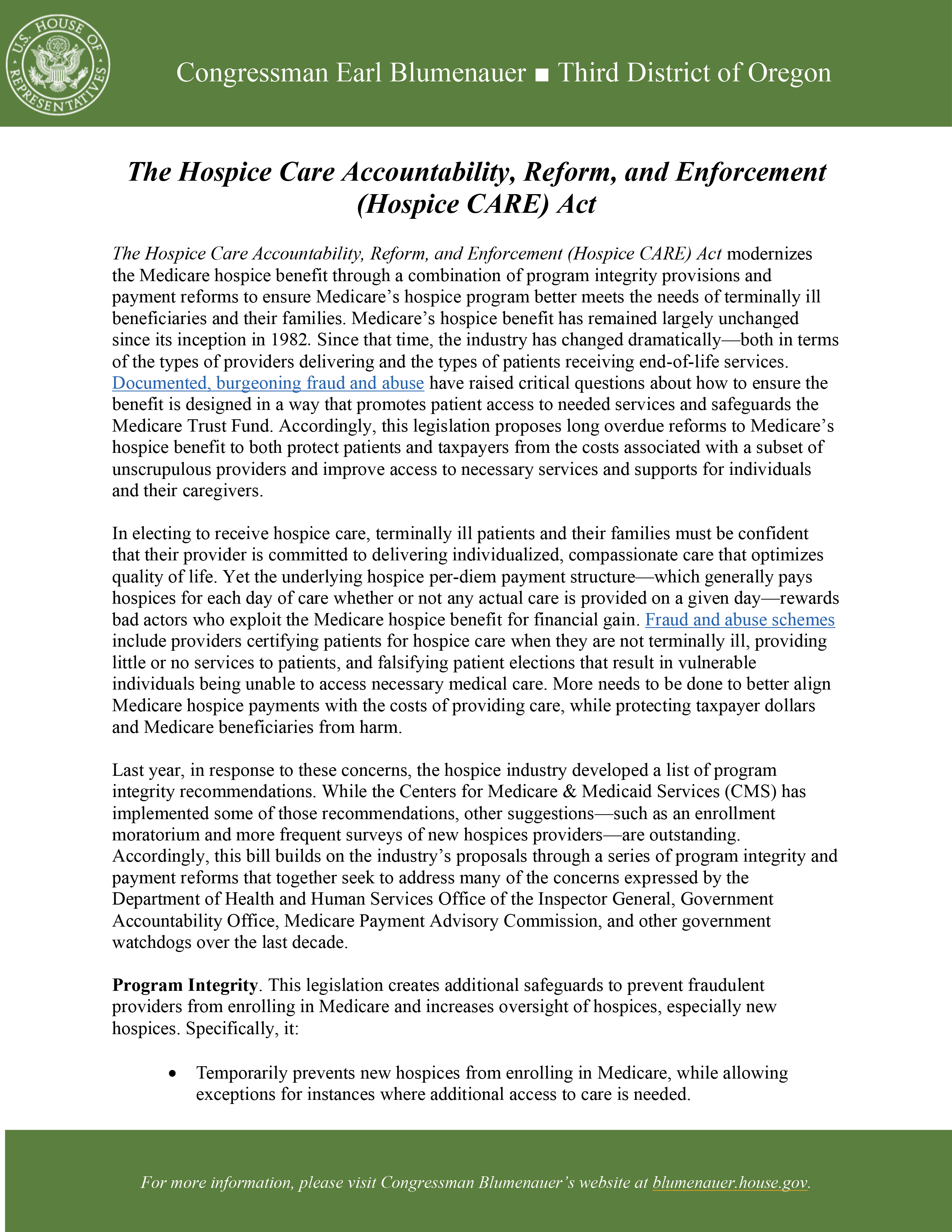
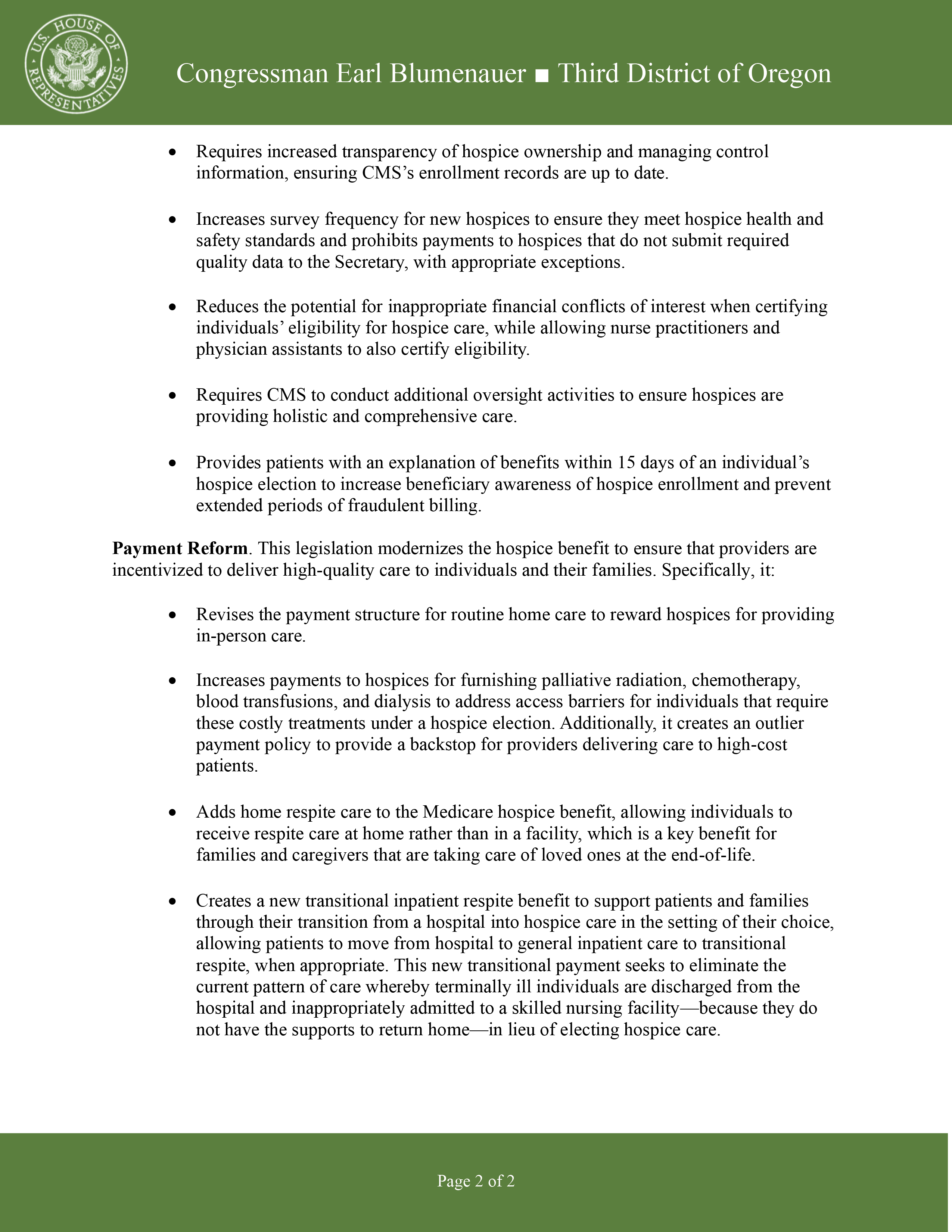
The Hospice CARE Act was proposed September 26, 2024 by Representative Blumenauer (D-OR) after “egregious” reports of continuing fraud and abuse. The original fact sheet can be found here.

Hospice CARE ACT
Hospice CARE Act

Read the Press Release from Rep. Blumenauer’s office here.

Read the full text of the Bill here.

BREAKING NEWS: Blumenauer Proposes Hospice Overhaul

FOR IMMEDIATE RELEASE

Contact:      Portland District Office
503-231-2300

blumenauer proposes overhaul to hospice benefit

If enacted, the legislation would be the single most significant update to the hospice benefit and payment structure since its inception in 1982

WASHINGTON, D.C., SEPTEMBER 26, 2024 – Today, Congressman Earl Blumenauer (D-OR), a senior member of the Ways and Means Committee, introduced the Hospice Care Accountability, Reform and Enforcement Act (Hospice CARE Act) to modernize Medicare’s hospice benefit, which has remained largely unchanged since its inception in 1982. The proposal comes as egregious reports of fraud and abuse within the benefit persist, despite action from Centers for Medicare & Medicaid Services (CMS). The legislation is the product of years of collaboration between stakeholders, lawmakers, and industry leaders. It builds on Blumenauer’s decades-long commitment to ensure the federal government supports families at a time of great stress and vulnerability: the end of life. 

“The United States spends significantly more on health care than other developed nations for worse outcomes. Nowhere is this more egregious than in the hospice industry,” said Congressman Earl Blumenauer. “Patients and families deserve better. We need a reset. It is past time for Congress to act to end the fraud, waste, and abuse within the hospice benefit and bring it into the 21st century.”

To protect patients and taxpayers, the Hospice CARE Act would institute a number of long overdue reforms to crackdown on fraud while incentivizing high-quality care. Critically, it would:

    • Reform the payment structure: The underlying hospice per-diem payment structure—which generally pays hospices for each day of care regardless of if care is provided on a given day—rewards bad actors who exploit the benefit for financial gain. The legislation revises the payment structure to ensure that providers are incentivized to deliver high-quality care and meet the current needs of individuals and their families.
    • Bolster program integrity: Additional safeguards and oversight is needed to prevent fraudulent providers from enrolling in Medicare, especially for new hospices. That includes temporarily preventing new hospices from enrolling in Medicare, with exceptions where additional access to care is needed, increasing survey frequency, and increasing ownership transparency

A one-page fact sheet can be found here. Bill text here

“The hospice benefit, while unique, is ripe for change. This legislation is a first-of-its-kind opportunity to improve it,” said Katie Smith Sloan, president and CEO, LeadingAge, the association of nonprofit providers of aging services, including hospice, on the Hospice Care Accountability, Reform and Enforcement (CARE) Act of 2024. “Revising a benefit that has not been altered significantly since its creation in 1982 is a formidable undertaking – but a necessary one. Done right, changes will expand the benefit to support the realities of modern-day hospice care and address vulnerabilities that are currently being exploited.  There is more work to do and we look forward to continuing our productive partnership to ensure this bill achieves these goals.” 

 “The National Partnership for Healthcare and Hospice Innovation (NPHI) is thankful for the work of Congressman Blumenauer, his staff, and the Ways and Means Committee staff who worked with the hospice and advanced illness community to put forward the Hospice Care Accountability, Reform, and Enforcement (CARE) Act. This legislation is an encouraging and unique opportunity to consider reforms that would strengthen the Medicare hospice benefit by ensuring it continues to support patients, families, and the non-profit providers who were the original foundation of hospice care,” said Tom Koutsoumpas, CEO and founder of NPHI. “We look forward to continuing to work closely with Congress and relevant stakeholders on efforts to modernize the hospice benefit and improve care of those at the end-of-life.

“The Coalition to Transform Advanced Care (C-TAC), truly appreciates the introduction of the Hospice Care Accountability, Reform, and Enforcement (Hospice CARE) Act. We commend Representative Earl Blumenauer (D-OR-3rd) for this important work and for his decades of support for compassionate end-of-life care and for bringing policies to the national stage with bi-partisan support,” stated Jon Broyles, C-TAC CEO.  “We have had the privilege to work with the Congressman, his staff, Ways & Means Committee staff and other advocates on this bill and it is an important starting point for ideas that will lead to modernizing the hospice program and improving the lives of people with serious illness and their family caregivers.”

# # #

This press release was issued by the office of U.S. Congressman Earl Blumenauer, representing the 3rd district of Oregon. The original press release can be found here. The Rowan Report has reached out to The Alliance for Care at Home for comment.

Home Health in a Post-Chevron World

by Elizabeth E. Hogue, Esq.

The "Wicked Witch" Chevron is Gone

On June 28, 2024, the U.S. Supreme Court overturned a decision of the Court in 1984 often referred to as “Chevron.” The Chevron case said that Courts must defer to administrative actions that are reasonable interpretations of ambiguous statutory language.

 In Loper Bright Enterprises v. Raimondo, however, the U.S. Supreme Court abandoned the decision in Chevron and said that:

    • The “deference that Chevron requires of courts reviewing agency action cannot be squared with” the Administrative Procedure Act (APA). The APA “specified that courts, not agencies, will decide ‘all relevant questions of law’ arising on review of agency action…even those involving ambiguous laws – and set aside any such action inconsistent with the law as they interpret it.” 
    • The framers of the U.S. Constitution envisioned that the final “interpretation of the laws” would be “the proper and peculiar province of the courts.” 
    • The views of the executive branch should inform the judgment of the judiciary, not supersede it. 
    • “Chevron’s presumption is misguided because agencies have no special competence in resolving statutory ambiguities. Courts do.”

What Does it Mean for Providers?

The short answer is that we don’t know yet. It is unclear how the new standards of the Loper Bright decision will be applied and affect health care providers. The Supreme Court said that the recent Court decision does not call past cases into question that were based on Chevron, but existing regulations are not insulated from challenges. It is likely that several providers will “swing for the fences” for favorable rulings based on Loper Bright!

One possible “candidate” for disruption is the reliance of administrative law judges (ALJs) on Chapter 8 of the Medicare Program Integrity Manual. This section offers an overview of use of inferential statistics and statistical sampling to estimate overpayments in Medicare audits. Chapter 8 of the Manual is only nine pages long. ALJs routinely use this section of the Manual to hamper providers’ ability to mount a compelling defense that challenges auditors’ methods using widely accepted standards within the statistical community. Challenges to this practice based on Loper Bright may prevent ALJs from reliance on these sections of the Manual.

Chevron Deference Gone

Another possible target is the use of sub-statutory and even sub-regulatory guidance from the Centers for Medicare and Medicaid Services (CMS) and the Medicare Administrative Contractors (MACs) by fraud and abuse enforcers to make determinations about illegal conduct, especially under the False Claims Act (FCA). Defendants arguably now have a better chance to challenge the basis of claims of illegal conduct in light of Loper Bright. 

The story of Loper Bright has not been written by any means. Surely providers should use this significant change in the law to their benefit whenever possible.

# # #

Elizabeth E. Hogue, Esq.

Elizabeth Hogue is an attorney in private practice with extensive experience in health care. She represents clients across the U.S., including professional associations, managed care providers, hospitals, long-term care facilities, home health agencies, durable medical equipment companies, and hospices.

©2024 by The Rowan Report, Peoria, AZ. All rights reserved. This article originally appeared in Healthcare at Home: The Rowan Report. One copy may be printed for personal use: further reproduction by permission only. editor@therowanreport.com

©2024 Elizabeth E. Hogue, Esq. All rights reserved.

No portion of this material may be reproduced in any form without the advance written permission of the author.

What are You Hiding?

by Elizabeth E. Hogue, Esq.

Bring on the Fraud Enforcers

We Have Nothing to Hide!

Oh, but you do! Statements like this from providers are cringe-worthy. If you have said it before, please don’t ever say it again.

Here’s why:

Fraud Enforcement

First, many providers think that when fraud enforcers are required to show intent they must show that providers sat down at their desks on a Friday afternoon, for example, and decided to engage in fraud. On the contrary, enforcers can demonstrate intent by showing that there was fraudulent conduct that providers knew about or should have known about. This is a game changer! It’s not hard to imagine fraudulent conduct that providers should have known about, but have not identified and corrected.

In addition, George Will points out in his Washington Post column, “Have you committed a felony yet? Probably so.” that the volume of legal requirements has skyrocketed. Here is what Mr. Will says:

“Less than a century ago, …a single volume contained all federal statutes. By 2018, they filled 54 volumes – about 60,000 pages. In the past 10 years, Congress has enacted about 2 million to 3 million words of law each year. The average length of a bill is nine times what it was in the 1950s. Agencies publish their proposals and final rules in the Federal Register, which began at 16 pages in 1936, and now expands by an average of more than 70,000 pages annually. By 2021, the Code of Federal Regulations filled about 200 volumes. And in a recent 10-year span, federal agencies churned out approximately 13,000 guidance documents.”

Mr. Will goes on to point out that ignorance of the law is, therefore, inevitable. Congress has added an average of 56 new federal crimes each year so that there are not more than 5,000 federal statutory crimes. In addition, at least 300,000 regulations of federal agencies include criminal sanctions.

 Here are some common examples:

Fraud Enforcement George Will
    • If you are a discharge planner/case manager in a hospital or skilled nursing facility you may not know about guidance from the Office of Inspector General of the U.S. Department of Health and Human Services that says you can’t accept gift cards from post-acute providers that want referrals.
    • If you are a home care/private duty provider and accept payments from the Medicaid Program, you may have repeatedly violated technical requirements, such as recording the time caregivers arrive and leave patients’ homes.
    • If you provide home health services and use the services of consulting physicians as Medical Directors, chances are very good that fraud enforcers will demonstrate that you violated at least one of a multitude of requirements that govern these relationships.
    • Finally, hospice providers know all too well that enforcers are going to claim that their patients are not terminally ill.

Mr. Will says in his column that James Madison predicted our current situation in which laws are “so voluminous that they cannot be read, or so incoherent that they cannot be understood” and “undergo such incessant changes that no man, who knows what the law is today, can guess what it will be tomorrow.” 

So, don’t even think that you have nothing to hide, much less say it!


# # #

Elizabeth E. Hogue, Esq.

Elizabeth Hogue is an attorney in private practice with extensive experience in health care. She represents clients across the U.S., including professional associations, managed care providers, hospitals, long-term care facilities, home health agencies, durable medical equipment companies, and hospices.

©2024 by The Rowan Report, Peoria, AZ. All rights reserved. This article originally appeared in Healthcare at Home: The Rowan Report. One copy may be printed for personal use: further reproduction by permission only. editor@therowanreport.com

©2024 Elizabeth E. Hogue, Esq. All rights reserved.

No portion of this material may be reproduced in any form without the advance written permission of the author.

Another One Bites the Dust

by Kristin Rowan, Editor

Essentia Drops Medicare Advantage

Essentia Health is an integrated health system with locations in Minnesota, North Dakota and Wisconsin. The health system offers 285 different services across more than 1,700 locations. They employ more than 2,700 doctors. Essentia also includes 14 hospitals, emergency care, same-day care for mental health crises, and multiple specialties.

This is all to say that Essentia Health is not a small player. They contract with the largest payers in the industry.

Re-Evaluation

Recently, the health system began re-evaluating its participation in some Medicare Advantage plans. According to the chief medical officer for population health at Essentia, Cathy Cantor, M.D., M.B.A., too often deny or delay care. Cantor said in a statement:

“This was not a decision we made lightly. The frequent denials and associated delays negatively impact our ability to provide the timely and appropriate care our patients deserve. This is the right thing to do for the people we are honored to serve.”

Essentia informed patients that they will no longer be an in-network provider for MA plans through UnitedHealthcare (UHC) or Humana beginning January 1, 2025. The health system claims that UHC and Humana delay and deny approval of care at more than twice the rate of other Medicare Advantage plans.  They are encouraging its patients to choose a different plan during open enrollment that is in-network with Essentia.

UHC Responds

UnitedHealthcare responded to the press release that Essentia issued. According to their statement, the two parties extended their contract just this past July. Negotiations included a number of items on which they agreed to collaborate, but Medicare Advantage was not specified among them.

“Essentia Health didn’t raise concerns regarding its participation in our Medicare Advantage network until last week. We have since met with Essentia on Sept. 9 and are committed to working with the health system to explore solutions with the goal of renewing our relationship. We hope Essentia shares our commitment toward reaching an agreement.”

Essentia Drops Medicare Advantage

Following Suit

Essentia’s departure from Medicare Advantage is just one in a recent mass exodus.

Sanford Health of South Dakota ended its Humana MA participation due to “ongoing challenges and concerns that negatively effect patients including ongoing denials of coverage and delays in accessing care.”

HealthPartners out of Minnesota announced over the summer that “UnitedHealthcare delays and denies approval of payment for MA claims at an exceptionally high rate…up to 10 times higher than other insurers….  After over a year of being unable to persuade UnitedHealthcare to change their practices, we’ve determined that we can no longer participate in the UnitedHealthcare Medicare Advantage network.”

Mercy, the official medical provider of the St. Louis Cardinals, announced its year-end departure from the Anthem Blue Cross Blue Shield network. This includes all Medicare Advantage, ACA marketplace, and managed Medicaid plans. They cited administrative tasks that create a barrier to timely, appropriate patient care. Mercy also complained that Anthem has raised its rates for patients and employers, increased its profits, and still has not raised reimbursement rates to providers. Like Essentia, Mercy is encouraging its patients to consider whether the health care plan they choose during open enrollment will list Mercy as one of its in-network providers.

Final Thoughts

CMS reimbursement rates, Medicare Advantage denials, payment delays, and other interruptions are impeding patient care. As Tim mentions in his editorial this week, we are in an election year and we urge you to research how each party might impact our industry.

If more providers and payors continue to drop Medicare Advantage from their offerings, will we see more patients returning to traditional Medicare plans with an affordable Medicare Supplement or MediGap coverage? One can only hope!

# # #

Kristin Rowan, Editor

Kristin Rowan has been working at Healthcare at Home: The Rowan Report since 2008. She has a master’s degree in business administration and marketing and runs Girard Marketing Group, a multi-faceted boutique marketing firm specializing in event planning, sales, and marketing strategy. She has recently taken on the role of Editor of The Rowan Report and will add her voice to current Home Care topics as well as marketing tips for home care agencies. Connect with Kristin directly kristin@girardmarketinggroup.com or www.girardmarketinggroup.com

©2024 by The Rowan Report, Peoria, AZ. All rights reserved. This article originally appeared in Healthcare at Home: The Rowan Report. One copy may be printed for personal use: further reproduction by permission only. editor@therowanreport.com

Hospice Fraud Oversight

by Kristin Rowan, Editor

CMS Oversight in Fraud-Ridden States

In 2023, The Centers for Medicare and Medicaid Services (CMS) cited research suggesting that hospices profit from fraud far too often. CMS has identified cases of hospices certifying benficiaries who are not terminally ill, providing little to no services, and still billing CMS. Four states have had rapid growth in fraudulent hospices: Arizona, California, Nevada, and Texas.

Churn-and-Burn

Some of the registered hospices had non-operational addresses. This information led to an investigation that resulted in evidence of the fraud dubbed “Churn and Burn.” This scheme involves registering a new hospice and billing for services until there is an audit or the agency maxes out on yearly payments. Then, the hospice closes, keeps the money, registers for a new Medicare billing number, and starts all over again.

Program Integrity Strategy

As a result of  the findings of this research, CMS put more effort behing the hospice program integrity strategy to find and address fraudulent activity. Part of the strategy was unannounced visits to hospices nationwide. Hospices not active at listed addresses were deactivated and Medicare billing privileges were revoked. Of the more than 7,000 hospices visited, 400 had potential administrative action pending.

Enhanced Oversight

In the four states identified as having higher instances of fraud, CMS implemented a provisional period of enhanced oversight. During the provisional period, CMS conducted a medical review prior to payment for hospices in these states that have identified problems.

Nationwide Pilot Project

In addition to the provisional period for the four identified states, CMS started a pilot project to review hospice claims after a patient’s intitial 90 days of hospice care. This pilot project was not limited to the four states, but was implemented nationwide. CMS launched the program to help inform medical reviews in determining whether hospices are submitting claims for eligible patients.

Regulatory Changes

CMS also proposed some regulatory changes to combat hospice fraud. Some of these regulatory changes were initially suggested by hospice providers. The proposals include:

Hospice Fraud
    • Prohibiting the transfer of Medicare billing privileges of a new hospice for 36 months
    • Clarifying the definition of “Managing Employee” to include the administrator and medical director of a hospice
    • Implementing a Special Focus Program to increase oversight on poor-performing hospices that have ongoing health and safety deficiencies
    • Adding criminal background checks for owners when they initially enroll for Medicare billing privileges.

Prepayment Review Expanded

CMS has just announced that they will expand the prepayment review process in the four states beginning in September, 2024. Information from CMS is limited and states that prepayment review volume will start low to protect compliant hospices, but will increase if a hospice is found to be non-compliant. Consequences for non-compliance includes delays in payment, extended review, or additional administrative actions.

According to preliminary information we received from a hospice consultant, the expanded program puts all new hospices or hospices with ownership changes into prepayment review even if they have not had identified problems. 

We have reached out to both CMS and some of our expert hospice consultants to get more information and will update this story as information becomes available.

# # #

Kristin Rowan, Editor

Kristin Rowan has been working at Healthcare at Home: The Rowan Report since 2008. She has a master’s degree in business administration and marketing and runs Girard Marketing Group, a multi-faceted boutique marketing firm specializing in event planning, sales, and marketing strategy. She has recently taken on the role of Editor of The Rowan Report and will add her voice to current Home Care topics as well as marketing tips for home care agencies. Connect with Kristin directly kristin@girardmarketinggroup.com or www.girardmarketinggroup.com

©2024 by The Rowan Report, Peoria, AZ. All rights reserved. This article originally appeared in Healthcare at Home: The Rowan Report. One copy may be printed for personal use: further reproduction by permission only. editor@therowanreport.com