The $100,000 Visa

by Kristin Rowan, Editor

The $100,000 Visa

What Care at Home Needs to Know

Highly skilled, highly trained, and highly in-demand professionals fill roles that very few are qualified to hold. These roles are usually in math, engineering, technology, medical science. They can also be in healthcare, trade jobs like plumbers and welders, and professional fields like financial managers and market research analysts. 

Due to the specialized training and education, extensive experience, and other unique qualifications required for these positions, the number of people qualified to fill them is much lower than the number of positions to fill. The U.S. has relied on the H-1B visa, a type of permission for highly skilled professions to work temporarily in the U.S. in these specialty jobs. The H-1B visa starts at three years, but can be extended to six.

H-B Visa Availability & Distribution

Very few of these visas are available. Standard H-1B visas are capped at 65,000 per year. There are an additional 20,000 H-1B visas available only to persons who have earned a master’s degree or doctorate from a U.S. school.

Currently more than 70% of H-1B visa holders have citizenship in India. The largest petitioners for H-1B visas are tech and retail giants Amazon, Microsoft, Meta, Apple, Google, Cognizant Technology Solutions, JPMorgan Chase, and Walmart.

Executive Order

On September 21, the fee to petition for a new H-1B visa increased from $2,000-5,000, depending on the size of the employer, to $100,000. This change was implemented by proclamation. The administration has since clarified that the fee will apply to new petitions, not those already in process and that it is a one-time fee.

Impact on Care at Home

According to Becker’s Hospital Review, healthcare uses the H-1B visa often to sponsor medical residents and physicians. Overall, immigrant workers account for 27% of physicians and surgeons, 22% of nursing assistants, and 16% of RNs nationwide. Included in the proclamation is an exemption clause. This allows the $100,000 visa fee to be waived if the Secretary of Homeland Security decides, on an individual basis, for specific companies, that the hiring is in the national interest. It is unclear whether that exemption will extend to health care workers.

According to Ellis Porter, immigration attorneys, standard nursing positions do not qualify for H-1B visas because they are not considered “specialty occupations.” RNs in the U.S. must have a two-year associate’s degree, not the required bachelor’s degree for the H-1B visa. Ellis Porter says even if you have a bachelor’s degree, that alone does not qualify an RN for an H-1B visa. Nurse Managers, Nurse Practitioners, Certified Registered Nurse Anesthetists, Certified Nurse Midwives, and Clinical  Nurse Specialists qualify as “specialty occupations” under the H-1B visa regulations.

If healthcare workers are not exempt from the new fee, some nurse positions will be effected. This could increase the workforce shortage for nurses outside the care at home industry, driving care at home nurses into hospitals, medical centers, doctor’s offices, and SNFs, which could, in turn, exacerbate the workforce shortage for care at home. However, until there is clarity on the exemption, this is not a definite.

$100,000 Visa Overturned

Immigration attorneys are already preparing lawsuits to challendge the proclamation. They are calling it excessive, unlawful, and equal to a ban on immigrant workers. Some critics argue the proclamation bypassed established rulemaking procedures. Others say there are provisions to charge visa fees to cover expenses, but no legal precedent to charge exorbitant fees. Legal experts call the proclamation vague and arbitrary, leaving it open for misinterpretation, and therefore is likely to be overturned.

This is an ongoing story that requires additional clarification and explanation. The White House has promised an FAQ page soon. We will continue to follow this story as it develops.

# # #

Kristin Rowan, Editor

Kristin Rowan has been working at The Rowan Report since 2008. She is the owner and Editor-in-chief of The Rowan Report, the industry’s most trusted source for care at home news, and speaker on Artificial Intelligence and Lone Worker Safety and state and national conferences.

She also runs Girard Marketing Group, a multi-faceted boutique marketing firm specializing in content creation, social media management, and event marketing.  Connect with Kristin directly kristin@girardmarketinggroup.com or www.girardmarketinggroup.com

©2025 by The Rowan Report, Peoria, AZ. All rights reserved. This article originally appeared in The Rowan Report. One copy may be printed for personal use: further reproduction by permission only. editor@therowanreport.com

 

AI Eases Clinician Burnout

by Curantis Solutions

AI in Hospice and Palliative Care

Eases Clinician Burnout and Drives Retention

In hospice and palliative care, clinicians are your most valuable and most vulnerable resource. They’re the heart of care delivery, and often the largest expense line item on your budget. But today, many are walking a tightrope between compassion fatigue and after-hours documentation burnout. Hospice organizations can’t afford to lose them. And with AI-powered tools, you don’t have to.

Clinician burnout Is a crisis and a cost center

Hospice nurses and interdisciplinary team members are burning out at unsustainable rates. The emotional weight of their work is immense, but it’s the after-hours charting, documentation delays, and system inefficiencies that often push them over the edge. The cost of clinician turnover is staggering. Onboarding and training a new hospice nurse takes time, money, and trust, and patients feel the impact, too. 

AI bridges the gap without replacing the human touch

Curantis Solutions is leading the way with AI that lightens the load. Our embedded AI assistant, EVA, supports clinicians in real-time, reducing documentation friction and eliminating the need to chart late into the evening. 

How AI may help

  • Voice-to-text documentation
    • captures patient-specific details naturally, as they happen
  • Smart prompts and reminders
    • prevent missed data points and reduce rework
  • Less screen time after shifts
    • improves work-life balance and job satisfaction
  • Clinicians feel more supported and less likely to leave
AI in Hospice and Palliative Care Curantis Solutions

Retain the staff you've worked so hard to hire

When your staff hears that another organization doesn’t have modern tech or AI tools? They stay. Providing intuitive, hospice-specific tools isn’t just about efficiency. It’s about creating a culture that respects their time, honors their energy, and values their expertise. 

AI as a strategic investment in care and culture

Hospice leaders are being called to solve two problems at once:

  • Deliver exceptional, person-centered care
  • Do it with fewer resources and higher costs

AI-powered software like Curantis helps close this gap. By streamlining documentation and workflow, we help you preserve the well-being of your clinicians, which, in turn, protects your operations and your outcomes. 

Imagine this...

  • No more nurses charting late into the night
  • Fewer resignations and higher morale
  • Patients receiving care from clinicians who aren’t drained, but present and energized

# # #

Let's make clinician burnout a thing of the past

Explore how Curantis Solutions empowers your team and strengthens your bottom line. Contact us today to schedule a demo and see how we are making your software experience refreshingly simple with ChartBoost AI. 

Contact us today to see a demo and learn how we are making your software experience refreshingly simple. 

© 2025 This blog article originally appeared on the Curantis Solutions website and is reprinted with permission. For more information, please contact Curantis Solutions directly.

AI in Hospice: 3 Questions Before Adopting

by Curantis Solutions

AI in Hospice

3 question to ask before adoption

AI in healthcare

Artificial intelligence (AI) is transforming healthcare. From voice-to-text documentation to predictive analytics, AI promises to streamline operations, reduce clinician burden, and improve outcomes. However, in hospice and palliative care, where care is deeply personal and the margin for error is razor thin, adopting AI cannot be treated as just another trend. It must be thoughtful, mission-aligned, and clinically appropriate.

AI in hospice

Hospice leaders are under pressure. Staff shortages are real. Regulatory demands like Hospice HOPE are intensifying. Vendor inboxes are flooded with promises of automation, optimization, and return on investment (ROI). It is easy to feel like you must adopt AI quickly just to keep up.

But the truth is, not all AI is ready for hospice and palliative care. And not all hospice organizations are ready to implement it effectively. The stakes are too high to rush.

If your hospice or palliative care organization is exploring AI, here are three critical questions to ask before making a decision:

1. Is the AI built for the way hospice and palliative care work?

Hospice and palliative care are fundamentally different from other healthcare environments. The workflows are interdisciplinary. Much of the documentation relies on narrative detail. Clinicians manage complex emotional, spiritual, and medical needs at the same time. Care is not episodic or transactional. It is longitudinal, values-driven, and highly individualized.

Many AI tools on the market today were built for hospitals or outpatient clinics. They may offer efficiencies in acute care but fail in hospice because they do not understand the subtleties of team-based care, psychosocial documentation, or end-of-life symptom management.

AI for Hospice

Ask the vendor: Has your AI been developed specifically for hospice or palliative care? Or are you expecting our team to adapt to your tool?

Healthcare isn't hospice

Some hospices have tried generic AI dictation tools and found them inadequate. They could not capture the nuance of hospice documentation, especially when it comes to describing spiritual distress, family dynamics, or legacy work. Other teams tried predictive tools that produced frequent, non-actionable alerts that distracted the clinical team and created more work, not less.

Hospice AI must be purpose-built. It needs to support interdisciplinary team meetings, comply with documentation standards like HOPE, and align with Medicare Conditions of Participation. If the tool does not understand your workflow, it will only add friction.

2. Will this AI solution actually save time, or will it create more work?

AI should make your clinicians’ lives easier, not harder. Unfortunately, many solutions promise time savings but fail to deliver because they are poorly implemented or require too much manual oversight.

Here is where hidden costs show up. If your team needs to log into separate platforms, copy and paste information, or manually verify AI-generated content line by line, the benefits quickly disappear. Add in the time it takes to train staff, troubleshoot bugs, and manage updates, and you might find you are investing more time than you are saving.

Ask the vendor: What does your implementation and training process look like? What kind of support do you provide after go-live?

AI in Hospice<br />

Responsible AI vendors should provide more than software. They should offer a clear rollout plan with defined milestones, retraining sessions for staff turnover, and a roadmap for future enhancements. Without this, even the most impressive AI tool will fail to achieve meaningful ROI.

You also want to ensure that your team can trust the AI. If it produces content that needs to be heavily edited or raises questions about accuracy, clinicians will disengage. The best AI makes documentation feel intuitive, not burdensome.

Ultimately, the right solution should reduce charting time, improve documentation quality, and give your clinicians more time for direct patient care. Do not just ask 

what the AI can do. Ask what the experience of using it will be like for your team on day one, day 30, and day 365.

3. Does the AI preserve your mission and center the patient?

This is perhaps the most important question of all. Hospice care is defined by its human connection. Patients and families count on your team to be present, compassionate, and attentive during the most vulnerable moments of life. Any technology you introduce must uphold that standard.

Ask yourself: Does this tool enhance our ability to serve patients meaningfully? Or does it get in the way?

AI should never replace the clinician’s presence. It should support that presence by taking on administrative tasks, summarizing clinical notes, or preparing IDG summaries. It should make care feel more personal, not less.

There is a real risk in adopting tools that do not align with your mission. Some AI solutions are focused solely on efficiency. Others may depersonalize care by reducing complex human experiences into checkboxes or canned phrases. If the technology distances your team from the bedside, it is not the right fit.

Ethical, mission-aligned AI empowers your team. It helps clinicians spend less time documenting and more time connecting. For chaplins, it supports spiritual care providers in crafting better notes. It assists social workers in capturing family dynamics. Finally, it helps the entire team stay informed without increasing their cognitive load.

AI in Hospice

Final Thoughts

Thoughtful evaluation and the right questions make all the difference

The conversation about AI in hospice and palliative care is just beginning. There is enormous potential to reduce burnout, improve quality, and strengthen compliance. But realizing that potential requires more than excitement. It requires asking the right questions, involving the right stakeholders, and choosing tools that are built for this environment.

Before you adopt AI, pause and evaluate:

  • Is this solution designed for how we deliver care?
  • Will this save time or increase workload?
  • Does this align with our mission and center the patient?

If you can answer yes to all three, then you are on the path to responsible, effective AI adoption.
Hospice and palliative care deserve nothing less.

Bill Dombi Presents

by Kristin Rowan, Editor

Bill Dombi Presents...

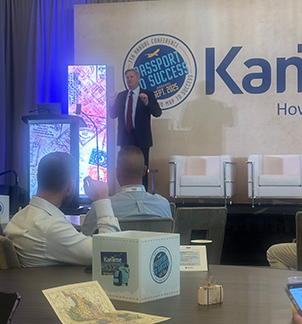
It has become almost customary for the President/CEO of The Alliance, and previously NAHC, to give the keynote address at state association and software user group meetings. The 2025 Kantime event, Passport to Success, was no exception. Dr. Steve Landers was scheduled to speak first thing Tuesday morning. But, Dr. Landers is in D.C. speaking to members of Congress and CMS for Advocacy Week, trying to convince anyone who will listen of the needed changes in Care at Home.

When Kantime asked Bill Dombi, former President of NAHC, to take Landers’s place, they asked him not to give his customary “vanilla” talk about the state of the industry. According to Dombi, Kantime gave him a bit of a license to step outside the traditional industry address. He took that license and ran with it, regaling the audience with stories of his school days, being educated (and tortured) by KCatholic nuns in full habits, his road to both the law and care at home, and his thoughts on the future of the industry.

Bill Dombi Presents

“I shouldn’t be here. I’m retired! I should have no shoes in, wearing shorts, or maybe still sleeping, waking up just in time to catch Let’s Make a Deal or the Price is Right, have lunch, take a nap, and then watch a movie or mow my lawn. I had retirement dreams of lounging on a two-person hammock by the beach. My hammock is in the basement. And the guitar I bought myself as a retirelment present, with dreams of coming back here with my band, remains unopened in my living room. It has never been out of its case.”

Bill Dombi

President Emeritus, National Alliance for Care at Home

“But, one of my jobs is to make my successor a success. So, here I am.”

This led Bill to his first topic, Passion: Powering Health Care at Home. He invited the audience to think not of his story, but of their own what lead to their passion for care at home. If you’ve ever heard Bill Dombi speak about care at home and his wish to in his lifetime see the industry become what he has advocated for and imagined for more than 50 years, then you know how spirited and passionate he is. He has fought against injustice since the 6th grade and fought for radical improvement in care at home since college.

Bill spoke openly about the fraud, waste, and abuse that has plagued home health and hospice since before most of us knew what home care was. He lamented the continued need for advocacy at both state and federal levels with each new administration, bill, and MedPAC recommendation since before the Reagan era. He recalled the advent of Medicare and Medicaid when care at home was limited and underused. And he warned of the disasterous idea of rolling Hospice care into Medicare Advantage. In true “Bill Dombi style,” he managed to do all of this in a way that left an air of hope in the room rather than doom.

What's in Store for Care at Home?

Bill talked about the progress his successor has made, including his current work on The Hill for Advocacy week. According to Bill, the advocacy focus for the National Alliance for Care at Home is:

  • PDGM
  • Hospice Carve-in
  • HCBS OBBA Risks
  • HCBS 80/20 rule
  • Medicare Advantage
  • Workforce Improvement

Final Thoughts - Dombi's Care at Home Forecast

The scope of Health care at home will continue to expand. There will continue to be technology and artificial intelligence advances in care at home. The provide design and delivery of care model will evolve. Consolidation and competition are definitely in play. And the workforce is a common denominator for success. 

# # #

Kristin Rowan, Editor

Kristin Rowan has been working at The Rowan Report since 2008. She is the owner and Editor-in-chief of The Rowan Report, the industry’s most trusted source for care at home news, and speaker on Artificial Intelligence and Lone Worker Safety and state and national conferences.

She also runs Girard Marketing Group, a multi-faceted boutique marketing firm specializing in content creation, social media management, and event marketing.  Connect with Kristin directly kristin@girardmarketinggroup.com or www.girardmarketinggroup.com

©2025 by The Rowan Report, Peoria, AZ. All rights reserved. This article originally appeared in The Rowan Report. One copy may be printed for personal use: further reproduction by permission only. editor@therowanreport.com

 

Advocacy Week

Advocacy Week

FOR IMMEDIATE RELEASE

Contact:                                                                       Elyssa Katz
communications@allianceforcareathome.org
571-281-0220

Over 240 Advocates Rally in DC for the Future of Care at Home

National Alliance for Care at Home Hosts Inaugural Advocacy Week on Capitol Hill

Alexandria, VA and Washington, D.C., September 12, 2025.

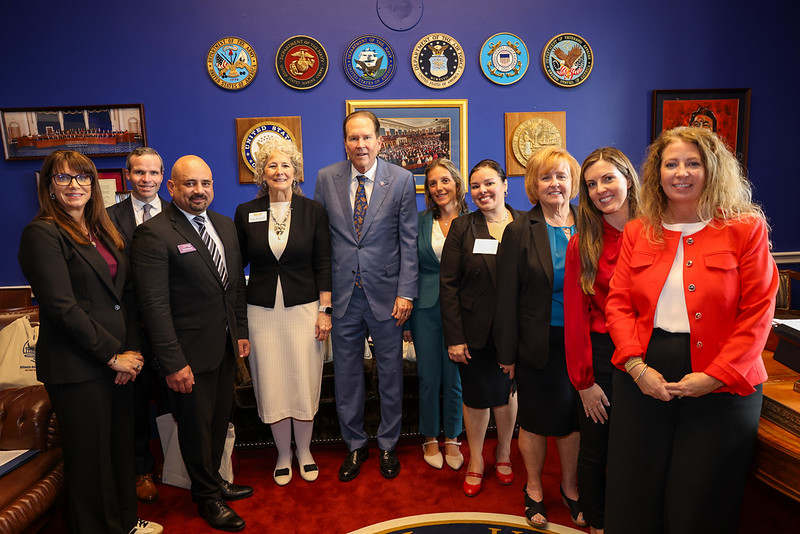
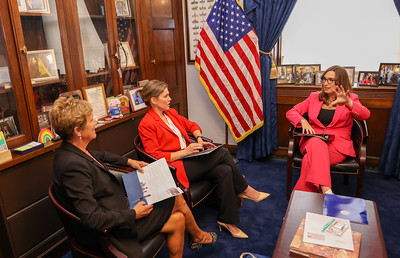
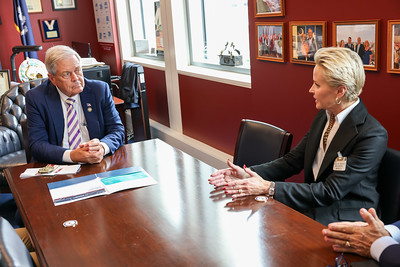
More than 240 care at home care advocates from across the country met with over 275 congressional offices this week to discuss key legislative and regulatory priorities for expanding access to home-based care services. The meetings were part of the 2025 National Alliance for Care at Home’s inaugural Advocacy Week.  

Alliance Advocacy Week brings together leaders, advocates, and supporters to unite as one voice for care at home, driving positive legislative change and shaping the future of care to ensure broader access to the life-changing home care services for all Americans.  

Advocates focused on four key issues during their congressional meetings:

  • Protecting home health care by preventing dangerous payment cuts
  • Safeguarding the Medicare Hospice Benefit by ensuring hospice remains a separate holistic managed care model outside of Medicare Advantage
  • Expanding telehealth access across many care at home services
  • Supporting robust Medicaid HCBS funding to strengthen community-based care
Advocacy Week National Alliance for Care at Home
Advocacy Week Strategy Session<br />
Advocacy Week Strategy Session

In addition to Wednesday’s congressional meetings, Alliance Advocacy Week featured strategy sessions, beginner advocate training featuring a panel discussion with Congressional staffers, and in-depth policy briefings. On Thursday, the Alliance’s Assembly of State Associations – a network of leaders of state home care and hospice organizations – came together for a robust conversation.   

The Alliance celebrates the achievements of this inaugural Advocacy Week on behalf of home-based care providers nationwide and will continue engaging in critical policy dialogue to support and expand access to essential care at home services.  

# # #

About the National Alliance for Care at Home

The National Alliance for Care at Home (the Alliance) is the leading authority in transforming care in the home. As an inclusive thought leader, advocate, educator, and convener, we serve as the unifying voice for providers and recipients of home care, home health, hospice, palliative care, and Medicaid home and community-based services throughout all stages of life. Learn more at www.AllianceForCareAtHome.org.   

©2025. This press release originally appeared on the National Alliance for Care at Home website and is reprinted here with permission. For questions or to request permission to use, please see press contact information above.

Update on Malpractice Claims

by Elizabeth E. Hogue, Esq.

Update on Malpractice Claims

New analysis by Claggett, Sykes and Garza Trial Lawyers shows that registered nurses (RNs) and physicians continue to top the list of health professions most likely to be sued for malpractice. A total of 50,555 claims were filed in 2024. Complaints included 12,655 against RNs while 12,299 complaints were filed against physicians. There were 5,851 complaints against licensed practical nurses. There were also 2,889 complaints against nursing paraprofessionals and 1,068 complaints against advanced practice nurses. Registered nurses now have a risk level that is 2.3 times higher than average. The report says that large patient volumes make nurses especially vulnerable.

Claims and Payouts

While the total number of malpractice suits has decreased by almost 20% in ten years, the severity of claims has risen. In 2024, total payouts were $4.93 billion, averaging $433,000 per case, while the cost per claim against home health nurses was previously much lower as described below. 

Home care nurses, including those providing hospice and palliative care, were the most vulnerable to professional liability claims of all nursing specialties for the period from 2015 to 2019, according to “Nurse Professional Liability Exposure Claim Report: 4th Edition,” recently issued by Nurses Service Organization and CNA. This is 

Malpractice

the first time that nurses in home care topped the list since the reports were first compiled in 2008. According to the report, home care nurses accounted for 20.7% of claims, which represents an increase of 12.4% over the previous number reported in 2015. Adult medical/surgical nurses topped the list in past reports.

Cost

The average total costs incurred per claim against home care nurses, including legal fees and amounts awarded to patients and/or families, was $216,051 over the five-year period of the study. This amount is a little higher than the overall average for claims against nurses. 

The average total costs incurred from closed liability lawsuits against all nurses was $210,513, representing a 4% rise since the last report in 2015. This increase is likely based on more expensive legal and expert counsel, and the rising cost of healthcare since payments to patients include costs of medical treatment that led to malpractice suits.

The following may contribute to increases in claims against home health nurses:

  • Lack of institutional support for home care nurses that is routinely received by nurses in hospitals and other facilities
  • Growing popularity of home care
  • Rising acuity of home care patients
  • Lack of 24-hour oversight of patients
  • Absence of equipment in patients’ homes that is readily available in institutional settings to help identify patients at high risk for negative outcomes

Strategies that nurses can use to protect themselves from malpractice claims include:

  • Stay up to date on education and training
  • Document assessments of patients in a timely and objective manner
  • Go up the chain of command when concerned about the well-being of patients
  • Maintain files that demonstrate character; such as letters of recommendation, notes from patients, and performance evaluations

Final Thoughts

And, of course, complete, accurate and contemporaneous documentation may provide the best defense of all. 

It is time to keep risk management close to the top of lists of potential problems that need on-going attention.

# # #

Elizabeth E. Hogue, Esq.

Elizabeth Hogue is an attorney in private practice with extensive experience in health care. She represents clients across the U.S., including professional associations, managed care providers, hospitals, long-term care facilities, home health agencies, durable medical equipment companies, and hospices.

©2025 Elizabeth E. Hogue, Esq. All rights reserved.

No portion of this material may be reproduced in any form without the advance written permission of the author.

©2025 by The Rowan Report, Peoria, AZ. All rights reserved. 

Momentum Consulting Expands Leadership Team

MOMENTUM HEALTHCARE & TECHNOLOGY CONSULTING EXPANDS LEADERSHIP TEAM

Chris Taylor joins as COO, strengthens Momentum’s commitment to helping providers and innovators scale, transform operations, and make smarter technology decisions.

TAMPA, FL, Sept. 16 — Momentum Healthcare and Technology Consulting announced today the appointment of Chris Taylor as Managing Partner and Chief Operating Officer. Taylor joins Founder & CEO Kristen Duell in leading the firm, reinforcing Momentum’s commitment to meeting the growing demand for independent and unbiased guidance in the healthcare and care-at-home sectors.

Duell, who has spent more than two decades leading growth and innovation in the care-at-home industry, founded Momentum to bring clear, technology-forward consulting to providers and technology innovators seeking measurable growth and market leadership. The firm is privately held and does not own any technology, able to advise providers objectively on finding the right solutions, whether layering new platforms or replacing existing systems.

Taylor brings more than 30 years of leadership experience across healthcare technology, population health, and chronic care management, with senior roles at Axxess, Medtronic, KanTime, AMC Health, Modernizing Medicine, Allscripts, Honeywell HomMed, and Spacelabs Medical. A valedictorian MBA graduate of Brigham Young University, Taylor has also developed and taught nationally, training thousands of professionals in leadership, sales, and organizational performance.

“I have spent my career helping organizations unlock their potential,” said Taylor. “What drew me to Momentum was its reputation for integrity, clarity, and impact. I am thrilled to join Kristen and the team in guiding providers and technology innovators as they scale nationally and deliver care that truly makes a difference.”

Momentum has long touted the importance of strategic partnerships, and this addition to their leadership team only reinforces that point.

“Together, we provide clients with a complete growth engine, from vision and brand strategy to operational execution and partnership acceleration,” said Duell. “Our industry is changing fast, and our clients need a team that can meet them where they are and take them where they want to go.”

With Duell’s strategic leadership and Taylor’s operational expertise, Momentum is uniquely positioned to help healthcare organizations and technology innovators move from concept to national scale with speed, precision, and purpose. 

# # #

About Momentum Healthcare and Technology Consulting

Momentum Healthcare and Technology Consulting is an independent, privately held advisory firm serving the care-at-home and healthcare technology industries. Founded by industry veteran Kristen Duell, Momentum helps providers and technology innovators accelerate growth, strengthen operations, and scale nationally with clarity and precision. With decades of combined leadership experience, the Momentum team partners with clients to deliver measurable impact and lasting results.

©2025 This press release originally appeared on the Momentum Consulting website and reprinted here with permission. For additional information, please contact Momentum directly.

Medicare Home Health Cuts: Survey Says

FOR IMMEDIATE RELEASE

Contact:                                                                       Elyssa Katz
571-281-0220
communications@allianceforcareathome.org  

70% of Americans Oppose Medicare Home Health Cuts, National Poll Finds

Alexandria VA, and Washington, DC, September 4, 2025– A new national poll by Fabrizio Ward, commissioned by the National Alliance for Care at Home (the Alliance), finds that seven in ten Americans oppose the Centers for Medicare & Medicaid Services’ (CMS) 2026 Medicare home health proposed rule, which would slash Medicare home health funding by an additional 9%, or $1.1 billion, next year. These cuts would put lifesaving home health care for millions of Americans at risk, particularly seniors and those with disabilities, while doing nothing to address fraud, waste, and abuse occurring in the home health payment system.

In one of the strongest bipartisan rebukes of Medicare home health cuts to date, the poll found overwhelming opposition across party lines. Large majorities of voters support targeting cost savings to eliminating waste and fraud rather than across-the-board cuts. Voters widely recognize that home health provides significant savings for taxpayers, that lack of access to home health due to recent cuts hurts Medicare patients, and that many more would be hurt if the proposed cuts go into effect.

CMS home health proposed rule

“The results send a crystal-clear message: Americans want more home-based care, not less, and preserving access to care is critical. Cutting home health doesn’t save money – it hurts patients, worsens outcomes, and costs taxpayers more in the long run.” 

Dr. Steve Landers

CEO, National Alliance for Care at Home

The poll reveals Americans see home health as essential to keeping patients safe at home, lowering costs, and easing pressure on already overburdened hospitals and emergency rooms.

Key findings:

  • 70% of all voters oppose Medicare cutting home health services by an additional 9% next year.
  • 91% of all voters believe it’s important that home health services be available when Medicare patients require extra medical support.
  • 55% of all voters support President Trump taking steps to reverse the proposed Medicare home health cuts and ordering a crackdown on fraud in the system.
  • 71% of all voters believe home care is the most affordable care option, compared to just 17% who believe hospital care is more affordable.
  • 73% of all voters say that cutting Medicare home health harms patients and legitimate providers while failing to stop the fraudulent operators that scam hundreds of millions of dollars from the program each year is a good reason to oppose the cuts.

“With more than one out of every two voters either on Medicare, or with a parent on Medicare, voters are clear that people want treatment at home if it’s an option and that home medical care is less expensive than care provided at hospitals and nursing homes. Voters also see the folly in across-the-board cuts that harm everyone rather than focusing efforts to root out known fraud in the home health system. Across the political spectrum voters oppose cuts and support redoubling efforts to fight fraud.”

Tony Fabrizio

Partner, Fabrizio Ward

“These numbers should give every lawmaker pause,” Dr. Landers cautioned. “Patients want to recover where they’re safest – at home. It’s time for Congress to protect what’s working and stop the home-care bleeding. Lawmakers have an opportunity to protect a program that saves lives, lowers costs, enjoys overwhelming bipartisan support, and reflects the clear will of the American people.”

The Alliance is urging Congress and CMS not to finalize the proposed payment cuts and to work with providers to revise their approach and strengthen, not weaken, access to home-based care.

A memo of the poll findings can be found here.

###

About the National Alliance for Care at Home

The National Alliance for Care at Home (the Alliance) is the leading authority in transforming care in the home. As an inclusive thought leader, advocate, educator, and convener, we serve as the unifying voice for providers and recipients of home care, home health, hospice, palliative care, and Medicaid home and community-based services throughout all stages of life. Learn more at www.AllianceForCareAtHome.org.

Medicare Advantage Excess Payments

by Kristin Rowan, Editor

Medicare Advantage Excess Payments

Investigational Study

Researchers from the Department of Health Services, Policy and Practice at Brown Universchool of Public Health and the Department of Geriatrics and Palliative Medicine at Icahn School of Medicine published an original investigative study on spending versus payments in Medicare Advantage under the hospice carve-out model.

Carve-out to VBID to Carve-out

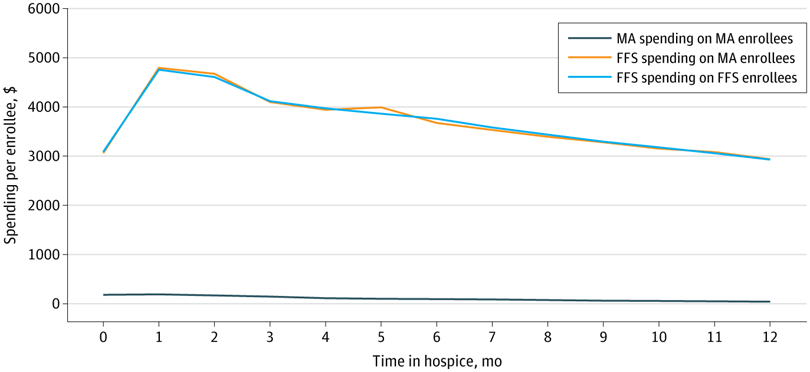
In 2021, CMS started a Value-Based Insurance Design (VBID) to test the impact of adding hospice services to Medicare Advantage benefits. By December of 2024, CMS ended the program due to widespread upset. CMS returned to the hospice carve-out model. Under this model, when an MA beneficiary chooses hospice, any health care expenses related to the terminal illness is paid on a fee-for-service (FFS) basis. MA no longer receives inpatient and outpatient payments, but continues to receive premiu, and rebate payments.

Carve-out Hospice Benefit

Once an MA enrollee enrolls in hospice, MA is no longer responsible for payments. Under the carve-out model, hospice services are paid by Medicare. MA plans are still responsible for paying for services that are not related to hospice care. These services can include inpatient, outpatient, physician, skilled nursing facility, home health care, and prescription drug expenses. 

Medicare Advantage Spending and Payments

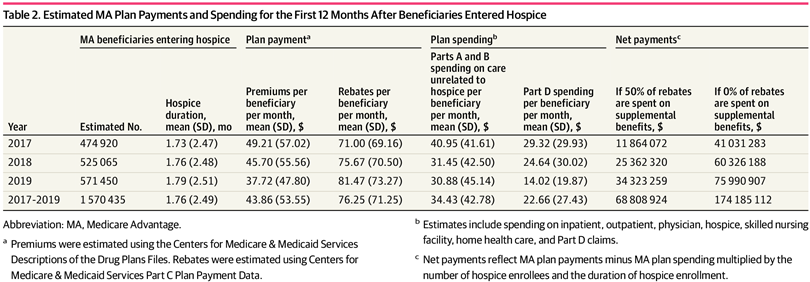
The study spanned 12 months and looked at 314,087 MA beneficiaries. In that period, 80.5% of enrollees had no spneding unrelated to their terminal illness. MA was not responsible for any healthcare related payments, but continued to receive $120 per enrollee per month. Estimated spending from MA on hospice enrollees was $57-70 per month. 

Medicare Advantage Excess Payments

In the 12 months following an enrollee electing hospice, MA plans netted $50-60 per month per enrollee. If half of the rebate payments received pay for supplemental benefits, MA receives excess payments to the tune of $68,808,924 over three years. If no rebate payments go toward supplemental benefits, MA receives $174,185,112 in excess payments over three years. The care a hospice enrollee receives uses the fee-for-service model. Medicare Advantage providers are seemingly paid on a fee-for-no-service model. 

Medicare Advantage plans do not currently report the actual amount of rebate payments used to pay supplemental benefits.

Study Conclusion

The researchers conclude that MA receives excess payments under the hospice carve-0ut model. They also note that there is no accountability for spending after hospice election from MA plans to CMS. The researchers suggest that CMS could require MA plans to report actual spending on supplemental services after hospice election and pay premiums and rebates only to cover the amount spent. 

I have a different recommendation….MA plans should not receive any additional premium payments or rebates following hospice election. MA plans should be required to report total payments and spending from enrollment date to election date. The balance, less the same 8% average margin of home and health and hospice agencies, should be used to pay for hospice services from election to passing. Any remaining balance after the patient’s passing should be returned to the beneficiary’s family.

# # #

Kristin Rowan, Editor

Kristin Rowan has been working at The Rowan Report since 2008. She is the owner and Editor-in-chief of The Rowan Report, the industry’s most trusted source for care at home news, and speaker on Artificial Intelligence and Lone Worker Safety and state and national conferences.

She also runs Girard Marketing Group, a multi-faceted boutique marketing firm specializing in content creation, social media management, and event marketing.  Connect with Kristin directly kristin@girardmarketinggroup.com or www.girardmarketinggroup.com

©2025 by The Rowan Report, Peoria, AZ. All rights reserved. This article originally appeared in The Rowan Report. One copy may be printed for personal use: further reproduction by permission only. editor@therowanreport.com

 

BREAKING NEWS: CMS Changes AHEAD

From cms.gov

CMS Changes AHEAD

CMS Announces Changes to Achieving Healthcare Efficiency through Accountable Design (AHEAD) Model to Improve Quality, Promote Transparency, and Decrease Costs

September 2, 2025

What's New

The CMS Innovation Center announced new policy and operational changes, as well as a new end date, to the Achieving Healthcare Efficiency through Accountable Design (AHEAD) Model to help states achieve their total cost of care (TCOC) targets, while advancing the Center’s commitment to promote choice and competition, increase prevention, empower patients, and protect taxpayer dollars.

Why it Matters

Participating states now have more tools to manage Medicare costs (designed to support sustainable growth) and improve quality of care and population health outcomes

What to Expect

Changes will be implemented across all cohorts beginning in January 2026. AHEAD’s end date for all cohorts is now December 31, 2035.

The Big Picture

Changes made to the model will help to advance the CMS Innovation Center’s strategic pillars of: 1) choice and competition, with states implementing at least two policies focused on promoting choice and competition in their health care markets and 2) prevention, with a new Population Health Accountability Plan focused on preventive care, including chronic disease prevention.

CMS Change AHEAD

Additional Details

CMS is also introducing payment reforms through AHEAD for patients with Original Medicare and establishing new transparency requirements around TCOC and primary care investment targets. For the first time ever, AHEAD will bring total cost of care accountability to all Original Medicare beneficiaries in AHEAD regions through geographic attribution of beneficiaries not attributed to other CMS accountable care organization programs. This novel framework will offer risk-bearing Geographic Entities additional tools and enhanced flexibilities to improve health outcomes and lower spending for their patients while receiving shared payments (or losses) through two-sided risk arrangements. In return, patients may receive additional beneficiary incentives while enjoying existing protections under the Original Medicare program.

Total Cost of Care Model

The AHEAD Model is a state total cost of care (TCOC) model that seeks to drive state and regional health care transformation and multi-payer alignment, with the goal of improving the total health of a state population and lowering costs. Under a TCOC approach, a participating state uses its authority to assume responsibility for managing health care quality and costs across all payers, including Medicare, Medicaid, and private coverage. States also assume responsibility for ensuring health providers in their state deliver high-quality care, improve population health, offer greater care coordination, and promote healthier living for all people participating in the model. The AHEAD Model provides participating states with funding and other tools to address rising health care costs and improve health outcomes.

More Information

# # #

©2025 Centers for Medicare & Medicaid Services. This announcement originally appeared on the CMS website here. For more information, please contact the CMS Innovation Center.