Hospice Fraud Oversight

by Kristin Rowan, Editor

CMS Oversight in Fraud-Ridden States

In 2023, The Centers for Medicare and Medicaid Services (CMS) cited research suggesting that hospices profit from fraud far too often. CMS has identified cases of hospices certifying benficiaries who are not terminally ill, providing little to no services, and still billing CMS. Four states have had rapid growth in fraudulent hospices: Arizona, California, Nevada, and Texas.

Churn-and-Burn

Some of the registered hospices had non-operational addresses. This information led to an investigation that resulted in evidence of the fraud dubbed “Churn and Burn.” This scheme involves registering a new hospice and billing for services until there is an audit or the agency maxes out on yearly payments. Then, the hospice closes, keeps the money, registers for a new Medicare billing number, and starts all over again.

Program Integrity Strategy

As a result of  the findings of this research, CMS put more effort behing the hospice program integrity strategy to find and address fraudulent activity. Part of the strategy was unannounced visits to hospices nationwide. Hospices not active at listed addresses were deactivated and Medicare billing privileges were revoked. Of the more than 7,000 hospices visited, 400 had potential administrative action pending.

Enhanced Oversight

In the four states identified as having higher instances of fraud, CMS implemented a provisional period of enhanced oversight. During the provisional period, CMS conducted a medical review prior to payment for hospices in these states that have identified problems.

Nationwide Pilot Project

In addition to the provisional period for the four identified states, CMS started a pilot project to review hospice claims after a patient’s intitial 90 days of hospice care. This pilot project was not limited to the four states, but was implemented nationwide. CMS launched the program to help inform medical reviews in determining whether hospices are submitting claims for eligible patients.

Regulatory Changes

CMS also proposed some regulatory changes to combat hospice fraud. Some of these regulatory changes were initially suggested by hospice providers. The proposals include:

Hospice Fraud
    • Prohibiting the transfer of Medicare billing privileges of a new hospice for 36 months
    • Clarifying the definition of “Managing Employee” to include the administrator and medical director of a hospice
    • Implementing a Special Focus Program to increase oversight on poor-performing hospices that have ongoing health and safety deficiencies
    • Adding criminal background checks for owners when they initially enroll for Medicare billing privileges.

Prepayment Review Expanded

CMS has just announced that they will expand the prepayment review process in the four states beginning in September, 2024. Information from CMS is limited and states that prepayment review volume will start low to protect compliant hospices, but will increase if a hospice is found to be non-compliant. Consequences for non-compliance includes delays in payment, extended review, or additional administrative actions.

According to preliminary information we received from a hospice consultant, the expanded program puts all new hospices or hospices with ownership changes into prepayment review even if they have not had identified problems. 

We have reached out to both CMS and some of our expert hospice consultants to get more information and will update this story as information becomes available.

# # #

Kristin Rowan, Editor

Kristin Rowan has been working at Healthcare at Home: The Rowan Report since 2008. She has a master’s degree in business administration and marketing and runs Girard Marketing Group, a multi-faceted boutique marketing firm specializing in event planning, sales, and marketing strategy. She has recently taken on the role of Editor of The Rowan Report and will add her voice to current Home Care topics as well as marketing tips for home care agencies. Connect with Kristin directly kristin@girardmarketinggroup.com or www.girardmarketinggroup.com

©2024 by The Rowan Report, Peoria, AZ. All rights reserved. This article originally appeared in Healthcare at Home: The Rowan Report. One copy may be printed for personal use: further reproduction by permission only. editor@therowanreport.com
NHPCO and NAHC Announce New Name and Website

by Kristin Rowan, Editor

The Alliance

Since the announcement that the National Hospice and Palliative Care Organization and the National Association for Home Care and Hospice would merge, the default name for the combined entities has been “The Alliance.” NAHC President Bill Dombi and Interim NHPCO CEO Ben Marcantonio, along with a transition board and other members have been working since August of 2023 on the merger. In June of 2024, the two organizations signed an official affiliation agreement.

Alliance Updates

In the last year, the two organizations have spoken about the work they’ve been doing to create the new affiliation. They jointly hosted a town hall to answer questions, and Bill Dombi has spoken at state and national association meetings about the merger. On August 26, 2024, The Alliance named its inaugural CEO, Dr. Steven Landers.

National Association for Care at Home (NACH)

Our industry loves its acronyms and this one rolls off the tongue like we’ve been using it for years. Although, we may all need to perfect the German guttural sound to differentiate it from NAHC.

In a press release on Sept. 5, 2024, the two associations officially announced that The National Alliance for Care at Home (NACH) is the new name of the combined organizations. Along with this announcement, The Alliance has also launched its new logo (below) and new website at www.AllianceForCareAtHome.org.

From The Alliance

Statements from both organizations outline the path forward and the mission and vision for the new affiliation:

    • The National Alliance for Care at Home will Combine the Strengths of the Two Largest National Organizations Representing Healthcare Providers Delivering Care Primarily in Homes
    • The Alliance Will Provide Unparalleled Resources and Representation to Support the Care-at-Home Community
    • This Alliance will be the leading authority on transforming care in the home. We will implement that mission under a new name that welcomes providers across the care continuum to join – the National Alliance for Care at Home
    • The Alliance will be your advocate, your resource, and your network to help you reach your goals

The new logo for NACH is, according to the press release, both an homage to the past and a symbol for the future. It creates a visual representation of both NAHC and NHPCO. The star shape of the logo is representative of the stars on the American flag, part of the NAHC logo. The visual aesthetic of the logo is reminiscent of the lotus flower from the NHPCO logo. The individual sections of the logo represent people holding hands, the visual representation of the coming together of types of care. The white space in the middle is meant to symbolize a house or home.

The logo is based on guidance from a workgroup comprised of members from both organizations, whose input has helped shape the Alliance brand.

The National Alliance for Care at Home

About Us

This press release also included a new boilerplate, describing the National Association for Care at Home, rather than two separate descriptions of each organization. This is probably still a temporary description, as it mentions that they are still in the process of combining operations and Communications Officers from both separate organizations are listed as press contacts. 

More to Come

Despite the announcement of the new CEO and the new name, the merger is far from over. There are logistical and operational hurdles still to overcome, a new board to enstate, the combining of assets and competencies, and a restructuring of existing employees. We will continue to report on press releases coming from NACH.

# # #

Kristin Rowan, Editor

Kristin Rowan has been working at Healthcare at Home: The Rowan Report since 2008. She has a master’s degree in business administration and marketing and runs Girard Marketing Group, a multi-faceted boutique marketing firm specializing in event planning, sales, and marketing strategy. She has recently taken on the role of Editor of The Rowan Report and will add her voice to current Home Care topics as well as marketing tips for home care agencies. Connect with Kristin directly kristin@girardmarketinggroup.com or www.girardmarketinggroup.com

©2024 by The Rowan Report, Peoria, AZ. All rights reserved. This article originally appeared in Healthcare at Home: The Rowan Report. One copy may be printed for personal use: further reproduction by permission only. editor@therowanreport.com
HHA to pay Nearly $4 Million after False Claims Act Violations

by Kristin Rowan, Editor

False Claims Act Violations

According to allegations in U.S. es rel. Jones v Intrepid U.S.A. Healthcare Inc. and U.S. es rel. Rigney v Intrepid U.S.A. Inc., Intrepid U.S.A. Inc. (Intrepid) violated the False Claims Act multiple times over five years.

Intrepid is based in Texas and includes more than 80 Personal Care, Home Health, Palliative Care, and Hospice Care agencies across 18 states. Intrepid describes their services as “concierge medical home healthcare, hospice at home, private duty home care, and independent living support.”

Whistleblowers

Whistleblowers filed Civil cases against Intrepid under the whistleblower provisions of the False Claims Act. A former travel nurse and a former Director of Quality and Improvement for Intrepid filed the first case. A former Director of Clinical Excellence and Integrity and a former Regional Manager of Clinical Excellence for Intrepid filed the second. Under the False Claims Act, a private party can file an action against a company on behalf of the United States. Should there be a settlement or resolution, the filing party(ies) receive a portion of any recovery.

Allegations

Each of the cases addresses different lines of business for Intrepid. The first case alleges that Intrepid knowingly submitted home healthcare Medicare claims for patients who did not qualify for the home healthcare benefit, or where services did not qualify for reimbursement. The second case alleges that Intrepid knowlingly submitted Medicare claims for patience who did not qualify for the hospice benefit.

More Allegations

Additionally, the United States claims that from 2016 to 2021, Intrepid submitted claims for services that were not reasonable or medically necessary, services provided by untrained staff, and services that were never provided at all. Separately, the United States alleges that Intrepid admitted patients who were ineligible for hospice benefits because they were not terminally ill and continued providing services to patients who should have been discharged because they no longer met the requirements to qualify for the hospice benefits.

Settlement

The Justice Department’s Civil Division, Commercial Litigation Branch, Fraud Section, the U.S. Attorney’s Office for the Western District of Kentucky and U.S. Attorney’s Office for the District of Minnesota worked together to investigate and resolve these matters. According to the Department of Justice report, no liability or admission of guilt was determined and the settlement resolved allegations only.

Repeat Offender

It seems this is not the first run-in with the law that Intrepid U.S.A. has faced.

2014: a class action suit alleged unpaid wages.

2019: Intrepid settled a class action suit where employees alleged unpaid overtime.

2021: William Buchanan filed a civil right – employment discrimination suit against Intrepid in Indiana.

Intrepid in Minnesota and North Carolina faced similar Medicare fraud charges as well.

Intrepid USA False Claims Act

Not Alone

Intrepid U.S.A. Inc. is not the only home health or hospice agency to face these types of allegations.

Evolution Health LLC

In July, 2024, Guardian Health Care, Inc., Gem City Home Care LLC, and Care Connection of Cincinnati LLC, together with their parent company Evolution Health LLC, settled a False Claims Act case in which the Companies were accused of providing illegal kickbacks to ALFs and physicians in exchange for referrals. That settlement totaled almost $4.5 million dollars.

Halo Home Healthcare

Similarly, in June, 2024, the former owner of Halo Home Healthcare pled guilty to billing more than $8.5 million in fraudulent claims to Medicare, Medicaid, and Veterans Affairs from 2015 to 2021. Halo Home Healthcare hired more than 50 employees with criminal backgrounds that should have excluded them from providing home health services, one of whom was charged with a quadruple murder during their employment at Halo. The former owner also hid her ownership of the company because she had been convicted in 2013 of passing forged and fraudulent prescriptions for oxycodone and hydrocodone.

Atlantic Home Health Care

In January, 2024, Atlantic Home Health Care was accused of falsely billing the Energy Employees Occupational Illness Compensation Program. The claim alleges Atlantic charged for in-home nursing and personal care when employees weren’t providing services and paying kickbacks for patient referrals. The Arizona-based company paid almost $10 million to resolve that case.

Speak Up, Speak Out

Fraudulent billing, up-coding, and other illegal acts from home health and hospice agencies put additional strain on the already stretched CMS budget for reimbursement. The millions of dollars recovered just this calendar year is just a portion of fraudulent claims filed. Whistleblower laws protect employees from retaliation by their employers. Fraudulent practices that send money directly to an agency without benefitting a patient hurts the whole industry. The only way the Department of Justice can address and stop these billing practices and keep that money going directly to patient care is with the help of whistleblowers.

# # #

Kristin Rowan, Editor

Kristin Rowan has been working at Healthcare at Home: The Rowan Report since 2008. She has a master’s degree in business administration and marketing and runs Girard Marketing Group, a multi-faceted boutique marketing firm specializing in event planning, sales, and marketing strategy. She has recently taken on the role of Editor of The Rowan Report and will add her voice to current Home Care topics as well as marketing tips for home care agencies. Connect with Kristin directly kristin@girardmarketinggroup.com or www.girardmarketinggroup.com

©2024 by The Rowan Report, Peoria, AZ. All rights reserved. This article originally appeared in Healthcare at Home: The Rowan Report. One copy may be printed for personal use: further reproduction by permission only. editor@therowanreport.com
HHVBP Model Payments Begin January 1, 2025

by Kristin Rowan, Editor

Background on the HHVBP Model

The Home Health Value Based Purchasing (HHVBP) Model, implemented by CMS in 2016, began in nine states. The goal is “to provide incentives for better quality care, to study new quality and efficiency measures, and to enhance the reporting process.” It may also provide new avenues for payment models.

According to the CMS website, the original HHVBP Model, launched in nine states, improved an average of 4.6 percent HHA performance scores and saved Medicare $141 million. Additionally, the model lowered unplanned hospitalizations for acute care and reduced skilled nursing facility (SNF) stays.

HHVBP Model Expansion

From the initial study, CMS surmised that expanding the model would increase performance, increase savings, and further reduce hospitalizations and SNF stays. Early in 2021, CMS announced the nationwide expansion of the HHVBP Model.

The expanded model started on January 1, 2022. In its first expansion year, CMS provided training and allowed HHAs time to adjust practices based on HHVBP expectations and requirements. During the transition year, HHA performance did not risk future payment rates.

HHVBP Model Performance Year

January 1, 2023 marked the beginning of the performance year, in which all HHA results would impact future payments. CMS will adjust fee-for-service payments based on performance relative to other HHAs. CMS groups HHAs into cohorts determined by beneficiary count the previous year. Cohorts include large- and small-volume for agencies above and below 60 unique HHCAHPS eligible beneficiaries, respectively.

Using data already reported by HHAs through the Home Health Quality Reporting Program (HH QRP) and HHCAHPS surveys, CMS compares an HHAs data to similar agencies. Based on this comparison, CMS adjusts future payments between -5% and 5% for fee-for-service payments.

Interim Performance Report

The Interim Performance Report (IPR) is a quarterly report with performance data for all HHAs participating in the HHVBP Model. Active HHAs that were Medicare certified before January 1, 2022, are eligible for payment adjustment, and meet the minimum threshold of data for at least one quality measure receive the reports. Reports are available at iQIES. Registration on the portal is required.

CMS publishes new reports every quarter and eligible HHAs should receive an email when a new report is available. 

Points System

Payment adjustments for the next calendar year are based on an HHAs performance in the last report. For CY 2025, payment adjustments will use the Final Annual Performance Report, published 30 days prior to each payment year.

The process to determine your HHAs ranking in relations to the other HHAs in your cohort can be confusing and has many steps. Payment adjustments are based on “Care Points”, which are calculated on a weighted scale, using the higher of the agency’s earned achievement points or improvement points. An HHA must have at least 20 quality stays for claims-based measures and at least 40 surveys for the HHCAHPS survey-based measure.

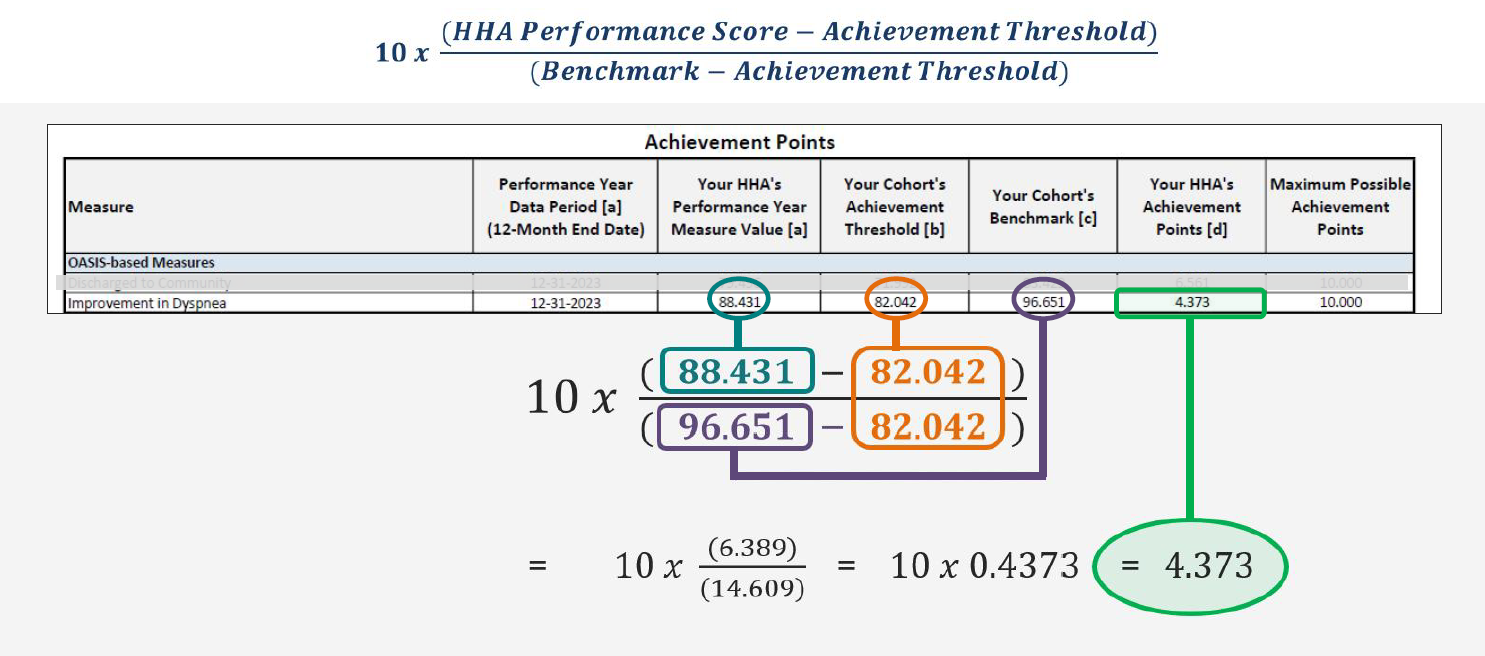
Achievement Points

Achievement points are earned by scoring above the median performance on each quality measure (better than half of the agencies in your cohort) and dividing that by the difference between your score and the top 10 percent in your cohort.

HHVBP Model Calculate Achievement Points
Improvement Points

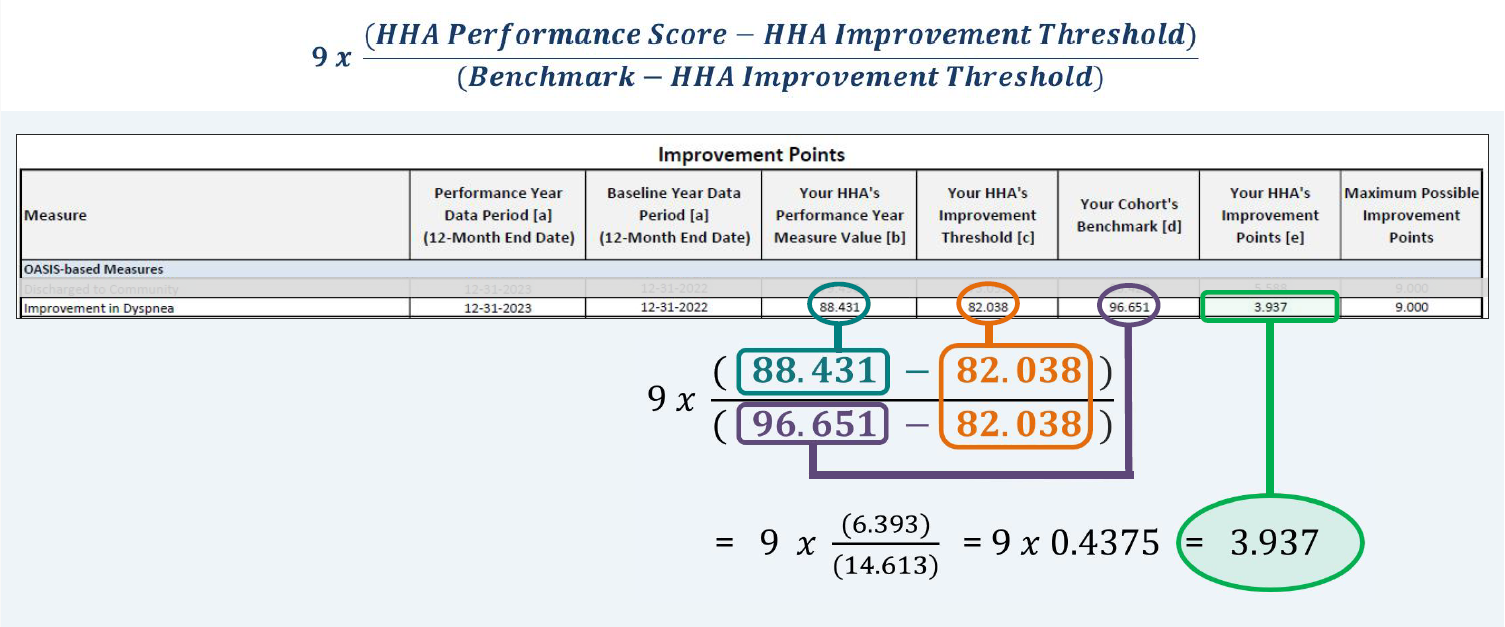
Improvement points are calculated using an HHAs prior year performance measure, current measure and the mean score of the top 10 percent of agencies in your cohort.

HHVBP Model Calculate Improvement Points
Care Points

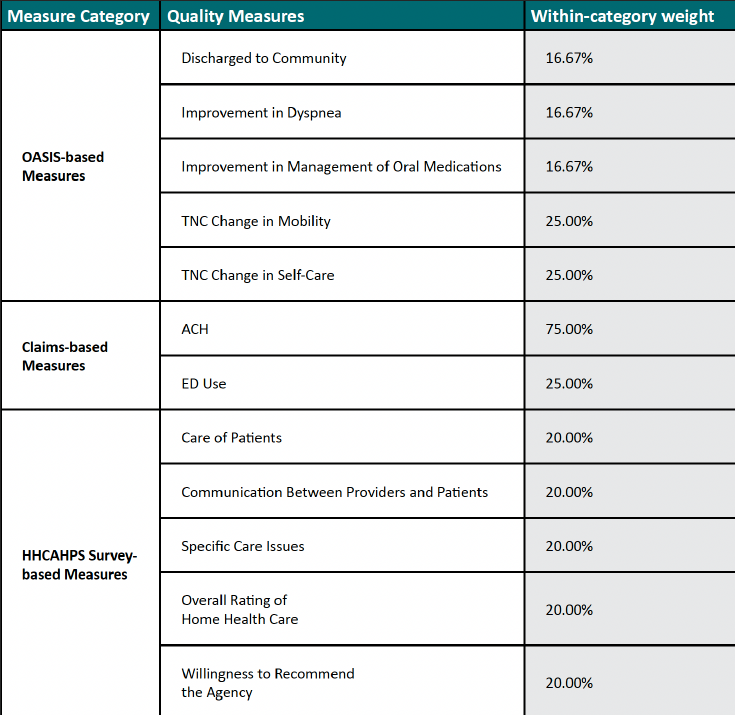
Care points are the higher of Achievement Points or Improvement Points for each quality measure. Each quality measure is weighted differently in each category of OASIS-based Measures, Claims-based Measures, and Survey-based Measures.

The higher of each agency’s achievement and improvement scores is multiplied by its assigned weight to calculate the weighted score within each measure. Each measure then has its own weight. OASIS- and Claims-based measures each count for 35% of the total score while Survey-based measures make up 30% of the final score.

The HHA score is measured against all HHAs in the cohort to determine your rank. Where your weighted points fall in comparison with the rest of your cohort determines whether your next payment cycle will go up or down by as much as 5 percent. 

HHVBP Model Weighted Scores

Public Reporting

Your scores will not only be used to determine your payment increase or decrease. These reports will be made public as well. CMS will publicly report each quality measure’s benchmark and achievement threshold. For every HHA that qualifies for a payment adjustment, CMS will also publish:

      • Measure results and improvement thresholds
      • Total Performance Score and Percentile Ranking
      • Payment adjustment percentage

Scoring well on the Achievement and Improvement markers for each measure may offer an HHA an opportunity to gain more referrals, recruit talented clinicians, and gain a reputation for quality care.

On the other hand, scoring low may hurt an agency irreparably. HHAs who think there is an error in the initial reporting can submit a recalculation request within 15 days of the publishing of a preview report. Based on CMS’s decision, HHAs have 15 days to submit a reconsideration request if they submitted a recalculation request and are not happy with the decision. If the HHA is still not in agreement with the decision of the reconsideration request, they have seven days to submit a request for administrative review.

Next Steps

According to the information we can find on CMS, these reports will be published quarterly. Logically, then, the recalculation requests can also be submitted quarterly along with reconsideration and administrative review requests. We will continue to follow this and provide updated deadlines to submit requests as we find them.

# # #

Kristin Rowan, Editor

Kristin Rowan has been working at Healthcare at Home: The Rowan Report since 2008. She has a master’s degree in business administration and marketing and runs Girard Marketing Group, a multi-faceted boutique marketing firm specializing in event planning, sales, and marketing strategy. She has recently taken on the role of Editor of The Rowan Report and will add her voice to current Home Care topics as well as marketing tips for home care agencies. Connect with Kristin directly kristin@girardmarketinggroup.com or www.girardmarketinggroup.com

©2024 by The Rowan Report, Peoria, AZ. All rights reserved. This article originally appeared in Healthcare at Home: The Rowan Report. One copy may be printed for personal use: further reproduction by permission only. editor@therowanreport.com
Medicare Advantage Predatory Marketing

by Kristin Rowan, Editor

Leading Associations Attempt to Curb Medicare Advantage Marketing Practices that Prey on the Unsuspecting

For some time now, we’ve been reporting on the marketing practices that Medicare Advantage uses to lure new members. And, it’s working, as more than 50% of eligible patients are now on Medicare Advantage plans. From federal lawsuits to fraud, to upcoding, Medicare Advantage has made headlines more often than almost any other topic in the industry in the last few years. A joint move last week by two national associations may bring the issue to a head once and for all.

The National PACE Association (NPA) and LeadingAge wrote to the Centers for Medicare and Medicaid Services (CMS) urging them to employ stricter oversight on Medicare Advantage marketing practices. The letter, dated July 25, 2024, cited the impact of these marketing tactics on adults served by Programs for All-Inclusive Care for the Elderly (PACE). They called the marketing “aggressive and misleading” and called upon CMS to protect PACE beneficiaries from harm.

 One of the selling points in the marketing of Medicare Advantage is the supplemental benefits. Medicare Advantage plans are allocated nearly $64 billion dollars to pay for dental, vision, gym memberships, and other benefits that are not available with traditional Medicare. However, the government has no idea where this money is going, who is using it, and what it’s for. Limited available data suggests that a very low number of Medicare Advantage enrollees are using these supplemental benefits. The rest of the money just sits with the payers at taxpayer expense.

The false promise of cash benefits draw even more of this population away from traditional Medicare and into Medicare Advantage plans. Cash benefits from MA plans are only available to dual eligible members. What they don’t tell you, though, is that if you are dual eligible and you switch from Medicare to Medicare Advantage, you are subject to prior authorization rules, care denials, and smaller networks, meaning you may lose your physician when you switch plans. Some of those cash benefits are restricted to use in particular stores. For example, Aetna restricts the use of cash benefits to stores owned by CVS Health. If there isn’t a CVS Health near you, the cash benefits can’t be used.  

PACE Programs

Programs of All-Inclusive Care for the Elderly (PACE) are typically traditional Medicare and Medicaid joint programs that provide medical and social services in home and community-based care settings. The programs cover prescriptions, dental care, emergency services, home care, meals services, primary care providers, nurses, social workers, and more. The program’s goal is to keep patients at home or in their communities and get the health care they need. There is no out-of-pocket costs to these programs for dual eligible members. Medicare only members have a monthly premium and prescription drug (Part D) premium. There are no additional deductibles or copayments for any service or level of care.

Bait and Switch

The marketing messages from Medicare Advantage are pulling PACE eligible members into dual MA and Medicaid plans, which significantly reduce the level of care, access to care, and continuity of care. The MA/Medicaid programs also have higher out-of-pocket costs to members, despite having no monthly premium. Research shows that Medicare Advantage is targeting healthier individuals who will use the provided benefits less often and that when Medicare Advantage patients become sicker, they switch back to traditional Medicare plans if they can.

Your content goes here. Edit or remove this text inline or in the module Content settings. You can also style every aspect of this content in the module Design settings and even apply custom CSS to this text in the module Advanced settings.

PACE LeadingAge MA ReformThe financial and health implications of uninformed disenrollment from PACE to conventional MA plans are significant. The needs of PACE beneficiaries, most of whom have multiple complex medical conditions, cognitive or functional impairments – or all three – are not comprehensively addressed by MA plans. The loss of PACE services is harmful and, in some cases, can be life-threatening.

Katie Smith Sloan

president and CEO, LeadingAge

Dire Need for Change

In their letter to CMS, NPA and LeadingAge called for the following changes to be made:

  • Require MA plans to explain, clearly and without embellishment, all out-of-pocket costs and network/coverage limitations. using easy to understand terms
  • When a member disenrolls from a PACE program, additional steps should be taken to ensure the disenrollment is voluntary and that the member is fully informed of the differences in coverage before leaving the PACE program.
  • Increased leniency in re-enrolling in PACE programs after leaving a Medicare Advantage program by allowing re-enrollment mid-month.
  • Require MA brokers, when providing comparative benefit information of their current coverage (e.g., PACE) to an alternate MA plan, to also inform them, in plain language, if the new plan does not cover or coordinate their Medicaid benefits; and any benefits the individual would “lose” under the new plan (e.g., transportation to groceries).

Pace LeadingAge MA ReformWe share CMS’ stated desire that people have access to accurate and complete information when they make health care choices. We have numerous examples of vulnerable seniors being induced to enroll in MA plans without being fully-informed of what they are giving up when they enroll.

Shawn Bloom

president and CEO, National PACE Association

The Rowan Report reached out to LeadingAge to see if CMS has responded to their letter.

Updates will be provided when we have them.

# # #

Kristin Rowan, Editor

Kristin Rowan has been working at Healthcare at Home: The Rowan Report since 2008. She has a master’s degree in business administration and marketing and runs Girard Marketing Group, a multi-faceted boutique marketing firm specializing in event planning, sales, and marketing strategy. She has recently taken on the role of Editor of The Rowan Report and will add her voice to current Home Care topics as well as marketing tips for home care agencies. Connect with Kristin directly kristin@girardmarketinggroup.com or www.girardmarketinggroup.com

©2024 by The Rowan Report, Peoria, AZ. All rights reserved. This article originally appeared in Healthcare at Home: The Rowan Report. One copy may be printed for personal use: further reproduction by permission only. editor@therowanreport.com

Product Review: AI Comes to Data Analytics

by Kristin Rowan, Editor

Artificial Intelligence has existed in basic forms for many years and has recently advanced to include augmented intelligence and generative intelligence. The Rowan Report has provided several examples of quality AI usage and even more examples of AI applications that are fraudulent, improperly applied, and/or poorly executed. As we continue our journey of AI discovery, we are seeing more companies researching how to effectively use AI to enhance existing software solutions as well as new solutions entirely based on AI. We’ve reviewed AI software for point of referral, talk to text documentation, employee recruitment and retention, and now data analytics.

The Rowan Report recently met the founder of a data analytics AI software solution, Skyra.ai. “Our goal is to advance the industry to be technology forward,” said Skyra founder Mickel Mirchandani, “we imagined a future were technology empowers home care agencies to focus on what matters – serving patients.”

Data Analytics: From What to Why

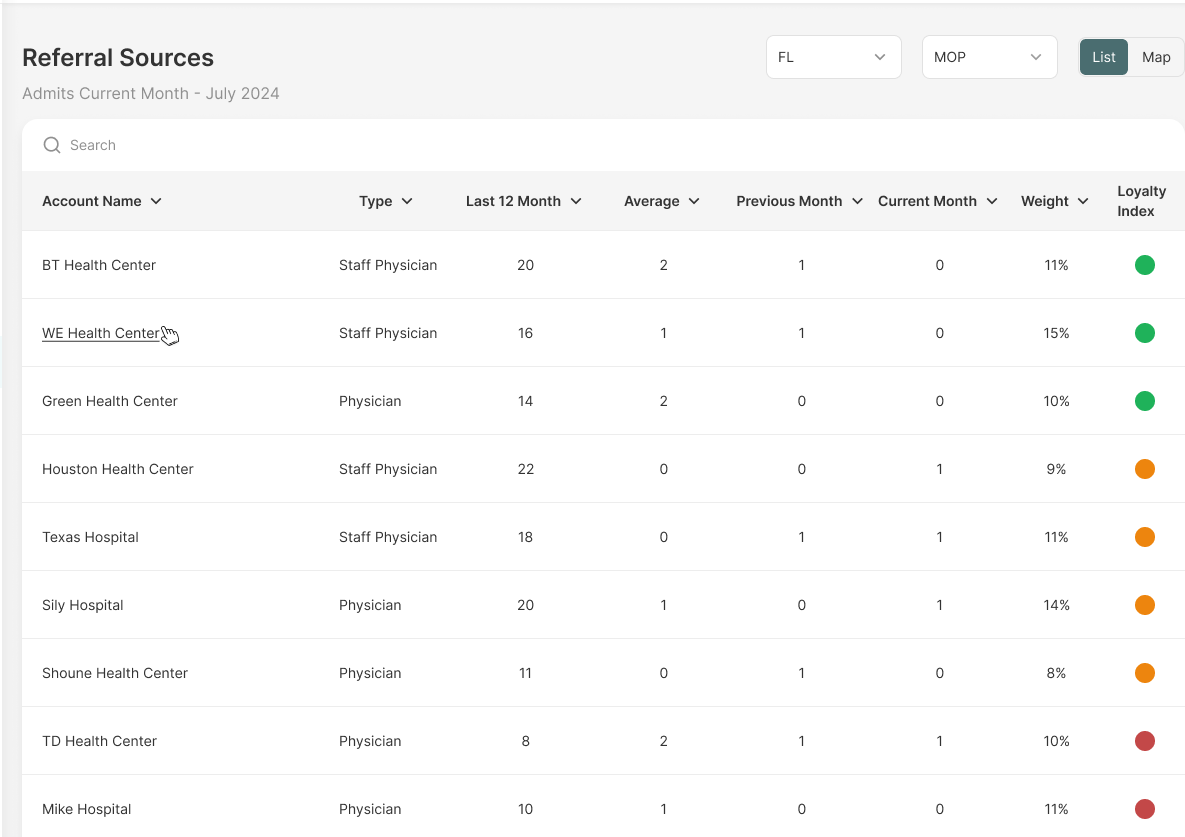
Care at Home agencies have no shortage of access to reports through various tech solutions. Hours worked and earnings from payroll reporting, average length of visit and number of patients per week from EMR and EVV reports, average daily census, employee turnover rate, and the list goes on. These reports are useful in telling us what is happening within our agency, with our staff, and with our partners. Once you have this information, what do you do with it? Does it tell you why your top clinician saw five fewer clients last week? Does it explain the decrease in referrals from area hospitals and physicians? Can the reports tell you whether the recent trends will continue? Why are these things happening in your agency? And what’s more, how do I fix them?

Give Your Home Health Agency a Much-Needed Tune-Up

Like the warning light on your dashboard, data is meaningless until it is diagnosed. That warning light that tells you your referral numbers dropped last week might indicate new competition in your area, a drop in confidence in your agency by hospitals and physicians, too many NTUCs on your scorecard, or simply a glitch in paperwork or your website. The data tells you the numbers have dropped. Skyra.ai tells you why.

Skyra AI Data Analytics

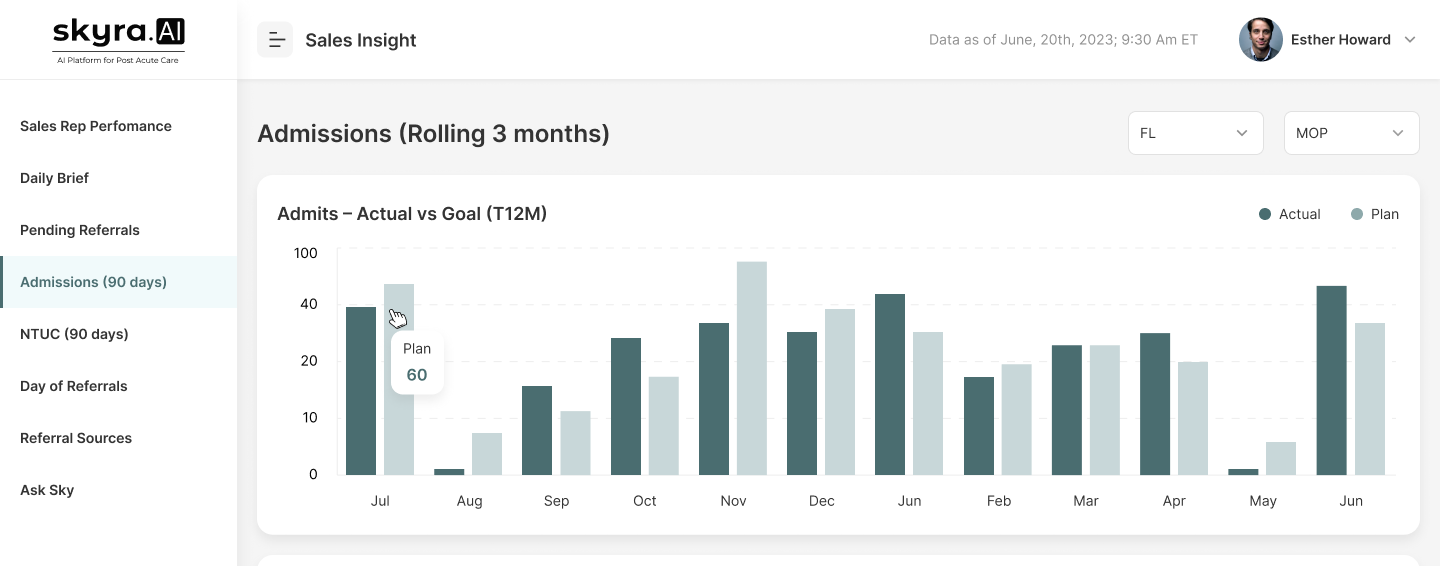
Skyra is a data analytics solution that connects to your EMR, payroll, accounts payable, scheduling, and quite literally almost any other piece of your tech stack that has useful data you want to see.

With a standard dashboard containing the most relevant and popular queries, and the ability to create custom insights, Skyra makes understanding the volumes of data collected simple and easy. Once you understand the “why” behind the numbers, you can make adjustments in your operating, scheduling, ordering, and operations to improve the overall health of your agency.

Features

  • Standard Dashboard
  • Insights for each Team (Sales, Executive, Clinical)
  • Two-Month Data Trends
  • Custom Insights Page
  • Pinned Query that refreshes itself daily
  • Understands multiple languages
  • Zero Percent Hallucination
  • HIPAA Compliant with multiple security layers applied vertically and horizontally
Skyra AI Data Analytics
  • “Ask Sky” – the Generative AI assistant you can tap into for custom insights into your agency
  • Compliance Monitor to avoid payment penalties by ensuring accuracy and timeliness of submissions
  • Control Tower for key metrics and alerts

Platform Agnostic

Data analytics is difficult enough without using multiple tech solutions. Even worse is when you’ve decided that a particular solution no longer works for your agency and you find yourself shopping for a new payroll, scheduling, or EMR solution. How do you preserve the years of data from your legacy systems without interruption?

Skyra.ai’s unique process stores all your data as though it comes from the same source, in the same language. Switching from solution to solution is a seamless process that keeps your data intact and reduces the opportunity cost of changing systems.

Future Plans

The team at Skyra is not content with one of the most advanced AI applications in the space. With a recently redesigned website, and new partners, Skyra is now looking to the future. Look for a two-way communication solution over a secured system with encrypted messages. The messaging system will connect caregivers to patients, patients to care teams, and caregivers, to care teams. The solution will reduce triage costs, reduce rehospitalizations rates, assist with marketing efforts, and increase CHAP scores. Skra Connect will launch sometime in 2025.

But, first, Skyra is focusing its development efforts on an application for sales teams and marketers. An alternative to a traditional CRM that requires large amounts of useless data input and doesn’t help close a deal, Skyra’s sales solution will provide a CRM solution that sales people actually want to use and will free up their time to spend on customer-facing activities. 

The Rowan Report will provide a separate review of each of these new products as they become available. 

Overall Impression

A Familiar Problem

Skyra.ai found Mickel tells a familiar story about the idea for his solution. Familiar, at least, to those of us who grew up in the 80s. When our favorite band released new songs, we ran to the nearest music retail store to buy a cassette tape. If your favorite song on the tape was track 3, you know the pains of fast forwarding and rewinding to get the tape to the perfect spot at the beginning of the song, only to have to do it all over again when the song ends. Today, we ask “Alexa” or “Siri” or “Google” to play our favorite song and it starts at exactly the right second every time. Mickel strove to make accessing and understand data as easy as asking Alexa to play your favorite song. Ask Sky removes the fast forward and rewind buttons and lets you understand your data faster. 

A Consolidated Solution

As a small business, and even as an individual, I know how many applications I have to log in to daily to see my business analytics and personal information. Skyra houses all of your business information in one place for easy access and provides an open-ended query so each agency gets the information they need most to help the agency operate at its fullest potential. The possibilities that will exist as the AI technology advances is near endless.

As we have mentioned before, there are a lot of misuses for artificial intelligence, and a lot of misunderstanding. Now, it seems, we have found at least one more company doing AI well.

# # #

Kristin Rowan, Editor

Kristin Rowan has been working at Healthcare at Home: The Rowan Report since 2008. She has a master’s degree in business administration and marketing and runs Girard Marketing Group, a multi-faceted boutique marketing firm specializing in event planning, sales, and marketing strategy. She has recently taken on the role of Editor of The Rowan Report and will add her voice to current Home Care topics as well as marketing tips for home care agencies. Connect with Kristin directly kristin@girardmarketinggroup.com or www.girardmarketinggroup.com

©2024 by The Rowan Report, Peoria, AZ. All rights reserved. This article originally appeared in Healthcare at Home: The Rowan Report. One copy may be printed for personal use: further reproduction by permission only. editor@therowanreport.com

Patient Relationships Drive Satisfaction

by Kristin Rowan, Editor

Caregiver Motivation

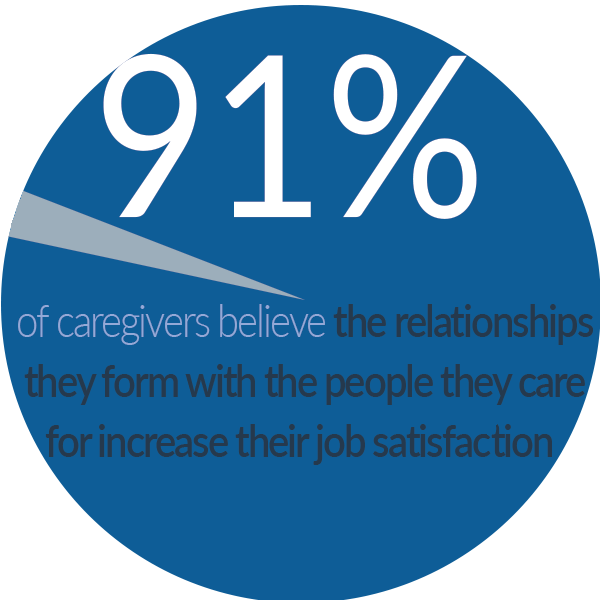
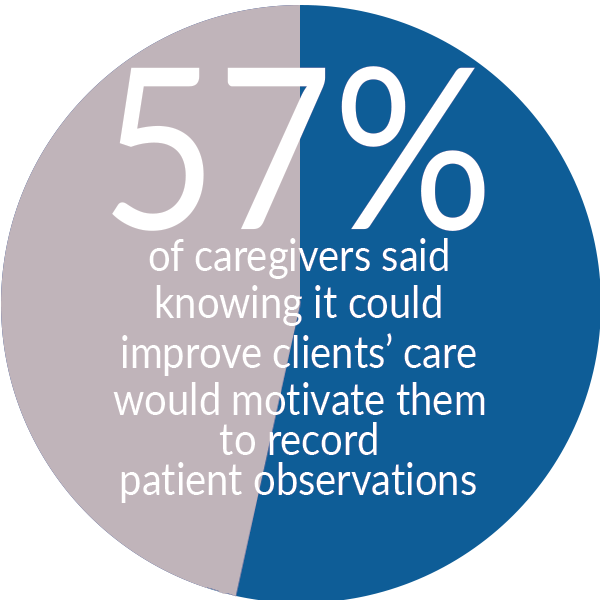
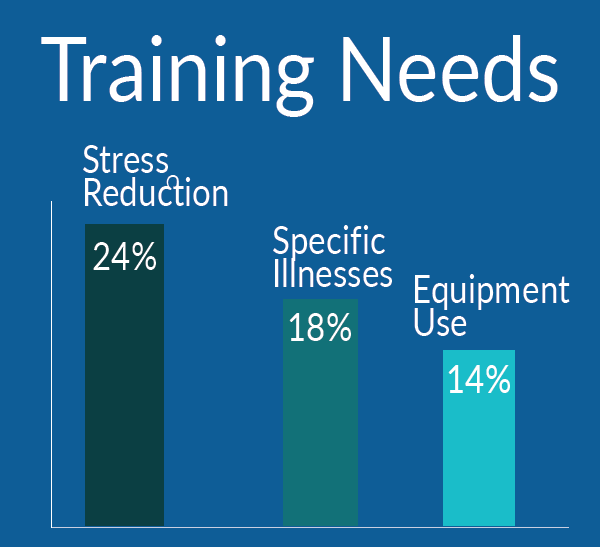
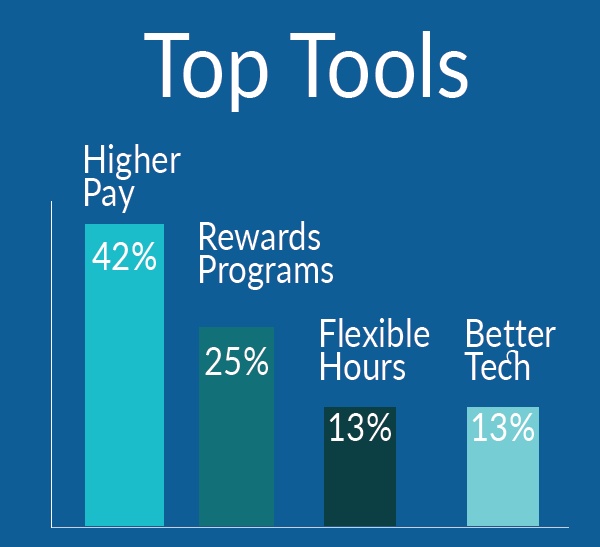
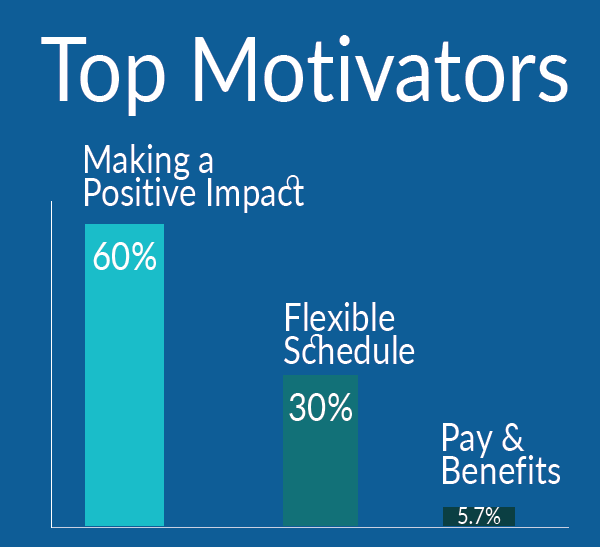
HHAeXchange recently conducted a survey of more than 3,900 caregivers. The company set out to understand caregiver motivation and to use this information to increase caregiver satisfaction and improve outcomes.

Highlights

This data highlights the motivations of caregivers to improving health and wellness for their patients

Caregiver Motivation Relationships
Caregiver Motivation client care
Caregiver Motivation Survey Training
Insights Survey Top Tools<br />
Insights Survey Top Motivators<br />

From HHAeXchange

While the challenges and demands of being a caregiver still remain – low compensation, feelings of stress and exhaustion, and risk of catching infectious diseases – this survey shows that caregivers remain committed to their work to improve the lives of their patients. As more individuals seek homecare options, the homecare industry must continue to evolve to ensure caregivers are given the resources and recognition they need to remain motivated and focused on patient care.

Stephen Vaccaro, President, HHAeXchange

For more details and information about the study, see the HHAeXchange press release.

Kristin Rowan, Editor

Kristin Rowan has been working at Healthcare at Home: The Rowan Report since 2008. She has a master’s degree in business administration and marketing and runs Girard Marketing Group, a multi-faceted boutique marketing firm specializing in event planning, sales, and marketing strategy. She has recently taken on the role of Editor of The Rowan Report and will add her voice to current Home Care topics as well as marketing tips for home care agencies. Connect with Kristin directly kristin@girardmarketinggroup.com or www.girardmarketinggroup.com

©2024 by The Rowan Report, Peoria, AZ. All rights reserved. This article originally appeared in Healthcare at Home: The Rowan Report. One copy may be printed for personal use: further reproduction by permission only. editor@therowanreport.com

NAHC NHPCO Town Hall

by Kristin Rowan, Editor

The Alliance

On June 18, 2024, the National Association for Home Care & Hospice (NAHC) and the National Hospice and Palliative Care Organization (NHPCO) announced they had met in Washington D.C. to formally sign an affiliation agreement between the two organizations. After 18 months of meetings, conversations, and compromises, the two groups announced their “Alliance” would be the leading authority of the care at home community.

Bill Dombi Ken Albert Town Hall Alliance

During the opening keynote address at the NAHC Financial Management Conference in July, Bill Dombi, President of NAHC and interim President of The Alliance, and Kenneth Albert, Chair of the Transition Board of Directors overseeing the merger, spoke about the progress they have made.

Albert spoke of the thoughtful consideration the board and members of both organizations have put into this change. They are focusing on the biggest concerns of home health and hospice providers both now and in the future. The unification will create one voice as they advocate for home health and hospice in Washington D.C.

New Leadership

Albert and Dombi shared the stage at the NAHC Financial Management Conference about the ongoing search for a CEO of the new organization. According to Albert, there were some candidates who were very excited about the role, but whom the board did not feel there was a great fit. Contrarily, there were candidates the board eagerly wanted to move forward with who declined to continue the process. According to Dombi, the search has gone outside care at home as they look for the right fit from qualified candidates from multiple industries. Both agreed that they felt the search was close to over and they should have an announcement about the new CEO, and possibly the new name, sometime in August of this year.

New Resources

The conjoined organization promises more than just new leadership. Currently under construction is a new logo and website to encompass both groups. Dombi alluded to new resources for providers, training for quality care, and other tools for the industry. While the organization’s name and leadership are forthcoming, the website is projected to launch sometime in the spring of 2025. 

Operating as One

Since the announcement of the merger last year, and even before the deal was inked, NAHC and NHPCO have already been integrating. Dombi told The Rowan Report in a previous interview that the two groups have already been lobbying together, working on policy together, and integrating the management of the two associations. 

The Last NHPCO Conference and the First Alliance Conference

September, 2024 marks the final standalone event for the NHPCO. The 2024 NHPCO Annual Leadership Conference runs September 16-18, with a pre-conference September 14-15 in Denver, CO. The conference will have on-demand access until December 31, 2024. NAHC members will receive member rates to the NHPCO conference. 

The “2024 Home Care and Hospice Conference and Expo” will be the last conference held solely by NAHC, but we are seeing quite a few hospice companies on the exhibitor list and expect this to be a sneak peek at future conferences. The national conference is scheduled for October 20-24, 2024 in Tampa, Florida. This will also mark the final conference for Bill Dombi as President. Dombi announced earlier this year that he will retire at the end of 2024.

NAHC NHPCO Alliance Town Hall

Town Hall

With quite a few remaining unanswered questions about the future of the two organizations, NAHC and NHPCO hosted a virtual Town Hall on July 31, 2024. With more than 250 association members from both groups in attendance, Bill Dombi and Ben Marcantonio, interim-CEO for NHPCO, along with Kenneth Albert and Melinda Gruber, Vice Chair of the Transition Board of Directors.

Naming "The Alliance"

Albert mentioned that there has been some success using the term Alliance, but it is not a long term solution. The finalization of the name is awaiting some trademark issues to be ironed out and that announcement, which they had hoped to be able to make in July, is coming soon.

CEO Search Update

Gruber thanked the search committee and recruiting firm for their work on the CEO search. Gruber reiterated that they are nearing the final selection phase and after board approval, an announcement will be made. 

Website

Ben Marcantonio, current interim CEO of NHPCO and future CIO of The Alliance confirmed that the new website will allow access to both legacy websites (the current NAHC and NHPCO websites). The new website will have a preliminary version this fall with a fully completed version next spring.

Members of either organization will have full access to the preliminary version of the website this fall. Currently, members can only access information from their own organization, but Marcantonio stressed that if there is information you need, they can help you access it.

Integration

There are eleven committees working together to integrate the two associations. advocacy, programs, education, and HR are a few of these workgroups that each have two to three high priority goals that will most effectively bring about the integration of the two groups. Work plans are now in place to create significant integration by the end of the calendar year. 

Policy and Advocacy

Bill Dombi presented an updated on the joint policy and advocacy issues The Alliance is undertaking. “What stands out for the immediate term has been how the resources have been employed of the two legacy organizations under the banner of The Alliance, focusing on hospice and palliative care,” Dombi said, “In a matter of weeks we saw significant regulatory and legislative action taking place.”

Hospice

The Hospice Final Rule 2025 has undergone an intense review and indepth analysis by members of both teams. The rule will have “tremendous impact” under the Medicare hospice program.

According to Dombi, the two organizations have come together to jointly fund a research project for the Special Focus Program to understand the impact and targeting. Dombi is hopeful that U.S. Representative Earl Blumenauer’s (D-OR) discussion draft will serve as a stepping stone for Hospice reform.

Home Health

The ongoing battle in Congress against CMS is gaining momentum. Dombi said there is a “tremendous amount of support” in Congress to role back the authority of CMS to institute rate changes and rate cuts under the Patient Driven Groupings Model (PDGM). “We have gained a seat at the table, which really helps,” Dombi said. We are continuing with litigation challenging Medicare’s validity of the regulation which has set all these rate cuts in motion.

Medicaid Home and Community-Based Services

The Final Rule modified in a positive way the 80/20 requirement. “We agree with the intentions of improving the status of direct care workers who positively impact so many lives. But in the absence of additional funding, it’s very very difficult to support this rule,” Dombi said. The modification stepped back from the more “draconian” interpretation, but The Alliance is not yet satisfied with the result. There is talk of a joint lawsuit challenging the validity of that rule.

Private Duty

The Private Duty Home Care world, one of the less regulated in the industry, is gaining a lot of attention from Fair Labor Standards as well as Non-Compete Laws. There is currently a joining of forces around solutions that will help Private Duty in the workforce arena, more specifically the Credit for Caring Act, which is gaining some traction, and would offer some financial support for family members who are paying for home care services directly.

The Alliance Needs You

Bill Dombi’s final statement in the Town Hall meeting centered on advocacy. He called for everyone who was in attendance and every member of both legacy organizations to join the fight. Everyone needs to part of that team of advocacy.

Final Thoughts

There is much more news to come out of these to associations as we near the end of 2024, and still more through the first quarter of 2025. The Rowan Report expects additional announcements to be made at both the NHPCO and NAHC annual conferences and we will be there to update everyone on the progress and statements coming out of those two meetings. 

# # #

Kristin Rowan, Editor

Kristin Rowan has been working at Healthcare at Home: The Rowan Report since 2008. She has a master’s degree in business administration and marketing and runs Girard Marketing Group, a multi-faceted boutique marketing firm specializing in event planning, sales, and marketing strategy. She has recently taken on the role of Editor of The Rowan Report and will add her voice to current Home Care topics as well as marketing tips for home care agencies. Connect with Kristin directly kristin@girardmarketinggroup.com or www.girardmarketinggroup.com

©2024 by The Rowan Report, Peoria, AZ. All rights reserved. This article originally appeared in Healthcare at Home: The Rowan Report. One copy may be printed for personal use: further reproduction by permission only. editor@therowanreport.com

2025 Hospice Final Rule

by Kristin Rowan, Editor

2025 Hospice Final Rule Update

On July 30, 2024, CMS issued its final rule for the 2025 Hospice Final Rule Update (CMS-1810-F), with updates to HQRP and HOPE. The rule also finalizes a proposal to change the statistical area delineations. This will impact the hospice wage index. The rule includes clarifications on the hospice election statement and notice of election as well as clarifying language around hospice admission and certification of terminal illness.

Wage Decrease for Some Hospices Assigned to a New Area

The change in area delineations will have a negative impact on some hospices. They will see a decrease in payments based on their new area. However, CMS emphasizes that, regardless of the area change, the maximum change is a 5% decrease from the 2024 wage index, as there is a 5% cap on any decrease to the wage index. 

2025 Hospice Final Rule Routine Annual Rate Setting Changes

Just one month after proposing additional deduction to the home health payment rate, the 2025 hospice final rule increases the base rate by 2.9%. This is an aggregate of a 3.4% inpatient hospital increase and a 0.5% productivity decrease. The quality data reporting requirement remains. Hospices that do not submit quality data would still see a 4% decrease in payment rates, yielding an aggregate 1.1% decrease. The payment update also includes an aggregate cap of $34,465.34 per individual per year.

Hospice Quality Reporting Program (HQRP)

The new rule includes two new process measures to HQRP:

    • Timely Follow-up for Pain Impact
    • Timely Follow-up for Non-Pain Symptom Impact 

These two measures are expected to begin in 2028 and address hopsice care delivery documentation on whether a follow-up visit occurred with 48 hours of the first assessment. The measures include visits where there was an impact of moderate to severe symptoms, both with and without pain.

Adoption and Implementation of HOPE

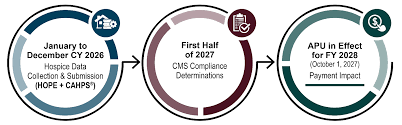
Hospice Outcomes and Patient Evaluation (HOPE) will replace the current Hospice Item Set (HIS) structure. The gradual roll-out will begin in FY 2025 and will collect data at different time points throughout a hospice stay. In contrast, HIS only collected data at admission and discharge.

New or expanded categories of HOPE relative to HIS include:

Hospice Payment Rule 2025

Changes to CAHPS Survey

CMS conducted an experiment in 2021 surrounding the Hospice CAHPS Survey. Based on those results, the final rule will implement these change to the survey:

    • The addition of a web-mail mode (email invitation to a web survey, with mail follow-up to non-responders).
    • A shortened and simplified survey.
    • Modifications to survey administration protocols to include a pre-notification letter and extension of the field period from 42 to 49 days.
    • The addition of a new, two-item Care Preferences measure.
    • Revisions to the existing Hospice Team Communication measure and the existing Getting Hospice Care Training measure.
    • The removal of three nursing home items and additional survey items impacted by other proposed changes in this rule.

Hospice Special Focus Program (SFP)

The SFP allows CMS to monitor those hospices that are identified as poor performers based on quality indicators from the CAHPS surveys. Additional oversight from CMS will “enable continuous improvement” for those hospices identified. The four measures used to determine poor performance are Help for Pain and Symptoms, Getting Timely Help, Willingness to Recommend this Hospice, and Overall Rating of this Hospice.

According to CMS, the final rule includes changes to the Overall Rating of this Hospice measure. CMS states that these changes are not substantive and will not impact the SFP algorithm. “CMS adjusts measure scores for mode of survey administrations, so the introduction of a new mode should not impact measure scores.” 

NAHC previously submitted comments to CMS stating that some aspects of the Hospice Special Focus Program are flawed and need to be adjusted for accuracy and fairness. NAHC/NHPCO has created a research project to understand the impact and validity of the Hospice Special Focus Program.

2025 Hospice Final Rule Conditions of Participation and Payment Requirements

There are language discrepancies in existing hospice requirements for medical director and physician designee, physician member, and payment requirements for the certification of the terminal illness and admission to hospice care. Therefore, CMS is making technical changes to the CoPs by adding the physician mmever of the hospice IDG as someone who can review technical information and provide certification of life expectancy. 

# # #

Kristin Rowan, Editor

Kristin Rowan has been working at Healthcare at Home: The Rowan Report since 2008. She has a master’s degree in business administration and marketing and runs Girard Marketing Group, a multi-faceted boutique marketing firm specializing in event planning, sales, and marketing strategy. She has recently taken on the role of Editor of The Rowan Report and will add her voice to current Home Care topics as well as marketing tips for home care agencies. Connect with Kristin directly kristin@girardmarketinggroup.com or www.girardmarketinggroup.com

©2024 by The Rowan Report, Peoria, AZ. All rights reserved. This article originally appeared in Healthcare at Home: The Rowan Report. One copy may be printed for personal use: further reproduction by permission only. editor@therowanreport.com

HHAeXchange: An Interview with Paul Joiner

by Kristin Rowan, Editor

Paul Joiner Talks to The Rowan Report

The care at home industry changes seemingly daily with new regulations, HH agencies opening and closing, more people qualifying for Medicare, technological advances like artificial intelligence, and the list goes on. Since 2008, HHAeXchange has been part of the change and growth of the industry. This week, The Rowan Report sat down with CEO Paul Joiner to discuss HHAeXchange’s recent changes, upcoming changes, and acquisitions. 

Cashé Software

On June 18, 2024, HHAeXchange announced the acquisition of Cashé Software, a Minnesota-based solution for homecare operations and billing. The merging of these two companies yields expanded ability to help homecare providers and billers with compliance, streamlined billing, and optimized workforce management.

Generations Homecare System

Just three weeks later, on July 8, 2024, HHAeXchange announced the acquisition of Generations Homecare System, an all-in-one homecare agency management software solution that connects care teams, simplifies daily tasks, and maintains compliance. This pairing aims to drive innovation and excellence in homecare.

Minnesota Office and Call Center

Ten days after the acquisition of Generations, HHAeXchange announced the opening of a new office and call center in Bloomington, MN. The office will offer localized, skilled agents to provide timely, efficient, and responsive customer support. This location will also be a home base for HHAeXchange employees who work remotely in the area and will provide job opportunities and growth in Bloomington.

Paul Joiner: On the Record

Paul Joiner became the CEO of HHAeXchange in March of 2023. Joiner came to HHAeXchange after serving as CEO in the substance abuse and mental health space. We sat down with Paul this week to talk about his position, the recent acquisitions, and future plans for HHAeXchange.

The Rowan Report:

HHAeXchange has gone through significant change and growth just in the last couple of months. Can you tell us about some of the plans you made for HHAeXchange?

Paul Joiner:

A lot of the growth was keyed up when I came on board. I just took it to the finish line. Implementing growth effectively required some changes. There is some pressure in this industry to evolve quickly.

RR:

What are some of the challenges you faced?

Joiner:

The current issues of recruiting, onboarding, retention, and training put a lot of pressure on technology solutions. And the pace of that change makes it harder for tech solutions to keep up.

Paul Joiner, CEO, HHAeXchange

Paul Joiner, CEO, HHAeXchange

XRR:

Did that drive the strategy behind your recent acquisitions?

Joiner:

Looking at strategy in the context of current challenges: finding people who understand the space and finding knowledge applied in technology is not easy to find or to develop organically. Then we find businesses like Cashé where we like the people, their position, their geography, and they have pieces that will help us build toward our vision of being the leader in Medicaid homecare and driving value and efficiency.

RR:

What does acquiring Cashé do for HHAeXchange?

Joiner:

Well…I can’t tell you, because it’s part of a strategy that comes with a bigger reveal. But I can tell you that acquiring Cashé is part of our technology lift. They have built a new technology with modern architecture. We will use that as a starting point to provide an additional offering in the marketplace. Cashé enables us to build faster, and innovate faster. While we continue to invest in HHAeXchange, Cashé gives us a head start on modern tech that can be added to our current offerings, or sold as a stand-alone solution.

RR:

And what about Generations?

Joiner:

Generations is a great business that has put business logic and rules into their technology. They also have a geographical presence where HHAeXchange does not.

RR:

How did this rapid growth of two acquisitions and a new call center impact HHAeXchange?

Joiner:

Taking on this much change created the need for improved communication across three organizations. That communication helped us provide a better narrative for Cashé and Generations employees who may have been a little nervous about the change.

RR:

You must have some really great teams in those three organizations to navigate these changes.

Joiner:

We have a great team. There are a lot of people we’ve brought on board in the last two years as we continue to grow along with the incredible team of people who have been at HHAeXchange much longer. We’re comfortable dealing with scale, size, and complexity, so the changes didn’t overwhelm us.

RR:

What does future growth look like for HHAeXchange?

Joiner:

We will probably continue to acquire companies. Maybe not multiple companies in a matter of weeks, but we will continue when the opportunity arises. The spirit behind our strategy is to focus on what our customers need. We are in a position in the market to have a big responsibility to be good stewards, help our customers, caregivers, and agencies, and improve the quality of life for patients.

HHAeXchange is focused on getting the right technology into the hands of caregivers. We’ve already done EVV and point-of-care well. Can we make a difference now in how they are onboarded and scheduled? Can we make a difference in billing and how they’re getting paid? That requires acquisitions and investing organically.

RR:

Any final remarks on what the future holds for HHAeXchange?

Joiner:

Part of our vision board is building a community of caregivers through technology. The good agencies are trying to figure out how to think as much about the caregiver as they do for the people receiving care. Turnover and training is so hard, so we need to invest in our caregivers.

We also need to be a better supplier of data to arm agencies and health plans with the data they need so they can have useful discussion around the date and how they’re supporting caregivers. I’m sad sometimes because agencies don’t get enough financial support for their effort. The industry can be doing more for their caregivers.

We take our responsibility to do the right thing seriously. Because of this, we are investing in the space and we want more options so we can be better for the industry. Our intention is to make a difference.

RR:

Thank you, Paul for talking with us today. 

About HHAeXchange

Founded in 2008, HHAeXchange is the leading technology platform for homecare and self-direction program management. Developed specifically for Medicaid home and community-based services (HCBS), HHAeXchange connects state agencies, managed care organizations, providers, and caregivers through its intuitive web-based platform, enabling unparalleled communication, transparency, efficiency, and compliance. For more information, visit hhaexchange.com or follow the company on TwitterLinkedIn and Facebook.

# # #

Kristin Rowan, Editor

Kristin Rowan has been working at Healthcare at Home: The Rowan Report since 2008. She has a master’s degree in business administration and marketing and runs Girard Marketing Group, a multi-faceted boutique marketing firm specializing in event planning, sales, and marketing strategy. She has recently taken on the role of Editor of The Rowan Report and will add her voice to current Home Care topics as well as marketing tips for home care agencies. Connect with Kristin directly kristin@girardmarketinggroup.com or www.girardmarketinggroup.com

©2024 by The Rowan Report, Peoria, AZ. All rights reserved. This article originally appeared in Healthcare at Home: The Rowan Report. One copy may be printed for personal use: further reproduction by permission only. editor@therowanreport.com