by Kristin Rowan | Feb 7, 2024 | Uncategorized
By Kristin Rowan, Editor
Last month, we published an article in partnership with Bob Roth of Cypress HomeCare Solutions in Scottsdale, AZ about paying for long-term care at home. Since then, I have come across some interesting information as we continue to tackle the issue of paying for care that is not reimbursed by the current Medicare/Medicaid system.
Medicare and Medicare Advantage have set pay rates for home health and hospice care. Home Health Value-Based Purchasing (HHVBP), implemented by CMS, was designed to incentivize agencies by paying more for quality care rather than a higher number of services provided. This is similar to giving advances and pay raises based on performance rather than longevity in a job, which I’m all for. However, the HHVBP overlooked palliative care altogether and neither the fee-for-service model nor the HHVBP model includes supportive (read private duty) care at home. Since these services are not reimbursed, there is no incentive to provide them nor way to get paid for them if the patient cannot pay out-of-pocket.
This causes two problems:
1. Home Health and Hospice Agencies are reluctant to provide unreimbursed care, with good reason, so the overall patient experience is less than ideal, rehospitalization rates increase, star-ratings and scores decrease, bonuses go away, and the agencies make less money than before.
2. Patients can’t get the care they need and want. Palliative care patients may receive Hospice care too early, or they may not receive care at all because they fall between home health and hospice. Patients who need supportive care at home can’t afford it so they either go without, causing increased complications or they rely on friends and family members who burn out under the stress of being a full-time caregiver.
Innovative care strategies can overcome the obstacles faced by agencies and patients alike. There may not yet be a perfect solution, but there are some innovative ideas out there and something has to disrupt the current pay model.
Palliative Care Partners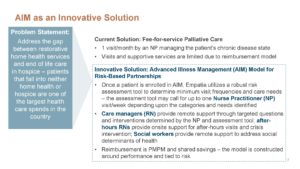
Medicare Advantage organizations and primary physician groups receive a “cost of care” analysis for the duration of the patient care. The organization takes on the risk of that patient costing more than what the MA plan will pay, but can make more money if patient care costs less than anticipated. Palliative care at home costs less. David Causby, President and CEO of Gentiva, a Hospice organization that operates in 35 states across the U.S. and has an average daily census of 26,000, has implemented a plan of care in cooperation with these organizations in what he calls Advanced Illness Management (AIM) Model for Risk-Based Partnerships. Designed for palliative care, Gentiva creates a plan of care that includes visit frequency and care needs and employs nurse practitioners, care managers, after hours RNs and social workers. The hospital pays Gentiva on a PMPM model with shared savings. The hospital still gets paid the full amount from MA but uses fewer resources, has lower costs, and sees reduced rehospitalizations, saving more than what they pay out. According to Gentiva, this partnership “provides value to contracted organizations by decreasing the overall end-of-life spend on this high-risk patient population.”
Supportive Care at Home Innovations
Supportive Care at Home (Private Duty Home Care, Private Pay, Non-medical home care) is not covered by Medicare, Medicare Advantage, or most health insurance plans. Limited Medicaid grants, VA plans, and long-term health insurance pay for some supportive care at home. Without one of these plans, patients and family members pay out-of-pocket for supportive care at home, averaging $22-$27 per hour with a 4-hour minimum. In some states it can cost up to $50 per hour. At $80 per day, that’s around $20,000 per year.
One software company we recently spoke with is upending the home care model with fee-for-service model that charges by the minute, rather than by the hour, making care more affordable for more people. You can see our product review of Caring on Demand here. By reducing the cost for customers and reducing the time for caregivers, agencies can onboard more customers without hiring more caregivers. The system is being used in facilities where these services are not provided, which allows a caregiver to visit several people in one stop. The agency and the caregiver can see the same income in the same time, spread out across multiple private payers.
Combining Innovation for a Win-Win-Win
I heard about Caring on Demand and spoke with its founder in August of 2023. I spoke with one Home Care agency owner who recently started working with Caring on Demand. “Times have changed,” the agency owner said. With fewer caregivers joining the workforce, increased levels of burnout since 2020, and CMS changes that overlook palliative and non-medical care, maybe there’s another way…
- Partnerships with organizations and physician groups that have Medicare, MA, and traditional health insurance patients, non-medical home care agencies, and palliative care providers.
- Localized groups of patients in limited areas like retirement villages, planned communities, neighborhoods, or small towns.
- Cost sharing and care coordination that includes in-home palliative care visits, supportive care, communication with primary care providers and specialists
- Preventative intercessions to avoid unnecessary ER visits and hospitalizations
- Shorter visits per caregiver with multiple visits to a community each day
- Cost sharing among patients splitting a 4-hour minimum visit among 4-8 patients
- Shared savings from reduced hospital stays, shorter durations of hospice care, and nursing visits that are supplemented by supportive care
Gentiva has experienced some success already in using shared savings as a payment model. Can costs be decreased even more by adding supportive home care to this plan? Is there enough shared savings for three payees instead of two? I don’t have the answers to these questions, but I do believe providers of supportive care and palliative care have been in the background, overlooked by CMS and MedPAC for long enough. If they aren’t going to recognize the positive impact and cost savings of home care and palliative care and include them in the reimbursement model, we may have to do it for them.
We’d love to hear your feedback on this and other innovative ways to combat the crisis of paying for care at home.
# # #
Kristin Rowan has been working at Healthcare at Home: The Rowan Report since 2008. She has a master’s degree in business administration and marketing and runs Girard Marketing Group, a multi-faceted boutique marketing firm specializing in event planning, sales, and marketing strategy. She has recently taken on the role of Editor of The Rowan Report and will add her voice to current Home Care topics as well as marketing tips for home care agencies. Connect with Kristin directly kristin@girardmarketinggroup.com or www.girardmarketinggroup.com
©2024 by The Rowan Report, Peoria, AZ. All rights reserved. This article originally appeared in Healthcare at Home: The Rowan Report.homecaretechreport.com One copy may be printed for personal use: further reproduction by permission only. editor@homecaretechreport.com
by Kristin Rowan | Feb 7, 2024 | Regulatory
by Kristin Rowan, Editor,
On Wednesday, January 31, Cigna and HCSC signed an agreement to sell all of Cigna’s Medicare business — including traditional Medicare, supplemental benefits, Medicare Part D offerings, and CareAllies, a value-based care management subsidiary. — to HCSC, a Blue Cross / Blue Shield partner with operations in Illinois, Texas, New Mexico, Oklahoma and Montana. The $3.3 billion deal will quadruple the size of HCSC’s Medicare Advantage population, which numbered 217,623 as of this month.
Medicare Advantage had not been a significant business for Cigna. CEO David Cordani explained that it required resources disproportionate to its size in the company. With 19 million insurance customers, Cigna had a little over a half million in its MA business, a little under a half million Medicare supplement members, and 2.5 million in Part D.
It had previously been reported that Cigna believed divesting its Medicare business would make its merger with Humana more acceptable to regulators. The company completed its HCSC deal even though negotiations with Humana had already broken down. Though inked today, the deal is not expected to close until the first quarter of 2025.
# # #
 Kristin Rowan has been working at Healthcare at Home: The Rowan Report since 2008. She has a master’s degree in business administration and marketing and runs Girard Marketing Group, a multi-faceted boutique marketing firm specializing in event planning, sales, and marketing strategy. She has recently taken on the role of Editor of The Rowan Report and will add her voice to current Home Care topics as well as marketing tips for home care agencies. Connect with Kristin directly kristin@girardmarketinggroup.com or www.girardmarketinggroup.com
©2024 by The Rowan Report, Peoria, AZ. All rights reserved. This article originally appeared in Healthcare at Home: The Rowan Report.homecaretechreport.com One copy may be printed for personal use: further reproduction by permission only. editor@homecaretechreport.com
by Kristin Rowan | Jan 31, 2024 | Clinical
By Kristin Rowan, Editor
The National Association for Home Care and Hospice joined other advocacy groups this month on Capitol Hill to fight against the looming pay cuts from CMS. Some members of Congress joined the fight for “common sense policies” to expand access to care in the home for Americans.
Rep. Adrian Smith (R-NE-3), who spoke at the event, decried moves against home health, saying “there are cuts looming that are not based on reality” and “we want to make sure reimbursement policies are reflective of the actual realities.” Smith is also the representative who introduce the “Homecare for Seniors Act,” H.R. 1795, which would allow the use of Health Savings Accounts (HSAs) to be used for home care.
Rep. Terri Sewell (D-AL-7) has a personal connection to home care and spoke about how her mother cared for her father through a series of strokes he suffered. She expressed strong opinions about payment reductions that could see home health lose as much as $20 billion dollars over the next ten years. Sewell called the idea “frightening” and said, “I am a big fan of making sure that my constituents have access to quality, affordable health care.”
The Medicare program has admitted that home health is not just a bringing of great care and not just a more cost effective way to provide care, but is a service that provides dynamic value. Care in the home has decreased overall costs by $3.2 billion dollars just in the small segment of value-based payment model test cases. Patients who receive care in the home are re-admitted to the hospital 37% less frequently than those who do not and are 43% less likely to die than patients who do not receive care at home. Still, CMS is looking at additional pay cuts which bring the total payment reduction down 13.72% since 2019. The costs of everything else have increased in that time. According to the U.S. Bureau of Labor and Statistics, the average cost of living has increased 22% since 2019. NAHC President Bill Dombi said, “Where we’re headed in 2024 is that half of all home health agencies will be operating in the red with the cuts facing them in the Medicare program. It’s not a recipe for continued access to care.”
Dombi, along with many others, is predicting that 50 percent of agencies will be operating in the red after the next round of payment reductions and that without a reversal of these pay cuts we could see the end of care at home altogether with a collapse of the home health payment system.
The advocacy event on Capitol Hill helped raise awareness of the plight of care at home among some policymakers, but more help and advocacy is needed. Please, take a few minutes to click the link below and tell your members of Congress to support the Preserving Access to Home Health Act of 2023.
# # #
Kristin Rowan has been working at Healthcare at Home: The Rowan Report since 2008. She has a master’s degree in business administration and marketing and runs Girard Marketing Group, a multi-faceted boutique marketing firm specializing in event planning, sales, and marketing strategy. She has recently taken on the role of Editor of The Rowan Report and will add her voice to current Home Care topics as well as marketing tips for home care agencies. Connect with Kristin directly kristin@girardmarketinggroup.com or www.girardmarketinggroup.com
©2024 by The Rowan Report, Peoria, AZ. All rights reserved. This article originally appeared in Healthcare at Home: The Rowan Report. One copy may be printed for personal use: further reproduction by permission only. editor@therowanreport.com
- Please GO HERE to tell your members of Congress to support the Preserving Access to Home Health Act of 2023
by Kristin Rowan | Jan 31, 2024 | Admin, CMS, Regulatory
By Kristin Rowan, Editor
The National Association for Home Care and Hospice joined other advocacy groups this month on Capitol Hill to fight against the looming pay cuts from CMS. Some members of Congress joined the fight for “common sense policies” to expand access to care in the home for Americans.
Rep. Adrian Smith (R-NE-3), who spoke at the event, decried moves against home health, saying “there are cuts looming that are not based on reality” and “we want to make sure reimbursement policies are reflective of the actual realities.” Smith is also the representative who introduce the “Homecare for Seniors Act,” H.R. 1795, which would allow the use of Health Savings Accounts (HSAs) to be used for home care.
Rep. Terri Sewell (D-AL-7) has a personal connection to home care and spoke about how her mother cared for her father through a series of strokes he suffered. She expressed strong opinions about payment reductions that could see home health lose as much as $20 billion dollars over the next ten years. Sewell called the idea “frightening” and said, “I am a big fan of making sure that my constituents have access to quality, affordable health care.”
The Medicare program has admitted that home health is not just a bringing of great care and not just a more cost effective way to provide care, but is a service that provides dynamic value. Care in the home has decreased overall costs by $3.2 billion dollars just in the small segment of value-based payment model test cases. Patients who receive care in the home are re-admitted to the hospital 37% less frequently than those who do not and are 43% less likely to die than patients who do not receive care at home. Still, CMS is looking at additional pay cuts which bring the total payment reduction down 13.72% since 2019. The costs of everything else have increased in that time. According to the U.S. Bureau of Labor and Statistics, the average cost of living has increased 22% since 2019. NAHC President Bill Dombi said, “Where we’re headed in 2024 is that half of all home health agencies will be operating in the red with the cuts facing them in the Medicare program. It’s not a recipe for continued access to care.”
Dombi, along with many others, is predicting that 50 percent of agencies will be operating in the red after the next round of payment reductions and that without a reversal of these pay cuts we could see the end of care at home altogether with a collapse of the home health payment system.
The advocacy event on Capitol Hill helped raise awareness of the plight of care at home among some policymakers, but more help and advocacy is needed. Please, take a few minutes to click the link below and tell your members of Congress to support the Preserving Access to Home Health Act of 2023.
# # #
Kristin Rowan has been working at Healthcare at Home: The Rowan Report since 2008. She has a master’s degree in business administration and marketing and runs Girard Marketing Group, a multi-faceted boutique marketing firm specializing in event planning, sales, and marketing strategy. She has recently taken on the role of Editor of The Rowan Report and will add her voice to current Home Care topics as well as marketing tips for home care agencies. Connect with Kristin directly kristin@girardmarketinggroup.com or www.girardmarketinggroup.com
©2024 by The Rowan Report, Peoria, AZ. All rights reserved. This article originally appeared in Healthcare at Home: The Rowan Report.homecaretechreport.com One copy may be printed for personal use: further reproduction by permission only. editor@homecaretechreport.com
Please GO HERE to tell your members of Congress to support the Preserving Access to Home Health Act of 2023
by Kristin Rowan | Jan 24, 2024 | Clinical, Regulatory, Vendor Watch
The Arizona Healthcare Cost Containment System (AHCCCS American Rescue Plan (ARP) Program has awarded a grant to a collaborative group of care providers, solutions providers, and educators. On January 18th, Arizona home care agency Cypress HomeCare Solutions announced they have been selected at the recipient of this program award along with solutions provider PocketRN and educator Nevvon. As a team, they will implement services that improve client and provider experiences while also creating health system savings.
Last week, we spoke with PocketRN CEO Jenna Morganstern-Gaines. “Nevvon and PocketRN are working with Cypress to implement [the use of] PocketRN by Cypress’s caregivers to study cost of care, experience for clients, families, and the care team, and outcomes,” explained Morganstern-Gaines. She further explained that part of the requirements of the grant is to issue quarterly reports and a final evaluation of the program after one year. They are currently through the first phase of the study, which was to onboard patients, families, and caregivers.
PocketRN is a telehealth platform that engages in “whole person clinical care.” It is a flexible, virtual nursing and clinical service application that wraps clinical care around non-medical care in the home. The use a proactive approach by assigning a virtual nurse to each patient who continues to check in with the patient and the family to provide coaching and assistance and to help coordinate care.
“There’s a real reason we use the phrase ‘nurse you back to health’ and not ‘doctor you back to health’. The person that will help follow through is the nurse and PocketRN provides you a one-to-one relationship with a nurse that will follow through with all of your care providers to ensure that you are ‘nursed’ back to health.”
CEO, PocketRN
We will be following this ongoing study and providing updates from the reports we receive.
Kristin Rowan has been working at The Rowan Report since 2008. She is the owner and Editor-in-chief of The Rowan Report, the industry’s most trusted source for care at home news .She also has a master’s degree in business administration and marketing and runs Girard Marketing Group, a multi-faceted boutique marketing firm specializing in content creation, social media management, and event marketing. Connect with Kristin directly kristin@girardmarketinggroup.com or www.girardmarketinggroup.com
©2025 by The Rowan Report, Peoria, AZ. All rights reserved. This article originally appeared in The Rowan Report. One copy may be printed for personal use: further reproduction by permission only. editor@therowanreport.com
by Kristin Rowan | Jan 17, 2024 | Admin, Clinical
with Bob Roth, Managing Partner at Cypress HomeCare Solutions
Saving for Long-term Care Starts in High School
What is the primary focus for an 18-year-old? Graduating high school, getting into the college or career training program of their choice, their first apartment, perhaps their first car, and their first adult job are things that come to mind. As the parent of a 20-year-old and a 16-year-old, I can attest to most of these and have encouraged both my kids to plan for them. Of course, the 18-year-olds might tell you they are focusing on spending time with friends, travelling, having fun, “finding” themselves, discovering their passion, and learning how to adult. These are all important as well. I’m sure there are other items you would add to these lists. But, how many of you would put long-term care on that list? How many of you were planning for private pay personal care services when you were 18? I’d guess not many of you.
Bob Roth, Managing Partner at Cypress HomeCare Solutions knows all too well that so many families are ill-prepared for long-term care needs for themselves and their families. In his recent article, “The aging dilemma: Long-term care”, which originally appeared in Jewish News, Roth says we should start planning for long-term care when we graduate high school. Not knowing how to provide and, especially, afford this kind of care is something Bob has seen countless times in his more than 20 years in the industry.
Long-term care can be a critical part of the health care spectrum as we age and long-term care insurance alone in the United States is inadequate. According to Roth, this stark reality prompts a crucial conversation on the state of continuing care here and around the globe. The costs of long-term care are up, the need for quality care threatens economic fallout, and the current models are unsustainable.
According to a recent study from the Joint Center for Housing Studies of Harvard University, most older adults are unable to afford in-home or assisted living care. The number of older adults continues to rise, as does the number of cost-burdened older adults. Cost-burdened older adults pay 30 percent or more of their total household income for housing. When you add in the costs for food, transportation, medicine, etc., there is nothing left for in-home care.1
Neither Bob nor I have answers or solutions to this problem. For many years, we’ve talked about the continuity of care across hospitals, doctors, home health, and home care. (Read our article this week on the patient data exchange network.) Perhaps a trusted exchange framework that includes personal care might one day lead to insurance coverage. In the meantime, we are looking for alternative solutions to the widening gap between people who need in-home care and people who can afford it.
Kristin Rowan has been working at Healthcare at Home: The Rowan Report since 2008. She has a master’s degree in business administration and marketing and runs Girard Marketing Group, a multi-faceted boutique marketing firm specializing in event planning, sales, and marketing strategy. She has recently taken on the role of Editor of The Rowan Report and will add her voice to current Home Care topics as well as marketing tips for home care agencies. Connect with Kristin directly kristin@girardmarketinggroup.com or www.girardmarketinggroup.com
©2024 by The Rowan Report, Peoria, AZ. All rights reserved. This article originally appeared in Healthcare at Home: The Rowan Report. One copy may be printed for personal use: further reproduction by permission only. editor@therowanreport.com
Bob Roth is Managing Partner of Cypress HomeCare Solutions. Bob assisted in creating Cypress HomeCare Solutions with his family in 1994. With nearly 36 years of consumer products, health care and technology experience, Bob has successfully brought the depth and breadth of his experience to the home care trade and in doing so, Cypress HomeCare Solutions has been honored to receive a number of awards over the years.
He is a well-respected and knowledgeable member of our community.
1. Harvard (2023) Housing America’s Older Adults Key Facts chrome-extension://efaidnbmnnnibpcajpcglclefindmkaj/https://www.jchs.harvard.edu/sites/default/files/interactive-item/files/Harvard_JCHS_Housing_Americas_Older_Adults_2023_Key_Facts.pdf
by Kristin Rowan | Dec 13, 2023 | CMS, Regulatory
by Kristin Rowan, Editor
Last week, MedPAC met for their December meeting to discuss “Assessing payment adequacy and updating payments.” Hospice services and Home health care services were each presented separately to Congress and commissioners are set to review the key indicators and discuss updates to Medicare payment rates for 2024.
The findings presented to Congress gave me whiplash.
Hospice Services
- There is ‘mixed evidence’ on whether hospice reduces Medicare expenditures, but is has important benefits for beneficiaries
- 2021 saw a 6% increase in hospices, mostly in for-profit agencies
- Hospice use rates are down overall, but MedPAC blames the effects of the pandemic on death rates and patterns of care
- Hospice use continues to shift from SNFs to in-home care
- In 2020, 18.6% of hospices exceeded the payment cap
- MedPAC recommends the cap be wage adjusted and reduced by 20%
See the full Hospice Services presentation to Congress here.
Opinion
Of the 18.6% of hospices that exceeded the payment cap in 2020, 17.2% of those were also in the highest bracket of hospice providers with stays longer than 180 days. The payment cap is not enough to cover patients who need hospice care for longer time periods, even though the requirement for hospice care is expected death within 6 months. If hospice is intended to care for a patient for 180 days, shouldn’t the payment cap be equal to 180 days of care? If a hospice provider is caring for a patient for longer, shouldn’t they get paid more?
MedPAC is convinced that lowering the cap would only impact those hospice providers who have the longest stays. However, if those hospices can no longer provide care because the payment cap has been reached, it will fall to other providers to continue care, stretching the already overworked hospice nurses even thinner.
Home Health Care Services
- The Bipartisan Budget Act (BBA) of 2018 prompted CMS to implement PDGM and required MedPAC to review PDGM in its first year of operation
- BBA 2018 changes must be budget neutral
- CMS issued a $2 billion one-time reduction for overages and a 3.925 percent permanent reduction
- The decline in the number of Home Health Agencies continues
- The number of FFS beneficiaries declined, but the per capita use of HHS increased
- The median Medicare margin (profit) for efficient providers is 28.4 percent, but only 14% of HHAs met cost and quality criteria
- The median Medicare margin indicates Medicare payments are too high
Opinion
This makes about as much sense as the new phenomenon “dog math.” 14% of all Home Health Care agencies are considered efficient. On average, those who are efficient have a 28% Medicare profit margin. Among 133 industries reporting gross profit margins across the U.S., a 28% profit margin puts Home Care Agencies at number 104 out of 133, much lower than the average or median profit margins of every other industry.1 The all-payer margin is about 12%, making them the second least profitable industry in the U.S., coming in only slightly higher than auto manufacturers. The smallest HHAs have a profit margin just under 6%. MedPAC’s stance seems to be that if an HHA is making enough money to barely survive, they are making too much money.
See the full Home Health Care Agency presentation to Congress here.
©2023 by Rowan Consulting Associates, Inc., Colorado Springs, CO. All rights reserved. This article originally appeared in Home Care Technology: The Rowan Report. homecaretechreport.com One copy may be printed for personal use; further reproduction by permission only. editor@homecaretechreport.com
by Kristin Rowan | Nov 8, 2023 | CMS, Regulatory
By Kristin Rowan, Editor
On November 1, CMS issued its Home Health Final Rule for CY 2024. As expected, the final rule includes drastic pay cuts to Medicare home health services payments. The original proposed rule issued earlier this year included a 5.653% rate reduction, the remainder of the 7.85% reduction from 2020-2021 and an additional 1.636% for 2022, for a total rate reduction of 9.36% overall from the start of PDGM. In a surprising turn, CMS has not implemented the full 5.779% rate cut from the initial proposal, opting instead to introduce the rate cuts over two years. The 2024 rate cut will be 2.890%, half of the full adjustment CMS alleges is still needed. The CMS final rule does not attempt to collect any of the alleged overpayments from 2020-2022, totaling $3,439,284,729.00.
NAHC President Bill Dombi offered this response:
“We continue to strenuously disagree with CMS’s rate setting actions, including the budget neutrality methodology that CMS employed to arrive at the rate adjustments. We recognize that CMS has reduced the proposed 2024 rate cut. However, overall spending on Medicare home health is down, 500,000 fewer patients are receiving care annually since 2018, patient referrals are being rejected more than 50% of the time because providers cannot afford to provide the care needed within the payment rates, and providers have closed their doors or restricted service territory to reduce care costs. If the payment rate was truly excessive, we would not see these actions occurring. The fatally flawed payment methodology that CMS continues to insist on applying is having a direct and permanent effect on access to care. When you add in the impact of shortchanging home health agencies on an accurate cost inflation update of 5.2% over the last two years, the loss of care access is natural and foreseeable.
We now implore Congress to correct what CMS has done and prevent the impending harm to the millions of highly vulnerable home health patients that depend and will depend in the future on this essential Medicare benefit. Fortunately, longstanding advocates for home health care, Senator Debbie Stabenow (D-MI) and Senator Susan Collins (R-ME) have introduced S. 2137 to eliminate the rate cuts. We urge the Congress to support this legislation and enact it into law before the end of the year. The 2024 rate cuts must not take effect.”
The final rule includes the following:
- A net 3.0% inflation update
- A 2.890% Budget Neutrality permanent adjustment
- A $3,489,523,364 alleged overpayment in 2020-2022. CMS has not scheduled a collection of the alleged overpayment in 2024 or any other year yet.
- Recalibration of the 432 case mix weights with a separate budget neutrality adjustment in the payment rates of +1.0124%
- CMS estimates an increase in CY2024 Medicare spending of $140 million ($525 million inflation increase minus the $455 million rate adjustment plus a $70 million outlier FDL change)
HHAs that fail to provide required quality data will have these rates reduced by two percent.
Non-payment-related changes
In addition to the inflation increase and payment adjustments, the CMS Final Rule includes a number of other changes. These changes include amendments for the payment of Disposable Negative Pressure Wound Therapy, removing and replacing OASIS measures in HHVBP, new coverages and payments in IVIG services, the adoption of two new measures and the removal of one existing measure in HHQRP, coverage for lymphedema therapy items under a new Medicare Part B benefit, and revisions to Medicare provider enrollment requirements.
Hospice Provisions
Hospice Special Focus Program (SFP)
CMS is pushing forward with the Hospice SFP. Despite the commonsense suggested changes requested by NAHC and multiple others, CMS is using a flawed algorithm in the structure and implementation of SFP. This flawed algorithm will fail to identify hospices most appropriate for additional oversight and support. This creates the risk of reducing access to higher quality care and directing patients and families to hospices that perform most poorly relative to health and safety requirements. The official stance from NAHC is strong support of the SFPs goal to improve poor performing hospices, but are emphatically against the method in which SFP is being implemented and will continue to advocate for changes to the structure of the program.
Hospice Informal Dispute Resolution (IDR)
The IDR process for hospice is for condition-level survey findings which may trigger an enforcement action. The finalized IDR process allows hospice programs an opportunity to resolve disputes during recertification or reaccreditation for continued participation in Medicare. this allows for settlement agreement prior to a formal hearing, which will save time and money for the hospice agency. NAHC has additional recommendations for the Hospice IDR process that have not been implemented in the final rule.
Hospice 36-month rule
CMS is extending the “36-month” rule that currently applies to home health agencies and hospices, which is designed to prevent the flipping of Medicare certifications to non-vetted hospice owners. There are several exceptions to the rule for hospices. Even if a hospice undergoes a CIMO, a new owner must enroll as a new hospice and undergo a survey or accreditation unless:
- The hospice submitted 2 consecutive years of full cost reports since initial enrollment or the last CIMO, whichever is later.
- A hospice’s parent company is undergoing an internal corporate restructuring, such as a merger or consolidation.
- The owners of an existing HHA are changing the hospice’s existing business structure (for example, from a corporation to a partnership (general or limited)), and the owners remain the same.
- An individual owner of an hospice dies
New hospice owners will immediately be placed into the “high-risk” category for screening requirements and will have to submit fingerprints for a national background check from all owners with a 5% or greater direct or indirect ownership interest.
CMS Final Rule Synopsis and NAHC Response
We reached out to NAHC President Bill Dombi after the release of the Final Rule for CY2024. He provided us with a full breakdown of each provision in the final rule and the NAHC stance on each topic.
You can read all of these changes and how NAHC will continue to advocate for changes to the final rule here.
# # #
Kristin Rowan has been working at Healthcare at Home: The Rowan Report since 2008. She has a master’s degree in business administration and marketing and runs Girard Marketing Group, a multi-faceted boutique marketing firm specializing in event planning, sales, and marketing strategy. She has recently started writing for The Rowan Report and will add her voice to current Home Care topics as well as marketing tips for home care agencies. Connect with Kristin directly kristin@girardmarketinggroup.com or www.girardmarketinggroup.com
©2023 by The Rowan Report, Peoria, AZ. All rights reserved. This article originally appeared in Healthcare at Home: The Rowan Report. homecaretechreport.com One copy may be printed for personal use: further reproduction by permission only.
editor@homecaretechreport.com
by Kristin Rowan | Oct 25, 2023 | Admin, Regulatory
by Kristin Rowan, Editor
Marking a significant victory for the HCAOA Connecticut Chapter and the home care industry, in the legislative session that ended last week, lawmakers unanimously passed a bill to reverse the policy guidance issued by the Department of Consumer Protection in January that banned use of the word “care” by home care agencies. In response to the guidance that directly harmed the industry, the Chapter and its members engaged in a strong lobbying effort to reverse it.
The guidance had caused significant concern and confusion for agencies, caregivers, consumers and lawmakers. Indeed, the Department had recently begun enforcing the ban against HCAs, requiring them to remove the word “care” from websites and other advertising.
On June 2, the state Senate gave final legislative approval to House Bill 5781, which allows HCAs to use the word “care” in their business names and advertising and advertise having employees trained to provide services to individuals experiencing memory difficulties as long as the agency prominently advertises that it solely provides nonmedical care, and doesn’t use any words, such as those related to medical or health care licensure or services, to describe services beyond the scope of those a HCA is authorized to provide. Also, HCAs must give consumers written notice that the agency provides nonmedical care and obtain the consumer’s signature on the notice before providing services. The Governor is expected to sign Public Act 23-48 shortly.
Chapter leaders and many members testified in support of the legislation, contacted the Governor and met with lawmakers and other officials, engaged in grass roots support, and advocated for the change. “It was a significant effort by the Chapter but our strategy and the work of members paid off,” said Marlene Chickerella, Chapter Chair and owner of B&M Homemaking Services in West Haven. “We are very grateful to lawmakers for changing the policy and appreciate all the support and assistance of our member-home care agency owners. They stepped up and clearly made a difference.”
Additionally, House Bill 5781, which originally arose out of the Homemaker-Companion Task Force recommendations:
• Requires the Office of Policy and Management to develop a plan and proposed timeline to transfer oversight of HCAs from Consumer Protection to the Department of Public Health; the plan will include recommendations on training standards and appropriate use of the term “care” to describe home care services.
• Adds failure to give a consumer written notice that the agency provides nonmedical care to a list of violations for which DCP may revoke, suspend, or refuse to issue or renew a HCA’s registration; requires DCP to revoke a HCA’s registration if the agency is found to have violated any revokable provisions three times in a calendar year.
• Requires HCAs to develop in consultation with the consumer a service plan or contract that includes (1) a person-centered plan of care, (2) anticipated oversight by the agency of the caregiver assigned to the consumer, and (3) how often the person who oversees the agency’s caregiver and consumer will meet.
• Requires DCP to post on its website a guide detailing the process for consumers to file complaints against a HCA; and requires agencies to give consumers a printed copy of this guide with their contract or service plan.
• Requires HCAs to create a brochure and maintain a website detailing the services it provides.
###
Kristin Rowan has been working at Healthcare at Home: The Rowan Report since 2008. She has a master’s degree in business administration and marketing and runs Girard Marketing Group, a multi-faceted boutique marketing firm specializing in event planning, sales, and marketing strategy. She has recently taken on the role of Editor of The Rowan Report and will add her voice to current Home Care topics as well as marketing tips for home care agencies. Connect with Kristin directly at kristin@girardmarketinggroup.com or www.girardmarketinggroup.com
by Kristin Rowan | Sep 13, 2023 | Editorial, M&A, Regulatory
UnitedHealth Group Makes Bid to Buy Amedisys after Acquiring LHC Group
Amedisys is one of the leading providers of home health, hospice, and other healthcare at home services. It operates more than 500 locations in 37 states and the District of Columbia. After acquiring Contessa Health in 2021 for $250 million, Amedisys added hospital-at-home, SNF-at-home, and palliative care to its list of services.
Optum Outbids Option Care Health
In May of this year, Option Care Health and Amedisys issued joint statements announcing a merger of the two companies in an all stock-option bid. Option Care Health provides home and alternate site infusion services, while Amedisys provides home health, hospice, and high-acuity care. The merger was valued at $3.6 billion. It would have increased stockholder value, increased access to care across the United States, and created a network of more than 16,000 health care professionals, according to the joint statement.1
By June 26th, Option Care Health confirmed the termination of the merger and a $106 million termination payment from Amedisys, after Amedisys accepted an all-cash bid from UnitedHealth Group.2
UnitedHealth Expanding Service Options
UnitedHealth Group acquired LHC Group earlier this year for $5.4 billion.3 That acquisition folded LHC Group into UnitedHealth Group’s Optum. The acquisition came after increased demands for home care services. UnitedHealth Group considered this a move toward value-based care. The Federal Trade Commission stalled the merger with requests for additional details in mid-2022. Despite the FTC probe and a shareholder lawsuit, the deal was ultimately approved and the LHC Group delisted its stock on February 22.4
New Merger Faces Federal Scrutiny
Optum and Amedysis expected concerns over anti-trust issues surrounding the merger, according to a joint statement from the two groups. The Department of Justice recently asked for more information.5 The request will push back the timeline for the merger. Amedisys believes there is little geographic overlap between Amedisys and LHC Group and that the scrutiny is a result of other UnitedHealth Group acquisitions.
In a press release about the merger, Optum CEO Patrick Conway, M.D. said, “Amedisys’ commitment to quality and care innovation within the home, and the patient-first culture of its people, combined with Optum’s deep value-based care expertise can drive meaningful improvement in the health outcomes and experiences of more patients at lower costs, leading to continued growth.”6
Even with the recent acquisitions and mergers, if this deal with Amedisys proceeds, Optum will have only a 10% market share across the U.S. For this reason, as well as the demand for home care far exceeding the supply, Optum believes this merger will be approved.
Should a company that brokers health insurance also be allowed to be the provider of care? In this author’s experience, job-based healthcare insurance does not come with many options. There may be different levels of care to fit your budget, but the insurance company is already chosen by the employer. This means that employees and their families choose to have health insurance or not but cannot choose the insurance company.
Home Care, Hospice, Post-Acute Care, Palliative Care, and other in-home services are very personal. The company you choose and the care provider you get have to fit your needs and personality and there is a high level of trust needed to allow a stranger into your home when you are in a vulnerable state. If the insurance company is also providing the care, the option to find a care provider that suits the level of trust needed almost disappears.
In 2021, President Joe Biden signed an executive order for more vigorous oversight of the healthcare market. Mergers and acquisitions are being scrutinized more heavily to preclude monopolies of care. The FTC and DOJ, in response to this executive order, have proposed updates to antitrust guidelines that will make healthcare mergers and acquisitions more difficult.7
Medicare beneficiaries enrolled in Medicare Advantage has now reached 50%, making insurance companies more involved in senior care than ever before.8 Insurance companies only recently increased the percentage of revenue spent on patient care to 80%, up from as low as 50% before 2010.9 Given these facts, it may be worth questioning whether the insurance companies have too much control over care now, and if the acquisition of care providers by insurance providers should be eliminated completely to avoid a complete takeover of healthcare by insurance companies that already focus more on profit than people.
Kristin Rowan has been working at Healthcare at Home: The Rowan Report since 2008. She has a master’s degree in business administration and marketing and runs Girard Marketing Group, a multi-faceted boutique marketing firm specializing in event planning, sales, and marketing strategy. She has recently taken on the role of Editor of The Rowan Report and will add her voice to current Home Care topics as well as marketing tips for home care agencies. Connect with Kristin directly kristin@girardmarketinggroup.com or www.girardmarketinggroup.com
©2024 by The Rowan Report, Peoria, AZ. All rights reserved. This article originally appeared in Healthcare at Home: The Rowan Report. One copy may be printed for personal use: further reproduction by permission only. editor@therowanreport.com