Federal Regulations for Adult Protective Services

Regulatory

by Elizabeth E. Hogue, Esq.

Dept of Health & Human Services Final Rule

On May 7, 2024, the U.S. Department of Health and Human Services (HHS) issued a final rule establishing the first federal regulations for Adult Protective Services (APS). The regulations took effect on June 7, 2024. The entire rule is at https://acl.gov/apsrule.

One goal of the new regulations is to promote high quality APS that better meet the needs of adults who experience or are at risk of maltreatment and self-neglect. Another goal is to improve consistency in services among the states. 

APS services have historically been funded by state and local governments. There has been wide variation in APS services and practices between and even within states. New regulations, along with recent funding from HHS to state APS programs, now make it possible to improve consistency.

Adult Protective Services

The APS final rule:

    • Establishes a set of national minimum standards for the operation of APS programs that all state APS systems meet
    • Requires APS systems to ensure that planning and delivery of all services respect the fundamental right of adults to make their own life choices and that services are driven by the person receiving them
    • Establishes stronger protections for clients subject to, or at risk of, guardianship. Specifically, APS must consider guardianship only when there are not alternatives.
    • Requires responses within 24 hours of screening cases that are life-threatening or likely to cause irreparable harm or significant loss of income, assets, or resources
    • Requires APS to provide at least two ways, at least one of which must be online, to report maltreatment or self-neglect 24 hours per day, seven days per week
    • Requires robust conflict of interest policies to support ethical APS practice
    • Establishes definitions for key APS terms to improve information sharing, data collection, and program standardization
    • Promotes coordination and collaboration with state Medicaid agencies, long-term care ombudsmen, tribal APS, law enforcement, and other partners.

The Need for Adult Protective Services

Adult Protective Services

HHS points out that at least one in ten older adults who live in communities experience some form of maltreatment each year.

All providers have been involved in situations in which adult protective services are needed. Case managers/discharge planners in hospitals and long-term care facilities are especially likely to encounter and to be expected to assist with situations involving APS.

Providers of services to patients in their homes; including home health agencies, hospices, home medical equipment (HME) companies, and home care or private duty companies; are on the “front lines” with regard to identifying situations in which APS is needed. At least anecdotally, however, providers have received very little assistance and support from APS in situations of abuse and neglect.

Hopefully, providers can look forward to greater assistance in view of enhanced funding and standards.

# # #

Elizabeth E. Hogue, Esq.

Elizabeth Hogue is an attorney in private practice with extensive experience in health care. She represents clients across the U.S., including professional associations, managed care providers, hospitals, long-term care facilities, home health agencies, durable medical equipment companies, and hospices.

©2024 Elizabeth E. Hogue, Esq. All rights reserved.

No portion of this material may be reproduced in any form without the advance written permission of the author.

BREAKING NEWS: Warren, Cassidy React to Supreme Court Ruling

CMS

by Kristin Rowan, Editor

The Background

Senators Warren and Cassidy react to the landmark decision by the Supreme Court in Loper Bright Enterprises v. Raimondo. That decision effectively overturned the Chevron Doctrine, which gave deference to federal agency decisions in interpreting ambiguous statutes. Eliminating the Chevron Deference puts more responsibility on federal agencies to show reason behind their interpretations. Likewise, it requires Congress to be less ambiguous in its wording of statutes. This decision would impact CMS’s ability to create their own definitions of terms when calculating reimbursement rates, implementing rules.

Senator Elizabeth Warren Reacts

Warren Chevron Bill

Senator Elizabeth Warren (D-MA)

Less than one month after the U.S. Supreme Court decided the case that overturned Chevron Deference, Senator Elizabeth Warren (D-MA) introduced a bill in the Senate that would override the Supreme Court’s decision and establish Chevron Deference as law.

“Giant corporations are using far-right, unelected judges to hijack our government and undermine the will of Congress,” Warren said. According to Warren, the pending legislation, “The Stop Corporate Capture Act”, will stop corporate interest groups from using their own interpretations of statutes over the judgment of Congress or expert agencies.

Senator Cory Booker (D-NJ) called the Supreme Court decision “an egregious power grab from the US Supreme Court.”

Warren asserts that the overturning of Chevron Deference would put more power in the hands of industry-backed lobbyists who already have more negotiating power than the general public. This assertion is contrary to the majority opinion from Chief Justice John Roberts, who wrote, “Courts must exercise their independent judgment in deciding whether an agency has acted within its statutory authority.”

Increasing Congressional Authority

In addition to making Chevron Deference law, the Stop Corporate Capture Act would also:

Modernize and Reform the Regulatory Process

    • Streamline the White House’s review period for regulations, creating a 120-day time limit for review.
    • Authorize agencies to reinstate rules that are rescinded by Congress through the Congressional Review Act.
    • Reform agencies’ cost-benefit analysis to emphasize public benefits of a rule, including non-quantifiable benefits like promoting human dignity, securing child safety, and preventing discrimination.

Empower and Expand Public Participation in Rulemaking

    • Create an Office of the Public Advocate to help members of the public participate more effectively in regulatory proceedings.
    • Strengthen agency procedures for notifying the public about pending rulemakings.
    • Provide the public with greater authority to hold agencies accountable for unreasonable delays in completing rules. 
    • Require agencies to respond to citizen petitions for rulemaking that contain 100,000 or more signatures.

Increase Transparency and Protect Independent Expertise in Rulemaking

    • Require all rulemaking participants to disclose industry-funded research or other related conflicts of interest.
    • Require any submitted scientific or other technical research that raises a specified corporate conflict of interest be made available for independent public review. 
    • Bring transparency to the White House regulatory review process by requiring disclosure of changes to draft rules during that process and the source of those changes.
    • Require agency officials to provide justification when the regulatory review process ends with a rule being withdrawn.  
    • Establish financial penalties for corporate special interests that knowingly submit false information during the rulemaking process. 

Senator Bill Cassidy Responds

At the same time that Warren introduced her bill overriding Loper v. Raimondo, Senator Bill Cassidy (R-LA) introduced the “Upholding Standards of Accountability (USA) Act of 2024.” Cassidy’s bill takes the removal of the Chevron Deference further than simply overturning the previous ruling. According to the description, the USA Act imposes additional accountability in agency rulemaking. 

Senator Cassidy is the ranking member of the Senate Health, Education, Labor, and Pensions (HELP) Committee. He stated, “For decades, the executive branch has exploited Chevron deference to increase its power beyond what Congress intended, all while skirting congressional oversight. Now, with Chevron deference overturned, Congress must work to rein in the executive branch and hold it accountable to the people and their elected representatives.”

Cassidy Chevron Bill

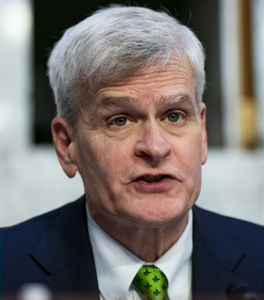
Senator Bill Cassidy (R-LA)

Decreasing Agency Authority

The direct impact of the Supreme Court decision is that federal agencies do not get preferential treatment when interpreting a statute. Cassidy’s bill requires the head of any federal agency signing a major rule to testify before the committee of jurisdiction within 30 days of the rule’s publication.

Additionally, the bill would:

    • Require each person nominated to a Senate-confirmed position to testify before the committee of jurisdiction prior to Senate confirmation; 
    • Improve cost-benefit analyses by requiring federal agencies to conduct retrospective reviews of such analyses for major rulemakings within five years of each rule’s effective date; 
    • Clarify that federal agencies are permitted to communicate with Congress at all times regarding proposed rules; and  
    • Require timely, substantive responses to congressional oversight from federal agencies. 

Cassidy Challenges Existing Rules

Immediately after the Loper v Raimondo decision, Sen. Cassidy sent a letter to the U.S. Secretary of Education Miguel Cardona asserting that the Education Department has established rules outside of the authority given to it by Congress. He specifically alluded to the new Title IX rule. Cassidy asked Cardona, “How will the department change its current practice to enforce the laws as Congress writes them, and not to improperly legislate via agency action?”

Given Cassidy’s position in the Senate HELP Committee and his previous statements on medical debt, the multitude of bills he introduced on transparency, accountability, and decreasing authority, this is likely not Cassidy’s last attempt to challenge agency rules.

Likely Outcomes

Senator Warren's Bill

There are ten co-sponsors of Warren’s bill and a long list of endorsing organizations. Despite that, experts say the bill has only a slim chance of passing in an election year in the Senate, where Democrats currently have a narrow majority control. The bill is even less likely to pass in the Republican controlled House of Representatives. 

Senator Cassidy's Bill

Similar to Warren’s bill, Cassidy’s bill has a low likelihood of passing. The Democrat majority in the Senate may dismiss the bill before it ever reaches the house. In 2023, the 118th Congress passed only 34 bills, the lowest number in decades. With only a few months remaining for the Congress, and the focus turning to a new Democratic nominee, passing this, or any other, bill seems improbable.

Final Thoughts

Regardless of your political affiliation, the overturning of the Chevron Deference is good news for home health, hospice, and palliative care. This ruling puts more pressure on CMS to justify its reasoning for certain decisions it has made. Senator Warren’s bill threatens the advantage given to the home health industry related to NAHC’s senate and house bills and pending lawsuits. Senator Cassidy’s bill ensures federal agency oversight and requires CMS to rationalize their decisions and prove budget-neutrality.

We will continue following these and other Chevron Deference related stories.

# # #

Kristin Rowan, Editor

Kristin Rowan has been working at Healthcare at Home: The Rowan Report since 2008. She has a master’s degree in business administration and marketing and runs Girard Marketing Group, a multi-faceted boutique marketing firm specializing in event planning, sales, and marketing strategy. She has recently taken on the role of Editor of The Rowan Report and will add her voice to current Home Care topics as well as marketing tips for home care agencies. Connect with Kristin directly kristin@girardmarketinggroup.com or www.girardmarketinggroup.com

©2024 by The Rowan Report, Peoria, AZ. All rights reserved. This article originally appeared in Healthcare at Home: The Rowan Report. One copy may be printed for personal use: further reproduction by permission only. editor@therowanreport.com

Kickbacks for Referrals are Costly…and Illegal

Admin

by Elizabeth E Hogue, Esq.

Kickback on Kickbacks

Three home health agencies and their parent company in Cincinnati, Ohio, must pay $4,496,330 to resolve alleged violations of the federal False Claims Act by providing kickbacks to assisted living facilities in exchange for referrals of Medicare patients. The settlement resolves allegations that, between 2013 and 2022, the companies provided lease payments and other valuable benefits; including wellness health services, sports tickets, and meals; to numerous ALFs and their residents. The companies then billed Medicare for the services provided to patients referred by the ALFs.

Referrals from ALFs

Getting more referrals from ALF’s and retirement communities seems to be a crucial piece of the puzzle for all types of providers. As the number of years in which they have been in business increases, ALF’s and retirement communities are more eager to assist their residents to “age in place.” This means that they often view availability of services from post-acute providers as essential to allow them to achieve this goal. 

While providers compete aggressively in the marketplace, they cannot, however, lose sight of the fact that the healthcare industry is highly regulated. With ever-increasing emphasis on fraud and abuse compliance, providers cannot afford to violate the law.

Kickbacks for Referrals

How can providers get more referrals from ALF’S and retirement communities? What are the potential legal pitfalls that providers must avoid? 

The most effective way to maximize referrals from these sources may be to take a multi-pronged approach that includes:

Assigning at least one coordinator/liaison to each referral source on at least a part-time basis

Use of coordinators/liaisons at ALF’s and retirement communities raises issues related to violation of the federal anti-kickback statute. This statute generally prohibits providers from either offering to give or actually giving anything to referral sources in order to induce referrals. Consequently, liaisons and coordinators must be scrupulous about avoiding the provision of free services to ALF’s and retirement communities and/or their residents. Possible violations include “staffing” an office with an RN who responds to requests from residents in their apartments or has “office hours” to address health conditions of residents.

Renting space for coordinators/liaisons to occupy so that providers have a frequent or continuous presence on the premises of referral sources to better serve patients

Renting space from referral sources also involves potential kickbacks, so providers must meet the requirements of the space rental exception or safe harbor. In order to do so, providers must enter into a written lease with the facility/community for a term of least one year. The lease must include the number of square feet providers are renting. Rent must be set in advance at fair market value and cannot take into account either the volume or value of referrals received. Finally, providers may rent only the amount of space that is commercially reasonable or that they actually need.  

The OIG has provided significant guidance about these requirements, which providers must master before they establish these types of relationships. Common pitfalls for providers is insistence by ALFs that providers must rent an entire apartment, whether or not they need it, and must pay an amount equal to the residents’ monthly rent, which includes food and other services. 

Entering into Preferred Provider Agreements

Preferred Provider Agreements may be verbal or in writing. There may be significant value in reducing these preferred provider relationships to writing. These types of relationships raise issues related to patients’ right to freedom of choice of providers. The common law or court decisions require providers of all types to honor patients’ right to freedom of choice. There are also federal statutes that guarantee this right to Medicare and Medicaid patients. In addition, states sometimes address these issues in applicable statutes and regulations. For this reason, providers should not attempt to use standard or “sample” Agreements, but must adhere to requirements in all of the states in which they use these types of Agreements.

Providing a full range of screenings and educational events for and about common chronic illnesses or community awareness activities

ALF’s and retirement communities often ask providers to conduct educational events and basic screenings for common chronic conditions. Generally, providers may do so if they walk a relatively fine line between engaging in community awareness activities and providing free skilled services to residents that exceed $15.00 in value at a time. At a minimum, such activities must be conducted consistent with a detailed policy and procedure that governs the provision of such services, so that providers do not violate the anti-kickback statute.

No kickbacks for referrals

Establishing relationships with ALF’s and retirement communities may result in numerous referrals to post-acute providers. Such relationships should be based on standard documents and comprehensive policies, as described above, in order to ensure compliance. Legal representation is essential for the development and implementation of these documents due to the complexity of the issues involved. 

Enforcement actions like those described above are avoidable.

Elizabeth E. Hogue, Esq.

Elizabeth Hogue is an attorney in private practice with extensive experience in health care. She represents clients across the U.S., including professional associations, managed care providers, hospitals, long-term care facilities, home health agencies, durable medical equipment companies, and hospices.

©2024 Elizabeth E. Hogue, Esq. All rights reserved.

No portion of this material may be reproduced in any form without the advance written permission of the author.

HIPAA Violations

Clinical

by Elizabeth E. Hogue, Esq.

Mom Needs More Fiber?

Imagine that a celebrity receives care where you work and curiosity gets the better of you, or someone you know is admitted and you would love to know the details. It’s oh so very tempting! So, you access records of care provided to patients that you have no legitimate need to view. The HIPAA police are on it! Because let’s not forget that the HIPAA Privacy Rule is a criminal statute.

An emergency room physician, for example, pled guilty to illegally obtaining the personal health information of multiple individuals. He was convicted of one count of wrongfully obtaining individually identifiable health information under false pretenses. The physician received a resident physician license and participated in an emergency medicine residency program at a university hospital. He worked in the emergency room of two hospitals in the university system.

The doctor used his access as a resident physician to the hospitals’ electronic health record to access the records of two patients without their knowledge or consent. He was never the patients’ physician. The patients were not receiving care in the emergency rooms where the doctor worked at the time he accessed the records.

HIPAA Violations Oops

The doctor also admitted that he sent a photograph to someone else of one of the patients wearing a hospital gown in which the patient’s rectum was hanging out of the patient’s body. And now for the “best” part: the doctor also admitted that he falsely wrote in a letter that he sent the picture of the patient with a prolapsed rectum to his mother to remind her of the importance of fiber intake! 

Do you remember the comedian, Flip Wilson, who repeatedly claimed that the devil made him do it? When it comes to accessing patients’ medical records in violation of HIPAA, you must “put the devil behind you!” Protecting patients’ private health information is serious business – serious criminal business. Be vigilant! 

By the same token, providers must also always remember that the HIPAA Privacy Rule isn’t just about protecting health information; it’s also about giving appropriate access to it. In the zeal to protect information, it anecdotally seems that practitioners have lost sight of the fact that access to information is at least as important as protection of information. In fact, the Office for Civil Rights, the federal enforcer of HIPAA violations, has focused on denial of access in enforcement actions for the past several years. 

Remember that, however tempting the information you would like to have may be, temptation pales in comparison to jail time!

# # #

Elizabeth E. Hogue, Esq.

Elizabeth Hogue is an attorney in private practice with extensive experience in health care. She represents clients across the U.S., including professional associations, managed care providers, hospitals, long-term care facilities, home health agencies, durable medical equipment companies, and hospices.

©2024 Elizabeth E. Hogue, Esq. All rights reserved.

No portion of this material may be reproduced in any form without the advance written permission of the author.

Chevron Deference Derailed

Advocacy

by Kristin Rowan, Editor

Chevron Deference

“A government agency must conform to any clear legislative statements when interpreting and applying a law, but courts will give the agency deference in ambiguous situations as long as its interpretation is reasonable.”

This statement followed the unanimous (minus the three who did not take part in the decision) U.S. Supreme Court decision in the Chevron U.S.A., Inc. v. National Resources Defense Council. The case is known for establishing the extent to which a federal court should defer to a government agency’s interpretation of an ambiguous statement when constructing statutes.

Breaking Down Chevron Deference

For those of you who don’t have a law degree, here’s what that means:

  • When a statutory term (required by law) is not explicitly defined and explained by Congress, there is room for interpretation
  • When a government agency interprets that statutory term, the interpretation may come under question
  • As long as the interpretation is not arbitrary (random), capricious (impulsive or unpredictable), or contrary to the statute (opposite the intent when put into practice), federal courts should give more weight to the government agency’s interpretation than to any other interpretation

Implications

At the time, the Supreme Court argued that if Congress leaves a term open to interpretation, it is either stated openness to interpretation, or an implied openness to interpretation. If a statute is implicity open, the intent of Congress is to allow a government agency to create provisions and regulations from that statute as they see fit. 

No one foresaw the impact this ruling would have on commerce and regulation in the U.S. To date, the Chevron Doctrine has been cited nearly 18,000 times in federal court decisions. The application of a statute based on agency interpretation could no longer be questioned or changed by judicial review.

Chevron Deference in Home Health

Since the advent of the PDGM model, CMS has calculated payment rates based on its interpretation of budget neutrality. The National Association for Home Care and Hospice has disputed the validity of both the interpretation of budget neutrality and the formulas used to calculate it.

Last year’s 2024 CMS Proposed Rule cut payment rates even further with a 2.890% Budget Neutrality permanent payment rate adjustment and a temporary rate adjustment to account for alleged overpayments from 2020-2022.

The lawsuit filed against CMS in response to the 2024 Final Rule was dismissed. NAHC began pursuing an administrative review with CMS. However, CMS has already stated that their final position is that budget neutrality has been calculated within the law. 

NAHC Comment: 2023 CMS Rule

“That proposal also fails logically in that it puts care access in severe jeopardy in applying a budget neutrality reconciliation methodology that takes PDGM-induced behavior changes to assess what otherwise would have been expended by Medicare in the absence of PDGM. In doing so, CMS fully fails to meet its obligation to ensure that the transition to a new payment model is budget neutral.”

  1. NAHC Comment Source

Chevron Deference Repealed

In a landmark ruling on Friday, June 28. 2024, the Supreme Court removed the power of federal agencies to interpret laws and ruled that the courts should rely on their own intrepretation of ambiguous laws. Justice Elena Kagan, who dissented the ruling, predicts this change “will cause a massive shock to the legal system.”

Chief Justice John Roberts explained in his opinion that the Chevron Deference is inconsistent with the Administrative Procedure Act (APA). The APA is a federal law which contains instructions for courts to review actions by federal agencies. According to Roberts, the APA directs courts to decide legal questions using their own judgment. Therefore, he noted, agency interpretations of statutes are not entitled to deference. “…it remains the responsibility of the court to decide whether the law means what the agency says,” concluded Roberts.

NAHC to Refile Lawsuit after Chevron Deference Repeal

2024 Final Rule

In April, 2024, the lawsuit filed against CMS regarding the methodology for calculating budget neutrality was dismissed. Now, NAHC can refile the lawsuit and force CMS to justify its decision to enact repeated reimbursement cuts for home health.

In an interview on Wednesday, Bill Dombi told The Rowan Report, “This improves the chances of success for our lawsuit. CMS is going to have to support their regulatory interpretations going forward. Congress is going to have to offer more detail in its legislative language, leaving less to being open to interpretation.” Regarding the PDGM lawsuit, CMS argued that the law was clear and the agency’s interpretation was valid. The overturning of Chevron Deference allows the possibility of arguing that CMS’s interpretation of the law is flawed. 

80/20 Rule

Dombi also explained that the Ensuring Access to Medicaid Services rule, also known as the 80/20 rule, was “drawn out of a whole cloth.” Previously, there were limited avenues available to challenge this rule. The repeal of Chevron Deference significantly improves the ability to challenge the 80/20 rule. The argument now, Dombi told The Rowan Report, is “Does CMS even have the authority to do this?”

More to Come

The Rowan Report anticipates more news coming out of Washington D.C. and the NAHC office regarding the 2024 pay cuts and the 80/20 rule. We will provide ongoing updates and information as it becomes available.

# # #

Kristin Rowan, Editor

Kristin Rowan has been working at Healthcare at Home: The Rowan Report since 2008. She has a master’s degree in business administration and marketing and runs Girard Marketing Group, a multi-faceted boutique marketing firm specializing in event planning, sales, and marketing strategy. She has recently taken on the role of Editor of The Rowan Report and will add her voice to current Home Care topics as well as marketing tips for home care agencies. Connect with Kristin directly kristin@girardmarketinggroup.com or www.girardmarketinggroup.com

©2024 by The Rowan Report, Peoria, AZ. All rights reserved. This article originally appeared in Healthcare at Home: The Rowan Report. One copy may be printed for personal use: further reproduction by permission only. editor@therowanreport.com

Department of Labor Changes Exemption and Overtime Thresholds

Admin

by Tim Rowan, Editor Emeritus

Overtime and exemption thresholds impact employers trying to balance cost-effective policies with employee fairness. As such, they keep a close eye on rules they must follow that come down from the U.S. Department of Labor. When those rules change, remaining compliant requires a company HR leader to adapt those policies. One of those times is at hand.


Exemption and Overtime Thresholds for Hourly and Salaried Earners

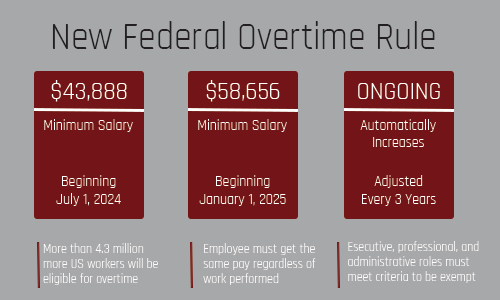
Effective last week, July 1, the annual salary threshold for overtime exemption increased from $35,568 to $43,888. The DoL’s final rule does not stop there but sets another increase on January 1, 2025, to $58,656 per year or $1,128 per week. Salaries below those thresholds cannot be declared “exempt,” meaning they must be paid overtime rates for hours worked over eight per day and forty per week.


Executive Salaries also Affected

In addition to overtime and exemption thresholds, the new rule increases the highly compensated employee threshold twice as well. On July 1, the annual salary threshold increased from $107,432 to $132,964. That annual threshold will increase again on January 1 to $151,164.

Going forward, the DOL will increase all thresholds every three years starting July 1, 2027, relying on up-to-date wage data.

We learned these DoL rule details from Angelo Spinola, Executive Director and lead home care attorney with Polsinelli, a national law firm. 

Federal Overtime Rule

Angelo Spinola Comments

“Home care providers that have been making adjustments to comply with the July 1 deadline may have heard about a recent case out of Texas blocking the July 1 increases. While the Texas court did use a partial injunction blocking the July 1 increase, it only applies to Texas government employees. It does not affect any private employers.”

He recommended that all home health and home care employers continue to make changes as planned to comply with the July 1 increases. Spinola stated that his statements are for informational purposes only and are not intended to be legal advice. His comments quoted here should not be relied upon or used without consulting a lawyer to consider your specific circumstances, possible changes to applicable laws, rules and regulations and other legal issues.

Spinola Concludes

“There are still challenges pending that could affect the January 1, 2025 increases, however, those decisions are not expected for several months, and it is too soon to predict whether that deadline will be affected. We will continue to monitor these cases and provide any updates that may have an effect on the home care industry.”

Angelo Spinola can be reached via email at onlinesolutions@polsinelli.com

NAHC Comments on Exemption and Overtime Thresholds

“The long-awaited U.S. Department of Labor rule regulating minimum salaries levels to qualify for exemption to the Fair Labor Standards Act was issued today. We strongly advise the home care community to gain a comprehensive understanding of the rule and institute steps for timely compliance. While the changes may have limited impact on most home care companies, noncompliance comes with serious penalties.” – NAHC President Bill Dombi

# # #

Tim Rowan, Editor Emeritus

Tim Rowan is a 30-year home care technology consultant who co-founded and served as Editor and principal writer of this publication for 25 years. He continues to occasionally contribute news and analysis articles under The Rowan Report’s new ownership. He also continues to work part-time as a Home Care recruiting and retention consultant. More information: RowanResources.com
Tim@RowanResources.com

©2024 by The Rowan Report, Peoria, AZ. All rights reserved. This article originally appeared in Healthcare at Home: The Rowan Report.homecaretechreport.com One copy may be printed for personal use: further reproduction by permission only. editor@homecaretechreport.com

Disincentives for Information Blocking

Partner News

From the U.S. Department of Health and Human Services

FOR IMMEDIATE RELEASE

June 24, 2024

Contact: HHS Press Office
202-690-6343
media@hhs.gov

HHS Finalizes Rule Establishing Disincentives for Health Care Providers That Have Committed Information Blocking

The U.S. Department of Health and Human Services (HHS) today released a final rule that establishes disincentives for health care providers that have committed information blocking. This final rule exercises the Secretary’s authority under the 21st Century Cures Act (Cures Act) to establish “disincentives” for health care providers who engage in practices that the health care providers knew were unreasonable and were likely to interfere with, prevent, or materially discourage the access, exchange, or use of electronic health information (EHI), except as required by law or covered by a regulatory exception.

“This final rule is designed to ensure we always have access to our own health information and that our care teams have the benefit of this information to guide their decisions. With this action, HHS is taking a critical step toward a health care system where people and their health providers have access to their electronic health information,” said HHS Secretary Xavier Becerra. “When health information can be appropriately accessed and exchanged, care is more coordinated and efficient, allowing the health care system to better serve patients. But we must always take the necessary actions to ensure patient privacy and preferences are protected – and that’s exactly what this rule does.”

HHS has established the following disincentives for health care providers found by the HHS Office of Inspector General (OIG) to have committed information blocking and referred by OIG to the Centers for Medicare & Medicaid Services (CMS): 

  • Under the Medicare Promoting Interoperability Program, an eligible hospital or critical access hospital (CAH) that has committed information blocking and is referred to CMS by OIG will not be a meaningful electronic health record (EHR) user during the calendar year of the EHR reporting period in which OIG refers its determination to CMS.  If the eligible hospital is not a meaningful EHR user, the eligible hospital will not be able to earn three quarters of the annual market basket increase they would have been able to earn for successful program participation; for CAHs, payment will be reduced to 100 percent of reasonable costs instead of 101 percent. This disincentive will be effective 30 days after publication of the final rule.
  • Under the Promoting Interoperability performance category of the Merit-based Incentive Payment System (MIPS), a MIPS eligible clinician (including a group practice) who has committed information blocking will not be a meaningful EHR user during the calendar year of the performance period in which OIG refers its determination to CMS. If the MIPS eligible clinician is not a meaningful EHR user, then they will receive a zero score in the MIPS Promoting Interoperability performance category. The MIPS Promoting Interoperability performance category score is typically a quarter of an individual MIPS eligible clinician’s or group’s total final score in a performance period/MIPS payment year, unless an exception applies and the MIPS eligible clinician is not required to report measures for the performance category. CMS has modified its policy for this disincentive to clarify that if an individual eligible clinician is found to have committed information blocking and is referred to CMS, the disincentive under the MIPS Promoting Interoperability performance category will only apply to the individual, even if they report as part of a group. This disincentive will be effective 30 days after publication of the final rule.
  • Under the Medicare Shared Savings Program, a health care provider that is an Accountable Care Organization (ACO), ACO participant, or ACO provider or supplier who has committed information blocking may be ineligible to participate in the program for a period of at least one year. Consequently, the health care provider may not receive revenue that they might otherwise have earned through the Shared Savings Program. CMS also finalized in this rule that it will consider the relevant facts and circumstances (e.g. time since the information blocking conduct, the health care provider’s diligence in identifying and correcting the problem, whether the provider was previously subject to a disincentive in another program, etc.) before applying a disincentive under the Shared Savings Program. This disincentive will be effective 30 days after publication of the final rule; however, any disincentive under the Shared Savings Program would be imposed after January 1, 2025.
  • Additional disincentives may be established through future rulemaking.

This HHS final rule complements OIG’s final rule from June 2023 that established penalties for information blocking actors other than health care providers, as identified in the Cures Act (health information technology (IT) developers of certified health IT or other entities offering certified health IT, health information exchanges, and health information networks). If OIG determines that any of these individuals or entities committed information blocking, they may be subject to a civil monetary penalty of up to $1 million per violation.

The Office of the National Coordinator for Health Information Technology (ONC) and CMS will host a joint information session about the final rule on June 26, 2024 at 2pm ET. More information can be found at healthit.gov/informationblocking and via ONC’s X account, @ONC_HealthIT.

# # #

All HHS press releases, fact sheets and other news materials are available at https://www.hhs.gov/news.
Like HHS on Facebook, follow HHS on Twitter @HHSgov, and sign up for HHS Email Updates.
Last revised: 

The Future of Care at Home

Admin

by Kristin Rowan, Editor

Home Nurses are joining unions. The advent and unionization of Hospital-at-Home (H@H) is changing the care at home landscape. Large hospital systems across the country have engaged in H@H studies and launched H@H programs, providing hospital-level ambulatory services in their communities. As H@H continues to take a foothold in the healthcare landscape, what do those changes mean for care at home?

Hospital at Home Popularity

Most of the existing H@H programs are operating under a CMS waiver. A few of the H@H programs use a private pay model. The CMS waiver needs to be extended in order to continue the programs. As many H@H organizations are pushing for CMS to extend the waiver, they are looking to patients for advocacy.

A recent survey by Vivalink showed that 84% of U.S. individuals over the age of 40 are interested in H@H monitoring after a hospital visit so they can return home sooner. 77% of respondents said they would trust a recommendation that included at-home monitoring. Respondents who had been hospitalized three or more times in the past 12 months were more interested in H@H programs than those who had been hospitalized less.

Massachusetts Ambulatory Nurses Unionize

On May 20, 2024, 33 ambulatory nurses from Martha’s Vineyard Hospital (MVH) filed with the National Labor Board to join a union that is already active within the hospital, the Massachusetts Nurses Association (MNA). The MNA currently represents 23,000 hospital workers from 85 healthcare facilities across the Commonwealth of Massachusetts. The hospital denied the request to join the union. The group of ambulatory nurses joined MVH through an acquisition of a physician’s group. Therefore, those nurses were not recognized under the existing collective bargaining agreement.

Hospital-at-Home Nurses at Mass General Unionize

The Hospital-at-Home nurses at Mass General Brigham (MGB) have unionized in the hopes of influencing the future of in-home acute care. They are also hoping this will encourage more people working in home healthcare to join unions. In the last seven months of 2023, almost half of all registered nurses working in home health care and non medical care at home left their jobs within a year. One registered nurse from MGB said she hopes HaH nurse unions become more common as HaH expands across the country.

The clinicians in the MGB home care segment are hoping to follow the H@H group into unionization soon. The home care segment, which includes home health, palliative, and other care at home services, are currently voting on whether to unionize.

Hospital-at-home nurses unionize at Mass Gen

Among the listed reasons for considering unionization are changes in expectations on productivity, and wages. Some of the more recent changes at MGB were rolled out across the company and did not take into consideration the territories and limitations that care at home clinicians have. More than 400 clinicians are in the care at home side of MGB and they have all received ballots to vote on unionization.

Home Health Unionization

hospital-at-home changing home health unions

The nature of care at home clinicians is disparate. Therefore, it is difficult to organize them into one cohesive group. Recently, though, more home health workers are looking to service workers and healthcare workers unions for better pay, better working conditions, and more buy-in on the day-to-day operations of the agency.

Opponents of unionization among home health clinicians argue that pay rates are largely set by CMS reimbursement rates. Employers may want to raise rates but are unable to do say because they accept Medicare and Medicaid. Home health unions could force employers to pay more than the set CMS rates.

CMS Response to Union Backlash

Otherwise known as the 80/20 rule, CMS responds to agencies worried about unionization with a mandate to pay their workers 80% of total Medicaid payments. Some agency owners say the proposed rule ignores the low reimbursement rates and further burdens agencies that are barely making a profit now. It is unlikely that CMS will see the unionization of home health clinicians as a reason to increase reimbursement rates. Experts advise agencies to start working on contract negotiations within the VBPM, to engage in risk-sharing and cost-benefit analyses with all parties within the VBPM. For example, Remote Patient Monitoring (RPM) is Medicare reimbursable, but not through home health use. However, a home health agency can share the benefits of RPM when it is billed through an approved provider for Medicare reimbursement. These strategies can lower overall care costs, increasing the share of reimbursement flowing to HHAs.

Maximize VBPM with Technology

Technologies available today include RPM, generative AI for data analytics, automated scheduling, and apps for secure communication, among others. Technology can lower overhead costs, allow you to eliminate some FTEs, and provide added value to providers during contract negotiations. If you don’t already have a robust tech-stack, look at some of our most recent product reviews, or contact The Rowan Report for more information about technology adoption consultations.

# # #

Kristin Rowan, Editor

Kristin Rowan has been working at Healthcare at Home: The Rowan Report since 2008. She has a master’s degree in business administration and marketing and runs Girard Marketing Group, a multi-faceted boutique marketing firm specializing in event planning, sales, and marketing strategy. She has recently taken on the role of Editor of The Rowan Report and will add her voice to current Home Care topics as well as marketing tips for home care agencies. Connect with Kristin directly kristin@girardmarketinggroup.com or www.girardmarketinggroup.com

©2024 by The Rowan Report, Peoria, AZ. All rights reserved. This article originally appeared in Healthcare at Home: The Rowan Report. One copy may be printed for personal use: further reproduction by permission only. editor@therowanreport.com

BREAKING NEWS – CMS Proposed Rule for 2025

CMS

by Kristin Rowan, Editor

CMS Proposed Rule for 2025

Citing “budget neutrality adjustments”, the Centers for Medicare & Medicaid Services (CMS) June 26 issued its proposed rule for 2025 for the home health prospective payment system. Here are the highlights:

  • Overall net reduction in home health payments by $280 million dollars
  • Market basket update of 3.0%
  • Productivity adjustment of -0.5%
  • Base payment rate reduction of 4.067% due to PDGM
  • Update fixed dollar loss for outlier payments
  • Update LUPA thresholds, functional impairment levels, and comorbidity adjustment subgroups
CMS Proposed Rule CY 2025

We did the math. This is an overall reduction in payment by 3.6%. This come after multiple years of similar adjustments that reduced the overall payment rates.

Included in the proposal is an additional adjustment to the fixed-dollar loss amount for high-cost outliers. This will reduce payments another 0.6%.

As we focus primarily on the payment reductions, CMS is looking at additional data. CMS provides a detailed account of the requirements for behavior assumptions and actual changes, as outlined in earlier rules. Using CY 2023 claims, and the methodology from the CY 2023 final rule, CMS believes they paid more under the PDGM system than they would have under the old system, leading to the deduction in base payment rate.

HHA Conditions of Participation

In addition to the payment cuts, CMS is also proposing an update to the Conditions of Participation. This new standard would require HHAs to develop, apply, and maintain a policy for accepting new patients into service.

According to the proposal, CMS is not moving to add or modify any quality measures from the Quality Reporting Program. They do, however, propose to modify some patient assessment items related to health-related social needs. This would require HHAs to collect and report data related to living situation, food, and utilities. This proposed modification would be implemented beginning with the calendar year 2027 QRP.

COVID-19 Reporting

Also included in the CY 2025 proposal is a revision to the infection prevention and control requirements for long-term care facilities. The revision calls for an extension on reporting some of the Covid-19 data elements to the Centers for Disease Control and Prevention. It also requires influenza and RSV reporting beginning January 1, 2025.

Additional Items

CMS also used data from OASIS-D and OASIS-E, making adjustments for missing and altered data from the two different information sets. The proposed rule includes a new methodology to address the issue of varying data sets from OASIS-D to OASIS-E.

LUPA add-ons are meant to establish equitable compensation for all home health services. CMS is proposing an occupational therapy (OT) specific LUPA add-on factor, rather than continuing to use the PT add-on factor for OT.

Payment groups under the PDGM model use an associated case-mix weight and LUPA threshold, specific to each of the 432 payment groups. CMS is proposing a recalibration of the case-mix weights, including funtional levels and comorbidity adjustment subgroups.

Request for Information: CMS is seeking feedback on Future Performance Measure Concepts for the expanded HHVBP Model. New proposed measure include care activities like bathing and dressing, which are not currently included in the function measures. Additional potential measures include family caregiver status and claims-based falls with major injuries.

Feedback

The American Hospital Association has expressed “serious concerns” about the payment rate adjustments in the proposed rule. “We urge the agency to adequately resource HH providers as they are a critical part of the care continuum,” AHA wrote. “We are particularly concerned about the substantial size of the agency’s proposed budget neutrality adjustment, a cut of 5.653%, and again call on CMS to withdraw it.” The AHA has asked CMS to revise its accounting methodology to more accurately account for changes in the payment system and care delivery due to PDGM.

President of the National Association for Home Care and Hospice (NAHC), Bill Dombi, today released a statement:

“The 2025 proposed version of Medicare home health payment rates shows the ongoing and predictable rate reductions impacting home health agencies since the beginning of the new payment model in 2020. That decline is solely due to a fatally flawed budget neutrality methodology that CMS employed to arrive at the rate adjustments,” stated NAHC President William A. Dombi.

“While this means that Medicare spending on home health services will continue to decline as costs continue rise, the more important element is that care access and utilization continues to decline at significant levels. When Congress set Medicare payment reform in motion starting in 2020, it was not planned or even expected that the outcome would be that nearly 500,000 Medicare beneficiaries would be able to access care or that those who could find care would get fewer services,” he added.

“Congress must step in immediately to put an end to this dismantling of the Medicare home health benefit. The value of home health services is not only undeniable; it has been proven by CMS in its analysis and expansion of the highly successful Home Health Value Purchasing demonstration project. We call on Congress to correct what CMS has done and prevent the growing harm to the millions of highly vulnerable home health patients that depend and will depend in the future on this essential Medicare benefit. Fortunately, longstanding advocates for home health care, Senator Debbie Stabenow (D-MI) and Senator Susan Collins (R-ME) have introduced S. 2137 to eliminate the rate cuts. We urge the Congress to support this legislation and enact it into law before the end of the year. The 2025 rate cuts must not take effect” Dombi added.

Comments

CMS has issued a fact sheet with more details on their assumptions and calculations. You can access the fact sheet here. The proposed rule can be downloaded here.

CMS will accept comments on the proposed rule through August 26th.

# # #

Kristin Rowan, Editor

Kristin Rowan has been working at Healthcare at Home: The Rowan Report since 2008. She has a master’s degree in business administration and marketing and runs Girard Marketing Group, a multi-faceted boutique marketing firm specializing in event planning, sales, and marketing strategy. She has recently taken on the role of Editor of The Rowan Report and will add her voice to current Home Care topics as well as marketing tips for home care agencies. Connect with Kristin directly kristin@girardmarketinggroup.com or www.girardmarketinggroup.com

©2024 by The Rowan Report, Peoria, AZ. All rights reserved. This article originally appeared in Healthcare at Home: The Rowan Report. One copy may be printed for personal use: further reproduction by permission only. editor@therowanreport.com

NAHC and NHPCO Sign Affiliation Agreement

Admin

by Kristin Rowan, Editor

BREAKING NEWS

In a joint statement on June 18, 2024, NAHC and NHPCO announced that the Board Chairs and CEOs of each organization met in Washington. During this meeting, they formally signed the affiliation agreement. This is a union of the two largest advocate organizations for care at home providers. They hope to unify the voice of the care at home community. The combined resources of the organizations will provide education, expert advice, and increased advocacy for policies that help deliver the best care to those who need it most.

After 18 months of discussions, meetings, and challenges, the two organizations have agreed on terms for the combining of the two groups.


“The affiliation of NAHC and NHPCO is a historic event,” said NAHC President and CEO William A. Dombi. “Unifying the voice of health care at home has been a longstanding goal of NAHC, as it is the essence of the original formation of NAHC in 1982. Combining our two organizations will significantly strengthen that voice for the benefit of our members and the patients they serve.”

Read the full press release from NAHC and NHPCO here.

# # #

Kristin Rowan, Editor

Kristin Rowan has been working at Healthcare at Home: The Rowan Report since 2008. She has a master’s degree in business administration and marketing and runs Girard Marketing Group, a multi-faceted boutique marketing firm specializing in event planning, sales, and marketing strategy. She has recently taken on the role of Editor of The Rowan Report and will add her voice to current Home Care topics as well as marketing tips for home care agencies. Connect with Kristin directly kristin@girardmarketinggroup.com or www.girardmarketinggroup.com

©2024 by The Rowan Report, Peoria, AZ. All rights reserved. This article originally appeared in Healthcare at Home: The Rowan Report. One copy may be printed for personal use: further reproduction by permission only. editor@therowanreport.com

NLRB Targets Non-Compete Agreements

Admin

by Elizabeth E. Hogue, Esq.

The National Labor Relations Board (NLRB) has now joined the Federal Trade Commission (FTC) and some state legislatures to target non-compete agreements. The general counsel for the NLRB argued in a recent memo that non-compete agreements violate the National Labor Relations Act because they interfere with employees’ right to engage in protected concerted activity. Two recent actions by the Board provide more information about efforts of the NLRB to limit use of non-compete agreements.

Juvly Aesthetics Non-Compete Agreement Settlement

In February of 2024, the regional office of the Board in Cincinnati approved a settlement agreement between Juvly Aesthetics and three former employees. The Board claimed that Juvly, an operator of medical clinics, violated the rights of employees through the use of confidentiality, non-disparagement, non-competition, non-solicitation and requirements to repay training expenses under certain conditions. 

According to the NLRB, Juvly prohibited employees from discussing their rates of pay. The Company also required some employees to sign a non-compete agreement that was in effect for a period of twenty-four months for any competing medical practice within twenty miles of any location of the Company.

Juvly agreed to a settlement agreement that required:

  • Payment of back pay to some employees
  • Termination of unlawful policies and procedures
  • Release of employees from unlawful agreements
  • Posting of all of requirements of the settlement agreements for review by employees
Non-compete agreements juvly aesthetics<br />

NLRB Division of Advice

non-compete agreements

In December, the NLRB Division of Advice issued guidance that evaluated the legality of these issues:

  • Customer non-solicitation provisions do not violate the Act because they only prevent employees from soliciting existing customers for one year so that employees are likely not barred from other employment opportunities for more than one year.
  • Confidentiality agreements do not violate the Act because they prohibit only disclosure of trade secrets, marketing plans, customer lists, and other proprietary information, as opposed to information that could involve employee activity regulated by the Act, such as wage information. 
  • Provisions requiring the return of company property do not violate the Act.

Providers are now clearly operating in an environment that prohibits employers from restricting employee activities that were fair game in the past. The specifics of efforts to limit the actions of employers remain unclear, but will likely be “fleshed out” in enforcement actions.

©2024 Elizabeth E. Hogue, Esq. All rights reserved.

No portion of this material may be reproduced in any form without the advance written permission of the author.

©2024 by The Rowan Report, Peoria, AZ. All rights reserved. This article appeared in Healthcare at Home: The Rowan Report. Reproduction by permission only.

editor@therowanreport.com

The Future of NAHC: An Interview with Bill Dombi

Admin

by Kristin Rowan, Editor

NAHC President Bill Dombi announced at last week’s CAHSAH annual meeting and expo that he would end his tenure at NAHC and retire at the end of 2024. We reached had an interview with Dombi on Thursday, May 23rd. He said he was not prepared to speak yet about his upcoming retirement, but we should hear more about that soon.

In the meantime, he provided additional details from his session at CAHSAH. We also discussed updates on the lawsuit against CMS and the status of the merger between NAHC and NHPCO. Tim’s article from last week talks about Dombi’s progress with Senator Wyland.

Ongoing Litigation

When we last spoke with Bill, he told us about the lawsuits filed against CMS. The suit claims that the budget-neutral calculations were based on faulty data and outdated software. These calculations determined the reimbursement rate reductions. Dombi explained the process for those lawsuits.

“The first round of the battle is around whether the court has the power to hear the case either at all or at that point in time. The courts are littered with litigation that have been dismissed on jurisdictional grounds,” Dombi offered. The court dismissed the lawsuit and the case is now closed. The Department of Justice (DoJ) attacked jurisdiction to get the case dismissed. Most concerning, according to Dombi, was the DoJ’s question of whether the statute passed by Congress precluded any litigation. If the courts had found in their favor, they would have dismissed the lawsuit no further suits could be filed. Luckily, that argument didn’t hold. The second attack was whether NAHC had expedited administrative review, which is the argument that caused the dismissal. Now, they have to establish that it would be futile to get CMS to agree to expedited judicial review.

Next Steps

In light of the dismissal, NAHC had to decide whether to appeal the ruling, exhaust the expedited review step with CMS, or both. Ultimately, they decided not to appeal and is pursing the review with CMS. This process could take up to 6 months, according to Dombi. Although they are pursuing the review, CMS has already stated that their final position is that the budget neutrality has been calculated within the law. Dombi feels the review is futile because CMS is not going to change their position. Now, they just have to prove the futility.

Two-Step Approach

Advocacy from NAHC, NHPCO, and other individuals and organizations was always intended to be a two-pronged effort: Litigation and Congress. The two do not interfere with each other. Even though the court dismissed the litigation suit in favor of judicial review, the approach in Congress continues. Of Senator Wyland, Dombi said, “A year ago at this time, his view was that home health agencies needed no relief. Now, he’s indicated a willingness to find a way to help home health agencies and recognizes that the cuts have been harmful to home health agencies and others that provide care.” According to Dombi, it was the personal stories and individual provider information that was crucial in swaying Wyland. The organizations continue to meet with other members of Congress to persuade them in the same way.

Dombi Provides Merger Update

Last year, NAHC and NHPCO announced they would join forces and merge into a new, as yet to be named, organization. That merger is still moving forward, but there are a lot of odds and ends to tie up. Dombi told us, “Nothing is final, final, but I don’t see anything but tailwinds moving forward.” The two organizations are still hoping for a July 1, 2024 launch of the organization. There is an active, open search for a new CEO to actively run both organizations as one. According to Dombi, no one has been slated for that position yet, so they may end up launching before there is a CEO in place.

The two organizations have already started integrating. They have lobbied together and they have worked on policy together. Additionally, they are integrating the association management system and building a website. “We feel confident enough that it’s going to reach the finish line that we’re investing time and money in these elements,” Dombi said. The two organizations can continue to operate together without a CEO, but there are a lot of decisions that need to be made that won’t be made until after there is a CEO.

After the Merger

Once the merger is complete and the two organizations operate under a new name with a new CEO, Dombi and his counterpart Bill Marcantonio of NHPCO will stay on for some time. Dombi will take the title President Emeritus and Council to the organization and Marcantonio will become the Chief Integration Officer. The new name of the organization has not been announced. Dombi says a lot of things are tied together, from an action standpoint, and it’s better to announce all of those details together along with the new name.

Reflections From Bill Dombi

When asked what was next for him after the merger is completed and he moves to retirement, Dombi reflected on his career:


“I’m proud of what I’ve accomplished in my life, but I’m more proud of what the people I work with I have accomplished. It’s not the first time we’ve tried to merge the two organizations, but this time, we had all the right ingredients and I’m proud of that. I live with the confidence that my constituency is up to the challenge. Every time they get kicked back, they’re right back at it.

To see where we are today compared to the 70s, we are so many light years ahead of where we were then. I mean, we’re talking about a hospital level of care at home. That was part of the dream. The fore-runners of healthcare at home truly believed those things were possible. The problems that caused the workforce shortage are multi-faceted, so the solutions are multi-pronged.”

Bill Dombi Spring Tour
We will continue following the story of both the lawsuits and the merger and update you as soon as there is more information.
Kristin Rowan, Editor
Kristin Rowan has been working at Healthcare at Home: The Rowan Report since 2008. She has a master’s degree in business administration and marketing and runs Girard Marketing Group, a multi-faceted boutique marketing firm specializing in event planning, sales, and marketing strategy. She has recently taken on the role of Editor of The Rowan Report and will add her voice to current Home Care topics as well as marketing tips for home care agencies. Connect with Kristin directly kristin@girardmarketinggroup.com or www.girardmarketinggroup.com

©2024 by The Rowan Report, Peoria, AZ. All rights reserved. This article originally appeared in Healthcare at Home: The Rowan Report. One copy may be printed for personal use: further reproduction by permission only.
editor@therowanreport.com

Use of Preferred Provider Agreements

Clinical

by Elizabeth E. Hogue, Esq.

Preferred Provider Agreements as Referral Source

In a highly competitive marketplace, home care providers of all types, including home health agencies, hospices, private duty/home care companies and home medical equipment (HME) suppliers are looking for a “leg up,” especially for patients with certain types of payors. Providers may be able to cement important referral sources using Preferred Provider Agreements. For example, a provider may wish to approach an assisted living facility (ALF) to see if it is interested in a preferred provider relationship. If so, then management of the ALF may want to sign a Preferred Provider Agreement in order to further a relationship with this provider.

Problems with Preferred Provider Agreements

The anti-kickback statute may apply if providers involved in referral arrangements receive any type of federal or state funds, including, but not limited to, payments for services provided from Medicaid waiver programs, managed Medicaid programs, the Tri-Care Program, the VA, or any other state or federal programs. The anti-kickback statute generally says that anyone who either offers to give or actually gives anyone anything in order to induce referrals has engaged in criminal conduct. There are, however, several exceptions to this statute that may be applicable.

How to Assess Your Preferred Provider Agreements

Providers should ask two crucial questions about the application of the anti-kickback statute to referral arrangements:

  1. Is there a kickback or rebate?
  2. If so, is there an exception or “safe harbor” that permits the arrangement even though it would otherwise violate the statute?

 kickback or rebate occurs when a provider receives referrals from another provider and something flows back to the referral source from the provider who received referrals. If there is a kickback or rebate, providers must automatically ask the second question listed above. If they fail to utilize applicable exceptions, they may miss out on useful marketing strategies that are likely to result in numerous referrals.

With regard to Preferred Provider Agreements, however, it is important to note that they can be structured so that no money or anything of value changes hands between providers and the other party involved. If so, there is no kickback or rebate.

Patient Choice

The parties to Preferred Provider Agreements must also make certain that they honor patients’ choices of providers. There are a number of sources of patients’ right to freedom of choice of providers applicable to preferred provider arrangements, including:

  • Court decisions or the common law says that all patients – regardless of payor source, type of care rendered, or types of providers involved – have the right to control the care they receive and who provides it.
  • A federal statute that guarantees all Medicare and Medicaid patients the right to freedom of choice of providers. This statute may be applicable if either party receives reimbursement from the Medicare or Medicaid Programs.

When patients express preferences for certain providers, however, their choices must be honored despite the existence of Preferred Provider Agreements. The agreement of the parties to honor patients’ choices should be included in Preferred Provider Agreements.

Final Thoughts

The market to provide services to patients in their homes is expanding, but the competition for referrals among providers seems to be extremely fierce. Providers are well advised to utilize Preferred Provider Agreements to help them to increase and/or maintain referrals in order to help ensure profitability.

©2024 Elizabeth E. Hogue, Esq. All rights reserved.

No portion of this material may be reproduced in any form without the advance written permission of the author.

Bill Dombi Spring Tour has two Major Announcements

Admin

by Tim Rowan, Editor Emeritus

Bill Dombi Spring Tour

For the last time, NAHC President Bill Dombi is spending another Spring on airplanes. It is state association meeting season, and the Bill Dombi Spring Tour has been bringing his regular Capitol Hill update from coast to coast, this time adding the announcement that he will retire at the end of the year.

After 40 years with NAHC, the lengthy standing ovation Californians gave him at the end of his Tuesday speech was well-deserved.

Advocacy and Change

Bill’s core message has not changed, though the details of his ongoing battle to force CMS to take HHAs and Hospices more seriously has its 2024-2025 nuances. “Letting Congress know that you are an important healthcare sector, and clearly the most popular sector, is not NAHC’s job alone. Every one of you has power. Use it. Make your voices heard.”

Meetings with the Senate Finance Committee

To illustrate the point, he related a story about his recent visit to Portland to meet with the Chair of the Senate Finance Committee, Ron Wyland (D-OR).

“Senator Wyden has been one of the major roadblocks to Medicare agencies getting fair payment rates. I went to see him with a group of agency owners and workers to describe the hardships the current and planned pay rate cuts will impose, and to explain the exact problems with the dumb formula CMS is using to calculate those pay rates.

“The Senator said, ‘But MedPAC says you make too much money and rates should be cut. Were they wrong? Or has something changed?’

Reaching Agreement…Almost

“Both, the group and I harmonized. One by one, each agency representative told him about the growing demand of an aging population, the difficulty hiring staff with the salaries our low pay rates allow them to pay, and a full litany of all the problems with Medicare Advantage.

“By the end of our meeting, we hadn’t turned him 180 degrees, but I could see he was beginning to turn.”Later, Dombi added, he met with Senator Debbie Stabenow (D-MI), who is not only a member of the same Finance Committee but the fourth in line in the Senate pecking order. She offered to have a conversation with her colleague, and that turned Senator Wyden the rest of the way toward changing his position 180 degrees.

You Can Make a Difference

“If you think you as an individual owner have no power in Sacramento, Congress, or the White House,” Dombi concluded, “think again.”

See sidebar for the complete list of Finance Committee members. Everyone has power, but if you are a voter in one of their states, you have an even more powerful voice.

The Bill Dombi Spring Tour will continue throughout the year until his retirement. Join Dombi at the 2024 Financial Management Conference & Expo in Las Vegas, July 21-23 and at the 2024 Home Care and Hospice Conference and Expo in Tampa, October 20-22.

Bill Dombi Senator Wyden

Senator Ron Wyland (D-OR)

SENATE FINANCE COMMITTEE MEMBERS

Chair: Ron Wyland (D-OR)
Ranking Member: Mike Crapo (R-ID)
Debbie Stabenow (D-MI)
Chuck Grassley (R-IA)
Maria Cantwell (D-WA)
John Cornyn (R-TX)
Robert Menendez (D-NJ)
John Thune (R-SD)
Thomas Carper (D-DE)D-
Tim Scott (R-SC)
Benjamin Cardin (D-MD)
Bill Cassidy (R-LA)
Sherrod Brown (D-OH)
James Lankford (R-OK)
Michael Bennet (D-CO)
Steve Daines (R-MT)
Bob Casey (D-PA)
Todd Young (R-IN)
Mark Warner (D-VA)
John Barrasso (R-WY)
Sheldon Whitehouse (D-RI)
Ron Johnson (R-WI)
Maggie Hassan (D-NH)
Thom Tillis (R-NC)
Catherine Cortez Masto (D-NV)
Marsha Blackburn (R-TN)
Elizabeth Warren (D-MA)

# # #

Tim Rowan, Editor Emeritus

Tim Rowan is a 30-year home care technology consultant who co-founded and served as Editor and principal writer of this publication for 25 years. He continues to occasionally contribute news and analysis articles under The Rowan Report’s new ownership. He also continues to work part-time as a Home Care recruiting and retention consultant. More information: RowanResources.com
Tim@RowanResources.com

©2024 by The Rowan Report, Peoria, AZ. All rights reserved. This article originally appeared in Healthcare at Home: The Rowan Report.homecaretechreport.com One copy may be printed for personal use: further reproduction by permission only. editor@homecaretechreport.com

The Wrong Way to Use AI in Healthcare

Admin

by Tim Rowan, Editor Emeritus

Lawsuits are beginning to pile up against insurance companies participating in the Medicare Advantage program. The complaint? The wrong way to use AI in healthcare is with faulty algorithms to approve or deny claims. While AI can be extremely helpful in streamlining administrative tasks — comparing physician notes with Home Health assessments and nursing notes or reading hospital discharge documents — it seems not to be any good at deciding whether to approve or deny care.

The Wrong Way to Use AI in Healthcare Example 1

The Minnesota case, November, 2023, UnitedHealth Group:

    • An elderly couple’s doctor deemed extended care medically necessary
    • UnitedHealth’s MA arm denied that care
    • Following their deaths, the couple’s family sued UnitedHealth, alleging:
      • Straight Medicare would have approved the extended care
      • United uses an AI model developed by NaviHealth called nH Predict to make coverage decisions
      • UnitedHealth Group acquired NaviHealth in 2020 and assigned it to its Optum division
      • nH Predict is known to be so inaccurate, 90% of its denials are overturned when appealed to the ALJ level
      • UnitedHealth Group announced in October, 2023 that its division that deploys nH Predict will longer use the NaviHealth brand name but will refer to that Optum division as “Home & Community Care.”

The family’s complaint stated, “The elderly are prematurely kicked out of care facilities nationwide or forced to deplete family savings to continue receiving necessary medical care, all because [UnitedHealth’s] AI model ‘disagrees’ with their real live doctors’ determinations.”

The Wrong Way to Use AI in Healthcare Example 2

The Class-Action case, December 2023, Humana:

    • A lawsuit was filed on December 12, 2023 in the U.S, District Court for the Western District of Kentucky
    • It was filed by the same Los Angeles law firm that filed the Minnesota case the previous month, Clarkson
    • The suit notes that Louisville-based Humana also uses nH Predict from NaviHealth
    • The plaintiffs claim, “Humana knows that the nH Predict AI Model predictions are highly inaccurate and are not based on patients’ medical needs but continues to use this system to deny patients’ coverage.”
    • The suit says Medicare Advantage patients who are hospitalized for three days usually are eligible to spend as many as 100 days getting follow-up care in a nursing home, but that Humana customers are rarely allowed to stay as long as 14 days.
    • A Humana representative said Humana their own employed physicians see AI recommendations but make final coverage decisions.

What Makes This Possible

According to experts we speak with, there are many ways to use data analytics. The insurance companies named in the lawsuits use predictive decision making. This way of analyzing data compares a patient to millions of others and deduces what treatment plan might be suitable for one patient, based on what was effective for most previous patients. Opponents of this method have called it “data supported guessing.”

A superior analysis method experts are coming to understand  is prescriptive decision making. This is taking all of the available historical and current data surrounding a patient and making a clinical decision specifically designed to that patient’s age, gender, co-morbidities, doctor recommendations, and treatment records.The Power of AI with SmartCare

Until recently, predictive analysis was the preferred method because of its resource efficiency. Examining the data of every individual patient used to be prohibitively labor-intensive, requiring hours of reading hospital records, physician notes, and claims. Today, however, AI tools are able to do that work in seconds, making prescriptive analytics and customized plans of care possible.

Fix May Be in the Works

In a February 6, 2024 memo to all Medicare Advantage Organizations and Medicare-Medicaid Plans, CMS explained the difference between predictive and prescriptive analytics. The memo said these plans may not make coverage determinations based on aggregated data but must look at each individual:

“For Medicare basic benefits, MA organizations must make medical necessity determinations in accordance with all medical necessity determination requirements, outlined at § 422.101(c)1 ; based on the circumstances of each specific individual, including the patient’s medical history, physician recommendations, and clinical notes; and in line with all fully established Traditional Medicare coverage criteria.”

In response to a request for clarification, the CMS memo laid out its rule in specific language:Wrong AI in Healthcare Prescriptive Analytics

An algorithm or software tool can be used to assist MA plans in making coverage determinations, but it is the responsibility of the MA organization to ensure that the algorithm or artificial intelligence complies with all applicable rules for how coverage determinations by MA organizations are made. For example, compliance is required with all of the rules at § 422.101(c) for making a determination of medical necessity, including that the MA organization base the decision on the individual patient’s circumstances, so an algorithm that determines coverage based on a larger data set instead of the individual patient’s medical history, the physician’s recommendations, or clinical notes would not be compliant with § 422.101(c).
(emphasis added)

“Therefore, the algorithm or software tool should only be used to ensure fidelity with the posted internal coverage criteria which has been made public under § 422.101(b)(6)(ii).”

In further responses to questions in the same memo, CMS made it clear MA plans must make the same coverage decision original Medicare would make. The only allowable exception is that plans may use their own criteria when Medicare Parts A and B coverage criteria “are not fully established.”

Knowledge of this CMS directive may give Home Health agencies one more arrow in their quiver when going to battle with powerful, profit-oriented insurance companies over harmful, illogical AI algorithm decisions.

For information on the right way to use AI in healthcare, see our complimentary article in this week’s issue.


Tim Rowan, Editor EmeritusTim Rowan is a 30-year home care technology consultant who co-founded and served as Editor and principal writer of this publication for 25 years. He continues to occasionally contribute news and analysis articles under The Rowan Report’s new ownership. He also continues to work part-time as a Home Care recruiting and retention consultant. More information: RowanResources.com
Tim@RowanResources.com

 ©2024 by The Rowan Report, Peoria, AZ. All rights reserved. This article originally appeared in Healthcare at Home: The Rowan Report.homecaretechreport.com One copy may be printed for personal use: further reproduction by permission only. editor@homecaretechreport.com