Could Jimmy Carter’s Hospice Care Lead to Covered Palliative Care Services?

Clinical

By Kristin Rowan, Editor

The news this week has been filled with stories about former president Jimmy Carter, 99, who entered hospice care last year. His wife, Rosalynn Carter was in hospice care for only a few days before she passed away in November. Advocates and hospice providers are hoping that Carter’s length of care in hospice will help increase awareness of what hospice care really is.

Hospice care is a misunderstood service. Many people equate hospice care with dying. While it is true that patients are only eligible for hospice care if they have a life-ending illness with no hope of cure, hospice care involves a lot more than easing a patient through the end-of-life transition. Physical symptoms are eased with medicine and the patient’s emotional well-being is supported as well. Just as importantly, the family’s emotional needs are met through hospice care.

The Carter family’s high profile has shed some much needed light on hospice care in general. The vast difference in length of care between the former first lady (three days) and the former president (one year and counting) has also highlighted the degree to which hospice care can be administered.

The hope for many, in light of the public coverage of Carter’s hospice care, is a change in long-term care coverage to cover the gap between hospital care and hospice care. Medicare does not have a long-term care benefit, so patients either go without this needed care or pay for it out of pocket. Detractors argue that new taxes would have to be levied in order to fund this type of care, making the change politically difficult.

I would argue that long-term care benefits could be used to pay for step-down care instead of hospice care and would not need a separate budget. After all, isn’t that what palliative care aims to do? Home health care aids in recover and hospice care maintains quality of life during end-of-life care. Palliative care is the bridge that spans the two, when a patient is not going to recover, but isn’t ready or eligible for hospice care. Adding Medicare and Medicaid coverage for palliative would lower the overall cost of hospice care and add much-needed service for the patients that fall between the gap.

# # #

Kristin Rowan

Kristin Rowan has been working at Healthcare at Home: The Rowan Report since 2008. She has a master’s degree in business administration and marketing and runs Girard Marketing Group, a multi-faceted boutique marketing firm specializing in event planning, sales, and marketing strategy. She has recently taken on the role of Editor of The Rowan Report and will add her voice to current Home Care topics as well as marketing tips for home care agencies. Connect with Kristin directly kristin@girardmarketinggroup.com or www.girardmarketinggroup.com

©2024 by The Rowan Report, Peoria, AZ. All rights reserved. This article originally appeared in Healthcare at Home: The Rowan Report.homecaretechreport.com One copy may be printed for personal use: further reproduction by permission only. editor@homecaretechreport.com

Family Caregiver Tax Credit Bill

CMS

By Kristin Rowan, Editor

Republican and Democratic leaders joined forces to introduce the Credit for Caring Act (S. 3702, H.R. 7165) in support of family caregivers across the country. Family caregivers are those who are caring for a family member but are not nurses or employees of any home care agency. They are not eligible for Medicare or Medicaid payments, nor is there an employer paying them for the endless hours of support they provide. Family caregivers are often under a lot of emotional and financial stress. Some have full-time jobs in addition to the care provide. Others are caring for more than one family member, sometimes in different homes.

The Credit for Caring Act, a bipartisan effort to recognize the personal cost to family caregivers with a $5,000 federal tax credit for eligible working family caregivers. As is generally the case with government intercession, the “eligible” part will exclude many family caregivers. From Congress.gov:

“This bill allows an eligible caregiver a tax credit of up to $5,000 for 30% of the cost of long-term care expenses that exceed $2,000 in a taxable year. The bill defines eligible caregiver as an individual who has earned income for the taxable year in excess of $7,500 and pays or incurs expenses for providing care to a spouse or other dependent relative with long-term care needs.”

The bill also includes the caveat that eligible caregivers must incur qualified expenses, limited to goods, services, and supports. The language excludes the time and energy a family caregiver expends, essentially limiting the tax credit to repayment of money paid out of pocket for care that should have been covered by Medicare, Medicaid, or private health insurance, but isn’t. The cost of a direct care giver is included in eligible expenses, but doesn’t consider the family caregiver to be one.

As I break down the math in my head, I come up with this:

A tax credit of $5,000 is received if the caregiver has spent $16,600 in the previous year (5,000/.3). This leaves a total out of pocket amount of $11,100. Supportive home care services average $30/hour. $16,660 is equivalent to 555 hours of non-medical home care. That’s roughly 10 hours per week or 1-1/2 hours per day. This doesn’t include the costs for DME, doctor visits, lost wages from time off work, medication, or any of the other eligible expenses included in the bill.

This is getting us one step closer to paying for supportive in-home care and palliative care services, but I don’t think it goes far enough. An under-served, under-paid population who makes $7,500 per year cannot afford $16,000 in out-of-pocket expenses in order to qualify for the maximum tax credit. Once this bill is (hopefully) passed, we should move on to including additional services in the Medicare/Medicaid reimbursement model. The Rowan Report joins NAHC in its support of the Credit for Caring Act and urges you to reach out to your representatives to urge them to support the passing of the bill.

# # #

Kristin Rowan

Kristin Rowan has been working at Healthcare at Home: The Rowan Report since 2008. She has a master’s degree in business administration and marketing and runs Girard Marketing Group, a multi-faceted boutique marketing firm specializing in event planning, sales, and marketing strategy. She has recently taken on the role of Editor of The Rowan Report and will add her voice to current Home Care topics as well as marketing tips for home care agencies. Connect with Kristin directly kristin@girardmarketinggroup.com or www.girardmarketinggroup.com

©2024 by The Rowan Report, Peoria, AZ. All rights reserved. This article originally appeared in Healthcare at Home: The Rowan Report.homecaretechreport.com One copy may be printed for personal use: further reproduction by permission only. editor@homecaretechreport.com

 Read the article and statement from NAHC here

Read the full text of the bills: H.R. 3321 and S. 3702

Find your Senator here

Find your Representative here

Is There an Answer to Paying for Palliative and Private Care?

Uncategorized

By Kristin Rowan, Editor

Last month, we published an article in partnership with Bob Roth of Cypress HomeCare Solutions in Scottsdale, AZ about paying for long-term care at home. Since then, I have come across some interesting information as we continue to tackle the issue of paying for care that is not reimbursed by the current Medicare/Medicaid system.

Medicare and Medicare Advantage have set pay rates for home health and hospice care. Home Health Value-Based Purchasing (HHVBP), implemented by CMS, was designed to incentivize agencies by paying more for quality care rather than a higher number of services provided. This is similar to giving advances and pay raises based on performance rather than longevity in a job, which I’m all for. However, the HHVBP overlooked palliative care altogether and neither the fee-for-service model nor the HHVBP model includes supportive (read private duty) care at home. Since these services are not reimbursed, there is no incentive to provide them nor way to get paid for them if the patient cannot pay out-of-pocket.

This causes two problems:

1. Home Health and Hospice Agencies are reluctant to provide unreimbursed care, with good reason, so the overall patient experience is less than ideal, rehospitalization rates increase, star-ratings and scores decrease, bonuses go away, and the agencies make less money than before.

2. Patients can’t get the care they need and want. Palliative care patients may receive Hospice care too early, or they may not receive care at all because they fall between home health and hospice. Patients who need supportive care at home can’t afford it so they either go without, causing increased complications or they rely on friends and family members who burn out under the stress of being a full-time caregiver.

Innovative care strategies can overcome the obstacles faced by agencies and patients alike. There may not yet be a perfect solution, but there are some innovative ideas out there and something has to disrupt the current pay model.

Palliative Care Partners

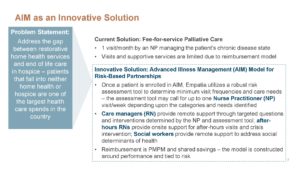
Medicare Advantage organizations and primary physician groups receive a “cost of care” analysis for the duration of the patient care. The organization takes on the risk of that patient costing more than what the MA plan will pay, but can make more money if patient care costs less than anticipated. Palliative care at home costs less. David Causby, President and CEO of Gentiva, a Hospice organization that operates in 35 states across the U.S. and has an average daily census of 26,000, has implemented a plan of care in cooperation with these organizations in what he calls Advanced Illness Management (AIM) Model for Risk-Based Partnerships. Designed for palliative care, Gentiva creates a plan of care that includes visit frequency and care needs and employs nurse practitioners, care managers, after hours RNs and social workers. The hospital pays Gentiva on a PMPM model with shared savings. The hospital still gets paid the full amount from MA but uses fewer resources, has lower costs, and sees reduced rehospitalizations, saving more than what they pay out. According to Gentiva, this partnership “provides value to contracted organizations by decreasing the overall end-of-life spend on this high-risk patient population.”

Supportive Care at Home Innovations

Supportive Care at Home (Private Duty Home Care, Private Pay, Non-medical home care) is not covered by Medicare, Medicare Advantage, or most health insurance plans. Limited Medicaid grants, VA plans, and long-term health insurance pay for some supportive care at home. Without one of these plans, patients and family members pay out-of-pocket for supportive care at home, averaging $22-$27 per hour with a 4-hour minimum. In some states it can cost up to $50 per hour. At $80 per day, that’s around $20,000 per year.

One software company we recently spoke with is upending the home care model with fee-for-service model that charges by the minute, rather than by the hour, making care more affordable for more people. You can see our product review of Caring on Demand here. By reducing the cost for customers and reducing the time for caregivers, agencies can onboard more customers without hiring more caregivers. The system is being used in facilities where these services are not provided, which allows a caregiver to visit several people in one stop. The agency and the caregiver can see the same income in the same time, spread out across multiple private payers.

Combining Innovation for a Win-Win-Win

I heard about Caring on Demand and spoke with its founder in August of 2023. I spoke with one Home Care agency owner who recently started working with Caring on Demand. “Times have changed,” the agency owner said. With fewer caregivers joining the workforce, increased levels of burnout since 2020, and CMS changes that overlook palliative and non-medical care, maybe there’s another way…

  • Partnerships with organizations and physician groups that have Medicare, MA, and traditional health insurance patients, non-medical home care agencies, and palliative care providers.
  • Localized groups of patients in limited areas like retirement villages, planned communities, neighborhoods, or small towns.
  • Cost sharing and care coordination that includes in-home palliative care visits, supportive care, communication with primary care providers and specialists
  • Preventative intercessions to avoid unnecessary ER visits and hospitalizations
  • Shorter visits per caregiver with multiple visits to a community each day
  • Cost sharing among patients splitting a 4-hour minimum visit among 4-8 patients
  • Shared savings from reduced hospital stays, shorter durations of hospice care, and nursing visits that are supplemented by supportive care

Gentiva has experienced some success already in using shared savings as a payment model. Can costs be decreased even more by adding supportive home care to this plan? Is there enough shared savings for three payees instead of two? I don’t have the answers to these questions, but I do believe providers of supportive care and palliative care have been in the background, overlooked by CMS and MedPAC for long enough. If they aren’t going to recognize the positive impact and cost savings of home care and palliative care and include them in the reimbursement model, we may have to do it for them.

We’d love to hear your feedback on this and other innovative ways to combat the crisis of paying for care at home.

# # #

Kristin Rowan

Kristin Rowan has been working at Healthcare at Home: The Rowan Report since 2008. She has a master’s degree in business administration and marketing and runs Girard Marketing Group, a multi-faceted boutique marketing firm specializing in event planning, sales, and marketing strategy. She has recently taken on the role of Editor of The Rowan Report and will add her voice to current Home Care topics as well as marketing tips for home care agencies. Connect with Kristin directly kristin@girardmarketinggroup.com or www.girardmarketinggroup.com

©2024 by The Rowan Report, Peoria, AZ. All rights reserved. This article originally appeared in Healthcare at Home: The Rowan Report.homecaretechreport.com One copy may be printed for personal use: further reproduction by permission only. editor@homecaretechreport.com


Why Every Provider Must Establish and Maintain a Fraud and Abuse Compliance Program

Admin

by Elizabeth E Hogue, Esq.

Providers may have heard or read about the importance of Fraud and Abuse Compliance Plans in their organizations. Despite the wealth of available information about Compliance Plans, many providers continue to express uncertainty about their value. Here are some of the questions providers commonly ask about Compliance Plans:

Why should we have a Fraud and Abuse Compliance Plan?

First, the Office of Inspector General (OIG) of the U.S. Department of Health and Human Services has clearly stated that, consistent with the Affordable Care Act (ACA) as described below, all providers are now expected to have current Compliance Plans that are fully implemented.

As a practical matter, when providers establish and maintain Compliance Plans, it clearly discourages regulators from pursuing allegations of fraud and abuse violations.

Technically speaking, the Federal Sentencing Guidelines make it clear that establishment and implementation of Compliance Plans is considered to be a mitigating factor. That is, if accusations of criminal conduct are made, the consequences may be substantially less severe because of a properly implemented Compliance Plan.

In addition, providers with Compliance Plans are more likely to avoid fraud and abuse. This is because Plans routinely establish an obligation on the part of every employee to report possible instances of fraud and abuse, and Plans include training for all employees.

Compliance Plans may help to prevent qui tam or so-called “whistleblower” lawsuits by private individuals, rather than by government enforcers, who believe that they have identified instances of fraud and abuse. There are significant incentives to bring these legal actions since whistleblowers receive a share of monies recovered because of their efforts. Some whistleblowers have received millions of dollars. Compliance Plans make it clear that employees have an obligation to bring any potential fraud and abuse issues to the attention of their employers first. Compliance Plans provide a clear path to resolve fraud and abuse issues internally.

In addition, the federal Affordable Care Act (ACA) requires providers to have Compliance Plans. In short, it’s the law!

Finally, the Deficit Reduction Act (DRA) requires providers who receive more than $5 million in monies from state Medicaid Programs per year to implement policies and procedures, provide education to employees, and put information in their employee handbooks about fraud and abuse compliance.  These requirements can be met through implementation of Fraud and Abuse Compliance Plans.

We don’t receive reimbursement from the Medicare or Medicaid Programs. Do we still need a Compliance Plan?

Statutes and regulations governing fraud and abuse also apply to providers who receive payments from any federal and state healthcare programs, including Medicaid, Medicaid waiver and other federal and state health care programs, such as TriCare and the VA. Many private insurers have followed the federal government’s lead in terms of fraud and abuse enforcement. Therefore, providers that don’t receive reimbursement from the Medicare Program must have compliance plans, too.

We hear that the OIG of the U.S. Department for Health and Human Services has provided guidance for various segments of the healthcare industry regarding Compliance Plans.

  • Specifically, the OIG has already published guidance for clinical laboratories, hospitals, home health agencies, hospices, physicians’ practices, third-party billing companies, and home medical equipment companies. Should we just use the model guidance that is applicable to us?

The answer is, “No!” Guidance from the OIG is not a model Compliance Plan.   Guidance from the OIG consists of general guidelines and does not constitute valid Compliance Plans. In addition, the OIG has made it clear that Plans must be customized for each organization.

We have read that, before implementing Compliance Plans, providers must conduct expensive internal audits that can take many months to complete. Is this true?

While beginning the compliance process with an extensive internal audit is certainly one way to proceed, it is not the only viable way to work toward compliance. It is equally valid to begin with Compliance Plans that are customized for the organization and include training for all employees about fraud and abuse, and Compliance Plans. Then all staff members can subsequently participate in internal compliance activities, including audits, with a process in place to handle any issues that arise as a result of the audits.

We have all sorts of policies and procedures in our organization. Why do we need something else called a Compliance Plan?

Compliance Plans are specific types of documents that routinely address fraud and abuse issues that providers do not usually cover in internal policies and procedures. In addition, providers may not gain benefits under the Federal Sentencing Guidelines described in paragraph one (1) above if there is no formal document called a Compliance Plan.

We just spent a lot of money to become accredited or reaccredited. Doesn’t certification mean that we are in compliance?

On the contrary, Compliance Plans appropriately address potential fraud and abuse issues. They also include mechanisms for helping to ensure compliance, such as processes for identification and correction of potential problems that are not addressed during the certification process. In other words, organizations may be accredited, but fail to meet applicable compliance standards for fraud and abuse.

Will the fact that our organization has a Compliance Plan make any difference regarding the outcome of fraud and abuse investigations and the imposition of Corporate Integrity Agreements (CIA’s)?

Yes, it may make a considerable difference, based on statements from the OIG. If providers have Compliance Plans in place during investigations that are current and fully implemented, the OIG may be less aggressive in pursuing potential violations. Enforcers are likely to ask for information about Compliance Plans and related policies and procedures. Enforcers are now also likely to ask providers to show them how much money they have spent on fraud and abuse compliance activities!

When the OIG discovers problems with fraud and abuse in organizations, providers are usually asked to develop and implement a Corporate Integrity Agreement (CIA). The OIG often requires CIA’s to include a process for stringent monitoring by the OIG on a continuous basis. These monitoring activities can be extremely burdensome to providers in terms of both time and money. Providers with valid Compliance Plans may not be asked to develop and implement CIA’s.

Now is the time for all providers to recognize and act upon the need to establish and maintain Compliance Plans. “Working on it” is no longer good enough.

©2024 Elizabeth E. Hogue, Esq. All rights reserved.

No portion of this material may be reproduced in any form without the advance written permission of the author.


MedPAC Report Slammed for Telling Truth About MA Abuses

Regulatory

Untitled Document

Analysis by Tim Rowan, Editor Emeritus

P

erennial Home Health enemy MedPAC angered a different group last week by releasing a status report on insurance companies participating in the Medicare Advantage program.1


The report details the way in which giant, for-profit, health insurance companies improperly increase per-customer payments by upcoding their health assessment at enrollment, and then slash costs by denying coverage for healthcare services that traditional Medicare would have honored. MedPAC was also critical of the practice of requiring prior authorizations, backed up by utilization review algorithms that are supposedly intended to “minimize furnishing unnecessary services” but which effectively increase denials for necessary care.

According to the report, MedPAC expects CMS to pay MA plans $88 billion in 2024. 

On January 12, a meeting to discuss the report ended in what one reporter politely described as “a kerfuffle.” Other witnesses to the meeting chose to describe it as a shouting match.

“One member, Brian Miller, MD, MPH, of Johns Hopkins University in Baltimore, accused panel leadership of issuing a negative status report on MA plans’ market dominance, saying it had been ‘hijacked for partisan political aims to justify a rate cut to Medicare Advantage plans.’

“Miller said the analysis … ‘appears to be slanted to arrive at a foregone conclusion in order to set up and provide political cover’ just before the Centers for Medicare & Medicaid Services prepares its annual rate notice for MA plans, expected in coming weeks. ‘The chapter reads like attack journalism as opposed to balanced and thoughtful policy research.'”2

Report authors fired back, citing numerous ways MA plans generate higher revenue, including enrolling people who are relatively healthy, known as favorable selection. They then vigorously scan patients’ medical histories and charts to code for health factors that generate higher per-capita payments, known as coding intensity, often spending less on services. Coding intensity is also the difference between a risk score that a beneficiary would receive in an MA plan versus in fee-for-service. Though MA plans skew toward healthier enrollees, MedPAC found that MA risk scores are about 20.1% higher than scores would be for the same beneficiaries had they enrolled in Fee For Service Medicare.


Namath, Walker, Shatner and Brokers

Criticism of MA plan behavior did not only come from MedPAC commissioners and report authors. For example, Lynn Barr, MPH, founder of Caravan Health, which was acquired by CVS Health through its acquisition of Signify Health, exposed what the annual TV ads do not make clear, that their 800 numbers go to brokers, not to any one plan.

“This is not the big, lovely, glowing success that everybody says it is. And we continue to create policies that drive people into these plans. Medicare allows money paid to MA plans to be used for broker commissions as high as “$600 to recruit them, plus $300 a year every year that they stay in the MA plan.

“We have allowed MA to buy the market, and that is why MA is growing. It’s not because the quality’s so great. People don’t love the prior auth, people are leaving their plans a lot. Aside from Medicaid, Medicare is the least profitable payer for doctors. And at the same time, we give all this money to the plans. It’s unconscionable.”

Adding to the “kerfuffle” with a powerful anecdote, Stacie Dusetzina, PhD, of Vanderbilt University Medical Center in Nashville, Tennessee, noted that even cancer patients often have trouble getting necessary care because of the plans’ limited networks. She referenced a January 7 NPR story3 about an MA enrollee who could not get the cancer care he needed from his MA plan, and could not get out of the plan without facing 20% in expensive copays. In all but four states, supplemental plans that could pick up the difference can reject patients with costly conditions.

“When you are 65 and aging into the program,” Dr. Dusetzina summarized, “you are healthy at that time and may not be thinking about your long-term needs. [If you did], it would push you to think harder about the specialty networks that you may or may not have access to when the MA plan is making your healthcare decisions.”


1 A 30-page slide presentation is available to the public at medpac.gov/wp-content/uploads/2023/10/MedPAC-MA-status-report-Jan-2024.pdf. The complete report is available only to MedPAC commissioners. The charts on slides 26 and 27 show how MA plans learned to pad profits in 2018 and increased the practices exponentially since then.

2 Cheryl Clark, MedPage Today January 16, 2024 medpagetoday.com/special-reports/features/108275

3 npr.org/2024/01/07/1223353604/older-americans-say-they-feel-trapped-in-medicare-advantage-plans


Tim Rowan


Tim Rowan is a 30-year home care technology consultant who co-founded and served as Editor and principal writer of this publication for 25 years. He continues to occasionally contribute news and analysis articles under The Rowan Report’s new ownership. He also continues to work part-time as a Home Care recruiting and retention consultant. RowanResources.com; Tim@RowanResources.com


©2024 by The Rowan Report, Peoria, AZ. All rights reserved. This article originally appeared in Healthcare at Home: The Rowan Report.homecaretechreport.com One copy may be printed for personal use: further reproduction by permission only. editor@homecaretechreport.com

CMS Proposes Policy Changes to Medicare C & D

CMS

From the NAHC Newsroom

Public comments due January 5, 2024

CMS Policy Changes to Medicare C & D. On November 5, 2023, the Centers for Medicare & Medicaid Services (CMS) issued the Contract Year 2025 Policy and Technical Changes to the Medicare Advantage Program, Medicare Prescription Drug Benefit Program, Medicare Cost Plan Program, and Programs of All-Inclusive Care for the Elderly; Health Information Technology Standards and Implementation Specifications.

Key provisions in the CMS policy changes that are of interest to home health and hospice providers are detailed below.CMS Policy Changes

Behavior Health

CMS aims to improve access to behavioral health care by adding certain behavioral health provider specialties to the MA network adequacy standards as a new facility-specialty type. The new facility-specialty type, ‘‘Outpatient Behavioral Health,’’ can include Marriage and Family Therapists (MFTs), Mental Health Counselors (MHCs), Opioid Treatment Program (OTP) providers, Community Mental Health Centers or other behavioral health and addiction medicine specialists and facilities.

Special Supplemental Benefits for the Chronically Ill (SSBCI)

CMS is proposing regulatory changes that would help ensure that SSBCI items and services offered are appropriate and improve or maintain the health or overall function of chronically ill enrollees. The MA organization must be able to demonstrate through relevant acceptable evidence that an item or service offered as SSBCI has a reasonable expectation of improving or to maintain the health or overall function of a chronically ill. The MA plan must follow its written policies based on objective criteria for determining an enrollee’s eligibility for an SSBCI when making such eligibility determinations. CMS is proposing to require that the MA plan document its denials of SSBCI eligibility rather than its approvals.

CMS will also modify and strengthen the current requirements for the SSBCI disclaimer that MA organizations offering SSBCI must use whenever SSBCI are mentioned. Additionally, CMS proposes to require MA plans to notify enrollees mid-year of the unused supplemental benefits available to them. The notice would list any supplemental benefits not utilized by the beneficiary during the first 6 months of the year.

Guardrails for Agent and Broker Compensation

CMS is proposing to generally prohibit contract terms between MA organizations and agents, brokers or other third party marketing organizations (TPMOs) that may interfere with the agent’s or broker’s ability to objectively assess and recommend the plan that best fits a beneficiary’s health care needs, CMS proposes to set a single compensation rate for all plans; revise the scope of items and services included within agent and broker compensation; and eliminate the regulatory framework which currently allows for separate payment to agents and brokers for administrative services. CMS also intends to make similar changes to the Part D agent broker compensation rules.

Health Equity and Utilization Management (UM)

CMS proposes to require that a member of the UM committee have expertise in health equity and that t the UM committee conduct an annual health equity analysis of the use of prior authorization. The analysis would examine the impact of prior authorization on enrollees with one or more of the following social risk factors (SRFs): receipt of the lowincome subsidy or being dually eligible for Medicare and Medicaid (LIS/DE); or having a disability.

Right To Appeal an MA Plan’s Decision To Terminate Coverage for Non-Hospital Provider Services

Beneficiaries enrolled in Traditional Medicare and MA plans have the right to a fast-track appeal by an Independent Review Entity (IRE) when their covered skilled nursing facility (SNF), home health, or comprehensive outpatient rehabilitation facility (CORF) services are being terminated. Currently, Quality Improvement Organizations (QIO) act as the IRE and conduct these reviews. Under current regulations, MA enrollees do not have the same access to QIO review of a fast-track appeal as Traditional Medicare beneficiaries. CMS proposes to (1) require the QIO, instead of the MA plan, to review untimely fast-track appeals of an MA plan’s decision to terminate services in an HHA, CORF, or SNF; and (2) fully eliminate a provision that requires the forfeiture of an enrollee’s right to appeal a termination of services decision when they leave the facility. These proposals would bring MA regulations in line with the parallel reviews available to beneficiaries in Traditional Medicare and expand the rights of MA beneficiaries to access the fast-track appeals process.

  • Dual eligible Special Needs Plans (D-SNP)
  • CMS proposes to increase the percentage of dually eligible managed care enrollees who receive Medicare and Medicaid services from the same organization.
  • CMS is also proposing to limit out-of-network cost sharing for D–SNP preferred provider organizations (PPOs) for specific services.

Further, CMS is proposing to lower the D–SNP look-alike threshold from 80 percent to 70 percent for plan year 2025 and 60 percent for plan year 2026. This proposal would help address the continued proliferation of MA plans that are serving high percentages of dually eligible individuals without meeting the requirements to be a D–SNP.

The National Association for Home Care and Hospice will continue to analyze the proposed rule, but    supports CMS’ aim to protect Medicare beneficiaries by modifying policies and procedures that will improve programs under Part C and Part D.

Public comments are due January 5, 2024.

This article originally appeared at https://nahc.org/cms-proposes-policy-changes-to-medicare-part-c-and-part-d/. All rights reserved.

OIG Crackdown on Employees Ineligible to Work for Medicare

CMS

Dear Friends,

I have some news that may be upsetting. Frankly, that is my intention, to frighten you into action.

In August, a Home Health provider in New York paid an $$866,339.25 fine for violating the “Civil Monetary Penalties Law.”* The Chinese-American Planning Council Home Attendant Program had employed an individual, in connection with the New York State Consumer Directed Personal Assistance Program (CDPAP), who was excluded from participation in the New York Medicaid program and was not eligible to furnish services under the CDPAP.

Georgia provider Agape Hospice Care paid $250,993.97 in penalties, the specific amount it had paid in salary and benefits to two unlicensed nurses.

If this law is unfamiliar to you, it is the requirement that you may not employ any individuals who are not eligible to work within the Medicare system.*

This is only one example of a new OIG crackdown!

  • Bridges MN, a non-profit with services to the disabled, was fined $150,171.96 for employing a single excluded individual.
  • Vicki Roy Home Health Service paid a $38,000 fine for employing one excluded caregiver.
  • Providence Health System-Southern California, doing business as Providence Little Company of Mary Medical Centers, which includes two hospitals, agreed to pay $141,562 in connection with the employment of an excluded emergency services technician from Aug. 8, 2016, to June 5, 2019. (Note that this person was employed for nearly three years without the health system knowing, as they are required to know, that he or she was excluded.)
  • Joseph Health Personal Care Services, doing business as Nurse Next Door, agreed to pay $32,244 in connection with the employment of an excluded constant care attendant from Nov. 2, 2017, to Aug. 8, 2019.

My friends, the list goes on and on, and these are just the Home Health agencies:

  • Serenity Home Healthcare Services Agreed to Pay $146,000
  • Professional Home Health Care 2: $77,000
  • Chinese-American Planning Council Home Attendant Program: $866,000
  • Visiting Angels of Rhode Island: $158,000

I learned of at least 25 other healthcare providers that were fined under this law. Clearly, the HHS OIG is on the warpath. This is not a regulation you are wise to ignore.

That is why I write you today. I have found an affordable service that performs monthly OIG exclusion screening for you. Doing it yourself would require a dedicated FTE and hours of painstaking work.

I would be honored if you would accept my introduction to the company that provides this service. If the fines I listed above grabbed your attention, you can see that a service of this type is like an insurance policy that costs a fraction of the disaster it can prevent.

The company is called Carosh Compliance Services. The monthly service is called “OIG Express.” I know and trust the founding CEO, Roger Shindell. To contact Roger and learn more about this necessary service, use this link: https://oig.hhs.gov/faqs/exclusions-faq/
Sincerely,

Tim Rowan
Editor Emeritus
The Rowan Report
Tim@RowanResources.com

Medicare Dollars Flow Freely to MA Plans

Editorial

analysis by Tim Rowan, Editor

It is good to occasionally remind ourselves that 2023 is the year enrollment in Medicare Advantage reached a full half of Medicare beneficiaries. Originally conceived as a plan to control spending, MA does seem to be achieving that goal.

At what cost, however?

The Medicare trust fund pays insurance companies participating in the MA program a per-patient-per-month fee based on the company’s own declaration of each customer’s health and likely future needs. With those monthly payments, MA companies provide care as needed. Or at least they are supposed to.

Frequently, since the program began, whistleblowers have told the government that employees are rewarded for increasing a patient’s risk-adjustment, the clinical assessment that is supposed to be scored by a physician but is often instead scored through data mining. That practice involves employees searching through patient records, looking for signs of health conditions that would raise their assessment, and thus their value to the insurer. In other words, a class of crime that would earn an HHA a hefty fine if they did it with their OASIS assessments.

Evidence has been mounting lately that these insurance companies not only fudge the numbers to gather more than they should from Medicare, but they also provide as little care as they can get away with. Our industry is familiar with the penny-pinching MA companies practice when authorizing in-home care. The problem is larger than that.

String of Recent Accusations

  • The HHS Office of Inspector General issued a report revealing how Elevance, the company formerly known as Anthem, made $5.5 billion in profits in the first six months of this year, a 14.4% jump from the $4.8 billion in profits it made during the same period of 2022. The profits, OIG said, came mostly from denying care to Medicaid beneficiaries, care that their physicians had recommended.
  • The largest insurer, with 27 percent of the market, UnitedHealth’s investors were distraught in June when it appeared the company was spending too much on patient care. Their fears were calmed, however, when United reported revenue of $56.3 billion for 2Q 2023, compared to $45.1 billion in the same quarter of 2022.
  • Cigna is the target of a class action suit in California, in which it is accused of using an algorithm to deny care, overriding and sometimes ignoring physician recommendations.1

Last October, the New York Times summarized the problem with a list of recent government findings and accusations:

“Kaiser Permanente called doctors in during lunch and after work and urged them to add additional illnesses to the medical records of patients they hadn’t seen in weeks. Doctors who found enough new diagnoses could earn bottles of champagne, or a bonus in their paycheck.

“Elevance Health paid more to doctors who said their patients were sicker. And executives at UnitedHealth Group, the country’s largest insurer, told their workers to mine old medical records for more illnesses — and when they couldn’t find enough, sent them back to try again.

“Each of the strategies — which were described by the Justice Department in lawsuits against the companies — led to diagnoses of serious diseases that might have never existed. But the diagnoses had a lucrative side effect: They let the insurers collect more money from the federal government’s Medicare Advantage program.”

Comparison to Home Health and Hospice

Naturally, these examples reach into the hundreds of billions because MA covers hospital and physician claims, but the comparison to our sector is nevertheless valid.

Since payments to HHAs were first attached to patient assessments a quarter century ago, clinicians have gotten better and better at the task. OASIS assessments are more accurate and thorough than they used to be. Professional coders are more adept at identifying and sequencing appropriate diagnosis codes. AI-assisted tools entering the fray promise an enhanced level of accuracy. (See our product review of the most promising of these tools.)

From the beginning, more accurate assessments have always meant a 10 to 15 percent increase in an agency’s episodic payment over less accurate OASIS scores. Wary of being accused of upcoding, nurses have always been unnecessarily cautious with their intake assessments.

Upcoding Accusations

CMS has always responded to increasing accuracy with accusations of upcoding, even though the Medicare trust fund more often benefits from the above described undercoding habit. Regulatory adaptations have enshrined the fear of upcoding into an assumption that it will happen, with payments slashed in advance just in case it does.

When errors in assessments and claims are discovered by CMS contractors through sampling, the overpayment amount found in the sample is extrapolated to an agency’s entire patient census. The result has at times crossed the line into seven figures, with a payback demand that occasionally cripples the HHA.

Compare this practice to the gift given to MA companies that we revealed in these pages last February: “Government Lets Health Plans That Ripped Off Medicare Keep the Money” In researching that story, we found that CMS typically postpones its duty to audit the risk adjustment figures that MA plans submit annually. After getting more than a decade behind, they decided to write off overpayments to MA plans prior to 2018 and start auditing from that year forward.

As an additional gift they said they would demand repayments only on the amounts turned up in their sample dataset, without extrapolating to each MA’s total patient population as they do with HHAs.

What can one conclude from this comparison? Possibly that CMS is very good at policing millions of dollars but gets overwhelmed and gives up with amounts in the billions.

Tim Rowan, Editor EmeritusTim Rowan is a 30-year home care technology consultant who co-founded and served as Editor and principal writer of this publication for 25 years. He continues to occasionally contribute news and analysis articles under The Rowan Report’s new ownership. He also continues to work part-time as a Home Care recruiting and retention consultant. More information: RowanResources.com
Tim@RowanResources.com

©2024 by The Rowan Report, Peoria, AZ. All rights reserved. This article originally appeared in Healthcare at Home: The Rowan Report.homecaretechreport.com One copy may be printed for personal use: further reproduction by permission only. editor@homecaretechreport.com


1 https://sharylattkisson.com/2023/08/class-action-suit-filed-against-cigna-over-alleged-use-of-algorithm-to-review-reject-patient-claims/