UnitedHealth Causes Heightened Alarm

by Kristin Rowan, Editor

UnitedHealth Causes Heightened Alarm

Guardian Investigation Launches Probe

In July of 2025, The Guardian reported that UnitedHealth had secretly paid nursing homes to reduce hospital transfers. The investigation revealed that UnitedHealth was placing its own medical teams inside nursing homes and pushing them to cut care expenses, delay transfers, and deny care.

Senators Push for Answers

In the weeks following The Guardian report, Senators Ron Wyden (D-OR) and Elizabeth Warren (D-MA) launched their own investigation of the insurance giant’s cost cutting measures in nursing homes. Wyden and Warren sent a letter to then UnitedHealth Group leaders requesting documents and information about the nursing home incentive program.

New Allegations

A new letter from Senators Wyden and Warren states that UHG has refused to comply with the initial request. In the months since the demand for information, UHG has provided only “brief and unsubstantial answers” to their questions.

“Because you have failed to respond adequately to our inquiry – and in light of additional recent reporting – we are renewing our inquiry with heightened alarm.”

Ron Wyden and Elizabeth Warren

United States Senators

Additional Reports

The Senators’s letter alludes to recent additional reports. They were referring to a December story, also from The Guardian, reporting allegations of wrongful deaths inside the nursing home care program. In a statement, UnitedHealth denied any allegations their practices “endanger patient safety or violate ethical standards.”

No Response is a Response

When asked about the second letter, UnitedHealth Group did not respond to reporters at The Guardian. UHG leadership said in statement that they would “continue to engage” with the senators. The company’s leadership also maintains that its nursing home program “improves outcomes” and “reduces unnecessary hospitalizations.”

Unanswered Questions

UnitedHealth attended a briefing with the senators’ offices last July. During that meeting, UnitedHealth made several claims the Senators are now questioning.

  • UHG maintained their nurses are not required to contact company representatives prior to taking a nursing home patient to the hospital, but a document provided by a whistleblower alleges the opposite 
  • UHG failed to adequately explain why hospital admission rates are part of the metrics for determining bonuses
  • UHG chose not to respond to questions about pending wrongful death lawsuits for Mary GrantCindy Deal, and an unnamed nursing home resident in New York

Deadline to Comply

Senators Wyden and Warren allege that UnitedHealth Group has withheld internal documents that directly relate to their initial request for information. The senators gave a deadline of January 28, 2026 to respond with the following information:

  • Hospitalization policies, including clinical protocols for determining when transfers are warranted, definitions of avoidable versus unavoidable hospitalizations, and whether staff must consult Optum supervisors before hospital transfers.
  • Bonus program metrics and thresholds, including how UnitedHealth determines APK limits, whether facilities are penalized for exceeding thresholds, and five years of documentation on bonus payments to nursing homes.
  • Advance directive policies, including training materials for end-of-life conversations, the mortality risk assessment tool used, and who participates in those discussions with residents.
  • Marketing and enrollment practices for I-SNP plans at contracted nursing homes.
  • Federal oversight and compliance, including any CMS sanctions or enforcement actions in the past five years.
Wyden Warren UnitedHealth Group Heightened Alarm

Failure to Respond

Without adding details, the letter states that should UnitedHealth Group fail to respond it full, they will seek answers to their questions using “all tools at the Committee’s disposal.”

This is an ongoing inquiry/investigation and story. The Rowan Report will continue to provide updates as they become available.

# # #

Kristin Rowan Editor The Rowan Report

Kristin Rowan is the owner and Editor-in-chief of The Rowan Report, the industry’s most trusted source for care at home news. She is also a sought-after speaker on Artificial Intelligence, Technology Adoption and Lone Worker Safety. She is available to speak at state and national conferences as well as software user-group meetings.

Kristin also runs Girard Marketing Group, a multi-faceted boutique marketing firm specializing in content creation, social media management, and event marketing. She works with care at home software providers to create dynamic content that increases conversions for direct e-mail, social media, and websites.  Connect with Kristin directly at kristin@girardmarketinggroup.com or www.girardmarketinggroup.com

©2026 by The Rowan Report, Peoria, AZ. All rights reserved. This article originally appeared in The Rowan Report. One copy may be printed for personal use: further reproduction by permission only. editor@therowanreport.com


 

CMS Proposed Changes

by Kristin Rowan, Editor

CMS is Making Changes

Good or Bad?

CMS is making changes across Medicare and Medicare Advantage. From Star Ratings to Prescription Drug Prices to the Hospice benefit, CMS is embracing Make America Healthy Again. Will these initiatives benefit Medicare and Medicare Advantage recipients or the insurance companies who provide the plans?

Drug Payment Model

In early November, CMS announced a plan to lower prescription drug costs for Medicaid recipients. State Medicaid programs can opt in to the GENErating cost Reductions fOr U.S. Medicaid Model (GENEROUS). The pilot program is using the most-favored-nation pricing that was recently negotiated and announced by President Trump. Most-favored-nation pricing requires prescription drug manufacturers to charge the same low rate paid in other countries.

Limited Pilot

Beginning in 2026, CMS will negotiate with manufacturers of select drugs for lower pricing. Participating states will start using uniform, transparent coverage criteria. This is not criteria for inital coverage in Medicaid, but for standardizing access to high-cost medications.

Manufacturers are not required to participate in the GENEROUS Model, but can voluntarily apply. Participating manufacturers agree NOT to seek additional supplemental rebates or discounts outside the model price.

New Medicare Advantage Policies

CMS has proposed updates to the Medicare Advantage and Medicare Part D programs. The new plan would begin in CY 2027 and includes major changes to the Star Ratings system. CMS is also seeking feedback on new ways to modernize MA. 

Star Rating Changes

The proposed changes are supposed to incentivize plans to improve care. CMS suggests removing 12 unique measures that look at administrative processes and those that don’t highlight differences between plans. Star Rating measurements of care, outcomes, and patient experience will remain. 

Request for Feedback

CMS is seeking feedback on Medicare Advantage changes, including improving competition, refining risk adjustment, and aligning quality incentives to deliver greater value. CMS is open to either a limited model test or program-wide changes. Interested parties can submit feedback through January 26, 2026. Read the Proposed Rule here. Submit your comments.

Expanding Technology-Enabled Care

CMS may finally be recognizing what we’ve been promoting for 25 years: Care improves with technology support. 

CMS Proposed Changes<br />
Technology-based Care

The ACCESS model tests a new payment approach in original Medicare to expand access to technology-supported care options. CMS aims to increase technology-supported care options to improve health and prevent and manage chronic diseases. More than two-thirds of Medicare beneficiaries are dealing with high blood pressure, diabetes, chronic musculoskeletal pain, and depression.

An interest form is now available for the 10-year Advancing Chronic Care with Effective, Scalable Solutions (ACCESS) Model test. The model test begins July 1, 2026. The application to participate must be received by April 1, 2026.

Impact

As these programs roll out between now and 2029, the impact on insurance plans, payors, beneficiaries, and taxpayers will unfold. Will lower cost prescriptions and technology-based care lower insurance rates? Payor reform may be necessary to change out-of-pocket costs. Regulations may have to further incentivize payors to increase care when costs go down, particularly with value-based care models. 

Please take a few minutes to read the details on each of these proposals, add your comments, and sign up to participate. The industry needs reform and our aging family members deserve better.

# # #

Kristin Rowan, Editor

Kristin Rowan has been working at The Rowan Report since 2008. She is the owner and Editor-in-chief of The Rowan Report, the industry’s most trusted source for care at home news, and speaker on Artificial Intelligence and Lone Worker Safety and state and national conferences.

She also runs Girard Marketing Group, a multi-faceted boutique marketing firm specializing in content creation, social media management, and event marketing.  Connect with Kristin directly kristin@girardmarketinggroup.com or www.girardmarketinggroup.com

©2025 by The Rowan Report, Peoria, AZ. All rights reserved. This article originally appeared in The Rowan Report. One copy may be printed for personal use: further reproduction by permission only. editor@therowanreport.com

 

MedPAC Proposes Drastic Cut

by Kristin Rowan, Editor

MedPAC Proposes Drastic Cuts

Five Year Decrease Not Enough

The onset of PDGM and the recalculations of payments in 2020 have led to an overall decrease in Medicare reimbursement rates for home health by approximately 12%. CMS continues to calculate budget neutrality with flawed formulas. The Alliance, along with several other advocacy groups as well as agencies and individuals, continues to fight against the formula and the pay cuts, estimating that nearly half of all home health agencies will be losing money in order to stay open. 

Industry Report

Despite the continual decrease in payment rates, MedPAC recommends additional steep cuts. Highlights from the MedPAC report include:

  • 97% of beneficiaries have access to 2 or more HHAs
  • The total number of HHAs declined 1% in 2024 (excluding CA)
  • Only 7.9% of beneficiaries used HH in 2024
  • Number of 30-day periods per beneficiary increased 2.6%
  • The overall profit margin for Traditional Medicare is 21.2%
  • The overall profit margin for all payers is 5%
  • Anticipated profit margin for 2026 is 19% for Traditional Medicare (3% overall)

Less than 0

The Traditional Medicare profit margin in 2026 is projected at 19%. This is offset by the negative profit margin from Medicare Advantage and private insurance plans. It may not be realistic or fair for the taxpayer to offset poor policies in Medicare Advantage and private insurance plans, but that has been the reality for years. Medicare Advantage plans yield high profits for insurance payors, and negative margins for HHAs. With an overall profit margin of 3%, lowering the Medicare reimbursement rate by more than 3% will put all HHAs in the red.

The Math Isn't Mathing

The numbers are there. HHAs earn 5% now, 3% next year. MedPAC recommends that CMS reduce the 2026 rate by an additional 7%.

NET PROFIT MARGIN -4%

Conclusion from MedPAC: This will not impact care; providers will still be willing to treat Traditional Medicare beneficiaries.

MedPAC proposes drastic cuts

That statement may be true. However, in order for HHAs to survive, they will have to drop all MA plans. More than 50% of Medicare beneficiaries are on MA plans. 40% of MA patients use HH care after hospitalization. Medicare Advantage will survive through hospitals and physicians, but the Home Health benefit won’t have any providers.

Hospice Tie-In

CMS is currently weighing the option of the hospice carve-in to Medicare Advantage plans. The pilot plan failed miserably and yet rolling this out across all plans is an option, somehow. CMS and MedPAC must not be able to see what has happened to Home Health under MA plans. Hospice will suffer the same fate through the carve-in. It is irresponsible and destructive to add Hospice to MA. For that matter, it is irresponsible and destructive NOT to remove Home Health from MA. Move it all back to Traditional Medicare where at least the profit margin is above 0.

May Cooler Heads Prevail

From the proposed rule in July to the final rule in November, CMS lessened the permanent rate cut by about 5%, finally hearing the concerns of advocates who told them HHAs would go out of business. We certainly hope CMS will keep that in mind when considering the MedPAC recommendation.

# # #

Kristin Rowan, Editor

Kristin Rowan has been working at The Rowan Report since 2008. She is the owner and Editor-in-chief of The Rowan Report, the industry’s most trusted source for care at home news, and speaker on Artificial Intelligence and Lone Worker Safety and state and national conferences.

She also runs Girard Marketing Group, a multi-faceted boutique marketing firm specializing in content creation, social media management, and event marketing.  Connect with Kristin directly kristin@girardmarketinggroup.com or www.girardmarketinggroup.com

©2025 by The Rowan Report, Peoria, AZ. All rights reserved. This article originally appeared in The Rowan Report. One copy may be printed for personal use: further reproduction by permission only. editor@therowanreport.com

 

BREAKING NEWS: Home Health Final Rule

by Kristin Rowan, Editor

BREAKING NEWS

Home Health Final Rule

While most of us were still recovering from our Thanksgiving feast overload, CMS quietly released the CY 2026 Home Health Prospective Payment System Final Rule (HH Final Rule). In past years, CMS published the HH Final Rule on or about November 1. The HH Final Rule was delayed this year due to the government shutdown.

Payment & Policy Updates

The payment rate for 2026 will change based on multiple factors:

  • HH payment update of +2.4%
  • The final permanent rate adjustment of -0.9%
  • The final temporary adjustment of -2.7%
  • Fixed-dollar loss ratio for outlier payments update of -0.1%

The aggregated payment update for 2026 is a net decrease of 1.3%

Read the CMS Fact Sheet

Face-to-Face

The CARES Act allows Nurse Practitioners, Certified Nurse Specialists, and Physicians Assistants to order and certify eligibility for Medicare HH and establish a plan of care. CMS has updated face-to-face encounters to now allow NPs, CNSs, PAs and physicians to perform face-to-face encounters whether or not they were the certifying practitioner or one who cared for the patient prior to home health care.

Home Health VBPM

Effective in April 2026, the HHCAHPS survey will undergo changes. CMS is removing these three survey-based measures:

  • Care of Patients
  • Communications between Providers and Patients
  • Specific Care Issues

CMS is adding four measures to them measure set. These include three measures related to bathing and dressing and the Medicare Spending per Beneficiary setting measure. These changes also prompted alterations to the weights of each measure and measure category. 

The expanded model has built-in criteria for the removal of any quality measure. CMS is adding an additional criteria to the list of factors. Factor 9 reads that CMS may remove a quality measure if it is not feasible to implement the measure specificiations.

Medicare Provider Enrollment Revocation

Currently, any provider must enroll and be approved to become a Medicare provider. CMS has the authority to both approve and revoke provider Medicare enrollment. When CMS revokes a provider’s Medicare enrollment, the revocation is effective 30 days after CMS mails notification to the provider. In certain circumstances, CMS can revoke enrollment retroactively to the first date of non-compliance and consequently collect any money paid to that provider back to the retroactive date. CMS is adding to the allowable grounds for retroactive revocation.

  • If an enrolled physician or practitioner has not ordered or certified services for 12 consective months
  • If a beneficiary attests that a provider did not actually perform the services they billed

Additional Changes

CMS is recalibrating case-mix weights under PDGM and LUPA thresholds.

DMEPOS accreditation regulations will now require suppliers to be resurveyed and reaccredited annually. Additionally, CMS is increasing the amount and frequency of data accrediting organizations (AOs) submit, expanding their ability to monitor AOs, and strengthening their ability to address poorly performing AOs.

The DMEPOS Competitive Bidding Program will change, but we are still waiting for the finalized improvements. CMS will begin paying for all continuous glucose monitors and insulin infusion pumps.

Read the Final Rule and additional Documents

Final Thoughts

A decrease in pay of any amount is unfortunate. However, we applaud CMS for listening to the feedback. CMS stated, “…commenters raised concers that behavior change after CY 2022 might [attribute] to factors unrelated to…PDGM.” Changes since 2020 include the introduction of OASIS-E, the expansion of value-based purchasing, and the large increase in the percentage of Medicare Advantage enrollees.

Whatever the reason, The Rowan Report joins the National Alliance for Care at Home in commending CMS for adjusting its payment calculations. The permanent pay adjustment for 2026 is listed as the final adjustment, a positive for HH moving forward. The proposed rule issued mid-year had a net -6.4% decrease in payments for a net decrease of more than $1 billion dollars. The final rule payment adjustment has a net decrease of $220 million. Still a decrease, but much more palatable.

CMS will continue to assess the need for temporary payment adjustments for several more years. Additional adjustments (read decreases) to the payment rate will impact patient access to care. The Alliance will continue to advocate and educate members of Congress and HHS to lower or eliminate they reductions. Your advocacy and support is needed to ensure the future of Care at Home. The Rowan Report will continue to support the Alliance and other advocacy groups and share with you opportunities for advovacy.

# # #

Kristin Rowan, Editor

Kristin Rowan has been working at The Rowan Report since 2008. She is the owner and Editor-in-chief of The Rowan Report, the industry’s most trusted source for care at home news, and speaker on Artificial Intelligence and Lone Worker Safety and state and national conferences.

She also runs Girard Marketing Group, a multi-faceted boutique marketing firm specializing in content creation, social media management, and event marketing.  Connect with Kristin directly kristin@girardmarketinggroup.com or www.girardmarketinggroup.com

©2025 by The Rowan Report, Peoria, AZ. All rights reserved. This article originally appeared in The Rowan Report. One copy may be printed for personal use: further reproduction by permission only. editor@therowanreport.com
 

Hospice Carve-In is Out

FOR IMMEDIATE RELEASE

Contact:                                                                   Hannah Kristan
communications@allianceforcareathome.org
202-355-1647

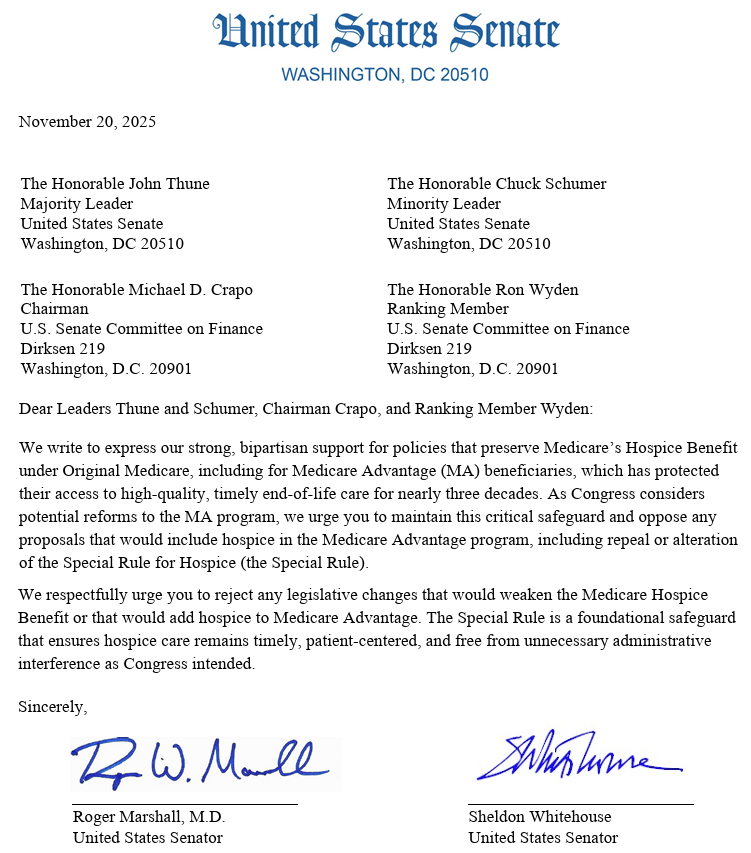
Sen. Marshall and Sen. Whitehouse Issue Letter to Senate Leadership Expressing Bipartisan Support for Policies that Preserve Medicare’s Hospice Benefit Under Original Medicare

Alexandria, VA and Washington, D.C., November 24, 2025. On November 20, Senator Roger Marshall (R-KS) and Senator Sheldon Whitehouse (D-RI) sent a letter to Senate leadership expressing strong bipartisan support for policies that preserve the Medicare Hospice Benefit under Original Medicare, including for Medicare Advantage (MA) beneficiaries, which has protected their access to high-quality, timely end-of-life care for nearly three decades. 

Repeal Special Rule

As Congress considers potential reforms to the MA program, the letter urges Senate leadership to maintain this critical safeguard and oppose any proposals that would include hospice in the Medicare Advantage program, including repeal or alteration of the Special Rule for Hospice (the Special Rule), also known as hospice carve-in.  

Hopice in MA

Despite years of attempts from Congress, the Alliance strongly opposes efforts to integrate hospice into Medicare Advantage (MA). Past attempts have revealed challenges such as administrative burdens, difficulty creating networks, and delayed payments for claims. Bringing hospice under Medicare Advantage would undermine patient choice, adversely impact timely access to care, and fragment the hospice experience for patients and families at a highly vulnerable time.

View the full letter here. 

Leave Hospice Carve-In Out

Excerpt

“MA enrollees who elect hospice currently retain the freedom to choose any Medicare-certified hospice provider, free from network limitations or prior authorization requirements. More than half of hospice beneficiaries pass away within 14 days of election, making delays in care both harmful and unacceptable. Integrating the hospice benefit into MA plan design would jeopardize this access by layering additional managed care terms (or policies) on top of an already managed and coordinated benefit.” 

Marshall and Whitehouse

U.S. Senators

Your content goes here. Edit or remove this text inline or in the module Content settings. You can also style every aspect of this content in the module Design settings and even apply custom CSS to this text in the module Advanced settings.

“The Alliance thanks Sen. Marshall and Sen. Whitehouse for listening to the concerns of the care at home community and taking action to protect our nation’s most vulnerable patient population by defending the Hospice Benefit under original Medicare,” said Scott Levy, Chief Government Affairs Officer at the Alliance. “The Alliance will continue to lead on this important public policy priority for hospice providers nationwide by advocating to preserve this sacred promise established by Congress and kept on behalf of the American people for over four decades.” 

# # #

About the National Alliance for Care at Home

The National Alliance for Care at Home (the Alliance) is the leading authority in transforming care in the home. As an inclusive thought leader, advocate, educator, and convener, we serve as the unifying voice for providers and recipients of home care, home health, hospice, palliative care, and Medicaid home and community-based services throughout all stages of life. Learn more at www.AllianceForCareAtHome.org.  

© 2026. This press release originally appeared on the National Alliance for Care at Home Website and is published with permission. For additional information or for permission to print, please see press contact above.

Medicare Advantage Reform

by Kristin Rowan, Editor

Medicare Advantage Reform

Background

Traditional Medicare is available to any U.S. citizen over the age of 65 or with a qualifying disability. Part A covers hospital care, skilled nursing facility care, hospice care, and some medically necessary home health care while Part B covers doctor visits and outpatient care. Medicare is billed through and paid by the federal government.

Medicare Advantage (originally Medicare+Choice) is Medicare coverage offered by private insurance companies who are then reimbursed by the government. The goal was to create competition and lower costs. It has done neither. Medicare Advantage plans are supposed to provide all of the coverage from Parts A, B, & D except hospice care. That is still handled by traditional Medicare.

Hospice Carve-in Plan

Despite the epic failure of the recent hospice carve-in experiment, House representative Schweikert (R-AZ) introduced H.R. 3467 to reform the Medicare Advantage program and included a requirement for hospice care. The goal, according to Schweikert, is to eliminate waste and fraud and stop MA insurance companies from making billions in profits by upcoding. The solutions, outlined in H.R.3467, include requiring MA recipients to stay on the same plan for at least three years and permanently including the hospice benefit in MA plans.

Eight New Bills

On November 19, 2025, Representative Mark Pocan (D-WI), with the support of 12 other members of the House, introduced eight separate bills aimed at Medicare Advantage reform and strengthening traditional Medicare. The eight bills include:

1. Disincentives for delaying and denying lifesaving care due to prior authorization requirements
2. Automatic appeals for any denial of care
3. Visually and audibly disclosing delay and denial rates in advertising
4. Banning participation in MA for any company convicted of defrauding the government
5. Lowering MA reimbursement rates to at or below traditional Medicare rates
6. Limiting the number of MA plans a company can offer to 3 per year
7. Prohibiting MA from being the default option
8. Creating a website listing all doctors by plan

Commentary

In addition to the package cosponsors and six endorsing organizations, Rep Pocan received industry expert support for his bill package.

“Big Insurance has long pitched Medicare Advantage as a key tool to lowering health care costs and delivering better care, but like so much of their rhetoric, this is nothing but bold-faced lies. The truth is, Medicare Advantage is neither Medicare nor an advantage. And it certainly doesn’t exist to lower costs. It exists to help Big Insurance make sky-high profits and enrich shareholders. It is long past time Congress stepped in and protected patients. The legislative package Congressman Pocan is introducing is the most comprehensive plan ever introduced to rein in Medicare Advantage and protect patients. Congress should pass these bills without delay.”

Wendell Potter, President, The Center for Health and Democracy

“Medicare Advantage insurers profit from withholding medically necessary care, and can withhold care with near impunity. So, people enrolling in corporate MA plans are forced to gamble with their health and with their lives. They can’t avoid the bad actors. It’s time Congress protected older Americans and people with disabilities from bad actor Medicare Advantage insurers, as Congressman Pocan’s MA Bill package would do.”

– Diane Archer, President and Founder, Just Care

Rep. Pocan’s bills do not include the hospice carve-in and would leave hospice care under traditional Medicare. 

Faulty Logic?

Medicare Advantage plan payors have been accused of upcoding, fraud, overbilling, delays in care, and denials that circumvent the rule that MA must cover everything traditional Medicare does. It may be naive to assume that passing these bills will force unscrupulous companies to suddenly have integrity.

MA enrollees pay the standard Part B premium and might pay an additional MA premium depending on their income, geographic locations, and/or additional plan benefits. Rep. Pocan’s bill lowers what MA charges the government (aka tax payers) but does not address what the plans charge enrollees. If MA plans are required to lower reimbursement rates by 10%, for example, won’t they just increase premiums, deductibles, and copays or remove additional benefits? Sure, the government spends less, but out-of-pocket costs increase and quality of care drops.

The “Seniors Choice” bill limiting the number of plans to three is unclear in its direction. A 2019 rule removed the meaningful difference requirement for MA plans. This bill seeks to reinstate that requirement, but changes the term to “significantly different” in premiums, benefits, and cost-sharing. There are too many variables in health insurance to limit the choices to three. Three choices per company lessens the competitive need to keep prices low. 

Not so Hidden Agenda

Medicare Advantage reform is sorely needed. MA is largely fraudulent, misleading, and costly both in spending and health. Chipping away at some of these pieces is for the good of the enrollees on their surfaces. But dig just a little deeper and the goal is clear. 

Overwhelmingly, the organizations in support of this bill package are proponents of a single payer system. The prior authorizations disincentive is termination of the entire contract for the year. The disallowing participation bill includes all companies and individuals convicted of any crime, misdemeanor or greater, in any way connected to healthcare, all financial misconduct in or out of healthcare, and all acts of fraud, kickbacks, and misrepresentation of material fact. Any plan charging more than its traditional Medicare counterpart will be eliminated. Given these restrictions, it will not take long for every Medicare Advantage plan to be eliminated entirely.

 The recent government shutdown centered around the ACA subsidies that are set to expire at the end of the year. The elimination of those subsidies could push healthcare insurance premiums to a level that few can afford, furthering the need for a single payer plan.

Final Thoughts

The White House has promised a health care proposal with much speculation but no facts. The proposal has yet to be released. Congress is still negotiating the extension of Covid-era subsidy increases with only a few weeks remaining before they adjourn for the holidays. ACA participants are having to renew their health insurance without knowing what the final cost will be and many believe the number of participants will drop significantly, leaving millions uninsured. 

None of the proposed solutions will fix all the problems with healthcare. But, a temporary stay is better than losing access to healthcare altogether. This is an ongoing issue and The Rowan Report will continue to bring you the latest information as it becomes available.

# # #

Kristin Rowan, Editor

Kristin Rowan has been working at The Rowan Report since 2008. She is the owner and Editor-in-chief of The Rowan Report, the industry’s most trusted source for care at home news, and speaker on Artificial Intelligence and Lone Worker Safety and state and national conferences.

She also runs Girard Marketing Group, a multi-faceted boutique marketing firm specializing in content creation, social media management, and event marketing.  Connect with Kristin directly kristin@girardmarketinggroup.com or www.girardmarketinggroup.com

©2025 by The Rowan Report, Peoria, AZ. All rights reserved. This article originally appeared in The Rowan Report. One copy may be printed for personal use: further reproduction by permission only. editor@therowanreport.com
 

Alliance to Congress: STOP CUTS

by Kristin Rowan, Editor

9% Cut Proposed

CMS proposed home health rule for 2026 includes disastrous cuts. A 3.2% market basket increase, a 0.8% productivity cut, a 5% reduction to recoup prior overpayments, and a 4.1% permanent reduction to prevent further overpayments. CMS proposed an additional 0.5% cut to account for high-risk outliers. In other words, CMS wants to pay less for all patients to make up for the small percentage of patients who need more care.

Deadline Looming

The mandatory comment period ended on August 29. Next, CMS reviews the submitted comments, responds to those comments (generally explaining why they are not going to listen), and then finalizes the 2026 rule. The final rule is due November 1, 2025. Although, that falls on a Saturday, so the deadline may extend to Monday. A good many of us will be in New Orleans for the Alliance annual conference and expo by then.

Group Effort

The National Alliance for Care at Home (Alliance) joined 150+ provider, patient, community, and advocacy groups to write a letter to Congress urging them to prevent the CMS proposed cut.

“The proposed payment reductions for home health pose a serious threat to the health and safety of Medicare beneficiaries and to the broader integrity of our healthcare system. With the 2026 payment rule under review and due by November 1, we urge you to promptly intervene and press CMS to stop the cuts and realign payments.”

Pattern of Payment Reduction

The letter, addressed to Senate Majority Leader John Thune, Senate Minority Leader Chuck Schumer, Speaker Mike Johnson, and House Minority Leader Hakeem Jeffries, asks Congress to look at the consecutive years of pay reductions and how they have impacted home health. Because of the cuts, agencies have gone out of business or downsized, leaving rural areas without care.

Home Health Costs Less

The letter also explains that cutting medicare payments actually costs more. When more patients have access to home health, CMS spends less on unplanned hospital visits and ER trips. Patients have fewer falls and accidents. Risk factors are identified earlier and preventative treatments are used before a patient’s condition requires hospitalization. Home health patients stay home years longer than those not receiving home health before entering a skilled nursing or assisted living facility. 

What's at Risk

The Medicare Trust Fund, funded partially by payroll taxes, includes hospital insurance that pays for hospital (Medicare Part A) services. When these costs increase, the trust fund is at risk being insolvent and taxes are increased to put money back into the fund. Lowering home health payment rates and cutting off millions of people who depend on home health will impact tax payers as well.

CMS home health payment cuts
“The cuts currently proposed to Medicare’s home health benefit are unsustainable and would be deeply harmful to those who depend on care at home. The Alliance will continue to work with policymakers and our stakeholder allies to oppose these harmful cuts and protect access to home health services for millions of older adults, individuals with disabilities, and their families.”
Dr. Steve Landers

CEO, National Alliance for Care at Home

The Alliance issued a press release with the highlights from the letter. You can read the full letter here.

# # #

Kristin Rowan, Editor
Kristin Rowan has been working at The Rowan Report since 2008. She is the owner and Editor-in-chief of The Rowan Report, the industry’s most trusted source for care at home news, and speaker on Artificial Intelligence and Lone Worker Safety and state and national conferences.

She also runs Girard Marketing Group, a multi-faceted boutique marketing firm specializing in content creation, social media management, and event marketing.  Connect with Kristin directly kristin@girardmarketinggroup.com or www.girardmarketinggroup.com

©2025 by The Rowan Report, Peoria, AZ. All rights reserved. This article originally appeared in The Rowan Report. One copy may be printed for personal use: further reproduction by permission only. editor@therowanreport.com

 

Medicare Advantage Excess Payments

by Kristin Rowan, Editor

Medicare Advantage Excess Payments

Investigational Study

Researchers from the Department of Health Services, Policy and Practice at Brown Universchool of Public Health and the Department of Geriatrics and Palliative Medicine at Icahn School of Medicine published an original investigative study on spending versus payments in Medicare Advantage under the hospice carve-out model.

Carve-out to VBID to Carve-out

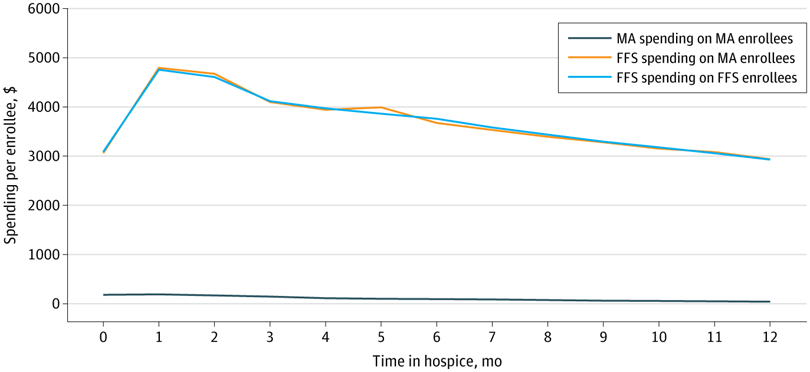
In 2021, CMS started a Value-Based Insurance Design (VBID) to test the impact of adding hospice services to Medicare Advantage benefits. By December of 2024, CMS ended the program due to widespread upset. CMS returned to the hospice carve-out model. Under this model, when an MA beneficiary chooses hospice, any health care expenses related to the terminal illness is paid on a fee-for-service (FFS) basis. MA no longer receives inpatient and outpatient payments, but continues to receive premiu, and rebate payments.

Carve-out Hospice Benefit

Once an MA enrollee enrolls in hospice, MA is no longer responsible for payments. Under the carve-out model, hospice services are paid by Medicare. MA plans are still responsible for paying for services that are not related to hospice care. These services can include inpatient, outpatient, physician, skilled nursing facility, home health care, and prescription drug expenses. 

Medicare Advantage Spending and Payments

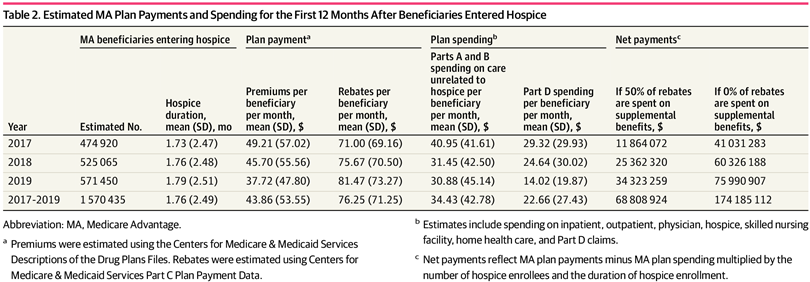
The study spanned 12 months and looked at 314,087 MA beneficiaries. In that period, 80.5% of enrollees had no spneding unrelated to their terminal illness. MA was not responsible for any healthcare related payments, but continued to receive $120 per enrollee per month. Estimated spending from MA on hospice enrollees was $57-70 per month. 

Medicare Advantage Excess Payments

In the 12 months following an enrollee electing hospice, MA plans netted $50-60 per month per enrollee. If half of the rebate payments received pay for supplemental benefits, MA receives excess payments to the tune of $68,808,924 over three years. If no rebate payments go toward supplemental benefits, MA receives $174,185,112 in excess payments over three years. The care a hospice enrollee receives uses the fee-for-service model. Medicare Advantage providers are seemingly paid on a fee-for-no-service model. 

Medicare Advantage plans do not currently report the actual amount of rebate payments used to pay supplemental benefits.

Study Conclusion

The researchers conclude that MA receives excess payments under the hospice carve-0ut model. They also note that there is no accountability for spending after hospice election from MA plans to CMS. The researchers suggest that CMS could require MA plans to report actual spending on supplemental services after hospice election and pay premiums and rebates only to cover the amount spent. 

I have a different recommendation….MA plans should not receive any additional premium payments or rebates following hospice election. MA plans should be required to report total payments and spending from enrollment date to election date. The balance, less the same 8% average margin of home and health and hospice agencies, should be used to pay for hospice services from election to passing. Any remaining balance after the patient’s passing should be returned to the beneficiary’s family.

# # #

Kristin Rowan, Editor

Kristin Rowan has been working at The Rowan Report since 2008. She is the owner and Editor-in-chief of The Rowan Report, the industry’s most trusted source for care at home news, and speaker on Artificial Intelligence and Lone Worker Safety and state and national conferences.

She also runs Girard Marketing Group, a multi-faceted boutique marketing firm specializing in content creation, social media management, and event marketing.  Connect with Kristin directly kristin@girardmarketinggroup.com or www.girardmarketinggroup.com

©2025 by The Rowan Report, Peoria, AZ. All rights reserved. This article originally appeared in The Rowan Report. One copy may be printed for personal use: further reproduction by permission only. editor@therowanreport.com
 

DOJ Settles with UnitedHealth and Amedisys

by Kristin Rowan, Editor

DOJ Settles with UnitedHealth and Amedisys

Judge to Weigh In

DOJ settles with UnitedHealth and Amedisys after almost nine months of negotiations. The Department of Justice (DOJ) initially blocked the proposed merger between UnitedHealth and Amedisys, citing concerns over eliminating competition in home health and hospice services in some areas of the U.S. After the most recent settlement hearing, the merger seems to be back on track.

Public Comment Period and Judicial Review

Now that the DOJ hurdle has been passed, there is a public comment period. Following the public comment period, the U.S. District Court for the District of Maryland will enter final judgement. From the Justice Department website:

As required by the Tunney Act, the proposed settlement, along with a competitive impact statement, will be published in the Federal Register. Any interested person should submit written comments concerning the proposed settlement within 60 days following the publication to Jill Maguire, Acting Chief, Healthcare and Consumer Products Section, Antitrust Division, U.S. Department of Justice, 450 Fifth Street NW, Suite 4100, Washington, DC 20530. 

Antitrust Division Statement

“In no sector of our economy is competition more important to Americans’ well-being than healthcare. This settlement protects quality and price competition for hundreds of thousands of vulnerable patients and wage competition for thousands of nurses. I commend the Antitrust Division’s Staff for doggedly investigating and prosecuting this case on behalf of seniors, hospice patients, nurses, and their families.”

Abigail Slater

Assistant Attorney General, Justice Department Antitrust Division

Divestiture Agreement

According to the new agreement, UnitedHealth will sell 164 home health and hospice locations across 19 states. In addition to the sale, the agreement provides the buyers of these locations with assets, personnel, and relationships to help them compete with remaining UnitedHealth locations. Also included are protections to deter UnitedHealth from interfering with the new owners’ ability to compete.

BrightSpring Health Services and Pennant Group will acquire the 164 locations. Slater said the settlement, which includes the largest ever divestiture of outpatient healthcare, protects quality and price competition patients as well as wage competition for nurses. However, antitrust specialist Robin Crauthers, a partner with McCarter & English, says it doesn’t go far enough. According to Crauthers, the settlement agreement does not address all of the markets that would have less competition and that the DOJ accepted less than they wanted in the agreement.

Additionally, critics argue the divestiture moves 164 home health and hospice agencies from one large player to two other large players in the space. Arguably, rather than preserve competition, this divestiture agreement will only serve to strengthen the largest players in the market, giving them a substantial advantage over smaller agencies in these areas.

UnitedHealth Amedisys divestiture locations

Not the Only Concern

Vertical Integration

Joe Widmar, Director of M&A at West Monroe consulting firm, says that the number of home health and hospice agencies is not the tipping factor in competition. Rather, it is UnitedHealth’s vertical integration. A health insurance company that also owns nearly 2,700 subsidiaries, including pharmacies, home health and hospice, behavioral health, consulting for healthcare organizations, surgery centers, hospitals, mental health, managed care for Medicaid and Medicare, and specialty care. Virtually any referral from a PCP to any other health professional puts more money into the health care giant’s pockets. The lack of competition is across all forms of healthcare, leaving patients no choice buy to support UnitedHealth Group in areas where all local healthcare providers are subsidiaries. I 2024, UnitedHealth insurance paid $150.9 million to its subsidiaries for care. These provider companies are not counted in the profit caps placed on insurance companies.

Upcoding

In addition to side-stepping profit caps, vertical integration aids in upcoding. Upcoding is the practice of digging into a patient’s life to find (or create) additional patient needs. Insurers add as many codes as possible for the greatest reimbursement rates. According to a recent study, UnitedHealthcare overbilled Medicare Advantage by $14 billion through upcoding. 

In-home health risk assessments and patient reviews, often offered to beneficiaries as a free service, result in an average risk score 7% higher than in patients seen in medical practices and hospitals. UnitedHealth generates more income from patient review diagnoses than any other MA insurer. The Department of Justice is currently investigating UnitedHealth’s Medicare billing practices.

Final Thoughts

If you own a home health, hospice, or palliative care agency in any of the states shown in the graphic above, write to Jill Maguire with comments and concerns. Our primary objective is providing quality care to patients in their homes. We know that home care is less expensive for the patient and government-funded insurance. But not when all the home care agencies in an area are owned by only a few of the largest home health agencies in the country. And not when the insurer is adding diagnostic codes to pad their bill. 

# # #

Kristin Rowan, Editor

Kristin Rowan has been working at The Rowan Report since 2008. She is the owner and Editor-in-chief of The Rowan Report, the industry’s most trusted source for care at home news, and speaker on Artificial Intelligence and Lone Worker Safety and state and national conferences.

She also runs Girard Marketing Group, a multi-faceted boutique marketing firm specializing in content creation, social media management, and event marketing.  Connect with Kristin directly kristin@girardmarketinggroup.com or www.girardmarketinggroup.com

©2025 by The Rowan Report, Peoria, AZ. All rights reserved. This article originally appeared in The Rowan Report. One copy may be printed for personal use: further reproduction by permission only. editor@therowanreport.com
 

Fraudsters Arrested, Oz Issues Warning

by Kristin Rowan, Editor

Fraudsters Arrested, Oz Issues Warning

Fraud in California

Fraudsters arrested in West Covina, CA this week were allegedly running a Medicare scheme. Authorities arrested hospice owner-operator Normita Sierra. They charged her with nine counts of health care fraud, one count of conspiracy, and four counts illegal remuneration (kick-backs) for health care referrals. The U.S. Attorney’s Office named co-conspirator Rowena Elegado. They also arrested her and charged her with one count of conspiracy and four counts of illegal remuneration for health care referrals.

Kickbacks

Sierra and Elegado worked together to pay marketers to recruit patients who did not have a hospice referral from their PCP and who were not terminally ill. Some of the kickbacks paid to marketers were as high as $1,300 per patient per month. After six months, the patients were referred out to Sierra’s home health company.

Medicare Claims

According to the U.S. Attorney’s Office, from 2018 to 2022, Sierra’s hospice agences submitted $4.8 million in fraudulent claims. Of those claims, Medicare paid approximately $3.8 million.

Dr. Oz Issues Warning

In a video statement, Dr. Oz explained how Medicare recipients are falling victim to scams. Sales people call, email, and even knock on your door, offering advice, free samples, and referrals. These marketers have one goal: get you sign a piece of paper. That paper signs you up for hospice care and agrees to allow a specific hospice agency to provide that care. The hospice agency then bills Medicare for services they never provide. Watch the video statement here.

HHS OIG Issues Consumer Alert

In a similar statement, HHS issued a consumer alert regarding DME companies. The alert warns that some DME companies are contacting Medicare beneficiaries. They claim to work for or on behalf of Medicare. Once they receive the patient’s Medicare number, they bill Medicare for unnecessary medical items. These items include urinary catheters, knee and back braces, orthotic braces, and prescription drugs, which may or may not ever be sent to the patient. HHS urges enrollees not to give their Medicare number to anyone. Further, they suggest regulary reviewing items charged to insurance, and refusing delivery of any medical supply not ordered by a physician.

Oz Issues Warning
Fraudsters Arrested

Combating Waste, Fraud, and Abuse

Dr. Oz and CMS have spoken numerous times about combatting the waste, fraud, and abuse withing the Medicare and Medicaid systems. Originally a strong proponent for Medicare Advantage, Oz has promised to audit MA after discovering the government pays more for MA than traditional Medicare. Oz also promised to reduce the amount of prior authorization requests needed before a patient gets services. Oz responded to the Republican-backed House bill requiring more oversight on Medicaid eligibility. Oz indicated that some Medicaid patients are enrolled in more than one state and that Medicaid is paying for able-bodied patients. The waste, fraud and abuse across Medicare and Medicaid is costing the government between $1 and $10 billion and Dr. Oz plans to find it and make significant changes to the management of the system.

A Cautionary Tale for Hospice Providers

You may be thinking, “What does this have to do with me?” Unfortunately, even the most scrupulous hospice agencies can fall prey to marketers running schemes. There are legitimate referral resources in the market who can help your agency get more referrals and more clients. There are also underhanded marketers who know how the system works. These predators will promise new referrals (for a fee) and then enroll uneligible patients without your knowledge. If you are working with or looking for a referral partner for your hospice agency, use one that is referred by someone you trust, and/or do a lot of research on the company history before working with anyone. Be especially wary of the ones who promise much more than what most referral companies offer.

# # #

Kristin Rowan, Editor

Kristin Rowan has been working at The Rowan Report since 2008. She is the owner and Editor-in-chief of The Rowan Report, the industry’s most trusted source for care at home news, and speaker on Artificial Intelligence and Lone Worker Safety and state and national conferences.

She also runs Girard Marketing Group, a multi-faceted boutique marketing firm specializing in content creation, social media management, and event marketing.  Connect with Kristin directly kristin@girardmarketinggroup.com or www.girardmarketinggroup.com

©2025 by The Rowan Report, Peoria, AZ. All rights reserved. This article originally appeared in The Rowan Report. One copy may be printed for personal use: further reproduction by permission only. editor@therowanreport.com