by Kristin Rowan | Apr 18, 2024 | Caring for the Caregiver, Clinical, Regulatory
In October of 2023, nurse Joyce Grayson went to the home (halfway house) of a released convict. She was later found dead in the basement of the house. In addition to adding focus to home care worker safety, the immediate response to this tragic event was an increase in nurses being afraid to do their jobs. Lawmakers in Connecticut vowed to increase protection for visiting nurses to ensure health care worker safety. The nurses requested additional reporting requirements for assaults while lawmakers suggested requiring an escort for high-risk situations.
Home Care Worker Safety by Law
Connecticut Senator Saud Anwar recognizes the growing segment of people wanting to age at home. “We want people to be able to get treatment at home,” he said. However, he also recognized the need for more information about potentially dangerous homes. He said at-home health care workers should be aware of what they’re walkin into “if there’s a high-risk situation.” Conn. lawmakers introduced Senate Bill One for Session Year 2024. The bill would require agencies to provide patient information, as applicable, including:
- Medical History
- Psychiatric history
- History of violence
- History of substance abuse
- History of domestic abuse,
- Current infections and treatments
- Stability of diagnoses or symptoms over time
- Housing Information
- Other persons in the home
- Name and relationship to patient
- Psychiatric history
- History of violence or domestic violence
- Criminal records
- History of substance abuse
- Location of Service
- Crime rate
- Presence of hazardous materials
- Presence of firearms or other weapons
- Status of location’s fire alarm system
- Presence of any other safety hazards
The bill also included ongoing safety training, safety assessments, and safety checks including:
- A mobile app with patient information
- A GPS enabled wearable device that allows staff to contact law enforcement
The Bill included payment rates to offset the cost of implementing all safety items to ensure cost-neutrality.
Implications for Hospice Agencies
Barbara Pearce, interim CEO of Connecticut Hospice, raised some legitimate concerns over the bill. Pearce warns that the background screenings required are lengthy and would result in many patients not receiving hospice care at all. According to Pearce, Connecticut Hospice “had 300 people die within three days, 200 people within two days, and 100 people within one day of entering home hospice care.” None of these patients would have been cared for if the bill had been in place at the time. Pearce discussed her concerns with Conn. lawmakers, who have since changed their approach.
Senate Bill One "Home Care Worker Safety" Moving Forward
Connecticut lawmakers are opting to exclude hospices from the bill for now. Sen Anwar said they plan to write a hospice-tailored bill “in the future” to ensure safety of hospice workers. Anwar continued, “We will have a plan of action to see what can be done to reduce the risk for hospice care workers too because…we want to make sure they’re safe too.”
The Connecticut 2024 legislative session is scheduled to adjourn on May 8. Senate and House representatives are racing the clock to modify the bill before the session ends.
Implication for Home Health
Few, if any, states have laws for home health worker safety. Alaska and Idaho have strict penalties for violence against health care workers. Wyoming introduced a similar bill in 2013, but it was defeated. Oregon passed a law in 2007 to require hospitals and surgery centers to implement safety strategies. Washington state established a law in 1999 that requires the development and implementation of a work-place violence plan. The law includes home health, hospice, and home care agencies, but does not have the detailed measures included in Connecticut’s bill.
If Senate Bill One passes in Connecticut, it could pave the way for additional state or federal regulations for in-home care safety precautions. Violence in home health, hospice, and home care has increased and steps need to be taken to ensure the safety and well-being of caregivers. Keep an eye out for some upcoming product reviews on mobile apps and hand-held emergency devices that allow home care workers to alert the agency, law enforcement, and/or family members before, during, and after a care visit.
Kristin Rowan has been working at Healthcare at Home: The Rowan Report since 2008. She has a master’s degree in business administration and marketing and runs Girard Marketing Group, a multi-faceted boutique marketing firm specializing in event planning, sales, and marketing strategy. She has recently taken on the role of Editor of The Rowan Report and will add her voice to current Home Care topics as well as marketing tips for home care agencies. Connect with Kristin directly kristin@girardmarketinggroup.com or www.girardmarketinggroup.com
©2024 by The Rowan Report, Peoria, AZ. All rights reserved. This article originally appeared in Healthcare at Home: The Rowan Report. One copy may be printed for personal use: further reproduction by permission only. editor@therowanreport.com
by Elizabeth E. Hogue, Esq. | Apr 11, 2024 | Clinical, Regulatory
By Elizabeth E. Hogue, Esq.
A key purpose of the Health Insurance Portability and Accountability Act (HIPAA) is certainly to protect patient information. Another is to help ensure that patients have access to their health information. In fact, the Office of Civil Rights (OCR) of the U.S. Department of Health and Human Services, the primary enforcer of HIPAA, has focused on enforcement actions against providers that do not make information available to patients on a timely basis. OCR launched a right to access enforcement initiative in 2019 that is continuing.
Providers must give medical information to patients and their representatives within thirty days of requests. When they fail to do so, they may be subject to enforcement action by OCR. Following are two examples of recent enforcement actions.
OCR announced on April 1, 2024, that Essex Residential Care in New Jersey will pay a civil money penalty of $100,000 to resolve violation of HIPAA’s right of access standard. This is the 48th settlement reached under the right of access initiative. OCR received a complaint in May of 2020 from the personal representative of the estate of a patient who passed away. Following an investigation by OCR, the personal representative, who was the son of the patient, received the records in November of 2020. The provider did not contest the fine.
In another recent case, the daughter of a patient who passed away was appointed as the personal representative of her mother’s estate. She made multiple requests to Phoenix Healthcare for a copy of her mother’s medical records. She finally received the records one year after her initial request. Phoenix Healthcare initially received a civil money penalty of $250,000 for failure to provide timely access.
The provider appealed. An administrative law judge (ALJ) upheld the violation and ordered Phoenix to pay a civil money penalty of $75,000. The Departmental Appeals Board affirmed the ALJ’s decision. Then Phoenix agreed to settle for $35,000 and waived the right to further appeals. While it may seem in this case that the provider’s appeals significantly lowered its costs, it is important to note that the provider also undoubtedly expended significant resources on two appeals of OCR’s enforcement action.
Providers have placed a great deal of time and effort into the protection of healthcare information in compliance with HIPAA. Rightfully so, but providers seem to have lost sight of the fact that HIPAA is also about ensuring that patients and their representatives have timely access to their records. Now is the time for providers to conduct intensive education of staff members about HIPAA’s requirements regarding access in order to avoid enforcement actions like those described above.
©2024 Elizabeth E. Hogue, Esq. All rights reserved. No portion of this material may be reproduced in any form without the advance written permission of the author. For more information on how to get access to this or any other article, please contact The Rowan Report.
by Tim Rowan | Apr 11, 2024 | Clinical, Editorial, Telehealth
by Tim Rowan, Editor Emeritus
In 2020, doctors flooded telehealth companies with requests for help caring for patients reluctant to leave home to come to their appointments. Following suit, many Home Health agencies that had never considered investing in home telehealth before, opened up their wallets to acquire equipment, from simple wearables to high-end, HIPAA-compliant video systems.
In addition to the need to provide care at a safe distance, many HHA leaders knew the added service would attract the attention of hospitals desperate to discharge recovering Covid victims as well as non-Covid patients. Some HHAs established relationships with hospitals they had not had before, given the chance to demonstration Home Health’s unique advantages over extended hospital stays and discharges to institutions such as SNFs that had become virtual death sentences during the height of the pandemic.
All Things Must Pass
 With the introduction and widespread free availability of Covid mRNA vaccines, the death rate graph line began to tilt downward. Then came the discovery that the SARS-CoV-2 and its variants are transmitted through the air and not through unwashed surfaces. People stopped disinfecting their counter tops after unloading groceries. And they started in-person doctor visits again. Patients returned to allowing nurses into their homes.
In regions where vaccination and booster rates were high, hospitals found themselves with more and more empty beds. They took down tented treatment centers in their parking lots and sent refrigerated trailers back to trucking companies. Desperation referrals to Home Health tapered off, as did the need for virtual visits.
Isaac Newton said every action has an equal and opposite reaction. If that holds true in the healthcare business as it does in physics, the reaction to Covid easing is seen in Remote Patient Monitoring tech companies. According to Fierce Healthcare, the New York Stock Exchange told one RPM company, Amwell, formerly known as “American Well,” to raise its stock price or be delisted. Fierce added detail about the company’s woes:
“Despite decimating its workforce at the end of 2023 to cut expenses, the company still projects a 2024 loss between $160 million and $155 million amid incremental revenue growth. The company’s market cap was a stone’s throw from $6 billion at the height of its valuation, when shares were trading for more than $42 each. Amwell shares were trading at $0.72 as of market close on April 5, giving the company a current market cap of about $208.6 million.
Another market leader fared no better, Fierce Healthcare found. “Telehealth giant Teledoc, which has been in operation for 20 years, has struggled in the stock market and is facing headwinds as the virtual care market has become crowded with digital health players. Shares dropped 22 percent in February as the company missed fourth-quarter revenue estimates and offered a downbeat forecast for the rest of the year.”
Teledoc’s 15-year CEO, Jason Gorevic, resigned last week after the company reported a net loss of $220 million for 2023, following 2022’s historic loss of $13.7 billion, mostly from a write-off related to the plummeting value of its ill-advised Livongo acquisition. According to Fierce Healthcare, Teladoc shelled out $18.5 billion for the digital chronic condition management company, a record in digital health.
Gorevic’s rationale that the telehealth field has become too crowded may not be far off. Last July, Becker’s Hospital Review published an industry survey titled “280+ Telehealth Companies to Know.” The list included a half dozen names we recognized from past Home Health conferences, including Health Recovery Solutions, AMC, Vivify, and FoneMed.
Do Hospital Woes Translate Down to Home Health?
 Making comparisons between telemedicine companies that focus on hospitals and physicians and those who focus on post-acute providers is hampered by the fact that few in our sector are publicly traded and do not share their numbers. UnitedHealth, which acquired Vivify in 2019 and assigned it to its Optum division, does not separately report Vivify revenue.
Health Recovery Solutions, one of the best-known names in post-acute RPM, is privately held by its founding CEO and seven investors. Its most recent influx of $800,000 occurred in January, 2022, making it impossible to determine whether it was motivated by investor confidence or the need for cash as Covid began its decline.
Analysis
This publication has promoted the advantages of remote patient monitoring for its entire 25-year existence. We have covered startups and established tech companies offering every technology from PERS to Zo monitors to automated phone calls, in-home cameras and microphones. We have followed the evolution of two-way communications and vital sign detectors from tabletop devices to tablets and smartphones. We have even tested a few robots. We have seen HHAs experience great success, and we have seen devices collecting dust on shelves.
Throughout, we have maintained that, when selected, implemented, and deployed properly, monitoring patients 24/7 instead of once or twice a week can improve patient outcomes, boost agency reputation, and, more often than not, produce a healthy ROI. The end of the latest pandemic may mean the end of demand for Remote Patient Monitoring systems, but that would be unfortunate.
 Tim Rowan is a 30-year home care technology consultant who co-founded and served as Editor and principal writer of this publication for 25 years. He continues to occasionally contribute news and analysis articles under The Rowan Report’s new ownership. He also continues to work part-time as a Home Care recruiting and retention consultant. More information: RowanResources.com or Tim@RowanResources.com
©2024 by The Rowan Report, Peoria, AZ. All rights reserved. This article originally appeared in Healthcare at Home: The Rowan Report. One copy may be printed for personal use: further reproduction by permission only. editor@therowanreport.com
by Kristin Rowan | Apr 4, 2024 | CMS, Regulatory
By Kristin Rowan, Editor
On March 28, CMS issued a new proposed rule to update Medicare hospice payments. Here’s what we know.
The new proposed rule:
- Would change the existing hospice wage index
- Clarifies current policy related to the hospice “eletion statement” and the “ntoice of election”
- Adds clarifying language around hospice certification
- Includes a request for information to get comments on implementing a separate payment mechanism for high-intensity palliative care services
- Proposes that Hospice Quality Reporting Program (HQRP) measures be collected through the Hospice Outcomes and Patient Evaluation (HOPE), adding two new measures
- Also proposes changes to the Consumer Assessment of Healthcare Providers and Systems (CAHPS) Hospice Survey
The new proposed rule includes a net 2.6% increase in payments over FY 2024. This includes a 3% market-based update, and a 0.4% cut for productivity. Submitting quality data is a requirement of the net pay. Hospices that do not submit quality data will be penalized 4%, netting a 1.4% decrease in payments. The propsed rule for 2025 is .5% lower than the 2024 hospice payment increase.
The National Hospice and Palliative Care Organization (NHPCO) says the rate increase is good, but not high enough. NHPCO COO and Interim CEO, Ben Marcantonio said, “To continue providing the high level of care our patients and their families deserve, hospices require a payment rate that accurately reflects the current economic challenges. We know that hospice care has demonstrated $3.5 billion in annual savings for Medicare, which underscores the critical importance of investing in hospice to ensure continued beneficiary access to quality end-of-life care.”
Palliative Care
CMS is interested in feedback and proposals from hospice agencies for providing complex palliative treatments and high-intensity hospice care when that care negatively impacts hospices financially. CMS aims to care for high-cost patients through palliative care rather than acute care. The NHPCO agrees with the CMS proposal to fund palliative care separately from standard hospice or acute care. CMS will take feedback and proposals through May 28, 2024. Comments can be submitted electronically at http://www.regulations.gov, by following the “Submit a Comment” instructions. Comments can also be sent by regular or express mail. Addresses can be found in the full proposed rule. Follow the search instructions at http://www.regulations.gov to see all submitted comments.
The proposed rule can be viewed starting April 4, 2024 at the Federal Register at https://www.federalregister.gov/public-inspection.
# # #
Kristin Rowan has been working at Healthcare at Home: The Rowan Report since 2008. She has a master’s degree in business administration and marketing and runs Girard Marketing Group, a multi-faceted boutique marketing firm specializing in event planning, sales, and marketing strategy. She has recently taken on the role of Editor of The Rowan Report and will add her voice to current Home Care topics as well as marketing tips for home care agencies. Connect with Kristin directly kristin@girardmarketinggroup.com or www.girardmarketinggroup.com
©2024 by The Rowan Report, Peoria, AZ. All rights reserved. This article originally appeared in Healthcare at Home: The Rowan Report. One copy may be printed for personal use: further reproduction by permission only. editor@therowanreport.com
by Rowan Report | Feb 14, 2024 | Partner News
FOR IMMEDIATE RELEASE
Contact: Johnathan Eaves
(903) 445-6969
jeaves@axxess.com
Axxess Launches New Axxess Connect Solution to Accelerate Health Information Exchange
Secure Data Sharing Now Possible Across Any Network
DALLAS, January 18, 2024 – Axxess, the leading global technology innovator for healthcare at home, launched a new product called Axxess Connect, a groundbreaking interoperability solution. This new product will revolutionize the way Axxess users connect and share data with healthcare providers and specialists, further enhancing care coordination, improving patient outcomes and driving the future by enabling new care models and value-based care.
“Axxess Connect is a new benchmark for interoperability in healthcare,” says Tim Ingram, Executive Vice President of Interoperability at Axxess. “By working with our partner Kno2 we can now connect our solutions to help accelerate the exchange of health information securely across any network. This means our clients will have easier access to a broader range of providers and specialists, making data sharing and referrals more efficient.”
By being Kno2 Connected™, Axxess Connect, enables the secure, effortless, and maximized exchange of patient information across patients, providers, payers and HIT vendors. The solution meets data security and compliance requirements in accordance with HITRUST and HIPAA regulation for privacy, data sharing and healthcare communication standards supported by national and regional frameworks including Direct Trust, Carequality and most recently, TEFCA. This ensures that patient data is interoperable, secured and protected when shared across systems.
“Our collaboration with Kno2 not only improves the overall experience for our users, but it also reduces the administrative load on healthcare providers,” said Ingram. “By minimizing time spent on administrative tasks, our clients can focus more on providing quality patient care.”
Added Theresa Bell, Co-founder, President and Chief Technology Officer of Kno2: “By seamlessly connecting Axxess users with healthcare providers and specialists, we are breaking down barriers and revolutionizing the way data is shared in every care setting. Axxess Connect represents the power of the partnership and the value of being Kno2 Connected. Together, we are revolutionizing care delivery and thoughtfully solving healthcare’s biggest problems.”
Axxess Connect will first be available to Axxess Palliative Care clients before eventually being rolled out to the entire Axxess suite of solutions for home health, hospice and home care.
To start using Axxess Connect, contact Axxess’ enterprise sales team via email at integrations@axxess.com.
###
About Axxess
Axxess is the leading global technology innovator for healthcare at home, focused on solving the most complex industry challenges. Trusted by more than 9,000 organizations that serve more than 5 million patients worldwide, Axxess offers a complete suite of easy-to-use software solutions that empower home health, home care, hospice, and palliative providers to make healthcare in the home human again. Multiple independent certifications have confirmed that Axxess has the most secure and industry-compliant software available for providers. The company’s collaborative culture focused on innovation and excellence is recognized nationally as a “Best Place to Work.”
by Kristin Rowan | Feb 7, 2024 | Uncategorized
By Kristin Rowan, Editor
Last month, we published an article in partnership with Bob Roth of Cypress HomeCare Solutions in Scottsdale, AZ about paying for long-term care at home. Since then, I have come across some interesting information as we continue to tackle the issue of paying for care that is not reimbursed by the current Medicare/Medicaid system.
Medicare and Medicare Advantage have set pay rates for home health and hospice care. Home Health Value-Based Purchasing (HHVBP), implemented by CMS, was designed to incentivize agencies by paying more for quality care rather than a higher number of services provided. This is similar to giving advances and pay raises based on performance rather than longevity in a job, which I’m all for. However, the HHVBP overlooked palliative care altogether and neither the fee-for-service model nor the HHVBP model includes supportive (read private duty) care at home. Since these services are not reimbursed, there is no incentive to provide them nor way to get paid for them if the patient cannot pay out-of-pocket.
This causes two problems:
1. Home Health and Hospice Agencies are reluctant to provide unreimbursed care, with good reason, so the overall patient experience is less than ideal, rehospitalization rates increase, star-ratings and scores decrease, bonuses go away, and the agencies make less money than before.
2. Patients can’t get the care they need and want. Palliative care patients may receive Hospice care too early, or they may not receive care at all because they fall between home health and hospice. Patients who need supportive care at home can’t afford it so they either go without, causing increased complications or they rely on friends and family members who burn out under the stress of being a full-time caregiver.
Innovative care strategies can overcome the obstacles faced by agencies and patients alike. There may not yet be a perfect solution, but there are some innovative ideas out there and something has to disrupt the current pay model.
Palliative Care Partners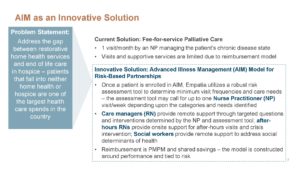
Medicare Advantage organizations and primary physician groups receive a “cost of care” analysis for the duration of the patient care. The organization takes on the risk of that patient costing more than what the MA plan will pay, but can make more money if patient care costs less than anticipated. Palliative care at home costs less. David Causby, President and CEO of Gentiva, a Hospice organization that operates in 35 states across the U.S. and has an average daily census of 26,000, has implemented a plan of care in cooperation with these organizations in what he calls Advanced Illness Management (AIM) Model for Risk-Based Partnerships. Designed for palliative care, Gentiva creates a plan of care that includes visit frequency and care needs and employs nurse practitioners, care managers, after hours RNs and social workers. The hospital pays Gentiva on a PMPM model with shared savings. The hospital still gets paid the full amount from MA but uses fewer resources, has lower costs, and sees reduced rehospitalizations, saving more than what they pay out. According to Gentiva, this partnership “provides value to contracted organizations by decreasing the overall end-of-life spend on this high-risk patient population.”
Supportive Care at Home Innovations
Supportive Care at Home (Private Duty Home Care, Private Pay, Non-medical home care) is not covered by Medicare, Medicare Advantage, or most health insurance plans. Limited Medicaid grants, VA plans, and long-term health insurance pay for some supportive care at home. Without one of these plans, patients and family members pay out-of-pocket for supportive care at home, averaging $22-$27 per hour with a 4-hour minimum. In some states it can cost up to $50 per hour. At $80 per day, that’s around $20,000 per year.
One software company we recently spoke with is upending the home care model with fee-for-service model that charges by the minute, rather than by the hour, making care more affordable for more people. You can see our product review of Caring on Demand here. By reducing the cost for customers and reducing the time for caregivers, agencies can onboard more customers without hiring more caregivers. The system is being used in facilities where these services are not provided, which allows a caregiver to visit several people in one stop. The agency and the caregiver can see the same income in the same time, spread out across multiple private payers.
Combining Innovation for a Win-Win-Win
I heard about Caring on Demand and spoke with its founder in August of 2023. I spoke with one Home Care agency owner who recently started working with Caring on Demand. “Times have changed,” the agency owner said. With fewer caregivers joining the workforce, increased levels of burnout since 2020, and CMS changes that overlook palliative and non-medical care, maybe there’s another way…
- Partnerships with organizations and physician groups that have Medicare, MA, and traditional health insurance patients, non-medical home care agencies, and palliative care providers.
- Localized groups of patients in limited areas like retirement villages, planned communities, neighborhoods, or small towns.
- Cost sharing and care coordination that includes in-home palliative care visits, supportive care, communication with primary care providers and specialists
- Preventative intercessions to avoid unnecessary ER visits and hospitalizations
- Shorter visits per caregiver with multiple visits to a community each day
- Cost sharing among patients splitting a 4-hour minimum visit among 4-8 patients
- Shared savings from reduced hospital stays, shorter durations of hospice care, and nursing visits that are supplemented by supportive care
Gentiva has experienced some success already in using shared savings as a payment model. Can costs be decreased even more by adding supportive home care to this plan? Is there enough shared savings for three payees instead of two? I don’t have the answers to these questions, but I do believe providers of supportive care and palliative care have been in the background, overlooked by CMS and MedPAC for long enough. If they aren’t going to recognize the positive impact and cost savings of home care and palliative care and include them in the reimbursement model, we may have to do it for them.
We’d love to hear your feedback on this and other innovative ways to combat the crisis of paying for care at home.
# # #
Kristin Rowan has been working at Healthcare at Home: The Rowan Report since 2008. She has a master’s degree in business administration and marketing and runs Girard Marketing Group, a multi-faceted boutique marketing firm specializing in event planning, sales, and marketing strategy. She has recently taken on the role of Editor of The Rowan Report and will add her voice to current Home Care topics as well as marketing tips for home care agencies. Connect with Kristin directly kristin@girardmarketinggroup.com or www.girardmarketinggroup.com
©2024 by The Rowan Report, Peoria, AZ. All rights reserved. This article originally appeared in Healthcare at Home: The Rowan Report.homecaretechreport.com One copy may be printed for personal use: further reproduction by permission only. editor@homecaretechreport.com