Impact of H.R. 1: The Homebound and Overlooked

Analysis by Tim Rowan, Editor Emeritus

The Impact of H.R. 1

Homebound and Overlooked

In early 2025, the Republican-led Congress introduced its proposed budget for FY2026 and beyond, a sweeping legislative effort aimed at curbing federal expenditures and restructuring entitlement programs. Medicaid, one of the largest healthcare safety nets in the United States, faces major revisions under this bill. Central to the proposed changes is the shift toward block grants or per-capita caps on federal funding. The legislation also rolls back incentives enacted into law by the Affordable Care act, including those that supported Medicaid expansion. The reconciliation bill, signed into law on July 4, also eliminates financial support for optional services such as home and community-based services (HCBS). A new set of work requirements in the new law will expand the paperwork burden for beneficiaries.

Risks for Home- and Community-Based Care

The figure below presents a visual from the Commonwealth Fund showing their projection of over $100 billion in cumulative federal Medicaid cuts by 2035. These reductions are expected to disproportionately affect non-mandated programs like HCBS, which are many times more economical than residential care. With diminished federal support, states will face pressure to reallocate limited resources, often at the expense of these optional, yet critical, programs. ¹

For nearly eight million elderly Americans, Medicaid-funded HCBS has helped reduce hospital admissions, extend independence, and relieve stress on long-term care facilities. However, the new budget cuts destabilize these programs. Barbara Merrill, CEO of ANCOR, expressed concern, stating, “When you cut federal Medicaid dollars, even for optional services, states have to make tough decisions about who gets care and when.”² Experts anticipate that approval delays, extended waitlists, and even termination of services could follow as states struggle to maintain existing infrastructure.
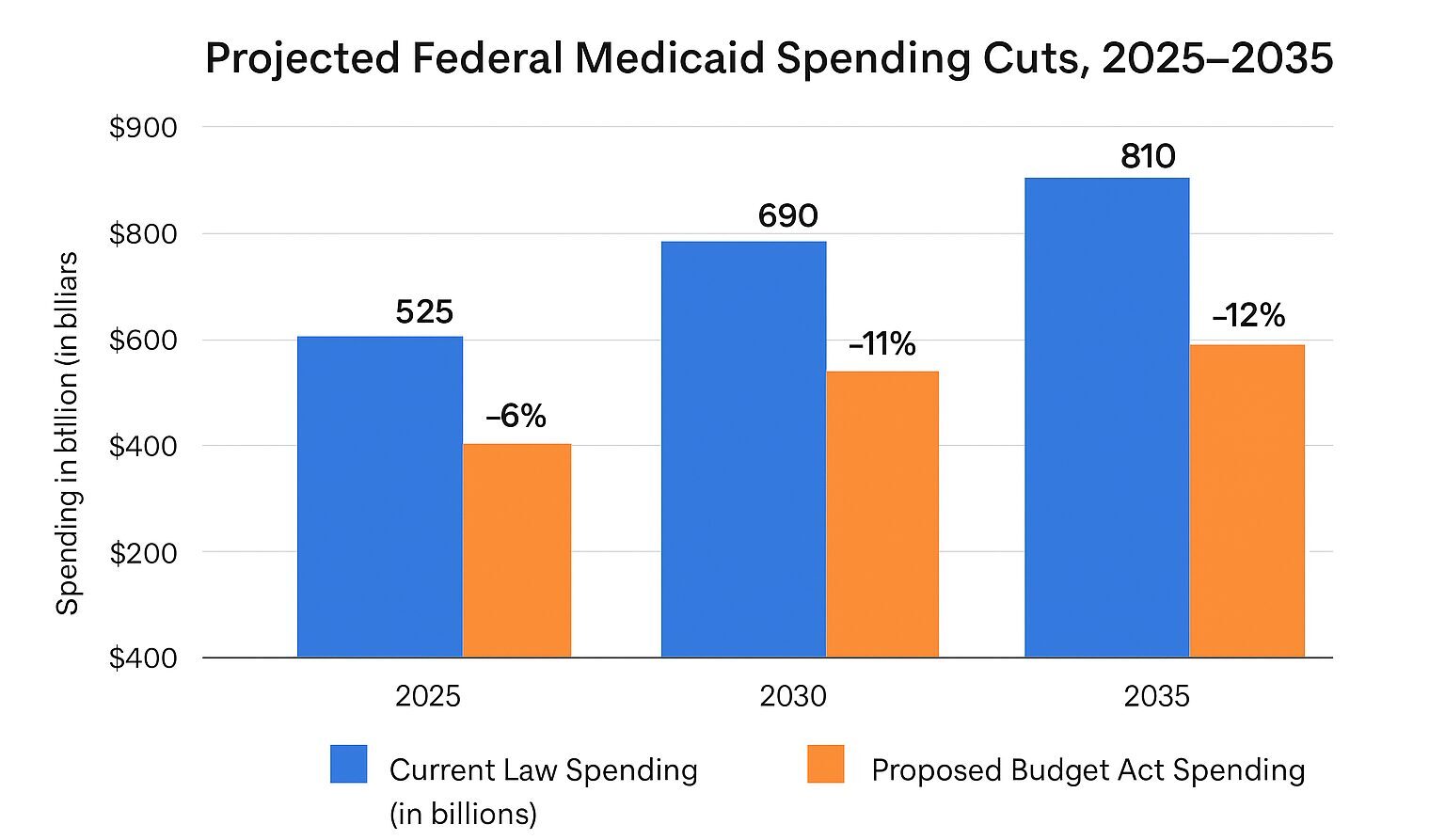
Bar chart of Medicaid spending.

Comparing the 2005 Budget Bill to the Affordable Care Act

Compared to the Affordable Care Act (ACA), the Republican budget bill marks a significant policy reversal. The ACA expanded Medicaid eligibility and incentivized states to develop non-institutional care models. It emphasized preventive care and home-based treatment options, helping shift care away from costly institutional settings. By contrast, the new bill eliminates such incentives and introduces fiscal and operational barriers. According to data from Medicaid.gov and the Kaiser Family Foundation, Medicaid enrollment, which rose steadily during the ACA years, is projected to drop by 10% nationwide once the budget bill is implemented³. This decline reflects both tightening eligibility and retreat from HCBS programs.

Healthcare providers will need to brace for substantial ripple effects. With fewer patients accessing home care, hospitals and emergency departments may see an uptick in acute episodes related to unmanaged chronic conditions. Providers may also encounter staffing shortages and reduced reimbursements, undermining service quality and sustainability. Richard Edwards, policy director at Amivie Home Health, warned, “If states cut home care services, many patients have no other choice but to enter a skilled nursing facility. That’s not just a shift in care—it’s often a worse outcome at a higher cost.” ⁴ These operational challenges could exacerbate pressure on an already strained healthcare workforce.

Scope and Severity of Coming Changes

Today, over eight million seniors rely on Medicaid-funded HCBS, with an average annual cost per recipient of $29,000. Thirty-three states use HCBS waivers to administer these services, yet the average state waitlist already exceeds 3,000 applicants. Institutional care costs remain 57% higher than home care, making HCBS not only more humane but more fiscally prudent. Despite that, projected federal cuts of $100 billion by 2035 threaten to replace HCBS with nursing home care. Meanwhile, a national enrollment drop of 10% would leave millions at risk of losing coverage and care.

Richard Edwards, policy director at Amivie Home Health, explains, “If states cut home care services, many patients have no other choice but to enter a skilled nursing facility. That’s not just a shift in care—it’s often a worse healthcare and social outcome at a higher cost.” ⁴

  • 8 million elderly rely on Medicaid HCBS
  • $29,000/year average cost per Medicaid home care recipient
  • 33 states use HCBS waivers
  • Average state waitlist for HCBS exceeds 3,000 applicants
  • Institutional care costs 57% more than home care
  • Estimated federal Medicaid cuts by 2035: $100 billion
  • Projected national enrollment drop: 10%

Implications for Care at Home: Next Steps

To mitigate these risks, policy experts are advocating for pragmatic alternatives, knowing that implementation depends entirely on the direction in which political winds blow. Federal stabilization grants could offer targeted relief to states with high HCBS enrollment, preserving continuity of care. Streamlining waiver approvals would reduce bureaucratic delays and ease access for both providers and patients. Retaining key ACA incentives could help maintain momentum in home-based care innovation. States would also benefit from flexible financing rules, including reformed provider tax policies, to better manage Medicaid funds under new constraints. 

Final Thoughts

Ultimately, the new budget, passed with no Democratic votes, may reshape eldercare delivery for years to come. With states facing hard choices, the healthcare community must prepare for transitions that could disrupt care and deepen inequities. Advocacy for vulnerable populations, investment in alternatives, and ongoing engagement in policy reform will be essential to ensure seniors receive the care they deserve in the setting they prefer.

# # #

____________________________________________

¹ Congressional Budget Office, Federal Healthcare Outlook 2025–2035
² Barbara Merrill, ANCOR Policy Brief, March 2025
³ Kaiser Family Foundation, Medicaid Enrollment Tracker, April 2025
⁴ Amivie Health, Testimony to House Budget Committee, June 2025

Tim Rowan The Rowan Report

Tim Rowan is a 30-year home care technology consultant who co-founded and served as Editor and principal writer of this publication for 25 years. He continues to occasionally contribute news and analysis articles under The Rowan Report’s new ownership. He also continues to work part-time as a Home Care recruiting and retention consultant. More information: RowanResources.com
Tim@RowanResources.com

©2025 by The Rowan Report, Peoria, AZ. All rights reserved. This article originally appeared in The Rowan Report. One copy may be printed for personal use: further reproduction by permission only. editor@therowanreport.com

Bill Cuts Medicaid Directly, Medicare Indirectly

by Tim Rowan, Editor Emeritus

Bill Cuts Medicaid Directly, Medicare Indirectly

This is what online publishers call a “living article.” With the House and Senate passing different bills, progress toward the President’s desk changes by the hour. What follows is everything we knew to be true on Tuesday evening, July 1. However, this bill will impact Home Health, Home Care, and Hospice. To keep readers informed, we will continuously update this article as need through the weekend. We will not send our usual emails to subscribers with every update, so we urge you to return here from time to time for updates to this breaking news item. We will add the date and time to each update.

July 3: Bill Passes, The Alliance Responds

Nearly as soon as House Republicans began their celebration, Alliance President Dr. Steve Landers issued a response from the National Alliance for Care at Home. We reprinted the complete statement from The Alliance here.

“As these Medicaid provisions become law, the Alliance will work tirelessly to monitor their implementation and advocate for the protection of Medicaid enrollees, families, and providers nationwide. We will continue to champion the delivery of HCBS – proven services that are preferred by beneficiaries and save the system money.” 

Dr. Steve Landers

CEO, The National Alliance for Care at Home

Final House Vote: July 3

In spite of a couple of Republican holdouts, H.R. 1 passed the House on a 2018-2014 vote on Thursday afternoon. All of the Senate’s changes were approved, meaning the bill does not have to go back to Senate for re-approval. Now begin final assessments of the impact on Medicaid and SNAP. Changes made in the Senate, approved by the House, increased the size of spending cuts for those two programs. As analysts inside and away from our home care community weigh in, we will post them here.

As of the end of the day, July 1

It appears as though the stalemate, if there is to be one, will center around Medicaid and SNAP cuts. There are some House Republicans who are upset that the Senate increased their H.R. 1 proposed cuts to nearly $1 Trillion. Contrarily, other House Republicans threaten to vote no because cuts are not deep enough. They point to the predicted $3.3 trillion addition to the national debt over ten years. As of the evening of July 1, the House Rules Committee continues the debate. We will update this page as often as possible for you.

As of the morning of July 1

Early Tuesday morning, the Senate passed its version of Donald Trump’s bill. Among its changes are increased cuts to Medicaid. The Congressional Budget Office calculated that the House version would have resulted in $700 billion in spending reductions. It would also have removed health insurance from 10.9 million people over 10 years. The version the Senate sent back to the House Tuesday, according to the CBO, increases those cuts to $930 billion and 11.8 million people.

Senate passes bill

June 29th

The Senate reconciliation bill would cut gross federal Medicaid and Children’s Health Insurance Program (CHIP) spending by $1.02 trillion over the next ten years.  These cuts are $156.1 billion (18%) larger than even the House-passed bill’s draconian cuts of $863.4 billion over ten years.

  • These larger gross Medicaid and CHIP cuts are driven by changes to the House-passed bill that would:

    • further restrict state use of provider taxes to finance Medicaid
    • eliminate eligibility for many lawfully present immigrants
    • cut federal funding for payments to hospitals furnishing emergency Medicaid services
    • further reduce certain supplemental payments to hospitals and other providers (known as state-directed payments)
  • The spending effect of these additional cuts is modestly offset by increased Medicaid and CHIP spending from provisions not in the House-passed bill

    • a rural health transformation program
    • increased federal Medicaid funding for Alaska and Hawaii (Already ruled out by the parliamentarian)
    • expanded waiver authority for home- and community-based services
  • Overall, the Senate Republican reconciliation bill’s Medicaid, CHIP, Affordable Care Act marketplace, and Medicare provisions would increase the number of uninsured by 11.8 million in 2034, relative to current law

    • In comparison, the House-passed bill would increase the number of uninsured by 10.9 million in 2034.
    • More detailed CBO estimates of the specific Medicaid health coverage effects under the Senate Republican reconciliation bill are not yet available
    • CBO estimates the House-passed bill’s Medicaid and CHIP provisions would cut Medicaid enrollment by 10.5 million by 2034 and by themselves, increase the number of uninsured by 7.8 million by 2034

How the Senate Pushed the Bill Through

Majority leader Thune could only afford to lose three Republican votes. With GOP Senators Thom Tillis (N.C.), Rand Paul (Ky.) and Susan Collins (Maine) voting against the measure, along with every Democrat, centrist Lisa Murkowski of Alaska became the sole target of Republican pressure. The tactic used to get the vote close enough for VP Vance to cast the deciding vote is disturbing. 

First, leadership wrote an amendment that would have exempted Alaska from Medicaid and SNAP cuts. The parliamentarian killed that idea, saying it violated the Senate’s “Byrd Rule.” Next, marathon negotiations brought Murkowski and Parliamentarian MacDonough together to appease both. The compromise became exceptions to Medicaid and SNAP cuts that had less of an appearance of a bribe. They devised a formula that delayed cuts to states with a history of high error rates in calculating who is entitled to benefits. The CBO said that would cover as many as 10 states. The parliamentarian decided this did not violate Senate rules because it did not specifically benefit one state. They also increased the federal subsidy for rural hospitals that will be harmed by the bill from $25 billion to $50 billion.

In agreeing to vote ‘yes,’ Murkowski essentially declared that she knows the cuts will be bad for most states but will be good for her state. With the Alaska Senator’s vote secured, the final count was 50-50, leaving the final decision up to the vice president.

# # #

Tim Rowan The Rowan Report

Tim Rowan is a 30-year home care technology consultant who co-founded and served as Editor and principal writer of this publication for 25 years. He continues to occasionally contribute news and analysis articles under The Rowan Report’s new ownership. He also continues to work part-time as a Home Care recruiting and retention consultant. More information: RowanResources.com
Tim@RowanResources.com

©2025 by The Rowan Report, Peoria, AZ. All rights reserved. This article originally appeared in The Rowan Report. One copy may be printed for personal use: further reproduction by permission only. editor@therowanreport.com

Medicaid Cuts Update: Meet the Senate Parliamentarian

by Tim Rowan, Editor Emeritus

Medicaid Cuts Update

Senate Parliamentarian Elizabeth MacDonough

The ongoing negotiations in Congress will impact Medicaid and Medicare. There has been little movement from the Senate since we reported on this last week, but here’s what we know now:

When H.R. 1 was passed by the House of Representatives and forwarded to the Senate, it was immediately subjected to scrutiny by the Senate Parliamentarian, Elizabeth MacDonough. The job of the parliamentarian is to ensure that every proposed bill complies with Senate rules. The story of Ms. MacDonough taking her scissors to the “One Big Beautiful Bill” requires more than a little unpacking, but it is a good story.

Problem with Medicaid Cuts: "One Bill"

It appears that the idea to put all of the President’s legislative agenda into a single bill is acceptable in the House, but the Senate has different rules. The Senate forces itself to live under the filibuster system. When the filibuster is evoked, a bill must receive 60 votes to pass, but there is an exception. “Budget Reconciliation” is a rule that allows expedited passage of certain specific budget-related bills with only a simple majority, 51 votes.

The problem of the week is that H.R. 1 includes dozens of provisions that have nothing to do with spending. The Senate parliamentarian took her scissors to parts of the bill that:

  • change environmental regulations to pave the way to sell public lands
  • reduce the ability of federal judges to block Presidential orders1
  • dissolve the Consumer Financial Protection Bureau
  • change the rules about who can be excluded from receiving Medicare benefits, even after contributing through FICA taxes
Medicaid Cuts

Cutting Medicaid Cuts

Parliamentarian MacDonough has also applied her scissors to the portion of the bill that would reduce Medicaid spending by nearly $800 billion over ten years. Writing for The Hill, Alexander Bolton reported on June 26:

“The Senate’s referee rejected a plan to cap states’ use of health care provider taxes to collect more federal Medicaid funding, a proposal that would have generated hundreds of billions of dollars in savings… The decision could force Senate Majority Leader John Thune (R-S.D.) to reconsider his plan to bring the Senate bill up for a vote this week.”

Alexander Bolton

Journalist, The Hill

The provision, which would have forced states to take over substantially more Medicaid costs, came under strong bipartisan opposition. Sen. Josh Hawley (R-Mo.), Susan Collins (R-Maine), Lisa Murkowski (R-Alaska) and Jerry Moran (R-Kan.) warned deep cuts to federal Medicaid spending could cause dozens of rural hospitals in their states to close. Senate Democrats, led by Jeff Merkley (D-Ore.), the ranking Democratic on the Senate Budget Committee, praised MacDonough’s exclusions.

The Hill reported, “Democrats are fighting back against Republicans’ plans to gut Medicaid, dismantle the Affordable Care Act, and kick kids, veterans, seniors, and folks with disabilities off of their health insurance – all to fund tax breaks for billionaires,” Merkley said in a statement.

The President pushed back against the parliamentarian’s rulings in a June 24 social media post:

“To my friends in the Senate, lock yourself in a room if you must, don’t go home, and GET THE DEAL DONE THIS WEEK. Work with the House so they can pick it up, and pass it, IMMEDIATELY. NO ONE GOES ON VACATION UNTIL IT’S DONE.”

Donald Trump

President of the United States

Sorting out the Complex Immigration Question

If the above seems complicated, it becomes rudimentary compared to the background that sets the stage for the parliamentarian’s next cut. Except for emergencies, most often crisis pregnancies, persons in the country illegally cannot, and do not, receive Medicaid-reimbursed healthcare. According to a study by Kaiser Family Foundation, however, fourteen states plus the District of Columbia use state taxpayer money, not federal funds, to cover children regardless of immigration status, Seven of those fourteen, and D.C., also cover some adults with state funds regardless of immigration status.

In the bill was a provision to punish these fourteen states and D.C. by reducing their federal Medicaid payments from 90 percent to 80 percent. Though there is no accusation in the bill that these states are guilty of improper use of federal funds, the states will lose some of those funds because of the way they have chosen to use their own funds. Parliamentarian MacDonough said that is not a budget line item but an attempt by the federal government to force states to change their own healthcare policies.

Medicare Restrictions also Scrapped

Almost as a postscript, a House restriction on Medicare eligibility also fell victim to the Senate Parliamentarian’s scissors. Non-citizens who work in W-2 wage jobs pay FICA taxes, many of them for 30 years or more. When these workers turn 65, they are eligible for Medicare benefits due to their contributions, regardless of their status. Though H.R. 1, the House version, would eliminate that eligibility, Ms. MacDonough said, “Nope, this is not a budget reconciliation issue.”

Although the White House is pressuring Senators to vote quickly — so that a joint House/Senate negotiating committee can hammer out differences and send their compromise version to the President’s desk by July 4 — that self-imposed deadline is up in the air at the moment. Both President Trump and House Speaker Johnson are adamant that every spending and every non-budgetary policy change they want must be enacted in one big bill. In spite of Ms. MacDonough’s cuts, the Senate it not exactly handcuffed either. Because it makes its own rules, Senators could simply decide, with a 51-49 party-line vote, to ignore the parliamentarian.

The power, as well as the future health of Medicaid, falls into the hands of the four dissenting Republican Senators. Home Health and Home Care folks in Missouri, Maine, Alaska and Kansas take note.

____________________________________

1  From White House correspondent Bart Jansen, writing for USA Today:

  • Currently, judges have discretion to set bonds on plaintiffs who file civil suits. Legal experts say judges often waive bonds in lawsuits against the government because the disputes are typically over policy rather than money.
  • A provision in the House-passed version of the bill would remove that discretion from federal judges and require litigants to post a bond when the issue under consideration is whether to block a Trump policy.
  • So far, judges have blocked Trump policies in 180 cases. All of them would have to be reviewed for bonds if the Senate approves the House provision and Trump signs it into law.
  • The law would effectively kill most of the limitations on Trump policies because bond amounts are determined by the dollar amount of the contested policy. In federal cases involving massive policy changes, those bonds can amount to hundreds of billions.

# # #

Tim Rowan The Rowan Report

Tim Rowan is a 30-year home care technology consultant who co-founded and served as Editor and principal writer of this publication for 25 years. He continues to occasionally contribute news and analysis articles under The Rowan Report’s new ownership. He also continues to work part-time as a Home Care recruiting and retention consultant. More information: RowanResources.com
Tim@RowanResources.com

©2025 by The Rowan Report, Peoria, AZ. All rights reserved. This article originally appeared in The Rowan Report. One copy may be printed for personal use: further reproduction by permission only. editor@therowanreport.com

Medicaid Cuts Still Looming

by Tim Rowan, Editor Emeritus

Medicaid Cuts Looming

Terminal Prognosis

Let me tell you about my brother. In his early 30’s, Tom was diagnosed with a rare disorder, one of the 25 versions of Ataxia. A disorder that is sometimes genetic, sometimes of unknown cause. It damages the part of the brain stem that controls balance, eye-hand coordination, and speech. He was supposed to be confined to a wheelchair by age 45 and not make it to 60.

Medicaid to the Rescue

Tom will celebrate his 71st birthday next week. Some years back, an experimental drug appeared that happened to be effective with his variation of Ataxia. That medication, administered intravenously in his home, is ridiculously expensive. If not for Medicare and Medicaid, those early prognoses would have come true. With the treatments, the disorder does still progress, though much more slowly. During my visits to his home — yes, he still manages on his own for now — he and I talk about the Assisted Living or Skilled Nursing Facility that looms in his future. Always with his head low and a sigh, he says he knows that day will come.

One in 71 Million

The 20 percent of American citizens who qualify for Medicaid are as nervous as Tom is about a bill making its way through Congress. As of May 22, 2025, H.R. 1 passed the House of Representatives by one vote. Today, it is still under debate in the Senate, where several amendments are being considered.

Medicaid Pays More than Medicare

In a February report, the Kaiser Family Foundation explained it this way:

Medicaid road sign "cuts ahead"

Four in ten adults incorrectly believe that Medicare is the primary source of coverage for low-income people. For those who need nursing or home care, Medicaid is the primary payer. Medicaid covered two-thirds of all home care spending in the United States in 2022. With House Republicans considering $2.3 trillion in Medicaid cuts over 10 years, the availability of home care could be affected in future years. Home care cannot afford the loss of almost one-third of the entire Medicaid budget.

Medicaid Cuts Impact

The February report indicates that H.R 1 could fundamentally change how Medicaid financing works. This would consequently impact enrollees’ access to care. The authors assert that “cuts of this magnitude would put states at financial risk, forcing them to raise new revenues or reduce Medicaid spending by eliminating coverage for some people, covering fewer services, and/or cutting rates paid to home care workers and other providers.”

“Such difficult choices would have implications for home care because over half of Medicaid spending finances care for people ages 65 and older and those with disabilities, the enrollees most likely to use home care and related services.”

Mohamed, A.; Burns, A.; O'Malley Watts, M.

Authors, What is Medicaid Home Care (HCBS)?

Medicaid Cuts Proposals

The Center on Budget and Policy Priorities has been listening to Senate debates and reading proposed amendments. In a news release this week, CBPP offered a dismal assessment.

“The health provisions in the Senate Republican leaders’ plan are, alarmingly, even harsher and more damaging than the health provisions in [H.R. 1]. Under both plans, tens of millions of people would face substantially higher health care costs and millions would lose access to life-saving treatments, routine care, and medications they need.”

Medicaid Cuts

Higher Costs, Less Access

Home Care and the Work Requirement

There is much talk in Congress and in social media about able-bodied Medicaid beneficiaries who sit at home and play video games all day. Not only does this indicate a confusion between healthcare and welfare (you can’t eat or sleep in Medicaid), but it also tends to exaggerate the scope of this fraud/waste/abuse target. 

As KFF points out, most Medicaid adults under age 65 are already working but are paid low enough that they still qualify. Many who are not working (12%) serve as caregivers for a family members. If they are removed from the home to go to a job, someone else would have to take over caregiving duties, probably a home care agency. Thus, there would be a net loss to the system. 

Net Loss

The Congressional Budget Office found when examining the House version that work requirements would decrease federal spending by reducing the number of uninsured. However, in the same report, the CBO notes that there would be no increase in employment numbers.

On top of the uncertain benefit of the work requirement, the bill as it stands today would greatly increase reporting requirements. In place of “once qualified, always qualified,” Medicaid eligibility will require regular reporting to prove employment and annual re-qualification paperwork. The new red tape burdens will be especially difficult on seasonal workers or those who frequently change jobs.

Medicaid Cuts and Rural Hospitals

No one is quite sure what the impact on home care will be when Medicaid cuts force rural hospitals to close, as the CBO predicts. Longer journeys to receive hospital care and doctor visits may push more beneficiaries to home care while home care will be struggling to find caregiving staff.

Before the bill becomes law, rural hospitals are already in trouble. The American Hospital Association says that 48 percent of rural hospitals operated at a loss in 2023 and 92 closed their doors over the past 10 years. There are 16.1 million Medicaid beneficiaries living in rural communities, including 65 percent of nursing home residents. Can home care cover the losses if a portion of the estimated $800 billion in Medicaid cuts over 10 years hit home care just as hard?  

Medicaid Support in Congress

There are home care champions on the Republican side of the House and Senate. Some of them have already expressed their doubts about whether cutting home care would decrease or increase overall spending. In the “strange bedfellow” category, conservative icon Josh Hawley of Missouri swore he would “tank any bill that cuts Medicaid benefits.”

Senate Republicans can afford to lose only three votes to get this bill passed and sent back to the House. Today would be the time for all of them to hear from the care at home industry. Call your Senator. All phone numbers start with 202-224-

# # #

Tim Rowan The Rowan Report

Tim Rowan is a 30-year home care technology consultant who co-founded and served as Editor and principal writer of this publication for 25 years. He continues to occasionally contribute news and analysis articles under The Rowan Report’s new ownership. He also continues to work part-time as a Home Care recruiting and retention consultant. More information: RowanResources.com
Tim@RowanResources.com

©2025 by The Rowan Report, Peoria, AZ. All rights reserved. This article originally appeared in The Rowan Report. One copy may be printed for personal use: further reproduction by permission only. editor@therowanreport.com

Medicaid Cuts Remain Unknown So Far

by Tim Rowan, Editor Emeritus

"Life and Death"

Medicaid Cuts are Looming

We don’t need to cut benefits, and it really infuriates me to hear people here talking about that because it stresses people out. This is life and death for them.     –Senator Bernie Moreno (R-OH)

Budget Reconciliation Threatens Medicaid

After last weeks HHS purge, all of Care at Home is on edge as the U.S. House and Senate negotiate differences in each body’s budget reconciliation bill. The same jitters are found among Medicaid-eligible citizens, especially those who hear more rumors than actual progress reports from Washington. All we know for sure this week are two things: Speaker Johnson has pushed his deadline for a vote on the bill, asking for $880 billion in cuts, from Memorial Day to Independence Day; and the parallel Senate budget bill, at this date, is quite different. Watching the reconciliation talks should be nerve-wracking but entertaining.

The House Version

As of May 1, it is too early to assign a dollar amount to the FY 2026 Medicaid budget. H.B. 1968, named “Full-Year Continuing Appropriations Act of 2025,” delegates specific cut decisions to committees. It first directs the House Energy and Commerce Committee, which oversees Medicaid and part of Medicare, to reduce the federal deficit by $880 billion over ten years. The Agriculture Committee, which oversees SNAP, is ordered to cut $230 billion over the same time period.

Image of a Congressional Bill Document

Medicaid Cuts: Per Capita Caps

The Energy and Commerce Committee is the oldest standing legislative committee in the House. It has broad jurisdiction over our nation’s energy, health care, telecommunications, and consumer product safety policies. In the 119th Congress, it is chaired by Brett Guthrie (R-KY), a West Point graduate with a degree in Public and Private Management from Yale.

Guthrie has advocated changes to Medicaid since his days as a Kentucky state legislator. He pushed for the $880 billion in cuts that found life in H.B. 1968. Guthrie’s solution to growing Medicaid costs is “per capita caps” which would give states a fixed maximum amount of money for each person on Medicaid. According to an analysis by Axios, published after interviewing Guthrie:

  • “The federal government now covers a percentage of states’ Medicaid costs, so the amount reimbursed goes up or down depending on how much a state spends on the program.
  • Per capita caps would likely result in less money for states, forcing them to make up the difference by raising taxes or cutting spending elsewhere.”

In His Own Words

Guthrie told Axios he saw how the Medicaid program affected state budgets firsthand while serving in the Kentucky Statehouse. “I dealt with it,” he told Axios. “That is why I care about this…It just overwhelmed state budgets. What I’ve learned is, as we keep subsidizing health care, the price keeps going up. So, my idea with per capita allotments has always been that it will control costs.”

People might “fall off” Medicaid. “I’ve talked to a lot of providers, other groups, and they’re concerned. I’m not saying they’re not, but I think we can do it in a way that people get service.”
(202) 225-3501; (202) 225-3501

Brett Guthrie

Chairman, Energy and Commerce Committee

SNAP Cuts

Glenn Thompson (R-PA) chairs the Agricultural Committee, which will be asked to make cuts to SNAP. Prior to being elected to Pennsylvania’s Fifteenth District, Thompson spent 28 years as a therapist, rehabilitation services manager, and a licensed nursing home administrator.
(202) 225-5121; (814) 353-0215

Strange Bedfellows in the Senate

Along with every Democrat, at least two conservative Republicans have expressed uncertainty about putting budget savings on the backs of Medicaid beneficiaries. Senators Bernie Moreno of Ohio and Josh Hawley of Missouri both warned in interviews with newsmagazine Semafor that proposals to cut the federal government’s share of the costs in states that have expanded Medicaid, and to otherwise cap Medicaid expansion spending, could lead to coverage losses. Moreno bluntly told Semafor that both ideas amount to “cutting benefits.”

“There’s not 50 votes for any kind of cuts in benefits. That’s just a fact,” Moreno said.

Just A Skosh of A Difference to Negotiate

A detailed analysis by the Geiger Gibson Program in Community Health at the Milken Institute School of Public Health at George Washington University compares the House and Senate versions side by side. Their analysis points out that the Senate outline for its bill calls for at least $1 billion in Medicaid spending reductions over the 10-year budget window. As already noted, the House wants its committees to find at least $880 billion over the same window.

“The Senate bill also authorizes the Budget Committee to adjust the targets for the purpose of “protecting the Medicaid program,” which may include “strengthening and improving” Medicaid (undefined) in a deficit-neutral fashion. The Senate measure thus effectively prioritizes protections for Medicaid over other potential policy aims to be achieved through the reconciliation process. The House bill, by contrast, calls for scaling back tax relief if the spending reduction targets are not met, thereby placing additional pressure on the $880 billion floor.

The House and Senate now must reconcile two extremely different measures before the reconciliation process actually proceeds, the university report concludes. “Although it is unclear whether the House will proceed with a legislation to achieve reconciliation in advance of a final agreement.”

$779 billion is a lot of reconciling...

One final independent analysis may draw this discussion to a close that speaks directly to our industry’s concerns. The Commonwealth Fund, in a March 25 “Issue Briefing,” looked at the long-term consequences of deep Medicaid cuts. In its executive summary, the briefing says:


Key Findings and Conclusions

Combined losses from proposed Medicaid and SNAP cuts would reach $1.1 trillion over a decade, including a $95 billion loss of federal funding in 2026 alone. State gross domestic products (GDPs) would be $113 billion lower, exceeding federal budget savings. About 1.03 million jobs would be lost nationwide in health care, food-related industries, and other sectors. State and local governments would lose $8.8 billion in state and local tax revenues. Not extending the enhanced health insurance premium tax credits that are scheduled to expire after December 2025 would lead to an additional 286,000 jobs lost in 2026, for a combined total of more than 1.3 million jobs lost in the United States.

Stay tuned. We at the Rowan Report are committed to keeping a close eye on developments in this bi-partisan battle.

# # #

Tim Rowan Editor Emeritus

Tim Rowan is a 30-year home care technology consultant who co-founded and served as Editor and principal writer of this publication for 25 years. He continues to occasionally contribute news and analysis articles under The Rowan Report’s new ownership. He also continues to work part-time as a Home Care recruiting and retention consultant. More information: RowanResources.com
Tim@RowanResources.com

©2024 by The Rowan Report, Peoria, AZ. All rights reserved. This article originally appeared in Healthcare at Home: The Rowan Report. One copy may be printed for personal use: further reproduction by permission only. editor@therowanreport.com

MedPAC Comments on CY 2026

by Kristin Rowan, Editor

MedPAC Comments on CY 2026

MedPac Sends Recommendations to Congress

 MedPAC makes recommendations to Congress and HHS on issues affecting the Medicare program. The March report for 2025 includes recommendations for hospice, home health, and SNFs, in addition to in-patient and out-patient hospital services.

Hospice

Using the exact terminology from the 2024 report, MedPAC recommends that Congress eliminate the update to the 2025 Medicare base payment rates for hospice. MedPAC pointed to a number of statistics to support the evaluation:

  • The number of hospice providers increased in 2023
  • Some of the growth in hospice providers occurred in states where CMS has concerns over program integrity
  • The percentage of patients using hospice increased by .8 percent nationwide, as did the days of care and visits per week
  • Medicare payments exceeded marginal costs by 14 percent

Opinion

  • The population of the U.S. is aging as more and more Baby Boomers qualify for Medicare; there is an increased need for hospice agencies to accommodate the volume of patients
  • Whether there are more hospices in states where program integrity is questioned does not impact the need for hospice care; program integrity reform changes this, not reimbursement rates
  • The rise in use, length of stay, and days of care explain the increase in the number of hospice; need, not profitability drives this growth
  • The average markup in 2022 was 72 percent above marginal cost

Marginal Cost

Marginal cost is the cost of adding one more unit of production. In simple terms, that would be the overall costs of adding one hour of care for a hospice patient. This would include scheduling, hourly wage, and other operational costs. MedPAC believes that if an agency adds one hour of care and make 14 percent more than their costs, that is sufficient.

Home Health

Keeping with tradition, MedPAC used the same language again from 2024 to recommend that Congress reduce the 205 Medicare base payment rate for home health agencies by 7 percent. 

Home Health & Hospice
  • The number of HHAs participating in Medicare increased by 3.4 percent.
  • Most of the growth in HHAs was in LA County. Outside LA County, the number of HHAs decreased by 2.8 percent.
  • The number of 30-day episodes per beneficiary decreased by 1.8 percent, but is still higher than in prepandemic years
  • MedPAC was unable to compute the marginal profit for 2023
  • Quality of care (percent discharged to community) increased by 1.3 percent
  • The all-payer margin in HHAs was 8.2 percent, attracting investors
  • The projected Medicare payment margin for 2025 is 19 percent
Image of letters spelling health and wealth

Opinion

  • LA County has more HHAs, but the rest of the country has fewer. We believe if you ask The National Alliance for Care at Home, Bill Dombi, or any number of prior HHA owners, low reimbursement rates forced them out of business
  • Pandemic numbers skewed the need for care at home because everyone was at home; if you only look at prepandemic numbers compared with 2023 numbers, the need for home health is increasing
  • HHAs keep patients out of the hospital, which accounts for more Medicare payments and higher costs
  • Again, the average margin across the U.S. is 72 percent, but MedPAC somehow believes 8 percent will attract investors and buyers; volume is attracting buyers, not margins
  • The projected 2025 margin is 19 percent and MedPAC recommends lowering it to 14 percent, matching hospice, and is 58 percent lower margins than the average industry

One Point of Parity

Surprisingly, there is an overlap in thinking between providers and MedPAC. In the February 2025 comment on the CMS notice of proposed rulemaking for 2026, MedPAC addressed the coding intensity and increased Medicare Advantage payments. 

Last summer, Editor Emeritus Tim Rowan reported on the inflated health conditions filed by payers. Medicare Advantage payers also routinely deny care that traditional Medicare plans would cover. MA payers are collecting on both the front and back ends of the “Bank of CMS.” According to the Center for Economic Policy Research, upcoding by MA plans costs CMS 106 percent of traditional Medicare costs. Quality bonus payments add an additional 2 percent. Operating surplus from enrolling healthier beneficiaries adds another 11 percent. Payments to MA plans are 19 percent higher. MedPAC agrees and urges CMS to further investigate coding intensity from MA payers.

Point of Contention

Although we agree with MedPAC’s assessment of MA coding intensity, that is where the similarity ends. Let’s take that recommendation one step further and require that MA plans pay hospice and home health providers a higher percentage of their risk-assessment adjustment and let the payers make their profits elsewhere.

It Could be Worse

Given the recent upheaval in D.C. and the fear that Medicare, Medicare Advantage, Medicaid, Social Security, and other benefits would be done away with completely, we are relieved to see the House Budget Bill passing without the drastic reductions to care at home.

From the Alliance

Following the passing of the House Budget Bill,  The National Alliance for Care at Home issued a response statement. We’ve published the full response here for you.

# # #

Kristin Rowan, Editor

Kristin Rowan has been working at The Rowan Report since 2008. She is the owner and Editor-in-chief of The Rowan Report, the industry’s most trusted source for care at home news. She also has a master’s degree in business administration and marketing and runs Girard Marketing Group, a multi-faceted boutique marketing firm specializing in content creation, social media management, and event marketing.  Connect with Kristin directly kristin@girardmarketinggroup.com or www.girardmarketinggroup.com

©2025 by The Rowan Report, Peoria, AZ. All rights reserved. This article originally appeared in The Rowan Report. One copy may be printed for personal use: further reproduction by permission only. editor@therowanreport.com

 

Product Review: Startup Reimagines the EMR

by Tim Rowan, Editor Emeritus

Catherine Zhang was thriving in product engineering while Mayur Pandya held a similar leadership role for Silicon Valley’s Workday. Their futures were predictable and bright until Catherine’s close friend unexpectedly passed away, changing her career goals as profoundly as her heart.

Over a cup of coffee, Zhang and Pandya learned they both had close family working in health care. The conversation turned to how they might apply their product development expertise to, as they put it today, “improve patient outcomes, empower care teams, and reduce the cost of care in the U.S.”

Their first task was to identify which healthcare sector had a pain point that needed their talents most. Naturally, they found their way to the $129 billion Home Health sector. Ms. Zhang told us they were taken aback by the severity of the harm done to Home Health by Medicare Advantage plans.

Catherine Zhang Narrable

“We learned that over 600 HHAs had closed their doors in the previous five years. MA reimbursement ranges from 60% to 70% of what Medicare pays, and the administrative burden imposed by MA plans is seven to eight times what it is for traditional Medicare. Making matters worse, or perhaps because of these pressures, we found the turnover rate among HHA nurses to be 31%.”

Mayur Pandya Narrable

Fast Forward Two Years

Working together, the pair attracted investors, additional coders, and, most importantly, experienced Home Health advisors and product designers. What began as an idea to ease the workload on the nurse in the field grew into a full-fledged electronic medical record system, complete with AI-enabled intake, scheduling, revenue management, physician signatures, and quality control. Naturally, created in the 2020’s, the new system is built around Artificial Intelligence tools. They dubbed it “Narrable.”

“What we wanted to do,” Ms. Zhang continued, “was to harness the power of AI to eliminate the inefficiencies we were learning from owners and nurses within HHAs. Some spend hours completing assessments and visit notes in the evening because ‘it is too hard to document in the patient’s home.’ Many told us that intake, scheduling, chasing physician signatures, and productivity tracking are too unpredictable or too complex for their existing EMR and they resort to multiple spreadsheets.” One HHA owner told Zhang that he “spent $500,000 last year on double data entry.”

Narrable Features We Saw

Narrable’s roots are in the field nurse’s experience. Ms. Zhang explained that the system’s clinician-centric design can eliminate tens of thousands of “invisible” clinician work. In the product demonstration she walked us through, we were able to understand how an AI engine might save work by eliminating both steps and errors.

    • Scheduler analyzes each clinician’s capacity, ability to accept an additional patient, and geographic location, automatically recommending the best person to take a new case. Still, a human makes the final decision.
    • OASIS assessment answers are automatically checked against referral documents and internal logic quality checks are performd.
    • Clinical notes benefit from AI pre-filling demographic data, reminding the clinician of OASIS determinations and goals stated on the Plan of Care.
    • Eligibility is checked against payer data and prior Home Health admissions
    • Physician PECOS integration auto-fills fields, eliminating repetitive data entry
    • Claims management includes:
      • alerts to find uncompleted tasks that may delay billing
      • automated claims submission
      • automatic monitored and posted remittances

Lastly, Narrable offers a suite of configurable management reports that check for maximum allowable PDGM revenue, HHVBP outcomes that may affect adjustments, and real-time financials. A configurable financial report displays paid vs expected revenue, A/R, adjustments, and denials.

Our Narrable Recommendation

At last month’s inaugural conference of the new National Alliance for Care at Home, we witnessed a virtual AI explosion. Every established tech company and a plethora of startups are diligently experimenting to identify the appropriate role for artificial intelligence in Home Health and Hospice. As with all breakthrough technologies, there will be a race to the finish line, with the large, established companies enjoying a head start and others scrappily inventing and innovating with no legacy products acting as a ball and chain.

In this writer’s opinion, Zhang and Pandya have come up with something different. Any HHA thinking about launching an EMR search and evaluation project would not regret the time invested in giving Narrable a look.

# # #

Tim Rowan, Editor Emeritus

Tim Rowan is a 30-year home care technology consultant who co-founded and served as Editor and principal writer of this publication for 25 years. He continues to occasionally contribute news and analysis articles under The Rowan Report’s new ownership. He also continues to work part-time as a Home Care recruiting and retention consultant. More information: RowanResources.com
Tim@RowanResources.com

©2024 by The Rowan Report, Peoria, AZ. All rights reserved. This article originally appeared in Healthcare at Home: The Rowan Report. One copy may be printed for personal use: further reproduction by permission only. editor@therowanreport.com

Here We Go Again

by Tim Rowan, Editor Emeritus

OIG Accuses Medicare Advantage Providers of Padding Patient Assessments...Again

“Hello, this is your Medicare Advantage company calling. I am one of their clinicians and it is time for us to update your health assessment. If you will agree to a home visit, we will send you a $50 gift card to CVS.”

This phone call my brother received is typical, increasingly common, and not necessarily on the up-and-up, according to a new report to CMS from the Department of Health and Human Services Office of the Inspector General (OIG). OIG found that these home visits, known in the insurance industry as “Health Risk Assessments,” (HRA) when coupled with HRA-related claims data, increased Medicare Trust Fund payments to MA companies $7.5 billion in 2022 and twice that in 2023. Most of it went to the top 20 companies.

Concerned woman on a telephone call

The October 2024 report, “Medicare Advantage: Questionable Use of Health Risk Assessments Continues to Drive Up Payments to Plans by Billions,” accuses the industry as a whole of improperly padding payments by “finding” new health conditions during these HRA’s that may indicate the need for additional care at additional cost to the company. It questions the use of MA plan employees doing these assessments instead of relying on the customer’s primary care physician’s reports.

OIG references CMS’s own report, Part C Improper Payment Measure (Part C IPM) Fiscal Year 2023 (FY 2023) Payment Error Rate Results,” to determine that gross overpayments to Medicare Part C plans in 2023 amounted to just over six percent of total payments, or $14.6 billion. The net increase to MA plans, after adjusting for underpayments, brought the percentage to 4.62. Total 2023 payments to MA plans came to $275,605,962,817.

The report also points out that identifying additional customer need during an HRA does not necessarily translate into the insurance company paying for additional care.

OIG Recommendations

In addition to implementing prior OIG recommendations, the new report asks CMS to:

    • Impose additional restrictions on the use of diagnoses reported only on in-home HRAs or chart reviews that are linked to in-home HRAs for risk-adjusted payments,
    • Conduct audits to validate diagnoses reported only on in-home HRAs and HRA-linked chart reviews, and
    • Determine whether select health conditions that drove payments from in-home HRAs and HRA-linked chart reviews may be more susceptible to misuse among MA companies.

CMS concurred with OIG’s third recommendation but rejected the other two.

While the entire 38-page report is well-worth reading, OIG has also published a one-page summary.

At this year’s annual conference of The National Alliance for Care at Home, the new merger of NAHC and NHPCO, a number of education sessions were devoted to teaching Home Health agency owners how to negotiate with Medicare Advantage plans in order to minimize losses and better care for patients who chose those plans. Comments included the high rate of care denial, unreasonable prior authorization policies, and slow payments as compared to traditional Medicare. Other healthcare entities have chosen a potentially more effective response: Just Say No. 

Hospital systems have had enough

According to a roundup of recent decisions by large and small healthcare systems in Becker’s Hospital CFO Report (10/25/24), no fewer than 30 healthcare providers are severing their relationships with one or more MA plans, with another 60 who told Beckers they are seriously considering the same move.

Doctor tears up contract

States Have as Well

A sister publication, Becker’s Payer Issues, reported in its October 23 edition that more and more states are issuing fines against MA plans for violations ranging from excessive denied claims to collection of co-pays when none was required.

How Much Longer?

All of this demands a serious question. How much longer will Home Health continue to tolerate abuse by these giant, for-profit payers now that a different path forward has been paved by hospital systems and state regulatory arms? The loudest voice for Home Health to join the “Just Say No” movement over the last few years has been that of Bruce Greenstein, CTO of LHC Group. Following his company’s acquisition by UnitedHealth’s Medicare Advantage division, Optum, his less loud message is to work with MA plans to teach them what Home Health is and what it can do for them.

Statement from Dr. Landers

In his inaugural address to The Alliance last month, new CEO Dr. Steven Landers called for our entire industry and everyone taking a paycheck from it to join him in advocacy. We fully support that call to action, recognizing that no national association can influence lawmakers and CMS regulators without member support, but he was referring to Medicare rules and payment structures. As we know, that includes less than half of Medicare beneficiaries today. Thanks to deceptive TV ads during open enrollment every year, that number will continue to shrink.

Widespread Advocacy

We need to turn at least part of our advocacy focus to the dominant payers, the MA divisions of insurance companies. Read the Beckers report on the 30 healthcare systems that have torn up their MA contracts. Read the companion report about the epidemic of care denials. Yes, it is a David vs. Goliath story, with even the largest organizations in Home Health dwarfed by the size of the payers. As so many hospital systems have shown, however, it is possible to switch from begging for a few more cents per visit to forcing a plan to beg you to take their patients.

It will only work though if everyone does it. We have already lost LHC Group, and Optum is in the final stages of adding Amedisys to their stable. Out of 11,000 HHAs, there is still a chance we have a united voice loud enough to be heard and taken seriously.

Final Thoughts

One of their improper cost-cutting tactics is routine care denial. For example, the Labor Department alleged that UnitedHealth subsidiary UMR denied all urine drug screen claims from August 2015 to August 2018 without determining whether a claim was medically necessary. In my brother’s case, following his wife’s HRA by her MA company, with no additional care offered, he made the tough choice to put her on in-home hospice care. The assessing nurse immediately detected she had a UTI and ordered the appropriate antibiotics. She responded quickly and may be discharged from hospice soon. Hospice care, of course, is paid by traditional Medicare, not Medicare Advantage.

Tim Rowan, Editor Emeritus

Tim Rowan is a 30-year home care technology consultant who co-founded and served as Editor and principal writer of this publication for 25 years. He continues to occasionally contribute news and analysis articles under The Rowan Report’s new ownership. He also continues to work part-time as a Home Care recruiting and retention consultant. More information: RowanResources.com or contact Tim at Tim@RowanResources.com

©2024 by The Rowan Report, Peoria, AZ. All rights reserved. This article originally appeared in Healthcare at Home: The Rowan Report.homecaretechreport.com One copy may be printed for personal use: further reproduction by permission only. editor@homecaretechreport.com

The Great Hospital/Home Health Divorce Movement

by Tim Rowan, Editor Emeritus

Hospitals Divesting Home Health Departments

Is this an early omen of two related trends? A number of hospitals are divesting their home health departments, while large health insurance companies are swallowing up large home health companies.

Beckers reported on October 23 that Providence Health plans to spin off its home-health services along with hospice and palliative care into a new joint venture that will be managed by Compassus, a for-profit, Tennessee-based provider of home care services in 30 states. The move will affect about 700 patients receiving care every day in Spokane County.

The Catholic not-for-profit health system’s agreement with Compassus will be known as “Providence at Home with Compassus.”

After a regulatory review, the deal is expected to close in early 2025. Providence and Compassus will each own a 50% stake. The new venture is part of a strategy to expand and improve home-based services, but also to cut costs. Providence, which operates Sacred Heart Medical Center and Holy Family Hospital in Spokane, declined to disclose the financial details of the joint venture.

LHC Group Was Not Enough

A news release that surfaced on October 25 said that UnitedHealth Group representatives are set to meet with Justice Department officials to make the case for the insurance giant’s acquisition of Amedisys to be approved. The meeting is often the last step before the Justice Department decides whether to file a lawsuit challenging an acquisition, according to the news outlet

Amedisys operates more than 500 facilities in 37 states. Shareholders approved the acquisition in September 2023, but the deal has been held up by regulatory scrutiny. Justice Department officials are concerned the deal could increase prices for home health, according to Bloomberg. 

Hospitals Divesting Home Health

If approved, this would be phase two of UnitedHealth’s historic foray into our sector. United acquired LHC Group, a home health provider with more than 900 locations, in February 2023. If UnitedHealth’s acquisition of Amedisys is approved, the company would own 10% of the entire home health market, with significant overlap between Amedisys and LHC acquisitions in some Southern states, according to Bloomberg. 

Regulators could approve the deal with some changes to address competition concerns, Bloomberg reported. In August, Amedisys and UnitedHealth agreed to sell a reported 100 home health and hospice care centers to VitalCaring Group if the merger is approved.

Three or More is a Trend

UnitedHealth is not the only insurance company interested in owning home health agencies and hospices:

  1. Humana acquired Kindred, one of the nation’s largest HHAs, and rebranded it CenterWell Home Health. Today it operates more than 360 home health locations in 38 states. In 2023, the company said it would expand into in-home primary care in several states.
  2. In 2023, CVS Health acquired home health provider Signify Health for $8 billion. The company won a bidding war for Signify over UnitedHealth Group, Amazon and Option Care Health. Signify Health has more than 10,000 clinicians.
  3. Evernorth, Cigna’s health services arm, offers home health services with a staff of more than 430. In January, Cigna CEO David Cordani said home health was one area where it would focus on future acquisitions.
  4. In 2021, Centene sold its majority stake in home-based primary care provider U.S. Medical Management. Centene retained a minority stake in the company.

Our healthcare sector is changing as the entire U.S. healthcare scene changes. Next week we will delve further into the ramifications of the CMS 2025 final rule and of course the political events of this week.

# # #

Tim Rowan, Editor Emeritus
Tim Rowan is a 30-year home care technology consultant who co-founded and served as Editor and principal writer of this publication for 25 years. He continues to occasionally contribute news and analysis articles under The Rowan Report’s new ownership. He also continues to work part-time as a Home Care recruiting and retention consultant. More information: RowanResources.com
Tim@RowanResources.com

©2024 by The Rowan Report, Peoria, AZ. All rights reserved. This article originally appeared in Healthcare at Home: The Rowan Report. One copy may be printed for personal use: further reproduction by permission only. editor@therowanreport.com

UnitedHealth Study: Is Medicare Advantage Killing Seniors

by Tim Rowan, Editor Emeritus

Is Medicare Advantage Killing Us?

Dr. Steve Landers has long been eloquent in his speaking and writing about the importance of Home Health over the years. Though I was already impressed, I gained a new level of respect this week. Simultaneously with his debut as CEO of the new Alliance, Dr. Landers released an article about a recent study on the impact of Medicare Advantage on Medicare beneficiaries.

It is an article that everyone in our healthcare sector should read.

In “Home Health Cuts and Barriers are Life and Death Issues for Medicare Beneficiaries,” Dr. Landers points readers toward a study conducted by Dr. Elan Gada of UnitedHealthcare’s Optum Group. The results are disturbing. That the findings were released by a Medicare Advantage company is surprising.

Yes, Virginia, Home Healthcare Really Does Save Lives

Landers cited the study’s primary finding. “Medicare Advantage beneficiaries in their plan who did not receive needed home health care after hospitalization were 42% more likely to die in the 30 days following a hospital stay than those who received the prescribed care.” If a drug proved to be as effective as post-discharge home healthcare in saving lives, Landers wrote, “it would dominate the news, restricting access would be considered immoral, and health officials would be pushing its adoption.”

Medicare Advantage Enrollees Go Without

There are a number of reasons a hospital discharged patient might not receive home healthcare, including system issues and patient refusal. However, Dr. Gada’s study also discovered that MA customers go without post-discharge home health at a higher rate than traditional Medicare beneficiaries. Traditional Medicare beneficiaries go without in-home care about 25% of the time. Medicare Advantage beneficiaries 38% of the time. Landers notes that this data is a few years old and that the denial rate for MA customers is likely higher today.

Stop the Killing

We know the life-saving impact of post-hospital home healthcare. The question becomes: how does our little corner of the U.S. healthcare system help regulators and payers to know it as well as we do? At this week’s inaugural conference of the National Alliance for Care at Home, at least three education sessions discussed Medicare Advantage. All three offered strategies for negotiating with insurance companies and surviving under their oppressive rate structures and their frequent care denials.

UnitedHealth Group Medicare Advantage Landers

These Are Bandages, Not Cures

In previous opinion pieces, I have quoted revelations in government lawsuits against MA divisions of insurance companies. These prove the program that was originally launched to extend the lifespan of the Medicare Trust Fund actually costs CMS 118 percent of what traditional Medicare costs. At the same time, insurance company reports to shareholders proudly point out that their MA division is their most profitable.

One of last week’s most read stories was the report from UnitedHealth Group on their astounding Q3 growth.

In the Long Run

Learning to cope with MA care denials and below-cost visit payments is fine for those focused on making next month’s payroll. An entirely different tactic is needed for those focused on the care needs of their elderly parents or who are approaching age 65 themselves. The question must be asked, “Why does Medicare Advantage exist?”

Medicare Advantage Lobbyists

AHIP is the insurance company lobby. It put extreme pressure on Congress in 2009 when the Affordable Care Act was being written. That pressure resulted in then-President Obama removing a core plank from his bill. Obama struck the public option healthcare insurance plan in order to win enough votes to get the bill to his desk.

More $ Makes More $

That lobbying effort continues today precisely because MA is so profitable. How does it bring in so much cash? One after another, all of the large insurance companies have been caught padding patient assessments, the very fraud Home Health is so often accused of. Their monthly checks are determined by how much care they predict their covered lives will need, and they exaggerate it. Later, when it comes time to treat these same customers, MA plans deny care that would have been covered by traditional Medicare. They book profits at both ends, and they gladly pay the minimal fines when the practice is exposed.

The Reality of Medicare Advantage Fraud

To make each covered life more profitable, MA plans have begun calling customers to offer “free” nurse visits. These are essentially re-assessments where the MA staffer is rewarded for “finding” additional illnesses. This is not theoretical. My brother was offered a $50 gift certificate to CVS if he would allow his wife’s MA plan representative to drop in and chat with her, to “make sure she was getting all the benefits she was entitled to.”

Dr. Steven Landers: Call for Advocacy

In his article and in his speeches this week, Dr. Landers made it quite clear what must be done. EVERY person whose livelihood depends on the Medicare Trust Fund must make their voice heard. Letters and phone calls to Congress, to the Senate, to CMS, and to the Secretary of Health and Human Services, telling them you do not want to happen to your community what happened in Maine. After years of negative profit margins, in a state where MA adoption is at two-thirds, Andwell Health Partners ceased business in a wide swath of the northern regions of the state. Andwell was the only Home Health provider there.

The combined advocacy strength of NAHC and NHPCO is not enough to tip the scales. Your input is crucial.

Here's How it Works:

  1. Your letter explaining the damage coming from shrinking CMS reimbursement and MA care denials will be opened by a Congressional staffer.
  2. The staffer will read only enough of your letter to see its topic and which side of that topic you are on.
  3. No need to be lengthy or eloquent
  4. Put your topic and your position in your first paragraph
  5. The staffer will add a checkmark in the pro or con side of their Home Health ledger.
  6. The Congressperson, Senator, HHS Secretary will see a one-page summary of the numbers.
  7. When the numbers are small, the summary goes into a file
  8. When the numbers are large, the elected or appointed official will pay attention
  9. In rare cases, you may even get a phone call
UnitedHealth Group Advocacy Medicare Advantage

Dr. Landers, in His Own Words

The article Dr. Landers wrote detailing all of these includes wording suggestions for your message in your letter and/or call. For convenience, I have included one paragraph below,* but I urge you to spend three minutes reading the entire inspiring and frightening piece. In person, he explained all this in an emotional appeal. He said he cannot emphasize enough the importance of universal participation in our new organization’s advocacy effort. Based on what we have learned about post-hospital nursing care in the home, your letters and phone calls are a matter of life and death.

Excerpt

*To save lives and avoid unnecessary suffering, Medicare officials must reverse their plans to cut Traditional Medicare home health payments for 2025 and ensure payments are stable after adjusting for the dramatically increased healthcare labor cost inflation experienced over the past 5 years. Additionally, Medicare officials and lawmakers must study and address the possibility of the disproportionate administrative and financial barriers to home health in Medicare Advantage.

We are fortunate to have leaders in Congress like Senator Debbie Stabenow, Senator Susan Collins, Representative Terri Sewell, and Representative Adrian Smith who are working to champion a comprehensive bi-partisan legislative fix. Our leaders in Washington must act swiftly, before the end of the year, to save lives and avoid further destabilizing home health services for Medicare beneficiaries.

# # #

Tim Rowan, Editor Emeritus

Tim Rowan is a 30-year home care technology consultant who co-founded and served as Editor and principal writer of this publication for 25 years. He continues to occasionally contribute news and analysis articles under The Rowan Report’s new ownership. He also continues to work part-time as a Home Care recruiting and retention consultant. More information: RowanResources.com
Tim@RowanResources.com

©2024 by The Rowan Report, Peoria, AZ. All rights reserved. This article originally appeared in Healthcare at Home: The Rowan Report.homecaretechreport.com One copy may be printed for personal use: further reproduction by permission only. editor@homecaretechreport.com