How pay transparency, financial stability, and a better hiring experience can help home health agencies reduce turnover, strengthen their workforce, and support sustainable growth.
The home health workforce challenge
Home health care is facing a significant workforce challenge. As demand for in-home services grows, agencies are struggling to recruit and retain the clinicians needed to provide consistent, high-quality care.
According to the 2024 Benchmarking Report from Activated Insights, annual clinician turnover in home-based care approaches 80%. At the same time, agencies report turning away referrals because they lack the staff to provide authorized services. It’s easy to assume the solution is simply to attract more applicants. But recruiting volume doesn’t tell the whole story. The real challenge is often finding candidates whose expectations align with the realities of the job.
Clinicians may accept positions without fully understanding compensation structures, scheduling demands, or how quickly they’ll begin earning income. When the reality doesn’t match their expectations, frustration can develop quickly, leading to early turnover. The consequences extend beyond HR. Repeated hiring increases costs, staffing gaps disrupt operations, and patients may experience delays or interruptions in care.
A better approach is precision hiring: focusing not just on attracting candidates, but on helping the right candidates make informed decisions before they apply.
Workforce stability matters
Home health and personal care are among the fastest-growing areas of the U.S. workforce. The Bureau of Labor Statistics has projected employment growth of approximately 21% to 22% for home health and personal care aides between 2023 and 2033, significantly faster than the average for all occupations.
As the population ages and more care shifts into the home, agencies will need to expand their workforce to meet growing demand. But growth is difficult when staffing remains unpredictable. When clinicians leave, agencies must fill vacancies, rearrange schedules, and work to maintain patient coverage. HR teams spend more time recruiting and onboarding, while managers may struggle to maintain consistent staffing levels.
For patients and families, workforce instability can affect continuity of care. For agency leaders, it can limit the ability to accept new referrals and expand services. A stable workforce is therefore more than an HR objective. It’s essential to operational performance, financial health, and the ability to deliver reliable care.
The financial cost of turnover
Every unsuccessful hire represents an investment that may need to be repeated. Recruiting, interviewing, background checks, credential verification, onboarding, and training all require time and resources. When a clinician leaves shortly after starting, much of that effort must begin again.
The financial impact also includes operational disruption. Early departures can leave patient visits uncovered, increase overtime costs, create additional administrative work, and delay the start of services.
For financial leaders, these challenges can affect margins and revenue opportunities. Agencies cannot fully capitalize on demand when they lack the clinicians needed to deliver care. Improving hiring outcomes can help reduce these avoidable costs. By attracting candidates who understand the role and are more likely to remain, agencies can make better use of recruiting resources and protect their capacity to serve patients.
Why traditional hiring approaches fall short
Vague compensation promises
Job postings often emphasize competitive pay and flexible schedules. Although these phrases may attract applicants, they don’t necessarily explain what working in home health actually looks like.
Depending on the position, compensation may involve pay-per-visit arrangements, different rates for different duties, travel differentials, or overtime calculations involving multiple pay rates. Schedules may also vary according to patient needs.
Candidates who don’t understand these details may form unrealistic expectations about their income or workload. When they discover the differences after accepting a position, they may quickly reconsider their decision.
Clear communication before the application helps candidates evaluate whether a position meets their financial needs and lifestyle.
Complicated hiring processes
Paperwork, repeated document requests, unclear instructions, and unnecessary in-person requirements can create barriers for busy clinicians. Candidates balancing work and family responsibilities may lose momentum when the hiring process becomes confusing or time-consuming. Some may abandon the process altogether.
A straightforward, mobile-friendly experience can make it easier to complete applications, submit credentials, understand outstanding requirements, and move toward employment. The goal is to eliminate unnecessary friction without compromising credential verification, background checks, or other compliance requirements.
3 Pillars of Precision Hiring
Pay Transparency
Compensation is a major factor in employment decisions, yet candidates may struggle to understand how home health pay structures work. Agencies can improve the hiring experience by explaining compensation in plain language. Candidates should understand how they earn income, how visit rates work, when travel-related pay applies, and how overtime is calculated. Scheduling expectations deserve equal attention. Applicants should know whether workloads may fluctuate and what factors can affect their earnings.
This transparency helps candidates make informed decisions and reduces the likelihood of misunderstandings after employment begins. It also builds trust. When employees feel their employer has been straightforward from the beginning, they have a stronger foundation for a positive working relationship.
Financial stability
Financial stress can influence how employees evaluate their jobs and whether they remain with an employer. A PwC workforce financial wellness survey cited in the original research found that nearly 60% of hourly workers live paycheck to paycheck. For clinicians managing household expenses and transportation costs, the timing and predictability of income can be especially important.
Agencies can consider ways to support employees’ financial well-being, including clear communication about pay schedules, accurate and timely payroll, and access to earned wage programs where appropriate. Earned wage access allows eligible employees to access wages they’ve already earned before their scheduled payday, potentially providing greater flexibility when unexpected expenses arise.
These approaches won’t eliminate financial stress, but they recognize an important part of the employment relationship: employees’ financial experiences can affect their satisfaction and stability.
Mobile-friendly hiring and onboarding
Home health clinicians spend much of their time working in patient homes rather than traditional offices. Hiring processes should reflect that reality. A mobile-friendly experience allows candidates to complete documents, upload licenses and credentials, receive reminders, and track outstanding onboarding requirements with greater convenience. Clear instructions and timely communication help applicants understand what happens next and what they need to do to get started.
For HR teams, organized digital processes can reduce repetitive administrative work, improve visibility into hiring progress, and help identify outstanding compliance requirements earlier. The objective isn’t simply to speed up hiring. It’s to make the process easier to navigate while ensuring every necessary screening and verification step is completed.
The first 90 days
The first three months of employment are a critical period. New clinicians are learning the role, evaluating the work environment, and deciding whether the position matches their expectations. When the job differs significantly from what they anticipated, disengagement can happen quickly. That’s why precision hiring must continue beyond the offer letter. Clear expectations should be reinforced during onboarding, and employees should have opportunities to ask questions and raise concerns.
Regular check-ins during the first 30, 60, and 90 days can help managers identify problems before they lead to resignation. These conversations can reveal whether compensation is understood, scheduling expectations are being met, and employees feel prepared for their responsibilities. They can also uncover patterns that point to broader problems. If several new hires struggle with the same process or express similar concerns, the agency may need to revisit its hiring practices. Retention begins before the first day, but it depends on the experience that follows.
Measure success beyond volume
A large applicant pool doesn’t necessarily mean an agency is hiring effectively. Leaders need to understand whether candidates are progressing through the hiring process and becoming successful long-term employees.
Useful measures include:
Application-to-hire conversion:
How many applicants become employees?
Onboarding completion time:
How quickly do new hires complete required documentation?
Early turnover:
How many employees leave within their first 30, 60, or 90 days?
Cost per successful hire:
How much does the agency invest in employees who remain?
Staffing capacity:
Are improved retention and hiring outcomes helping the agency fill visits and accept more referrals?
New hire satisfaction:
Do employees understand their compensation and feel prepared for the job?
Reviewing these measures together helps leaders identify where the hiring process needs improvement and whether changes are delivering meaningful results.
It also creates a stronger connection between HR initiatives and business performance.
Bringing HR and finance together
Precision hiring works best when HR and finance leaders collaborate. HR understands candidate behavior, recruiting challenges, onboarding, and employee feedback. Finance understands labor costs, margins, and the financial consequences of vacancies and turnover.
Together, these teams can investigate why employees leave and identify the most effective response. If early turnover is high, for example, the answer may not be to spend more on recruiting. The agency may need to clarify compensation, improve scheduling communication, simplify onboarding, or strengthen support for new employees.
By connecting hiring data with financial and operational results, leaders can direct resources toward improvements that strengthen retention and workforce stability.
The bottom line
Home health agencies face growing demand, persistent staffing challenges, and financial pressure associated with turnover. Increasing applicant volume alone won’t solve these problems. Sustainable hiring begins with candidates who understand the position, have realistic expectations, and see how the role fits their needs. Pay transparency builds trust. Attention to financial stability recognizes employees’ everyday concerns. A convenient hiring process helps qualified candidates complete the steps required to get started.
Together, these practices can strengthen retention, reduce repeated recruiting costs, and improve an agency’s ability to provide consistent patient care. In an industry where staffing often determines how much an organization can grow, hiring is too important to treat as a numbers game.
The goal isn’t simply to hire faster. It’s to hire more intentionally, set clear expectations, and give clinicians a stronger reason to stay.
Because the best hiring decisions don’t begin when an application arrives. They begin when a candidate understands the opportunity and can confidently decide that it’s the right one.
# # #
Viventium develops award-winning human capital management software for post-acute care organizations of every size, helping providers unlock efficiency and improve the caregiver experience. This hire-to-retire suite was designed exclusively for the industry’s unique demands and nuanced rules. Viventium is technology built for healthcare. Because expertise matters.
From time to time, The Rowan Report invites our partners to participate in a video interview. Earlier this year, we sat down with Viventium CEO Navin Gupta. Last week, we had the pleasure of speaking with Adam Lewis, Founder of Apploi and General Manager of Talent and Workforce Management at Viventium.
Adam brings years of experience and passion for care at home to Viventium after its acquisition of Apploi earlier in 2026. The Viventium and Apploi merger creates a seamless, end-to-end management platform from recruitment to the first paycheck.
# # #
Kristin Rowan is the owner and Editor-in-chief of The Rowan Report, the industry’s most trusted source for care at home news. She is also a sought-after speaker on Artificial Intelligence, Technology Adoption and Lone Worker Safety. She is available to speak at state and national conferences as well as software user-group meetings.
Kristin also runs Girard Marketing Group, a multi-faceted boutique marketing firm specializing in content creation, social media management, and event marketing. She works with care at home software providers to create dynamic content that increases conversions for direct e-mail, social media, and websites. Connect with Kristin directly at kristin@girardmarketinggroup.com or www.girardmarketinggroup.com
Viventium acquires Apploi to create a leading nationally scaled, healthcare-exclusive human capital management platform
Acquisition supports the full employee lifecycle, ensuring a better experience for caregivers and more stability for the organizations they serve
BERKELEY HEIGHTS, N.J., Feb. 4, 2026. Viventium today announced the strategic acquisition of Apploi, creating a category-leading human capital management (HCM) provider purpose-built for the post-acute market. This move establishes a new industry standard: a unified system of record that combines recruiting, credentialing, onboarding, payroll, and workforce management, including scheduling and time and attendance, with a foundation in healthcare compliance.
Tackling the Labor Shortage
Post-acute and long-term care providers currently face persistent labor shortages and a complex regulatory environment. Until now, the industry has relied on a fragmented mix of generalist software and disconnected point solutions that create data silos and administrative friction. The combination of Viventium and Apploi solves these challenges by providing a single, verticalized platform that manages the entire care staff journey across all 50 states.
From Viventium
“Healthcare leaders are tired of fighting with fractured systems that weren’t built for their specific needs. By acquiring Apploi, we are creating the only scaled, healthcare-native platform that unifies everything from the first job application to the final paycheck. We are providing thousands of providers with the visibility and operational speed they need to manage their entire workforce, from clinical staff in the field to administrative teams in the office.”
Navin Gupta
CEO,Viventium
From Apploi
Adam Lewis, CEO of Apploi, added, “Our mission has always been to solve the staffing crisis in healthcare. Joining Viventium allows us to take that mission further than ever before. We are moving beyond just hiring to support the full employee lifecycle, ensuring a better experience for caregivers and more stability for the organizations they serve.”
Integration
The unified platform touches thousands of healthcare providers and hundreds of thousands of employees nationwide. By integrating Apploi’s recruiting and credentialing tools with Viventium’s premier payroll, HR, and workforce management engine, the company offers an unparalleled level of verticalized scale and compliance.
The acquisition officially closed on January 30, 2026. Goodwin Proctor LLP represented Viventium in connection with the transaction, while Houlihan Lokey served as financial advisor and Dentons served as legal advisor for Apploi. Financial terms of the deal are not being disclosed.
# # #
About Viventium
Viventium is the category-leading human capital management provider for the post-acute market. Built exclusively for healthcare, Viventium’s unified platform combines payroll, HR, recruiting, onboarding, and workforce management—including scheduling and time and attendance—into a single system of record. Serving clients in all 50 states and supporting nearly 800,000 healthcare employees, Viventium enables healthcare organizations to focus on what matters most: providing compassionate care.
About Apploi
Apploi helps healthcare facilities stabilize their workforce and increase occupancy in the midst of a labor shortage with an all-in-one platform built to hire, onboard, and schedule top healthcare talent.
Working with over 9,000 healthcare organizations across the United States, the NYC-based tech company helps leaders solve the industry’s most pressing problem: how to provide superb care with few workers and more turnover. With the Apploi platform, facilities can manage the staff experience from job post through shift fulfillment—empowering teams to fill roles quicker, lessen agency dependence, and increase occupancy rates.
I’m sure many of you remember the days before automated processes. Hand-written notes, paper forms, and paychecks that were filled in on a typewriter. Those days are behind us (mostly) in care at home with the alphabet soup of technology we have today: EMR, EVV, EHR, PECOS, API, EDI, UB-04, ADP
Technology evolves in unpredictable paths and patterns. And the best developers adjust to that evolution. That is the story of a software provider that we recently interviewed. What started as a general payroll and HR software evolved and steered the developers toward health care. Now, that payroll company is built for care at home and includes so much more than standard payroll. Introducing…Viventium
Home Health and Home Care Enhancements
When the Viventium team started their software, it was not industry specific. But some key clients put home care on their radar six years ago and the software development shifted to meet the unique needs of care at home agencies. Today, Viventium is a workforce management system that is built for care at home and includes features not found in general payroll software. Some of Viventium’s capabilities include:
Applicant tracking
Job board integration
Hiring data and talent recognition
Recruitment insights and analysis
Onboarding
Tax filing
Employee self-help section
Integration with Tapcheck
Time and Attendance approval
Time off requests
Scheduling and Open Shift management
Continuing education tracking
Benefits management
ACA compliance tracking and reporting
Automated blended rate payroll
Integrations and Automations
Viventium is already working with a handful of EMRs for direct integration. The system is also integrated with TapCheck for on-demand pay and with Nevvon for CEUs. For EMRs that are not fully integrated, they offer pre-built exports that can handle different export formats. Viventium can import information from virtually any patient record system.
Once the payroll system is set up for your agency, or agencies, many of the workflows are automated, relieving time and stress on your staff and saving you money on recruitment, retention, FTEs and missed visits. The staff responsible for new hires will experience such automations as pre-filling demographic information everywhere once it is entered once, customizable CEU requirement task assignment and reminders, tax preparation and filing, sharing job listings across multiple job boards, and payroll generation from EVV import.
Industry Differentiators
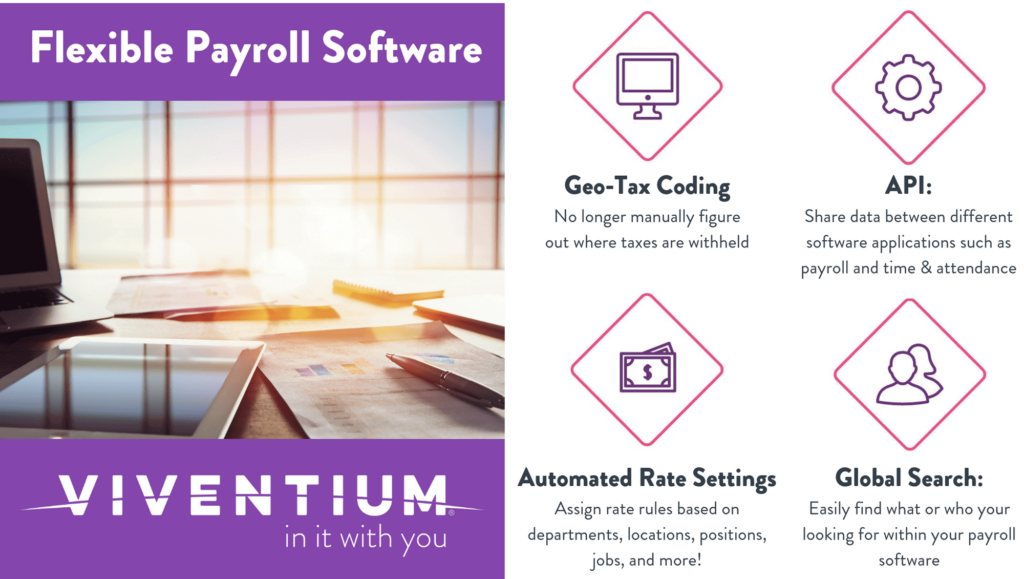
Standard payroll companies and software are perfectly capable of running weekly time cards and calculating state and federal taxes. Most of them automate direct deposit. Very few have the built-in capability to change hourly rates during a shift. Viventium allows agencies to customize visit types, names, and rates, allowing an employee to clock in at the start of a shift and adjust their job code as needed throughout the day. Even fewer calculate overtime, benefits eligibility, sick leave accrual, and daily overtime for per visit employees automatically. And Viventium is the first payroll software I’ve come across that is piece-rate compliant, calculating rest pay and non-productive time.
Customizations
HHAs are not “one size fits all” and neither is Viventium. The list of available customizations keeps growing. Agencies can apply custom parameters to:
CEU requirements based on license type, expertise, PiPs, etc.
Benefit information
Reminders for expirations and deadlines on performance reviews, licenses, certifications, and CEUs
Workflows for digital onboarding documents, progress tracking, and completion
Re-hire eligibility
Payroll and overtime calculations for one employee working across agency locations
Reporting, analytics, data, in addition to the static analytics dashboard
User Reviews
As a small business with very little need for robust HR systems, payroll software is not really on my “must have” list. Still, I’d be remiss if I didn’t consider using a system with this many “extras”. But, don’t take my word for it. Here is what Viventium customers have to say:
Hospital System with 11-50 Employees
“I enjoy the software and it beats most if not all payroll systems out there for attractiveness to use and navigate through. Very user friendly. When they update the product they always have a training associated with it. It easy to use for our employees as well.”
Home Care Agency with 51-200 Employees
“Viventium has really helped my company by providing payroll services. As a new and small business owner, the “V” team has been patient, helpful and always a pleasure to work with. In our first 2 years, the service has been very helpful and timely. I am very happy I decided to go with the “V” team. Highly recommend for payroll services.”
∼ Carlos, SYNERGY HomeCare in Palm Bay.
Health and Wellness with 1,001-5,000 Employees
“It’s not just another payroll or HR tool, it feels thoughtfully built for real people, especially those of us in healthcare….
Plus, having everything from benefits administration to compliance tracking in one place has saved me countless hours. It’s helped our team stay organized and focused on what really matters: supporting our staff and growing our business.”
Review
In the care at home industry, Viventium is relatively new in comparison with other systems. Outside of care at home, Viventium is trusted by more than 3,000 companies and has the experience and expertise to support more than just payroll, but all workforce management.
The user interface is pleasant and visually pleasing enhancing its very user-friendly, easy to use platform. 3rd party tools are fully integrated, keeping every feature under a single sign-on. Also included is an Android and iOS app for your staff to track and view hours, pay rates, benefits, and education all in one place.
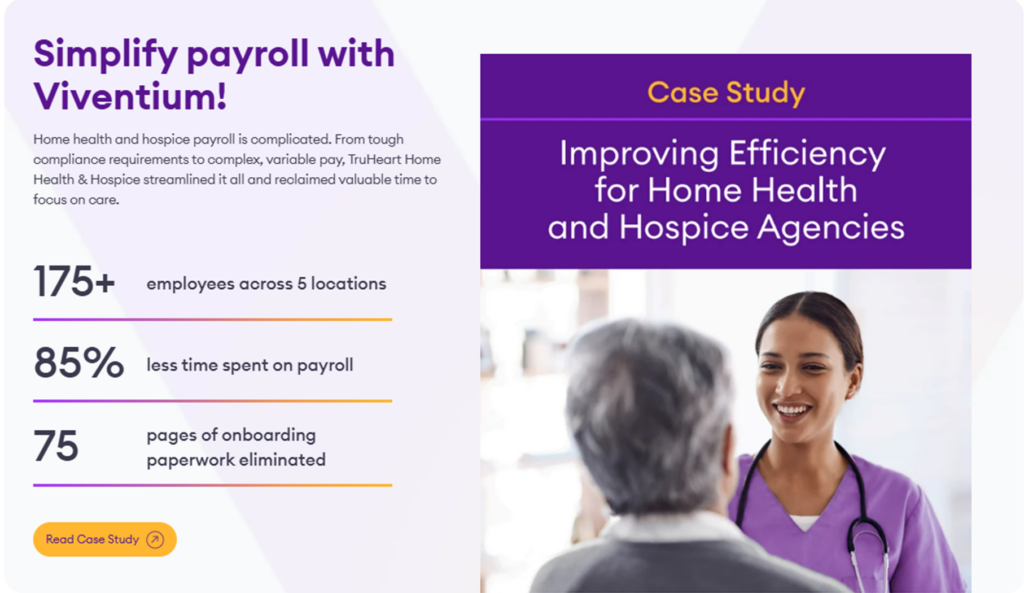
The automation and customization reduces payroll prep time, improves compliance and accuracy, strengthens retention and recruitment, eliminates physical paperwork for onboarding, and much more. This part is not my opinion, but is based on this efficiency study.
Final Thoughts
If you’re not using Viventium, it is worth exploring. The potential to eliminate multiple software systems and logins is real. The savings in time, retention, and reduced errors are measurable. Viventium is the best kept secret in care at home and based on my conversations with their team, we haven’t heard the last of Viventium’s innovation and industry-specific features.
# # #
Kristin Rowan has been working at The Rowan Report since 2008. She is the owner and Editor-in-chief of The Rowan Report, the industry’s most trusted source for care at home news, and speaker on Artificial Intelligence and Lone Worker Safety and state and national conferences.
She also runs Girard Marketing Group, a multi-faceted boutique marketing firm specializing in content creation, social media management, and event marketing. Connect with Kristin directly kristin@girardmarketinggroup.com or www.girardmarketinggroup.com
Viventium Releases its 2024 Caregiver Onboarding Experience Report, Demonstrating a Need to Raise the Bar for Onboarding in the Post-Acute Care Industry
BERKELEY HEIGHTS, N.J., April 02, 2024 (GLOBE NEWSWIRE) — Viventium, the leading SaaS-based human capital management platform serving the post-acute care industry, released its 2024 Caregiver Onboarding Experience Report, a comprehensive research study analyzing survey responses from 175 post-acute care administrators and 220 caregivers. The report finds a shockingly low bar for what passes as a “good” onboarding experience in home-based and facility/community-based care, with strong indications that raising that bar could correlate to higher retention rates.
“Staffing shortages and high turnover rates within post-acute care are recurring issues in need of solutions,” said Navin Gupta, Viventium CEO. “Our research illuminates a crucial pathway towards addressing these persistent challenges, and it begins with onboarding.”
Findings point to post-acute care managers and administrators having a major impact on the steps their organization can take to better engage, motivate, and retain its caregiving staff.
“The study significantly advances our knowledge of what it takes to recruit and retain caregivers in today’s highly competitive workforce market. The onboarding process is fully within the control of the employer, and the study shows that doing it right pays dividends. Most notably, many of the elements of successful onboarding are simple improvements in the process that bring a real return on investment. I would encourage all of home care to learn from this study.”
About Viventium
Viventium provides a SaaS-based human capital management solution that is focused on the post-acute care industry. The company’s mission is to enrich the lives of caregivers through technology so they love going to work every day. By providing specialized software and expert guidance, Viventium helps its clients throughout the lifecycle of each caregiver. The company has clients in all 50 states and supports over 420,000 client employees each year.