UnitedHealth Study: Is Medicare Advantage Killing Seniors

by Tim Rowan, Editor Emeritus

Is Medicare Advantage Killing Us?

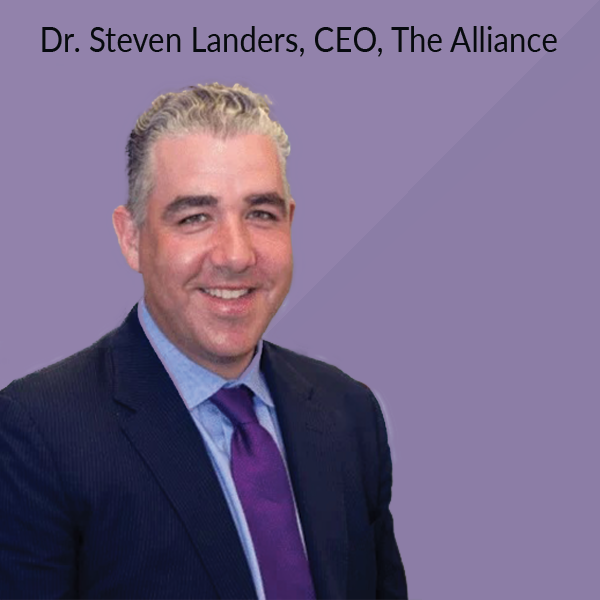
Dr. Steve Landers has long been eloquent in his speaking and writing about the importance of Home Health over the years. Though I was already impressed, I gained a new level of respect this week. Simultaneously with his debut as CEO of the new Alliance, Dr. Landers released an article about a recent study on the impact of Medicare Advantage on Medicare beneficiaries.

It is an article that everyone in our healthcare sector should read.

In “Home Health Cuts and Barriers are Life and Death Issues for Medicare Beneficiaries,” Dr. Landers points readers toward a study conducted by Dr. Elan Gada of UnitedHealthcare’s Optum Group. The results are disturbing. That the findings were released by a Medicare Advantage company is surprising.

Yes, Virginia, Home Healthcare Really Does Save Lives

Landers cited the study’s primary finding. “Medicare Advantage beneficiaries in their plan who did not receive needed home health care after hospitalization were 42% more likely to die in the 30 days following a hospital stay than those who received the prescribed care.” If a drug proved to be as effective as post-discharge home healthcare in saving lives, Landers wrote, “it would dominate the news, restricting access would be considered immoral, and health officials would be pushing its adoption.”

Medicare Advantage Enrollees Go Without

There are a number of reasons a hospital discharged patient might not receive home healthcare, including system issues and patient refusal. However, Dr. Gada’s study also discovered that MA customers go without post-discharge home health at a higher rate than traditional Medicare beneficiaries. Traditional Medicare beneficiaries go without in-home care about 25% of the time. Medicare Advantage beneficiaries 38% of the time. Landers notes that this data is a few years old and that the denial rate for MA customers is likely higher today.

Stop the Killing

We know the life-saving impact of post-hospital home healthcare. The question becomes: how does our little corner of the U.S. healthcare system help regulators and payers to know it as well as we do? At this week’s inaugural conference of the National Alliance for Care at Home, at least three education sessions discussed Medicare Advantage. All three offered strategies for negotiating with insurance companies and surviving under their oppressive rate structures and their frequent care denials.

UnitedHealth Group Medicare Advantage Landers

These Are Bandages, Not Cures

In previous opinion pieces, I have quoted revelations in government lawsuits against MA divisions of insurance companies. These prove the program that was originally launched to extend the lifespan of the Medicare Trust Fund actually costs CMS 118 percent of what traditional Medicare costs. At the same time, insurance company reports to shareholders proudly point out that their MA division is their most profitable.

One of last week’s most read stories was the report from UnitedHealth Group on their astounding Q3 growth.

In the Long Run

Learning to cope with MA care denials and below-cost visit payments is fine for those focused on making next month’s payroll. An entirely different tactic is needed for those focused on the care needs of their elderly parents or who are approaching age 65 themselves. The question must be asked, “Why does Medicare Advantage exist?”

Medicare Advantage Lobbyists

AHIP is the insurance company lobby. It put extreme pressure on Congress in 2009 when the Affordable Care Act was being written. That pressure resulted in then-President Obama removing a core plank from his bill. Obama struck the public option healthcare insurance plan in order to win enough votes to get the bill to his desk.

More $ Makes More $

That lobbying effort continues today precisely because MA is so profitable. How does it bring in so much cash? One after another, all of the large insurance companies have been caught padding patient assessments, the very fraud Home Health is so often accused of. Their monthly checks are determined by how much care they predict their covered lives will need, and they exaggerate it. Later, when it comes time to treat these same customers, MA plans deny care that would have been covered by traditional Medicare. They book profits at both ends, and they gladly pay the minimal fines when the practice is exposed.

The Reality of Medicare Advantage Fraud

To make each covered life more profitable, MA plans have begun calling customers to offer “free” nurse visits. These are essentially re-assessments where the MA staffer is rewarded for “finding” additional illnesses. This is not theoretical. My brother was offered a $50 gift certificate to CVS if he would allow his wife’s MA plan representative to drop in and chat with her, to “make sure she was getting all the benefits she was entitled to.”

Dr. Steven Landers: Call for Advocacy

In his article and in his speeches this week, Dr. Landers made it quite clear what must be done. EVERY person whose livelihood depends on the Medicare Trust Fund must make their voice heard. Letters and phone calls to Congress, to the Senate, to CMS, and to the Secretary of Health and Human Services, telling them you do not want to happen to your community what happened in Maine. After years of negative profit margins, in a state where MA adoption is at two-thirds, Andwell Health Partners ceased business in a wide swath of the northern regions of the state. Andwell was the only Home Health provider there.

The combined advocacy strength of NAHC and NHPCO is not enough to tip the scales. Your input is crucial.

Here's How it Works:

  1. Your letter explaining the damage coming from shrinking CMS reimbursement and MA care denials will be opened by a Congressional staffer.
  2. The staffer will read only enough of your letter to see its topic and which side of that topic you are on.
  3. No need to be lengthy or eloquent
  4. Put your topic and your position in your first paragraph
  5. The staffer will add a checkmark in the pro or con side of their Home Health ledger.
  6. The Congressperson, Senator, HHS Secretary will see a one-page summary of the numbers.
  7. When the numbers are small, the summary goes into a file
  8. When the numbers are large, the elected or appointed official will pay attention
  9. In rare cases, you may even get a phone call

UnitedHealth Group Advocacy Medicare Advantage

Dr. Landers, in His Own Words

The article Dr. Landers wrote detailing all of these includes wording suggestions for your message in your letter and/or call. For convenience, I have included one paragraph below,* but I urge you to spend three minutes reading the entire inspiring and frightening piece. In person, he explained all this in an emotional appeal. He said he cannot emphasize enough the importance of universal participation in our new organization’s advocacy effort. Based on what we have learned about post-hospital nursing care in the home, your letters and phone calls are a matter of life and death.

Excerpt

*To save lives and avoid unnecessary suffering, Medicare officials must reverse their plans to cut Traditional Medicare home health payments for 2025 and ensure payments are stable after adjusting for the dramatically increased healthcare labor cost inflation experienced over the past 5 years. Additionally, Medicare officials and lawmakers must study and address the possibility of the disproportionate administrative and financial barriers to home health in Medicare Advantage.

We are fortunate to have leaders in Congress like Senator Debbie Stabenow, Senator Susan Collins, Representative Terri Sewell, and Representative Adrian Smith who are working to champion a comprehensive bi-partisan legislative fix. Our leaders in Washington must act swiftly, before the end of the year, to save lives and avoid further destabilizing home health services for Medicare beneficiaries.

# # #

Tim Rowan, Editor Emeritus

Tim Rowan is a 30-year home care technology consultant who co-founded and served as Editor and principal writer of this publication for 25 years. He continues to occasionally contribute news and analysis articles under The Rowan Report’s new ownership. He also continues to work part-time as a Home Care recruiting and retention consultant. More information: RowanResources.com
Tim@RowanResources.com

©2024 by The Rowan Report, Peoria, AZ. All rights reserved. This article originally appeared in Healthcare at Home: The Rowan Report.homecaretechreport.com One copy may be printed for personal use: further reproduction by permission only. editor@homecaretechreport.com
Introducing “The National Alliance for Care at Home”

by Tim Rowan, Editor Emeritus

National Alliance for Care at Home

The merger of the National Association for Home Care and Hospice and the National Hospice and Palliative Care Organization, which was inked on July 1, became official this week in Tampa, Florida. The new National Alliance for Care at Home said farewell to retiring NAHC President Bill Dombi and gave a rousing welcome to incoming Alliance CEO, Steven Landers, MD. Both Bill’s farewell address and Dr. Landers’ introduction speech ended with the same theme. We do what we do for the good of our patients. Yes, there is money. Yes, there are politics. In the end, our legacy and our future are about people.

Dr. Steven Landers

Integrity, Quality and Compliance

That future will begin with a commitment to patient care excellence. Dr. Landers closed his opening address with an announcement. From now on, every member, upon beginning or renewing their annual membership, will be asked to sign an attestation pledging their company and themselves personally to commit to Integrity, Quality, and Compliance. “Our members will be known to the world as the best in the industry,” he proclaimed. “They will assure patients, families, and payers that they participate in Medicare and Medicaid quality performance standards.”

In a press conference the next day, Dr. Landers elaborated that NAHC and NHPCO have always worked with public and private payers and law enforcement agencies to rid our industry of those who are not in it for noble reasons. Those cooperative efforts will continue, he told the reporters. The new attestation will further assure the world that members of The Alliance publicly join that mission. One is reminded of a code of conduct common to all our national military academies. “We will not lie, steal, or cheat, nor tolerate among us anyone who does.”

Emphasis on Advocacy

The Alliance is new, and Dr. Landers candidly admits he is gradually learning his new role as he goes along. But he is guided by a commitment to care in the home that has been with him since medical school. “I didn’t want to be just another cog in the system,” he told 2,000+ attendees. “The first time I went along on a home visit, I immediately realized that this is what I wanted to commit my career to.” Through his years at the VNA and Cleveland Clinic, he saw the power of in-home care, including its ability to extend live expectancy and reduce the total cost of care.

Bill Dombi

A Semi-Farewell at Best

National Alliance for Care at Home Dombi

Bill Dombi will serve the new Alliance through the end of this year before fully entering retirement. Following his closing address on the last day of the conference, during which he summarized his 38 years with NAHC (years that began with a promise to his wife Lynn that they would only have to leave their home in Connecticut for the DC area for three to four years), I asked him what he planned to do that first day in January. He said that he accumulated a ton of frequent flyer miles during his career and that they would love to travel somewhere other than state and national association conference cities.

He also mentioned the ongoing legal actions he initiated to force CMS to develop more honest formulae for calculating Home Health reimbursement and added, “It is very difficult to change litigators in the middle of a lawsuit.” Draw your own conclusion but take it from one who knows how difficult it is to completely walk away from this mission and its people. We may not have heard the last of William A. Dombi.

# # #

Tim Rowan, Editor Emeritus

Tim Rowan is a 30-year home care technology consultant who co-founded and served as Editor and principal writer of this publication for 25 years. He continues to occasionally contribute news and analysis articles under The Rowan Report’s new ownership. He also continues to work part-time as a Home Care recruiting and retention consultant. More information: RowanResources.com
Tim@RowanResources.com

©2024 by The Rowan Report, Peoria, AZ. All rights reserved. This article originally appeared in Healthcare at Home: The Rowan Report. homecaretechreport.com One copy may be printed for personal use: further reproduction by permission only. editor@homecaretechreport.com

Home Health and Hospice Face Another Election Year

by Tim Rowan, Editor Emeritus

Home Health Hospice and the Election

It happens every four years. Once the Olympic torch has been extinguished, Americans turn their attention from athletics to politics, specifically to choosing their next President. While watching the Harris/Trump debate this week, my thoughts turned to the dilemma faced by Home Health, Hospice, and Home Care owners, managers, and field staff.

U.S. voters can make their voting decision after taking into consideration the policy proposals of each candidate and analyzing which policies might better benefit themselves or their businesses. Voters can also vote along party lines, regardless of the candidate or their policies. And then, there is always a percentage who set their personal advantages aside and vote for the candidate they believe to be better for the nation as a whole.

home health hospice election

Choice 2024

This may be where our healthcare sector finds itself this year. Is what is best for the country also best for Home Health, Hospice, Palliative Care, and Home Care? Or might the needs of one diverge from the needs of the other? If the latter, which choice is the higher calling?

In this week’s debate, the broad healthcare issue merited little more than a mention and some vague promises. Post-acute care was apparently unimportant or unknown to both candidates. Had a clever writer been tasked with summarizing that moment, it might have read, “Unhealthy Healthcare Debate Fails to Heal.” What did we learn, and where does it leave us?

Balancing Your Responsibilities

Voters have twin responsibilities, each as simple as it is profound. First, to decide whether to base their choice on party alone, on personal or business gain, or for the benefit of all. This includes whether the same vote will accomplish both or whether it is necessary to pick one or the other. The second responsibility is to research the issues and each candidate’s position on each issue. An informed voter is a patriotic voter.

Taylor Knows Best?

home health hospice election
Once a voter has committed to the basis for their choice, the second responsibility is met by reading. Oddly, this retired grandfather cannot express that idea any better than a 34-year-old pop singer. In her September 10 endorsement statement, Taylor Swift said:

“Now is a great time to do your research on the issues at hand and the stances these candidates take on the topics that matter to you the most. As a voter, I make sure to watch and read everything I can about their proposed policies and plans for this country. I’ve done my research, and I’ve made my choice. Your research is all yours to do, and the choice is yours to make.”

History May Repeat Itself

Home Health and Hospice are deeply dependent on government spending. In the immediate future, MedPAC and CMS can be counted upon to continue to squeeze profit margins as they shift their gaze from services to outcomes. For more than two decades, CMS has enacted rules that shrink the total number of Home Health agencies. This happened across four administrations with different political ideologies. The result is agencies serving the same number of beneficiaries with the same number of nurses while supporting fewer executives.

The meeting of self-interest and national interest may be stronger in the Home Care sector. Caregiver shortage pushes higher hourly pay rates, which pushes higher hourly fees, which decreases the number of clients willing and able to pay. An economy that creates more spendable income or savings means the threshold between “can’t afford it” and “we’ll make it work” lowers.

No, This is not an Endorsement

I guess the bottom line is that I agree with the young pop singer. Like her, I have done my research and made my decision. I urge you to do the same. Read everything you can from the source, if you can. Avoid the temptation to rely on anyone else’s summaries of candidate positions and plans. Think “patriotism” first and “what’s in it for me” second. When in doubt, revisit the words of speechwriter Ted Sorensen, whose brilliant poetry was etched permanently into American history through the voice of John F. Kennedy. “And so, my fellow Americans, ask not what your country can do for you; ask what you can do for your country.”

# # #

Tim Rowan, Editor Emeritus

Tim Rowan is a 30-year home care technology consultant who co-founded and served as Editor and principal writer of this publication for 25 years. He continues to occasionally contribute news and analysis articles under The Rowan Report’s new ownership. He also continues to work part-time as a Home Care recruiting and retention consultant. More information: RowanResources.com
Tim@RowanResources.com

©2024 by The Rowan Report, Peoria, AZ. All rights reserved. This article originally appeared in Healthcare at Home: The Rowan Report. One copy may be printed for personal use: further reproduction by permission only. editor@therowanreport.com

More Rural Providers Say ‘No’ to MA

by Tim Rowan, Editor Emeritus

O

ne just does not know whom to believe anymore. This week, we were sent three opinions of the pros and cons of Medicare Advantage programs. One says they reduce costs and improve patient satisfaction for rural residents. Another says rural hospitals are turning away MA customers at a growing rate. The third says MA customers utilize healthcare services at a lower rate than traditional Medicare beneficiaries. Let’s take a look at each opinion.

The Pro

Better Medicare Alliance is a non-profit advocacy group that promotes Medicare Advantage. They describe themselves and the genesis of their recent report this way:

“Better Medicare Alliance engaged ATI Advisory to understand Medicare beneficiaries who live in rural areas and how they are served across Medicare Advantage and Fee-for-Service (FFS) Medicare. Understanding geographic differences in beneficiary experiences is important to both the Medicare Advantage and FFS Medicare program. This research can help policymakers and stakeholders identify opportunities to improve access to and quality of rural health care.”

That sounds good so far. Let’s look at their conclusions.

    • 30 percent fewer MA client live in rural areas compared to cities and suburbs
    • rural MA enrollees are more likely to be Black or LatinX but health needs are consistent across all rural demographics
    • satisfaction is the same between rural MA clients and traditional Medicare beneficiaries, though MA enrollees use preventive services more and outpatient services less
    • rural MA enrollees spend less in premiums and out of pocket costs than traditional Medicare beneficiaries

Rural Hospitals Tell a Different Story

Healthcare Uncovered, an online publication with a patient advocacy slant, describes BMA as “an active front group for the health insurance industry and perhaps the country’s greatest champion of Medicare Advantage plans.” and “with a well-stocked, industry-financed war chest to promote insurers’ premier product.”

Writing for Healthcare Uncovered, longtime healthcare journalist Trudy Lieberman added perspective to the BMA-sponsored report:

More places say no to medicare advantage

There was evidence last fall that Medicare Advantage was under attack when several hospitals announced they were reviewing their arrangements with Advantage plan sellers and were not accepting some or all plans. The CEO of the Brookings Hospital system in Brookings, South Dakota, told me, “The difference between original Medicare and Medicare Advantage is vast. Advantage plans pay less, don’t follow medical policy, coverage, billing, and payment rules and procedures, and they are always trying to figure out how to deny payment for services.”

In 2023, Becker’s Hospital Review began reporting on hospitals that were dropping some or all of their contracts with Advantage plans. The August 20, 2024 update indicates 18 more hospitals have or will drop MA plans this year. 

Ms. Lieberman went on to report that MA plans frequently limit in-plan physicians. When they eliminate a physician in a rural community, patients often must travel miles to reach an approved doctor.

“Another damning report, this one issued by the Nebraska Rural Health Association, also revealed the pitfalls of joining an Advantage plan. The report warned that Nebraskans with Advantage plans ‘have created such a financial burden for rural residents’ that when they get sick, those with Medicare Advantage coverage ‘represent the largest growing segment of charity care for Nebraska’s rural hospitals.’ I’d bet few if any seniors are told they may end up on charity care if they choose an Advantage plan.”

A hospital in 23,000-resident North Platte, Nebraska has stopped accepting all MA patients. CEO Ivan Mitchell told Ms. Lieberman that transfers to nursing home and Home Health are denied 13 percent of the time. “Hospital stays are 40 percent longer for MA patients. They are stuck in the hospital two or three days waiting for approval to be transferred, and we need those beds for sicker patients.”

RIHC logo

Home Health Weighs In

The Research Institute for Home Care awarded a grant to Tami M. Videon, PhD, and Robert J. Rosati, PhD, of the VNA Health Group, the honored Home Health not-for-profit in New Jersey. The researchers divided beneficiaries into three groups: Traditional Medicare, MA with a premium, and MA without a premium. Their findings resonated with the experiences of rural hospitals more than those of the MA advocacy group.

Research Findings

    • Traditional Medicare (TM) beneficiaries were more likely to utilize outpatient, inpatient, and home health care services than beneficiaries in Medicare Advantage (MA) plans, regardless of whether the plan had a monthly premium or not.
    • Beneficiaries who reported being in zero premium MA plans were substantially less likely to use dental, hearing, and vision services compared to other beneficiaries.
    • Rates of utilization of hearing and dental services were relatively similar for beneficiaries reporting they were in MA plans with a premium and those enrolled in TM. Access to vision services was greatest among beneficiaries reporting being in MA plans with a premium.

In their research briefing, the researchers stated:

“Consistent with the literature, this study found beneficiaries enrolled in MA  plans had lower utilization for services required to be covered by Medicare (outpatient visits, inpatient admission, and home health care use) than beneficiaries enrolled in TM. The observed lower rate of home health care utilization among MA beneficiaries may result from restrictions in inpatient care. However, prior research indicates when analyses are restricted to similar patient populations (a subset of diagnostic codes), MA beneficiaries are less likely to receive home health care than TM beneficiaries.”

Where Does the Money Go?

We have often reported on the lawsuits that various federal departments have lodged against the largest health insurance companies for their Medicare Advantage practices.  With their payments from the Medicare Trust Fund based on patient assessments, they have been caught exaggerating illnesses, adding chronic conditions that do not exist, and conducting periodic home visits to “update” their data on the health condition of their customers. These nurse visits to the home frequently “identify” serious health conditions that the person did not know they had, or in most cases did not have at all.

As a consequence of this practice, coupled with denying care that Traditional Medicare would have covered, the program has been determined by government audits to cost 119 percent of what Traditional Medicare costs. 

Final Thoughts

Should Home Health follow the lead of so many rural hospitals and begin to Just Say No? Our guess is that this will be a prominent topic at this October’s NAHC Conference in Tampa.

# # #

Tim Rowan, Editor Emeritus
Tim Rowan is a 30-year home care technology consultant who co-founded and served as Editor and principal writer of this publication for 25 years. He continues to occasionally contribute news and analysis articles under The Rowan Report’s new ownership. He also continues to work part-time as a Home Care recruiting and retention consultant. More information: RowanResources.com Tim@RowanResources.com ©2024 by The Rowan Report, Peoria, AZ. All rights reserved. This article originally appeared in Healthcare at Home: The Rowan Report. One copy may be printed for personal use: further reproduction by permission only. editor@therowanreport.com

Startup Offers $3 Caregiver Recruiting Service

by Tim Rowan, Editor Emeritus

Costly Caregiver Recruiting

Out of desperation, the nationwide caregiver shortage has driven many Home Care agency owners to resort to expensive recruiting tools. How much, for example, do you spend on services such as Indeed, ZipRecruiter, or Monster, each of which charges per-click?

A Needle in a Stack of Needles

You know how job seekers use these services, correct? They complete one resumè and send it to dozens, if not hundreds, of companies every day. When you respond to their inquiry, thinking they have a keen interest in applying for your caregiver position, they typically respond, “Now, which one are you?”

Caregiver Recruiting GoInstaCare

Caregiver Recruiting Database Emerges

In the process of building a web site and app for families to find in-home caregiver services, former Home Care agency owner Amit Shrivastava suddenly found himself with more job seekers than he could place in homes, and this after launching in only five states. His solution was to open his collection of resumés to other agencies. After we tested his idea, we believe it will one day give Indeed and the others a run for their money.

Simple Process with Customized Results

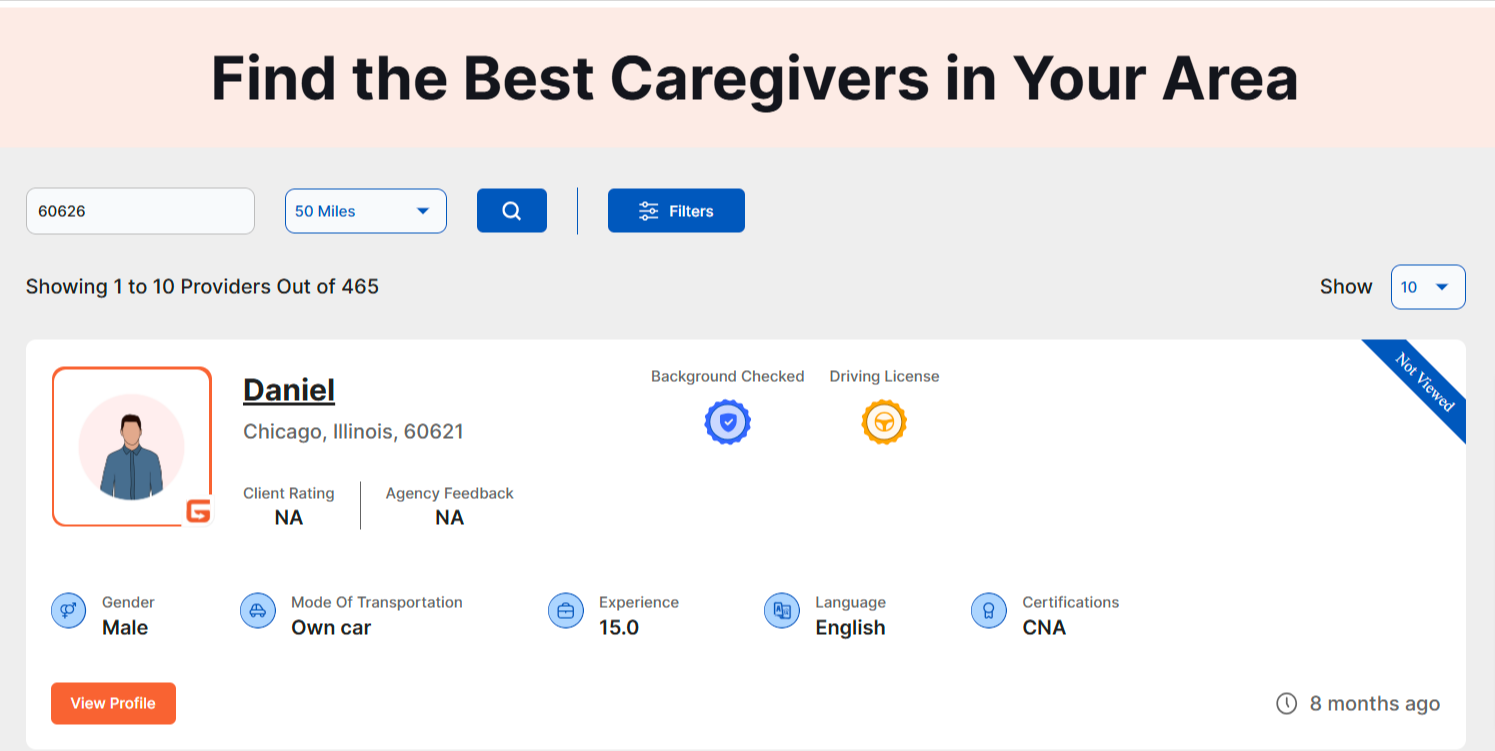
After a $200 set-up fee, GoInstaCare users can look at the names, certificates, personality types, and work preferences of 10,000 caregivers, a list that continues to grow. An easy filtering system allows the user to narrow the list by certification, gender, zip code, and experience. Each entry displays whether the caregiver has a driver’s license, his or her own car, languages spoken, and ratings from past employers and clients.

GoInstaCare performs background checks so the hiring agency knows that the caregiver has a higher degree of passing their own checks. By selecting filters, a hiring agency can focus its search to the qualifications it requires. Once the 10,000 names are filtered down to a manageable half dozen or so, the hiring agency pays $3 each to download their contact information. At that point, GoInstaCare steps back and leaves the rest of the onboarding process to their participating agency.

"Uberized" Employer

For Caregivers

Like its counterparts in ride shares, delivery services, virtual assistants, and other gig economy positions, GoInstaCare allows caregivers to set their own schedules, provide flexible rates, get paid daily, and accept or decline a job at will. Caregivers are reviewed by clients and their families directly on the GoInstaCare platform.

For Agencies

The gig job nature of the platform gives agencies the option to cover a gap in scheduling or temporarily raise employee numbers without the hiring, onboarding, training, and retention of a full-time or part-time employee. Agencies can also save a caregiver profile to share with a team, or for future reference.

Where to Find GoInstaCare

As this is written, GoInstaCare has spread to five states, Texas, Illinois, Michigan, New York, and Florida. Mr. Shrivastava told The Rowan Report there are plans to continue to expand.

There are two ways to get in touch with Amit Shrivastava. Click on this link to schedule a product demo: calendly.com/goinstacare-sales/meeting. Or sign up to use the service here: Goinstacare.com/partner-with-us

Caregiver Recruiting GoInstaCare

# # #

Tim Rowan, Editor Emeritus

Tim Rowan is a 30-year home care technology consultant who co-founded and served as Editor and principal writer of this publication for 25 years. He continues to occasionally contribute news and analysis articles under The Rowan Report’s new ownership. He also continues to work part-time as a Home Care recruiting and retention consultant. More information: RowanResources.com
Tim@RowanResources.com

©2024 by The Rowan Report, Peoria, AZ. All rights reserved. This article originally appeared in The Rowan Report. One copy may be printed for personal use: further reproduction by permission only. editor@therowanreport.com

MA Past, Present, and Possible Future: Nothing Good to Report

by Tim Rowan, Editor Emeritus

Past

For at least the last five years, every Home Health conference this reporter has attended has featured at least one keynote speaker or expert panelist complaining about sparse and shrinking payments from Medicare Advantage plans. As thousands of seasonal TV ads convince more and more Medicare beneficiaries to enroll in what insurance company executive-turned-whistleblower Wendell Potter called “neither Medicare nor an advantage,” the calls from Home Health executives to turn away MA members, following the lead of many hospitals, have grown louder and more frequent.

Originally designed to extend the lifespan of the Medicare Trust Fund by bringing managed care practices to the federal healthcare program for seniors and disabled, Medicare Advantage has failed to do so. As long ago as 2021, an exposé by Fred Schulte in Kaiser Family Foundation Health News found that MA costs to taxpayers began to explode in 2018 and today equal 119 percent of what traditional Medicare should cost. We looked at more recent studies and found similar reports.

From the Experts

Referencing a study by Richard Kronick, a former federal health policy researcher and a professor at the University of California-San Diego, Schulte said, “his analysis of newly released Medicare Advantage billing data estimates that Medicare overpaid the private health plans by more than $106 billion from 2010 through 2019 because of the way the private plans charge for sicker patients. A third of that overpayment occurred in 2018 and 2019.”

Since Kronick’s 2021 report, more beneficiaries have opted in to Medicare Advantage. So far, just over half have switched from straight Medicare, with or without a supplement, and that number may reach 100 percent if those who profit most from the option have their way.

Present

In recent months, we have investigated and reported on the insurance industry’s practice of exaggerating MA member health conditions and denying care that traditional Medicare would have covered, collecting from both ends of the CMS trough. We have also mentioned several federal and state lawsuits piling up against insurance companies for both of those practices. One of our sources, The Center for Economic and Policy Research, said this in the Executive Summary of its detailed, September 2023 study:

Profiting at the Expense of Seniors: The Financialization of Home Health Care

“The nonpartisan Medicare Payment Advisory Commission (MedPAC) estimates that upcoding by MA plans that make enrollees appear to be sicker than they are costs CMS 106 percent of what traditional Medicare costs; adding in the quality bonus payments brings it to 108 percent. MA plans also enroll healthier Medicare beneficiaries, increasing their operating surplus by another 11 percent, making the payments to MA plans 19 percent higher than the payments to traditional Medicare. 

CMS’s announced goal for traditional Medicare beneficiaries is to move all of them to Accountable Care Organizations, which use the valued-based payment model, or other similar care arrangements, by 2030. CMS’s leading model to accomplish this shift is ACO REACH — a gentler, kinder version of the Trump administration’s backdoor enrollment of traditional Medicare beneficiaries in a capitated payment model.”

The Center for Economic Policy Research

Future

Past Present Future Medicare Advantage

Depending on results in the unpredictable world of politics later this year, CMS may or may not see its shift to value-based ACO models come to fruition. Kaiser News‘ Schulte examined the Heritage Foundation’s “Project 2025,” the conservative think tank’s blueprint for any possible future Republican administration, and found an entire section on the Department of Health and Human Services.

Within its “Mandate for Leadership,” the authors identify Medicare and Medicaid as “the principal drivers of our $31 trillion national debt.” While admitting that Medicare and Medicaid “help many,” the authors assert that the programs “operate as runaway entitlements that stifle medical innovation, encourage fraud, and impede cost containment, in addition to which their fiscal future is in peril.”

Rebuttal

Commenting on the Heritage Foundation’s claim, researcher Sonali Kolhatkar, writing for “OtherWords.org,” counters that this opinion is often used to justify ending social programs, but actual CMS data indicates that per person Medicare spending has plateaued for more than a decade and represents one of the greatest reductions to the federal debt. Even with 10,000 to 11,000 Boomers reaching Medicare eligibility every day, total per beneficiary expenditures have stopped climbing, hovering around $12,000 per year since 2010. Before reaching that 2010 plateau, per beneficiary spending had steadily risen from $2,000 at the program’s 1965 inception.

Medicare Advantage for All

Project 2025 proposes making Medicare Advantage the default enrollment option rather than a choice beneficiaries can opt into. With 100 percent of seniors on MA plans, already historic insurance profits will skyrocket further. But will Medicare beneficiaries benefit as well?

The Center for Economic and Policy Research cites multiple lawsuits that have proven eight of the ten largest MA plans routinely add chronic conditions – some non-existent – to patient assessments at enrollment…or later. We reported recently that UnitedHealth Group, operator of the largest MA plan, recently began sending nurses into homes to search for additional health conditions that would raise company payments from the trust fund. The report we quoted included evidence that these home visit upcodes do not lead to any treatments. The Center added that MA’s “heavily restricted networks damage one’s choice of provider along with introducing dangerous delays and denials of necessary care.”

As we have mentioned before, Medicare Advantage is neither Medicare nor an Advantage.

Medicaid also Attacked

Project 2025 also proposes restrictions on Medicaid eligibility by imposing work requirements. The blueprint sees the program for low-income Americans as a  “cumbersome, complicated, and unaffordable burden on nearly every state.” Their plan includes bringing private insurance companies in to “manage” care.

A June, 2024 report by the Center on Budget and Policy Priorities concluded that the ACA’s expansion of Medicaid helped millions of Americans who would otherwise be uninsured, and that its enabling and encouragement of preventive care actually saved money in state budgets. Last month’s report asserted “the people who gained coverage have grown healthier and more financially secure, while long-standing racial inequities in health outcomes, coverage, and access to care have shrunk.”

Project 2025 authors make no mention of a KFF News report from April 2023 that said most Medicaid-eligible people are already working. Nor does it take into account a Government Accountability Office report to Congress October 2020 and again in 2023 that determined that hourly wages in many large companies are low enough to keep even full-time workers eligible for Medicaid and SNAP. Walmart and McDonalds, to name two, land in the top five in almost every state for having Medicaid-eligible workers.

EVEN THE WALL STREET JOURNAL IS CRITICAL

Under the front page Headline “Medicare paid $50 billion to insurers for untreated ills,” a detailed WSJ investigation highlighted a number of findings, including:

  • “The questionable diagnoses included some for potentially deadly illnesses, such as AIDS, for which patients received no subsequent care, and for conditions people couldn’t possibly have, the analysis showed. Often, neither the patients nor their doctors had any idea.”
  • “Instead of saving taxpayers money, Medicare Advantage has added tens of billions of dollars in costs, researchers and some government officials have said.”
  • “Medicare Advantage has cost the government an extra $591 billion over the past 18 years, compared with what Medicare would have cost without the help of the private plans, according to a March report of the Medicare Payment Advisory Commission, or MedPAC, a nonpartisan agency that advises Congress. Adjusted for inflation, that amounts to $4,300 per U.S. tax filer.”
  • “The Journal reviewed the Medicare data under an agreement with the federal government. The data doesn’t include patients’ names, but covers details of doctor visits, hospital stays, prescriptions and other care.”
People voting

Now it is in the Hands of Voters

Home Health, Hospice, and Home Care owners, management, and workers will be voting in November. Consideration of what four years under a Project 2025-friendly administration will mean to businesses dependent on Medicare and Medicare will weigh heavily on their minds as they enter their polling booths.

# # #

Tim Rowan, Editor Emeritus

Tim Rowan is a 30-year home care technology consultant who co-founded and served as Editor and principal writer of this publication for 25 years. He continues to occasionally contribute news and analysis articles under The Rowan Report’s new ownership. He also continues to work part-time as a Home Care recruiting and retention consultant. More information: RowanResources.com
Tim@RowanResources.com

©2024 by The Rowan Report, Peoria, AZ. All rights reserved. This article originally appeared in Healthcare at Home: The Rowan Report.homecaretechreport.com One copy may be printed for personal use: further reproduction by permission only. editor@homecaretechreport.com

Payer or Competitor?

by Tim Rowan, Editor Emeritus

UnitedHealth Making Home Health Visits

Payer or Competitor…that is the question. According to a report in the Wall Street Journal, and questioned by the insurance industry’s lobbying arm, AHIP, UnitedHealth Group has increased its revenue from the Medicare Trust Fund by $50 billion by “finding” additional health issues during home visits to its MA customers.

In a July 16 investor call, CEO Andrew Witty said UnitedHealth clinicians made more than 2.5 million home health visits to UnitedHealthcare MA members in 2023. Following these visits to more than 500,000 seniors, UnitedHealth upgraded over 300,000 of them to higher payment levels by uncovering health conditions the individual seniors did not know they had.

The WSJ investigation found that between 2018 and 2021, insurers received $50 billion for diagnoses they added to members’ charts. Many of these diagnoses were “questionable,” according to that investigation.

Questionable Visits

Uncover versus Discover United Health

Though a UnitedHealth spokesperson called the analysis “inaccurate and biased,” former UnitedHealth employees told the Journal home visits are often used to add diagnoses. Clinicians say they use software during visits that offer suggestions as to what illnesses a patient might have.

CEO Witty maintained in the investor call that the practice is good for seniors. “UnitedHealth clinicians discovered more than 3 million gaps in care through home visits in 2023,” he reported, “and 75% of patients receive follow-up care in a clinic within 90 days of a home visit.” 

He added that the United home visit program “helps patients live healthier lives and saves taxpayers money,” concluding. “…Medicare Advantage makes programs and results like this possible.” 

The Journal concluded with the finding that few of these upgraded seniors are ever seen by a physician for their newly discovered health conditions. 

# # #

Tim Rowan, Editor Emeritus

Tim Rowan is a 30-year home care technology consultant who co-founded and served as Editor and principal writer of this publication for 25 years. He continues to occasionally contribute news and analysis articles under The Rowan Report’s new ownership. He also continues to work part-time as a Home Care recruiting and retention consultant. More information: RowanResources.com
Tim@RowanResources.com

©2024 by The Rowan Report, Peoria, AZ. All rights reserved. This article originally appeared in Healthcare at Home: The Rowan Report. One copy may be printed for personal use: further reproduction by permission only. editor@therowanreport.com

Department of Labor Changes Exemption and Overtime Thresholds

by Tim Rowan, Editor Emeritus

Overtime and exemption thresholds impact employers trying to balance cost-effective policies with employee fairness. As such, they keep a close eye on rules they must follow that come down from the U.S. Department of Labor. When those rules change, remaining compliant requires a company HR leader to adapt those policies. One of those times is at hand.


Exemption and Overtime Thresholds for Hourly and Salaried Earners

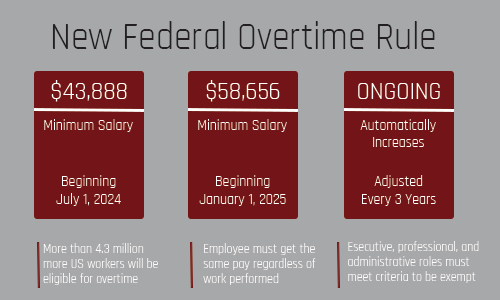
Effective last week, July 1, the annual salary threshold for overtime exemption increased from $35,568 to $43,888. The DoL’s final rule does not stop there but sets another increase on January 1, 2025, to $58,656 per year or $1,128 per week. Salaries below those thresholds cannot be declared “exempt,” meaning they must be paid overtime rates for hours worked over eight per day and forty per week.


Executive Salaries also Affected

In addition to overtime and exemption thresholds, the new rule increases the highly compensated employee threshold twice as well. On July 1, the annual salary threshold increased from $107,432 to $132,964. That annual threshold will increase again on January 1 to $151,164.

Going forward, the DOL will increase all thresholds every three years starting July 1, 2027, relying on up-to-date wage data.

We learned these DoL rule details from Angelo Spinola, Executive Director and lead home care attorney with Polsinelli, a national law firm. 

Federal Overtime Rule

Angelo Spinola Comments

“Home care providers that have been making adjustments to comply with the July 1 deadline may have heard about a recent case out of Texas blocking the July 1 increases. While the Texas court did use a partial injunction blocking the July 1 increase, it only applies to Texas government employees. It does not affect any private employers.”

He recommended that all home health and home care employers continue to make changes as planned to comply with the July 1 increases. Spinola stated that his statements are for informational purposes only and are not intended to be legal advice. His comments quoted here should not be relied upon or used without consulting a lawyer to consider your specific circumstances, possible changes to applicable laws, rules and regulations and other legal issues.

Spinola Concludes

“There are still challenges pending that could affect the January 1, 2025 increases, however, those decisions are not expected for several months, and it is too soon to predict whether that deadline will be affected. We will continue to monitor these cases and provide any updates that may have an effect on the home care industry.”

Angelo Spinola can be reached via email at onlinesolutions@polsinelli.com. 

NAHC Comments on Exemption and Overtime Thresholds

“The long-awaited U.S. Department of Labor rule regulating minimum salaries levels to qualify for exemption to the Fair Labor Standards Act was issued today. We strongly advise the home care community to gain a comprehensive understanding of the rule and institute steps for timely compliance. While the changes may have limited impact on most home care companies, noncompliance comes with serious penalties.” – NAHC President Bill Dombi

# # #

Tim Rowan, Editor Emeritus

Tim Rowan is a 30-year home care technology consultant who co-founded and served as Editor and principal writer of this publication for 25 years. He continues to occasionally contribute news and analysis articles under The Rowan Report’s new ownership. He also continues to work part-time as a Home Care recruiting and retention consultant. More information: RowanResources.com
Tim@RowanResources.com

©2024 by The Rowan Report, Peoria, AZ. All rights reserved. This article originally appeared in Healthcare at Home: The Rowan Report.homecaretechreport.com One copy may be printed for personal use: further reproduction by permission only. editor@homecaretechreport.com

Poor Joe is Out of A Job

by Tim Rowan, Editor Emeritus

We have been keeping an eye on the Medicare Advantage business as the number of beneficiaries who switch exceeds fifty percent. In past reports, we have described the federal lawsuits that accuse MA insurance companies of illicitly padding revenues while illegally denying treatments that straight Medicare would have covered. (See MedPAC Exposes More Medicare Advantage Crimes – 3/20/24)

Until now, we haven’t gone into detail about those independent brokers with the continuous TV commercials every November. It turns out, they may be even more dishonest than the insurance companies themselves.

Poor Joe

Perhaps the most famous of these brokers is the one that put Broadway Joe Namath in our living rooms a hundred times a day. The company started life as Health Insurance Innovations, owned by Chicago-based private equity firm Madison Dearborn Partners. After accusations of fraud, the company folded and re-emerged as Benefytt. When the same accusations returned, the owners shut that company down and came back as Blue Lantern Health.

According to Healthcare Uncovered, the firm filed for a state-level bankruptcy equivalent in Delaware last April, called “assignment for the benefit of creditors.” Blue Lantern’s website is down, as are MedicareCoverageHelpline.com and HealthInsurance.com, their signature assets. Nobody answers the 800 number Namath hocked for years.

A History of Fraud

The bankruptcy litigation revealed a database of 7 million seniors who had been bombarded by 17 million phone calls. The bankruptcy was apparently precipitated by the Federal Trade Commission, which forced Benefytt to pay $100 million to the people it had scammed by selling sham Obamacare plans, with checks distributed to victims in March. The Securities and Exchange Commission forced Health Insurance Innovations and the company’s co-founder Gavin Southwell to pay a $12 million settlement. Another close associate of the company, Steven Dorfman, was convicted of wire fraud in February.

Deceptive Practices

Tolerance for the firm’s deceptive advertising scheme ended with changes to the Medicare Advantage rule in 2023 that took effect in 2024. Blue Lantern stated after the fines were imposed that the new rule was critical to the company’s downfall,

Previously, former HHS Security Alex Azar characterized the Namath ads as “real savings, real options” in Medicare Advantage, ignoring the studies showing that the MA program costs the Trust Fund not less but $140 billion more than original Medicare.

Healthcare Uncovered concluded with this observation, “Further rules imposed since then by the Biden administration are putting even more pressure on Medicare Advantage lead generators, also called ‘third-party marketing organizations.’ (TPMOs) Beginning October 1 of this year, CMS will require that TPMOs get express consent from individuals before selling contact information to other marketers and brokers — a key loophole that enabled the growth of Blue Lantern and its predecessors.”


Don’t worry about Joe Namath’s retirement income though.
He has already landed a gig hawking hearing aids.

Joe Namath TV ad

# # #

Tim Rowan, Editor Emeritus

Tim Rowan is a 30-year home care technology consultant who co-founded and served as Editor and principal writer of this publication for 25 years. He continues to occasionally contribute news and analysis articles under The Rowan Report’s new ownership. He also continues to work part-time as a Home Care recruiting and retention consultant. More information: RowanResources.com
Tim@RowanResources.com

©2024 by The Rowan Report, Peoria, AZ. All rights reserved. This article originally appeared in Healthcare at Home: The Rowan Report. One copy may be printed for personal use: further reproduction by permission only. editor@therowanreport.com

Florida Hospice Teaches Dementia Care by Simulating Dementia

by Tim Rowan, Editor Emeritus

“This [virtual dementia] tour opened my eyes to the reality of what a dementia patient lives with every day. It is completely different when you walk in their shoes. I highly recommend this program for caregivers.” 
“I can’t tell you how the dementia tour workshop has impacted my daily journey with my husband. He is 64 and suffers from a combination of Lewy Body and Frontal Temporal Dementia. We have been navigating this as a family for 7 years. I thought I understood his struggle, but the virtual tour has opened my eyes completely. It was a very emotional experience for me. You have changed our lives.”
“Thanks to this training, I will be a better caregiver starting today!”

These are a few of the comments from caregivers and family members who were trained by the Hospice of Marion County (HMC) in Ocala, Florida. HMC offers training based on research conducted by P.K. Beville, geriatric specialist and founder of Second Wind Dreams®. Second Wind is an international organization offering services to caregivers. Known as “The Virtual Dementia Tour,” the training is a patented, evidence-based, scientific method of building a greater understanding of dementia for clinicians, caregivers, and family members.

Virtual Dimentia Tour

Virtual Dementia Tour

Trained facilitators outfit trainees with patented devices that alter their senses. They then guide participants while they try to complete common everyday tasks and exercises. The Virtual Dementia Tour enables caregivers to experience for themselves the physical and mental challenges those with dementia face. This experience helps to provide better person-centered care.

HMC began The Virtual Dementia Tour in 2020 following an endowment from the widower of an Alzheimer’s patient who had been under MCH care. Named after his late wife, the Nancy Renyhart Dementia Education Program offers trainings through the hospice. The training is not only for hospice patient families and care teams, but to others who request it.

Meet the Team

DJ Ryan, Dementia Education RN, is certified by Second Wind Dreams as a Certified Dementia Practitioner. He has been with HMC since 2015 and provides trainings at the hospice offices and in the community. Chief Medical Officer Mery J. Lossada is dual certified in neurology and psychiatry. She has been with HMC since 2007. She works with local police, EMS providers, the department of Children and Family Services, and mental health providers to coordinate healthcare services to the community, including dementia patients and their families.

In its first three and a half years, the Nancy Renyhart Dementia Education Program has provided dementia education to 9,968 people. This number includes 926 first responders and 482 caregivers who have gone through the Virtual Dementia Tour® in the last two years. It also includes 2,026 healthcare professionals and first responders who have gone through the Tour since the inception of the program in January, 2021. 6,534 people have attended 167 dementia presentations. HMC provides all these services at no charge to the individuals or their employers.

Dr. Lossada told us, “We are a non-profit organization, and we have identified the three most common diagnoses leading to admission to hospice care: cardiological, pulmonary, and dementia. We have a specific program for each one of those disorders, each one intended to improve quality of life for the patient and the caregiver. We have seen that these dementia disorders are causing the most distress. Our training program helps with that.”

Outcomes

Nurse DJ Ryan said the reduction in hospitalizations, emergency department visits, and transfers to residential memory care facilities is impossible to translate into a mere financial advantage. He is more familiar with the impact of the training on individuals and families. “In the case of Lewy Body Dementia, which includes hallucinations, we have seen people believe they were being watched, attacked, or had bad guys coming in through the heating vents. One person called 911 475 times one year. Once we get involved with our part of the task force, we get them the resources that they need and get them connected with support to reduce those 911 calls. And the numbers are astounding.”

Ryan told us he has been receiving calls from all over the country inquiring about participating in or duplicating his training program. This interest comes without having engaged in any promotional efforts outside of the HMC web site. DJ can be reached via the HMC web site, hospiceofmarion.org/dementia.

# # #

Tim Rowan, Editor Emeritus

Tim Rowan is a 30-year home care technology consultant who co-founded and served as Editor and principal writer of this publication for 25 years. He continues to occasionally contribute news and analysis articles under The Rowan Report’s new ownership. He also continues to work part-time as a Home Care recruiting and retention consultant. More information: RowanResources.com or Tim@RowanResources.com

©2024 by The Rowan Report, Peoria, AZ. All rights reserved. This article originally appeared in Healthcare at Home: The Rowan Report. One copy may be printed for personal use: further reproduction by permission only. editor@homecaretechreport.com