Feedback Adjusts Final Rule

CMS

FOR IMMEDIATE RELEASE
November 28, 2025

Contact:                                                        Hannah Kristan
communications@allianceforcareathome.org
202-355-1647

National Alliance for Care at Home: CMS Modifies Final Payment Rule Based on Stakeholder Feedback, but 1.3% Cut Still Undermines Access

Despite positive changes in final rule, home health leaders remain deeply concerned payment cuts will continue to impact patient access to care at home 

ALEXANDRIA, VA and WASHINGTON, D.C. The National Alliance for Care at Home (the Alliance) today acknowledged that the Centers for Medicare & Medicaid Services (CMS) made significant adjustments in the Home Health Perspective Payment System (HH PPS) Final Rule for CY 2026 in response to community concerns regarding patient access and data integrity. 

However, the Alliance remains concerned that any payment cut for home health providers will continue to compromise access for the millions of Medicare beneficiaries who rely on these services to age and recover from illness or injury safely at home.

Since 2019, Medicare home health providers have experienced severe cuts that have already led to a cascade of home health agency closures and reduced patient access to care, especially in rural and underserved communities. The cuts finalized by CMS today – 1.023% permanent and 3% temporary – will likely continue to exacerbate these trends.

Medicare Advantage Home Health Use

“While the Alliance acknowledges that CMS took into account some of the home health community’s recommended changes in its final rule, resulting in a lower payment cut for next year, a 1.3% overall reduction in payments compared to 2025 will likely result in continued reductions in patient access, the closure of more home health agencies, and more patients waiting in costly hospital settings instead of recovering safely at home.”

– Dr. Steve Landers, CEO for the Alliance

The Alliance commends CMS for revisiting aspects of its flawed payment approach, including the conclusion of permanent payment adjustments with CY 2026 (using data from CY 2020 through 2022) based on issues that CMS acknowledged with isolating PDGM behavior changes from non-PDGM behavior changes in CYs 2023 and beyond. In total, CMS’s changes from proposed to final rule amount to approximately $915 million more in payments to home health agencies for 2026. However, any cut will be detrimental in the face of years of compounding decreases, and more action is needed to help preserve integrity, stability, and predictability in Medicare’s home health benefit. While CMS reduced the amount of overpayments that inform the temporary payment adjustments down to 4.7 billion for CYs 2020 through 2024, home health agencies will continue to face several more years of temporary adjustments without additional action. 

“Home health care is among the most trusted, cost-effective, and patient-centered services in the Medicare program. The Alliance thanks its members, the broader home health community, and allied organizations and leaders for their advocacy to help achieve this substantial improvement for home health providers and patients nationwide. Congress must take further action to enact lasting reforms to the system that protect patient access to these services and ensure the sustainability of the Medicare home health benefit.” 

Steve Landers

CEO, National Alliance for Care at Home

Expanding access to home health care is essential to improving health outcomes, enhancing patient independence, and reducing healthcare costs. Research shows that when patients are unable to access clinically appropriate home health services, hospital readmissions are 35% higher, mortality rates are 43% greater, emergency department utilization grows by 16%, and total spending is 5.4% more than if patients were able to access the services they need. Protecting this vital benefit is also popular as 70% of U.S. voters are opposed to Medicare home health cuts. 

# # #

About the National Alliance for Care at Home

The National Alliance for Care at Home (the Alliance) is the leading authority in transforming care in the home. As an inclusive thought leader, advocate, educator, and convener, we serve as the unifying voice for providers and recipients of home care, home health, hospice, palliative care, and Medicaid home and community-based services throughout all stages of life. Learn more at www.AllianceForCareAtHome.org. 

© 2025 by National Alliance for Care at Home. This press release originally appeared on the Alliance website and is reprinted here with permission. For more information or to request reprint permission, please see press contact information above.

Appeals Court Filing

Advocacy

by Kristin Rowan, Editor

Appeals Court Filing

Hospice ALJ

A hospice claim may fall under review either before or after the claim has been paid. A hospice agency with a denied claim must file appeals until the claim is approved or the appeals are exhausted. First, they file a written request to reconsider. Then, they file an appeal to a Qualified Independent Contractor (QIC) who employs medical professionals to assess the case. Next, they file an appeal to an Administrative Law Judge (ALJ).

The ALJ is meant to review the documentation to determine whether it satisfies Medicare requirements. That’s all. There are two sets of criteria: the Medicare requirements and the patient record. If they match, the claim is paid. However, a recent ALJ decision and subsequent challenge suggests that the ALJ ignored expert testimony and decided independently that the patient did not qualify for hospice care.

Request to File

The hospice agency in this case filed suit against the ALJ, arguing that physician expertise should be shown deference in these cases. The National Alliance for Care at Home (the Alliance), joined by the American Academy of Hospice and Palliative Medicine (AAHPM), represented by William A. Dombi of Arnall Golden Gregory (AGG), has requested the right to file an amicus brief. An amicus brief provides extra information in a court case from an individual or group that is not part of the lawsuit, but has a vested interest in the outcome.

The Dispute

The Alliance puts at the heart of the case several issues, including:

  • Predicting death is inherently difficult
  • Physicians are the experts and their opinion should carry more weight
  • Oversight from non-qualified third parties add confusion, increase costs, and limit care

The Argument

The wording in multiple parts of the hospice benefit recognizes the expertise and importance of the physician. It is the physician who determines terminal illness. Physicians must have a face-to-face for continued eligibility. And it is the physician’s clinical judgment makes these determinations based on a patient’s individual circumstances, not an arbitrary set of standards.

If an ALJ, or any non-medical person, can overrule the treating physician’s assessment of a patient, they are effectively usurping the role of the doctor in providing a treatment plan. Medical care is subjective, which is why CMS has repeatedly considered and rejected defined criteria that would overrule a physician.

Broader Implications

The brief argues that medical professionals are better able to make care determinations. Further, the brief includes the complexity of health care prognosis, particularly in terminal illnesses. Previous court decisions have noted that “clinical judgments must be tethered to a patient’s valid medical records….” which already eliminates the need for this oversight. The Alliance stated a high probability that the decision in this case will carry substantial weight and influence both in the Sixth Circuit and in courts nationwide.

In fact, the implications may be farther reaching than that. Payors in and out of hospice deny claims deemed “unnecessary” regularly. Claims denials range from about 19% in the ACA Marketplace to as much as 49% from private payers. Even though about 80% of appeals are later accepted, only about 1% of denied claims are appealed.

Not only could this case help more patients get the hospice care they need, it could also lay the groundwork to require insurance companies to rely more heavily on the treating physician’s recommendation. We could see lower denials from prior authorization requests, unconventional treatment plans, VA benefits, and more. 

Final Thoughts

The Rowan Report supports the Alliance’s efforts in this case and wholeheartedly agrees that a physician knows better the care his patient needs than a judge ever could. We are hopeful that Bill Dombi and his team at AGG will be successful in this case and that hospice providers can get back to the  business of patient care. Read the statement from the Alliance here.

# # #

Kristin Rowan, Editor

Kristin Rowan has been working at The Rowan Report since 2008. She is the owner and Editor-in-chief of The Rowan Report, the industry’s most trusted source for care at home news, and speaker on Artificial Intelligence and Lone Worker Safety and state and national conferences.

She also runs Girard Marketing Group, a multi-faceted boutique marketing firm specializing in content creation, social media management, and event marketing.  Connect with Kristin directly kristin@girardmarketinggroup.com or www.girardmarketinggroup.com

©2025 by The Rowan Report, Peoria, AZ. All rights reserved. This article originally appeared in The Rowan Report. One copy may be printed for personal use: further reproduction by permission only. editor@therowanreport.com


 

BREAKING NEWS: Home Health Final Rule

Breaking News

by Kristin Rowan, Editor

BREAKING NEWS

Home Health Final Rule

While most of us were still recovering from our Thanksgiving feast overload, CMS quietly released the CY 2026 Home Health Prospective Payment System Final Rule (HH Final Rule). In past years, CMS published the HH Final Rule on or about November 1. The HH Final Rule was delayed this year due to the government shutdown.

Payment & Policy Updates

The payment rate for 2026 will change based on multiple factors:

  • HH payment update of +2.4%
  • The final permanent rate adjustment of -0.9%
  • The final temporary adjustment of -2.7%
  • Fixed-dollar loss ratio for outlier payments update of -0.1%

The aggregated payment update for 2026 is a net decrease of 1.3%

Read the CMS Fact Sheet

Face-to-Face

The CARES Act allows Nurse Practitioners, Certified Nurse Specialists, and Physicians Assistants to order and certify eligibility for Medicare HH and establish a plan of care. CMS has updated face-to-face encounters to now allow NPs, CNSs, PAs and physicians to perform face-to-face encounters whether or not they were the certifying practitioner or one who cared for the patient prior to home health care.

Home Health VBPM

Effective in April 2026, the HHCAHPS survey will undergo changes. CMS is removing these three survey-based measures:

  • Care of Patients
  • Communications between Providers and Patients
  • Specific Care Issues

CMS is adding four measures to them measure set. These include three measures related to bathing and dressing and the Medicare Spending per Beneficiary setting measure. These changes also prompted alterations to the weights of each measure and measure category. 

The expanded model has built-in criteria for the removal of any quality measure. CMS is adding an additional criteria to the list of factors. Factor 9 reads that CMS may remove a quality measure if it is not feasible to implement the measure specificiations.

Medicare Provider Enrollment Revocation

Currently, any provider must enroll and be approved to become a Medicare provider. CMS has the authority to both approve and revoke provider Medicare enrollment. When CMS revokes a provider’s Medicare enrollment, the revocation is effective 30 days after CMS mails notification to the provider. In certain circumstances, CMS can revoke enrollment retroactively to the first date of non-compliance and consequently collect any money paid to that provider back to the retroactive date. CMS is adding to the allowable grounds for retroactive revocation.

  • If an enrolled physician or practitioner has not ordered or certified services for 12 consective months
  • If a beneficiary attests that a provider did not actually perform the services they billed

Additional Changes

CMS is recalibrating case-mix weights under PDGM and LUPA thresholds.

DMEPOS accreditation regulations will now require suppliers to be resurveyed and reaccredited annually. Additionally, CMS is increasing the amount and frequency of data accrediting organizations (AOs) submit, expanding their ability to monitor AOs, and strengthening their ability to address poorly performing AOs.

The DMEPOS Competitive Bidding Program will change, but we are still waiting for the finalized improvements. CMS will begin paying for all continuous glucose monitors and insulin infusion pumps.

Read the Final Rule and additional Documents

Final Thoughts

A decrease in pay of any amount is unfortunate. However, we applaud CMS for listening to the feedback. CMS stated, “…commenters raised concers that behavior change after CY 2022 might [attribute] to factors unrelated to…PDGM.” Changes since 2020 include the introduction of OASIS-E, the expansion of value-based purchasing, and the large increase in the percentage of Medicare Advantage enrollees.

Whatever the reason, The Rowan Report joins the National Alliance for Care at Home in commending CMS for adjusting its payment calculations. The permanent pay adjustment for 2026 is listed as the final adjustment, a positive for HH moving forward. The proposed rule issued mid-year had a net -6.4% decrease in payments for a net decrease of more than $1 billion dollars. The final rule payment adjustment has a net decrease of $220 million. Still a decrease, but much more palatable.

CMS will continue to assess the need for temporary payment adjustments for several more years. Additional adjustments (read decreases) to the payment rate will impact patient access to care. The Alliance will continue to advocate and educate members of Congress and HHS to lower or eliminate they reductions. Your advocacy and support is needed to ensure the future of Care at Home. The Rowan Report will continue to support the Alliance and other advocacy groups and share with you opportunities for advovacy.

# # #

Kristin Rowan, Editor

Kristin Rowan has been working at The Rowan Report since 2008. She is the owner and Editor-in-chief of The Rowan Report, the industry’s most trusted source for care at home news, and speaker on Artificial Intelligence and Lone Worker Safety and state and national conferences.

She also runs Girard Marketing Group, a multi-faceted boutique marketing firm specializing in content creation, social media management, and event marketing.  Connect with Kristin directly kristin@girardmarketinggroup.com or www.girardmarketinggroup.com

©2025 by The Rowan Report, Peoria, AZ. All rights reserved. This article originally appeared in The Rowan Report. One copy may be printed for personal use: further reproduction by permission only. editor@therowanreport.com

 

Hospice Carve-In is Out

Advocacy

FOR IMMEDIATE RELEASE

Contact:                                                                   Hannah Kristan
communications@allianceforcareathome.org
202-355-1647

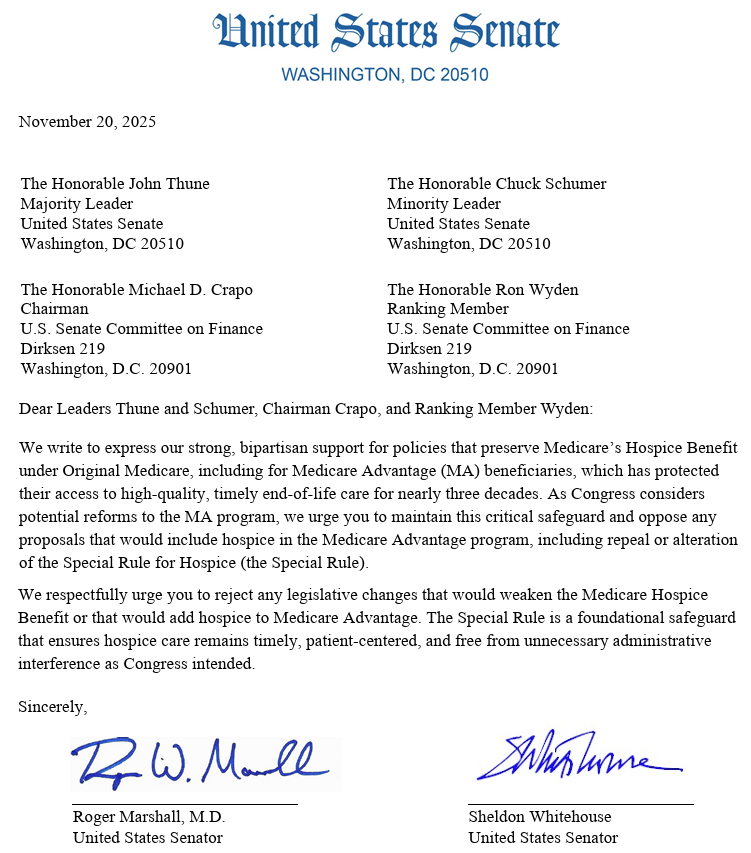
Sen. Marshall and Sen. Whitehouse Issue Letter to Senate Leadership Expressing Bipartisan Support for Policies that Preserve Medicare’s Hospice Benefit Under Original Medicare

Alexandria, VA and Washington, D.C., November 24, 2025. On November 20, Senator Roger Marshall (R-KS) and Senator Sheldon Whitehouse (D-RI) sent a letter to Senate leadership expressing strong bipartisan support for policies that preserve the Medicare Hospice Benefit under Original Medicare, including for Medicare Advantage (MA) beneficiaries, which has protected their access to high-quality, timely end-of-life care for nearly three decades. 

Repeal Special Rule

As Congress considers potential reforms to the MA program, the letter urges Senate leadership to maintain this critical safeguard and oppose any proposals that would include hospice in the Medicare Advantage program, including repeal or alteration of the Special Rule for Hospice (the Special Rule), also known as hospice carve-in.  

Hopice in MA

Despite years of attempts from Congress, the Alliance strongly opposes efforts to integrate hospice into Medicare Advantage (MA). Past attempts have revealed challenges such as administrative burdens, difficulty creating networks, and delayed payments for claims. Bringing hospice under Medicare Advantage would undermine patient choice, adversely impact timely access to care, and fragment the hospice experience for patients and families at a highly vulnerable time.

View the full letter here. 

Leave Hospice Carve-In Out

Excerpt

“MA enrollees who elect hospice currently retain the freedom to choose any Medicare-certified hospice provider, free from network limitations or prior authorization requirements. More than half of hospice beneficiaries pass away within 14 days of election, making delays in care both harmful and unacceptable. Integrating the hospice benefit into MA plan design would jeopardize this access by layering additional managed care terms (or policies) on top of an already managed and coordinated benefit.” 

Marshall and Whitehouse

U.S. Senators

Your content goes here. Edit or remove this text inline or in the module Content settings. You can also style every aspect of this content in the module Design settings and even apply custom CSS to this text in the module Advanced settings.

“The Alliance thanks Sen. Marshall and Sen. Whitehouse for listening to the concerns of the care at home community and taking action to protect our nation’s most vulnerable patient population by defending the Hospice Benefit under original Medicare,” said Scott Levy, Chief Government Affairs Officer at the Alliance. “The Alliance will continue to lead on this important public policy priority for hospice providers nationwide by advocating to preserve this sacred promise established by Congress and kept on behalf of the American people for over four decades.” 

# # #

About the National Alliance for Care at Home

The National Alliance for Care at Home (the Alliance) is the leading authority in transforming care in the home. As an inclusive thought leader, advocate, educator, and convener, we serve as the unifying voice for providers and recipients of home care, home health, hospice, palliative care, and Medicaid home and community-based services throughout all stages of life. Learn more at www.AllianceForCareAtHome.org.  

© 2026. This press release originally appeared on the National Alliance for Care at Home Website and is published with permission. For additional information or for permission to print, please see press contact above.

Medicare Advantage Reform

CMS

by Kristin Rowan, Editor

Medicare Advantage Reform

Background

Traditional Medicare is available to any U.S. citizen over the age of 65 or with a qualifying disability. Part A covers hospital care, skilled nursing facility care, hospice care, and some medically necessary home health care while Part B covers doctor visits and outpatient care. Medicare is billed through and paid by the federal government.

Medicare Advantage (originally Medicare+Choice) is Medicare coverage offered by private insurance companies who are then reimbursed by the government. The goal was to create competition and lower costs. It has done neither. Medicare Advantage plans are supposed to provide all of the coverage from Parts A, B, & D except hospice care. That is still handled by traditional Medicare.

Hospice Carve-in Plan

Despite the epic failure of the recent hospice carve-in experiment, House representative Schweikert (R-AZ) introduced H.R. 3467 to reform the Medicare Advantage program and included a requirement for hospice care. The goal, according to Schweikert, is to eliminate waste and fraud and stop MA insurance companies from making billions in profits by upcoding. The solutions, outlined in H.R.3467, include requiring MA recipients to stay on the same plan for at least three years and permanently including the hospice benefit in MA plans.

Eight New Bills

On November 19, 2025, Representative Mark Pocan (D-WI), with the support of 12 other members of the House, introduced eight separate bills aimed at Medicare Advantage reform and strengthening traditional Medicare. The eight bills include:

1. Disincentives for delaying and denying lifesaving care due to prior authorization requirements
2. Automatic appeals for any denial of care
3. Visually and audibly disclosing delay and denial rates in advertising
4. Banning participation in MA for any company convicted of defrauding the government
5. Lowering MA reimbursement rates to at or below traditional Medicare rates
6. Limiting the number of MA plans a company can offer to 3 per year
7. Prohibiting MA from being the default option
8. Creating a website listing all doctors by plan

Commentary

In addition to the package cosponsors and six endorsing organizations, Rep Pocan received industry expert support for his bill package.

“Big Insurance has long pitched Medicare Advantage as a key tool to lowering health care costs and delivering better care, but like so much of their rhetoric, this is nothing but bold-faced lies. The truth is, Medicare Advantage is neither Medicare nor an advantage. And it certainly doesn’t exist to lower costs. It exists to help Big Insurance make sky-high profits and enrich shareholders. It is long past time Congress stepped in and protected patients. The legislative package Congressman Pocan is introducing is the most comprehensive plan ever introduced to rein in Medicare Advantage and protect patients. Congress should pass these bills without delay.”

Wendell Potter, President, The Center for Health and Democracy

“Medicare Advantage insurers profit from withholding medically necessary care, and can withhold care with near impunity. So, people enrolling in corporate MA plans are forced to gamble with their health and with their lives. They can’t avoid the bad actors. It’s time Congress protected older Americans and people with disabilities from bad actor Medicare Advantage insurers, as Congressman Pocan’s MA Bill package would do.”

– Diane Archer, President and Founder, Just Care

Rep. Pocan’s bills do not include the hospice carve-in and would leave hospice care under traditional Medicare. 

Faulty Logic?

Medicare Advantage plan payors have been accused of upcoding, fraud, overbilling, delays in care, and denials that circumvent the rule that MA must cover everything traditional Medicare does. It may be naive to assume that passing these bills will force unscrupulous companies to suddenly have integrity.

MA enrollees pay the standard Part B premium and might pay an additional MA premium depending on their income, geographic locations, and/or additional plan benefits. Rep. Pocan’s bill lowers what MA charges the government (aka tax payers) but does not address what the plans charge enrollees. If MA plans are required to lower reimbursement rates by 10%, for example, won’t they just increase premiums, deductibles, and copays or remove additional benefits? Sure, the government spends less, but out-of-pocket costs increase and quality of care drops.

The “Seniors Choice” bill limiting the number of plans to three is unclear in its direction. A 2019 rule removed the meaningful difference requirement for MA plans. This bill seeks to reinstate that requirement, but changes the term to “significantly different” in premiums, benefits, and cost-sharing. There are too many variables in health insurance to limit the choices to three. Three choices per company lessens the competitive need to keep prices low. 

Not so Hidden Agenda

Medicare Advantage reform is sorely needed. MA is largely fraudulent, misleading, and costly both in spending and health. Chipping away at some of these pieces is for the good of the enrollees on their surfaces. But dig just a little deeper and the goal is clear. 

Overwhelmingly, the organizations in support of this bill package are proponents of a single payer system. The prior authorizations disincentive is termination of the entire contract for the year. The disallowing participation bill includes all companies and individuals convicted of any crime, misdemeanor or greater, in any way connected to healthcare, all financial misconduct in or out of healthcare, and all acts of fraud, kickbacks, and misrepresentation of material fact. Any plan charging more than its traditional Medicare counterpart will be eliminated. Given these restrictions, it will not take long for every Medicare Advantage plan to be eliminated entirely.

 The recent government shutdown centered around the ACA subsidies that are set to expire at the end of the year. The elimination of those subsidies could push healthcare insurance premiums to a level that few can afford, furthering the need for a single payer plan.

Final Thoughts

The White House has promised a health care proposal with much speculation but no facts. The proposal has yet to be released. Congress is still negotiating the extension of Covid-era subsidy increases with only a few weeks remaining before they adjourn for the holidays. ACA participants are having to renew their health insurance without knowing what the final cost will be and many believe the number of participants will drop significantly, leaving millions uninsured. 

None of the proposed solutions will fix all the problems with healthcare. But, a temporary stay is better than losing access to healthcare altogether. This is an ongoing issue and The Rowan Report will continue to bring you the latest information as it becomes available.

# # #

Kristin Rowan, Editor

Kristin Rowan has been working at The Rowan Report since 2008. She is the owner and Editor-in-chief of The Rowan Report, the industry’s most trusted source for care at home news, and speaker on Artificial Intelligence and Lone Worker Safety and state and national conferences.

She also runs Girard Marketing Group, a multi-faceted boutique marketing firm specializing in content creation, social media management, and event marketing.  Connect with Kristin directly kristin@girardmarketinggroup.com or www.girardmarketinggroup.com

©2025 by The Rowan Report, Peoria, AZ. All rights reserved. This article originally appeared in The Rowan Report. One copy may be printed for personal use: further reproduction by permission only. editor@therowanreport.com

 

Dr. Steve Landers: an Interview

Advocacy

by Kristin Rowan, Editor

Dr. Steve Landers

An Interview from the Alliance Annual Meeting

On the heels of the inaugural National Alliance for Care at Home Annual Meeting & Expo, I sat down with Alliance CEO Dr. Steve Landers to talk about his feelings on the event, the current state of the industry, and the future of the Alliance.

In His Own Words

The Rowan Report:

We’re just about at the end of the first annual meeting since the merger of NHPCO and NAHC. What are your thoughts on how the event was received?

Dr. Steve Landers:

Yeah, it’s been great. You know, we have, we’ve had great attendance, and the energy has been good, and we’ve got diverse participation from people all throughout the care at home community from all over the country, and I think people learned a lot and got to spend time with friends and colleagues and do business. I’m feeling good about it.

RR: I assume you’ve learned alot and we’ll see some changes next year. Where will we be in 2026?

Steve: We’ll be in Washington, D.C. next fall. Also, our summer financial summit is still on the agenda. So, we’ll be in Boston and we’re hoping to see as many people out as possible.

Alliance Annual Meeting Review Steve Landers

Alliance Outlook 2026

RR: And your new board members, who start in January, were announced earlier. Sounds like you have some great people incoming next year. What is the focus for the organization in 2026?

Steve:

We are continuing to position ourselves as strong advocates in Washington for the issues that our members are facing. The whole board and team will be very much dug in and committed to putting the best possible effort forward on the big things that our members are facing from an advocacy standpoint. Of course, we want to continue to strengthen the member programming and the educational offerings. We are going to try to build on our partnership with the research institute for home care to try and add more research activities to the to the programming.

There are some things that we’re still not sure about how next year is going to look, because on the public policy front, we still have some kind of pending issues that we’re hoping get ironed out in a positive way. Depending on how the year wraps up, we could be very much still in a bit of a firefight, whether that’s the Medicare Home Health payment system, face to face certification access for hospice and home health services, or depending on if any type of Medicare Advantage legislation comes up. So there’s still a lot unknown about how the early year looks from an advocacy standpoint, but definitely, you know, with the existing board members and new board members and our team will be leading the way on those fronts.

Medicare Home Health Proposal

RR:

There are a lot of unknowns right now with the shutdown, the hospice carve out, and other issues we’re not really seeing any movement on. Is there any one unknown that is more challenging than others?

Steve: I think the most front and center issue is the Medicare Home Health payment proposal, because it was a terrible, misguided proposal that’s going to hurt lots of people, probably cost lives, cost the system more money, and so that’s definitely so visible and acute because it’s right with us.

If we see any more movement on this issue of hospice and Medicare Advantage that will certainly become more of an acute issue. We’re already taking it very seriously and are very actively and aggressively trying to push back that bad idea. 

And, of course, the longer this government shutdown, the more harm there is with things like access to telehealth, so that’s high on our mind. There are a lot of other issues we’re concerned about with the future of Medicaid HCBS and the business environment for private duty home care as well. So, the list is long.

Advocacy

RR: Very long, indeed. During the opening keynote you mentioned a call for advocacy from everyone in attendance. Specifically, you mentioned presenting “one voice.” Are there current issues that has the industry divided?

Steve: I think we’re doing a good job of keeping people together. I think there’s always a risk when people get passionate and are wanting to solve problems. If we accidentally are publicly going in different directions, that’s not productive. I wouldn’t highlit any specifics, but I think, in general, the more we can come togehter on various issues because our goals are the same. None of us want to see care at home get cut back and over regulated. Everyone involved in these issues care about the same things. But, in Washington, when attention spans are very short, you only have so much political capital so we make sure we’re pushing for the same things in those advocacy efforts.

RR: Have you gotten any indication of where CMS is landing on the final payment rule? Last I heard, they had thousands of comments and feedback on the major cut.

Final Rule

CMS home health final rule

Steve: They have received an incredible amount of comments. here have been meetings at all levels of the administration on these issues. We have outlined all of the aspects of this, from the access challenges to how cutting back home health is only going to lead to lead to higher overall expenses. We’ve given them a clear outline of the methodological flaws that they made in doing their calculations and their budget neutrality calculations. We’ve been very clear as well on where they have likely baked in data from pockets of fraud that are creating disadvantages for legitimate care providers in the way that the rate system comes out, So they have everything that they should need to reset these payments to where they should be based on the law. But, it’s a scary moment because they made this proposal in the first place, and at some point, somebody thought it was a good idea.

Keep Fighting

RR: What is the next step if the cuts happen?

Steve: If we don’t get what we’re hoping for, which is a real reset of these methodologies, then, the amount of teamwork and intense advocacy that’s going to have to happen to try to get Congress to fix this mistake is going to be enormous. And every one of us is going to have to put in whatever we can. Because, letting ourselves fall off of this type of cliff, letting patients and families fall off this kind of cliff, is just… it’s not… we’re gonna have to fight it every every step of the way. It’s just not right.

Commentary

The interview paused here. It was barely perceptible and nearly impossible to describe on paper. The depth of emotion conveyed in Dr. Landers’ words was palpable, sincere, and honest. In these few seconds, I was given the gift of insight on how completely Dr. Landers commits to this cause and how strong are his convictions. It was a powerful moment that I hope you all have the opportunity to witness.

Home Health Stabilization Act

RR: Both you and your predecessor, Bill Dombi, have talked about how devastating these cuts will be. Estimates of 50% of home health agencies closing, reduced access to care, loss of jobs for caregivers, and especially devastating to the patients. What if this doesn’t change? Obviously, it’s going to take everybody working together. But what’s the first step? Is there a plan?

Steve: Oh, yeah, we’ve already been working with champions in Congress to introduce H.R. 5142 the Home Health Stabilization Act of 2025. If passed into law, would halt these cuts for 2026 and 2027 and allow time to work with Congress and the administration on more comprehensive, long term fix to this total mess that’s been developed by these flawed methods and give time to really work on comprehensive solutions to some of the fraud and abuse issues and potentially other reforms that could help. Now, anytime you’re trying to get an act of Congress passed, especially with a Congress that’s not open right now, with only so many days left in the legislative calendar, that’s no guarantee either, but that is the contingency that we’ve been developing.

Dr Steve Landers Interview

If they don’t fix their proposal, they’re going to march forward on January 1 with another set of cuts that are going to lead to more delays in care and more people getting referred and not getting care and more rural and high poverty communities not haveing access to care and more people going back to the hospital and costing the system more. There are life and death issues. Not just an inconvenience or a cost. People can die. It’s a big deal.

RR: I think the industry as a whole feels like CMS is only looking at the financial numbers and not the consequences of what theyre doing. There are real people who are being damaged by these decisions.

Steve: Yeah, the proposed rule did not seem to take these things into account and it was not a patient- or family-centered proposal. It’s not a final rule yet. Their final action is pending and they need to address those issues. They have a responsibility, I believe, as public servants. I believe there’s a moral obligation here to revisit what was done and get it right.

RR: And, we do have some advocates at the congressional level, correct?

Steve: Yeah, we’ve been working with members of Congress to get them to weigh in with the administration, to tell them “get your final rule right.” We have been working on a contigency that if the rule is not done correctly that Congress would force them through legislation to stop the cuts. We’re not there yet, but we could be any day now. We’ve done that work with Congress to make that progress. That amount of advocacy will require teamwork. This is one of the reasons I was trying to emphaze the importance of unity if we end up with a very short calendar and a really hard problem to solve. It’s going to be pretty intense.

RR: And we’ll be right there with you if that happens, saying “how can we help?” I know this is the most pressing issue right now, but is there anything else industry-wise that you’re looking forward to and excited about?

Future Outlook

Steve: You know, I think it’s been fun and exciting and in some ways inspiring to see this alliance community grow and build. Whether it’s all these new and innovative AI solutions that our members are getting excited about, how they can improve workflows and efficiences, or whether it’s the attention for the storytelling around the issues that our members care about on social media and earned media. There are a lot of reasons to be excited and enthusiastic about the future.

I think the AI advancements have been really exciting and interesting for the industry, because there’s so much that can be done. And certainly, regardless of how big the cuts are, any cuts are going to be difficult for home health, and especially on top of what we’ve already had, yeah, but, you know, you being able to use these AI solutions to kind of cut some of the costs and things and offset that is, is at least a silver lining in some of it, and improve the worker experience, maybe in ways that make it a little less burdensome, and you can maybe keep more people in the
workforce.

RR: Well, I want to congratulate you. You’ve made it through your firstfull year in thisposition. I think there was a sense of this event being the test, the “How did the two organizations really come together and produce this huge thing,” and, it seems likethe blending of the home health with the hospice has worked really. Attendance is high and the vibe seems to be very positive.

Steve: You know, there’s a test every day. We have to keep trying to serve our community, and it’s a journey. We’ve got a great board, and a great team. They’re focused on the mission. The team came together nicely after the merger. Now that it’s settling down, we’re just going to keep working towards a bright future. Just keep at it.

RR: I think you’ve handled it all really well and the success of this event is a testament to that, as well as the other education and advocacy you’ve accomplished in the last year. I appreciate you taking the time to talk to me today. Keep fighting the good fight. 

Steve: Absolutely. Thank you.

# # #

Kristin Rowan, Editor

Kristin Rowan has been working at The Rowan Report since 2008. She is the owner and Editor-in-chief of The Rowan Report, the industry’s most trusted source for care at home news, and speaker on Artificial Intelligence and Lone Worker Safety and state and national conferences.

She also runs Girard Marketing Group, a multi-faceted boutique marketing firm specializing in content creation, social media management, and event marketing.  Connect with Kristin directly kristin@girardmarketinggroup.com or www.girardmarketinggroup.com

©2025 by The Rowan Report, Peoria, AZ. All rights reserved. This article originally appeared in The Rowan Report. One copy may be printed for personal use: further reproduction by permission only. editor@therowanreport.com

 

Second Longest Shutdown Since 1980

Medicaid

by Kristin Rowan, Editor

Second Longest Shutdown Since 1980

–As of October 30, 2025–

Shutdown day 30

Subsidy Standoff

Senate Majority Leader John Thune spoke with MSNBC about the shutdown and the subsidy expiration. “Shouldn’t people who are signing up during open enrollment know what they’re signing up for?,” MSNBC asked. Thune said the first step has to be opening the government before that conversation happens, not in the context of the budget talks. According to Thune, the Republican party objects to the current operation of the subsidy program and the incentive structure needs reform.

Subsidy Standoff Not to Blame

Current estimates show insurance premiums rising by 18% – 22% in 2026. Leader Thune suggests that only a “tiny percentage” of that increase is due to the expiration of the enhanced subsidies and the rest is coming from the insurance companies. He says premiums should not being going up by this much and the extreme rate increase is because of waste, fraud, and abuse, and the lack of incentives for insurance companies to lower costs.

No Reform, No Subsidy

Throughout the interview, Leader Thune would not commit to 

Government Shutdown Senate Majority Leader John Thune

negotiating with Democrats, would not guarantee subsidies would be saved, and would not commit to voting for any extension without at least lowering income caps back to pre-COVID levels.

After the Senate session today, Thune spoke to reporters, indicating there was a “higher level of communication” happening. He went on to repeat his earlier statement to MSNBC.

“…there are a lot of rank-and-file members that continue, I think, to want to pursue solutions and to be able to address the issues they care about, including health care, which … we’re willing to do, but it obviously is contingent upon them opening up the government.”

John Thune

Senate Majority Leader

(Un)lucky Number 13

October 28th marked the 13th vote put to the Senate to reopen the government in 28 days. The Senate reconvened yesterday and plan to vote again today, October 30th. Senators have mixed opinions about the likelihood of an agreement now that deadlines for military pay, SNAP benefits, and other programs close in.

Senate Minority Leader Chuck Schumer (D) said negotiations were “occasional” and that Republicans haven’t offered anything different from the original House-passed budget.

Senator Lindsey Graham (R) said resolving the differences on health care would come after the government reopens. “I’m hoping next week, hopefully after the election, that we can get the government back open, talking about our differences on health care.”

Senator Thom Tillis (R) states there is no evidence that formal negotiations are happening, just discussions. 

When Will it End?

The Senate is expected to vote today, October 30th. The measure needs 60 affirmative votes to pass. The vote to automatically continue without discussion failed 37-61. The subsequent votes to temporarily fund the government through November 21st failed 55-45 on October 1 and 54-45 on October 28. Senator Jim Justice (R-WV) voted yes in the first vote, but did not vote yesterday.

If I Were a Gambler...

The rumors and accusations fly on both sides about who is to blame for the shutdown. There are betting sites placing odds on the date the standoff will end. I’m no political expert, but I think there’s something else going on. I believe both sides are playing risky games and that neither side knows the rules to the other’s game. I think both sides know the exact date they will each agree to end this standoff. And I’m sure there are underlying motives that have nothing to do with what they’re telling us.

We will continue to report on this ongoing story as more information becomes available.

# # #

Kristin Rowan, Editor

Kristin Rowan has been working at The Rowan Report since 2008. She is the owner and Editor-in-chief of The Rowan Report, the industry’s most trusted source for care at home news, and speaker on Artificial Intelligence and Lone Worker Safety and state and national conferences.

She also runs Girard Marketing Group, a multi-faceted boutique marketing firm specializing in content creation, social media management, and event marketing.  Connect with Kristin directly kristin@girardmarketinggroup.com or www.girardmarketinggroup.com

©2025 by The Rowan Report, Peoria, AZ. All rights reserved. This article originally appeared in The Rowan Report. One copy may be printed for personal use: further reproduction by permission only. editor@therowanreport.com

 

Alliance to Congress: STOP CUTS

Advocacy

by Kristin Rowan, Editor

9% Cut Proposed

CMS proposed home health rule for 2026 includes disastrous cuts. A 3.2% market basket increase, a 0.8% productivity cut, a 5% reduction to recoup prior overpayments, and a 4.1% permanent reduction to prevent further overpayments. CMS proposed an additional 0.5% cut to account for high-risk outliers. In other words, CMS wants to pay less for all patients to make up for the small percentage of patients who need more care.

Deadline Looming

The mandatory comment period ended on August 29. Next, CMS reviews the submitted comments, responds to those comments (generally explaining why they are not going to listen), and then finalizes the 2026 rule. The final rule is due November 1, 2025. Although, that falls on a Saturday, so the deadline may extend to Monday. A good many of us will be in New Orleans for the Alliance annual conference and expo by then.

Group Effort

The National Alliance for Care at Home (Alliance) joined 150+ provider, patient, community, and advocacy groups to write a letter to Congress urging them to prevent the CMS proposed cut.

“The proposed payment reductions for home health pose a serious threat to the health and safety of Medicare beneficiaries and to the broader integrity of our healthcare system. With the 2026 payment rule under review and due by November 1, we urge you to promptly intervene and press CMS to stop the cuts and realign payments.”

Pattern of Payment Reduction

The letter, addressed to Senate Majority Leader John Thune, Senate Minority Leader Chuck Schumer, Speaker Mike Johnson, and House Minority Leader Hakeem Jeffries, asks Congress to look at the consecutive years of pay reductions and how they have impacted home health. Because of the cuts, agencies have gone out of business or downsized, leaving rural areas without care.

Home Health Costs Less

The letter also explains that cutting medicare payments actually costs more. When more patients have access to home health, CMS spends less on unplanned hospital visits and ER trips. Patients have fewer falls and accidents. Risk factors are identified earlier and preventative treatments are used before a patient’s condition requires hospitalization. Home health patients stay home years longer than those not receiving home health before entering a skilled nursing or assisted living facility. 

What's at Risk

The Medicare Trust Fund, funded partially by payroll taxes, includes hospital insurance that pays for hospital (Medicare Part A) services. When these costs increase, the trust fund is at risk being insolvent and taxes are increased to put money back into the fund. Lowering home health payment rates and cutting off millions of people who depend on home health will impact tax payers as well.

CMS home health payment cuts
“The cuts currently proposed to Medicare’s home health benefit are unsustainable and would be deeply harmful to those who depend on care at home. The Alliance will continue to work with policymakers and our stakeholder allies to oppose these harmful cuts and protect access to home health services for millions of older adults, individuals with disabilities, and their families.”
Dr. Steve Landers

CEO, National Alliance for Care at Home

The Alliance issued a press release with the highlights from the letter. You can read the full letter here.

# # #

Kristin Rowan, Editor
Kristin Rowan has been working at The Rowan Report since 2008. She is the owner and Editor-in-chief of The Rowan Report, the industry’s most trusted source for care at home news, and speaker on Artificial Intelligence and Lone Worker Safety and state and national conferences.

She also runs Girard Marketing Group, a multi-faceted boutique marketing firm specializing in content creation, social media management, and event marketing.  Connect with Kristin directly kristin@girardmarketinggroup.com or www.girardmarketinggroup.com

©2025 by The Rowan Report, Peoria, AZ. All rights reserved. This article originally appeared in The Rowan Report. One copy may be printed for personal use: further reproduction by permission only. editor@therowanreport.com

 

Government Shutdown

Medicaid

by Kristin Rowan, Editor

Government Shutdown Threatens Care at Home

Lawmakers on opposite sides of the aisle failed to come to a budget agreement by the deadline. This causes an immediate cease to all non-essential government functions and many government employees aren’t being paid. 

UPDATE: Shutdown, Day 16

–As of October 16, 2025–

What it Means for Care at Home

After 10 attempts, the government is no closer to an agreement than they were on September 30th. The Senate is expected to break at the end of the day, leaving the next opportunity to negotiate until at least Monday. 

Telehealth

The biggest impact on care at home during the government shut down is the ability to complete required face-to-face visits using telehealth appointments. Both home health and hospice have employed telehealth for face-to-face encounters since the COVID-era waiver, which has now been extended several times. The most recent extension, which we anticipated Congress to extend in this budget, expired on September 30th.

All face-to-face encounters occurring after October 1, 2025 must be in person.

According to home health expert Melinda A. Gaboury of Healthcare Provider Solutions says it is unlikely an extension would be retroactive even if Congress includes an extension in the finalized budget.

Payments

Conflicting information on Medicare payments leave us unsure of the actual impact. Some reports say there will be no delay while others mention 10-day holds. It is unclear whether this is in addition to the standard 14-day hold. Either way, we are anticipating (and hoping for) minimal payment disruptions.

Surveys

Initial Medicare certification for home health and hospice as well as recertifications will be delayed. If ACHA, CHAP, or another accrediting body is conducting your survey, however, there should be no delay. These accrediting bodies are continuing without interruption. State agency surbveys will be delayed until after the budget is finalized and the shutdown ends.

Look for continued updates from The Rowan Report as the shutdown and negotiations continue.

–As of October 9, 2025–

The Disagreement

Reporters and spokespoeople from both sides of the debate have suggested various reasons for the shutdown. Equally, both sides claim they are not the holdouts. What we do know for sure is that one of the primary points of contention is the continuation of subsidies for Affordable Care Act Marketplace Insurance plans. One group wants an extension written into the current budget while the other says it’s not necessary since the subsidies currently run through the end of the calendar year.

Push to Extend

The lawmakers who are pushing to get the subsidy issue resolved believe that marketplace users are not going to sign up for insurance in November and do it again in January when the subsidies are fixed. Instead, insurance commissioners warn that without the subsidies, many people will opt not to have insurance at all and others will select substandard plans based on affordability. They will be priced out of the plans they want without the subsidies in place.

Priced Out

In 2025, even with the subsidies, the average family was paying $800 per month on health insurance through the marketplace. When the subsidies expire, those same families will see their existing plan rates jump to $3,000 per month. KFF, the nonpartisan health research organization, estimates that most users will have a 114% rate increase. 

Government Shutdown

Photo Credit – The New York Times

Counter

According to ND insurance commissioner Jon Godfread, lawmakers who oppose the subsidies are actually opposing the cost of health care and insurance across the board. They insist the subsidies aren’t necessary if healthcare and insurance costs drop instead. Proponents of the subsidies agree, but say that is a longer discussion that will take a lot of time to resolve and the subsidies provide an immediate solution to a bigger problem. They are urging the holdouts to include the subsidies in the budget and tackle the rising cost of healthcare later.

Open Enrollment

The clock is ticking. Open enrollment for 2026 begins November first in every state except Idaho, where open enrollment starts next week. Insurers have already locked in their 2026 premium rates, which will likely cause sticker shock for most marketplace users. Most insurers have prepared subsidy and non-subsidy rates, but without the extension, we will only see the much higher non-subsidy rates. These rates are unlikely to change before enrollment starts and the only hope for marketplace buyers is for Congress to extend the subsidies.

Home Health & Hospice

Care at Home Impact

There are several ways in which the shutdown and the loss of the subsidy may impact care at home.

Payment delays are the most pressing risk. Government officials have promised no delay for some essential services like SNAP and WIC. It is likely Medicare and Medicaid payments will be delayed. While those payments will come through eventually, care at home agencies have to operate without payment or hope the

payers will process payments locally while waiting on the government to reopen. The longer the shutdown lasts, the more likely it is that payments will be delayed. The 6th Senate budget vote failed today, sending the shutdown to day 8.

The longer term impact for care at home will come if the subsidies are not renewed. If insurance rates increase by more than 100% on November 1, users will opt for lower priced coverage, which may no longer include care at home benefits. Fewer patients seeking care at home means less money for agencies. Long-term, it also means higher hospital and ER usage and costs, which increases government spending and usually leads to additional care at home cuts to offset the costs.

National Alliance for Care at Home has identifed current and potential implications of the shutdown. Read their analysis here.

This is an ongoing story and we will continue to provide additional information as it happens. 

# # #

Kristin Rowan, Editor

Kristin Rowan has been working at The Rowan Report since 2008. She is the owner and Editor-in-chief of The Rowan Report, the industry’s most trusted source for care at home news, and speaker on Artificial Intelligence and Lone Worker Safety and state and national conferences.

She also runs Girard Marketing Group, a multi-faceted boutique marketing firm specializing in content creation, social media management, and event marketing.  Connect with Kristin directly kristin@girardmarketinggroup.com or www.girardmarketinggroup.com

©2025 by The Rowan Report, Peoria, AZ. All rights reserved. This article originally appeared in The Rowan Report. One copy may be printed for personal use: further reproduction by permission only. editor@therowanreport.com

 

Can This New Software Eliminate Fraud and Billing Errors?

Admin

by Tim Rowan, Editor Emeritus

Software Eliminates Fraud and Errors

Like so many Home Care providers, Aspen Home Care in Kansas City, Missouri was drowning in paper. Two hundred caregivers turned in weekly timesheets every Friday. A large office staff had to go through them, looking for errors, omissions, and unauthorized visits and shifts. Submitting erroneous claims, of course, leads to payment denials, even fines. When an agency submits too many bad claims every week over a long period, a surveyor will soon be knocking at their door.

The Hurdles

On a good week, Aspen completed all necessary payroll and billing tasks and had bills ready to submit by end of business on the following Thursday. Slowing down the process were the usual errors — forgotten check-outs, more hours worked than authorized, and late timesheet submission. Caregivers grew weary of the weekly phone calls asking for clarification, even when the error was their fault. Aspen did have a basic billing system, but paper timesheets fed it too. Electronic Visit Verification was possible, but only via a patient’s landline, using punched-in identification codes.

Then... the call came

“After years of software design, we have completed our replacement for your billing and EVV system. We would like you to switch from the basic system we sold you a few years ago and beta test our better one.”

– Henry (Hank) Schwab, Owner, Compliance Plus

Beta testing is a risky venture, but both owner Ahmed Jara and Office Manager Mohammed Mohammed* trusted Hank and agreed to give it a try. After all, the agency was drowning in paper, they reminded each other.

Dramatic Process Improvements

We took part in a demo of the Compliance Plus system before speaking with Mohammed and hearing Aspen’s experience. We saw a comprehensive, user-friendly system, with a color-coded user interface, that includes scheduling, EVV, and billing for Medicaid, Managed Care, and all other payers an agency contracts with.

Time Tracking

Caregivers clock in and out with an app that is GPS-enabled down to exact longitude and latitude coordinates. Should a patient live in an internet dead zone, caregivers can use their landline. If there is no landline, Aspen will install a “smart fob” in the home. Aspen does not require specific visit start times, but once a check-in is recorded, the app knows the patient’s authorized hours and automatically alerts the caregiver when it is time to clock out.

Verification

Mistakes do happen, of course, but fixing them is not difficult. When the Compliance Plus back end sees a 14-hour visit, it assumes the caregiver forgot to check out. The visit flashes red on the screen, indicating it is not ready to bill, and displays the difference between authorized and recorded hours. The office employee managing exceptions simply calls the caregiver for verification and then manually edits the end time, and compliance is maintained.

Caregiver Feedback

Mohammed told us his caregiving staff is thrilled with the app, though he did say the transition was hard at first. “They learn to use it in about 30 minutes,” he said. “Check-in and check-in take a few seconds and now they are happy to be done with paper forever, not to mention no longer having to deliver paper timesheets to the office.” He added that fake check-ins from the car on the way to a patient’s home have been completely eliminated.

Most importantly, the three-person office staff now completes payroll and billing for 200 caregivers by midday on Tuesday instead of late on Thursday.

The "Plus" of Compliance Plus

Certainly, procedural efficiencies are important, and many scheduling and EVV systems force caregivers to check in and check out in the presence of the patient and alert office staff when a caregiver arrives late or is a no-show. What we saw during our demo, however, we have not seen elsewhere. Compliance Plus automates the tedious task of rooting out EVV, billing, and payroll errors so efficiently, payment denials, aggregator rejections, and incorrect paychecks are virtually eliminated.

Denials are Rare

Mohammed confirmed what we saw in the demo. The file that includes hours, authorizations, patient demographics, and pre-arranged pay rates is prepared and perfected in advance. Then, the system uploads the same corrected file to the aggregator and to state and other payers. “If we need to fix hours or a bill, we do it before uploading to all entities,” he said. “We rarely get rejections from the aggregator or denials from payers.”

Aggregated Data

One of the requirements of payers and EVV aggregators is that all patient and caregiver names and other information must be in their respective databases in advance. Compliance Plus finds missing data and removes a bill from the file before it is uploaded, notifying the user with a red flag. Mohammed added, “We have to make sure all patient data is in system, but that is easy to do.”

Implementation and Training

In every home care agency, there is always a measure of trepidation among the staff when switching from familiar paper to automation. Aspen Home Care was no different when owner Ahmed Jara announced that he had accepted Hank’s invitation to join a beta test. Mohammed told us that his staff’s time from implementation to software expertise took a little less than three months. Compliance Plus customer relationship manager Sara Moore conducted online training of key office staff, a service that is included in Aspen’s monthly fee. Mohammed and a couple others trained the rest of the staff on the full system and then caregivers on the use of the app.

“After a short while, the new system became our normal workflow,” Mohammed commented. “The only speed bump is when they upload new features. We need to spend a little time learning them, but ultimately, the new features improve our workflow. Our caregivers pick up the app in about 30 minutes, including new hires.”

Favorite Features

He added that his 200 caregivers like checking in and out on the app better than the legacy ANI system, which used the patient’s landline for automatic number identification. “English is a second language for some of our caregivers, and they sometimes had trouble with the ANI prompts spoken by the computerized voice,” he explained. “GPS verification is the best feature. If a caregiver checks in from too far away, we see their distance from the patient’s home on a map, and we gently ‘re-educated’ them and it does not happen again. In the past, they would sometimes get away with asking a family member to check in for them from the patient’s landline. Those days are gone.”

He also told us that Aspen does not insist on specific start times. What matters is that visit length matches authorized hours over a billing period. This is especially helpful for waiver and HCBS plans when the caregiver lives in the home. In those arrangements, checking in or out used to be easily forgotten. “I take care of her all day, how do I know when I start and stop?” The Compliance Plus app rings its cell phone loudly to remind visiting and live-in caregivers to check in and then to check out after the authorized number of hours have been reached.

Simplifying Complex Billing

Presently, Aspen exclusively serves Medicaid beneficiaries, though that can mean several managed care payers. With varying reimbursement rates from payers, combined with different caregiver hourly rates, getting a bill to match an authorization used to be a challenge for Office Manager Mohammed and his team.

It's Complicated

In the case of an agency employed family caregiver, there are often days when the family member will spend one hour toileting and feeding, the next hour doing reimbursable homemaking chores, and the third hour running care-related errands. Not only might those tasks be paid at different rates, but they can, and often are, reimbursed by different payers.

Patient Profiles

Mohammed emphasized that the way Compliance Plus handles these situations saves considerable time and reduces payer and aggregator rejections. Like in a Venn diagram, every combination of patient, payer, task type, and caregiver creates a “patient profile.” The user created most profiles in advance, based on known payer rates, etc. Occasionally, a patient’s profile is unique, but a user can easily enter the specifics into the system manually. Once a profile is built, the system calculates all of the billing accurately without additional user supervision.

Compliance Plus

Task Rates

If a payer’s rate for a task changes, Mohammed or another office staffer makes the change one time for all affected patients. In that scenario where the live-in caregiver performs three different tasks in one day, he or she checks in and out only once, before the first task and after the last, and designates each task performed. Compliance Plus does the rest.

Company Prospects

Hank Schwab told us that he is confident, after 100 successful beta customers, that Compliance Plus is ready for general release. At $10 to $12 per patient per month, he believes that supplementing word-of-mouth with a modest marketing effort will help him replace paper and strengthen the bottom line for many Medicaid and Personal Care agencies. Hank’s plan is to begin that effort as soon as he identifies an investor or two and hires a marketing director. “I already manage a team of coders and personally pay all the bills,” he laughed. “I’m ready for someone else to take on a few of my jobs.”
https://complianceplus.com/

*No, that is not a typo. We also enjoyed Mohammed Mohammed’s sense of humor. He tells people his parents were too cheap to give him a first name, so they just copied his last name.

# # #

Tim Rowan The Rowan Report
Tim Rowan is a 30-year home care technology consultant who co-founded and served as Editor and principal writer of this publication for 25 years. He continues to occasionally contribute news and analysis articles under The Rowan Report’s new ownership. He also continues to work part-time as a Home Care recruiting and retention consultant. More information: RowanResources.com
Tim@RowanResources.com

©2025 by The Rowan Report, Peoria, AZ. All rights reserved. This article originally appeared in The Rowan Report. One copy may be printed for personal use: further reproduction by permission only. editor@therowanreport.com
MACPAC Rate Setting

CMS

FOR IMMEDIATE RELEASE

Contact:                                                                   Elyssa Katz
571-281-0220
communications@allianceforcareathome.org

MACPAC Rate Setting

The Alliance Expresses Concerns Regarding MACPAC Approach to HCBS Rate Setting

Alexandria, VA, and Washington, DC, September 18, 2025. The National Alliance for Care at Home (the Alliance) released the following statement in response to the Medicaid and CHIP Payment and Access Commission’s (MACPAC) discussion regarding home- and community-based services (HCBS) rate-setting held during today’s September MACPAC meeting.

MACPAC Rate Setting Quote

The Alliance appreciates MACPAC’s interest in addressing issues related to worker pay in HCBS. These workers should receive higher wages and benefits as they are the backbone of the long-term care system in our country. They are dedicated professionals who provide essential services that promote the community integration, independence, and positive health and social outcomes of older adults and people with disabilities.

Unfortunately, we are concerned about the draft recommendation MACPAC discussed during today’s meeting. Rather than seeking to address the root-cause of low worker wages, MACPAC’s recommendation instead focuses on collecting 

additional information that would further describe the issue. This approach increases administrative burden on states and providers without actually proposing solutions to this problem.

MACPAC Rate Setting Report

MACPAC’s report acknowledges that rate studies and wage data are insufficient to address chronically underfunded Medicaid HCBS programs. To create meaningful change, state administrations and state legislators must be held accountable to fund services at levels that enable improved wages for workers. Sixty years of Medicaid program history have demonstrated that such wholesale changes to state actions are only achieved through new and strengthened Federal requirements. We urge MACPAC and its Commissioners to be bold and recommend structural changes to Federal Medicaid law and regulations that mandate payment policies ensuring access to HCBS through livable wages for direct care workers. The Centers for Medicare & Medicaid Services (CMS) should be given the authority to require states to:

  • Perform comprehensive rate studies no less frequently than every five years that:
    • Use generally accepted accounting practices to develop a payment methodology that assures continued adequacy of each component of the rate model; and
    • Establish a rate model that includes individualized components for core provider cost drivers as well as a livable wage for workers.
  • Submit a copy of the rate review report and recommendations with any waiver renewal or state plan amendment and make the report publicly available on their website; and
  • Require states to justify any variance between the report recommendations and the actual established payment rates.

Further, CMS should be given the authority to disapprove rate methodologies that do not clearly account for all statutory and regulatory requirements of delivering services as well as demonstrating that the rates are sufficient to support a livable wage for workers.

Our members are committed to improving the lives and livelihoods of direct care workers because beneficiaries depend on them. We call on MACPAC to ensure that states and the federal government are equal partners in this critical endeavor.

MACPAC Rate Setting Quote The Alliance

# # #

About the National Alliance for Care at Home

The National Alliance for Care at Home (the Alliance) is the leading authority in transforming care in the home. As an inclusive thought leader, advocate, educator, and convener, we serve as the unifying voice for providers and recipients of home care, home health, hospice, palliative care, and Medicaid home and community-based services throughout all stages of life. Learn more at www.AllianceForCareAtHome.org.   

© 2025. This press release originally appeared on the National Alliance for Care at Home website and is reprinted here with permission. For more information or to request permissions, please see the contact information above.

Bill Dombi Presents

Advocacy

by Kristin Rowan, Editor

Bill Dombi Presents...

It has become almost customary for the President/CEO of The Alliance, and previously NAHC, to give the keynote address at state association and software user group meetings. The 2025 Kantime event, Passport to Success, was no exception. Dr. Steve Landers was scheduled to speak first thing Tuesday morning. But, Dr. Landers is in D.C. speaking to members of Congress and CMS for Advocacy Week, trying to convince anyone who will listen of the needed changes in Care at Home.

When Kantime asked Bill Dombi, former President of NAHC, to take Landers’s place, they asked him not to give his customary “vanilla” talk about the state of the industry. According to Dombi, Kantime gave him a bit of a license to step outside the traditional industry address. He took that license and ran with it, regaling the audience with stories of his school days, being educated (and tortured) by KCatholic nuns in full habits, his road to both the law and care at home, and his thoughts on the future of the industry.

Bill Dombi Presents

“I shouldn’t be here. I’m retired! I should have no shoes in, wearing shorts, or maybe still sleeping, waking up just in time to catch Let’s Make a Deal or the Price is Right, have lunch, take a nap, and then watch a movie or mow my lawn. I had retirement dreams of lounging on a two-person hammock by the beach. My hammock is in the basement. And the guitar I bought myself as a retirelment present, with dreams of coming back here with my band, remains unopened in my living room. It has never been out of its case.”

Bill Dombi

President Emeritus, National Alliance for Care at Home

“But, one of my jobs is to make my successor a success. So, here I am.”

This led Bill to his first topic, Passion: Powering Health Care at Home. He invited the audience to think not of his story, but of their own what lead to their passion for care at home. If you’ve ever heard Bill Dombi speak about care at home and his wish to in his lifetime see the industry become what he has advocated for and imagined for more than 50 years, then you know how spirited and passionate he is. He has fought against injustice since the 6th grade and fought for radical improvement in care at home since college.

Bill spoke openly about the fraud, waste, and abuse that has plagued home health and hospice since before most of us knew what home care was. He lamented the continued need for advocacy at both state and federal levels with each new administration, bill, and MedPAC recommendation since before the Reagan era. He recalled the advent of Medicare and Medicaid when care at home was limited and underused. And he warned of the disasterous idea of rolling Hospice care into Medicare Advantage. In true “Bill Dombi style,” he managed to do all of this in a way that left an air of hope in the room rather than doom.

What's in Store for Care at Home?

Bill talked about the progress his successor has made, including his current work on The Hill for Advocacy week. According to Bill, the advocacy focus for the National Alliance for Care at Home is:

  • PDGM
  • Hospice Carve-in
  • HCBS OBBA Risks
  • HCBS 80/20 rule
  • Medicare Advantage
  • Workforce Improvement

Final Thoughts - Dombi's Care at Home Forecast

The scope of Health care at home will continue to expand. There will continue to be technology and artificial intelligence advances in care at home. The provide design and delivery of care model will evolve. Consolidation and competition are definitely in play. And the workforce is a common denominator for success. 

# # #

Kristin Rowan, Editor

Kristin Rowan has been working at The Rowan Report since 2008. She is the owner and Editor-in-chief of The Rowan Report, the industry’s most trusted source for care at home news, and speaker on Artificial Intelligence and Lone Worker Safety and state and national conferences.

She also runs Girard Marketing Group, a multi-faceted boutique marketing firm specializing in content creation, social media management, and event marketing.  Connect with Kristin directly kristin@girardmarketinggroup.com or www.girardmarketinggroup.com

©2025 by The Rowan Report, Peoria, AZ. All rights reserved. This article originally appeared in The Rowan Report. One copy may be printed for personal use: further reproduction by permission only. editor@therowanreport.com
 

Advocacy Week

Advocacy

Advocacy Week

FOR IMMEDIATE RELEASE

Contact:                                                                       Elyssa Katz
communications@allianceforcareathome.org
571-281-0220

Over 240 Advocates Rally in DC for the Future of Care at Home

National Alliance for Care at Home Hosts Inaugural Advocacy Week on Capitol Hill

Alexandria, VA and Washington, D.C., September 12, 2025.

More than 240 care at home care advocates from across the country met with over 275 congressional offices this week to discuss key legislative and regulatory priorities for expanding access to home-based care services. The meetings were part of the 2025 National Alliance for Care at Home’s inaugural Advocacy Week.  

Alliance Advocacy Week brings together leaders, advocates, and supporters to unite as one voice for care at home, driving positive legislative change and shaping the future of care to ensure broader access to the life-changing home care services for all Americans.  

Advocates focused on four key issues during their congressional meetings:

  • Protecting home health care by preventing dangerous payment cuts
  • Safeguarding the Medicare Hospice Benefit by ensuring hospice remains a separate holistic managed care model outside of Medicare Advantage
  • Expanding telehealth access across many care at home services
  • Supporting robust Medicaid HCBS funding to strengthen community-based care
Advocacy Week National Alliance for Care at Home
Advocacy Week Strategy Session<br />
Advocacy Week Strategy Session

In addition to Wednesday’s congressional meetings, Alliance Advocacy Week featured strategy sessions, beginner advocate training featuring a panel discussion with Congressional staffers, and in-depth policy briefings. On Thursday, the Alliance’s Assembly of State Associations – a network of leaders of state home care and hospice organizations – came together for a robust conversation.   

The Alliance celebrates the achievements of this inaugural Advocacy Week on behalf of home-based care providers nationwide and will continue engaging in critical policy dialogue to support and expand access to essential care at home services.  

# # #

About the National Alliance for Care at Home

The National Alliance for Care at Home (the Alliance) is the leading authority in transforming care in the home. As an inclusive thought leader, advocate, educator, and convener, we serve as the unifying voice for providers and recipients of home care, home health, hospice, palliative care, and Medicaid home and community-based services throughout all stages of life. Learn more at www.AllianceForCareAtHome.org.   

©2025. This press release originally appeared on the National Alliance for Care at Home website and is reprinted here with permission. For questions or to request permission to use, please see press contact information above.

Medicare Advantage Excess Payments

CMS

by Kristin Rowan, Editor

Medicare Advantage Excess Payments

Investigational Study

Researchers from the Department of Health Services, Policy and Practice at Brown Universchool of Public Health and the Department of Geriatrics and Palliative Medicine at Icahn School of Medicine published an original investigative study on spending versus payments in Medicare Advantage under the hospice carve-out model.

Carve-out to VBID to Carve-out

In 2021, CMS started a Value-Based Insurance Design (VBID) to test the impact of adding hospice services to Medicare Advantage benefits. By December of 2024, CMS ended the program due to widespread upset. CMS returned to the hospice carve-out model. Under this model, when an MA beneficiary chooses hospice, any health care expenses related to the terminal illness is paid on a fee-for-service (FFS) basis. MA no longer receives inpatient and outpatient payments, but continues to receive premiu, and rebate payments.

Carve-out Hospice Benefit

Once an MA enrollee enrolls in hospice, MA is no longer responsible for payments. Under the carve-out model, hospice services are paid by Medicare. MA plans are still responsible for paying for services that are not related to hospice care. These services can include inpatient, outpatient, physician, skilled nursing facility, home health care, and prescription drug expenses. 

Medicare Advantage Spending and Payments

The study spanned 12 months and looked at 314,087 MA beneficiaries. In that period, 80.5% of enrollees had no spneding unrelated to their terminal illness. MA was not responsible for any healthcare related payments, but continued to receive $120 per enrollee per month. Estimated spending from MA on hospice enrollees was $57-70 per month. 

Medicare Advantage Excess Payments

In the 12 months following an enrollee electing hospice, MA plans netted $50-60 per month per enrollee. If half of the rebate payments received pay for supplemental benefits, MA receives excess payments to the tune of $68,808,924 over three years. If no rebate payments go toward supplemental benefits, MA receives $174,185,112 in excess payments over three years. The care a hospice enrollee receives uses the fee-for-service model. Medicare Advantage providers are seemingly paid on a fee-for-no-service model. 

Medicare Advantage plans do not currently report the actual amount of rebate payments used to pay supplemental benefits.

Study Conclusion

The researchers conclude that MA receives excess payments under the hospice carve-0ut model. They also note that there is no accountability for spending after hospice election from MA plans to CMS. The researchers suggest that CMS could require MA plans to report actual spending on supplemental services after hospice election and pay premiums and rebates only to cover the amount spent. 

I have a different recommendation….MA plans should not receive any additional premium payments or rebates following hospice election. MA plans should be required to report total payments and spending from enrollment date to election date. The balance, less the same 8% average margin of home and health and hospice agencies, should be used to pay for hospice services from election to passing. Any remaining balance after the patient’s passing should be returned to the beneficiary’s family.

# # #

Kristin Rowan, Editor

Kristin Rowan has been working at The Rowan Report since 2008. She is the owner and Editor-in-chief of The Rowan Report, the industry’s most trusted source for care at home news, and speaker on Artificial Intelligence and Lone Worker Safety and state and national conferences.

She also runs Girard Marketing Group, a multi-faceted boutique marketing firm specializing in content creation, social media management, and event marketing.  Connect with Kristin directly kristin@girardmarketinggroup.com or www.girardmarketinggroup.com

©2025 by The Rowan Report, Peoria, AZ. All rights reserved. This article originally appeared in The Rowan Report. One copy may be printed for personal use: further reproduction by permission only. editor@therowanreport.com

 

BREAKING NEWS: CMS Changes AHEAD

CMS

From cms.gov

CMS Changes AHEAD

CMS Announces Changes to Achieving Healthcare Efficiency through Accountable Design (AHEAD) Model to Improve Quality, Promote Transparency, and Decrease Costs

September 2, 2025

What's New

The CMS Innovation Center announced new policy and operational changes, as well as a new end date, to the Achieving Healthcare Efficiency through Accountable Design (AHEAD) Model to help states achieve their total cost of care (TCOC) targets, while advancing the Center’s commitment to promote choice and competition, increase prevention, empower patients, and protect taxpayer dollars.

Why it Matters

Participating states now have more tools to manage Medicare costs (designed to support sustainable growth) and improve quality of care and population health outcomes

What to Expect

Changes will be implemented across all cohorts beginning in January 2026. AHEAD’s end date for all cohorts is now December 31, 2035.

The Big Picture

Changes made to the model will help to advance the CMS Innovation Center’s strategic pillars of: 1) choice and competition, with states implementing at least two policies focused on promoting choice and competition in their health care markets and 2) prevention, with a new Population Health Accountability Plan focused on preventive care, including chronic disease prevention.

CMS Change AHEAD

Additional Details

CMS is also introducing payment reforms through AHEAD for patients with Original Medicare and establishing new transparency requirements around TCOC and primary care investment targets. For the first time ever, AHEAD will bring total cost of care accountability to all Original Medicare beneficiaries in AHEAD regions through geographic attribution of beneficiaries not attributed to other CMS accountable care organization programs. This novel framework will offer risk-bearing Geographic Entities additional tools and enhanced flexibilities to improve health outcomes and lower spending for their patients while receiving shared payments (or losses) through two-sided risk arrangements. In return, patients may receive additional beneficiary incentives while enjoying existing protections under the Original Medicare program.

Total Cost of Care Model

The AHEAD Model is a state total cost of care (TCOC) model that seeks to drive state and regional health care transformation and multi-payer alignment, with the goal of improving the total health of a state population and lowering costs. Under a TCOC approach, a participating state uses its authority to assume responsibility for managing health care quality and costs across all payers, including Medicare, Medicaid, and private coverage. States also assume responsibility for ensuring health providers in their state deliver high-quality care, improve population health, offer greater care coordination, and promote healthier living for all people participating in the model. The AHEAD Model provides participating states with funding and other tools to address rising health care costs and improve health outcomes.

More Information

# # #

©2025 Centers for Medicare & Medicaid Services. This announcement originally appeared on the CMS website here. For more information, please contact the CMS Innovation Center.