The Wrong Way to Use AI in Healthcare

Admin

by Tim Rowan, Editor Emeritus

Lawsuits are beginning to pile up against insurance companies participating in the Medicare Advantage program. The complaint? The wrong way to use AI in healthcare is with faulty algorithms to approve or deny claims. While AI can be extremely helpful in streamlining administrative tasks — comparing physician notes with Home Health assessments and nursing notes or reading hospital discharge documents — it seems not to be any good at deciding whether to approve or deny care.

The Wrong Way to Use AI in Healthcare Example 1

The Minnesota case, November, 2023, UnitedHealth Group:

    • An elderly couple’s doctor deemed extended care medically necessary
    • UnitedHealth’s MA arm denied that care
    • Following their deaths, the couple’s family sued UnitedHealth, alleging:
      • Straight Medicare would have approved the extended care
      • United uses an AI model developed by NaviHealth called nH Predict to make coverage decisions
      • UnitedHealth Group acquired NaviHealth in 2020 and assigned it to its Optum division
      • nH Predict is known to be so inaccurate, 90% of its denials are overturned when appealed to the ALJ level
      • UnitedHealth Group announced in October, 2023 that its division that deploys nH Predict will longer use the NaviHealth brand name but will refer to that Optum division as “Home & Community Care.”

The family’s complaint stated, “The elderly are prematurely kicked out of care facilities nationwide or forced to deplete family savings to continue receiving necessary medical care, all because [UnitedHealth’s] AI model ‘disagrees’ with their real live doctors’ determinations.”

The Wrong Way to Use AI in Healthcare Example 2

The Class-Action case, December 2023, Humana:

    • A lawsuit was filed on December 12, 2023 in the U.S, District Court for the Western District of Kentucky
    • It was filed by the same Los Angeles law firm that filed the Minnesota case the previous month, Clarkson
    • The suit notes that Louisville-based Humana also uses nH Predict from NaviHealth
    • The plaintiffs claim, “Humana knows that the nH Predict AI Model predictions are highly inaccurate and are not based on patients’ medical needs but continues to use this system to deny patients’ coverage.”
    • The suit says Medicare Advantage patients who are hospitalized for three days usually are eligible to spend as many as 100 days getting follow-up care in a nursing home, but that Humana customers are rarely allowed to stay as long as 14 days.
    • A Humana representative said Humana their own employed physicians see AI recommendations but make final coverage decisions.

What Makes This Possible

According to experts we speak with, there are many ways to use data analytics. The insurance companies named in the lawsuits use predictive decision making. This way of analyzing data compares a patient to millions of others and deduces what treatment plan might be suitable for one patient, based on what was effective for most previous patients. Opponents of this method have called it “data supported guessing.”

A superior analysis method experts are coming to understand  is prescriptive decision making. This is taking all of the available historical and current data surrounding a patient and making a clinical decision specifically designed to that patient’s age, gender, co-morbidities, doctor recommendations, and treatment records.The Power of AI with SmartCare

Until recently, predictive analysis was the preferred method because of its resource efficiency. Examining the data of every individual patient used to be prohibitively labor-intensive, requiring hours of reading hospital records, physician notes, and claims. Today, however, AI tools are able to do that work in seconds, making prescriptive analytics and customized plans of care possible.

Fix May Be in the Works

In a February 6, 2024 memo to all Medicare Advantage Organizations and Medicare-Medicaid Plans, CMS explained the difference between predictive and prescriptive analytics. The memo said these plans may not make coverage determinations based on aggregated data but must look at each individual:

“For Medicare basic benefits, MA organizations must make medical necessity determinations in accordance with all medical necessity determination requirements, outlined at § 422.101(c)1 ; based on the circumstances of each specific individual, including the patient’s medical history, physician recommendations, and clinical notes; and in line with all fully established Traditional Medicare coverage criteria.”

In response to a request for clarification, the CMS memo laid out its rule in specific language:Wrong AI in Healthcare Prescriptive Analytics

An algorithm or software tool can be used to assist MA plans in making coverage determinations, but it is the responsibility of the MA organization to ensure that the algorithm or artificial intelligence complies with all applicable rules for how coverage determinations by MA organizations are made. For example, compliance is required with all of the rules at § 422.101(c) for making a determination of medical necessity, including that the MA organization base the decision on the individual patient’s circumstances, so an algorithm that determines coverage based on a larger data set instead of the individual patient’s medical history, the physician’s recommendations, or clinical notes would not be compliant with § 422.101(c).
(emphasis added)

“Therefore, the algorithm or software tool should only be used to ensure fidelity with the posted internal coverage criteria which has been made public under § 422.101(b)(6)(ii).”

In further responses to questions in the same memo, CMS made it clear MA plans must make the same coverage decision original Medicare would make. The only allowable exception is that plans may use their own criteria when Medicare Parts A and B coverage criteria “are not fully established.”

Knowledge of this CMS directive may give Home Health agencies one more arrow in their quiver when going to battle with powerful, profit-oriented insurance companies over harmful, illogical AI algorithm decisions.

For information on the right way to use AI in healthcare, see our complimentary article in this week’s issue.


Tim Rowan, Editor EmeritusTim Rowan is a 30-year home care technology consultant who co-founded and served as Editor and principal writer of this publication for 25 years. He continues to occasionally contribute news and analysis articles under The Rowan Report’s new ownership. He also continues to work part-time as a Home Care recruiting and retention consultant. More information: RowanResources.com
Tim@RowanResources.com

 ©2024 by The Rowan Report, Peoria, AZ. All rights reserved. This article originally appeared in Healthcare at Home: The Rowan Report.homecaretechreport.com One copy may be printed for personal use: further reproduction by permission only. editor@homecaretechreport.com

Care at Home Events

Upcoming Events Webinars, podcasts, user group meetings, and conferences happening virtually and around the world. Home Health events, hospice events, home care events, and more, Let us know if we will see you at one of these upcoming care at home events. *The Rowan...

MedPAC Recommends More Pay Cuts

CMS

By Kristin Rowan, Editor

In December, 2023, The Medicare Payment Advisory Committee (MedPAC) recommended a 22% payment reduction for hospice providers. This week, they’ve recommended additional cuts once again. 

MedPAC has just released the March, 2024 Medicare Payment Policy Report, issued to Congress. The initial statement from MedPAC recognized the long-lasting impact of the COVID-19 pandemic on healthcare providers and the record inflation rates. The commission admits that the pandemic has caused burnout and personal risk to clinicians and other health care workers. The commission also admits that the effects of COVID-19, PHE-related policy changes, and emergency funding made it difficult to interpret the indicators of adequacy in Medicare’s payment rates. 

The commission openly states that the fundamental problem with FFS Medicare payments is that providers are paid more when they deliver more services, whether or not those services provide value. The call for additional payment reforms to force providers to coordinate care over time and across care settings and to eliminate what may be necessary services that MedPAC doesn’t deem valuable.

Home Health Agencies

The commission reports the Medicare margins for HHAs at 22.2 percent in 2022. The commission calculates these margins excluding some fixed costs. The margins, according to the commission, indicate that FFS Medicare payments exceed the costs of care. This should incentivize HHAs to take on additional beneficiaries, as the margins are calculating using only costs that diminish by volume. 

The commission notes a drop in HHA use in 2022 and lists possible causes including:

  • The number of FFS Medicare beneficiaries is lower due to the increased enrollment in Medicare Advantage
  • Lower use of inpatient hospital care among FFS beneficiaries
  • Hospitalized FFS beneficiaries were less likely to be discharged to home health care (no reason for this was given)
  • More FFA beneficiaries are using SNFs after hospitalization (no reason for this was given)
  • The staffing shortages reported by HHAs limit the volume of services they can provide

The commission implies that the staffing shortages are not a factor in the decline in HHA usage. The Department of Commerce’s employment data indicates staffing levels that are currently higher than pre-pandemic levels. Even though the data includes HHAs, hospice, private duty, pediatric agencies, and other home care providers, the commission still contends that Medicare HHAs comprise a significant enough share of this group to conclude there is no staffing shortage nationwide.

The commission also reports that the decrease in the number of HHAs nationwide is not a factor in the decline of HHA usage, because most beneficiaries still live in an area with at least on HHA. The commission recognizes that the number of employees and contract laborers is not used to calculate access to care, even though it is a factor. They also admit that an HHA does not need to serve an entire area to be counted as serving the area, and that the capacity to serve additional beneficiaries is not considered.

The report recognizes that preventable readmissions to hospitals is lower among for-profit and free-standing HHAs than for hospital-based care. However, the commission dismisses this data in favor of the all-cause measure of hospitalization, which is much higher for HHAs. This measure covers 60 days and includes all hospitalizations for any cause and includes community-admitted and home health admitted patients. Essentially, MedPAC is assigning a 14.2 percent hospitalization rate to all home health patients, regardless of the cause of hospitalization, whether or not it is deemed preventable, and whether or not it is in any way related to the initial 30-day-period of post acute care.

The average cost of a 30-day period increased by 4 percent in 2022, due to a higher cost per visit. The HHAs are combatting this by reducing the number of in-person visits per 30-day period. Since MedPAC did not track telehealth visits, there is no data on the overall cost per visit, regardless of whether it was in person or remote. HHAs are working within the PDGM model for reimbursement by lowering their overall costs per 30-day period through telehealth visits, remote patient monitoring, and other technologies implemented to increase efficiency in HHAs. MedPAC wants to penalize this by reducing payment rates. This will only serve to push HHAs to further decrease the number of visits, which will impact quality of care, satisfactions rates, and rehospitalization rates.

The commission concludes that because the payments exceed the costs, the benefits of home health care are devalued as a substitute for more costly care options. MedPAC argues that the overpayment since 2000 creates higher expenditures for beneficiaries, but fails to provide data to this effect.

As noted by NAHC, there are flaws in MedPACs calculations as well as in the foundation of their position:

  • Exclusions such as taxes, telehealth, and marketing in cost calculations incorrectly inflate the margins
  • MedPAC relies heavily on the CMS calculations for budget-neutrality, which NAHC has already refuted as incorrect, bordering illegal formulas
  • The data used in these calculations omitted all HHAs that are hospital-based.

NAHC, along with other agencies, will continue to advocate on behalf of HHAs, hospice providers, and other home-based care agencies in front of Congress to ensure these disastrous cuts will not become permanent inclusions in Medicare policy. We will continue to bring you updates as this issue continues to unfold.

# # #

Kristin Rowan

Kristin Rowan has been working at Healthcare at Home: The Rowan Report since 2008. She has a master’s degree in business administration and marketing and runs Girard Marketing Group, a multi-faceted boutique marketing firm specializing in event planning, sales, and marketing strategy. She has recently taken on the role of Editor of The Rowan Report and will add her voice to current Home Care topics as well as marketing tips for home care agencies. Connect with Kristin directly kristin@girardmarketinggroup.com or www.girardmarketinggroup.com

©2024 by The Rowan Report, Peoria, AZ. All rights reserved. This article originally appeared in Healthcare at Home: The Rowan Report.homecaretechreport.com One copy may be printed for personal use: further reproduction by permission only. 

editor@homecaretechreport.com

 

CMMI Terminates Hospice Carve-In Demonstration

Regulatory

From the NAHC News Desk,

Late on Monday, March 4, the Center for Medicare and Medicaid Innovation (CMMI) announced it plans to formally end the Value-Based Insurance Design (VBID) Medicare Advantage hospice “carve-in” demonstration on December 31, 2024, and that it will not accept applications to the previously released CY 2025 Request for Applications (RFA) for the hospice component of the Model. In its announcement, CMMI stated that it made the decision to terminate the demo “after carefully considering recent feedback about the increasing operational challenges of the Hospice Benefit Component and limited and decreasing participation among MAOs that may impact a thorough evaluation”. CMMI recently solicited input on the carve-in via a public request for information (RFI).

NAHC was pleased to be able to provide detailed comments to the RFI highlighting our members’ ongoing concerns and frustrations with the demonstration and registering our deep skepticism that the model was necessary or appropriate for hospice patients and families. We are pleased to see CMMI has decided to end this particular demo, and we look forward to continuing to work with them to advance innovation in care delivery and payment models for people with serious illness.

Since the carve-in was first announced, NAHC has maintained our strong opposition to the premise that incorporating hospice into the Medicare Advantage was necessary or would lead to positive outcomes. In 2019, NAHC emphasized our “unqualified opposition” to the program when it was first unveiled, and after more details were released in the model’s first request for applications (RFA); We have continued to stress our concerns since model implementation began, working with our hospice members to solicit feedback and translate those experiences into direct advocacy with CMS, CMMI, and members of Congress. As early evaluation data and inputs highlight, the model has been extremely burdensome for both hospices and participating plans, and has had no measurable positive impact on beneficiary or family outcomes, care experiences, or Medicare spending.

In the announcement about the model’s termination at the end of 2024, CMMI stated that the decision is not a result of the demo “not meeting its goals”, and that the agency will continue its evaluations of the hospice component to assess its overall impact. Over the course of the three years of the model, it was clear to NAHC that the demo was not meeting CMMI’s stated goals to drive greater care continuity and higher quality hospice care for beneficiaries and families. We also questioned the premise that a carve-in would save the Medicare program money in the long run. Contrary to what the VBID evaluators found, the seminal 2023 NORC research demonstrated that hospice utilization in the traditional Medicare program saves billions of dollars a year while delivering high-quality care.

CMS also indicated in their notification that later this year, they will issue additional guidance to ensure that “all obligations of any impacted organization may be met in a timely and reasonable manner so that hospice beneficiaries in the Hospice Benefit Component maintain a coordinated, seamless care experience.” NAHC will be following up directly with CMMI to better understand what may be included in this guidance and when it may be released.

Increasing access to hospice care remains NAHC’s primary policy goal. We are committed to working to improve more timely connection to hospice, reducing the percentage of very short stays that make it difficult to benefit fully from the hospice model, and ensuring every provider is capable of delivering high-quality, person-and-family-centered services. We appreciate our engagement with CMMI on the carve-in over the years, and we welcome the opportunity to collaborate with them on new ways to support seriously and terminally-ill people and their families.

© 2024 NAHC This article was originally published on the NAHC website. All rights reserved.

New Players in Home Care

Admin

By Kristin Rowan, Editor

Home care is no stranger to mergers and acquisitions. It seems there is news almost daily about companies joining forces or selling parts of their company to new entities. Notably, we reported just last week that Cigna has dropped its entire Medicare Advantage book of business. This week, we have two M&A stories to share with you.

Acquisition

Texas-based agency Angels of Care, previously of Varsity Healthcare Partners, has been bought by Nautic Partners, a private equity company. Angels of Care provides pediatric home health, including private duty and skilled nursing services, along with physical and speech therapy, and respite care. Angels of Care operates in seven states, up from two states prior to their partnership Varsity Healthcare Partners, and employs more than 2,000 nurses, physical therapists, and other service providers.

Nautic Partners, based in Providence, RI, is already a backer of VitalCaring Group, a similar agency with locations across the southern United States, Integrated Home Care Services, providers of DME, home care, and infusion services in Puerto Rico, almost 30 additional healthcare companies. Nautic is a middle-market firm founded in 1986. They specialize in healthcare, industrials, and services.

Partnership

CVS’ Aetna has partnered with Monogram Health to offer in-home care services to Medicare Advantage members with chronic kidney disease. Nurses from Monogram will provide in-home and virtual appointments to eligible members. The two companies will also reportedly work to get timely referrals for kidney transplant evaluations.

Monogram Health is a tech start-up for in-home kidney disease management. Their latest growth funding round garnered $375 million in new funding from health care companies and financial backers, including CVS. Monogram has raised a total of $557 million. Monogram operates by creating value-based care deals with health insurance plans and risk-bearing providers to manage chronic and end-stage renal diseases.

If this model sounds familiar to you, it might be because we wrote last week about Gentiva, which is partnering with risk-based providers to offer palliative care services with risk-sharing benefits on both sides. I expect this is not the last time we will hear/write about risk-sharing partnerships to pay for services that aren’t covered by health care plans.

# # #

Kristin Rowan

Kristin Rowan has been working at Healthcare at Home: The Rowan Report since 2008. She has a master’s degree in business administration and marketing and runs Girard Marketing Group, a multi-faceted boutique marketing firm specializing in event planning, sales, and marketing strategy. She has recently taken on the role of Editor of The Rowan Report and will add her voice to current Home Care topics as well as marketing tips for home care agencies. Connect with Kristin directly kristin@girardmarketinggroup.com or www.girardmarketinggroup.com

©2024 by The Rowan Report, Peoria, AZ. All rights reserved. This article originally appeared in Healthcare at Home: The Rowan Report.homecaretechreport.com One copy may be printed for personal use: further reproduction by permission only. editor@homecaretechreport.com
Get Closer to Bonus Pay with the Net Promoter Score

Admin

by Kristin Rowan, Editor

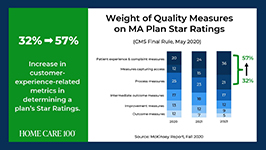
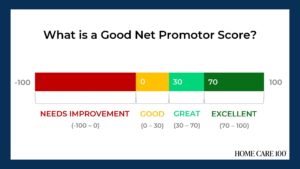
Medicare Advantage has multiple measures of success for payment bumps and bonuses. Rehospitalization rates has long been the most important measure of how well a care at home agency is performing, but there are additional measures that can help or hurt your agency. One that is gaining a lot of traction with MA and can impact your agency’s ability to survive is the overall patient experience. Measuring the patient experience can be subjective, but a great marketing tool to use is the Net Promoter Score (NPS). NPS is a calculation of patient responses regarding their likelihood to recommend you to others. A NPS score of “0” means that, overall, your clients are not going to speak positively or negatively about you; there just isn’t anything outstanding enough to bother saying anything. Anything above zero is better than nothing, but 30 and above is ideal.

During January’s HomeCare 100 Winter Conference, Tim Craig moderated the panel, “The MA Member Experience and Why it Matters” with a panel of experts. He posed this question to the audience:

“How well do home care providers perform when it comes to delivering on patient experience?”

Rating care provider performance on a scale of 1-5, the responses during the panel were somewhat surprising

  • 47% of those who responded rated the delivery on patient experience 3
  • 43% said 4
  • 6% responded 2
  • A mere 4% responded 5
  • There were no responses of 1

If we turn these answers into a Net Promoter Score, we get -6. If caregivers, administrators, and providers don’t believe we’re doing a good job, how can we expect our clients, patients, and families to be happy with the care they receive?

Statistics

  • Patient experience and complaint measures count higher toward star rating than they have before
  • CAHPS Scores have changed weight from 1.5 to 4 since 2021
  • Star Ratings Determine Bonus Eligibility and Amount – starts at 4 stars and above
  • Number of plans that have a 4.0 or higher star rating dropped from 64% to 43%
  • Disenrollment is on the rise from 10% in 2017 to 17% in 2021

Net Promoter Score

Glen Moller, CEO of Upward Health, whose net promoter score is a whopping 86, said:
“The Member Experience has always been important. What has changed is the way we manage it, given the implication of the CAHPS rating, you can’t be a 4 star without high CAHPS scores.” Moller improved his patient experience with internal surveys to get actionable intel and asking open-ended questions. Look at change and innovation and how that could be disruptive to members. Member experience is at the center of all the other measures. No matter what benefits you’re offering, embed member experience measures at every step of the process.

Because your star rating directly impacts your ability to receive bonuses and because experience-related metrics are increasingly weighted in determining star ratings, you should be looking at the member experience more closely in all of your process. You should also be measuring the member experience and looking at ways to improve it.

Ways to measure ME

• HHCAHPS
• Quality of Patient Care Ratings
• Word of Mouth
• Net Promoter Score
• Glassdoor
• YelpCalculating a Net Promoter Score can be challenging, especially when trying to get older or infirmed patients to answer a survey. For the most accurate NPS, send a single question survey to all of your current and past customers asking them to rate, on a scale of 1 to 10, “How likely are you to recommend us to a friend or family member.” If you aren’t able to do this, you can still calculate a rough NPS using your other measures. You can use your Google and Yelp reviews with a simple formula: % of promoters – % of detractors = NPS. Three stars and below are detractors; four and five stars are promoters.The NPS score is more about comparative to the usual experience rather then the actual experience. A high score from a customer doesn’t necessarily meant it’s “great”, only that it’s much better than what they’re used to or what they expected.

The NPS is not the only measure of customer experience. To get the whole picture, use all the data you have to find out what interventions should be done and implement them. Whether the change is in training your staff, updating your scheduling process, using AI to help communicate directly with patients and families, or simply streamlining your website for a better user experience, you can improve your chances for higher ratings and bigger bonuses in a few easy steps.

I won’t often insert a shameless plug into an article, but if increasing patient satisfaction and member experience can help your agency survive the CMS pay cuts, and you need help with getting a NPS, understanding how to measure your patient experience, or getting online reviews, please contact me for more information. My marketing agency is happy to help get you started.

# # #

Kristin Rowan

Kristin Rowan has been working at Healthcare at Home: The Rowan Report since 2008. She has a master’s degree in business administration and marketing and runs Girard Marketing Group, a multi-faceted boutique marketing firm specializing in event planning, sales, and marketing strategy. She has recently taken on the role of Editor of The Rowan Report and will add her voice to current Home Care topics as well as marketing tips for home care agencies. Connect with Kristin directly kristin@girardmarketinggroup.com or www.girardmarketinggroup.com

©2024 by The Rowan Report, Peoria, AZ. All rights reserved. This article originally appeared in Healthcare at Home: The Rowan Report.homecaretechreport.com One copy may be printed for personal use: further reproduction by permission only. editor@homecaretechreport.com
 

Is There an Answer to Paying for Palliative and Private Care?

Uncategorized

By Kristin Rowan, Editor

Last month, we published an article in partnership with Bob Roth of Cypress HomeCare Solutions in Scottsdale, AZ about paying for long-term care at home. Since then, I have come across some interesting information as we continue to tackle the issue of paying for care that is not reimbursed by the current Medicare/Medicaid system.

Medicare and Medicare Advantage have set pay rates for home health and hospice care. Home Health Value-Based Purchasing (HHVBP), implemented by CMS, was designed to incentivize agencies by paying more for quality care rather than a higher number of services provided. This is similar to giving advances and pay raises based on performance rather than longevity in a job, which I’m all for. However, the HHVBP overlooked palliative care altogether and neither the fee-for-service model nor the HHVBP model includes supportive (read private duty) care at home. Since these services are not reimbursed, there is no incentive to provide them nor way to get paid for them if the patient cannot pay out-of-pocket.

This causes two problems:

1. Home Health and Hospice Agencies are reluctant to provide unreimbursed care, with good reason, so the overall patient experience is less than ideal, rehospitalization rates increase, star-ratings and scores decrease, bonuses go away, and the agencies make less money than before.

2. Patients can’t get the care they need and want. Palliative care patients may receive Hospice care too early, or they may not receive care at all because they fall between home health and hospice. Patients who need supportive care at home can’t afford it so they either go without, causing increased complications or they rely on friends and family members who burn out under the stress of being a full-time caregiver.

Innovative care strategies can overcome the obstacles faced by agencies and patients alike. There may not yet be a perfect solution, but there are some innovative ideas out there and something has to disrupt the current pay model.

Palliative Care Partners

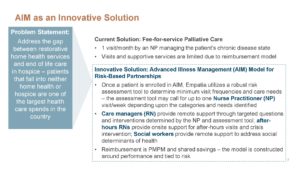
Medicare Advantage organizations and primary physician groups receive a “cost of care” analysis for the duration of the patient care. The organization takes on the risk of that patient costing more than what the MA plan will pay, but can make more money if patient care costs less than anticipated. Palliative care at home costs less. David Causby, President and CEO of Gentiva, a Hospice organization that operates in 35 states across the U.S. and has an average daily census of 26,000, has implemented a plan of care in cooperation with these organizations in what he calls Advanced Illness Management (AIM) Model for Risk-Based Partnerships. Designed for palliative care, Gentiva creates a plan of care that includes visit frequency and care needs and employs nurse practitioners, care managers, after hours RNs and social workers. The hospital pays Gentiva on a PMPM model with shared savings. The hospital still gets paid the full amount from MA but uses fewer resources, has lower costs, and sees reduced rehospitalizations, saving more than what they pay out. According to Gentiva, this partnership “provides value to contracted organizations by decreasing the overall end-of-life spend on this high-risk patient population.”

Supportive Care at Home Innovations

Supportive Care at Home (Private Duty Home Care, Private Pay, Non-medical home care) is not covered by Medicare, Medicare Advantage, or most health insurance plans. Limited Medicaid grants, VA plans, and long-term health insurance pay for some supportive care at home. Without one of these plans, patients and family members pay out-of-pocket for supportive care at home, averaging $22-$27 per hour with a 4-hour minimum. In some states it can cost up to $50 per hour. At $80 per day, that’s around $20,000 per year.

One software company we recently spoke with is upending the home care model with fee-for-service model that charges by the minute, rather than by the hour, making care more affordable for more people. You can see our product review of Caring on Demand here. By reducing the cost for customers and reducing the time for caregivers, agencies can onboard more customers without hiring more caregivers. The system is being used in facilities where these services are not provided, which allows a caregiver to visit several people in one stop. The agency and the caregiver can see the same income in the same time, spread out across multiple private payers.

Combining Innovation for a Win-Win-Win

I heard about Caring on Demand and spoke with its founder in August of 2023. I spoke with one Home Care agency owner who recently started working with Caring on Demand. “Times have changed,” the agency owner said. With fewer caregivers joining the workforce, increased levels of burnout since 2020, and CMS changes that overlook palliative and non-medical care, maybe there’s another way…

  • Partnerships with organizations and physician groups that have Medicare, MA, and traditional health insurance patients, non-medical home care agencies, and palliative care providers.
  • Localized groups of patients in limited areas like retirement villages, planned communities, neighborhoods, or small towns.
  • Cost sharing and care coordination that includes in-home palliative care visits, supportive care, communication with primary care providers and specialists
  • Preventative intercessions to avoid unnecessary ER visits and hospitalizations
  • Shorter visits per caregiver with multiple visits to a community each day
  • Cost sharing among patients splitting a 4-hour minimum visit among 4-8 patients
  • Shared savings from reduced hospital stays, shorter durations of hospice care, and nursing visits that are supplemented by supportive care

Gentiva has experienced some success already in using shared savings as a payment model. Can costs be decreased even more by adding supportive home care to this plan? Is there enough shared savings for three payees instead of two? I don’t have the answers to these questions, but I do believe providers of supportive care and palliative care have been in the background, overlooked by CMS and MedPAC for long enough. If they aren’t going to recognize the positive impact and cost savings of home care and palliative care and include them in the reimbursement model, we may have to do it for them.

We’d love to hear your feedback on this and other innovative ways to combat the crisis of paying for care at home.

# # #

Kristin Rowan

Kristin Rowan has been working at Healthcare at Home: The Rowan Report since 2008. She has a master’s degree in business administration and marketing and runs Girard Marketing Group, a multi-faceted boutique marketing firm specializing in event planning, sales, and marketing strategy. She has recently taken on the role of Editor of The Rowan Report and will add her voice to current Home Care topics as well as marketing tips for home care agencies. Connect with Kristin directly kristin@girardmarketinggroup.com or www.girardmarketinggroup.com

©2024 by The Rowan Report, Peoria, AZ. All rights reserved. This article originally appeared in Healthcare at Home: The Rowan Report.homecaretechreport.com One copy may be printed for personal use: further reproduction by permission only. editor@homecaretechreport.com


MedPAC Report Slammed for Telling Truth About MA Abuses

Regulatory

Untitled Document

Analysis by Tim Rowan, Editor Emeritus

P

erennial Home Health enemy MedPAC angered a different group last week by releasing a status report on insurance companies participating in the Medicare Advantage program.1


The report details the way in which giant, for-profit, health insurance companies improperly increase per-customer payments by upcoding their health assessment at enrollment, and then slash costs by denying coverage for healthcare services that traditional Medicare would have honored. MedPAC was also critical of the practice of requiring prior authorizations, backed up by utilization review algorithms that are supposedly intended to “minimize furnishing unnecessary services” but which effectively increase denials for necessary care.

According to the report, MedPAC expects CMS to pay MA plans $88 billion in 2024. 

On January 12, a meeting to discuss the report ended in what one reporter politely described as “a kerfuffle.” Other witnesses to the meeting chose to describe it as a shouting match.

“One member, Brian Miller, MD, MPH, of Johns Hopkins University in Baltimore, accused panel leadership of issuing a negative status report on MA plans’ market dominance, saying it had been ‘hijacked for partisan political aims to justify a rate cut to Medicare Advantage plans.’

“Miller said the analysis … ‘appears to be slanted to arrive at a foregone conclusion in order to set up and provide political cover’ just before the Centers for Medicare & Medicaid Services prepares its annual rate notice for MA plans, expected in coming weeks. ‘The chapter reads like attack journalism as opposed to balanced and thoughtful policy research.'”2

Report authors fired back, citing numerous ways MA plans generate higher revenue, including enrolling people who are relatively healthy, known as favorable selection. They then vigorously scan patients’ medical histories and charts to code for health factors that generate higher per-capita payments, known as coding intensity, often spending less on services. Coding intensity is also the difference between a risk score that a beneficiary would receive in an MA plan versus in fee-for-service. Though MA plans skew toward healthier enrollees, MedPAC found that MA risk scores are about 20.1% higher than scores would be for the same beneficiaries had they enrolled in Fee For Service Medicare.


Namath, Walker, Shatner and Brokers

Criticism of MA plan behavior did not only come from MedPAC commissioners and report authors. For example, Lynn Barr, MPH, founder of Caravan Health, which was acquired by CVS Health through its acquisition of Signify Health, exposed what the annual TV ads do not make clear, that their 800 numbers go to brokers, not to any one plan.

“This is not the big, lovely, glowing success that everybody says it is. And we continue to create policies that drive people into these plans. Medicare allows money paid to MA plans to be used for broker commissions as high as “$600 to recruit them, plus $300 a year every year that they stay in the MA plan.

“We have allowed MA to buy the market, and that is why MA is growing. It’s not because the quality’s so great. People don’t love the prior auth, people are leaving their plans a lot. Aside from Medicaid, Medicare is the least profitable payer for doctors. And at the same time, we give all this money to the plans. It’s unconscionable.”

Adding to the “kerfuffle” with a powerful anecdote, Stacie Dusetzina, PhD, of Vanderbilt University Medical Center in Nashville, Tennessee, noted that even cancer patients often have trouble getting necessary care because of the plans’ limited networks. She referenced a January 7 NPR story3 about an MA enrollee who could not get the cancer care he needed from his MA plan, and could not get out of the plan without facing 20% in expensive copays. In all but four states, supplemental plans that could pick up the difference can reject patients with costly conditions.

“When you are 65 and aging into the program,” Dr. Dusetzina summarized, “you are healthy at that time and may not be thinking about your long-term needs. [If you did], it would push you to think harder about the specialty networks that you may or may not have access to when the MA plan is making your healthcare decisions.”


1 A 30-page slide presentation is available to the public at medpac.gov/wp-content/uploads/2023/10/MedPAC-MA-status-report-Jan-2024.pdf. The complete report is available only to MedPAC commissioners. The charts on slides 26 and 27 show how MA plans learned to pad profits in 2018 and increased the practices exponentially since then.

2 Cheryl Clark, MedPage Today January 16, 2024 medpagetoday.com/special-reports/features/108275

3 npr.org/2024/01/07/1223353604/older-americans-say-they-feel-trapped-in-medicare-advantage-plans


Tim Rowan


Tim Rowan is a 30-year home care technology consultant who co-founded and served as Editor and principal writer of this publication for 25 years. He continues to occasionally contribute news and analysis articles under The Rowan Report’s new ownership. He also continues to work part-time as a Home Care recruiting and retention consultant. RowanResources.comTim@RowanResources.com


©2024 by The Rowan Report, Peoria, AZ. All rights reserved. This article originally appeared in Healthcare at Home: The Rowan Report.homecaretechreport.com One copy may be printed for personal use: further reproduction by permission only. editor@homecaretechreport.com