by Kristin Rowan | Aug 9, 2024 | Advocacy, CMS, Hospice, Medicare Advantage, Regulatory
On June 18, 2024, the National Association for Home Care & Hospice (NAHC) and the National Hospice and Palliative Care Organization (NHPCO) announced they had met in Washington D.C. to formally sign an affiliation agreement between the two organizations. After 18 months of meetings, conversations, and compromises, the two groups announced their “Alliance” would be the leading authority of the care at home community.
During the opening keynote address at the NAHC Financial Management Conference in July, Bill Dombi, President of NAHC and interim President of The Alliance, and Kenneth Albert, Chair of the Transition Board of Directors overseeing the merger, spoke about the progress they have made.
Albert spoke of the thoughtful consideration the board and members of both organizations have put into this change. They are focusing on the biggest concerns of home health and hospice providers both now and in the future. The unification will create one voice as they advocate for home health and hospice in Washington D.C.
Albert and Dombi shared the stage at the NAHC Financial Management Conference about the ongoing search for a CEO of the new organization. According to Albert, there were some candidates who were very excited about the role, but whom the board did not feel there was a great fit. Contrarily, there were candidates the board eagerly wanted to move forward with who declined to continue the process. According to Dombi, the search has gone outside care at home as they look for the right fit from qualified candidates from multiple industries. Both agreed that they felt the search was close to over and they should have an announcement about the new CEO, and possibly the new name, sometime in August of this year.
The conjoined organization promises more than just new leadership. Currently under construction is a new logo and website to encompass both groups. Dombi alluded to new resources for providers, training for quality care, and other tools for the industry. While the organization’s name and leadership are forthcoming, the website is projected to launch sometime in the spring of 2025.
Since the announcement of the merger last year, and even before the deal was inked, NAHC and NHPCO have already been integrating. Dombi told The Rowan Report in a previous interview that the two groups have already been lobbying together, working on policy together, and integrating the management of the two associations.
The Last NHPCO Conference and the First Alliance Conference
September, 2024 marks the final standalone event for the NHPCO. The 2024 NHPCO Annual Leadership Conference runs September 16-18, with a pre-conference September 14-15 in Denver, CO. The conference will have on-demand access until December 31, 2024. NAHC members will receive member rates to the NHPCO conference.
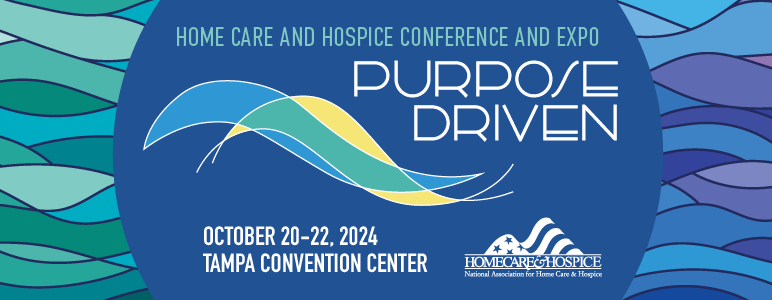
The “2024 Home Care and Hospice Conference and Expo” will be the last conference held solely by NAHC, but we are seeing quite a few hospice companies on the exhibitor list and expect this to be a sneak peek at future conferences. The national conference is scheduled for October 20-24, 2024 in Tampa, Florida. This will also mark the final conference for Bill Dombi as President. Dombi announced earlier this year that he will retire at the end of 2024.
With quite a few remaining unanswered questions about the future of the two organizations, NAHC and NHPCO hosted a virtual Town Hall on July 31, 2024. With more than 250 association members from both groups in attendance, Bill Dombi and Ben Marcantonio, interim-CEO for NHPCO, along with Kenneth Albert and Melinda Gruber, Vice Chair of the Transition Board of Directors.
Albert mentioned that there has been some success using the term Alliance, but it is not a long term solution. The finalization of the name is awaiting some trademark issues to be ironed out and that announcement, which they had hoped to be able to make in July, is coming soon.
Gruber thanked the search committee and recruiting firm for their work on the CEO search. Gruber reiterated that they are nearing the final selection phase and after board approval, an announcement will be made.
Ben Marcantonio, current interim CEO of NHPCO and future CIO of The Alliance confirmed that the new website will allow access to both legacy websites (the current NAHC and NHPCO websites). The new website will have a preliminary version this fall with a fully completed version next spring.
Members of either organization will have full access to the preliminary version of the website this fall. Currently, members can only access information from their own organization, but Marcantonio stressed that if there is information you need, they can help you access it.
There are eleven committees working together to integrate the two associations. advocacy, programs, education, and HR are a few of these workgroups that each have two to three high priority goals that will most effectively bring about the integration of the two groups. Work plans are now in place to create significant integration by the end of the calendar year.
Bill Dombi presented an updated on the joint policy and advocacy issues The Alliance is undertaking. “What stands out for the immediate term has been how the resources have been employed of the two legacy organizations under the banner of The Alliance, focusing on hospice and palliative care,” Dombi said, “In a matter of weeks we saw significant regulatory and legislative action taking place.”
The Hospice Final Rule 2025 has undergone an intense review and indepth analysis by members of both teams. The rule will have “tremendous impact” under the Medicare hospice program.
According to Dombi, the two organizations have come together to jointly fund a research project for the Special Focus Program to understand the impact and targeting. Dombi is hopeful that U.S. Representative Earl Blumenauer’s (D-OR) discussion draft will serve as a stepping stone for Hospice reform.
The ongoing battle in Congress against CMS is gaining momentum. Dombi said there is a “tremendous amount of support” in Congress to role back the authority of CMS to institute rate changes and rate cuts under the Patient Driven Groupings Model (PDGM). “We have gained a seat at the table, which really helps,” Dombi said. We are continuing with litigation challenging Medicare’s validity of the regulation which has set all these rate cuts in motion.
Medicaid Home and Community-Based Services
The Final Rule modified in a positive way the 80/20 requirement. “We agree with the intentions of improving the status of direct care workers who positively impact so many lives. But in the absence of additional funding, it’s very very difficult to support this rule,” Dombi said. The modification stepped back from the more “draconian” interpretation, but The Alliance is not yet satisfied with the result. There is talk of a joint lawsuit challenging the validity of that rule.
The Private Duty Home Care world, one of the less regulated in the industry, is gaining a lot of attention from Fair Labor Standards as well as Non-Compete Laws. There is currently a joining of forces around solutions that will help Private Duty in the workforce arena, more specifically the Credit for Caring Act, which is gaining some traction, and would offer some financial support for family members who are paying for home care services directly.
Bill Dombi’s final statement in the Town Hall meeting centered on advocacy. He called for everyone who was in attendance and every member of both legacy organizations to join the fight. Everyone needs to part of that team of advocacy.
There is much more news to come out of these to associations as we near the end of 2024, and still more through the first quarter of 2025. The Rowan Report expects additional announcements to be made at both the NHPCO and NAHC annual conferences and we will be there to update everyone on the progress and statements coming out of those two meetings.
Kristin Rowan has been working at Healthcare at Home: The Rowan Report since 2008. She has a master’s degree in business administration and marketing and runs Girard Marketing Group, a multi-faceted boutique marketing firm specializing in event planning, sales, and marketing strategy. She has recently taken on the role of Editor of The Rowan Report and will add her voice to current Home Care topics as well as marketing tips for home care agencies. Connect with Kristin directly kristin@girardmarketinggroup.com or www.girardmarketinggroup.com
©2024 by The Rowan Report, Peoria, AZ. All rights reserved. This article originally appeared in Healthcare at Home: The Rowan Report. One copy may be printed for personal use: further reproduction by permission only. editor@therowanreport.com
by Rowan Report | Jun 13, 2024 | Partner News
ROAD TO THE TELEHEALTH “SUPER BOWL”: ATA ACTION CAPITOL HILL DRIVE
WASHINGTON, DC, JUNE 12, 2024 – ATA Action, the American Telemedicine Association’s affiliated trade association focused on advocacy, hosted its 2nd annual Hill Day, bringing nearly two dozen ATA Action members to Capitol Hill for meetings with Congressional leaders to discuss top federal telehealth policy priorities. ATA Action members underscored the ATA and ATA Action playbook for comprehensive, permanent telehealth reform, including passage of the CONNECT for Health Act (H.R. 4189, S. 2016), the Telehealth Modernization Act (HR 7623, S.3967) and the Advancing Access to Telehealth Act (HR 7711).
“This well-timed Hill Day accomplished our goal, to keep telehealth access front-and-center in the minds of our Congressional champions and underscore the urgent need for Congress to act now to give patients and providers certainty about the continued availability of telehealth services,” said Kyle Zebley, senior vice president, public policy, the ATA and executive director, ATA Action. “We continue to hammer home the fact that access to telehealth is essential for delivering safe, effective, quality care to all individuals, including those in rural and underserved communities, as part of a modernized healthcare system.
“As we continue to seek permanent access to virtual care services, we remain grateful to the unwavering bipartisan, bicameral support for appropriate and necessary policies to ensure citizens have access to often life-saving telehealth services, when and where they need it. But the clock is ticking. We need Congress to act now, so that appropriate telehealth policies are implemented in a timely manner without arbitrary and unnecessary barriers to care such as in-person, brick-and-mortar, or geographic requirements,” Zebley added. “We are also eager to see our Senate champions act on these important telehealth policies.”
ATA Action members participating in Hill Day included a diverse range of organizations advocating for telehealth. Members of ATA Action’s Patient Voices for Telehealth Coalition also joined Hill Day meetings.
About ATA Action
ATA Action recognizes that telehealth and virtual care have the potential to transform the healthcare delivery system by improving patient outcomes, enhancing the safety and effectiveness of care, addressing health disparities, and reducing costs. ATA Action is a registered 501c6 entity and an affiliated trade organization of the American Telemedicine Association (ATA).
# # #
CONTACT:
Gina Cella
gcella@americantelemed.org
t: 781-799-3137
by Kristin Rowan | May 30, 2024 | Admin, Advocacy, CMS, Regulatory
by Kristin Rowan, Editor
NAHC President Bill Dombi announced at last week’s CAHSAH annual meeting and expo that he would end his tenure at NAHC and retire at the end of 2024. We reached had an interview with Dombi on Thursday, May 23rd. He said he was not prepared to speak yet about his upcoming retirement, but we should hear more about that soon.
In the meantime, he provided additional details from his session at CAHSAH. We also discussed updates on the lawsuit against CMS and the status of the merger between NAHC and NHPCO. Tim’s article from last week talks about Dombi’s progress with Senator Wyland.
Ongoing Litigation
When we last spoke with Bill, he told us about the lawsuits filed against CMS. The suit claims that the budget-neutral calculations were based on faulty data and outdated software. These calculations determined the reimbursement rate reductions. Dombi explained the process for those lawsuits.
“The first round of the battle is around whether the court has the power to hear the case either at all or at that point in time. The courts are littered with litigation that have been dismissed on jurisdictional grounds,” Dombi offered. The court dismissed the lawsuit and the case is now closed. The Department of Justice (DoJ) attacked jurisdiction to get the case dismissed. Most concerning, according to Dombi, was the DoJ’s question of whether the statute passed by Congress precluded any litigation. If the courts had found in their favor, they would have dismissed the lawsuit no further suits could be filed. Luckily, that argument didn’t hold. The second attack was whether NAHC had expedited administrative review, which is the argument that caused the dismissal. Now, they have to establish that it would be futile to get CMS to agree to expedited judicial review.
Next Steps
In light of the dismissal, NAHC had to decide whether to appeal the ruling, exhaust the expedited review step with CMS, or both. Ultimately, they decided not to appeal and is pursing the review with CMS. This process could take up to 6 months, according to Dombi. Although they are pursuing the review, CMS has already stated that their final position is that the budget neutrality has been calculated within the law. Dombi feels the review is futile because CMS is not going to change their position. Now, they just have to prove the futility.
Two-Step Approach
Advocacy from NAHC, NHPCO, and other individuals and organizations was always intended to be a two-pronged effort: Litigation and Congress. The two do not interfere with each other. Even though the court dismissed the litigation suit in favor of judicial review, the approach in Congress continues. Of Senator Wyland, Dombi said, “A year ago at this time, his view was that home health agencies needed no relief. Now, he’s indicated a willingness to find a way to help home health agencies and recognizes that the cuts have been harmful to home health agencies and others that provide care.” According to Dombi, it was the personal stories and individual provider information that was crucial in swaying Wyland. The organizations continue to meet with other members of Congress to persuade them in the same way.
Dombi Provides Merger Update
Last year, NAHC and NHPCO announced they would join forces and merge into a new, as yet to be named, organization. That merger is still moving forward, but there are a lot of odds and ends to tie up. Dombi told us, “Nothing is final, final, but I don’t see anything but tailwinds moving forward.” The two organizations are still hoping for a July 1, 2024 launch of the organization. There is an active, open search for a new CEO to actively run both organizations as one. According to Dombi, no one has been slated for that position yet, so they may end up launching before there is a CEO in place.
The two organizations have already started integrating. They have lobbied together and they have worked on policy together. Additionally, they are integrating the association management system and building a website. “We feel confident enough that it’s going to reach the finish line that we’re investing time and money in these elements,” Dombi said. The two organizations can continue to operate together without a CEO, but there are a lot of decisions that need to be made that won’t be made until after there is a CEO.
After the Merger
Once the merger is complete and the two organizations operate under a new name with a new CEO, Dombi and his counterpart Bill Marcantonio of NHPCO will stay on for some time. Dombi will take the title President Emeritus and Council to the organization and Marcantonio will become the Chief Integration Officer. The new name of the organization has not been announced. Dombi says a lot of things are tied together, from an action standpoint, and it’s better to announce all of those details together along with the new name.
Reflections From Bill Dombi
When asked what was next for him after the merger is completed and he moves to retirement, Dombi reflected on his career:
“I’m proud of what I’ve accomplished in my life, but I’m more proud of what the people I work with I have accomplished. It’s not the first time we’ve tried to merge the two organizations, but this time, we had all the right ingredients and I’m proud of that. I live with the confidence that my constituency is up to the challenge. Every time they get kicked back, they’re right back at it.
To see where we are today compared to the 70s, we are so many light years ahead of where we were then. I mean, we’re talking about a hospital level of care at home. That was part of the dream. The fore-runners of healthcare at home truly believed those things were possible. The problems that caused the workforce shortage are multi-faceted, so the solutions are multi-pronged.”
We will continue following the story of both the lawsuits and the merger and update you as soon as there is more information.
Kristin Rowan has been working at Healthcare at Home: The Rowan Report since 2008. She has a master’s degree in business administration and marketing and runs Girard Marketing Group, a multi-faceted boutique marketing firm specializing in event planning, sales, and marketing strategy. She has recently taken on the role of Editor of The Rowan Report and will add her voice to current Home Care topics as well as marketing tips for home care agencies. Connect with Kristin directly kristin@girardmarketinggroup.com or
www.girardmarketinggroup.com
©2024 by The Rowan Report, Peoria, AZ. All rights reserved. This article originally appeared in Healthcare at Home: The Rowan Report. One copy may be printed for personal use: further reproduction by permission only.
editor@therowanreport.com
by Kristin Rowan | Feb 14, 2024 | CMS, Regulatory
By Kristin Rowan, Editor
Republican and Democratic leaders joined forces to introduce the Credit for Caring Act (S. 3702, H.R. 7165) in support of family caregivers across the country. Family caregivers are those who are caring for a family member but are not nurses or employees of any home care agency. They are not eligible for Medicare or Medicaid payments, nor is there an employer paying them for the endless hours of support they provide. Family caregivers are often under a lot of emotional and financial stress. Some have full-time jobs in addition to the care provide. Others are caring for more than one family member, sometimes in different homes.
The Credit for Caring Act, a bipartisan effort to recognize the personal cost to family caregivers with a $5,000 federal tax credit for eligible working family caregivers. As is generally the case with government intercession, the “eligible” part will exclude many family caregivers. From Congress.gov:
“This bill allows an eligible caregiver a tax credit of up to $5,000 for 30% of the cost of long-term care expenses that exceed $2,000 in a taxable year. The bill defines eligible caregiver as an individual who has earned income for the taxable year in excess of $7,500 and pays or incurs expenses for providing care to a spouse or other dependent relative with long-term care needs.”
The bill also includes the caveat that eligible caregivers must incur qualified expenses, limited to goods, services, and supports. The language excludes the time and energy a family caregiver expends, essentially limiting the tax credit to repayment of money paid out of pocket for care that should have been covered by Medicare, Medicaid, or private health insurance, but isn’t. The cost of a direct care giver is included in eligible expenses, but doesn’t consider the family caregiver to be one.
As I break down the math in my head, I come up with this:
A tax credit of $5,000 is received if the caregiver has spent $16,600 in the previous year (5,000/.3). This leaves a total out of pocket amount of $11,100. Supportive home care services average $30/hour. $16,660 is equivalent to 555 hours of non-medical home care. That’s roughly 10 hours per week or 1-1/2 hours per day. This doesn’t include the costs for DME, doctor visits, lost wages from time off work, medication, or any of the other eligible expenses included in the bill.
This is getting us one step closer to paying for supportive in-home care and palliative care services, but I don’t think it goes far enough. An under-served, under-paid population who makes $7,500 per year cannot afford $16,000 in out-of-pocket expenses in order to qualify for the maximum tax credit. Once this bill is (hopefully) passed, we should move on to including additional services in the Medicare/Medicaid reimbursement model. The Rowan Report joins NAHC in its support of the Credit for Caring Act and urges you to reach out to your representatives to urge them to support the passing of the bill.
# # #
Kristin Rowan has been working at Healthcare at Home: The Rowan Report since 2008. She has a master’s degree in business administration and marketing and runs Girard Marketing Group, a multi-faceted boutique marketing firm specializing in event planning, sales, and marketing strategy. She has recently taken on the role of Editor of The Rowan Report and will add her voice to current Home Care topics as well as marketing tips for home care agencies. Connect with Kristin directly kristin@girardmarketinggroup.com or www.girardmarketinggroup.com
©2024 by The Rowan Report, Peoria, AZ. All rights reserved. This article originally appeared in Healthcare at Home: The Rowan Report.homecaretechreport.com One copy may be printed for personal use: further reproduction by permission only. editor@homecaretechreport.com
Read the article and statement from NAHC here
Read the full text of the bills: H.R. 3321 and S. 3702
Find your Senator here
Find your Representative here