NGS Shutters Valid Hospice

Will a Typo Shut Down Your Agency?

by Tim Rowan, Editor Emeritus

This is the first of a multi-part, investigative report about fraud, waste, and abuse by federal contractors. A Medicare consultant’s in-depth research found that some MACs may be guilty of worse fraud than the providers Dr. Oz talks about.


July 24 Update

The story below is evolving almost on a daily basis. On Monday, the hospice described in last week’s story will submit a formal complaint against NGS to the Office of the Inspector General in the Department of Health and Human Services. This move is in response to the apparent choice by CMS not to pursue accusations of impropriety by the victim hospice. We will publish the full details as soon as the OIG receives the complaint. In the meantime, we are gathering similar stories from other providers who may have experienced the same abuse by their MAC. Our contact information is at the end of this story.

It Was Supposed to be Routine

Every year, hospices submit revalidation paperwork to keep their Medicare enrollment current. For one unlucky Hospice in Phoenix, however, a paperwork glitch during that process triggered something far more sinister: classification as a “new provider” under the Provisional Period of Enhanced Oversight (PPEO) rules.

No ownership change

There was just one problem. Ownership had not changed since June 2019, as the PECOS enrollment record proved. On November 24 and 25, 2025, the hospice’s authorized officials sent NGS (their Medicare Administrative Contractor) clearly stated emails with an organizational chart attached. It showed that, as of July 13, 2026, official ownership records established in 2019 remained unchanged.
Even more telling: A CMS representative personally instructed the agency to write “Not a new agency” with its established date on the cover sheets of every Additional Documentation Request (ADR) form returned to NGS. NGS’s own auditors received forms bearing that exact, handwritten notation.

NGS received the message…and ignored it.

What is PPEO Fraud Prevention?

The consultant working with the Arizona hospice explained, “PPEO exists for one narrow purpose: enhanced prepayment review of claims from genuinely new providers, or those with qualifying ownership changes. It is not a post-payment cudgel to be applied retroactively to an established hospice’s existing charts to manufacture a “pattern or practice of abusive billing” under 42 C.F.R. § 424.535(a)(8).”

Yet that is exactly what happened, he told us.

NGS abandoned what the record suggests was a far more robust 54-chart review and instead conducted a lightning-fast, 10-chart PPEO “snapshot” over a mere 30-day period. Next, they denied eight claims, on a Post-payment rather than the PPEO standard Pre-payment review, looking back four months to November 2025. The denied claims totaled $54,568.42.

Grounds for denial bordered on the frivolous:

  • “missing” addendum forms, which are not required
  • hyper-technical formatting nitpicks
  • outright misrepresentations of the hospice’s medical record.
The consultant did not fail to notice NGS’s deceptions. Still falsely claiming there was a change of ownership, the MAC selected claims from a previous month before the non-existent ownership change.

The Clinical Reality NGS Ignored

Each of the eight patients had valid election statements. Addenda were either timely furnished via DocuSign (with irrefutable certificates of completion) or expressly declined by the beneficiary on the election form itself. Physician Certifications of Terminal Illness contained detailed narratives tying primary diagnoses — end-stage heart failure (NYHA Class IV), sarcopenia, senile degeneration of brain, end-stage MDS, advanced COPD — to synergistic comorbidities.

Objective prognostic indicators far exceeded LCD L33393 thresholds: PPS scores of 40–50%, 5/6 to 6/6 ADL dependence, MUAC measurements of 22–27 cm confirming severe malnutrition, serial weight loss, FAST progression to stage 6e–7A, incontinence, recurrent infections, oxygen or transfusion dependence (hemoglobin as low as 5).

NGS Shutters Hospice

Deadly consequences

In at least two cases, the beneficiary died within days or weeks of the service period — one during the benefit period itself, another just 37 days later. This is not “abusive billing.” This is hospice care for patients whose prognoses were tragically accurate.

Yet NGS’s initial denials were bare codes (commonly 55H1L or similar) with zero explanation — violating the regulatory requirement that determinations be written so a beneficiary can understand the reasons. At redetermination, new and contradictory theories emerged: one claim denied after NGS invented a “151-pound weight loss” when the chart showed a radically different number of pounds; another claimed “good appetite” while records documented clear decline.

These shifting rationales, and the refusal to engage the provider’s detailed page-by-page roadmaps mapping every regulatory element to the actual medical record pages, directly violate MLN Matters SE1521 and 42 C.F.R. §§ 405.921, 405.956, and 405.976.

Widely Known, Ongoing Issue

This case is not unique but is representative of the dilemma Medicare providers have faced since the early years of this century. The OIG has already issued reports documenting NGS’s systemic failures. Inspectors reopen cost reports after finding “obvious errors” by NGS, They have uncovered hundreds of thousands in net overpayment accusations, as well as 100% error rates in some desk-reviewed cost reports.

It does not speak well of the entire Medicare program that a contractor this error-prone in its accounting work was somehow trusted to make life-or-death clinical judgments and ownership determinations. Worse, the Milwaukee-based insurance company with the MAC contract rarely admits errors but instead doubles down, aggressively pursuing termination when caught in the act.

When the consultant fighting for the hospice could not shake loose satisfactory responses from NGS, he escalated. He managed to arrange a video conference with member of Dr. Oz’s staff. The conversation centered around hundreds of pages of documented contractor misconduct, including the “Not a new agency” notations NGS itself had accepted. Their response?

“We called the MAC and they said they didn’t do that.”

The case has now moved beyond Maximus QIC reconsideration. A master supplemental submission was filed this week (July 13–14, 2026) demanding reversal of all eight denials and a declaration that the PPEO was unlawful from day one. Protective ALJ hearings have been filed. A DAB appeal on the related enrollment revocation is pending. Federal court is the next stop if necessary.

This entire 2025-26 incident does not signal new behavior, but has been going on nearly 20 years. It is the exact pattern the Medicare Appeals Council condemned in Quality Home Health Services, Inc. v. Trust Solutions, LLC (DAB, Sept. 14, 2009) — a case in which NGS itself was the intermediary whose “very brief and conclusory,” “stock phrase,” non-individualized denials were rejected wholesale.

Sound Familiar?

As this is written, the Arizona hospice’s saga progresses toward a federal trial or a pre-trial settlement. We will stay on top of developments for future reports.

Administrator Oz, and the HHS OIG, may respond to NGS behavior by initiating measures to curb contractor fraud, or he may continue to stand before TV cameras to keep his focus on bad actors on the provider side. Neither consultants nor the press hold the power to influence CMS one way or the other.

United front

That will be up to the provider community. It will be up to you, dear reader. If anything like the Arizona experience happened to your agency at the hands of your MAC, please tell us. We will share your stories, anonymously if requested. The more stories we can deliver about insurance companies with CMS contracts that engage in lawbreaking, the more difficult it will be for top officials to ignore it. The most powerful evidence is first-person stories about improper MAC determinations that result in harm to a patient. Send your stories to editor@therowanreport.com.

More to Come

We are still receiving additional information on this breaking news story. We are communicating with the consultant involved and will have more information next week. Some of what we have learned game changing. Stay tuned.

# # #

Tim Rowan The Rowan Report
Tim Rowan is a 30-year home care technology consultant who co-founded and served as Editor and principal writer of this publication for 25 years. He continues to occasionally contribute news and analysis articles under The Rowan Report’s new ownership. He is also the creator of the new Home Care Technology Buyer’s Guide,” which will be released in the 4th quarter this year. More information: RowanResources.com
Tim@RowanResources.com

©2026 by The Rowan Report, Peoria, AZ. All rights reserved. This article originally appeared in The Rowan Report. One copy may be printed for personal use: further reproduction by permission only. editor@therowanreport.com

Justice Department’s Next Target

By Kristin Rowan, Editor

Justice Department's Next Target

New York Sued for Fraud

The past several months, Vice President JD Vance, Dr. Oz, and the anti-fraud task force have investigated home health and hospice agencies suspected of fraud. Much of the focus has been in Minnesota, Georgia, and California. Now, New York joins the list of targeted states, as the Justice Department suis the New York State Department of Health, the state’s Medicaid director, Public Partnerhsips, LLC (PPL), the company operating the $10 billion Consumer Directed Personal Assistance Program (CDPAP) for the state.

CDPAP Management

Prior to the fall of 2024, CDPAP was managed by hundreds of individual agencies. The state opted to consolidate management into one firm and selected PPL. At the time, CDPAP was one of the largest public health benefits programs in the state with more than 250,000 patients.

Justice Department Allegations

Skimming

In the lawsuit, the Justice Department alleges unauthorized profits going to PPL. These profits allegedly come from PPL skimming a percentage of each hour of care billed to Medicaid. The skimmed percentage, according to the suit, amounts to millions of dollars.

Favored Vendor

The Justice Department further alleges PPL was untruthful in its bid regarding its staffing plan, its financial readiness to handle the contract, and the quality of its software, among other aspects of the plan.

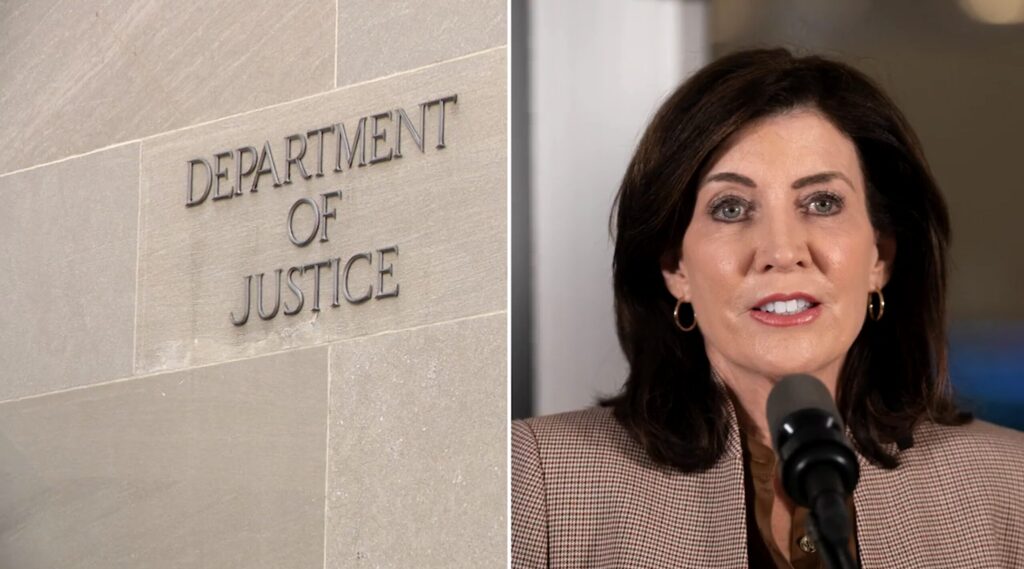
Department of Justice New York Fraud

The Department of Justice is blaming New York Governor Kathy Hochul and her administration for allowing the fraud. The DOJ alleges PPL was “preselected” as the winner of the contract in a fixed bid process.

Misrepresentation

The lawsuit further alleges that PPL won the contract after a “sham bid” process. The Justice Department claims PPL intended to stray from the representations made in their bid, that the New York Department of Health learned of the deceit, and failed to hold PPL accountable.

JD Vance Speaks

At a recent campaign event, Vice President JD Vance spoke about the lawsuit.

“You do not want your government facilitating fraud; you want your government fighting against fraud. You know what these fraudsters are doing? They’re taking advantage of American generosity to enrich themselves.”

JD Vance

Vice President of the United States

Response

New York State Department of Health spokesperson Cadence Acquaviva called the lawsuit a “baseless complaint” and an attempt by Republicans to “score political points at the expense of vulnerable New Yorkers.” Acquaviva called the lawsuit “inexcusable and completely lacking in merit.”

The Rowan Report reached out to PPL for comment, but did not hear back as of the publication of this article. We will provide updated information as it becomes available.

# # #

Kristin Rowan Editor The Rowan Report

Kristin Rowan is the owner and Editor-in-chief of The Rowan Report, the industry’s most trusted source for care at home news. She is also a sought-after speaker on Artificial Intelligence, Technology Adoption and Lone Worker Safety. She is available to speak at state and national conferences as well as software user-group meetings.

Kristin also runs Girard Marketing Group, a multi-faceted boutique marketing firm specializing in content creation, social media management, and event marketing. She works with care at home software providers to create dynamic content that increases conversions for direct e-mail, social media, and websites.  Connect with Kristin directly at kristin@girardmarketinggroup.com or www.girardmarketinggroup.com

©2026 by The Rowan Report, Peoria, AZ. All rights reserved. This article originally appeared in The Rowan Report. One copy may be printed for personal use: further reproduction by permission only. editor@therowanreport.com

California Hospice Fraud

by Kristin Rowan, Editor

California Hospice Fraud

Update 04-16-2026

Reports continue of additional arrests and revoked licenses in the California Hospice Fraud investigations. The anti-fraud task force suspensions rose to 447 hospices and 23 home health agencies this week. The total estimated fraud is more than $600 million. A White House official said, “[the task force] is reviewing and pursuing every possible lead. These suspension numbers, and the dollar values saved, are only going to increase.” Dr. Oz has promised to investigate “every single hospice in California.”

Multiple Arrests and Charges

Hospice fraud has been under investigation with much scrutiny by CMS. National efforts against waste, fraud, and abuse have focused on states with high probability of defrauding the Medicare Trust Fund. On April 9, 2026, California Attorney General Rob Bonta announced charges filed against 21 suspects accused of defrauding the government of $267 million. Five people were arrested and two handguns and more than $750,000 in cash were seized.

Intent to Defraud

After a credible report of fraud, an investigation ensued. The investigation uncovered this scheme. Individuals bought personal identifying information (PII) from people not living in California. They bought the PII through the dark web. They then enrolled these “people” in Medi-Cal, the California Medicaid program. Straw owners purchased 14 hospice companies and started billing Medi-Cal for hospice services for the stolen identities without providing those services.

Location Search

As part of a separate hospice fraud investigation, agencies conducted compliance reviews at a single location in Van Nuys. The address is home to more than 125 individual businesses. Of those, only 19 are licensed by the state and eligible to bill Medi-Cal. 60 percent of the remaining 109 businesses applied for hospice licenses and were denied by the state based on the moratorium on new hospices in place in California since 2021.

The 71 Million Dollar Doctor

Dr. Rajiv Bhuva has connections to Medicare claims from 126 different hospices in California, 115 of which are in LA County. The claims are for almost 2,800 patients. The average doctor cares for 140 patients annually. Dr. Oz confirmed that CMS has revoked Dr. Bhuva’s ability to bill Medicare. Dr. Bhuva has not yet been charged with a crime. A similar case in 2024 resulted in the conviction of Dr. Domingo Barrientos on the charge of conspiracy to commit healthcare fraud. Dr. Barrientos is in federal prison.

Task Force Suspends Providers

A federal anti-fraud task force working in California is investigating both hospice and home health providers. The focus is currently on Los Angeles and LA County, where high numbers of new agencies raised suspicion. As efforts have ramped up, the task force reported suspending 70 providers last week and a staggering 221 total providers suspended so far. The task force anticipates dramatically higher numbers before they’re done. The operation has identified multiple defendants and hundreds of millions in fraudulent claims.

# # #

Kristin Rowan Editor The Rowan Report

Kristin Rowan is the owner and Editor-in-chief of The Rowan Report, the industry’s most trusted source for care at home news. She is also a sought-after speaker on Artificial Intelligence, Technology Adoption and Lone Worker Safety. She is available to speak at state and national conferences as well as software user-group meetings.

Kristin also runs Girard Marketing Group, a multi-faceted boutique marketing firm specializing in content creation, social media management, and event marketing. She works with care at home software providers to create dynamic content that increases conversions for direct e-mail, social media, and websites.  Connect with Kristin directly at kristin@girardmarketinggroup.com or www.girardmarketinggroup.com

©2026 by The Rowan Report, Peoria, AZ. All rights reserved. This article originally appeared in The Rowan Report. One copy may be printed for personal use: further reproduction by permission only. editor@therowanreport.com


Hospice CARE Act

by Kristin Rowan, Editor

Hospice CARE Act

Congress breathes new life into hospice protection

In 2024, Representative Blumenauer (D-OR) introduced the Hospice Care Accountability, Reform, and Enforcement Act. The Bill, H.R. 9803, aimed “to amend title XVIII of the Social Security Act to ensure the integrity of hospice care furnished under the Medicare program.” The House referred the act to the Committee on Ways and Means and the Committee on Energy and Commerce for consideration. The Committee on Ways and Means later referred the act to the Subcommittee on Health, where it apparently remains under consideration.

On March 18, 2026, Congresswoman Sanchez (D-CA) and Senator Warner (D-VA) introduced, or re-introduced, the Hospice Care Accountability, Reform, and Enforcement (Hospice Care) Act. According to the joint press release from its sponsors, the act will “modernize the Medicare hospice benefit, protect patients and taxpayers from fraud, and expand access to essential services and caregiver support.”

Program Integrity and Payment Reform

The two primary foci of the act are program integrity provisions and payment reforms. The hospice benefit remains largely unchanged since it began in 1982 despite significant changes in both the providers delivering and patients receiving end-of-life care. The rise in reports of fraud and abuse puts into question whether the current system can ensure both meeting the needs of patients and families and safeguard the Medicare Trust Fund.

“Hospice should provide comfort and dignity at the end of life, yet the benefit has not evolved to meet families where there is need. This bill strengthens and enhances Medicare’s hospice benefit so it provides the critical care patients and their families need – like respite care for caregivers and coverage of palliative treatments like dialysis and radiation – all while protecting the program from those trying to exploit it.”

Linda T. Sanchez

Congresswoman, D-CA

Program Integrity

According to the sponsors, the bill “creates additional safeguards to precent fraudulent providers from enrolling in Medicare and increases oversight of hospices, especially new hospices.”

Specifically, the bill:

  • Temporarily prevents new hospices from enrolling in Medicare, while allowing exceptions for instances where additional access to care is needed.
  • Requires increased transparency of hospice ownership and managing control information, ensuring CMS’s enrollment records are up to date.
  • Increases survey frequency for new hospices to ensure they meet hospice health and safety standards and prohibits payments to hospices that do not submit required quality data to the Secretary, with appropriate exceptions.
  • Reduces the potential for inappropriate financial conflicts of interest when certifying individuals’ eligibility for hospice care, while allowing nurse practitioners and physician assistants to also certify eligibility.
  • Requires CMS to conduct additional oversight activities to ensure hospices are providing holistic and comprehensive care.
  • Provides patients with an explanation of benefits within 15 days of an individual’s hospice election to increase beneficiary awareness of hospice enrollment and prevent extended periods of fraudulent billing.

Payment Reform

The bill “ensures that providers are incentivized to deliver high-quality care to individuals and their families.”

Specifically, it:

  • Revises the payment structure for routine home care to reward hospices for providing in-person care.
  • Increases payments to hospices for furnishing palliative radiation, chemotherapy, blood transfusions, and dialysis to address access barriers for individuals that require these costly treatments under a hospice election. Additionally, it creates an outlier payment policy to provide a backstop for providers delivering care to high-cost patients.
  • Adds home respite care to the Medicare hospice benefit, allowing individuals to receive respite care at home rather than in a facility, which is a key benefit for families and caregivers that are taking care of loved ones at the end-of-life.
  • Creates a new transitional inpatient respite benefit to support patients and families through their transition from a hospital into hospice care in the setting of their choice, allowing patients to move from hospital to general inpatient care to transitional respite, when appropriate. This new transitional payment seeks to eliminate the current pattern of care whereby terminally ill individuals are discharged from the hospital and inappropriately admitted to a skilled nursing facility in lieu of electing hospice care.

“Making decisions about hospice and end-of-life care is one of the most difficult moments that families can endure, yet Medicare’s hospice benefit is out-of-touch with the needs of patients and providers. I’m proud to introduce this legislation that will prioritize patient comfort at home as well as in a health care facility, and protect patients and taxpayers from bad actors attempting to steal essential resources.”

Mark Warner

Senator, D-VA

Industry Support

The Hospice CARE Act received wide-spread industry support after its introduction to Congress. 

Hospice CARE Act
American Academy of Hospice and Palliative Medicine

“Patients and families in need of the care, comfort and quality of life that hospice care provides need to trust that they are receiving the best possible services. We look forward to working with Representative Sánchez and Senator Warner on these important issues and to ensure that all patients have access to this vital care.”

– Kristina Newport, CMO for AAHPM

Center for Medicare Advocacy

“In addition to significant payment reforms and program integrity measures, this bill takes important steps towards improving access to care for individuals on hospice.”

-David Lipschutz, Co-Director for the Center for Medicare Advocacy

National Alliance for Care at Home

“Hospice care is one of the most profound services our healthcare system offers, providing patients and families with compassionate, dignified care during life’s most difficult moments. As the number of Americans turning to hospice continues to grow, it is critical that the benefit keeps pace with how care is delivered today and what patients, families, and providers actually need. The Alliance looks forward to working with Representative Sánchez and Senator Warner and their congressional colleagues on this legislation. We are committed to being a constructive partner in any effort to protect what’s working, address what isn’t, and modernize the Medicare hospice benefit in ways that serve patients, families, and the future of care in our country.”

-Jennifer Sheets, CEO for The Alliance

LeadingAge

“At its best, compassionate, high-quality, person-centered care is delivered to beneficiaries and families by ethical, forward-thinking, competent providers, in keeping with the sector’s nonprofit origins, which established a standard of quality care. Currently, however, hospice is at an inflection point. Increased scrutiny – an appropriate response to fraudulent behavior of a limited group of bad actors – highlights the need for modernization.

-Katie Smith Sloan, President and CEO for LeadingAge

National Partnership for Healthcare and Hospice Innovation

“This legislation provides an important opportunity to pursue thoughtful reforms to the Medicare hospice benefit that both preserve patient access and address ongoing concerns related to program integrity. While the bill represents meaningful progress toward modernizing the benefit and reducing incentives for fraud, waste, and abuse, NPHI believes certain provisions – particularly those related to payment reform – present opportunities for further discussion and refinement.”

– Tom Koutsoumpas, Founder and CEO of NPHI

More Information

A section-by-section analysis of the bill is available HERE
A one-pager of the bill is available HERE

Congress is on recess until the middle of April. The last few months will dictate the priorities when the next session starts, which will likely be focused on finalizing the budget and fully reopening the government. Whether the Hospice CARE Act will progress past its 2024 version is unclear. The Rowan Report will continue to monitor its progress.

# # #

Kristin Rowan Editor The Rowan Report

Kristin Rowan is the owner and Editor-in-chief of The Rowan Report, the industry’s most trusted source for care at home news. She is also a sought-after speaker on Artificial Intelligence, Technology Adoption and Lone Worker Safety. She is available to speak at state and national conferences as well as software user-group meetings.

Kristin also runs Girard Marketing Group, a multi-faceted boutique marketing firm specializing in content creation, social media management, and event marketing. She works with care at home software providers to create dynamic content that increases conversions for direct e-mail, social media, and websites.  Connect with Kristin directly at kristin@girardmarketinggroup.com or www.girardmarketinggroup.com

©2026 by The Rowan Report, Peoria, AZ. All rights reserved. This article originally appeared in The Rowan Report. One copy may be printed for personal use: further reproduction by permission only. editor@therowanreport.com

LeadingAge and Alliance Join Dr. Oz

LeadingAge and Alliance Join Dr. Oz

CMS hosts listening session in LA

On January 9, 2026, CMS Administrator Dr. Mehmet Oz hosted a listening session in Los Angeles to discuss fraud, waste, and abuse in home health and hospice. Dr. Oz was joined by CMS Director of the Center for Program Integrity Kim Brandt and Director of the Center for Medicare Chris Klomp.

Statement to Dr. Oz

Representatives from both LeadingAge and the National Alliance for Care at Home attended the session. As part of their ongoing collaboration and participation in combatting fraud, waste, and abuse, the two organizations sent a joint letter to Dr. Oz regarding recommendations to strengthen program integrity.

“We strongly support CMS’s ongoing efforts to strengthen program integrity and believe that fraud, waste, and abuse can be effectively prevented and addressed while reducing burden on legitimate providers furnishing critical services in the home. As CMS continues to refine its oversight strategies, we encourage the agency to adopt measures that are analytically rigorous, operationally feasible, and take a targeted risk-based approach, consistent with CMS’s statutory authorities.” 

LeadingAge and the Alliance

CMS Fraud Prevention

CMS has identified areas of waste fraud and abuse they are actively working to combat. In 2025, CMS imposed nearly 500 payment suspension, stopping nearly $5 billion in payments. CMS identified $2.3 billion in overpayments and implemented automated edits to guard against improper payment. They also revoked Medicare billing from 4,780 providers and denied almost 112,000 claims for unnecessary services.

The Alliance

Members of National Alliance for Care at Home (The Alliance) attended the listening session with Dr. OZ, stating that program integrity is a key priority for the organization. The alliance continues to work closely with lawmakers and regulators to ensure providers are putting patients’ needs first without unnecessary or fraudulent claims.

“The Alliance appreciates the opportunity to continue our dialogue with CMS about ensuring program integrity across these essential home-based services. We share the administration’s goal of eliminating fraud, waste, and abuse in home health and hospice care, and will continue to partner with the agency as it pursues solutions that reduce the burden on legitimate providers and protect patient access to care at home.” 

Dr. Steve Landers

President, The Alliance

LeadingAge

Members from LeadingAge also attended the listening session stating that fraud in any care setting is concerning and preventable. The organization continues to work with CMS to address fraud and strengthen regulatory safeguards.

“We thank CMS for initiating this productive meeting, and for the input from Administrator Oz, Deputy Administrator and Chief Operating Officer Kim Brandt, and Deputy Administrator and Director of Medicare Chris Klomp. We look forward to continuing collaboration on this important issue.”

Katie Smith Sloan

President and CEO, LeadingAge

Interview with LeadingAge

The Rowan Report reached out to LeadingAge for a comment on the listening session with CMS. We are scheduled to speak with Mollie Gurian, VP of Policy and Government Affairs, this afternoon. We will update this article with that information immediately following the interview.

# # #

Kristin Rowan Editor The Rowan Report

Kristin Rowan is the owner and Editor-in-chief of The Rowan Report, the industry’s most trusted source for care at home news. She is also a sought-after speaker on Artificial Intelligence, Technology Adoption and Lone Worker Safety. She is available to speak at state and national conferences as well as software user-group meetings.

Kristin also runs Girard Marketing Group, a multi-faceted boutique marketing firm specializing in content creation, social media management, and event marketing. She works with care at home software providers to create dynamic content that increases conversions for direct e-mail, social media, and websites.  Connect with Kristin directly at kristin@girardmarketinggroup.com or www.girardmarketinggroup.com

©2026 by The Rowan Report, Peoria, AZ. All rights reserved. This article originally appeared in The Rowan Report. One copy may be printed for personal use: further reproduction by permission only. editor@therowanreport.com