Medicare Advantage Excess Payments

by Kristin Rowan, Editor

Medicare Advantage Excess Payments

Investigational Study

Researchers from the Department of Health Services, Policy and Practice at Brown Universchool of Public Health and the Department of Geriatrics and Palliative Medicine at Icahn School of Medicine published an original investigative study on spending versus payments in Medicare Advantage under the hospice carve-out model.

Carve-out to VBID to Carve-out

In 2021, CMS started a Value-Based Insurance Design (VBID) to test the impact of adding hospice services to Medicare Advantage benefits. By December of 2024, CMS ended the program due to widespread upset. CMS returned to the hospice carve-out model. Under this model, when an MA beneficiary chooses hospice, any health care expenses related to the terminal illness is paid on a fee-for-service (FFS) basis. MA no longer receives inpatient and outpatient payments, but continues to receive premiu, and rebate payments.

Carve-out Hospice Benefit

Once an MA enrollee enrolls in hospice, MA is no longer responsible for payments. Under the carve-out model, hospice services are paid by Medicare. MA plans are still responsible for paying for services that are not related to hospice care. These services can include inpatient, outpatient, physician, skilled nursing facility, home health care, and prescription drug expenses. 

Medicare Advantage Spending and Payments

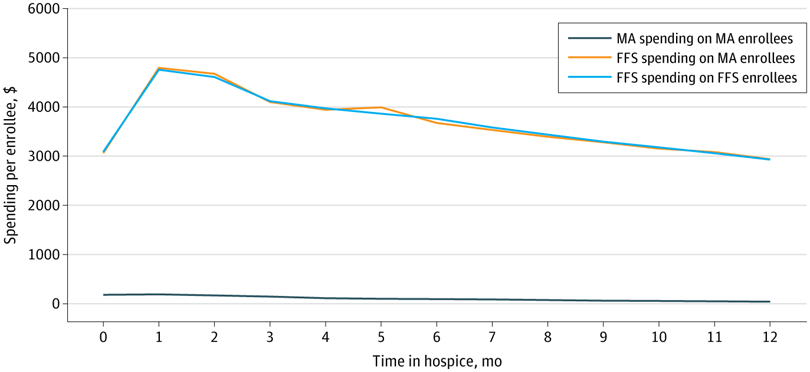
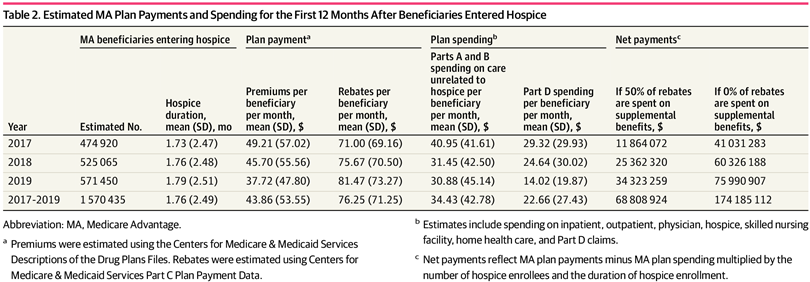
The study spanned 12 months and looked at 314,087 MA beneficiaries. In that period, 80.5% of enrollees had no spneding unrelated to their terminal illness. MA was not responsible for any healthcare related payments, but continued to receive $120 per enrollee per month. Estimated spending from MA on hospice enrollees was $57-70 per month. 
Medicare Advantage Excess Payments

In the 12 months following an enrollee electing hospice, MA plans netted $50-60 per month per enrollee. If half of the rebate payments received pay for supplemental benefits, MA receives excess payments to the tune of $68,808,924 over three years. If no rebate payments go toward supplemental benefits, MA receives $174,185,112 in excess payments over three years. The care a hospice enrollee receives uses the fee-for-service model. Medicare Advantage providers are seemingly paid on a fee-for-no-service model. 

Medicare Advantage plans do not currently report the actual amount of rebate payments used to pay supplemental benefits.

Study Conclusion

The researchers conclude that MA receives excess payments under the hospice carve-0ut model. They also note that there is no accountability for spending after hospice election from MA plans to CMS. The researchers suggest that CMS could require MA plans to report actual spending on supplemental services after hospice election and pay premiums and rebates only to cover the amount spent. 

I have a different recommendation….MA plans should not receive any additional premium payments or rebates following hospice election. MA plans should be required to report total payments and spending from enrollment date to election date. The balance, less the same 8% average margin of home and health and hospice agencies, should be used to pay for hospice services from election to passing. Any remaining balance after the patient’s passing should be returned to the beneficiary’s family.

# # #

Kristin Rowan, Editor

Kristin Rowan has been working at The Rowan Report since 2008. She is the owner and Editor-in-chief of The Rowan Report, the industry’s most trusted source for care at home news, and speaker on Artificial Intelligence and Lone Worker Safety and state and national conferences.

She also runs Girard Marketing Group, a multi-faceted boutique marketing firm specializing in content creation, social media management, and event marketing.  Connect with Kristin directly kristin@girardmarketinggroup.com or www.girardmarketinggroup.com

©2025 by The Rowan Report, Peoria, AZ. All rights reserved. This article originally appeared in The Rowan Report. One copy may be printed for personal use: further reproduction by permission only. editor@therowanreport.com


 

Overtime Changes

by Kristin Rowan, Editor

Overtime Changes

FLSA exemption to resume

In 1938, the Fair Labor Standards Act (FLSA) established a federal minimum wage, guaranteed overtime, and kept children out of the workforce. Exemptions to FLSA include executive, administrative, professional, computer employee, and outside sales positions. Employers did not pay minimum wage for retail workers, service workers, agricultural workers, or construction workers.

Domestic workers included

An amendment to FLSA in 1974 added domestic workers to those who must receive minimum wage and overtime. The amendment did not include “companionship services” and live-in domestic service employees. A later amendment from 2013 narrowed the definition of “companionship services.” This eliminated the exemptions for workers who provided “care.” Companions could still be exempted from overtime. This stopped home care agencies from claiming exemptions and required overtime pay for home care workers.

Overtime Changes FLSA Exempt

Rolling back the rule

The Department of Labor is considering unraveling the 2013 amendment. There is a concern that they may have misinterpretated the rule. Additionally, requiring overtime for home care workers will increase the cost of care. Supporters of the rule change believe that allowing exemptions for overtime among home care workers would make live-in care more affordable. If the 2013 amendment is removed, employers would not have to guarantee minimum wage or overtime for home care aides.

Industry impact

The DOL argues that this change will make care more affordable and expand access to care at home. However, there is already a workforce shortage in the industry. Lowering pay rates and removing overtime could cause a mass exodus from the industry. As far as we know, DOL did not discuss requiring CMS to increase reimbursements rates or covering non-medical supportive care at home as an alternative.

“Removing basic labor protections from home care workers will only exacerbate the multiple issues buffeting the home care sector, its workers and consumers: serious threats from cuts to federal Medicaid contributions, changing immigration policies and the lack of realistic long-term services and supports (LTSS) options.”

Katie Smith Sloan

President and CEO, LeadingAge

Comments from the industry

The public comments period on this proposed rule change ended on September 2, 2025. The proposed rule received roughly 5,300 comments. Some examples of feedback include:

“…reversing the 2013 protections, the DOL would undermine the wages and economic security of home care workers…exacerbate turnover and workforce shortages…[and] harm older adults and people with disabilities….” – Hand in Hand: The Domestic Employers Network

“This proposed change is a crucial step toward restoring flexibility and affordability in home care services, particularly for families relying on live-in support.” – Owner, Home Helpers Home Care of Larimer County and member of HCAOA and IFA

“…strongly support workforce development and has historically and continues to support thoughtful solutions to our workforce crisis. We strongly support the restoration of the overtime exemption.” – The Virginia Association for Home Care and Hospice and the West Virginia Council for Home Care and Hospice

Home care workers are also strongly vital for companion care, personal care, home health, nursing, therapy, caring for the disabled and the elderly, and more. The proposed rule that was meant to strip home care workers of wage and overtime protections is absolutely cruel and harmful for home care workers…” – Derek Dinh, CA

“I am not a home care worker, but used a home care worker to take care of my mom when she was unable to do things around the home and then got progressively worse. They need to be paid a living wage and receive overtime. They are professional people who take care of those who need care.” – Wendy Peale, NY

Opposition

  • Among the people and organizations who have publicly expressed opposition to this change are:
  • LeadingAge
  • Autistic Self Advocacy Network
  • American Civil Liberties Union
  • Congresswoman Pramila Jayapal
  • The Commonwealth of Pennsylvania, California, Colorado, Connecticut, District of Columbia, Hawaii, Illinois, Massachusetts, Maryland, Maine, Michigan, Minnesota, Nevada, New Jersey, New York, Oregon, Rhode Island, Vermont, and Washington

Final Rule

The has not issued a final rule. However, neither has the DOL enforced the requirement since July 25, 2025. Home care agencies can currently claim overtime exemptions. There is no set timeline yet for a final decision. We will continue to follow updates on this topic.

# # #

Kristin Rowan, Editor

Kristin Rowan has been working at The Rowan Report since 2008. She is the owner and Editor-in-chief of The Rowan Report, the industry’s most trusted source for care at home news, and speaker on Artificial Intelligence and Lone Worker Safety and state and national conferences.

She also runs Girard Marketing Group, a multi-faceted boutique marketing firm specializing in content creation, social media management, and event marketing.  Connect with Kristin directly kristin@girardmarketinggroup.com or www.girardmarketinggroup.com

©2025 by The Rowan Report, Peoria, AZ. All rights reserved. This article originally appeared in The Rowan Report. One copy may be printed for personal use: further reproduction by permission only. editor@therowanreport.com
 

Eleos Navigates Eligibility Risk

Eleos Navigates Eligibility Risk

FOR IMMEDIATE RELEASE

Contact:                  Amanda Wells

awells@sloanepr.com

Eleos Launches AI Scanner to Navigate Medicaid Eligibility Risk in Real Time

The new OBBBA AI scanner uses Eleos’ ambient AI technology to alert providers of patient eligibility changes, preserving revenue and ensuring care continuity amid sweeping Medicaid policy changes

BOSTON, MA, Aug. 20, 2025 — Eleos, the leading AI platform in post-acute care, today announced the launch of the OBBBA (One Big Beautiful Bill Act) AI scanner, the first real-time tool to proactively detect potential changes to Medicaid eligibility during client sessions. The OBBBA AI scanner uses Eleos’ purpose-built ambient AI scribing technology to inform providers about changes that may impact coverage, giving them time to act before Medicaid coverage lapses. The tool was launched in response to sweeping Medicaid funding cuts and eligibility rule changes.

Eligibility Check

Providers can select Medicaid-related “themes” to track such as housing status, diagnosis updates, or life events like marriage or aging out of eligibility. The OBBBA scanner captures contextual clues that could trigger changes in coverage. Providers use this information to take action to prevent eligibility loss, reduce care disruption and maintain treatment continuity. For care organizations, this means fewer denials and greater revenue stability, as well as better client support.

The OBBBA AI scanner arrives at a critical moment: new Medicaid rules introduce shorter retroactive coverage windows, semi-annual (versus annual) redeterminations and narrowed eligibility criteria — all of which lead to a higher risk of churn, especially for vulnerable groups such as people with serious mental illness and those experiencing housing instability.

Eleos Navigates Eligibility Risk

“We’re hearing from leaders across the country that Medicaid redetermination changes are already causing confusion and fear among clients and providers alike. The OBBBA AI scanner gives providers the earliest possible warning via real-time insights so they can protect coverage and avoid treatment disruptions, ensuring clients continue to receive necessary and life-saving care. This kind of provider-first technology is at the core of Eleos.”

Alon Joffe

Co-founder and CEO, Eleos

Embedded seamlessly within the Eleos Documentation experience, the tracker works in tandem with providers’ existing workflows, requiring no additional software or manual data entry.

Industry leader sees Eleos scanner as critical tool

“OBBBA has created significant uncertainty for the behavioral health sector, and organizations need every possible advantage to navigate it. Properly deployed, purpose-built AI tools help organizations navigate an ever-changing landscape while also promoting the health and well-being of clients and communities.”

Chuck Ingoglia

President and CEO, National Council for Mental Wellbeing

Rationale

The OBBBA AI scanner builds on Eleos’ mission to free care providers from administrative burdens and enable better, more data-informed care. Deployed in over 200 organizations in 30-plus states, Eleos is the most-used AI solution in behavioral health, substance use disorder (SUD) treatment and post-acute care. Its suite of AI-powered documentation and compliance solutions has been proven to reduce documentation time by more than 70%, double client engagement and drive 3-4x better treatment outcomes. 

For more information about the OBBBA AI scanner or to request a demo, visit www.eleos.health.

# # #

About Eleos

Eleos is the leading AI platform for behavioral health, substance use disorder, home health and hospice. At Eleos, we believe the path to better care is paved with provider-focused technology. Our purpose-built AI platform streamlines documentation, simplifies revenue cycle management and surfaces deep care insights to drive better client outcomes. Created using the industry’s largest database of real-world sessions and fine-tuned by our in-house clinical experts, our AI tools are scientifically proven to reduce documentation time by more than 70%, boost client engagement by 2x and improve symptom reduction by 3-4x. With Eleos, post-acute care providers are free to focus less on administrative tasks and more on what got them into this field in the first place: caring for their clients.

DOJ Settles with UnitedHealth and Amedisys

by Kristin Rowan, Editor

DOJ Settles with UnitedHealth and Amedisys

Judge to Weigh In

DOJ settles with UnitedHealth and Amedisys after almost nine months of negotiations. The Department of Justice (DOJ) initially blocked the proposed merger between UnitedHealth and Amedisys, citing concerns over eliminating competition in home health and hospice services in some areas of the U.S. After the most recent settlement hearing, the merger seems to be back on track.

Public Comment Period and Judicial Review

Now that the DOJ hurdle has been passed, there is a public comment period. Following the public comment period, the U.S. District Court for the District of Maryland will enter final judgement. From the Justice Department website:

As required by the Tunney Act, the proposed settlement, along with a competitive impact statement, will be published in the Federal Register. Any interested person should submit written comments concerning the proposed settlement within 60 days following the publication to Jill Maguire, Acting Chief, Healthcare and Consumer Products Section, Antitrust Division, U.S. Department of Justice, 450 Fifth Street NW, Suite 4100, Washington, DC 20530. 

Antitrust Division Statement

“In no sector of our economy is competition more important to Americans’ well-being than healthcare. This settlement protects quality and price competition for hundreds of thousands of vulnerable patients and wage competition for thousands of nurses. I commend the Antitrust Division’s Staff for doggedly investigating and prosecuting this case on behalf of seniors, hospice patients, nurses, and their families.”

Abigail Slater

Assistant Attorney General, Justice Department Antitrust Division

Divestiture Agreement

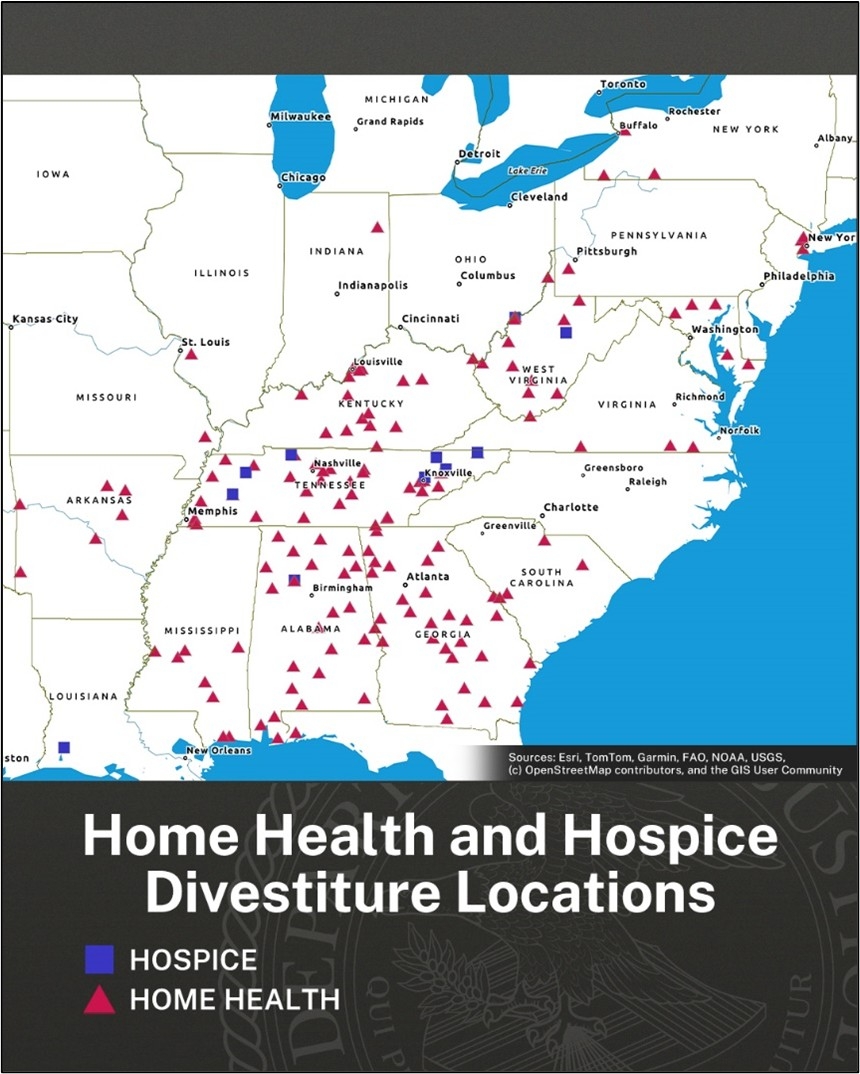
According to the new agreement, UnitedHealth will sell 164 home health and hospice locations across 19 states. In addition to the sale, the agreement provides the buyers of these locations with assets, personnel, and relationships to help them compete with remaining UnitedHealth locations. Also included are protections to deter UnitedHealth from interfering with the new owners’ ability to compete.

BrightSpring Health Services and Pennant Group will acquire the 164 locations. Slater said the settlement, which includes the largest ever divestiture of outpatient healthcare, protects quality and price competition patients as well as wage competition for nurses. However, antitrust specialist Robin Crauthers, a partner with McCarter & English, says it doesn’t go far enough. According to Crauthers, the settlement agreement does not address all of the markets that would have less competition and that the DOJ accepted less than they wanted in the agreement.

Additionally, critics argue the divestiture moves 164 home health and hospice agencies from one large player to two other large players in the space. Arguably, rather than preserve competition, this divestiture agreement will only serve to strengthen the largest players in the market, giving them a substantial advantage over smaller agencies in these areas.

UnitedHealth Amedisys divestiture locations

Not the Only Concern

Vertical Integration

Joe Widmar, Director of M&A at West Monroe consulting firm, says that the number of home health and hospice agencies is not the tipping factor in competition. Rather, it is UnitedHealth’s vertical integration. A health insurance company that also owns nearly 2,700 subsidiaries, including pharmacies, home health and hospice, behavioral health, consulting for healthcare organizations, surgery centers, hospitals, mental health, managed care for Medicaid and Medicare, and specialty care. Virtually any referral from a PCP to any other health professional puts more money into the health care giant’s pockets. The lack of competition is across all forms of healthcare, leaving patients no choice buy to support UnitedHealth Group in areas where all local healthcare providers are subsidiaries. I 2024, UnitedHealth insurance paid $150.9 million to its subsidiaries for care. These provider companies are not counted in the profit caps placed on insurance companies.

Upcoding

In addition to side-stepping profit caps, vertical integration aids in upcoding. Upcoding is the practice of digging into a patient’s life to find (or create) additional patient needs. Insurers add as many codes as possible for the greatest reimbursement rates. According to a recent study, UnitedHealthcare overbilled Medicare Advantage by $14 billion through upcoding. 

In-home health risk assessments and patient reviews, often offered to beneficiaries as a free service, result in an average risk score 7% higher than in patients seen in medical practices and hospitals. UnitedHealth generates more income from patient review diagnoses than any other MA insurer. The Department of Justice is currently investigating UnitedHealth’s Medicare billing practices.

Final Thoughts

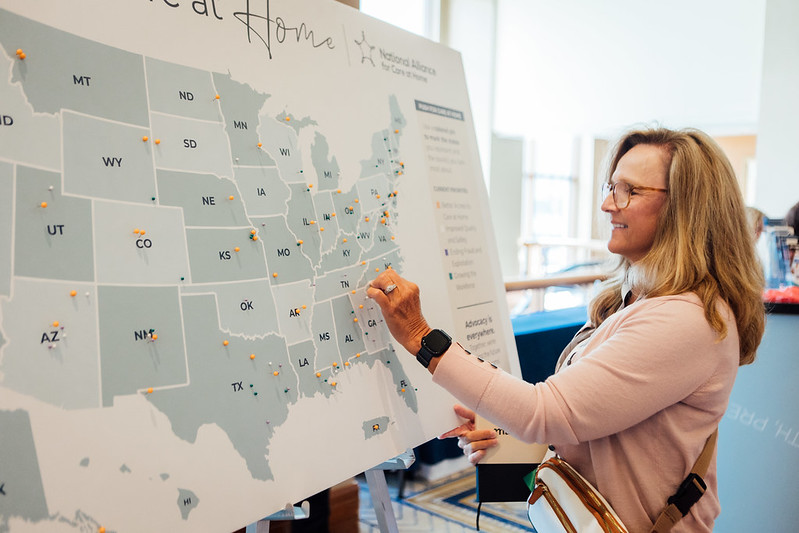
If you own a home health, hospice, or palliative care agency in any of the states shown in the graphic above, write to Jill Maguire with comments and concerns. Our primary objective is providing quality care to patients in their homes. We know that home care is less expensive for the patient and government-funded insurance. But not when all the home care agencies in an area are owned by only a few of the largest home health agencies in the country. And not when the insurer is adding diagnostic codes to pad their bill. 

# # #

Kristin Rowan, Editor

Kristin Rowan has been working at The Rowan Report since 2008. She is the owner and Editor-in-chief of The Rowan Report, the industry’s most trusted source for care at home news, and speaker on Artificial Intelligence and Lone Worker Safety and state and national conferences.

She also runs Girard Marketing Group, a multi-faceted boutique marketing firm specializing in content creation, social media management, and event marketing.  Connect with Kristin directly kristin@girardmarketinggroup.com or www.girardmarketinggroup.com

©2025 by The Rowan Report, Peoria, AZ. All rights reserved. This article originally appeared in The Rowan Report. One copy may be printed for personal use: further reproduction by permission only. editor@therowanreport.com

 

HIS to HOPE Help

by Curantis Solutions

HIS to HOPE Help

HOPE visit types

The HOPE (Hospice Outcomes & Patient Evaluation) model introduces a new rhythm to hospice documentation, one that centers on the patient’s evolving experience of care. To meet HOPE’s standards with confidence, it’s critical to understand the different visit types and their timing.

Let’s break down the three visit types defined by HOPE: INV, HUV, and Symptom Follow-Ups, so your team knows exactly what’s required, when, and why it matters.

HIS to HOPE Help Curantis Solutions

INV

Initial Nursing Visit

What it is: The first clinical touchpoint in the HOPE timeline. The INV marks the beginning of structured data collection and sets the baseline for all subsequent updates.

When it’s due: As soon as possible after admission, ideally within the first day.

What it captures:

  • Key demographic and clinical data
  • Initial symptom impact ratings
  • Observations that may trigger a future follow-up

HUV

HOPE Update Visits

HOPE requires two follow-up check-ins to capture how the patient’s condition is changing over time. These are called HOPE Update Visits—HUV1 and HUV2.

HUV1

When it’s due: Days 6–15 after admission
Purpose: Reassess symptoms and update the patient’s status.

HUV2

When it’s due: Days 16–30 after admission
Purpose: Continue tracking trends and changes, especially as patients stabilize or begin to decline.

Pro tip: Even if the visit wasn’t originally intended as a HOPE Update Visit, clinicians can update their response at visit close ensuring the right file is created.

Symptom Follow-Up Visits

What they are:
Special visits required when certain symptoms (e.g., pain, shortness of breath, anxiety) are rated as having a moderate or severe impact on the patient’s well-being.

When they’re due:
Time-sensitive, must occur within days of the symptom being flagged.

Why they matter:
These follow-ups are the heart of HOPE’s patient-centered approach. They ensure that care plans are adapted quickly and that patients don’t suffer in silence.

Symptom follow-ups should be:

  • Automatically evaluated after each visit
  • Clearly flagged with alerts across the system
  • Auto-documented into the HOPE record upon completion and QA

HOPE Hub

To support you every step of the way, Curantis Solutions has created the HOPE Hub—a dedicated resource center designed to guide your team through a seamless transition to HOPE-based documentation. For more HOPE Resources, visit here.

# # #

About Curantis Solutions

Curantis Solutions

Curantis Solutions was born from a desire to put hospice and palliative care first. With a genuine culture of caring, our team is dedicated to creating a refreshingly simple software experience that utilizes emerging technology, smart design and a cloud-native/serverless architecture to create an experience that is congruent with the technology you utilize in your everyday life. It’s time for hospice and palliative care software to make life easier vs creating arduous workarounds and added frustration. It’s time you experience Curantis Solutions!

Alliance Responds to Hospice Final Rule

by Kristin Rowan, Editor

The Alliance Responds to CMS Hospice Final Rule

CMS Issues FY 2026 Hospice Final Rule

On August 1, 2026, CMS issues the FY 2026 Hospice Wage Index and Payment Rate Update and Hospice Quality Reporting Programs Requirements Final Rule. Here are the high-level changes in this year’s final rule:

  • Rate Setting Changes
    • A 3.3% inpatient hospital market basket percentage increase
    • A 0.7% productivity adjustment (read decrease)
    • Statutory cap increases from $34,465.34 to $35,361.44
  • Hospice Care Admission
    • The physician member of the interdisciplinary group (IDG) may recommend admission to hospice care
  • Face-to-Face Attestation
    • Signature and date requirements restored
    • Eliminated requirement for attestation to be a separate and distinct document
    • Attestation requirement can be a section or addendum to recert form, or part of a signed and dated clinical note
  • Hospice Quality Reporting Program
  • The HOPE tool will replace the HIS tool on October 1, 2025, despite comments to delay implementation
  • CMS published a HOPE Technical Information webpage ,an HQRP training library, and a Requirements and Best Practices webpage
  • CMS recognized the error in their HOPE burden calculations. The burden is 21.1% higher than initially reported. The difference will be “taken into consideration” in the next PRA package submission.
  • The separate reporting tool (QIES) and reports tool (CASPER) will sunset and iQIES will replace both tools.
FY 2026 Hospice Quality Reporting Program

National Alliance for Care at Home Statement

After CMS issued the final rule, the Alliance responds with a statement addressing the wage adjustment, HOPE tool implementation, and sttestation changes. Read the full press release here.

Wage Adjustment

The Alliance recognizes that the 2.6% wage update is higher than the proposed 2.4% adjustment issued earlier this year. However, The Alliance maintains its position that the update does not go far enough to offset the very high and very real operational costs that hospices across the country face.  

Regulatory Relief

Both the physician member of the IDG recommending hospice admission and the inclusion of a clinical note to serve as attestation of a face-to-face were welcome changes to hospice regulations. The Alliance thanked CMS for these changes.

HOPE Tool Implementation

The Alliance was among the many commenters to CMS about the October 1, 2025 implementation date for the HOPE tool. Alliance CEO Dr. Steve Landers had this to say:

Despite responsiveness in other areas, the Alliance is deeply disappointed that CMS did not heed recommendations and delay the October 1, 2025 implementation of the Hospice Outcomes and Patient Evaluation (HOPE) tool nor waive the timeliness completion requirement for HOPE record submission. We expect providers to face a burdensome transition and urge CMS to remain responsive to real-world challenges, offering flexibility as providers navigate the change.  

Dr. Steve Landers

CEO, National Alliance for Care at Home

The Alliance is committed to working with CMS to reduce spending and strengthen the Medicare hospice benefit. They also continue to support the CMS initiative to reduce fraud, waste, and abuse.

Final Thoughts

The Hospice Final Rule is not what we hoped for. The wage update was increase, but not by enough to make a real impact on the operational burden hospices face. CMS has provided technical training and education for the HOPE tool, but severely underestimated the financial burden connected to the transition. CMS continues to use outdated, incorrect, or faulty information in its calculations of wage rate updates and ignores the repeated comments from advocacy groups and hospice providers. 

# # #

Kristin Rowan, Editor

Kristin Rowan has been working at The Rowan Report since 2008. She is the owner and Editor-in-chief of The Rowan Report, the industry’s most trusted source for care at home news, and speaker on Artificial Intelligence and Lone Worker Safety and state and national conferences.

She also runs Girard Marketing Group, a multi-faceted boutique marketing firm specializing in content creation, social media management, and event marketing.  Connect with Kristin directly kristin@girardmarketinggroup.com or www.girardmarketinggroup.com

©2025 by The Rowan Report, Peoria, AZ. All rights reserved. This article originally appeared in The Rowan Report. One copy may be printed for personal use: further reproduction by permission only. editor@therowanreport.com

 

First Joint Event for NAHC & NHPCO

FOR IMMEDIATE RELEASE
July 30, 2025
PHOTO LINK

National Alliance for Care at Home Hosts Inaugural Financial Summit

Over 700 industry leaders gather in Chicago for three-day event focused on financial leadership and innovation in home-based care

(Alexandria, VA and Washington, DC) — The National Alliance for Care at Home (the Alliance) successfully hosted its inaugural event, the 2025 Alliance Financial Summit, July 27-29 in Chicago, IL. The Summit brought together financial leaders from across the care at home community, with expert-led sessions, peer collaboration, and insights into market shifts and emerging technologies.

Arrival in Chicago

Welcome

The Summit officially launched Sunday evening with an opening keynote by Wendy Sue Swanson, MD, MBE, Founder and CEO of Skin Metal and Author of “Mama Doc Medicine.” Dr. Swanson delivered a forward-looking presentation on the intersection of medicine and technological innovation. The evening concluded with a Welcome Reception in the Exhibit Hall. 

Keynote

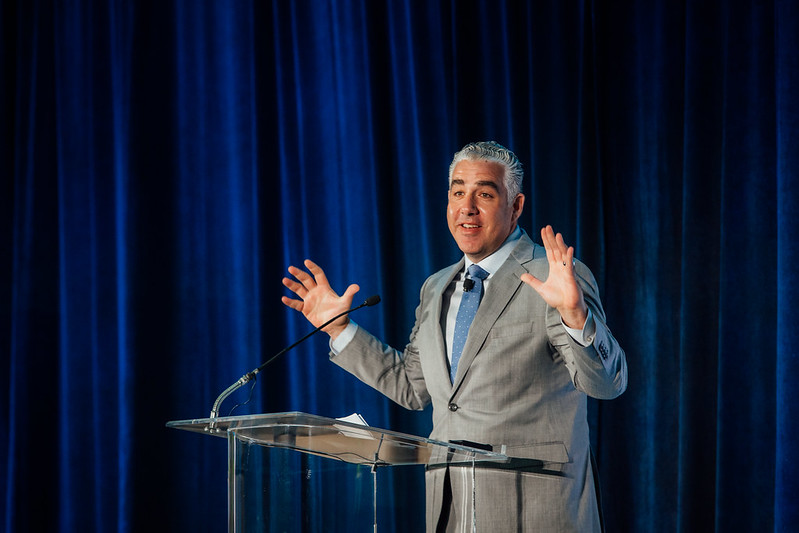
The day’s keynote session featured Alliance CEO Dr. Steve Landers alongside a panel of experts including Ken Albert, President and CEO of Andwell Health; Trisha Crissman, President and CEO of CommonSpirit Health at Home; and Hillary Loeffler, Vice President of Policy & Regulatory Affairs for the Alliance. Panel discussions addressed the potential impact of payment cuts in the Centers for Medicare & Medicaid Services Calendar Year 2026 Home Health proposed rule, hospice policy developments, workforce challenges and solutions, and actionable strategies for providers to protect the future of home-based care. Attendees then moved into a full day of concurrent sessions before an evening reception on the Chicago River.  

Steven Landers, CEO, The Alliance, Financial Summit
The Alliance Financial Summit Riverwalk Reception
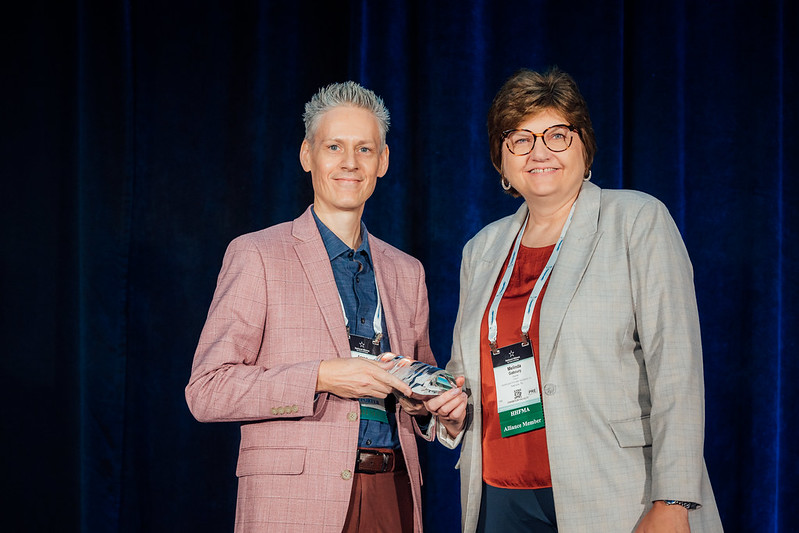
The Alliance Financial Summit Awards
The Alliance Financial Summit Attendee Map

Networking and Education

Tuesday featured dedicated peer-to-peer networking sessions, allowing for informal conversation and knowledge sharing, before the opportunity for more concurrent sessions. The Summit concluded with a closing keynote expert panel featuring leaders from the Alliance’s Home Health and Hospice Financial Managers Association (HHFMA). 

“This first Alliance event exceeded our expectations, bringing together care at home leaders from across the nation to connect, learn, and recommit to our shared vision of an America where everyone has access to the highest quality, person-centered healthcare wherever they call home,” said Alliance CEO Dr. Steve Landers. “The content was both practical, grounded in the day-to-day challenges and successes of providers, while incorporating innovation and aspiration to drive future growth and success.”  

The Alliance has announced two additional events for 2025: Alliance Advocacy Week, September 8-11 in Washington, DC, and the National Alliance for Care at Home Annual Meeting and Exposition, November 1-4 in New Orleans, LA.  

# # #

About the National Alliance for Care at Home

The National Alliance for Care at Home (the Alliance) is the leading authority in transforming care in the home. As an inclusive thought leader, advocate, educator, and convener, we serve as the unifying voice for providers and recipients of home care, home health, hospice, palliative care, and Medicaid home and community-based services throughout all stages of life. Learn more at www.AllianceForCareAtHome.org

Press Contact
communications@allianceforcareathome.org
Elyssa Katz | 571-281-0220

HHAeXchange Expands in Manhattan

FOR IMMEDIATE RELEASE

Contact:                                 Hollie Barnridge
Alloy, on behalf of HHAeXchange
855-300-8209
hhaexchange@alloycrew.com

HHAeXchange Unveils New Corporate Headquarters in New York City

New location reaffirms the company’s commitment to its employees and customers with expanded office space to support enhanced collaboration, creativity, and innovation

NEW YORK, June 3, 2025 – HHAeXchange, a leader in homecare management solutions for providers, caregivers, managed care organizations (MCOs), and state Medicaid programs, today announced the opening of its new corporate headquarters in New York City. 

Located in the heart of Midtown Manhattan, the reimagined workspace is a reflection of the company’s recent growth and its commitment to delivering advanced solutions for the home and community based services (HCBS) industry. The new space also marks an important step in uniting teams from HHAeXchange’s recent acquisitions of Sandata, Cashé Software, and Generations Homecare System. Efforts to foster stronger collaboration across functions will accelerate the delivery of a more connected, efficient experience for customers nationwide. 

“We are always striving to better meet the needs of our customers, and bringing our employees together at our new headquarters will support greater collaboration that drives product innovation. New York has been our home base since 2008, and we’re proud to grow the HHAeXchange footprint locally while creating a welcoming work environment for our network of employees, customers, and partners from across the nation.”

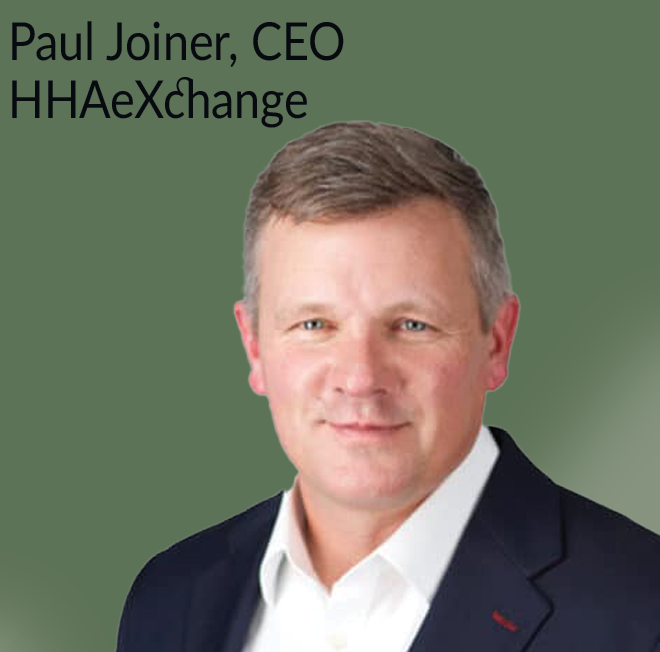
Paul Joiner

CEO, HHAeXchange

For more than 15 years, HHAeXchange has been at the forefront of homecare technology, innovating software solutions that empower personal care providers, self-direction program administrators, MCOs, and state Medicaid agencies to achieve operational efficiency, increased compliance, and improved member outcomes. The new central office space reflects HHAeXchange’s focus on supporting its teams and customers, helping to advance care delivery for all members.

HHAeXchange

In addition to the office’s collaborative workspace, HHAeXchange’s new headquarters features state-of-the-art employee training rooms and flexible meeting spaces designed to foster engagement with customers, prospective clients, and partners.

In His Own Words

We sat down with Paul Joiner, CEO of HHAeXchange, to talk about the new office space, how its impacting the company culture, and what’s next for the company. See our accompanying article here.

About HHAeXchange

Founded in 2008, HHAeXchange is the leading technology platform for homecare and self-direction program management. Developed specifically for Medicaid home and community-based services (HCBS), HHAeXchange connects state agencies, managed care organizations, providers, and caregivers through its intuitive web-based platform, enabling unparalleled communication, transparency, efficiency, and compliance. In 2024, HHAeXchange expanded through the strategic acquisitions of Sandata, Cashé Software, and Generations Homecare System, strengthening its commitment to advancing the industry. For more information, visit hhaexchange.com or follow the company on XLinkedIn, and Facebook.

Paul Joiner: On the Record

by Kristin Rowan, Editor

Paul Joiner

On the Record

Paul Joiner, CEO of HHAeXchange, sat down with The Rowan Report Editor Kristin Rowan to discuss the company’s new headquarters in Manhattan, the company culture he’s creating, his dedication to support those helping our most vulnerable populations.

In His Own Words

The Rowan Report: Paul, thank you for taking the time to talk to us. HHAeXchange is going through some significant growth recently. And now you’ve moved your headquarters from Long Island to Manhattan, correct? How did that decision come about?

Paul Joiner: HHAeXchange has been in Manhattan for a long time. Sandata, who we acquired earlier this year, was in Long Island. But, the move was planned with or without Sandata. We needed a nice sized space to convene people. We valued a large, multi-purpose meeting space over individual office space. It’s a space where the teams can meet when they come to town, where we can host clients, and larger company meetings.

RR: How does the new space support your team?

Paul: The majority of our team is remote. I don’t think remote work is healthy for everyone. It varies from person to person. It’s not a long-term healthy option. Returning back to the office 9-5 five days a week isn’t practical and not all that healthy either. We have created policies, a workspace, and a culture where people are invited to visit. Some come 2-3 days per week. Some only once a month. We maintain flexibility for our teams to work when and where they need to work. Being a single parent, for example, is really hard, so we stay flexible to support single parents to be where they need to be.

At the same time, we’ve seen the benefit of the connection and how much more healthy it is by physically coming together. For the younger workforce, they are enjoying getting together and coming into the office. We have to support our younger employees and their professional development. How do you professionally develop via Zoom or Teams? Physically coworking and promoting good and active environments compel people to come into the office. To build connections, you have to be together, not just on video.

RR: You have workers across the country, though. How does that work?

Paul: We have the main office here in Manhattan, a large and growing office in Minneapolis, and a smaller office in Miami. We try to keep people in areas that make it easy to meet. However, we do have some roles with certain criteria that allows for mostly remote work. Those teams come to one of the offices to meet when they can. We’ve hosted team meetings here and in Minneapolis recently.

RR: Has this new meeting space had an impact on the company culture?

Paul: Yeah, it has improved. We are having real, honest conversations about what needs to be improved. The team effort is the way we win and our teams understand that. We also understand that working hard doesn’t mean foregoing your life and the ability to recharge.

Work hard, be passionate, and motivate people with your mission and vision. The people we serve don’t have it easy, they are supporting the most vulnerable people.

RR: In a recent statement, you said that the new location will support collaboration and innovation. Do you have new features on the horizon? Are you investing in AI capabilities?

Paul: We have a lot in the works. We have a new mobile app in the beta phase that we’ll be rolling out that I’m really excited about. It’s actually an update, but it’s so massive that it’s basically new. We’re working on data analytics and data tracking for some of our largest clients.  We’ve consolidated some screens into one spot to streamline and make the user more efficient. A lot of what we’re working on is foundational. We’re focusing on supporting companies as they scale.

RR: Are you looking into AI, either within the HHAeXchange platform, or in a partner?

Paul: Yeah, of course. AI is the future and it’s everywhere. We are looking at ways to return time to users, make it easier to train users, and make things easier on caregivers. We will try to generate more buzz around AI, but not until there’s real, tangible value. AI definitely needs to be part of our strategy, but being smart where we apply it to truly get the value-add for our clients. It has to improve the quality of life for the user. Does it improve the ability of caregivers to care for people?

Paul Joiner, CEO, HHAeXchange

RR: Do you have any additional acquisition or growth plans for the second half of 2025?

Paul: There’s a lot going on in the marketplace right now. A lot of our clients are growing really well also. So, we’re sort of in a heads-down mode. There’s a handful of things we’re looking at. Right now, I’m really excited about being a bigger participant across the full continuum of care for our populations. There are some opportunities to innovate and evolve to support integrated care over the next few years. I’ll just leave it at that…for now.

RR: Paul, thank you for joining me today. It’s always a pleasure.

# # #

About HHAeXchange

Founded in 2008, HHAeXchange is the leading technology platform for homecare and self-direction program management. Developed specifically for Medicaid home and community-based services (HCBS), HHAeXchange connects state agencies, managed care organizations, providers, and caregivers through its intuitive web-based platform, enabling unparalleled communication, transparency, efficiency, and compliance. In 2024, HHAeXchange expanded through the strategic acquisitions of Sandata, Cashé Software, and Generations Homecare System, strengthening its commitment to advancing the industry.

About Paul Joiner

Paul Joiner is an accomplished executive with extensive leadership experience in the healthcare sector. Currently serving as a Board Member at AssistRx, Joiner has held prominent positions, including Chief Executive Officer at both HHAeXchange and Kipu Health. Previous roles include Chief Operating Officer as well as Executive Vice President and General Manager at Availity, and Senior Vice President and General Manager of Health Plan. Joiner also served as Vice President of Client Engagement and Business Development at Midas+ Solutions, Xerox Healthcare Provider Solutions. Educational qualifications include a Master of Accountancy from Belmont University and a Bachelor of Accountancy from the University of Mississippi.

Kristin Rowan, Editor

Kristin Rowan has been working at The Rowan Report since 2008. She is the owner and Editor-in-chief of The Rowan Report, the industry’s most trusted source for care at home news, and speaker on Artificial Intelligence and Lone Worker Safety and state and national conferences.

She also runs Girard Marketing Group, a multi-faceted boutique marketing firm specializing in content creation, social media management, and event marketing.  Connect with Kristin directly kristin@girardmarketinggroup.com or www.girardmarketinggroup.com

©2025 by The Rowan Report, Peoria, AZ. All rights reserved. This article originally appeared in The Rowan Report. One copy may be printed for personal use: further reproduction by permission only. editor@therowanreport.com
 

Alora is CHAP Verified

FOR IMMEDIATE RELEASE

Contact:           Alora Healthcare Systems
Media@AloraHealth.com
800-954-8250

Alora Healthcare Systems Earns CHAP Verified Status for Home Health, Hospice, and Home Care Software

ATLANTAJuly 23, 2025 — Alora Healthcare Systems, a leading provider of cloud-based solutions for post-acute care, announced this week that its full suite of software solutions – Home Health, Hospice, and Home Care, has earned CHAP Verified status from CHAP, Inc. (Community Health Accreditation Partner).

This designation confirms that Alora’s solutions meet CHAP’s highest standards in operational excellence, compliance, and quality improvement. The verification process included a detailed review of Alora’s functionality and alignment with CHAP’s Standards of Excellence. CHAP verified that Alora’s software fully supports compliance and actively enhances care delivery.

Alora Home Health CHAP verified

“The Alora team consistently delivers impressive software across Home Health, Hospice, and Home Care, marked by its user-friendly interface, extensive customization options, and powerful tools for operations and compliance. Their dedication to listening to customer feedback is evident in continuous enhancements like the OASIS-E analyzer, real-time reporting, and integrated HR and billing platforms, all designed to meet individual care needs and regulatory requirements efficiently.”

Teresa Harbour

COO, CHAP, Inc.

CHAP Verified status highlights Alora’s ability to support agencies in achieving compliance while advancing post-acute care technology. The platform is designed for efficiency, enabling high-quality, patient-centered care amid a changing regulatory landscape.

Sathish John, CEO of Alora, remarked, “This achievement is a direct reflection of our mission to simplify workflows for clinicians, administrators, and caregivers, while focusing on compliance, quality, and feedback.”

Alora’s comprehensive platform includes tools for documentation, billing, scheduling, visit verification, compliance, HR, and more, providing a streamlined experience for both skilled and non-skilled care.

This recognition strengthens Alora’s commitment to empowering home-based care agencies with CHAP Verified solutions that drive excellence and regulatory confidence.

# # #

About Alora

Alora is a leading provider of cloud-based home care softwarehome health software, and hospice software, for agencies across the U.S. Known for its intuitive interface and award-winning support, Alora delivers robust, integrated tools that empower agencies to streamline operations, ensure compliance, and focus on patient care.

About CHAP

CHAP is the nation’s first accrediting body for home and community-based healthcare organizations. As an independent, nonprofit accrediting body, CHAP advances the highest standards of community-based care.

© 2025 Alora Healthcare Systems