That’s a No-No

by Elizabeth E. Hogue, Esq.

No-no # 1

“No-No” may seem like something you would say to a toddler, but there is a list of things agency owners do that they should not do. Many of these are things providers may not often consider. This article focuses on the use of private duty services by hospice and home health patients, and what hospices and home health agencies cannot do with regard to aide services.

Aide Services

Both home health and hospice services are usually intermittent and provided in patients’ homes.  Patients and their families may elect to utilize the services of private duty/home care companies for additional assistance. At the same time, hospice and home health patients may receive aide services from hospices and home health agencies. 

Conditions of Participation no-no

Conditions of Participation

According to Medicare Conditions of Participation (CoPs), hospice and home health aides can only provide personal care services, including bathing. Aides provided by private duty/home care companies may also provide personal care. Unlike aides provided by hospices and home health agencies, however, they can provide additional services; such as laundry, food preparation, light housekeeping, shopping, and running errands.

Private Duty Services

When patients use private duty services, they are often paying for these services out of their own pockets. Even if they have long-term care insurance, patients still bear the financial burden of paying for private duty services. Longterm care insurance often costs thousands of dollars that patients probably paid for themselves. Patients usually pay by the hour for these services. 

Private Duty Aide Services No-No

That's a No-No

Patients may, of course, utilize private duty/home care services to perform any of the services described above. It seems, however, that hospices routinely tell patients who have private duty/home care that they will not provide aide services because private duty/home care aides are able to provide personal care for patients.

Breaking it Down

Here is an example: A hospice admitted a bedridden patient with urinary and fecal incontinence. The patient and caregiver requested aide services from the hospice five days a week to bathe him. He paid for a few hours of private duty/home care services each day. The hospice refused to provide aide services five days a week to bathe him because he had private duty/home care services. No-no!

Compelled to Provide Care

ospices must provide aide services consistent with patients’ needs related to their terminal illnesses. In the example above, the patient clearly had a need for aide services five days a week. If patients and their caregivers state that they prefer to use private caregivers for personal care, then hospices must document the refusal of hospice aide services offered, consistent with applicable standards of care. Then hospices are not required to provide aide services.

Profiteering

When hospices deny aide services that are consistent with applicable standards of care and require patients and caregivers to use private duty/home care services, hospices are shifting the cost of aide services onto patients and their families. Patients and their families may have to pay for additional private duty/home care services to meet patients’ needs. The result for hospices is that they do not incur the costs of aide services, thereby increasing their profits at the expense of patients and their families. 

If hospice staff members who refuse to provide aide services to patients and require patients and their families to use private duty/home care services instead are compensated in any way based on the financial performance or profitability of the hospices, let’s hope they look good in orange jumpsuits!

Intent to Defraud

If the private duty/home care services are being paid for by any federal or state health care program; such as Medicaid, Medicaid waiver, VA, or TriCare; then both home health agencies and hospices have engaged in fraudulent conduct by shifting costs that they should have incurred onto other federal government programs. 

God forbid that the hospice also owns the company from which patients receive private duty/home care services! Then hospices are limiting their costs while profiting from patients and their families.

Dig Deep and Find Your No-No's

Now is the time for all home health agencies and hospices especially to audit patients’ records to make certain that all patients have been offered services that they are required to provide. If patients and their families choose to use private duty/home care aides instead, documentation must show that they were offered the services but chose to use private duty/home care aides.

No-No's Final Thoughts

The bottom line is that hospices and home health agencies must always provide services needed by patients.  Patients may choose to pay for services that are paid for by the Medicare hospice or home health benefits. Patients cannot be required to pay for services privately that hospices and home health agencies must provide. Unacceptable!

This article is the first in a series of “No-no” items for agency owners.

# # #

Elizabeth E. Hogue, Esq.

Elizabeth Hogue is an attorney in private practice with extensive experience in health care. She represents clients across the U.S., including professional associations, managed care providers, hospitals, long-term care facilities, home health agencies, durable medical equipment companies, and hospices.

©2025 Elizabeth E. Hogue, Esq. All rights reserved.

No portion of this material may be reproduced in any form without the advance written permission of the author.

©2025 by The Rowan Report, Peoria, AZ. All rights reserved. This article originally appeared in The Rowan Report. One copy may be printed for personal use: further reproduction by permission only. editor@therowanreport.com


MedPAC Comments on CY 2026

by Kristin Rowan, Editor

MedPAC Comments on CY 2026

MedPac Sends Recommendations to Congress

 MedPAC makes recommendations to Congress and HHS on issues affecting the Medicare program. The March report for 2025 includes recommendations for hospice, home health, and SNFs, in addition to in-patient and out-patient hospital services.

Hospice

Using the exact terminology from the 2024 report, MedPAC recommends that Congress eliminate the update to the 2025 Medicare base payment rates for hospice. MedPAC pointed to a number of statistics to support the evaluation:

  • The number of hospice providers increased in 2023
  • Some of the growth in hospice providers occurred in states where CMS has concerns over program integrity
  • The percentage of patients using hospice increased by .8 percent nationwide, as did the days of care and visits per week
  • Medicare payments exceeded marginal costs by 14 percent

Opinion

  • The population of the U.S. is aging as more and more Baby Boomers qualify for Medicare; there is an increased need for hospice agencies to accommodate the volume of patients
  • Whether there are more hospices in states where program integrity is questioned does not impact the need for hospice care; program integrity reform changes this, not reimbursement rates
  • The rise in use, length of stay, and days of care explain the increase in the number of hospice; need, not profitability drives this growth
  • The average markup in 2022 was 72 percent above marginal cost

Marginal Cost

Marginal cost is the cost of adding one more unit of production. In simple terms, that would be the overall costs of adding one hour of care for a hospice patient. This would include scheduling, hourly wage, and other operational costs. MedPAC believes that if an agency adds one hour of care and make 14 percent more than their costs, that is sufficient.

Home Health

Keeping with tradition, MedPAC used the same language again from 2024 to recommend that Congress reduce the 205 Medicare base payment rate for home health agencies by 7 percent. 

Home Health & Hospice
  • The number of HHAs participating in Medicare increased by 3.4 percent.
  • Most of the growth in HHAs was in LA County. Outside LA County, the number of HHAs decreased by 2.8 percent.
  • The number of 30-day episodes per beneficiary decreased by 1.8 percent, but is still higher than in prepandemic years
  • MedPAC was unable to compute the marginal profit for 2023
  • Quality of care (percent discharged to community) increased by 1.3 percent
  • The all-payer margin in HHAs was 8.2 percent, attracting investors
  • The projected Medicare payment margin for 2025 is 19 percent
Image of letters spelling health and wealth

Opinion

  • LA County has more HHAs, but the rest of the country has fewer. We believe if you ask The National Alliance for Care at Home, Bill Dombi, or any number of prior HHA owners, low reimbursement rates forced them out of business
  • Pandemic numbers skewed the need for care at home because everyone was at home; if you only look at prepandemic numbers compared with 2023 numbers, the need for home health is increasing
  • HHAs keep patients out of the hospital, which accounts for more Medicare payments and higher costs
  • Again, the average margin across the U.S. is 72 percent, but MedPAC somehow believes 8 percent will attract investors and buyers; volume is attracting buyers, not margins
  • The projected 2025 margin is 19 percent and MedPAC recommends lowering it to 14 percent, matching hospice, and is 58 percent lower margins than the average industry

One Point of Parity

Surprisingly, there is an overlap in thinking between providers and MedPAC. In the February 2025 comment on the CMS notice of proposed rulemaking for 2026, MedPAC addressed the coding intensity and increased Medicare Advantage payments. 

Last summer, Editor Emeritus Tim Rowan reported on the inflated health conditions filed by payers. Medicare Advantage payers also routinely deny care that traditional Medicare plans would cover. MA payers are collecting on both the front and back ends of the “Bank of CMS.” According to the Center for Economic Policy Research, upcoding by MA plans costs CMS 106 percent of traditional Medicare costs. Quality bonus payments add an additional 2 percent. Operating surplus from enrolling healthier beneficiaries adds another 11 percent. Payments to MA plans are 19 percent higher. MedPAC agrees and urges CMS to further investigate coding intensity from MA payers.

Point of Contention

Although we agree with MedPAC’s assessment of MA coding intensity, that is where the similarity ends. Let’s take that recommendation one step further and require that MA plans pay hospice and home health providers a higher percentage of their risk-assessment adjustment and let the payers make their profits elsewhere.

It Could be Worse

Given the recent upheaval in D.C. and the fear that Medicare, Medicare Advantage, Medicaid, Social Security, and other benefits would be done away with completely, we are relieved to see the House Budget Bill passing without the drastic reductions to care at home.

From the Alliance

Following the passing of the House Budget Bill,  The National Alliance for Care at Home issued a response statement. We’ve published the full response here for you.

# # #

Kristin Rowan, Editor

Kristin Rowan has been working at The Rowan Report since 2008. She is the owner and Editor-in-chief of The Rowan Report, the industry’s most trusted source for care at home news. She also has a master’s degree in business administration and marketing and runs Girard Marketing Group, a multi-faceted boutique marketing firm specializing in content creation, social media management, and event marketing.  Connect with Kristin directly kristin@girardmarketinggroup.com or www.girardmarketinggroup.com

©2025 by The Rowan Report, Peoria, AZ. All rights reserved. This article originally appeared in The Rowan Report. One copy may be printed for personal use: further reproduction by permission only. editor@therowanreport.com

 

Alliance Member Testifies Before Congress

FOR IMMEDIATE RELEASE

Contacts:                                          Elyssa Katz
571-281-0220

Tom Threlkeld
202-547-7424

communications@allianceforcareathome.org

Alliance Member, Jonathan Fleece, Testifies Before Congress on the Value of Care at Home

Ways & Means Health Subcommittee Hearing on “After the Hospital: Ensuring Access to Quality Post-Acute Care”

(Washington, DC and Alexandria, VA) – The National Alliance for Care at Home (the Alliance) released the following statement at the conclusion of a hearing conducted by the House Ways & Means Subcommittee on Health on After the Hospital: Ensuring Access to Quality Post-Acute Care:

“The Alliance thanks Chairman Vern Buchanan (R-FL), Ranking Member Lloyd Doggett (D-TX), and all members of the Health Subcommittee for convening this important discussion on post-acute care. This hearing provided an opportunity to amplify the voices of home health and hospice providers and reinforce the essential role they play in delivering high-quality, patient-centered care in the setting people prefer—at home.”

Dr. Steve Landers

CEO, The Alliance

Alliance Member Testifies: Thank you, Jonathan Fleece

“We are especially grateful to Jonathan Fleece, CEO of Empath Health, for sharing his expertise and for his service on behalf of patients and families. Empath Health has long been a leader in setting the standard for high-quality, patient-centered care, and we appreciate its commitment to advancing care at home.

“As our nation’s population rapidly ages, it is more critical than ever to get these policies right and ensure that home health and hospice remain accessible and protected from harmful cuts and unnecessary administrative burdens. Not only is care at home beloved by patients and families, but it is also cost-efficient, easing strain on the healthcare system by reducing reliance on institutional care and allowing people to heal where they feel most comfortable.”

Jonathan Fleece The Alliance Testifies Before Congress

Continued Advocacy from The Alliance

“Coming out of this hearing, the Alliance remains committed to working with Congress and the Administration to strengthen home health and hospice, safeguard access to these essential services, and advance policies that support their long-term sustainability. We will continue advocating against payment cuts that threaten access, promoting value-based care models, and ensuring regulatory oversight enhances—rather than hinders—the ability of providers to deliver the best possible care.”

To read the full subcommittee hearing testimony of Jonathan Fleece, CEO of Empath Health, click here.

# # #

About the National Alliance for Care at Home

The National Alliance for Care at Home (the Alliance) is a new national organization representing providers of home care, home health, hospice, palliative care, and other health care services mainly delivered in the home. The Alliance brings together two organizations with nearly 90 years of combined experience: NAHC and NHPCO. NAHC and NHPCO have combined operations to better serve members and lead into the future of care offered in the home. Learn more at www.AllianceForCareAtHome.org.    

© 2025 This press release originally appeared on the National Alliance for Home Care website and is reprinted here with permission. For more information, see the contact information above.

Fractional Home Care

by Tim Rowan, Editor Emeritus

Solve Nagging Problems; Raise Revenue

Along with the rest of the Private Pay sector, Jessica Nobles’ Eastern Tennessee agency was struggling with caregiver recruitment and retention. Finding good people is less than half the battle. To keep them, you have to pay a competitive wage and provide enough hours to ensure that wage translates into an attractive and predictable monthly income. We spoke with Jennifer, Founder of Home Care Ops, last week to learn one of her solutions.

Fractional Home Care

What Nobles calls “Fractional Home Care” is providing services in a senior living community with one or more caregivers stationed on site. Residents pay a membership fee or pre-purchase a package of hours. The agency is thus guaranteed a small revenue base and clients are free to request services for a few minutes or a few hours on an as-needed basis.

“Our caregivers love this arrangement because it virtually guarantees them full-time pay. They remain on site at the facility for a contracted shift, which can be their choice of daytime or night hours. If demand warrants it, we will assign more than one caregiver at a time.”

Jessica Nobles

Founder, Home Care Ops

She added that the advantage to the agency is that nearly all of a caregiver’s day is paid hours. There are no mileage reimbursements and no paying for travel time or idle time. “Think of it as a co-op,” she continued. Ten clients can share one caregiver. They get all the care they need and our caregivers are earning for their entire day.”

The benefit accrues to independent living communities as well. Their arrangement with an outside Home Care agency means they no longer have the burden of hiring and retaining a caregiving staff of their own and their residents get better care. The residents pay for the services, not the facility, and they have the option of using the on-site caregivers as needed or through the pre-purchase plan of a block of ten or twenty 15-minute units.

A Typical Scenario

Jessica offered an example of how Fractional Home Care often works. An Assisted Living Facility resident lives independently but occasionally needs help with showers, or help getting to and from the community center, etc. In a typical home care setting, that person would have to bring in a caregiver for four, six, or eight hours, though less than an hour is needed. The family speaks with the onsite agency to arrange for the specific help needed, whether it is a few minutes

Fractional Home Care ALF

every other day or an hour every day. The agency offers a membership at flat fee and both parties get exactly what they need. The caregiver is available to add other residents to his or her schedule, making it possible to achieve a 40-hour work week.

“Some patients might need traditional daily care as they might get from any other agency,” Jessica explained. “They can contract for that for around $1,600 per month. Our caregiver can come multiple times a day since there are no drive time concerns.” She said that not every client needs a membership program. Some prefer pre-sold units, perhaps buying five 15-minute visits in advance. “They never have to pay for down time. Our caregivers never sit idle should their work be done before their shift is up.” 

Jessica Nobles Fractional Home Care

Fractional Home Care Improves Agency Reputation

Jessica has found that her agencies have earned a reputation for such excellent care that they have occasionally replaced franchise home care organizations locally that have national contracts with national ALFs. Some of these facilities have been dissatisfied with the care they were getting with their national organization’s contracted agency. When this happens, they seek a local agency to replace them. Jessica has seen this several times when the franchise was not staying on site.

“We explain our fractional model, with someone on site at specified times when at least three residents have signed on, and one caregiver per 10 clients. The more clients who sign up, the more caregivers we station at the facility. This leads to an additional benefit for the ALF. This level of service delays the day the family decides to move Mom from their community to a nursing facility.”

Fractional Home Care has been so successful, the word spread to other residential communities. Nobles’ company had had to turn some away. When that happened, she and her partner and husband began to teach the system to other agencies.

There was one obstacle, she admits. There were no Agency Management Software systems that could be adapted to the fractional way of providing care. She and her team finally created their own…right before she found one on the market that met their needs. Jessica introduced us to Tim and Gina Murray, co-founders of Cinch CCM. Jessica recommends Cinch CCM to fractional home care agencies. We have scheduled a demo and will have a review in the near future.

# # #

About Jessica Nobles

With over a decade of Private Duty Home Care leadership and knowledge, Jessica Nobles worked her way up through every position from Caregiver, Operations Coordinator, Franchise Developer, and Independent Agency Owner. As the founder and operator of Nobility Care Solutions, she grew her revenue to six figures within the first year of business through grassroots marketing, creative community engagements, and referral partnerships. She is also the Executive Administrator for Home Care Ops where she coaches, consults, and empowers other home care owners and operators to create operational systems and strategies that build lasting business success and consistently increases revenue.

Tim Rowan, Editor Emeritus

Tim Rowan is a 30-year home care technology consultant who co-founded and served as Editor and principal writer of this publication for 25 years. He continues to occasionally contribute news and analysis articles under The Rowan Report’s new ownership. He also continues to work part-time as a Home Care recruiting and retention consultant. More information: RowanResources.com
Tim@RowanResources.com

©2024 by The Rowan Report, Peoria, AZ. All rights reserved. This article originally appeared in Healthcare at Home: The Rowan Report. One copy may be printed for personal use: further reproduction by permission only. editor@therowanreport.com

Special Focus Program Ends

by Kristin Rowan, Editor

Special Focus Program Not Well Received

When the Hospice Special Focus Program (SFP) first appeared, the industry was told the program would help CMS identify and improve the performance of hospice providers that were struggling to meet quality standards. CMS developed the program to strenthen oversight, promote quality improvements, and ensure compliance for underperforming hospice agencies.

Soon after its inception and implementation in 2022, numerous concerns emerged. The National Alliance for Care at Home (then NAHC and NHPCO) voiced concerns over the program’s reliance on incomplete data as well as the potential for the program to unfairly targed providers in underserved communities.

Between February 2020 and January 2025, numerous state and national organizations have introduced Hospice Acts to Congress, given feedback to CMS on improvements to SFP, and filed lawsuits against the CMS.

Ramping Up the Opposition

In mid-2024, following the Council of States meeting, monthly opposition to the SFP became standard:

  • The McDermott Report highlighted significant flaws in the algorithm used for the program. Again, there was an objection over the use of incomplete and inconsistent data.
  • Bi-partisan Congress members sent a letter to CMS requesting revisions to SFP, criticizing outdated survey data and suggested that the quality metrics were inappropriately weighted.
  • Alliance CEO Steve Landers publicly criticized the implementation of SFP in his op-ed.
  • Representatives introduced Bill H.R. 10097 to delay SFP implementation, stating it would give CMS time to address the problems with the program and ensure fair application of standards for low-performing hospices without impacting quality programs.
  • The Texas Association for Home Care & Hospice; Indiana Association for Home & Hospice Care; Association for Home & Hospice Care of North Carolina; South Carolina Home Care & Hospice Association; and Houston Hospice filed a lawsuit challenging the SFP as unlawful and arbitrary.

CMS Backs Down

This week, CMS announced that it has paused the implementation of SFP for the calendar year 2025. The CMS statement say the pause will allow CMS to “further evaluate the program.” There is no mention of the opposition or the ongoing lawsuits.

The hospice special focus program page on the CMS website reads:

 Effective February 14, 2025, implementation of the Hospice Special Focus Program for CY 2025 has ceased so that CMS may further evaluate the program. Please contact QSOG_Hospice@cms.hhs.gov for policy questions.

All additional information about the program has been removed from the website page.

Special Focus Program gets First Positive Feedback

For the first time since 2020, industry leaders are applauding a CMS move regarding SFP. The move is halting the program altogether, but at least its positive feedback. 

“This decision is a positive move acknowledging that the current approach is not working as intended. The hospice community has long advocated for strong oversight and patient protections, but the SFP, as implemented, was deeply flawed, unlawful, and harmful to the very patients it was meant to protect.”

National Alliance for Care at Home

You can read the full statement from The Alliance in their press release.

Final Thoughts

It seems it is not often that CMS hears what the industry tells them. Reimbursement rates continue to drop, documentation is increasingly complex, and the industry has suffered from their misconceptions about what we need.  This time, at least, there was enough pressure and advocacy from Congress and from you, the people who are impacted daily by their decisions, to cause them to rethink this program. Keep up the good work and continue to advocate for yourself and for care at home. Perhaps this is not the last time CMS will listen.

# # #

Kristin Rowan, Editor

Kristin Rowan has been working at The Rowan Report since 2008. She is the owner and Editor-in-chief of The Rowan Report, the industry’s most trusted source for care at home news .She also has a master’s degree in business administration and marketing and runs Girard Marketing Group, a multi-faceted boutique marketing firm specializing in content creation, social media management, and event marketing.  Connect with Kristin directly kristin@girardmarketinggroup.com or www.girardmarketinggroup.com

©2025 by The Rowan Report, Peoria, AZ. All rights reserved. This article originally appeared in The Rowan Report. One copy may be printed for personal use: further reproduction by permission only. editor@therowanreport.com

 

Reduce Insurance Claim Denials

by Lynn Labarta, SimiTree

Reduce Insurance Claim Denials

2025 Guide for Home Health and Hospice Agencies

Is your home health or hospice agency struggling with insurance claim denials? You’re in good company. As we move into 2025, claim denials remain the #1 challenge affecting revenue cycles across the industry. But there’s hope – we’ve compiled the latest strategies and insights to help you overcome this persistent challenge.

The Current State of Home Health & Hospice Billing

The healthcare landscape continues to evolve, and with it, so do the complexities of billing and reimbursement. Home health and hospice agencies face unique challenges, from managing PDGM requirements on the home health side to navigating multiple payer systems on the hospice side. Recent data shows that denied claims significantly impact not just revenue but also patient care delivery and operational efficiency.

SimiTree Reduce Claim Denials<br />

Understanding Home Health & Hospice-Specific Denial Triggers

Let’s examine the primary causes of claim denials in our sector:

Home Health Eligibility Challenges

  • Medicare homebound status verification issues
  • Face-to-face documentation gaps
  • PDGM period confusion
  • Medicare Advantage plan authorization complexities

Hospice-Specific Documentation Issues

  • Terminal illness certification problems
  • Level of care documentation gaps
  • Missing physician narratives
  • Notice of Election timing issues

Strategic Solutions to Reduce Insurance Claim Denials in 2025

Optimize Your Intake Process

  • Implement robust homebound status verification- Home health
  • Establish face-to-face documentation protocols
  • Create PDGM period tracking systems- Home health
  • Develop payer-specific authorization workflows

Leverage Technology Effectively

  • Use specialized home health & hospice billing software
  • Implement automated eligibility verification systems
  • Set up PDGM period alerts- Home health
  • Utilize NOE and NOA tracking tools

Build a Specialized Denial Management Approach

  • Create dedicated teams for Medicare vs. non-Medicare appeals
  • Develop PDGM-specific denial protocols- Home Health
  • Establish hospice-specific documentation review processes
  • Implement specialty-focused staff training programs

Pro Tips for Implementation

  1. Focus on specialty-specific staff training in home health and hospice billing requirements
  2. Create separate workflows for different payer types (Medicare, Medicare Advantage (home health), private insurance)
  3. Implement weekly PDGM period reviews- Home Health
  4. Establish clear communication channels between clinical and billing staff

Looking Ahead in 2025

The home health and hospice landscape continues to evolve, but with proper strategies in place, your agency can thrive. Focus on building robust processes that address the unique challenges of our industry while maintaining compliance and optimization.

Action Steps to Reduce Insurance Claim Denials for Your Agency

  1. Evaluate your current denial rates by payer type
  2. Assess your PDGM period management effectiveness- Home Health
  3. Review your hospice documentation protocols
  4. Implement targeted improvements based on your findings

Remember, reducing claim denials isn’t just about better processes – it’s about ensuring your agency’s financial health so you can continue providing essential care to your community.

# # #

Lynn Labarta reduce insurance claim denials

Lynn Labarta, VP of Post Acute RCM and the founder of Imark Billing (now SimiTree) has a wealth of experience in the healthcare industry. Lynn provides comprehensive billing services for home health and hospice agencies, streamlining their revenue cycle management process while supporting and managing billing challenges and compliance with evolving healthcare regulations and managing billing challenges; essentially acting as a key partner to ensure accurate and timely claim submissions and optimal revenue collection for agencies.

©2024 by The Rowan Report, Peoria, AZ. All rights reserved. This article originally appeared in Healthcare at Home: The Rowan Report. One copy may be printed for personal use: further reproduction by permission only. editor@therowanreport.com

VitalCaring Pulls Agreement

by Kristin Rowan, Editor

Just as we were setting the article on UnitedHealth Group and Amedisys for publication, we received the following breaking news story:

VitalCaring Divestment Agreement Cancelled

VitalCaring entered into the agreement on June 28, 2024, just after the merger announcement and initial pushback from the Department of Justice. The DOJ approved the divestiture, despite some misgivings about the quality of care. VitalCaring said at the time that it believed the merger and the divestment were in the “best interest of patients and stakeholders.”

VitalCaring has been under its own scrutiny since 2022 when Encompass Health and its home health and hospice arm, Enhabit, Inc. accused VitalCaring CEO April Anthony of using unethical practices to establish the company. Anthony is the founder of Encompass Home Health & Hospice, the previous owner and CEO of Liberty Health Services, and founder and former CEO of Homecare Homebase.

She Who Shall Not be Named

Encompass Health filed an injunction against April Anthony, and her partners Vistria Group and Nautic Partners in 2021 for violation of the terms of her employment agreement, non-competition agreement, non-solicitation, and misappropriation of trade secrets.

Anthony and her partners purchased a small home health agency in Louisiana and started plan for its growth while Anthony was still CEO of Encompass. Additionally, Anthony recruited employees of Encompass to work at her new venture using a fake recruiter to cover her tracks. Anthony used fake names, spouses’ phones, and her personal laptop to remain undetected during this time. Anthony asked her partners and recruits to refer to her as Voldemort.

Judgment Day

In August of 2022, a judge called the actions of Anthony and her partners “willful misconduct” and agreed with almost all of Encompass’s allegations. The judge found that Anthony was in violation of her non-compete agreement and that she was actively running a direct competitor while still serving as CEO of Encompass. The judge stated, “These are not the actions of a person complying with her contractual obligations.” Although Encompass’s injunction asked to have the non-compete agreement extended, the judge only enforced the existing non-compete agreement, and found that that Anthony had violated the covenant.

Pay the Piper

The Delaware Court of Chancery, in December of 2024, agreed with the earlier findings of the court and found that Anthony, two former senior officers of Encompass, and the investment companies were complicit in their miconduct and that VitalCaring was a result of their deceit.

The court awarded an upfront payment for mitigation damages of $1.62 million dollars plus attorneys’ fees. The court also imposed a trust entitling Encompass Health and Enhabit to 43% of al of VitalCaring Group’s future profits, paid quarterly as well as 43% of proceeds if and when the company is sold.

Divorce Proceedings

Depending on the source, each of the companies involved in the divestiture agreement are claiming credit for filing for divorce. 

  • An equity analyst for UnitedHealth Group said, “UNH has abandoned VitalCaring as a divestiture buyer after the Delaware Chancery decision against VitalCaring’s executives.”
  • An article from a hospice website stated, “Amedisys has halted the divestiture of some of its home health and hospice locations to Texas-based VitalCaring. 
  • A stock market website reported “VitalCaring Group cancelled the acquisition of certain home health care centers from UnitedHealth Group, Inc.”

Regardless of who filed for divorce, UnitedHealth Group and Amedisys are courting new partners to acquire the home health centers that need to be divested before their marriage can be blessed by the DOJ.

# # #

Kristin Rowan, Editor

Kristin Rowan has been working at The Rowan Report since 2008. She is the owner and Editor-in-chief of The Rowan Report, the industry’s most trusted source for care at home news .She also has a master’s degree in business administration and marketing and runs Girard Marketing Group, a multi-faceted boutique marketing firm specializing in content creation, social media management, and event marketing.  Connect with Kristin directly kristin@girardmarketinggroup.com or www.girardmarketinggroup.com

©2025 by The Rowan Report, Peoria, AZ. All rights reserved. This article originally appeared in The Rowan Report. One copy may be printed for personal use: further reproduction by permission only. editor@therowanreport.com

 

Congress Allows Medicare Advantage to Deny Coverage

by Kristin Rowan, Editor

Medicare Advantage Bill Dies in Congress

The 118th United States Congress, ran from January 3, 2023 to January 3, 2025. This Congress’s first law was passed on March 20, 2023, much later than most previous congressional sessions. In its first year, it passed only 34 bills. In the two years of this congressional run, the 118th passed 209 public laws, almost half the average since 1989. Among the many bills that died on the floor before time ran out was the Improving Seniors’ Timely Access to Care Act (H.R. 8702/S. 4532). Senate and House members introduced the bill on June 12, 2024.

Improving Seniors' Timely Access to Care

In June of 2024, senators and representatives introduced bipartisan legislation that would have curbed Medicare Advantage’s ability to deny claims. The bill included language that allowed CMS the authority to establish standard timeframes for electronic prior authorizations requests including expedited requests and real-time decisions for routinely approved services. The bill also included requirements for transparency and reporting, including:

    • establishing an electronic prior authorization process
    • establishing a process for real-time decisions for routine services
    • providing more detailed reports on use of prior authorization including
      • rates of approvals
      • denials
      • average time for approvals
    • pressing Medicare Advantage providers to incorporate input from health care providers on their authorization processes and decisions
    • adopting prior authorization programs that adhere to evidence-based medical guidelines
    • requiring Medicare Advantage providers to report on the percentage of denied claims that were later overturned

Overwhelming Support

At the time this bill was reintroduced to Congress in June, 135 House co-sponsors and 44 Senate co-sponsors signed on. By the end of July, the bill had been read, sent to the House Ways and Means Committee, and passed. Representative Mike Kelly (R-PA) noted that more than 500 organizations had endorsed the act. 

Urgent Need for Change

In early 2024, an audit from the Office of the Inspector General (OIG) at the U.S. Department of Health and Human Services (HHS) revealed that Medicare Advantage plans eventually approve 75% of authorization requests for services that were initally denied. More recently, HHS OIG released a report showing that MA plans incorrectly denied services to beneficiaries even though they met the requirements for coverage. Following the report, HHS OIG made the following recommendations to CMS:

    • issue new guidance on the use of MAO clinical criteria in medical necessity reviews
    • update audit protocols for Medicare Advantage to address the issues of MAO use of clinical critera and examining service types
    • direct MAOs to indentify and address the causes for manual review errors and system errors.

CMS agreed with all three recommendations.

Dead in the Field

Despite the bipartisan, bicameral support of this much needed overhaul of Medicare Advantage providers, the bill is currently in pile of unaddressed issues that the 118th Congress just didn’t get to. Despite having it in front of them for five months, and despite passing nearly half the legislation of the 17 most recent congressional sessions, the bill that would keep MA beneficiaries from waiting inordinate amounts of time for routine care will have to wait for the next session to resume. Let’s hope the 119th Congress is more productive.

Medicare Advantage 118th Congress

# # #

Kristin Rowan, Editor

Kristin Rowan has been working at The Rowan Report since 2008. She is the owner and Editor-in-chief of The Rowan Report, the industry’s most trusted source for care at home news .She also has a master’s degree in business administration and marketing and runs Girard Marketing Group, a multi-faceted boutique marketing firm specializing in content creation, social media management, and event marketing.  Connect with Kristin directly kristin@girardmarketinggroup.com or www.girardmarketinggroup.com

©2025 by The Rowan Report, Peoria, AZ. All rights reserved. This article originally appeared in The Rowan Report. One copy may be printed for personal use: further reproduction by permission only. editor@therowanreport.com

 

Good News for Veterans and Care at Home

by Kristin Rowan, Editor

Biden's Final Acts

With only a short number of days left in office, President Joe Biden has been making headlines. Not all of his final decisions have been met with absolute approval, but his latest one will make a difference for our veterans wanting Care at Home. On Thursday, January 3, 2025, President Biden signed into law the Senator Elizabeth Dole 21st Century Veterans Healthcare and Benefits Improvement Act.

The Dole Act

The Elizabeth Dole Act improves upon much of the benefits, programs, and services provided by the Department of Veterans Affairs (VA). Some of these changes include providing protections for care agreements between veterans and clinicians, modifications to educational assistance programs and benefits, expansion of the Native American Direct Loan program, increases per diem rates for veteran transitional housing, and various administrative and oversight tasks.

Elizabeth Dole Home Care Act

The Elizabeth Dole Home Care Act is a bill within the larger act specific to home- and community-based services (HCBS). The home care act aims to enhance veterans’ access to the Program of All-Inclusive Care for the Elderly (PACE) nationwide. The new law also allows the VA to increase funding for HCBS. Prior to this, the VA was able to allocate 65% of nursing home care to home care services.

Additionally, the home care bill will provide support and benefits to caregivers of some disabled veterans, start a pilot to provide non-medical supportive care at home to veterans with limited access to home health aides, and increase access to HCBS for Native American Veterans.

The Industry Responds

The National Alliance for Care at Home responded to the landmark legislation, specifically siting section 301 of the bill, known as Gerald’s Law. Gerald’s is so named for a Michigan veteran who was denied his non-service related burial and plot benefit after he died at home while under VA hospice care. Gerald’s Law requires the VA to provide a burial and funeral allowance for veterans who were receiving VA hospice care in a home or other setting outside a hospital or nursing home.

“We are deeply grateful for the bipartisan support of Gerald’s Law and its inclusion in the Dole Act. This legislation ensures that Veterans and their families can choose hospice care in the setting that best meets their needs without risking the loss of crucial burial benefits. We thank Senators Moran, Tester, and Hassan, Representatives Ciscomani, Bost, Brownley, and Takano, and many others for their leadership, as well as President Biden for signing this important bill into law.”

Dr. Steve Landers

CEO, The Alliance

HCAOA, Leading Age, National PACE Association (NPA), and many others joined the Alliance in applauding Biden for signing the bill into law. They noted that providing care at home and in the community improves the quality of life for veterans and their caregivers. HCBS also come at a much lower cost than hospital and institutional care. 

HCAOA said in a statement that the bill is “…a crucial victory for both veterans and their caregivers.” The President and CEO of NPA said the bill would dramatically increase options for veterans who want to age in place and that Congress can “…easily implement PACE for hundreds of thousands of additional seniors and their families.”

The VA has found that HCBS can delay or remove the need for nursing home or assisted living admission. Care at Home also reduces the risk of preventable rehospitalizations. 

Final Thoughts

Once again, it seems the world is “discovering” that which we have known for ages: Home based care is better, cheaper, and more effective than institutional care. In the last few years, doctors and hospitals have figured this out and implemented hospital at home care. Now, the VA has finally figured it out as well. When this law takes effect, we as an industry will breathe a collective sigh when our veterans see better outcomes, their caregivers are better supported, the cost for their care decreases, and especially when our veterans enjoy a better quality of life in their final days without sacrificing the benefits to which they are so richly entitled. 

One small step for veterans, one giant leap for Care at Home.

# # #

Kristin Rowan, Editor

Kristin Rowan has been working at The Rowan Report since 2008. She is the owner and Editor-in-chief of The Rowan Report, the industry’s most trusted source for care at home news .She also has a master’s degree in business administration and marketing and runs Girard Marketing Group, a multi-faceted boutique marketing firm specializing in content creation, social media management, and event marketing.  Connect with Kristin directly kristin@girardmarketinggroup.com or www.girardmarketinggroup.com

©2025 by The Rowan Report, Peoria, AZ. All rights reserved. This article originally appeared in The Rowan Report. One copy may be printed for personal use: further reproduction by permission only. editor@therowanreport.com

 

Employee vs Independent Contractor

by Kristin Rowan, Editor

Follow the Rules

The very nature of care at home lends itself to different organizational structures. Hourly vs. per visit compensation. Employee vs. independent contractor. Shift work vs. standard schedules. Each decision can have its own advantages and disadvantages.

Two agencies were in the news this week after the Department of Labor determined they had misclassified employees as independent contractors and failed to pay overtime wages. In addition to back wages, these agencies were ordered to pay damages and civil penalties.

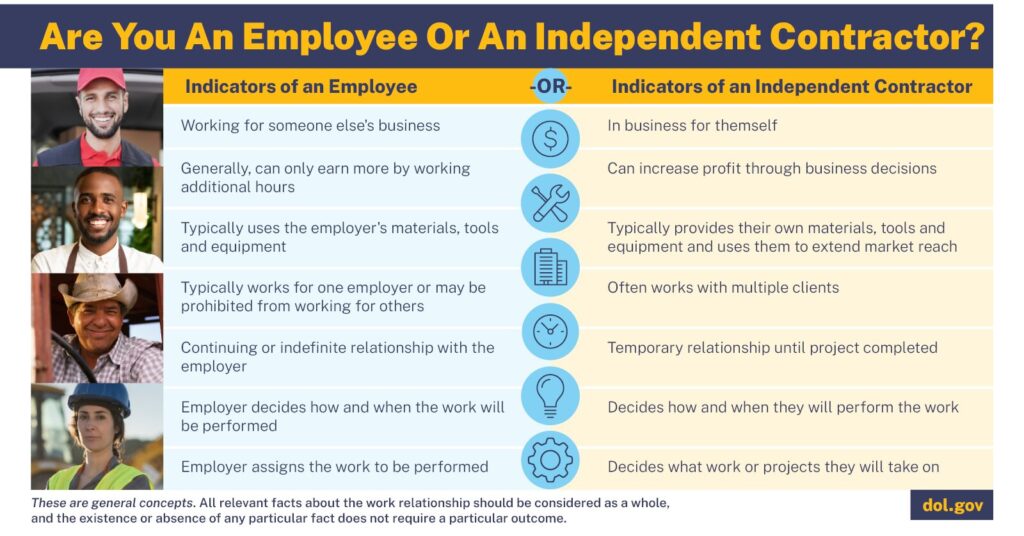
The Rowan Report has researched the 2024 Department of Labor Final Rule: Employee or Independent Contractor Classification Under the Fair Labor Standards Act, RIN 1235-AA43. We’ve provided our synopsis below to help you determine the classification of your workers to avoid similar penalties.

Employee vs Independent Contractor

The Fair Labor Standards Act, from the Department of Labor provides information on how to classify workers. Prior to 2021, the DoL used the economic reality test, used by courts to determine status. This test used economic factors including nature and degree of control over work, and the worker’s opportunity for profit or loss. These two factors weighed more heavily than the remaining three: the amount of skill required, how permanent was the relationship between the worker and the employer, and whether the work is part of an integrated unit of production (meaning all work leads to the same end product that cannot be completed without each person’s part.)  

Totality of the Circumstances

Because the courts openly admitted that the final three factors would likely never outweigh the first two, the DoL moved to establish a different rule, using the five factors to determine a “totality of circumstances” without the predetermined weight. It also bent the final factor to include the work being an integral part of the business, not of production. Also included is the discussion of how scheduling, supervision, price setting, and the ability to work for others are considered within the control factor.

This final change is what will impact most care at home agencies. As defined in the Final Rule (795.110(B)(1)), this factor considers whether a worker has control over their own profit or loss, has control over their own schedule, advertises on their own behalf to get more work, and generally engages in managerial tasks such as hiring, purchasing materials, and/or renting space for themselves.

Qualifying as an Employee vs Independent Contractor

In order to qualify as an independent contractor, a worker:

    • Must have control over their own profit and loss.
        • If a worker can choose to accept or deny and job offered through the agency, therefore making more or less money, they may be an IC.
    • Should be engaged for short-term projects with identified end dates.
        • This is vague in relation to care at home. An employer could argue that each home visit is a short-term engagement. However, the worker might say that the opportunity is on-going with no end date.
    • Invests in the building of their business.
        • If a worker uses all their own equipment, is free to take shifts or jobs from other agencies, and promotes their skills in order to attract more work from outside your agency, they are likely an IC.
        • If, however, the worker takes shifts from other agencies and promotes their skills to others because your business has predictable down-times, rather than of the worker’s own choice, they are likely an employee.
    • Should have control over multiple aspects of the job.
        • A common misperception is that if an employee controls their own schedule, they are automatically an IC. Many employees have flexible scheduling, work from home opportunities, and other controls over their schedule. Care at home workers make less money when they choose to change their schedule, indicating economic dependency on the company. Further, many agencies have a minimum hour requirement with disciplinary action or consequences for not meeting that minimum. These factors, regardless of scheduling flexibility, mean the worker is not an IC.
        • Nurses who have control over their own schedules do not control, for example, the rate they are paid for their services. When the employer controls prices for services, workers are likely employees.
        • How a job is performed should be a considerable factor. If the worker is free to determine how they actually do the work once they take a job, then they are likely an IC. This may be possible for non-medical supportive care at home, but is less likely for home health and hospice settings that are highly regulated.
    • Should not be supervised either in person or by technology, using a device or other electronic means. Ongoing and continuous supervision is not required to classify a worker as an employee, only that the employer maintains the right to supervise. Supervision in this case is not limited to watching the worker during a shift. Supervision also includes training and standards established during hiring, remote monitoring of a job using an electronic visit verification system, and/or the oversight of completed work in the case of a QA audit of documentation.
        • For home health and hospice agencies, this almost assuredly makes all nurses employees. However, exceptions may exist in the case of specialties such as wound care, physical or occupational therapy, ostomy care, and respiratory care.
        • For non-medical care at home, this factor should be weighed based on your agency’s protocols.
    • Must be able to work for others.
        • An employer who limits a worker’s ability to work for other agencies and/or put such constraints on a person’s schedule as to make it impossible to work for others has employees, not ICs.
        • Non-compete clauses and fines for taking clients outside of the agency point to employee status.
        • Working part-time and having the ability to work for another company, also part-time, does not necessarily make someone an IC.
    • Should not be an integral part of the business.
        • If the business cannot function without the service performed by the worker, the worker is an employee.
        • Similarly, if the work itself depends on the existence of the business, the worker is an employee.
        • Generally speaking, if a the primary business is to make a product or provide a service, then any worker involved in making that product or providing that service is integral to the business.
          • This final clarification from the DoL may require all care at home workers to be classified as employees.
Employee vs Independent Contractor

Implications for the Industry

If most care at home workers should be classified as employees, not independent contractors, you should expect to make significant changes if you currently have your workers classified as ICs.

  • Higher expenses in the form of taxes and benefits
  • Negotiations for paid vacation, personal, and sick leave
  • Potential auditing of prior business structure and classification
  • Complete overhaul of back-office hiring processes and software needs for onboarding employees instead of independent contractors

Employee vs Independent Contractor Corrective Action

  1. If your workers are misclassified as independent contractors, take steps to correct this effective January 1st so your new tax year is correct.
  2. Plan ahead to incorporate required taxes coming from your budget.
  3. Determine whether you may have workers who are owed back wages, overtime pay, or other benefits and take steps to rectify the situation before you end up on the Department of Labor radar.
Employee vs Independent Contractor

Final Thoughts

I’ve heard a lot of conversations from home health and non-medical supportive care agency owners about the policies they have in place for their caregivers. The new laws around non-compete clauses as well as this updated Independent Contractor test leads me to this conclusion:

Most workers in care at home are employees, not independent contractors. If you wish to classify your workers as independent contractors, do your research, reorganize your business, and make sure you are following the totality-of-the-circumstances test. 

If organizational change is not possible, look at transitioning your workers to employees before the start of the year and hire a consultant to help you with the changes you need to make.

# # #

Kristin Rowan, Editor

Kristin Rowan has been working at Healthcare at Home: The Rowan Report since 2008. She has a master’s degree in business administration and marketing and runs Girard Marketing Group, a multi-faceted boutique marketing firm specializing in event planning, sales, and marketing strategy. She has recently taken on the role of Editor of The Rowan Report and will add her voice to current Home Care topics as well as marketing tips for home care agencies. Connect with Kristin directly kristin@girardmarketinggroup.com or www.girardmarketinggroup.com

©2024 by The Rowan Report, Peoria, AZ. All rights reserved. This article originally appeared in Healthcare at Home: The Rowan Report. One copy may be printed for personal use: further reproduction by permission only. editor@therowanreport.com