




Department of Labor Changes Exemption and Overtime Thresholds

by Tim Rowan, Editor Emeritus

Overtime and exemption thresholds impact employers trying to balance cost-effective policies with employee fairness. As such, they keep a close eye on rules they must follow that come down from the U.S. Department of Labor. When those rules change, remaining compliant requires a company HR leader to adapt those policies. One of those times is at hand.


Exemption and Overtime Thresholds for Hourly and Salaried Earners

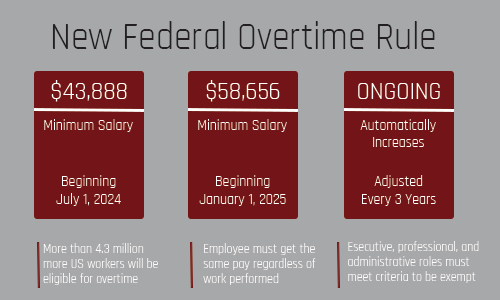
Effective last week, July 1, the annual salary threshold for overtime exemption increased from $35,568 to $43,888. The DoL’s final rule does not stop there but sets another increase on January 1, 2025, to $58,656 per year or $1,128 per week. Salaries below those thresholds cannot be declared “exempt,” meaning they must be paid overtime rates for hours worked over eight per day and forty per week.


Executive Salaries also Affected

In addition to overtime and exemption thresholds, the new rule increases the highly compensated employee threshold twice as well. On July 1, the annual salary threshold increased from $107,432 to $132,964. That annual threshold will increase again on January 1 to $151,164.

Going forward, the DOL will increase all thresholds every three years starting July 1, 2027, relying on up-to-date wage data.

We learned these DoL rule details from Angelo Spinola, Executive Director and lead home care attorney with Polsinelli, a national law firm. 
Federal Overtime Rule

Angelo Spinola Comments

“Home care providers that have been making adjustments to comply with the July 1 deadline may have heard about a recent case out of Texas blocking the July 1 increases. While the Texas court did use a partial injunction blocking the July 1 increase, it only applies to Texas government employees. It does not affect any private employers.”

He recommended that all home health and home care employers continue to make changes as planned to comply with the July 1 increases. Spinola stated that his statements are for informational purposes only and are not intended to be legal advice. His comments quoted here should not be relied upon or used without consulting a lawyer to consider your specific circumstances, possible changes to applicable laws, rules and regulations and other legal issues.

Spinola Concludes

“There are still challenges pending that could affect the January 1, 2025 increases, however, those decisions are not expected for several months, and it is too soon to predict whether that deadline will be affected. We will continue to monitor these cases and provide any updates that may have an effect on the home care industry.”

Angelo Spinola can be reached via email at onlinesolutions@polsinelli.com

NAHC Comments on Exemption and Overtime Thresholds

“The long-awaited U.S. Department of Labor rule regulating minimum salaries levels to qualify for exemption to the Fair Labor Standards Act was issued today. We strongly advise the home care community to gain a comprehensive understanding of the rule and institute steps for timely compliance. While the changes may have limited impact on most home care companies, noncompliance comes with serious penalties.” – NAHC President Bill Dombi

# # #

Tim Rowan, Editor Emeritus

Tim Rowan is a 30-year home care technology consultant who co-founded and served as Editor and principal writer of this publication for 25 years. He continues to occasionally contribute news and analysis articles under The Rowan Report’s new ownership. He also continues to work part-time as a Home Care recruiting and retention consultant. More information: RowanResources.com
Tim@RowanResources.com

©2024 by The Rowan Report, Peoria, AZ. All rights reserved. This article originally appeared in Healthcare at Home: The Rowan Report.homecaretechreport.com One copy may be printed for personal use: further reproduction by permission only. editor@homecaretechreport.com

Disincentives for Information Blocking

From the U.S. Department of Health and Human Services

FOR IMMEDIATE RELEASE

June 24, 2024

Contact: HHS Press Office
202-690-6343
media@hhs.gov

HHS Finalizes Rule Establishing Disincentives for Health Care Providers That Have Committed Information Blocking

The U.S. Department of Health and Human Services (HHS) today released a final rule that establishes disincentives for health care providers that have committed information blocking. This final rule exercises the Secretary’s authority under the 21st Century Cures Act (Cures Act) to establish “disincentives” for health care providers who engage in practices that the health care providers knew were unreasonable and were likely to interfere with, prevent, or materially discourage the access, exchange, or use of electronic health information (EHI), except as required by law or covered by a regulatory exception.

“This final rule is designed to ensure we always have access to our own health information and that our care teams have the benefit of this information to guide their decisions. With this action, HHS is taking a critical step toward a health care system where people and their health providers have access to their electronic health information,” said HHS Secretary Xavier Becerra. “When health information can be appropriately accessed and exchanged, care is more coordinated and efficient, allowing the health care system to better serve patients. But we must always take the necessary actions to ensure patient privacy and preferences are protected – and that’s exactly what this rule does.”

HHS has established the following disincentives for health care providers found by the HHS Office of Inspector General (OIG) to have committed information blocking and referred by OIG to the Centers for Medicare & Medicaid Services (CMS): 

  • Under the Medicare Promoting Interoperability Program, an eligible hospital or critical access hospital (CAH) that has committed information blocking and is referred to CMS by OIG will not be a meaningful electronic health record (EHR) user during the calendar year of the EHR reporting period in which OIG refers its determination to CMS.  If the eligible hospital is not a meaningful EHR user, the eligible hospital will not be able to earn three quarters of the annual market basket increase they would have been able to earn for successful program participation; for CAHs, payment will be reduced to 100 percent of reasonable costs instead of 101 percent. This disincentive will be effective 30 days after publication of the final rule.
  • Under the Promoting Interoperability performance category of the Merit-based Incentive Payment System (MIPS), a MIPS eligible clinician (including a group practice) who has committed information blocking will not be a meaningful EHR user during the calendar year of the performance period in which OIG refers its determination to CMS. If the MIPS eligible clinician is not a meaningful EHR user, then they will receive a zero score in the MIPS Promoting Interoperability performance category. The MIPS Promoting Interoperability performance category score is typically a quarter of an individual MIPS eligible clinician’s or group’s total final score in a performance period/MIPS payment year, unless an exception applies and the MIPS eligible clinician is not required to report measures for the performance category. CMS has modified its policy for this disincentive to clarify that if an individual eligible clinician is found to have committed information blocking and is referred to CMS, the disincentive under the MIPS Promoting Interoperability performance category will only apply to the individual, even if they report as part of a group. This disincentive will be effective 30 days after publication of the final rule.
  • Under the Medicare Shared Savings Program, a health care provider that is an Accountable Care Organization (ACO), ACO participant, or ACO provider or supplier who has committed information blocking may be ineligible to participate in the program for a period of at least one year. Consequently, the health care provider may not receive revenue that they might otherwise have earned through the Shared Savings Program. CMS also finalized in this rule that it will consider the relevant facts and circumstances (e.g. time since the information blocking conduct, the health care provider’s diligence in identifying and correcting the problem, whether the provider was previously subject to a disincentive in another program, etc.) before applying a disincentive under the Shared Savings Program. This disincentive will be effective 30 days after publication of the final rule; however, any disincentive under the Shared Savings Program would be imposed after January 1, 2025.
  • Additional disincentives may be established through future rulemaking.

This HHS final rule complements OIG’s final rule from June 2023 that established penalties for information blocking actors other than health care providers, as identified in the Cures Act (health information technology (IT) developers of certified health IT or other entities offering certified health IT, health information exchanges, and health information networks). If OIG determines that any of these individuals or entities committed information blocking, they may be subject to a civil monetary penalty of up to $1 million per violation.

The Office of the National Coordinator for Health Information Technology (ONC) and CMS will host a joint information session about the final rule on June 26, 2024 at 2pm ET. More information can be found at healthit.gov/informationblocking and via ONC’s X account, @ONC_HealthIT.

# # #

All HHS press releases, fact sheets and other news materials are available at https://www.hhs.gov/news.
Like HHS on Facebook, follow HHS on Twitter @HHSgov, and sign up for HHS Email Updates.
Last revised: 

A New Path for Recruitment and Retention

by Kristin Rowan, Editor

Recruitment and Retention amidst the national workforce shortage is not a new topic for The Rowan Report. We have feature articles dating back months, even years, talking about how you can recruit the top talent in the industry and keep the best employees you have. A lot of companies look at wages as the driving force for retention of great employees. While there is some merit to that idea, wages are not always the strongest indicator of employee satisfaction. In fact, happy employees say it would take a substantial (more than 30%) raise to get them to leave a great workplace.

The reality for many home health agencies (HHAs) is that higher wages are not always possible with the rising costs of everything else and the lower reimbursement rates from CMS. HHAs have to be creative in their recruitment and retention strategies and find new ways to engage their staff. Incentivizing staff outside of wage increases is becoming a standard part of recruitment and retention strategies and we’ve seen several of these companies popping up recently. And we’re not the only ones who have noticed.

The Rowan Report met with the team at Ava and will have a product review for you next week. In the meantime, you can read the press release from Wellsky here.

About Wellsky

Recruitment and Retention Wellsky Ava

Wellsky, a leading home health technology company, has been focusing on patient-centered coordinated care. The software for home health includes intake, scheduling, care delivery, claims management, analytics, and more. Recently, Wellsky has included caregiver retention as part of their platform, in a partnership with Ava.

About Ava

Ava is a home-care-focused employee management solution that personalizes your employee incentives and sends automated reminders to your staff. Together, Wellsky and Ava created “TeamEngage”, using Ava’s platform connected directly to your workflows. WellSky Team Engage promises to improve retention, incentivize productivity, capture engagement insights, and allow you to hire more efficiently.

Recruitement and Retention Ava Stats

# # #

Kristin Rowan, Editor

Kristin Rowan has been working at Healthcare at Home: The Rowan Report since 2008. She has a master’s degree in business administration and marketing and runs Girard Marketing Group, a multi-faceted boutique marketing firm specializing in event planning, sales, and marketing strategy. She has recently taken on the role of Editor of The Rowan Report and will add her voice to current Home Care topics as well as marketing tips for home care agencies. Connect with Kristin directly kristin@girardmarketinggroup.com or www.girardmarketinggroup.com

©2024 by The Rowan Report, Peoria, AZ. All rights reserved. This article originally appeared in Healthcare at Home: The Rowan Report. One copy may be printed for personal use: further reproduction by permission only. editor@therowanreport.com

Poor Joe is Out of A Job

by Tim Rowan, Editor Emeritus

We have been keeping an eye on the Medicare Advantage business as the number of beneficiaries who switch exceeds fifty percent. In past reports, we have described the federal lawsuits that accuse MA insurance companies of illicitly padding revenues while illegally denying treatments that straight Medicare would have covered. (See MedPAC Exposes More Medicare Advantage Crimes – 3/20/24)

Until now, we haven’t gone into detail about those independent brokers with the continuous TV commercials every November. It turns out, they may be even more dishonest than the insurance companies themselves.

Poor Joe

Perhaps the most famous of these brokers is the one that put Broadway Joe Namath in our living rooms a hundred times a day. The company started life as Health Insurance Innovations, owned by Chicago-based private equity firm Madison Dearborn Partners. After accusations of fraud, the company folded and re-emerged as Benefytt. When the same accusations returned, the owners shut that company down and came back as Blue Lantern Health.

According to Healthcare Uncovered, the firm filed for a state-level bankruptcy equivalent in Delaware last April, called “assignment for the benefit of creditors.” Blue Lantern’s website is down, as are MedicareCoverageHelpline.com and HealthInsurance.com, their signature assets. Nobody answers the 800 number Namath hocked for years.

A History of Fraud

The bankruptcy litigation revealed a database of 7 million seniors who had been bombarded by 17 million phone calls. The bankruptcy was apparently precipitated by the Federal Trade Commission, which forced Benefytt to pay $100 million to the people it had scammed by selling sham Obamacare plans, with checks distributed to victims in March. The Securities and Exchange Commission forced Health Insurance Innovations and the company’s co-founder Gavin Southwell to pay a $12 million settlement. Another close associate of the company, Steven Dorfman, was convicted of wire fraud in February.

Deceptive Practices

Tolerance for the firm’s deceptive advertising scheme ended with changes to the Medicare Advantage rule in 2023 that took effect in 2024. Blue Lantern stated after the fines were imposed that the new rule was critical to the company’s downfall,

Previously, former HHS Security Alex Azar characterized the Namath ads as “real savings, real options” in Medicare Advantage, ignoring the studies showing that the MA program costs the Trust Fund not less but $140 billion more than original Medicare.

Healthcare Uncovered concluded with this observation, “Further rules imposed since then by the Biden administration are putting even more pressure on Medicare Advantage lead generators, also called ‘third-party marketing organizations.’ (TPMOs) Beginning October 1 of this year, CMS will require that TPMOs get express consent from individuals before selling contact information to other marketers and brokers — a key loophole that enabled the growth of Blue Lantern and its predecessors.”


Don’t worry about Joe Namath’s retirement income though.
He has already landed a gig hawking hearing aids.

Joe Namath TV ad

# # #

Tim Rowan, Editor Emeritus

Tim Rowan is a 30-year home care technology consultant who co-founded and served as Editor and principal writer of this publication for 25 years. He continues to occasionally contribute news and analysis articles under The Rowan Report’s new ownership. He also continues to work part-time as a Home Care recruiting and retention consultant. More information: RowanResources.com
Tim@RowanResources.com

©2024 by The Rowan Report, Peoria, AZ. All rights reserved. This article originally appeared in Healthcare at Home: The Rowan Report. One copy may be printed for personal use: further reproduction by permission only. editor@therowanreport.com

Generative AI Comes to AlayaCare

by Kristin Rowan, Editor

Generative AI and Artificial Intelligence are taking the world, and the care at home industry, by storm. Not surprisingly, there are only a few companies that are doing AI well. We’ve started reviewing the best of of them. So far, each company doing AI well has a unique solution to a pain point in home care. No two companies are approaching or using AI the same way. This week, we’d like to re-introduce you to a company we’ve reviewed before that has a new Generative AI app launching soon.

History

Practically a household name in home care, AlayaCare is a 10-year-old software company that started as a mobile workforce platform. Like many of us, once Adrian Schauer, Co-Founder and CEO, spend some time in the care at home world, he was hooked. He shifted the focus of AlayaCare to the care at home space. With parents in their 80s, Adrian found a lack of inspiring software in the industry in Canada and he felt like that was an important problem to solve.

“Care workers are doing God’s work, and they are not getting the support they deserve,” says Schauer. In Canada, where AlayaCare started, agencies combine home health and supportive care. Because of this, the largest patient base on the AlayaCare platform is on the supportive care at home side, but they now operate within home health as well.  Since 2021, AlayaCare has added hospice to their network with the acquisition of Delta Health. 

AI Comes to AlayaCare

Through many iterations of the software, AlayaCare has advanced with new technological capabilities. Now, AlayaCare is embracing artificial intelligence; more specifically, Generative AI. Schauer explains that the purpose of their new AI technology is “to enable the type of care we want our loved ones to receive at home.” 

The new GenAI app was demoed in September of 2023 and is still in Beta testing. AlayaCare is anticipating an end-of-summer launch of the product.

Introducing...Layla

Layla is an in-app digital assistant, built on top of GenAI. It’s large language model allows the user to conversationally interact with the data in the system. It also includes a constrained internet search component. From the conversation, it can determine whether the user is seeking internal or external information.

Layla’s data exploration does more than just extracting data. The GenAi platform allows Layla to provide operational support around key metrics for employee retention.

Layla Generative AI AlayaCare

Agency Support

AlayaCare has determined some key factors in employee retention:

  • Utilization
  • Quality shifts
  • Qualified Hours
  • Recurrent shifts
  • Average weekly clients
  • Weekday hours vs weekend hours

Focusing on these factors, Layla provides improvements in onboarding, scripting information, data migration, and scheduler use of time.

Features

Visit Optimizer

AI generated, automated scheduler that takes into account route management, skill matching, daily hours, and schedule optimization to optimize care and reduce time from referral to first appointment.

The scheduling automation includes push notification capabilities to send schedule updates to clinicians in real time. As each week’s schedule is created, Layla can send a push notification to each clinician. It asks them to verify their availability and confirm the next week’s schedule.

Additionally, Layla considers environmental factors such as pets, neighborhoods, and other family members in the home.  According to AlayaCare users, the Visit Optimizer offers up to a 98% decrease in time required to fill visits, 35% improvement in visit fulfillment, and 35% improvement in data quality.

Notable

Notable transforms notes from patient visits, forms, and client records. Then, it uses AI to review, compile, categorize, and tag all the notes. 

From this information, Notable compiles an activity of daily living (ADL) for each client, including whether and why a task was completed. This information is also moved to the risk dashboard. The risk dashboard shows the whole population, the risk of that population, identifiable trends, risk level, and whether the risk has remained stable over time. All of this information is compiled into a single risk dashboard with customizable reports. 

Additional security measures for Notable include a grounded model to reduce the risk of AI hallucination and ensuring no PHI leaves the dashboard.

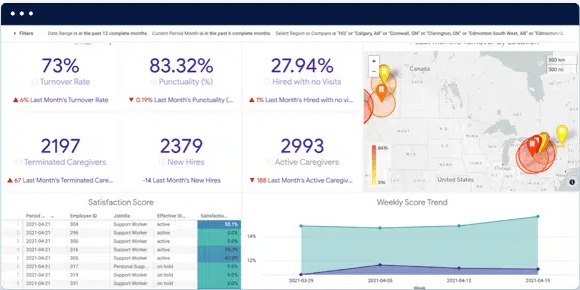
Employee Retention Dashboard

Several factors impact employee retention.  Among the top reasons for employee dissatisfaction are pay and benefits, inconsistent hours, and safety concerns. The current workforce shortage means keeping your best employees is more important than ever. With a quick snapshot of your employee satisfaction and engagement, you can address concerns earlier and improve turnover rates.

The employee retention dashboard highlights satisfaction scores, client capacity, scheduled hours, number of unique clients, overall turnover rates, turnovers by location, and more.

“Having a tool to predict employees who may be disengaged or dissatisfied prior to this happening is invaluable,” said Lee Grunberg, President & CEO, Integracare. “With the dashboard and algorithm behind it, we can see a caregivers’ satisfaction or engagement trend over time, and deploy preventative measures to reduce the likelihood that they’ll resign. It has empowered our coordinators to be much more retention-driven.”

On Deck for Layla

I spoke with Adrian Schauer, Co-founder and CEO of AlayaCare, during the online demo. “My passion project is…Layla. The people in your agency should be building relationships and making decisions. Anything else should be done by automation.” 

AlayaCare is currently in a high growth mode to build marketshare across the personal care and skilled sides of the marketing. Schauer’s goal is to elevate a level above their existing capabilities with home based care providers. This includes how payers are set up, how EVV is operating, lobbying, and advocacy. 

For Layla, AlayaCare is working on the GenAI capacity for chart completion by voice. Layla would use the conversational language model it already has to recognize and understand the conversation during a home visit and transcribe the conversation into notes, visit documentation, care plans, and codes.

Final Thoughts

As AI becomes more commonplace across care at home, we are scrutinizing AI platforms for safety, identity protection, accuracy, and ethical use. If you are looking for an AI solution for your business operations, we caution you to use discretion in your use of AI and thorougly vet the AI platform prior to adoption. We will continue to provide updates when Layla launches later this year. But, for now, it looks like we’ve found one more technology platform that is using AI the right way.

Kristin Rowan, Editor

Kristin Rowan has been working at Healthcare at Home: The Rowan Report since 2008. She has a master’s degree in business administration and marketing and runs Girard Marketing Group, a multi-faceted boutique marketing firm specializing in event planning, sales, and marketing strategy. She has recently taken on the role of Editor of The Rowan Report and will add her voice to current Home Care topics as well as marketing tips for home care agencies. Connect with Kristin directly kristin@girardmarketinggroup.com or www.girardmarketinggroup.com

©2024 by The Rowan Report, Peoria, AZ. All rights reserved. This article originally appeared in Healthcare at Home: The Rowan Report. One copy may be printed for personal use: further reproduction by permission only. editor@therowanreport.com

The Future of Care at Home

by Kristin Rowan, Editor

Home Nurses are joining unions. The advent and unionization of Hospital-at-Home (H@H) is changing the care at home landscape. Large hospital systems across the country have engaged in H@H studies and launched H@H programs, providing hospital-level ambulatory services in their communities. As H@H continues to take a foothold in the healthcare landscape, what do those changes mean for care at home?

Hospital at Home Popularity

Most of the existing H@H programs are operating under a CMS waiver. A few of the H@H programs use a private pay model. The CMS waiver needs to be extended in order to continue the programs. As many H@H organizations are pushing for CMS to extend the waiver, they are looking to patients for advocacy.

A recent survey by Vivalink showed that 84% of U.S. individuals over the age of 40 are interested in H@H monitoring after a hospital visit so they can return home sooner. 77% of respondents said they would trust a recommendation that included at-home monitoring. Respondents who had been hospitalized three or more times in the past 12 months were more interested in H@H programs than those who had been hospitalized less.

Massachusetts Ambulatory Nurses Unionize

On May 20, 2024, 33 ambulatory nurses from Martha’s Vineyard Hospital (MVH) filed with the National Labor Board to join a union that is already active within the hospital, the Massachusetts Nurses Association (MNA). The MNA currently represents 23,000 hospital workers from 85 healthcare facilities across the Commonwealth of Massachusetts. The hospital denied the request to join the union. The group of ambulatory nurses joined MVH through an acquisition of a physician’s group. Therefore, those nurses were not recognized under the existing collective bargaining agreement.

Hospital-at-Home Nurses at Mass General Unionize

The Hospital-at-Home nurses at Mass General Brigham (MGB) have unionized in the hopes of influencing the future of in-home acute care. They are also hoping this will encourage more people working in home healthcare to join unions. In the last seven months of 2023, almost half of all registered nurses working in home health care and non medical care at home left their jobs within a year. One registered nurse from MGB said she hopes HaH nurse unions become more common as HaH expands across the country.

The clinicians in the MGB home care segment are hoping to follow the H@H group into unionization soon. The home care segment, which includes home health, palliative, and other care at home services, are currently voting on whether to unionize.

Hospital-at-home nurses unionize at Mass Gen

Among the listed reasons for considering unionization are changes in expectations on productivity, and wages. Some of the more recent changes at MGB were rolled out across the company and did not take into consideration the territories and limitations that care at home clinicians have. More than 400 clinicians are in the care at home side of MGB and they have all received ballots to vote on unionization.

Home Health Unionization

hospital-at-home changing home health unions

The nature of care at home clinicians is disparate. Therefore, it is difficult to organize them into one cohesive group. Recently, though, more home health workers are looking to service workers and healthcare workers unions for better pay, better working conditions, and more buy-in on the day-to-day operations of the agency.

Opponents of unionization among home health clinicians argue that pay rates are largely set by CMS reimbursement rates. Employers may want to raise rates but are unable to do say because they accept Medicare and Medicaid. Home health unions could force employers to pay more than the set CMS rates.

CMS Response to Union Backlash

Otherwise known as the 80/20 rule, CMS responds to agencies worried about unionization with a mandate to pay their workers 80% of total Medicaid payments. Some agency owners say the proposed rule ignores the low reimbursement rates and further burdens agencies that are barely making a profit now. It is unlikely that CMS will see the unionization of home health clinicians as a reason to increase reimbursement rates. Experts advise agencies to start working on contract negotiations within the VBPM, to engage in risk-sharing and cost-benefit analyses with all parties within the VBPM. For example, Remote Patient Monitoring (RPM) is Medicare reimbursable, but not through home health use. However, a home health agency can share the benefits of RPM when it is billed through an approved provider for Medicare reimbursement. These strategies can lower overall care costs, increasing the share of reimbursement flowing to HHAs.

Maximize VBPM with Technology

Technologies available today include RPM, generative AI for data analytics, automated scheduling, and apps for secure communication, among others. Technology can lower overhead costs, allow you to eliminate some FTEs, and provide added value to providers during contract negotiations. If you don’t already have a robust tech-stack, look at some of our most recent product reviews, or contact The Rowan Report for more information about technology adoption consultations.

# # #

Kristin Rowan, Editor

Kristin Rowan has been working at Healthcare at Home: The Rowan Report since 2008. She has a master’s degree in business administration and marketing and runs Girard Marketing Group, a multi-faceted boutique marketing firm specializing in event planning, sales, and marketing strategy. She has recently taken on the role of Editor of The Rowan Report and will add her voice to current Home Care topics as well as marketing tips for home care agencies. Connect with Kristin directly kristin@girardmarketinggroup.com or www.girardmarketinggroup.com

©2024 by The Rowan Report, Peoria, AZ. All rights reserved. This article originally appeared in Healthcare at Home: The Rowan Report. One copy may be printed for personal use: further reproduction by permission only. editor@therowanreport.com

Staffing Crisis Solution from Wellsky and Ava

Recruitment and Retention Wellsky Ava Logo

WellSky® and Ava Launch Groundbreaking Solution to Combat Staffing Crisis for Home-Based Care Agencies

The new innovation helps improve healthcare employee retention and engagement through incentive-based rewards

OVERLAND PARK, Kan. & NEW YORK, NY. – May 30, 2024 – WellSky, a leading health and community care technology company, today announced the release of WellSky TeamEngage powered by Ava, a new innovation for home-based care providers aimed at increasing employee retention, reliability, and recruitment through gamification. The solution incentivizes and rewards caregivers for completing targeted activities and achieving performance goals, fostering a culture of appreciation while improving staff retention rates and agency differentiation.

WellSky TeamEngage comes at a time when home-based care providers face a growing workforce shortage crisis. The turnover rate for home care providers is 77%, challenging agencies to meet a growing demand for services with a shrinking supply of caregivers. This can result in higher rates of referral and client case rejection. With WellSky TeamEngage, agencies can implement customizable, data-driven incentives to attract and retain talent at scale, while shifting focus toward other operational priorities and providing exceptional care.

Using WellSky and Ava’s integrated technology, Griswold, one of the country’s largest home care franchises with more than 170 locations in 32 states and over 9,000 caregivers, reduced turnover rate in its eight company-owned offices by 13% in just seven months and helped a large majority of caregivers reach key goals, such as clocking in and out on time and meeting minimum weekly hour requirements. The company has since rolled out the technology to its franchise network and expects significant adoption.

“We have seen tremendous benefit from using WellSky TeamEngage powered by Ava, both in the retainment of talented staff members and in the differentiation of our agency,” said Caitlin Griffith, Director of People & Culture at Griswold. “Our organization believes that care professionals are the foundation of our success, with innovation being key to improving the lives of those we serve. We have been pleased with the adoption and staff satisfaction with the solution, and we look forward to further benefiting from a comprehensive set of insights to guide our approach to workforce engagement strategies.”

Ava acts as an AI-powered Chief Engagement Officer for healthcare providers, with its average customer improving employee retention rates by 45% in six months. Ava improves employee engagement so healthcare providers and administrators can redirect attention to scaling their businesses. Now in partnership with WellSky, the organizations will extend this technology to providers across the U.S., with the Ava platform integrated within WellSky electronic health records (EHR) technologies and the WellSky TeamInsights solution. TeamEngage will provide a comprehensive flow of data between systems and a seamless end-user experience.

“Ava works to remove the burden of administrative work and reconnect caregivers and home care administrators with why they chose a healthcare career in the first place,” said Victor Hunt, chief executive officer and co-founder of Ava. “We are excited to lend Ava’s Enterprise AI technologies to TeamEngage and, in doing so, tackle one of the greatest crises facing healthcare.”

By leveraging data directly from WellSky Personal Care, WellSky TeamEngage incorporates specific caregiver actions, such as taking open shifts and performing timely clock-ins, into the agency’s defined incentive model, which stores all actions and awards points that caregivers can redeem for monetary or other agency-defined rewards. These day-to-day behaviors combined with pulse survey results, gamified referrals, and other engagement metrics are all tracked within WellSky TeamInsights for Personal Care, where powerful algorithms help predict caregiver turnover risk to proactively guide retention strategies.

“The staffing crisis facing our clients and the industry at large is a major concern, both for people seeking care in the home and for agencies trying to meet that need,” said Wes Little, chief analytics officer at WellSky. “We are thrilled to bring WellSky TeamEngage to our clients to not only provide them a tool to incentivize and reward caregivers, but to also gain the insights needed to run their operations at scale in today’s challenging environment.”

To learn more about how WellSky is powering agency staff retention and engagement, visit WellSky.com.

# # #

WellSky Media Contact
Emma Neal
Phone: 617.401.3131
Email: emma.neal@allisonworldwide.com

Ava Media Contact
Deanna Carbone
Phone: 914.523.7865
Email: ava@hirschleatherwood.com

About WellSky®

WellSky is one of America’s largest and most innovative healthcare technology companies leading the movement for intelligent, coordinated care. Our proven software, analytics, and services power better outcomes and lower costs for stakeholders across the health and community care continuum. In today’s value-based care environment, WellSky helps providers, payers, health systems, and community organizations scale processes, improve collaboration for growth, harness the power of data analytics, and achieve better outcomes by further connecting clinical and social care. WellSky serves more than 20,000 client sites — including the largest hospital systems, blood banks, cell therapy labs, home health and hospice franchises, post-acute providers, government agencies, and human services organizations. Informed by more than 40 years of providing software and expertise, WellSky anticipates clients’ needs and innovates relentlessly to build healthy, thriving communities. For more information, visit wellsky.com.

About Ava

Ava is an enterprise AI platform helping healthcare providers streamline administrative busywork so that they can get back to care. In an industry where employee engagement and retention are crucial yet increasingly challenging to maintain, Ava provides an effective AI-driven solution that’s beneficial for clients, caregivers, and providers. Integrating seamlessly with Electronic Health Records (EHRs), Ava offers an engaging experience for caregivers and clinicians while providing administrators with a robust suite of tools for business intelligence, employee management, and gamified incentives. For more information, visit joinava.com.

©2024 Wellsky. All rights reserved. This press release was published by Wellsky and appears on The Rowan Report courtesy of Wellsky.

Ambassador of the Year

FOR IMMEDIATE RELEASE

Contact:

Johnathan Eaves

(903)445-6969

jeaves@axxess.com

Axxess’ Tim Ingram Wins MyHospice Ambassador of the Year

DALLAS, June 13, 2024 – During Hospice Action Week in Washington D.C., the Hospice Action Network (HAN) named Axxess Executive Vice President of Interoperability Tim Ingram the 2023 MyHospice Ambassador of the Year. This award recognizes Ingram’s outstanding leadership and advocacy for hospice care.

Ingram’s passion for hospice care is deeply personal and driven by his profound experiences with family members who benefited from hospice services. His efforts focus on educating lawmakers and the public about the essential benefits of hospice care, ensuring more families receive the compassionate care they deserve at the end of life.

“Advocacy for hospice means sharing the beauty of the hospice benefit with members of the House and Senate, state representatives and anyone else who will listen to our stories of lives improved because of the care patients received in the last weeks and months of their lives,” Ingram said. “It means making sure as many patients and families as possible learn about the benefits of hospice, and it means helping protect the future of hospice care for some of our most vulnerable people.”

“MyHospice Ambassadors play a critical role in ensuring the voices of diverse providers and community members from across the nation are heard,” said Logan Hoover, VP of Policy and Government Relations for the National Hospice and Palliative Care Organization (NHPCO) and Executive Director of the Hospice Action Network (HAN). “Tim’s standout storytelling and dedication have provided an important example of effective engagement for other advocates.”

The MyHospice Ambassadors Program is a volunteer advocacy program for individuals who have the capacity and initiative to lead, network and take action on hospice and palliative care advocacy efforts with the support of HAN. HAN, the 501(c)(4) affiliation of NHPCO, presented three MyHospice Ambassador annual awards, recognizing advocates who stood out, led by example and took action in 2023.

# # #

About Axxess

Axxess is the leading global technology innovator for healthcare at home, focused on solving the most complex industry challenges. Trusted by more than 9,000 organizations that serve more than 5 million patients worldwide, Axxess offers a complete suite of easy-to-use software solutions that empower home health, home care, hospice, and palliative providers to make healthcare in the home human again. Multiple independent certifications have confirmed that Axxess has the most secure and industry-compliant software available for providers. The company’s collaborative culture focused on innovation and excellence is recognized nationally as a “Best Place to Work.”

Tim Ingram Hospice Ambassador of the Year<br />
Tim Ingram Hospice Ambassador of the Year

Tim Ingram is senior vice president of business development for Axxess, a home healthcare technology company. He is responsible for leading the business development team to build valuable industry partnerships and key product integrations that create solutions for Axxess clients. Prior to joining Axxess in February 2018, Ingram served as the regional administrator for Encompass Home Health and vice president of sales for Homecare Homebase, among other industry positions.

Axxess SimiTree Partnership

Axxess SimiTree Partnership

FOR IMMEDIATE RELEASE

Contact:

 Christine Stein
(214) 435-6731
cstein@axxess.com

Axxess and SimiTree Partner to Launch Platforms
to Empower Home Health and Hospice Growth

Key Market, Referral and Utilization Data Available for Streamlined Decision-Making

DALLAS, June 20, 2024 – Axxess, the leading global technology innovator for healthcare at home, and SimiTree, a revenue cycle, coding, professional services, and talent management resource for post-acute and behavioral health organizations, today announced the launch of two new products designed to provide Axxess’ home health and hospice clients with even more valuable insights to strategically plan and drive growth.

With SimiTree’s Market Analysis Platform (MAP) home health and hospice providers can easily quantify their market position, including market share and trends, referral partner strength and competitor analysis. The platform offers key insights into service areas, changes in revenue, referral patterns, quality scores, and more.

“This partnership between SimiTree and Axxess is an incredible opportunity to bring together two organizations that equally strive for excellence, innovation, and making a positive impact on home healthcare,” said William Simione III, CEO . “Pairing our tools together will create an even more powerful technology suite that improves operating efficiency and contributes to better outcomes. It will also allow organizations in this space to take advantage of real-time data that will help them identify the best opportunities for growth. Together, we will continue to empower providers and create the best value possible.”

Axxess clients can now also leverage the new SimiTree Compass tool to help optimize home health visit utilization and resource management. This visit utilization guidance tool provides crucial data to help agencies make informed decisions, ensure consistent care and maintain appropriate documentation. SimiTree Compass includes information on standard visit ranges, LUPA likelihood, and visit discipline mix that is all presented in a user-friendly format tailored to clinicians and managers. Accessible early in the patient’s care episode, the system allows for quick lookups and adjustments to fit specific clinical profiles and agency needs without requiring changes to existing processes.

“We’re excited to partner with SimiTree to bring both of these cutting-edge solutions to our clients to further enhance their capabilities with Axxess,” said Chris Taylor, Senior Vice President of Channel Partnerships at Axxess. “The Market Analysis Platform aligns perfectly with our mission to empower home health and hospice providers with the tools they need to succeed. And by leveraging data and analytics from the SimiTree Compass tool, our clients can make informed decisions to optimize their operations and drive growth.”

SimiTree’s Compass tool is available to Axxess Home Health clients. The MAP tool is available to Axxess Home Health and Axxess Hospice clients.

# # # 

About Axxess

Axxess is the leading technology innovator for healthcare at home, focused on solving the most complex industry challenges. Trusted by more than 9,000 organizations that serve more than 3 million patients worldwide, Axxess offers a complete suite of easy-to-use software solutions that empower home health, home care, hospice, and palliative providers to make healthcare in the home human again. The company’s collaborative culture focused on innovation and excellence is recognized nationally as a “Best Place to Work.”

About SimiTree

SimiTree, a company that provides industry-leading, tech-enabled specialty revenue cycle management (RCM), coding, professional services, and talent management resources for post-acute and behavioral health organizations, was created by the merger of Simione Healthcare Consultants and BlackTree Healthcare Consulting in 2021. In 2022, SimiTree further expanded its RCM capabilities with its Imark Billing acquisition, and its behavioral health footprint with a strategic alignment with Infinity, a SimiTree company.

In addition to clinical, financial, and operational consulting, SimiTree offers a robust suite of outsourced services, including billing, coding, OASIS, Review Choice Demonstration (RCD) and Quality Assessment and Performance Improvement (QAPI), and revenue cycle management; executive placement, interim management, retention consulting and other talent solutions; mergers and acquisitions support; compliance assessments and risk mitigation plans; sales and growth training; and benchmarking and data analytics. For more information, visit www.SimiTreeHC.com.

NAHC and NHPCO Sign Affiliation Agreement

by Kristin Rowan, Editor

BREAKING NEWS

In a joint statement on June 18, 2024, NAHC and NHPCO announced that the Board Chairs and CEOs of each organization met in Washington. During this meeting, they formally signed the affiliation agreement. This is a union of the two largest advocate organizations for care at home providers. They hope to unify the voice of the care at home community. The combined resources of the organizations will provide education, expert advice, and increased advocacy for policies that help deliver the best care to those who need it most.

After 18 months of discussions, meetings, and challenges, the two organizations have agreed on terms for the combining of the two groups.


“The affiliation of NAHC and NHPCO is a historic event,” said NAHC President and CEO William A. Dombi. “Unifying the voice of health care at home has been a longstanding goal of NAHC, as it is the essence of the original formation of NAHC in 1982. Combining our two organizations will significantly strengthen that voice for the benefit of our members and the patients they serve.”

Read the full press release from NAHC and NHPCO here.

# # #

Kristin Rowan, Editor

Kristin Rowan has been working at Healthcare at Home: The Rowan Report since 2008. She has a master’s degree in business administration and marketing and runs Girard Marketing Group, a multi-faceted boutique marketing firm specializing in event planning, sales, and marketing strategy. She has recently taken on the role of Editor of The Rowan Report and will add her voice to current Home Care topics as well as marketing tips for home care agencies. Connect with Kristin directly kristin@girardmarketinggroup.com or www.girardmarketinggroup.com

©2024 by The Rowan Report, Peoria, AZ. All rights reserved. This article originally appeared in Healthcare at Home: The Rowan Report. One copy may be printed for personal use: further reproduction by permission only. editor@therowanreport.com