Fraudsters Arrested, Oz Issues Warning

by Kristin Rowan, Editor

Fraudsters Arrested, Oz Issues Warning

Fraud in California

Fraudsters arrested in West Covina, CA this week were allegedly running a Medicare scheme. Authorities arrested hospice owner-operator Normita Sierra. They charged her with nine counts of health care fraud, one count of conspiracy, and four counts illegal remuneration (kick-backs) for health care referrals. The U.S. Attorney’s Office named co-conspirator Rowena Elegado. They also arrested her and charged her with one count of conspiracy and four counts of illegal remuneration for health care referrals.

Kickbacks

Sierra and Elegado worked together to pay marketers to recruit patients who did not have a hospice referral from their PCP and who were not terminally ill. Some of the kickbacks paid to marketers were as high as $1,300 per patient per month. After six months, the patients were referred out to Sierra’s home health company.

Medicare Claims

According to the U.S. Attorney’s Office, from 2018 to 2022, Sierra’s hospice agences submitted $4.8 million in fraudulent claims. Of those claims, Medicare paid approximately $3.8 million.

Dr. Oz Issues Warning

In a video statement, Dr. Oz explained how Medicare recipients are falling victim to scams. Sales people call, email, and even knock on your door, offering advice, free samples, and referrals. These marketers have one goal: get you sign a piece of paper. That paper signs you up for hospice care and agrees to allow a specific hospice agency to provide that care. The hospice agency then bills Medicare for services they never provide. Watch the video statement here.

HHS OIG Issues Consumer Alert

In a similar statement, HHS issued a consumer alert regarding DME companies. The alert warns that some DME companies are contacting Medicare beneficiaries. They claim to work for or on behalf of Medicare. Once they receive the patient’s Medicare number, they bill Medicare for unnecessary medical items. These items include urinary catheters, knee and back braces, orthotic braces, and prescription drugs, which may or may not ever be sent to the patient. HHS urges enrollees not to give their Medicare number to anyone. Further, they suggest regulary reviewing items charged to insurance, and refusing delivery of any medical supply not ordered by a physician.

Oz Issues Warning
Fraudsters Arrested

Combating Waste, Fraud, and Abuse

Dr. Oz and CMS have spoken numerous times about combatting the waste, fraud, and abuse withing the Medicare and Medicaid systems. Originally a strong proponent for Medicare Advantage, Oz has promised to audit MA after discovering the government pays more for MA than traditional Medicare. Oz also promised to reduce the amount of prior authorization requests needed before a patient gets services. Oz responded to the Republican-backed House bill requiring more oversight on Medicaid eligibility. Oz indicated that some Medicaid patients are enrolled in more than one state and that Medicaid is paying for able-bodied patients. The waste, fraud and abuse across Medicare and Medicaid is costing the government between $1 and $10 billion and Dr. Oz plans to find it and make significant changes to the management of the system.

A Cautionary Tale for Hospice Providers

You may be thinking, “What does this have to do with me?” Unfortunately, even the most scrupulous hospice agencies can fall prey to marketers running schemes. There are legitimate referral resources in the market who can help your agency get more referrals and more clients. There are also underhanded marketers who know how the system works. These predators will promise new referrals (for a fee) and then enroll uneligible patients without your knowledge. If you are working with or looking for a referral partner for your hospice agency, use one that is referred by someone you trust, and/or do a lot of research on the company history before working with anyone. Be especially wary of the ones who promise much more than what most referral companies offer.

# # #

Kristin Rowan, Editor

Kristin Rowan has been working at The Rowan Report since 2008. She is the owner and Editor-in-chief of The Rowan Report, the industry’s most trusted source for care at home news, and speaker on Artificial Intelligence and Lone Worker Safety and state and national conferences.

She also runs Girard Marketing Group, a multi-faceted boutique marketing firm specializing in content creation, social media management, and event marketing.  Connect with Kristin directly kristin@girardmarketinggroup.com or www.girardmarketinggroup.com

©2025 by The Rowan Report, Peoria, AZ. All rights reserved. This article originally appeared in The Rowan Report. One copy may be printed for personal use: further reproduction by permission only. editor@therowanreport.com
 

Medicare Advantage Audits

by Kristin Rowan, Editor

CMS Strategy for Medicare Advantage Audits

Last week, The Centers for Medicare and Medicaid Services (CMS) rolled out a new, aggressive strategy to enhance and accelerate Medicare Advantage Audits under RADV. CMS will audit all eligible MA contracts in all newly initiated audits. The strategy will also invest additional resources to complete the audits for each payment year (PY) 2018 to 2024.

Falling Behind

CMS is several years behind in completing audits. In fact, the last payment year with any significant recovery was from PY 2007. Completed audits from 2011 to 2013 recovered 5%-8% in overpayments. Federal estimates put current overpayments at $17 billion annually. MedPAC‘s estimate is significantly higher at $43 billion annually.

“We are committed to crushing fraud, waste and abuse across all federal healthcare programs. While the Administration values the work that Medicare Advantage plans do, it is time CMS faithfully executes its duty to audit these plans and ensure they are billing the government accurately for the coverage they provide to Medicare patients.”

Dr. Mehmet Oz

Administrator, CMS

The Plan to Manage Medicare Advantage Audits

According to a press release from CMS, the plan is to complete all outstanding audits from PY 2018 to 2024 by early 2026. Here are key elements from the plan:

  • Enhanced Technology: CMS will deploy advanced systems to efficiently review medical records and flag unsupported diagnoses.
  • Workforce Expansion: CMS will increase its team of medical coders from 40 to approximately 2,000 by September 1, 2025. These coders will manually verify flagged diagnoses to ensure accuracy.
  • Increased Audit Volume: By leveraging technology, CMS will be able to increase its audits from ~60 MA plans a year to all eligible MA plans each year in all newly initiated audits (approximately 550 MA plans).  CMS will also be able to increase from auditing 35 records per health plan per year to between 35 and 200 records per health plan per year in all newly initiated audits based on the size of the health plan.  This will help ensure CMS’s audit findings are more reliable and can be appropriately extrapolated as allowed under the RADV final rule

CMS will also reportedly work with the Department of Health and Human Services Office of Inspector General (HHS-OIG) to recover uncollected payments identified in past audits. 

Impact of Medicare Advantage Audits on Providers

If CMS is able to audit as many plans and records as they are anticipating, Medicare Advantage payers could be looking at significant overpayments. CMS will aggressively seek repayment. When MA payers lose money, they tend to pass that loss on to providers and patients. We could see MA plans cutting benefits, denying procedures, and other cost-saving measures.

Providers who are aware of the unsupported diagnoses or who profited from them may be on the hook for overpayments. Law firm Ropes and Gray suggests that “[MA] plans should…minimize historical risk by correcting or deleting unsupported diagnoses for any time periods for which they are still able to do so.”

I suggest not using this particular law firm. I also suggest checking your payer contracts for clawback and indemnification clauses. When applicable, negotiate new and renewal contracts very carefully.

Medicare Advantage payers will push back on these audits, file lawsuits, and challenge how CMS is conducting audits. MA payers have historically denied treatments and medications that would be covered under traditional Medicare plans. They go to great lengths to avoid paying for services patients did receive. I’m certain they won’t be happy paying back money for services they never received.

CMS indicates it will start the new audit plan immediately. We will continue watching for updates through the end of the year to see if CMS reaches their goal. Of course, we will continue to report on changes at CMS and with Medicare Advantage payers as they happen.

# # #

Kristin Rowan, Editor

Kristin Rowan has been working at The Rowan Report since 2008. She is the owner and Editor-in-chief of The Rowan Report, the industry’s most trusted source for care at home news, and speaker on Artificial Intelligence and Lone Worker Safety and state and national conferences.

She also runs Girard Marketing Group, a multi-faceted boutique marketing firm specializing in content creation, social media management, and event marketing.  Connect with Kristin directly kristin@girardmarketinggroup.com or www.girardmarketinggroup.com

©2025 by The Rowan Report, Peoria, AZ. All rights reserved. This article originally appeared in The Rowan Report. One copy may be printed for personal use: further reproduction by permission only. editor@therowanreport.com


Trouble in MA Paradise?

by Kristin Rowan, Editor

Medicare Advantage

It’s no secret within the care at home community that Medicare Advantage is not without its problems. Coverage and care are good when the beneficiary is relatively healthy. When it’s really needed, MA plans deny coverage. Multiple insurance companies have upcoded patient care for higher reimbursements. And predatory marketing tactics target our most vulnerable.

Predatory Marketing

Medicare Advantage payers use unethical marketing to target seniors, sometimes going as far as to call unwitting customers and strong-arm them into changing from their traditional Medicare plans to MA. Anecdotally, a family friend was convinced to switch to Medicare Advantage three times. Each time, his family caregiver reversed that change before any real damage was done. Similarly, our own Editor Emeritus, Tim Rowan, fielded calls aimed at his disabled, grieving brother, urging him to change to a MA plan. Luckily, those calls were deflected by someone who knew better. Not everyone is as lucky.

UHC Projects Lower Earnings

Despite a 9.8 billion dollar year-over-year increase in revenue in the first quarter of 2025, UnitedHealth Group last week submitted a lower earnings outlook for 2025. UHG attributed the revision to “increased care activity” in its Medicare Advantage business. 

UHG has strong growth in providing benefits and services to more members. In Massachusetts, for example, the company reported 100% growth in care activity. Simultaneously, Optum Health, the arm responsible for home health, took on more clients with lower reimbursement rates, impacting overall revenue. Optum cites changes to the CMS risk adjustment model particularly for complex patients as a contributor to the problem.

Breaking it Down

UHG initially projected strong growth through 2025. The projection was partly based on the expection of a gradual increase in care activity. More members should increase revenue. What UHG did not account for was rapid growth of high-risk members in a risk-adjustment model that had not yet been thoroughly tested. Medicare Advantage is a money losing model that is propped up by Traditional Medicare. UHG is finally feeling that impact and it will only get worse as HHS cracks down on waste, fraud, and abuse in MA.  

Elevance Pulls Plug on MA Marketing

One week after UHG revised its earnings projections for 2025, Elevance announced plans to cut is Medicare Advantage marketing. EVP of payer solutions at ATI Advisory, a consulting firm in the healthcare space, says cutting spending on MA marketing happens for different reasons. 

“It’s often a temporary decision to give an MAO a year to ‘catch up’ or right-size impacts from the prior year. For example, it might be in response to larger-than-expected enrollment during the prior year, higher-than-expected utilization the plan is trying to get under control, or a change in federal policy.”

Breaking it Down

Elevance reported better earnings in Q1 2025 than were expected. The company listed home health as one of its key revenue drivers. The operating revenue increase came from higher premiums and growth in MA membership. The announcement to cut marketing spend came less than a week later. 

In other words, the company had a surge of MA sign-ups at the beginning of the year when plan coverage started after open-enrollment. Now that the company is seeing how many of those members actually need care and how much they will have to spend to provide that care, they no longer want to enroll additional MA members.

Opposition

The National Association of Benefits and Insurance Professionals expressed “deep concern” over Elevance’s announcement. NABIP represents licensed health insurance agents and brokers with a stated goal of promoting access to affordable health insurance coverage. 

“This decision directly harms Medicare beneficiaries by limiting their access to essential healthcare options and support during Medicare’s enrollment period,” NABIP CEO Jessica Brooks-Woods said.

NABIP asked CMS, Congress, and health plans to mitigate the effects of this announcement. They urged CMS to “freeze any carrier-initiated changes after October 1 that would limit agent access. 

Breaking it Down

NABIP represents agents and brokers who sell insurance plans to eligible members. They are membership based and rely on member fees as a main revenue stream along with fees collected for education, advertising, and sponsorships. Their PAC raises money from members to support political candidates.

Agents and brokers make money from commissions on sales of healthcare plans. The commission on Medicare Part D is around $109 per member per year. The commission on Medicare Advantage plans varies by state and carrier, but is as high as $780 per member per year. Commissions for Medicare Supplement plans are a percentage of premiums. The average commission for supplement plans is $322. 

But, of Course...

According to The Commonwealth Fund, average supplement plan premiums dropped from 2016 to 2020, decreasing agent compensation. In the same period, Medicare Advantage premiums have decreased, but agency compensation has increased at a rate higher than inflation.

It is not surprising, then, that the member-based advocacy group on behalf of sales people who earn nearly 7 times the commission on MA plans wouldn’t want companies like Elevance to stop marketing them.

Final Thoughts

I don’t believe Medicare Advantage is going anywhere anytime soon. I also don’t believe any government agency can monitor itself for fraud, waste, and abuse. Further, I don’t believe an association that makes its living on commissions has the best interest of its customers as its first priority. 

Perhaps fewer beneficiaries will be subjected to the predatory marketing and sales calls pushing them into Medicare Advantage plans. Perhaps knowledgeable, well-intentioned individuals and associations can shed light on the real advantages of Traditional Medicare. Perhaps CMS, under the direction of HHS, will turn the “waste, fraud, and abuse” mirror in the direction it belongs. 

# # #

Kristin Rowan, Editor

Kristin Rowan has been working at The Rowan Report since 2008. She is the owner and Editor-in-chief of The Rowan Report, the industry’s most trusted source for care at home news, and speaker on Artificial Intelligence and Lone Worker Safety and state and national conferences.

She also runs Girard Marketing Group, a multi-faceted boutique marketing firm specializing in content creation, social media management, and event marketing.  Connect with Kristin directly kristin@girardmarketinggroup.com or www.girardmarketinggroup.com

©2025 by The Rowan Report, Peoria, AZ. All rights reserved. This article originally appeared in The Rowan Report. One copy may be printed for personal use: further reproduction by permission only. editor@therowanreport.com

 

Vision for CMS

by Kristin Rowan, Editor

Vision for CMS from Dr. Oz

Last week, Dr. Mehmet Oz issued a statement on his vision for the future of CMS. Dr. Mehmet Oz is a cardiothoracic surgeon and former host of his own TV show. Under the Department of Health and Human Services, CMS has a $1.7 trillion budget and oversees the health outcomes of more than 160 million people.

“I want to thank President Trump and Secretary Kennedy for their confidence in my ability to lead CMS in achieving their vision to Make America Healthy Again. Great societies protect their most vulnerable. As stewards of the health of so many Americans – especially disadvantaged youth, those with disabilities, and our seniors, the CMS team is dedicated to delivering superior health outcomes across each program we administer. America is too great for small dreams, and I’m ready to get work on the President’s agenda.”

Dr. Mehmet Oz

Administrator of CMS, Department of Health and Human Services

Make America Healthy Again

With HHS Secretary Kennedy, Oz is throwing his support behind Make America Healthy Again, under direction from President Trump. Senator Kennedy says that, under the leadership of Dr. Oz, CMS will work to modernize Medicare, the Marketplaces, and Medicaid. The goal is to get Americans the care they want, need, and deserve. The agenda includes:

  • Empowering the American People with personalized solutions with which they can better manage their health and navigate the complex health care system. As a first step, CMS will implement the President’s Executive Order on Transparency to give Americans the information they need about costs.
  • Equipping health care providers with better information about the patients they serve and holding them accountable for health outcomes, rather than unnecessary paperwork that distracts them from their mission. For example, CMS will work to streamline access to life-saving treatments.
  • Identifying and eliminating fraud, waste, and abuse to stop unscrupulous people who are stealing from vulnerable patients and taxpayers.
  • Shifting the paradigm for health care from a system that focuses on sick care to one that fosters prevention, wellness, and chronic disease management.  For example, CMS operates many programs that can be used to focus on improving holistic health outcomes. 

Letter to Medicaid

Following the vision statement, Dr. Oz released a letter to state Medicaid Agencies outlining the use of Medicaid dollars during his tenure as Administrator. The two-page letter, citing recent studies on gender dysphoria, directed Medicaid agencies to eliminate gender reassignment surgery from covered procedures, opting instead for psychotherapy. Hormonal interventions will be reserved for exceptional cases.

“My top priority is protecting children and upholding the law. Medicaid dollars are not to be used for gender reassignment surgeries or hormone treatments in minors – procedures that can cause permanent, irreversible harm, including sterilization. We have a duty to ensure medical care is lawful, necessary, and truly in the best interest of patients. CMS will not support services that violate this standard or place vulnerable children at risk.”

Read the full letter here.

Final Thoughts

We believe this will be the first of many changes made to Medicare and Medicaid rules under Dr. Oz. We will continue to share updates from the CMS newsdesk.

# # #

Kristin Rowan, Editor

Kristin Rowan has been working at The Rowan Report since 2008. She is the owner and Editor-in-chief of The Rowan Report, the industry’s most trusted source for care at home news, and speaker on Artificial Intelligence and Lone Worker Safety and state and national conferences.

She also runs Girard Marketing Group, a multi-faceted boutique marketing firm specializing in content creation, social media management, and event marketing.  Connect with Kristin directly kristin@girardmarketinggroup.com or www.girardmarketinggroup.com

©2025 by The Rowan Report, Peoria, AZ. All rights reserved. This article originally appeared in The Rowan Report. One copy may be printed for personal use: further reproduction by permission only. editor@therowanreport.com

 

Industry Update

by Kristin Rowan, Editor

Industry Update with Dr. Steve Landers

At last week’s New England Home Care & Hospice Conference, Dr. Steve Landers, President of The National Alliance for Care at Home (The Alliance) gave the keynote address and offered some industry insights and updates.

A Heartfelt Introduction

Ken Albert, Chairman of the Board at The Alliance introduced Dr. Landers before his address. After reading Dr. Landers’s official biography, Albert offered his own thoughts on the first few months of Landers’ tenure.

Last year, five colleagues from organizations across the country sat in D.C. interviewing candidates. While interviewing Landers, I was remarkably engaged by someone who is deeply passionate about care at home. Steve describes hospice care as a national treasure, and I don’t disagree. More than just his passion for care at home, Dr. Landers is savvy in navigating the political paradigms driving policy. He artfully combines data and stories to navigate relationships with policy makers. What I see every day is someone who roles up his sleeves for the patients we take care of with tremendous respect for the caregivers who are in the patients’ homes.

Ken Albert

Chairman of the Board, The National Alliance for Care at Home

Industry Changes, Advancements, and Ongoing Advocacy Efforts

Dr. Landers attributes much of the positive changes in D.C. to the efforts of volunteer leaders looking to move the industry forward. Care at home needs to become more streamlined, more efficient, and with a better voice.

His vision for the care at home industry is an America where everyone can access high-quality care wherever they call home.

Strong Admonition for CMS

Dr. Landers noted positive movement in some areas. However, he became passionately adamant that a payment update is not an increase if it doesn’t keep up with inflation or pay increases. “The Alliance represents providers delivering high-quality, person-centered care to million of individuals in the home, and they deserve to be recognized and compensated for the work they do,” he said.

Our Aging Nation

It should come as no surprise that older adults have a strong preference for aging at home. They prioritize living where they feel in control and connected. They want to be in familiar surroundings and to maintain their routines.

The U.S. population over the age of 85 is expected to triple from 2020-2060 to more than 19 million people. Despite medical advances, only 1/3 of those over the age of 85 say they are free of disability or free of difficulty with daily living.

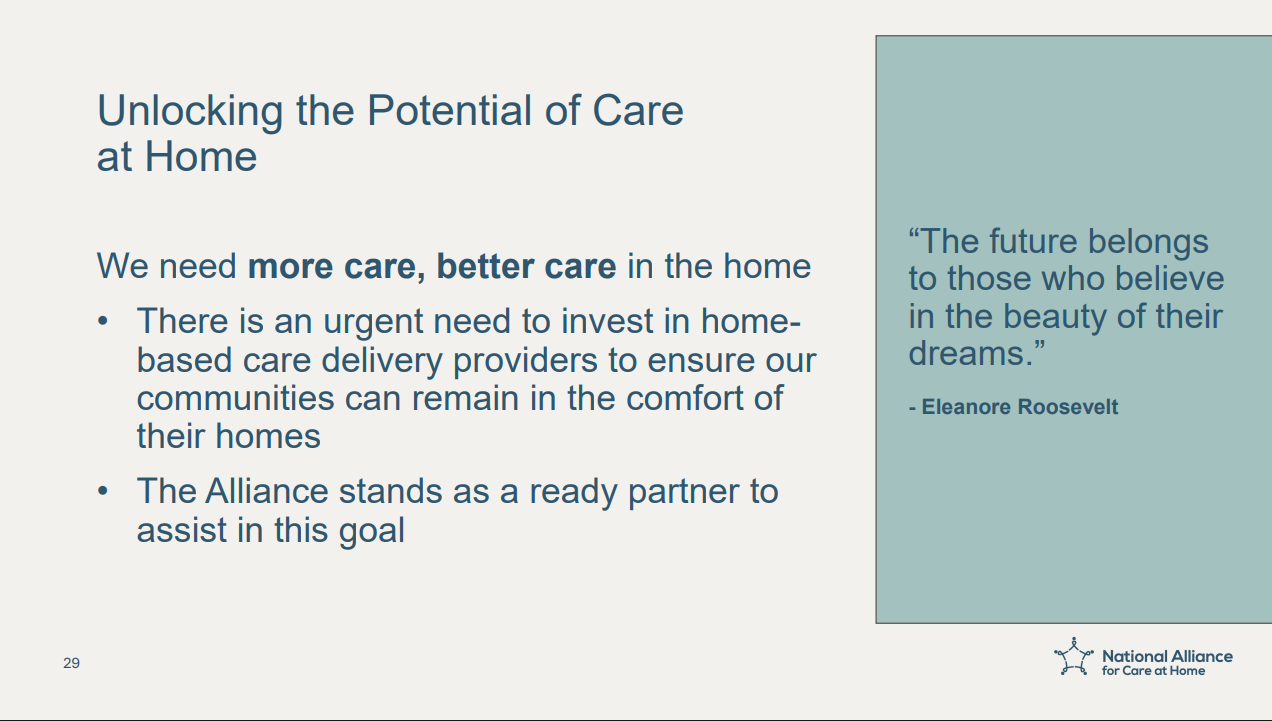
With the rising number of older individuals, caregiver to patient ratios are falling nearly everywhere across the country. Dr. Landers and The Alliance urge policymakers to make promoting the dignity and independence of our aging population one of their highest health policy priorities. The Alliance will continue to tell anyone and everyone who will listen that care at home offers the win-win solution that policymakers are looking for.

Changes at the Top

We’ve already seen numerous and sometimes drastic changes at the federal level. Dr. Landers points out that eight years ago the “Trump 1.0 Administration” developed the PDGM framework and signed hospice reform legislation. On the campaign trail, President Trump stated he would not be making cuts to Medicare. The “Trump 2.0” care at home priorities are not yet clear, but The Alliance will continue to emphasize cost savings and the preference to age in place.

Secretary Kennedy, head of HHS, placed his emphasis on the chronic disease epidemic, launching Making America Healthy Again. He has stated a preference for community-based solutions and patient-centered care.

New CMS Administrator Dr. Oz seems to be supportive of Medicare Advantage, but did have some critique of the program during senate hearings. Dr. Oz has a stated focus of finding and eliminating fraud, waste, and abuse.

Changes Near the Top

At the congressional level, The Alliance lost a few key supporters with the last election, but many care at home advocates remained. Of the returning members of the Senate and House, care at home advocates include:

  • Senators Collins (R-ME), Hassan (D-NH), Tillis (R-NC), Barrasso (R-WY), Blackburn (R-TN), CortezMasto (D-NV), and Rosen (D-NV)
  • Representatives: Adrian Smith (R-NE), Sewell (D-AL) Van Duyne (R-TX), Panetta (D-CA), Guthrie (RKY), and Carter (R-GA)

The support in Congress leaves us hopeful. Large Reconciliation Packages dominate the current conversation. Many questions remain as to what is at risk for care at home and what Medicaid’s future might hold.

Later this year, The Alliance sees opportunities for care at home outside of reconciliation. These include Home Health PDGM reform, hospice reform, the telehealth extension, revocation of the Medicaid HCBS 80/20 rule, tax credits, and long term care insurance.

Public Policy Priorities

As The Alliance moves forward, several key issues will remain priorities:

Access to Care at Home

  • PDGM Implementation
  • Telehealth Extension
  • Medicare Advantage Dynamics
  • Care for High Needs Beneficiaries

Quality Care at Home

  • Special Focus Program Implementation
  • DEA Telehealth Provisions
  • HOPE tool implementation?

Eliminating Fraud and Abuse in Care at Home

  • Hospice Concurrent Care
  • Hospice and Medicare Advantage
  • Medicaid 80/20 Rule
  • Caregiver Tax Credits / LTCI

Growing the Care at Home Workforce

  • Supply is simply not meeting demand
  • Strengthened rates, incentives, and educational opportunities will attract and retain a qualified workforce
Industry Update with Dr. Steve Landers

Follow Up

I spoke with Dr. Landers after the keynote address to ask him why lone worker safety was not among the top priorities of The Alliance. He assured me that there is a position within The Alliance who, among other tasks, is focusing on lone worker safety. I urged him to make it a higher priority and will follow up to get the contact information for the position he mentioned.

# # #

Kristin Rowan, Editor

Kristin Rowan has been working at The Rowan Report since 2008. She is the owner and Editor-in-chief of The Rowan Report, the industry’s most trusted source for care at home news, and speaker on Artificial Intelligence and Lone Worker Safety and state and national conferences.

She also runs Girard Marketing Group, a multi-faceted boutique marketing firm specializing in content creation, social media management, and event marketing.  Connect with Kristin directly kristin@girardmarketinggroup.com or www.girardmarketinggroup.com

©2025 by The Rowan Report, Peoria, AZ. All rights reserved. This article originally appeared in The Rowan Report. One copy may be printed for personal use: further reproduction by permission only. editor@therowanreport.com


That’s a No-No

by Elizabeth E. Hogue, Esq.

No-no # 1

“No-No” may seem like something you would say to a toddler, but there is a list of things agency owners do that they should not do. Many of these are things providers may not often consider. This article focuses on the use of private duty services by hospice and home health patients, and what hospices and home health agencies cannot do with regard to aide services.

Aide Services

Both home health and hospice services are usually intermittent and provided in patients’ homes.  Patients and their families may elect to utilize the services of private duty/home care companies for additional assistance. At the same time, hospice and home health patients may receive aide services from hospices and home health agencies. 

Conditions of Participation no-no

Conditions of Participation

According to Medicare Conditions of Participation (CoPs), hospice and home health aides can only provide personal care services, including bathing. Aides provided by private duty/home care companies may also provide personal care. Unlike aides provided by hospices and home health agencies, however, they can provide additional services; such as laundry, food preparation, light housekeeping, shopping, and running errands.

Private Duty Services

When patients use private duty services, they are often paying for these services out of their own pockets. Even if they have long-term care insurance, patients still bear the financial burden of paying for private duty services. Longterm care insurance often costs thousands of dollars that patients probably paid for themselves. Patients usually pay by the hour for these services. 

Private Duty Aide Services No-No

That's a No-No

Patients may, of course, utilize private duty/home care services to perform any of the services described above. It seems, however, that hospices routinely tell patients who have private duty/home care that they will not provide aide services because private duty/home care aides are able to provide personal care for patients.

Breaking it Down

Here is an example: A hospice admitted a bedridden patient with urinary and fecal incontinence. The patient and caregiver requested aide services from the hospice five days a week to bathe him. He paid for a few hours of private duty/home care services each day. The hospice refused to provide aide services five days a week to bathe him because he had private duty/home care services. No-no!

Compelled to Provide Care

ospices must provide aide services consistent with patients’ needs related to their terminal illnesses. In the example above, the patient clearly had a need for aide services five days a week. If patients and their caregivers state that they prefer to use private caregivers for personal care, then hospices must document the refusal of hospice aide services offered, consistent with applicable standards of care. Then hospices are not required to provide aide services.

Profiteering

When hospices deny aide services that are consistent with applicable standards of care and require patients and caregivers to use private duty/home care services, hospices are shifting the cost of aide services onto patients and their families. Patients and their families may have to pay for additional private duty/home care services to meet patients’ needs. The result for hospices is that they do not incur the costs of aide services, thereby increasing their profits at the expense of patients and their families. 

If hospice staff members who refuse to provide aide services to patients and require patients and their families to use private duty/home care services instead are compensated in any way based on the financial performance or profitability of the hospices, let’s hope they look good in orange jumpsuits!

Intent to Defraud

If the private duty/home care services are being paid for by any federal or state health care program; such as Medicaid, Medicaid waiver, VA, or TriCare; then both home health agencies and hospices have engaged in fraudulent conduct by shifting costs that they should have incurred onto other federal government programs. 

God forbid that the hospice also owns the company from which patients receive private duty/home care services! Then hospices are limiting their costs while profiting from patients and their families.

Dig Deep and Find Your No-No's

Now is the time for all home health agencies and hospices especially to audit patients’ records to make certain that all patients have been offered services that they are required to provide. If patients and their families choose to use private duty/home care aides instead, documentation must show that they were offered the services but chose to use private duty/home care aides.

No-No's Final Thoughts

The bottom line is that hospices and home health agencies must always provide services needed by patients.  Patients may choose to pay for services that are paid for by the Medicare hospice or home health benefits. Patients cannot be required to pay for services privately that hospices and home health agencies must provide. Unacceptable!

This article is the first in a series of “No-no” items for agency owners.

# # #

Elizabeth E. Hogue, Esq.

Elizabeth Hogue is an attorney in private practice with extensive experience in health care. She represents clients across the U.S., including professional associations, managed care providers, hospitals, long-term care facilities, home health agencies, durable medical equipment companies, and hospices.

©2025 Elizabeth E. Hogue, Esq. All rights reserved.

No portion of this material may be reproduced in any form without the advance written permission of the author.

©2025 by The Rowan Report, Peoria, AZ. All rights reserved. This article originally appeared in The Rowan Report. One copy may be printed for personal use: further reproduction by permission only. editor@therowanreport.com

Relief for Providers

by Elizabeth E. Hogue, Esq.

Relief for Providers from Devastating Penalties?

A judge in the Northern District of Texas recently decided that even the minimum penalties mandated under the False Claims Act (FCA) violate the Eighth Amendment’s Excessive Fines Clause [see U.S. ex rel. Taylor v. Healthcare Associates of Tex. (N.D. Tex. Feb. 26, 2025)]. The FCA punishes providers for submission of information that is not true in order to get paid by the federal government.

Life Threatening Penalties

The penalties assessed against providers under the FCA may be described as “life threatening.” That is, it may be difficult for providers’ businesses to survive payment of such severe penalties. The minimum penalty increased from $13,946 to $14,308 in 2025. The maximum penalty per claim increased from $27,894 to $28,619.

Ex Post Facto

These increased penalties will be assessed for violations that occurred prior to the change, but that are assessed after they are in effect. These penalties certainly make it clear why it is difficult for providers to survive violations of the FCA.

False Claims

In the Taylor case above, for example, the defendants allegedly submitted false claims as follows:

  • As “incident to” a physician’s care without proper documentation
  • For services by providers who were not eligible to bill the Medicare Program
  • For services performed by medical assistants instead of qualified practitioners
Ex Post Facto

FCA Math Doesn't Add Up

The jury found that one of the defendants, a primary care medical group practice, submitted 21,944 false claims for $2,753,641.86 in actual damages. After trebling the damages as required by the FCA, the Court said it would enter judgement against the defendant for approximately $8 million. The Court acknowledged, however, that penalties under the FCA are fines subject to the Eighth Amendment of the U.S. Constitution.

Gravity of Penalties

Grossly Disproportional to the Gravity

The Court then applied the following four factors to decide whether the “fine was grossly disproportional to the gravity of the offense” under the Eighth Amendment:

  • The essence of the defendant’s crime and its relationship to other criminal activity
  • Whether the defendant was within the class of people for whom the statute of conviction was principally designed
  • The maximum sentence, including the fine that could have been imposed
  • The nature of the harm resulting from the defendant’s conduct

Fraud...or a Reporting Error?

With regard to the first factor, the Court emphasized that the defendant’s misconduct involved violations of Medicare billing rules, but did not include billing for services that were not provided. In fact, the Court said that even though the defendant violated Medicare billing rules, the misconduct was “closer in gravity to something like a ‘reporting offense.’” There was, said the Court, no evidence that the defendant’s conduct was “related to other criminal or fraudulent activity.

Magnitude of Harm

The Court also focused attention on the fourth factor. The defendant’s harm was certainly significant, but the harm, according to the Court, did not necessitate a penalty “two orders of magnitude greater than the actual financial harm,” especially when the actual damages were substantial, i.e., one hundred times the amount of actual damages. That ratio was “grossly out of alignment with the ratios in other similar cases.” The Court imposed a civil penalty of $8,260,925.58 that represents less than 3% of the statutory minimum.

Final Thoughts

Whether other Courts follow the Taylor case described above remains to be seen, but it is quite clear that providers need relief from the penalties of the FCA.

# # #

Elizabeth E. Hogue, Esq.

Elizabeth Hogue is an attorney in private practice with extensive experience in health care. She represents clients across the U.S., including professional associations, managed care providers, hospitals, long-term care facilities, home health agencies, durable medical equipment companies, and hospices.

©2025 Elizabeth E. Hogue, Esq. All rights reserved.

No portion of this material may be reproduced in any form without the advance written permission of the author.

©2025 by The Rowan Report, Peoria, AZ. All rights reserved. This article originally appeared in The Rowan Report. One copy may be printed for personal use: further reproduction by permission only. editor@therowanreport.com

MedPAC Comments on CY 2026

by Kristin Rowan, Editor

MedPAC Comments on CY 2026

MedPac Sends Recommendations to Congress

 MedPAC makes recommendations to Congress and HHS on issues affecting the Medicare program. The March report for 2025 includes recommendations for hospice, home health, and SNFs, in addition to in-patient and out-patient hospital services.

Hospice

Using the exact terminology from the 2024 report, MedPAC recommends that Congress eliminate the update to the 2025 Medicare base payment rates for hospice. MedPAC pointed to a number of statistics to support the evaluation:

  • The number of hospice providers increased in 2023
  • Some of the growth in hospice providers occurred in states where CMS has concerns over program integrity
  • The percentage of patients using hospice increased by .8 percent nationwide, as did the days of care and visits per week
  • Medicare payments exceeded marginal costs by 14 percent

Opinion

  • The population of the U.S. is aging as more and more Baby Boomers qualify for Medicare; there is an increased need for hospice agencies to accommodate the volume of patients
  • Whether there are more hospices in states where program integrity is questioned does not impact the need for hospice care; program integrity reform changes this, not reimbursement rates
  • The rise in use, length of stay, and days of care explain the increase in the number of hospice; need, not profitability drives this growth
  • The average markup in 2022 was 72 percent above marginal cost

Marginal Cost

Marginal cost is the cost of adding one more unit of production. In simple terms, that would be the overall costs of adding one hour of care for a hospice patient. This would include scheduling, hourly wage, and other operational costs. MedPAC believes that if an agency adds one hour of care and make 14 percent more than their costs, that is sufficient.

Home Health

Keeping with tradition, MedPAC used the same language again from 2024 to recommend that Congress reduce the 205 Medicare base payment rate for home health agencies by 7 percent. 

Home Health & Hospice
  • The number of HHAs participating in Medicare increased by 3.4 percent.
  • Most of the growth in HHAs was in LA County. Outside LA County, the number of HHAs decreased by 2.8 percent.
  • The number of 30-day episodes per beneficiary decreased by 1.8 percent, but is still higher than in prepandemic years
  • MedPAC was unable to compute the marginal profit for 2023
  • Quality of care (percent discharged to community) increased by 1.3 percent
  • The all-payer margin in HHAs was 8.2 percent, attracting investors
  • The projected Medicare payment margin for 2025 is 19 percent
Image of letters spelling health and wealth

Opinion

  • LA County has more HHAs, but the rest of the country has fewer. We believe if you ask The National Alliance for Care at Home, Bill Dombi, or any number of prior HHA owners, low reimbursement rates forced them out of business
  • Pandemic numbers skewed the need for care at home because everyone was at home; if you only look at prepandemic numbers compared with 2023 numbers, the need for home health is increasing
  • HHAs keep patients out of the hospital, which accounts for more Medicare payments and higher costs
  • Again, the average margin across the U.S. is 72 percent, but MedPAC somehow believes 8 percent will attract investors and buyers; volume is attracting buyers, not margins
  • The projected 2025 margin is 19 percent and MedPAC recommends lowering it to 14 percent, matching hospice, and is 58 percent lower margins than the average industry

One Point of Parity

Surprisingly, there is an overlap in thinking between providers and MedPAC. In the February 2025 comment on the CMS notice of proposed rulemaking for 2026, MedPAC addressed the coding intensity and increased Medicare Advantage payments. 

Last summer, Editor Emeritus Tim Rowan reported on the inflated health conditions filed by payers. Medicare Advantage payers also routinely deny care that traditional Medicare plans would cover. MA payers are collecting on both the front and back ends of the “Bank of CMS.” According to the Center for Economic Policy Research, upcoding by MA plans costs CMS 106 percent of traditional Medicare costs. Quality bonus payments add an additional 2 percent. Operating surplus from enrolling healthier beneficiaries adds another 11 percent. Payments to MA plans are 19 percent higher. MedPAC agrees and urges CMS to further investigate coding intensity from MA payers.

Point of Contention

Although we agree with MedPAC’s assessment of MA coding intensity, that is where the similarity ends. Let’s take that recommendation one step further and require that MA plans pay hospice and home health providers a higher percentage of their risk-assessment adjustment and let the payers make their profits elsewhere.

It Could be Worse

Given the recent upheaval in D.C. and the fear that Medicare, Medicare Advantage, Medicaid, Social Security, and other benefits would be done away with completely, we are relieved to see the House Budget Bill passing without the drastic reductions to care at home.

From the Alliance

Following the passing of the House Budget Bill,  The National Alliance for Care at Home issued a response statement. We’ve published the full response here for you.

# # #

Kristin Rowan, Editor

Kristin Rowan has been working at The Rowan Report since 2008. She is the owner and Editor-in-chief of The Rowan Report, the industry’s most trusted source for care at home news. She also has a master’s degree in business administration and marketing and runs Girard Marketing Group, a multi-faceted boutique marketing firm specializing in content creation, social media management, and event marketing.  Connect with Kristin directly kristin@girardmarketinggroup.com or www.girardmarketinggroup.com

©2025 by The Rowan Report, Peoria, AZ. All rights reserved. This article originally appeared in The Rowan Report. One copy may be printed for personal use: further reproduction by permission only. editor@therowanreport.com

 

Update on Public Participation in Rule Making

by Kristin Rowan, Editor

Update

Last week, we reached out to some of our contacts for responses to this change.

Former President of NAHC and current Senior Counsel at Arnall Golden Gregory Bill Dombi said:

It is difficult to discern the impact of the rescission of the waiver. One concern is whether the administration considers Medicaid  a grant or benefit program thereby exempting it from APA public notice and comment rulemaking.  

With respect to Medicare, if it is considered a benefit, there is still a Medicare statutory requirement of public notice and opportunity for comment through formal rulemaking that should effectively nullify the practical impact of the rescission of the waiver. All that said, we will need to see more before being to judge the impact.

Frequent guest author and Fellow, American Healh Law Association, Elizabeth E. Hogue, Esq. had this to say:

Recission of the Richardson Waiver is not good news for providers. 

Many federal agencies voluntarily committed to give notice and comment for actions that otherwise would be exempt. The US Department of Health and Human Services was one of the federal agencies that adopted this policy in October, 1970, in a memorandum commonly referred to as the “Richardson Waiver.”  This policy was published in the Federal Register in 1971.  HHS did not, however, promulgate the Waiver through notice and comment rulemaking. 

The open process of give and take between agencies and providers under the Richardson Waiver resulted in resolution of important issues relatively informally.  Now it appears that only policies mandated by statute will go through the rulemaking process.  In other words, opportunities to resolve issues without formal resolution will be compromised. 

The recission of the Waiver may also make administration of both the Medicaid and Medicare programs more complicated and less effective, especially in view of US Supreme Court decisions that say everything that hasn’t gone through the notice and comment process is not binding on providers.

# # #

Below is the original article, published March 6, 2025

Public Participation Rescinded

The Administrative Procedure Act (APA) requires that an agency public a notice of proposed rulemaking in the Federal Register; allow sufficient time for public participation via written data, views, or arguments; and then publish a final rule. Matters relating to agency management, personnel, or public property; loans, grants, benefits, or contracts; and for “good cause” are exempt from the reporting requirements. The Richardson Waiver, adopted in 1971, waived the exemption and instructed agencies to use the good cause exemption sparingly. Effective immediately, the Richardson Waiver is rescinded.

“The policy waiving the statutory exemption…imposes on the Department obligations beyond the maximum procedural requirements specified by the APA, adds costs [that] are contrary to the efficient operation of the Department, and impedes the Department’s flexibility to adapt quickly to legal and policy mandates.”

Robert F. Kennedy, Jr.

Secretary, Department of Health and Human Services

What it Means

Public participation is now optional. Agencies and offices of the Department of HHS can, if desired, use the public notice and comment procedures for these matters, but are no longer required to do so. The Department will continue to follow these procedures in all circumstances in which they are required to do so.

Law firm Hogan Lovells, experts in healthcare law, wrote about the potential implications for the health care industry in a recent blog post. According to the firm, it is unclear how HHS will interpret the “benefits” portion of the exemption. HHS, and specifically CMS, currently uses the notice and comment procedure for various benefits programs, including Medicare and Medicaid. Secretary Kennedy’s statement clearly calls out the limitation in impacting any other law requiring notice and comment periods.

Public Participation in Medicare Rules

Hogan Lovells indicates that few if any policies written under the Medcare Act will be impacted by this change. The Medicare Act operates under additional rulemaking requirements under section 1871(a) of the SSA. Additionally, Azar v. Allina Health Services, 587 U.S. 566 (2019) confirms that Medicare rulemaking is independent from the APA. Some policies are currently exempt from the notice and comment obligations under the Medicare Act and will remain exempt.

Public Participation in Medicaid and CHIP rules

Medicare and CHIP fall under Title XIX of the SSA, which does not contain its own notice and comment requirements separate from the APA. HHS has used the APA notice and comment rules for many of the changes made to the Medicaid program. HHS could interpret the “benefits” clause as exempting Medicaid changes from the rule. Hogan Lovells states it is currently unclear whether HHS will take this route. They also purport the courts have not ruled on whether APA excludes Medicaid from the notice and comment requirements, and may not agree with that exclusion. Until the term “benefits” is better defined, Medicaid, CHIP, the insurance exchange marketplace, and TANF, among others, may be impacted.

Department of Veterans Affairs

A notable exception to these changes is the rulemaking in the Department of Veterans Affairs as it relates to the Veterans Health Care act of 1992. This program implemented Federal contractor requirements that established pricing and contracting standards for drug manufacturers. The VA policies and rules have historically been enacted using guidance letters, avoiding the rulemaking process altogether.

Final Thoughts

There is too much that is yet unknown regarding this change to understand its full impact. There will be immediate changes, court rulings, further changes, and likely a lot of advocacy from national organizations fighting for transparency for Medicare, Medicaid, and other “benefit” programs. This will be an ongoing story and The Rowan Report will bring updates as they happen.

# # # 

Kristin Rowan, Editor

Kristin Rowan has been working at The Rowan Report since 2008. She is the owner and Editor-in-chief of The Rowan Report, the industry’s most trusted source for care at home news .She also has a master’s degree in business administration and marketing and runs Girard Marketing Group, a multi-faceted boutique marketing firm specializing in content creation, social media management, and event marketing.  Connect with Kristin directly kristin@girardmarketinggroup.com or www.girardmarketinggroup.com

©2025 by The Rowan Report, Peoria, AZ. All rights reserved. This article originally appeared in The Rowan Report. One copy may be printed for personal use: further reproduction by permission only. editor@therowanreport.com

 

BREAKING NEWS: Kennedy Rescinds Public Participation in Rule Making

by Kristin Rowan, Editor

Public Participation Rescinded

The Administrative Procedure Act (APA) requires that an agency public a notice of proposed rulemaking in the Federal Register; allow sufficient time for public participation via written data, views, or arguments; and then publish a final rule. Matters relating to agency management, personnel, or public property; loans, grants, benefits, or contracts; and for “good cause” are exempt from the reporting requirements. The Richardson Waiver, adopted in 1971, waived the exemption and instructed agencies to use the good cause exemption sparingly. Effective immediately, the Richardson Waiver is rescinded.

“The policy waiving the statutory exemption…imposes on the Department obligations beyond the maximum procedural requirements specified by the APA, adds costs [that] are contrary to the efficient operation of the Department, and impedes the Department’s flexibility to adapt quickly to legal and policy mandates.”

Robert F. Kennedy, Jr.

Secretary, Department of Health and Human Services

What it Means

Public participation is now optional. Agencies and offices of the Department of HHS can, if desired, use the public notice and comment procedures for these matters, but are no longer required to do so. The Department will continue to follow these procedures in all circumstances in which they are required to do so.

Law firm Hogan Lovells, experts in healthcare law, wrote about the potential implications for the health care industry in a recent blog post. According to the firm, it is unclear how HHS will interpret the “benefits” portion of the exemption. HHS, and specifically CMS, currently uses the notice and comment procedure for various benefits programs, including Medicare and Medicaid. Secretary Kennedy’s statement clearly calls out the limitation in impacting any other law requiring notice and comment periods.

Public Participation in Medicare Rules

Hogan Lovells indicates that few if any policies written under the Medcare Act will be impacted by this change. The Medicare Act operates under additional rulemaking requirements under section 1871(a) of the SSA. Additionally, Azar v. Allina Health Services, 587 U.S. 566 (2019) confirms that Medicare rulemaking is independent from the APA. Some policies are currently exempt from the notice and comment obligations under the Medicare Act and will remain exempt.

Public Participation in Medicaid and CHIP rules

Medicare and CHIP fall under Title XIX of the SSA, which does not contain its own notice and comment requirements separate from the APA. HHS has used the APA notice and comment rules for many of the changes made to the Medicaid program. HHS could interpret the “benefits” clause as exempting Medicaid changes from the rule. Hogan Lovells states it is currently unclear whether HHS will take this route. They also purport the courts have not ruled on whether APA excludes Medicaid from the notice and comment requirements, and may not agree with that exclusion. Until the term “benefits” is better defined, Medicaid, CHIP, the insurance exchange marketplace, and TANF, among others, may be impacted.

Department of Veterans Affairs

A notable exception to these changes is the rulemaking in the Department of Veterans Affairs as it relates to the Veterans Health Care act of 1992. This program implemented Federal contractor requirements that established pricing and contracting standards for drug manufacturers. The VA policies and rules have historically been enacted using guidance letters, avoiding the rulemaking process altogether.

Final Thoughts

There is too much that is yet unknown regarding this change to understand its full impact. There will be immediate changes, court rulings, further changes, and likely a lot of advocacy from national organizations fighting for transparency for Medicare, Medicaid, and other “benefit” programs. This will be an ongoing story and The Rowan Report will bring updates as they happen.

# # # 

Kristin Rowan, Editor

Kristin Rowan has been working at The Rowan Report since 2008. She is the owner and Editor-in-chief of The Rowan Report, the industry’s most trusted source for care at home news .She also has a master’s degree in business administration and marketing and runs Girard Marketing Group, a multi-faceted boutique marketing firm specializing in content creation, social media management, and event marketing.  Connect with Kristin directly kristin@girardmarketinggroup.com or www.girardmarketinggroup.com

©2025 by The Rowan Report, Peoria, AZ. All rights reserved. This article originally appeared in The Rowan Report. One copy may be printed for personal use: further reproduction by permission only. editor@therowanreport.com