Eleos Navigates Eligibility Risk

Eleos Navigates Eligibility Risk

FOR IMMEDIATE RELEASE

Contact:                  Amanda Wells

awells@sloanepr.com

Eleos Launches AI Scanner to Navigate Medicaid Eligibility Risk in Real Time

The new OBBBA AI scanner uses Eleos’ ambient AI technology to alert providers of patient eligibility changes, preserving revenue and ensuring care continuity amid sweeping Medicaid policy changes

BOSTON, MA, Aug. 20, 2025 — Eleos, the leading AI platform in post-acute care, today announced the launch of the OBBBA (One Big Beautiful Bill Act) AI scanner, the first real-time tool to proactively detect potential changes to Medicaid eligibility during client sessions. The OBBBA AI scanner uses Eleos’ purpose-built ambient AI scribing technology to inform providers about changes that may impact coverage, giving them time to act before Medicaid coverage lapses. The tool was launched in response to sweeping Medicaid funding cuts and eligibility rule changes.

Eligibility Check

Providers can select Medicaid-related “themes” to track such as housing status, diagnosis updates, or life events like marriage or aging out of eligibility. The OBBBA scanner captures contextual clues that could trigger changes in coverage. Providers use this information to take action to prevent eligibility loss, reduce care disruption and maintain treatment continuity. For care organizations, this means fewer denials and greater revenue stability, as well as better client support.

The OBBBA AI scanner arrives at a critical moment: new Medicaid rules introduce shorter retroactive coverage windows, semi-annual (versus annual) redeterminations and narrowed eligibility criteria — all of which lead to a higher risk of churn, especially for vulnerable groups such as people with serious mental illness and those experiencing housing instability.
Eleos Navigates Eligibility Risk

“We’re hearing from leaders across the country that Medicaid redetermination changes are already causing confusion and fear among clients and providers alike. The OBBBA AI scanner gives providers the earliest possible warning via real-time insights so they can protect coverage and avoid treatment disruptions, ensuring clients continue to receive necessary and life-saving care. This kind of provider-first technology is at the core of Eleos.”

Alon Joffe

Co-founder and CEO, Eleos

Embedded seamlessly within the Eleos Documentation experience, the tracker works in tandem with providers’ existing workflows, requiring no additional software or manual data entry.

Industry leader sees Eleos scanner as critical tool

“OBBBA has created significant uncertainty for the behavioral health sector, and organizations need every possible advantage to navigate it. Properly deployed, purpose-built AI tools help organizations navigate an ever-changing landscape while also promoting the health and well-being of clients and communities.”

Chuck Ingoglia

President and CEO, National Council for Mental Wellbeing

Rationale

The OBBBA AI scanner builds on Eleos’ mission to free care providers from administrative burdens and enable better, more data-informed care. Deployed in over 200 organizations in 30-plus states, Eleos is the most-used AI solution in behavioral health, substance use disorder (SUD) treatment and post-acute care. Its suite of AI-powered documentation and compliance solutions has been proven to reduce documentation time by more than 70%, double client engagement and drive 3-4x better treatment outcomes. 

For more information about the OBBBA AI scanner or to request a demo, visit www.eleos.health.

# # #

About Eleos

Eleos is the leading AI platform for behavioral health, substance use disorder, home health and hospice. At Eleos, we believe the path to better care is paved with provider-focused technology. Our purpose-built AI platform streamlines documentation, simplifies revenue cycle management and surfaces deep care insights to drive better client outcomes. Created using the industry’s largest database of real-world sessions and fine-tuned by our in-house clinical experts, our AI tools are scientifically proven to reduce documentation time by more than 70%, boost client engagement by 2x and improve symptom reduction by 3-4x. With Eleos, post-acute care providers are free to focus less on administrative tasks and more on what got them into this field in the first place: caring for their clients.

Impact of H.R. 1: The Homebound and Overlooked

Analysis by Tim Rowan, Editor Emeritus

The Impact of H.R. 1

Homebound and Overlooked

In early 2025, the Republican-led Congress introduced its proposed budget for FY2026 and beyond, a sweeping legislative effort aimed at curbing federal expenditures and restructuring entitlement programs. Medicaid, one of the largest healthcare safety nets in the United States, faces major revisions under this bill. Central to the proposed changes is the shift toward block grants or per-capita caps on federal funding. The legislation also rolls back incentives enacted into law by the Affordable Care act, including those that supported Medicaid expansion. The reconciliation bill, signed into law on July 4, also eliminates financial support for optional services such as home and community-based services (HCBS). A new set of work requirements in the new law will expand the paperwork burden for beneficiaries.

Risks for Home- and Community-Based Care

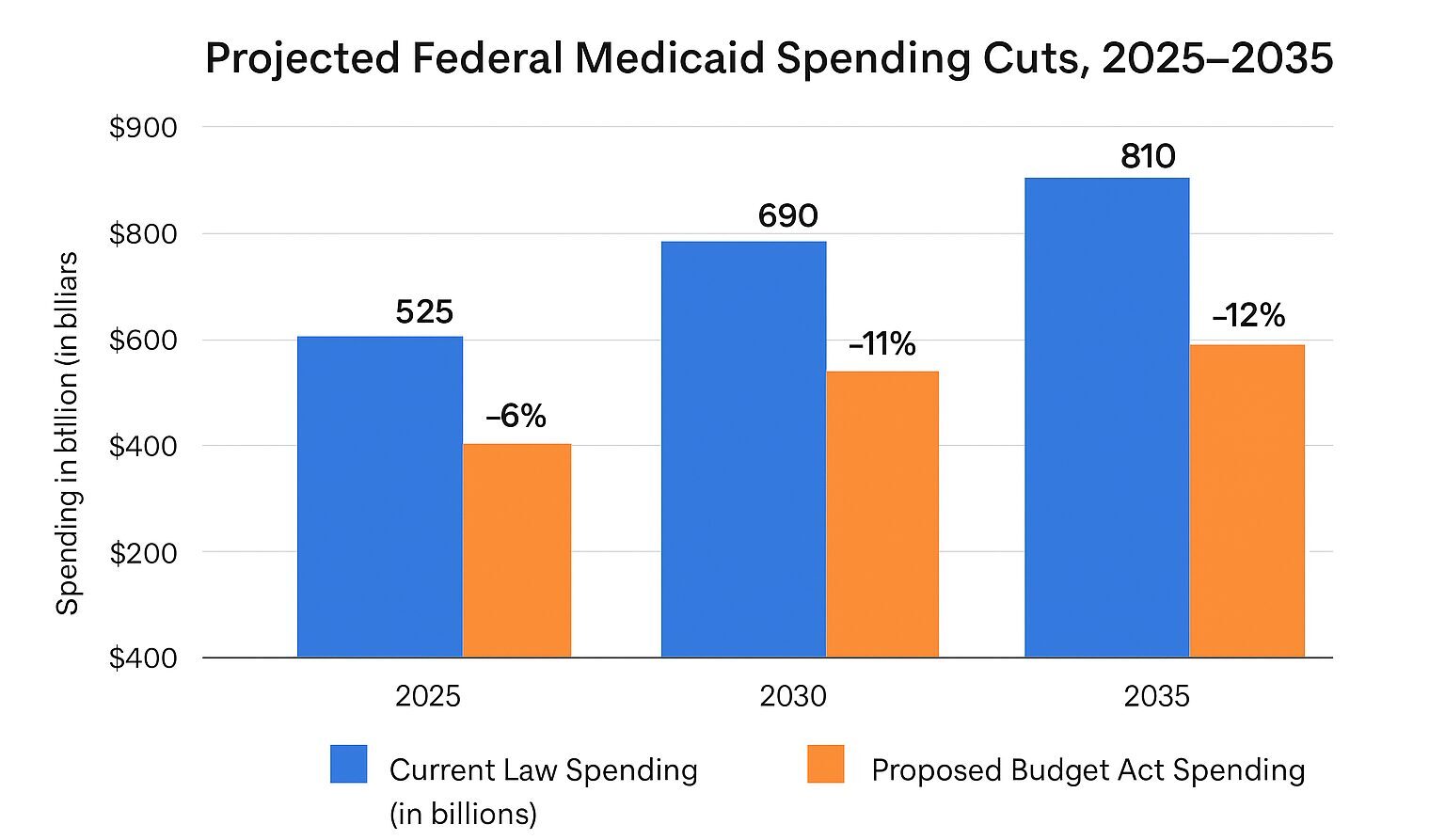
The figure below presents a visual from the Commonwealth Fund showing their projection of over $100 billion in cumulative federal Medicaid cuts by 2035. These reductions are expected to disproportionately affect non-mandated programs like HCBS, which are many times more economical than residential care. With diminished federal support, states will face pressure to reallocate limited resources, often at the expense of these optional, yet critical, programs. ¹

For nearly eight million elderly Americans, Medicaid-funded HCBS has helped reduce hospital admissions, extend independence, and relieve stress on long-term care facilities. However, the new budget cuts destabilize these programs. Barbara Merrill, CEO of ANCOR, expressed concern, stating, “When you cut federal Medicaid dollars, even for optional services, states have to make tough decisions about who gets care and when.”² Experts anticipate that approval delays, extended waitlists, and even termination of services could follow as states struggle to maintain existing infrastructure.

Bar chart of Medicaid spending.

Comparing the 2005 Budget Bill to the Affordable Care Act

Compared to the Affordable Care Act (ACA), the Republican budget bill marks a significant policy reversal. The ACA expanded Medicaid eligibility and incentivized states to develop non-institutional care models. It emphasized preventive care and home-based treatment options, helping shift care away from costly institutional settings. By contrast, the new bill eliminates such incentives and introduces fiscal and operational barriers. According to data from Medicaid.gov and the Kaiser Family Foundation, Medicaid enrollment, which rose steadily during the ACA years, is projected to drop by 10% nationwide once the budget bill is implemented³. This decline reflects both tightening eligibility and retreat from HCBS programs.

Healthcare providers will need to brace for substantial ripple effects. With fewer patients accessing home care, hospitals and emergency departments may see an uptick in acute episodes related to unmanaged chronic conditions. Providers may also encounter staffing shortages and reduced reimbursements, undermining service quality and sustainability. Richard Edwards, policy director at Amivie Home Health, warned, “If states cut home care services, many patients have no other choice but to enter a skilled nursing facility. That’s not just a shift in care—it’s often a worse outcome at a higher cost.” ⁴ These operational challenges could exacerbate pressure on an already strained healthcare workforce.

Scope and Severity of Coming Changes

Today, over eight million seniors rely on Medicaid-funded HCBS, with an average annual cost per recipient of $29,000. Thirty-three states use HCBS waivers to administer these services, yet the average state waitlist already exceeds 3,000 applicants. Institutional care costs remain 57% higher than home care, making HCBS not only more humane but more fiscally prudent. Despite that, projected federal cuts of $100 billion by 2035 threaten to replace HCBS with nursing home care. Meanwhile, a national enrollment drop of 10% would leave millions at risk of losing coverage and care.

Richard Edwards, policy director at Amivie Home Health, explains, “If states cut home care services, many patients have no other choice but to enter a skilled nursing facility. That’s not just a shift in care—it’s often a worse healthcare and social outcome at a higher cost.” ⁴

  • 8 million elderly rely on Medicaid HCBS
  • $29,000/year average cost per Medicaid home care recipient
  • 33 states use HCBS waivers
  • Average state waitlist for HCBS exceeds 3,000 applicants
  • Institutional care costs 57% more than home care
  • Estimated federal Medicaid cuts by 2035: $100 billion
  • Projected national enrollment drop: 10%

Implications for Care at Home: Next Steps

To mitigate these risks, policy experts are advocating for pragmatic alternatives, knowing that implementation depends entirely on the direction in which political winds blow. Federal stabilization grants could offer targeted relief to states with high HCBS enrollment, preserving continuity of care. Streamlining waiver approvals would reduce bureaucratic delays and ease access for both providers and patients. Retaining key ACA incentives could help maintain momentum in home-based care innovation. States would also benefit from flexible financing rules, including reformed provider tax policies, to better manage Medicaid funds under new constraints. 

Final Thoughts

Ultimately, the new budget, passed with no Democratic votes, may reshape eldercare delivery for years to come. With states facing hard choices, the healthcare community must prepare for transitions that could disrupt care and deepen inequities. Advocacy for vulnerable populations, investment in alternatives, and ongoing engagement in policy reform will be essential to ensure seniors receive the care they deserve in the setting they prefer.

# # #

____________________________________________

¹ Congressional Budget Office, Federal Healthcare Outlook 2025–2035
² Barbara Merrill, ANCOR Policy Brief, March 2025
³ Kaiser Family Foundation, Medicaid Enrollment Tracker, April 2025
⁴ Amivie Health, Testimony to House Budget Committee, June 2025

Tim Rowan The Rowan Report

Tim Rowan is a 30-year home care technology consultant who co-founded and served as Editor and principal writer of this publication for 25 years. He continues to occasionally contribute news and analysis articles under The Rowan Report’s new ownership. He also continues to work part-time as a Home Care recruiting and retention consultant. More information: RowanResources.com
Tim@RowanResources.com

©2025 by The Rowan Report, Peoria, AZ. All rights reserved. This article originally appeared in The Rowan Report. One copy may be printed for personal use: further reproduction by permission only. editor@therowanreport.com

OBBB Care at Home Adjustments

by Kristin Rowan, Editor

Care at Home Through Medicare and Medicaid

Adjustments from OBBB

Despite the passing and subsequent signing of the reconciliation bill, numerous lawsuits have paused its implementation in some areas. We will continue to report on those court decisions as they arise. In the meantime, the care at home industry can look at the few adjustments that will positively impact the industry.

Medicaid Waivers

Prior to this, the HHS Secretary could only approve Medicaid waivers to cover home and community-based services for beneficiaries who already met institutional level-of-care criteria. This bill provides additional flexibility to define waiver eligibility without the institutional level-of-care criteria.

For FY 2026, CMS has an additional $50 million to oversee the new waivers. There is an additional $100 million earmarked for FY 2027 to deliver HCBS under new and existing waivers. Although the expanded waivers and additional budget will not satisfy the more 700,000 on waiting lists for HCBS, it is a start.

Rural Health Transformation Program

For five years, beginning in 2026, states can apply for a portion of a $10 billion annual fund for rural health providers. To qualify, providers must submit a rural health care plan that includes technology adoption, local partnerships, using data-driven methods, and setting strategies for financial stability. This could provide an opportunity for care at home agencies to partner with rural hospitals to help provide care in rural settings.

Health Savings Accounts

Health Savings Accounts (HSAs) allow insurance beneficiaries to save money to pay for deductibles, copays, and other services not covered by insurance (such as non-medical supportive care and home health). Currently, people can only use HSAs if they have a high deductible health plan (HDHP). The bill allows for a plan to be considered an HDHP even if it covers telehealth and remote health services prior to meeting the deductible. Insurance companies can design new HDHPs that can be used with HSAs.

Telehealth Reconciliation Bill<br />

Another change to HSAs involves the type of plan that qualifies. Currently, bronze and catastrophic plans cannot be considered HDHPs because their out-of-pocket limits exceed IRS limits for HDHPs. The bill allows bronze and catastrophic plans to qualify as HDHPs and have access to HSAs.

Additionally, current regulations prohibit anyone with a Direct Primary Care (DPC) arrangement from contributing to our using HSAs. DPC is an arrangement with a flat monthly fee for services rather than using insurance for routine care. The bill removes the limitations, allowing people with DPC arrangements to contriute to HSAs and use them for DPC arrangements.

Adding telehealth/remote plans, bronze plans, and catastrophic plans to HSA eligibility could provide opportunities for care at home agencies to connect with beneficiaries of these plans who did not have expendable funds for non-covered services before, but can now use HSAs. Allowing patients with DPCs to use HSAs could provide yet another path to increasing patients by partnering with DPC offices.

Final Thoughts

As a whole, we are anticipating great disruption to Medicare and Medicaid stemming from the budget reconciliation bill. While we await the final word on legality from the U.S. Supreme Court on many of the provisions, we can look to the ones that may help brace the industry in the meantime.

 # # #

Kristin Rowan, Editor

Kristin Rowan has been working at The Rowan Report since 2008. She is the owner and Editor-in-chief of The Rowan Report, the industry’s most trusted source for care at home news, and speaker on Artificial Intelligence and Lone Worker Safety and state and national conferences.

She also runs Girard Marketing Group, a multi-faceted boutique marketing firm specializing in content creation, social media management, and event marketing.  Connect with Kristin directly kristin@girardmarketinggroup.com or www.girardmarketinggroup.com

©2025 by The Rowan Report, Peoria, AZ. All rights reserved. This article originally appeared in The Rowan Report. One copy may be printed for personal use: further reproduction by permission only. editor@therowanreport.com