A New Path for Recruitment and Retention

by Kristin Rowan, Editor

Recruitment and Retention amidst the national workforce shortage is not a new topic for The Rowan Report. We have feature articles dating back months, even years, talking about how you can recruit the top talent in the industry and keep the best employees you have. A lot of companies look at wages as the driving force for retention of great employees. While there is some merit to that idea, wages are not always the strongest indicator of employee satisfaction. In fact, happy employees say it would take a substantial (more than 30%) raise to get them to leave a great workplace.

The reality for many home health agencies (HHAs) is that higher wages are not always possible with the rising costs of everything else and the lower reimbursement rates from CMS. HHAs have to be creative in their recruitment and retention strategies and find new ways to engage their staff. Incentivizing staff outside of wage increases is becoming a standard part of recruitment and retention strategies and we’ve seen several of these companies popping up recently. And we’re not the only ones who have noticed.

The Rowan Report met with the team at Ava and will have a product review for you next week. In the meantime, you can read the press release from Wellsky here.

About Wellsky

Recruitment and Retention Wellsky Ava

Wellsky, a leading home health technology company, has been focusing on patient-centered coordinated care. The software for home health includes intake, scheduling, care delivery, claims management, analytics, and more. Recently, Wellsky has included caregiver retention as part of their platform, in a partnership with Ava.

About Ava

Ava is a home-care-focused employee management solution that personalizes your employee incentives and sends automated reminders to your staff. Together, Wellsky and Ava created “TeamEngage”, using Ava’s platform connected directly to your workflows. WellSky Team Engage promises to improve retention, incentivize productivity, capture engagement insights, and allow you to hire more efficiently.

Recruitement and Retention Ava Stats

# # #

Kristin Rowan, Editor

Kristin Rowan has been working at Healthcare at Home: The Rowan Report since 2008. She has a master’s degree in business administration and marketing and runs Girard Marketing Group, a multi-faceted boutique marketing firm specializing in event planning, sales, and marketing strategy. She has recently taken on the role of Editor of The Rowan Report and will add her voice to current Home Care topics as well as marketing tips for home care agencies. Connect with Kristin directly kristin@girardmarketinggroup.com or www.girardmarketinggroup.com

©2024 by The Rowan Report, Peoria, AZ. All rights reserved. This article originally appeared in Healthcare at Home: The Rowan Report. One copy may be printed for personal use: further reproduction by permission only. editor@therowanreport.com

Poor Joe is Out of A Job

by Tim Rowan, Editor Emeritus

We have been keeping an eye on the Medicare Advantage business as the number of beneficiaries who switch exceeds fifty percent. In past reports, we have described the federal lawsuits that accuse MA insurance companies of illicitly padding revenues while illegally denying treatments that straight Medicare would have covered. (See MedPAC Exposes More Medicare Advantage Crimes – 3/20/24)

Until now, we haven’t gone into detail about those independent brokers with the continuous TV commercials every November. It turns out, they may be even more dishonest than the insurance companies themselves.

Poor Joe

Perhaps the most famous of these brokers is the one that put Broadway Joe Namath in our living rooms a hundred times a day. The company started life as Health Insurance Innovations, owned by Chicago-based private equity firm Madison Dearborn Partners. After accusations of fraud, the company folded and re-emerged as Benefytt. When the same accusations returned, the owners shut that company down and came back as Blue Lantern Health.

According to Healthcare Uncovered, the firm filed for a state-level bankruptcy equivalent in Delaware last April, called “assignment for the benefit of creditors.” Blue Lantern’s website is down, as are MedicareCoverageHelpline.com and HealthInsurance.com, their signature assets. Nobody answers the 800 number Namath hocked for years.

A History of Fraud

The bankruptcy litigation revealed a database of 7 million seniors who had been bombarded by 17 million phone calls. The bankruptcy was apparently precipitated by the Federal Trade Commission, which forced Benefytt to pay $100 million to the people it had scammed by selling sham Obamacare plans, with checks distributed to victims in March. The Securities and Exchange Commission forced Health Insurance Innovations and the company’s co-founder Gavin Southwell to pay a $12 million settlement. Another close associate of the company, Steven Dorfman, was convicted of wire fraud in February.

Deceptive Practices

Tolerance for the firm’s deceptive advertising scheme ended with changes to the Medicare Advantage rule in 2023 that took effect in 2024. Blue Lantern stated after the fines were imposed that the new rule was critical to the company’s downfall,

Previously, former HHS Security Alex Azar characterized the Namath ads as “real savings, real options” in Medicare Advantage, ignoring the studies showing that the MA program costs the Trust Fund not less but $140 billion more than original Medicare.

Healthcare Uncovered concluded with this observation, “Further rules imposed since then by the Biden administration are putting even more pressure on Medicare Advantage lead generators, also called ‘third-party marketing organizations.’ (TPMOs) Beginning October 1 of this year, CMS will require that TPMOs get express consent from individuals before selling contact information to other marketers and brokers — a key loophole that enabled the growth of Blue Lantern and its predecessors.”


Don’t worry about Joe Namath’s retirement income though.
He has already landed a gig hawking hearing aids.

Joe Namath TV ad

# # #

Tim Rowan, Editor Emeritus

Tim Rowan is a 30-year home care technology consultant who co-founded and served as Editor and principal writer of this publication for 25 years. He continues to occasionally contribute news and analysis articles under The Rowan Report’s new ownership. He also continues to work part-time as a Home Care recruiting and retention consultant. More information: RowanResources.com
Tim@RowanResources.com

©2024 by The Rowan Report, Peoria, AZ. All rights reserved. This article originally appeared in Healthcare at Home: The Rowan Report. One copy may be printed for personal use: further reproduction by permission only. editor@therowanreport.com

Generative AI Comes to AlayaCare

by Kristin Rowan, Editor

Generative AI and Artificial Intelligence are taking the world, and the care at home industry, by storm. Not surprisingly, there are only a few companies that are doing AI well. We’ve started reviewing the best of of them. So far, each company doing AI well has a unique solution to a pain point in home care. No two companies are approaching or using AI the same way. This week, we’d like to re-introduce you to a company we’ve reviewed before that has a new Generative AI app launching soon.

History

Practically a household name in home care, AlayaCare is a 10-year-old software company that started as a mobile workforce platform. Like many of us, once Adrian Schauer, Co-Founder and CEO, spend some time in the care at home world, he was hooked. He shifted the focus of AlayaCare to the care at home space. With parents in their 80s, Adrian found a lack of inspiring software in the industry in Canada and he felt like that was an important problem to solve.

“Care workers are doing God’s work, and they are not getting the support they deserve,” says Schauer. In Canada, where AlayaCare started, agencies combine home health and supportive care. Because of this, the largest patient base on the AlayaCare platform is on the supportive care at home side, but they now operate within home health as well.  Since 2021, AlayaCare has added hospice to their network with the acquisition of Delta Health. 

AI Comes to AlayaCare

Through many iterations of the software, AlayaCare has advanced with new technological capabilities. Now, AlayaCare is embracing artificial intelligence; more specifically, Generative AI. Schauer explains that the purpose of their new AI technology is “to enable the type of care we want our loved ones to receive at home.” 

The new GenAI app was demoed in September of 2023 and is still in Beta testing. AlayaCare is anticipating an end-of-summer launch of the product.

Introducing...Layla

Layla is an in-app digital assistant, built on top of GenAI. It’s large language model allows the user to conversationally interact with the data in the system. It also includes a constrained internet search component. From the conversation, it can determine whether the user is seeking internal or external information.

Layla’s data exploration does more than just extracting data. The GenAi platform allows Layla to provide operational support around key metrics for employee retention.

Layla Generative AI AlayaCare

Agency Support

AlayaCare has determined some key factors in employee retention:

  • Utilization
  • Quality shifts
  • Qualified Hours
  • Recurrent shifts
  • Average weekly clients
  • Weekday hours vs weekend hours

Focusing on these factors, Layla provides improvements in onboarding, scripting information, data migration, and scheduler use of time.

Features

Visit Optimizer

AI generated, automated scheduler that takes into account route management, skill matching, daily hours, and schedule optimization to optimize care and reduce time from referral to first appointment.

The scheduling automation includes push notification capabilities to send schedule updates to clinicians in real time. As each week’s schedule is created, Layla can send a push notification to each clinician. It asks them to verify their availability and confirm the next week’s schedule.

Additionally, Layla considers environmental factors such as pets, neighborhoods, and other family members in the home.  According to AlayaCare users, the Visit Optimizer offers up to a 98% decrease in time required to fill visits, 35% improvement in visit fulfillment, and 35% improvement in data quality.

Notable

Notable transforms notes from patient visits, forms, and client records. Then, it uses AI to review, compile, categorize, and tag all the notes. 

From this information, Notable compiles an activity of daily living (ADL) for each client, including whether and why a task was completed. This information is also moved to the risk dashboard. The risk dashboard shows the whole population, the risk of that population, identifiable trends, risk level, and whether the risk has remained stable over time. All of this information is compiled into a single risk dashboard with customizable reports. 

Additional security measures for Notable include a grounded model to reduce the risk of AI hallucination and ensuring no PHI leaves the dashboard.

Employee Retention Dashboard

Several factors impact employee retention.  Among the top reasons for employee dissatisfaction are pay and benefits, inconsistent hours, and safety concerns. The current workforce shortage means keeping your best employees is more important than ever. With a quick snapshot of your employee satisfaction and engagement, you can address concerns earlier and improve turnover rates.

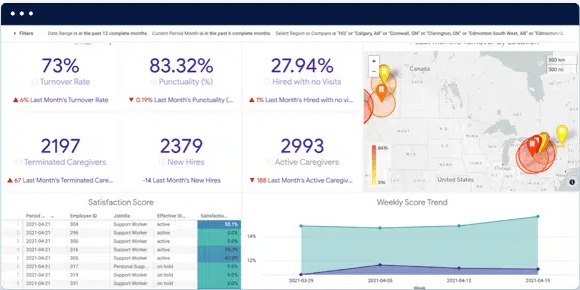
The employee retention dashboard highlights satisfaction scores, client capacity, scheduled hours, number of unique clients, overall turnover rates, turnovers by location, and more.

“Having a tool to predict employees who may be disengaged or dissatisfied prior to this happening is invaluable,” said Lee Grunberg, President & CEO, Integracare. “With the dashboard and algorithm behind it, we can see a caregivers’ satisfaction or engagement trend over time, and deploy preventative measures to reduce the likelihood that they’ll resign. It has empowered our coordinators to be much more retention-driven.”

On Deck for Layla

I spoke with Adrian Schauer, Co-founder and CEO of AlayaCare, during the online demo. “My passion project is…Layla. The people in your agency should be building relationships and making decisions. Anything else should be done by automation.” 

AlayaCare is currently in a high growth mode to build marketshare across the personal care and skilled sides of the marketing. Schauer’s goal is to elevate a level above their existing capabilities with home based care providers. This includes how payers are set up, how EVV is operating, lobbying, and advocacy. 

For Layla, AlayaCare is working on the GenAI capacity for chart completion by voice. Layla would use the conversational language model it already has to recognize and understand the conversation during a home visit and transcribe the conversation into notes, visit documentation, care plans, and codes.

Final Thoughts

As AI becomes more commonplace across care at home, we are scrutinizing AI platforms for safety, identity protection, accuracy, and ethical use. If you are looking for an AI solution for your business operations, we caution you to use discretion in your use of AI and thorougly vet the AI platform prior to adoption. We will continue to provide updates when Layla launches later this year. But, for now, it looks like we’ve found one more technology platform that is using AI the right way.

Kristin Rowan, Editor

Kristin Rowan has been working at Healthcare at Home: The Rowan Report since 2008. She has a master’s degree in business administration and marketing and runs Girard Marketing Group, a multi-faceted boutique marketing firm specializing in event planning, sales, and marketing strategy. She has recently taken on the role of Editor of The Rowan Report and will add her voice to current Home Care topics as well as marketing tips for home care agencies. Connect with Kristin directly kristin@girardmarketinggroup.com or www.girardmarketinggroup.com

©2024 by The Rowan Report, Peoria, AZ. All rights reserved. This article originally appeared in Healthcare at Home: The Rowan Report. One copy may be printed for personal use: further reproduction by permission only. editor@therowanreport.com

The Future of Care at Home

by Kristin Rowan, Editor

Home Nurses are joining unions. The advent and unionization of Hospital-at-Home (H@H) is changing the care at home landscape. Large hospital systems across the country have engaged in H@H studies and launched H@H programs, providing hospital-level ambulatory services in their communities. As H@H continues to take a foothold in the healthcare landscape, what do those changes mean for care at home?

Hospital at Home Popularity

Most of the existing H@H programs are operating under a CMS waiver. A few of the H@H programs use a private pay model. The CMS waiver needs to be extended in order to continue the programs. As many H@H organizations are pushing for CMS to extend the waiver, they are looking to patients for advocacy.

A recent survey by Vivalink showed that 84% of U.S. individuals over the age of 40 are interested in H@H monitoring after a hospital visit so they can return home sooner. 77% of respondents said they would trust a recommendation that included at-home monitoring. Respondents who had been hospitalized three or more times in the past 12 months were more interested in H@H programs than those who had been hospitalized less.

Massachusetts Ambulatory Nurses Unionize

On May 20, 2024, 33 ambulatory nurses from Martha’s Vineyard Hospital (MVH) filed with the National Labor Board to join a union that is already active within the hospital, the Massachusetts Nurses Association (MNA). The MNA currently represents 23,000 hospital workers from 85 healthcare facilities across the Commonwealth of Massachusetts. The hospital denied the request to join the union. The group of ambulatory nurses joined MVH through an acquisition of a physician’s group. Therefore, those nurses were not recognized under the existing collective bargaining agreement.

Hospital-at-Home Nurses at Mass General Unionize

The Hospital-at-Home nurses at Mass General Brigham (MGB) have unionized in the hopes of influencing the future of in-home acute care. They are also hoping this will encourage more people working in home healthcare to join unions. In the last seven months of 2023, almost half of all registered nurses working in home health care and non medical care at home left their jobs within a year. One registered nurse from MGB said she hopes HaH nurse unions become more common as HaH expands across the country.

The clinicians in the MGB home care segment are hoping to follow the H@H group into unionization soon. The home care segment, which includes home health, palliative, and other care at home services, are currently voting on whether to unionize.

Hospital-at-home nurses unionize at Mass Gen

Among the listed reasons for considering unionization are changes in expectations on productivity, and wages. Some of the more recent changes at MGB were rolled out across the company and did not take into consideration the territories and limitations that care at home clinicians have. More than 400 clinicians are in the care at home side of MGB and they have all received ballots to vote on unionization.

Home Health Unionization

hospital-at-home changing home health unions

The nature of care at home clinicians is disparate. Therefore, it is difficult to organize them into one cohesive group. Recently, though, more home health workers are looking to service workers and healthcare workers unions for better pay, better working conditions, and more buy-in on the day-to-day operations of the agency.

Opponents of unionization among home health clinicians argue that pay rates are largely set by CMS reimbursement rates. Employers may want to raise rates but are unable to do say because they accept Medicare and Medicaid. Home health unions could force employers to pay more than the set CMS rates.

CMS Response to Union Backlash

Otherwise known as the 80/20 rule, CMS responds to agencies worried about unionization with a mandate to pay their workers 80% of total Medicaid payments. Some agency owners say the proposed rule ignores the low reimbursement rates and further burdens agencies that are barely making a profit now. It is unlikely that CMS will see the unionization of home health clinicians as a reason to increase reimbursement rates. Experts advise agencies to start working on contract negotiations within the VBPM, to engage in risk-sharing and cost-benefit analyses with all parties within the VBPM. For example, Remote Patient Monitoring (RPM) is Medicare reimbursable, but not through home health use. However, a home health agency can share the benefits of RPM when it is billed through an approved provider for Medicare reimbursement. These strategies can lower overall care costs, increasing the share of reimbursement flowing to HHAs.

Maximize VBPM with Technology

Technologies available today include RPM, generative AI for data analytics, automated scheduling, and apps for secure communication, among others. Technology can lower overhead costs, allow you to eliminate some FTEs, and provide added value to providers during contract negotiations. If you don’t already have a robust tech-stack, look at some of our most recent product reviews, or contact The Rowan Report for more information about technology adoption consultations.

# # #

Kristin Rowan, Editor

Kristin Rowan has been working at Healthcare at Home: The Rowan Report since 2008. She has a master’s degree in business administration and marketing and runs Girard Marketing Group, a multi-faceted boutique marketing firm specializing in event planning, sales, and marketing strategy. She has recently taken on the role of Editor of The Rowan Report and will add her voice to current Home Care topics as well as marketing tips for home care agencies. Connect with Kristin directly kristin@girardmarketinggroup.com or www.girardmarketinggroup.com

©2024 by The Rowan Report, Peoria, AZ. All rights reserved. This article originally appeared in Healthcare at Home: The Rowan Report. One copy may be printed for personal use: further reproduction by permission only. editor@therowanreport.com

BREAKING NEWS – CMS Proposed Rule for 2025

by Kristin Rowan, Editor

CMS Proposed Rule for 2025

Citing “budget neutrality adjustments”, the Centers for Medicare & Medicaid Services (CMS) June 26 issued its proposed rule for 2025 for the home health prospective payment system. Here are the highlights:

  • Overall net reduction in home health payments by $280 million dollars
  • Market basket update of 3.0%
  • Productivity adjustment of -0.5%
  • Base payment rate reduction of 4.067% due to PDGM
  • Update fixed dollar loss for outlier payments
  • Update LUPA thresholds, functional impairment levels, and comorbidity adjustment subgroups
CMS Proposed Rule CY 2025

We did the math. This is an overall reduction in payment by 3.6%. This come after multiple years of similar adjustments that reduced the overall payment rates.

Included in the proposal is an additional adjustment to the fixed-dollar loss amount for high-cost outliers. This will reduce payments another 0.6%.

As we focus primarily on the payment reductions, CMS is looking at additional data. CMS provides a detailed account of the requirements for behavior assumptions and actual changes, as outlined in earlier rules. Using CY 2023 claims, and the methodology from the CY 2023 final rule, CMS believes they paid more under the PDGM system than they would have under the old system, leading to the deduction in base payment rate.

HHA Conditions of Participation

In addition to the payment cuts, CMS is also proposing an update to the Conditions of Participation. This new standard would require HHAs to develop, apply, and maintain a policy for accepting new patients into service.

According to the proposal, CMS is not moving to add or modify any quality measures from the Quality Reporting Program. They do, however, propose to modify some patient assessment items related to health-related social needs. This would require HHAs to collect and report data related to living situation, food, and utilities. This proposed modification would be implemented beginning with the calendar year 2027 QRP.

COVID-19 Reporting

Also included in the CY 2025 proposal is a revision to the infection prevention and control requirements for long-term care facilities. The revision calls for an extension on reporting some of the Covid-19 data elements to the Centers for Disease Control and Prevention. It also requires influenza and RSV reporting beginning January 1, 2025.

Additional Items

CMS also used data from OASIS-D and OASIS-E, making adjustments for missing and altered data from the two different information sets. The proposed rule includes a new methodology to address the issue of varying data sets from OASIS-D to OASIS-E.

LUPA add-ons are meant to establish equitable compensation for all home health services. CMS is proposing an occupational therapy (OT) specific LUPA add-on factor, rather than continuing to use the PT add-on factor for OT.

Payment groups under the PDGM model use an associated case-mix weight and LUPA threshold, specific to each of the 432 payment groups. CMS is proposing a recalibration of the case-mix weights, including funtional levels and comorbidity adjustment subgroups.

Request for Information: CMS is seeking feedback on Future Performance Measure Concepts for the expanded HHVBP Model. New proposed measure include care activities like bathing and dressing, which are not currently included in the function measures. Additional potential measures include family caregiver status and claims-based falls with major injuries.

Feedback

The American Hospital Association has expressed “serious concerns” about the payment rate adjustments in the proposed rule. “We urge the agency to adequately resource HH providers as they are a critical part of the care continuum,” AHA wrote. “We are particularly concerned about the substantial size of the agency’s proposed budget neutrality adjustment, a cut of 5.653%, and again call on CMS to withdraw it.” The AHA has asked CMS to revise its accounting methodology to more accurately account for changes in the payment system and care delivery due to PDGM.

President of the National Association for Home Care and Hospice (NAHC), Bill Dombi, today released a statement:

“The 2025 proposed version of Medicare home health payment rates shows the ongoing and predictable rate reductions impacting home health agencies since the beginning of the new payment model in 2020. That decline is solely due to a fatally flawed budget neutrality methodology that CMS employed to arrive at the rate adjustments,” stated NAHC President William A. Dombi.

“While this means that Medicare spending on home health services will continue to decline as costs continue rise, the more important element is that care access and utilization continues to decline at significant levels. When Congress set Medicare payment reform in motion starting in 2020, it was not planned or even expected that the outcome would be that nearly 500,000 Medicare beneficiaries would be able to access care or that those who could find care would get fewer services,” he added.

“Congress must step in immediately to put an end to this dismantling of the Medicare home health benefit. The value of home health services is not only undeniable; it has been proven by CMS in its analysis and expansion of the highly successful Home Health Value Purchasing demonstration project. We call on Congress to correct what CMS has done and prevent the growing harm to the millions of highly vulnerable home health patients that depend and will depend in the future on this essential Medicare benefit. Fortunately, longstanding advocates for home health care, Senator Debbie Stabenow (D-MI) and Senator Susan Collins (R-ME) have introduced S. 2137 to eliminate the rate cuts. We urge the Congress to support this legislation and enact it into law before the end of the year. The 2025 rate cuts must not take effect” Dombi added.

Comments

CMS has issued a fact sheet with more details on their assumptions and calculations. You can access the fact sheet here. The proposed rule can be downloaded here.

CMS will accept comments on the proposed rule through August 26th.

# # #

Kristin Rowan, Editor

Kristin Rowan has been working at Healthcare at Home: The Rowan Report since 2008. She has a master’s degree in business administration and marketing and runs Girard Marketing Group, a multi-faceted boutique marketing firm specializing in event planning, sales, and marketing strategy. She has recently taken on the role of Editor of The Rowan Report and will add her voice to current Home Care topics as well as marketing tips for home care agencies. Connect with Kristin directly kristin@girardmarketinggroup.com or www.girardmarketinggroup.com

©2024 by The Rowan Report, Peoria, AZ. All rights reserved. This article originally appeared in Healthcare at Home: The Rowan Report. One copy may be printed for personal use: further reproduction by permission only. editor@therowanreport.com

Staffing Crisis Solution from Wellsky and Ava

Recruitment and Retention Wellsky Ava Logo

WellSky® and Ava Launch Groundbreaking Solution to Combat Staffing Crisis for Home-Based Care Agencies

The new innovation helps improve healthcare employee retention and engagement through incentive-based rewards

OVERLAND PARK, Kan. & NEW YORK, NY. – May 30, 2024 – WellSky, a leading health and community care technology company, today announced the release of WellSky TeamEngage powered by Ava, a new innovation for home-based care providers aimed at increasing employee retention, reliability, and recruitment through gamification. The solution incentivizes and rewards caregivers for completing targeted activities and achieving performance goals, fostering a culture of appreciation while improving staff retention rates and agency differentiation.

WellSky TeamEngage comes at a time when home-based care providers face a growing workforce shortage crisis. The turnover rate for home care providers is 77%, challenging agencies to meet a growing demand for services with a shrinking supply of caregivers. This can result in higher rates of referral and client case rejection. With WellSky TeamEngage, agencies can implement customizable, data-driven incentives to attract and retain talent at scale, while shifting focus toward other operational priorities and providing exceptional care.

Using WellSky and Ava’s integrated technology, Griswold, one of the country’s largest home care franchises with more than 170 locations in 32 states and over 9,000 caregivers, reduced turnover rate in its eight company-owned offices by 13% in just seven months and helped a large majority of caregivers reach key goals, such as clocking in and out on time and meeting minimum weekly hour requirements. The company has since rolled out the technology to its franchise network and expects significant adoption.

“We have seen tremendous benefit from using WellSky TeamEngage powered by Ava, both in the retainment of talented staff members and in the differentiation of our agency,” said Caitlin Griffith, Director of People & Culture at Griswold. “Our organization believes that care professionals are the foundation of our success, with innovation being key to improving the lives of those we serve. We have been pleased with the adoption and staff satisfaction with the solution, and we look forward to further benefiting from a comprehensive set of insights to guide our approach to workforce engagement strategies.”

Ava acts as an AI-powered Chief Engagement Officer for healthcare providers, with its average customer improving employee retention rates by 45% in six months. Ava improves employee engagement so healthcare providers and administrators can redirect attention to scaling their businesses. Now in partnership with WellSky, the organizations will extend this technology to providers across the U.S., with the Ava platform integrated within WellSky electronic health records (EHR) technologies and the WellSky TeamInsights solution. TeamEngage will provide a comprehensive flow of data between systems and a seamless end-user experience.

“Ava works to remove the burden of administrative work and reconnect caregivers and home care administrators with why they chose a healthcare career in the first place,” said Victor Hunt, chief executive officer and co-founder of Ava. “We are excited to lend Ava’s Enterprise AI technologies to TeamEngage and, in doing so, tackle one of the greatest crises facing healthcare.”

By leveraging data directly from WellSky Personal Care, WellSky TeamEngage incorporates specific caregiver actions, such as taking open shifts and performing timely clock-ins, into the agency’s defined incentive model, which stores all actions and awards points that caregivers can redeem for monetary or other agency-defined rewards. These day-to-day behaviors combined with pulse survey results, gamified referrals, and other engagement metrics are all tracked within WellSky TeamInsights for Personal Care, where powerful algorithms help predict caregiver turnover risk to proactively guide retention strategies.

“The staffing crisis facing our clients and the industry at large is a major concern, both for people seeking care in the home and for agencies trying to meet that need,” said Wes Little, chief analytics officer at WellSky. “We are thrilled to bring WellSky TeamEngage to our clients to not only provide them a tool to incentivize and reward caregivers, but to also gain the insights needed to run their operations at scale in today’s challenging environment.”

To learn more about how WellSky is powering agency staff retention and engagement, visit WellSky.com.

# # #

WellSky Media Contact
Emma Neal
Phone: 617.401.3131
Email: emma.neal@allisonworldwide.com

Ava Media Contact
Deanna Carbone
Phone: 914.523.7865
Email: ava@hirschleatherwood.com

About WellSky®

WellSky is one of America’s largest and most innovative healthcare technology companies leading the movement for intelligent, coordinated care. Our proven software, analytics, and services power better outcomes and lower costs for stakeholders across the health and community care continuum. In today’s value-based care environment, WellSky helps providers, payers, health systems, and community organizations scale processes, improve collaboration for growth, harness the power of data analytics, and achieve better outcomes by further connecting clinical and social care. WellSky serves more than 20,000 client sites — including the largest hospital systems, blood banks, cell therapy labs, home health and hospice franchises, post-acute providers, government agencies, and human services organizations. Informed by more than 40 years of providing software and expertise, WellSky anticipates clients’ needs and innovates relentlessly to build healthy, thriving communities. For more information, visit wellsky.com.

About Ava

Ava is an enterprise AI platform helping healthcare providers streamline administrative busywork so that they can get back to care. In an industry where employee engagement and retention are crucial yet increasingly challenging to maintain, Ava provides an effective AI-driven solution that’s beneficial for clients, caregivers, and providers. Integrating seamlessly with Electronic Health Records (EHRs), Ava offers an engaging experience for caregivers and clinicians while providing administrators with a robust suite of tools for business intelligence, employee management, and gamified incentives. For more information, visit joinava.com.

©2024 Wellsky. All rights reserved. This press release was published by Wellsky and appears on The Rowan Report courtesy of Wellsky.

Ambassador of the Year

FOR IMMEDIATE RELEASE

Contact:

Johnathan Eaves

(903)445-6969

jeaves@axxess.com

Axxess’ Tim Ingram Wins MyHospice Ambassador of the Year

DALLAS, June 13, 2024 – During Hospice Action Week in Washington D.C., the Hospice Action Network (HAN) named Axxess Executive Vice President of Interoperability Tim Ingram the 2023 MyHospice Ambassador of the Year. This award recognizes Ingram’s outstanding leadership and advocacy for hospice care.

Ingram’s passion for hospice care is deeply personal and driven by his profound experiences with family members who benefited from hospice services. His efforts focus on educating lawmakers and the public about the essential benefits of hospice care, ensuring more families receive the compassionate care they deserve at the end of life.

“Advocacy for hospice means sharing the beauty of the hospice benefit with members of the House and Senate, state representatives and anyone else who will listen to our stories of lives improved because of the care patients received in the last weeks and months of their lives,” Ingram said. “It means making sure as many patients and families as possible learn about the benefits of hospice, and it means helping protect the future of hospice care for some of our most vulnerable people.”

“MyHospice Ambassadors play a critical role in ensuring the voices of diverse providers and community members from across the nation are heard,” said Logan Hoover, VP of Policy and Government Relations for the National Hospice and Palliative Care Organization (NHPCO) and Executive Director of the Hospice Action Network (HAN). “Tim’s standout storytelling and dedication have provided an important example of effective engagement for other advocates.”

The MyHospice Ambassadors Program is a volunteer advocacy program for individuals who have the capacity and initiative to lead, network and take action on hospice and palliative care advocacy efforts with the support of HAN. HAN, the 501(c)(4) affiliation of NHPCO, presented three MyHospice Ambassador annual awards, recognizing advocates who stood out, led by example and took action in 2023.

# # #

About Axxess

Axxess is the leading global technology innovator for healthcare at home, focused on solving the most complex industry challenges. Trusted by more than 9,000 organizations that serve more than 5 million patients worldwide, Axxess offers a complete suite of easy-to-use software solutions that empower home health, home care, hospice, and palliative providers to make healthcare in the home human again. Multiple independent certifications have confirmed that Axxess has the most secure and industry-compliant software available for providers. The company’s collaborative culture focused on innovation and excellence is recognized nationally as a “Best Place to Work.”

Tim Ingram Hospice Ambassador of the Year<br />
Tim Ingram Hospice Ambassador of the Year

Tim Ingram is senior vice president of business development for Axxess, a home healthcare technology company. He is responsible for leading the business development team to build valuable industry partnerships and key product integrations that create solutions for Axxess clients. Prior to joining Axxess in February 2018, Ingram served as the regional administrator for Encompass Home Health and vice president of sales for Homecare Homebase, among other industry positions.

Preventing Violence: More Action Items

By Elizabeth E. Hogue, Esq.

Violence in Healthcare

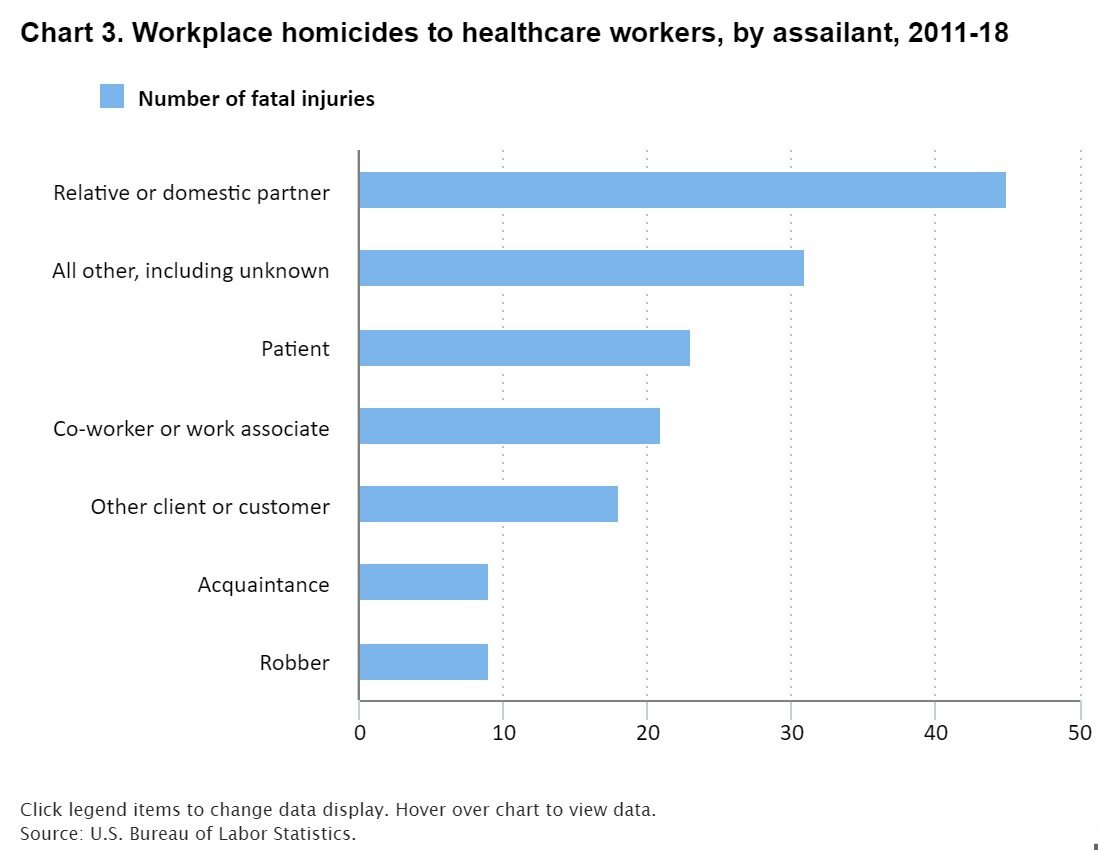
According to a recent analysis of Bureau of Labor Statistics data, healthcare is one of the most dangerous places to work. Homecare field staff members who provide services on behalf of private duty agencies, hospices, Medicare-certified home health agencies, and home medical equipment (HME) companies may be especially vulnerable. Contributing to their vulnerability is the fact that they work alone on territory that may be unfamiliar and over which they have little control. Staff members certainly need as much protection as possible.


Preventing Violence Bureau of Statistics Graph

Must-Haves

First, regardless of practice setting, management should develop a written policy of zero tolerance for all incidents of violence, regardless of source. The policy should include animals. The policy must require employees and contractors to report and document all incidents of threatened or actual violence, no matter how minor. Emphasis should be placed on both reporting and documenting. Employees must provide as much detail as possible. The policy should also include zero tolerance for visible weapons. Caregivers must be required to report the presence of visible weapons.

Below are some additional important actions for healthcare organizations to take that are based on UCHealth’s SAFE Program:

  • Encourage staff members to STOP if they feel unsafe for any reason.
  • Workers should pause to generally ASSESS their environments. Staff members should think about what has happened and observe what is currently occurring. Is there, for example, mounting frustration or anger?
  • Staff should then FAMILIARIZE themselves with the room. Who is the patient? Where is the patient? Are there any factors that might escalate behaviors? Staff members should also consider putting themselves in positions where they have a route to escape, if necessary.
  • Practitioners should also ENLIST help. Getting help may, for example, include pushing panic buttons on mobile devices.

Here is what Chris Powell, Chief of Security at UCHealth said in Becker’s Hospital Review on June 4, 2024:

“You can’t just talk about the shrimp and give you a good picture. We have to talk about the roux and the rice and everything else that goes into this for a good picture to be painted so people have an understanding. We want to solve this with an electronic learning or a 15-minute huddle, but we can’t. This is continuous and a persistent pursuit toward educating, communicating, recognizing, responding to, reporting and recovering from workplace violence.”

Every caregiver matters. The healthcare industry has lost caregivers to violence on the job in the past. Let’s not repeat these terrible events.

©2024 Elizabeth E. Hogue, Esq. All rights reserved.
No portion of this material may be reproduced in any form without the advance written permission of the author.

AI before AI

by Tom Herzog, COO of Netsmart

Navigating the Next Era of Tech-Enabled Healthcare

While the talk is about Artificial Intelligence, the immediate opportunity is Augmented Intelligence.

Some thoughts from Tom Herzog and Matthew Arnheiter 

We are living through one of the most exhilarating times in healthcare, a journey made possible by significant milestones over recent decades. As healthcare technologists deeply committed to the cause + communities we serve, we’re excited by the promise of the upcoming era of technological empowerment. This phase is set to showcase and expand upon the extensive work done in digitizing healthcare, highlighting the relentless pursuit of innovation that has characterized our field. In conversations with colleagues and clients, we have recognized the need to explore these developments as we progress collectively. Matthew and I thought a series of reflections on these conversations would be helpful for all of us, providing insights into technology’s transformative impact on healthcare and the critical initiatives currently underway. We envision this dialogue as a series of posts throughout the year, sparking discussion and reflection as we navigate forward.

Back to the Future

In 2015, we envisioned a future where the concept of navigation as we know it would be obsolete, advocating for a universal search that is nearly autonomous, informed by the known context specific to every role. By 2019, we were discussing workflow automation, using the example of Lane Departure Warning systems in automobiles as a metaphor for technology that enhances outcomes through precision responses. The pace at which these technologies are evolving is astounding, moving beyond mere speed of thought to how we can iterate at the speed of innovation itself. Before we achieve the aspirations of true Artificial Intelligence, we must start with Augmented Intelligence, which may very well be the most significant technological innovation in my lifetime.

The Gentle Guidance of Technology: Augmented Intelligence in Healthcare

Artificial Intelligence (AI) and Augmented Intelligence stand as beacon forces driving innovation forward in this fast-evolving technology landscape. Drawing an analogy to driver assistance systems in modern vehicles, we explore the nuanced differences between these concepts, simplifying their understanding and underscoring the distinct roles in enhancing human capabilities.

Artificial Intelligence: The Autonomous Navigator

Imagine AI as the driving force behind fully autonomous vehicles, adeptly navigating complex terrains without human intervention. This epitomizes the grand aspiration of AI: to emulate or even transcend human Intelligence in specific tasks, thus granting machines the ability to function independently. It’s a prospect that is as exhilarating as it is intimidating, reminiscent of scenarios depicted in futuristic films. Such advancements bring to light profound questions about the limits of technology and the ethical considerations it entails. While we marvel at the potential, apprehension about the unknown shadows our enthusiasm. As we venture into this era, it’s imperative that we tread thoughtfully, balancing our ambitions with caution, as we unlock new realms of possibilities. Together, we must navigate this journey towards outcomes that are not only innovative but also meaningful and ethically sound.

Augmented Intelligence: The Co-Pilot’s Nudge

Conversely, Augmented Intelligence mirrors the driver assistance systems in vehicles – providing “nudges” or guidance while ensuring the driver remains in control. These systems bolster safety and efficiency, complementing human Intelligence with technological support. This partnership epitomizes the collaborative synergy between technology and human skills for a safer and more efficient driving experience.

The American Medical Association (AMA) aligns with this vision, emphasizing Augmented Intelligence’s role in enhancing human Intelligence rather than replacing it. The AMA advocates for the use of AI in healthcare as a means to augment the capabilities of medical professionals, not to substitute their critical thinking or clinical judgment.

Augmented Intelligence in Healthcare: Enhancing the User’s Ability

Reflecting on the transition from conceptual frameworks to tangible applications, we’ve initiated the Augmented Intelligence family. These solutions are meticulously designed to support clinical, operational, and financial workflows across all healthcare roles. Aimed at simplifying user experiences, these tools provide the best available context and automate information for validation and use as needed. This initiative marks a significant step in harnessing the potential of augmented Intelligence, enabling transformative shifts in healthcare practices and outcomes.

Michelle Donelan MP, reflecting on the U.K.’s commitment to AI in healthcare, highlights the transformative impact of augmented Intelligence, “AI will revolutionize the way we live, including our healthcare system. That is why we’re backing the U.K.’s fantastic innovators to save lives by boosting the frontline of our NHS and tackling the major health challenges of our time”. Donelan’s statement emphasizes the government’s support for utilizing AI to enhance healthcare delivery and address pressing health issues.

Augmented Intelligence promises to extend the partnership between human capabilities and technological advancement to medical professionals. Vincent Liu, MD, from Kaiser Permanente, elucidates this synergy, stating,

There is a stage at which regulations can stifle some of the innovation [that AI might advance] … There is a role for providing a safe harbor [from certain regulations] so that we can use our best data to improve our patients’ care.

This perspective underscores the potential of augmented Intelligence to enrich patient care by integrating comprehensive data analysis within the regulatory framework.

From the inception of conversations at our annual user conferences in the early 2000s to the present, we’ve witnessed the evolving landscape of healthcare technology. The decades-long journey of healthcare digitization has set the stage for today’s advancements, where Artificial Intelligence and Augmented Intelligence solutions leverage data to significantly improve care and operational efficiency.

Navigating Ethical Considerations

The integration of Augmented Intelligence in healthcare navigates through a maze of ethical considerations. Upholding the sanctity of the caregiver-patient relationship, ensuring patient privacy, and addressing potential biases in AI algorithms are paramount. The objective is to leverage Augmented Intelligence in a manner that respects these ethical boundaries while enhancing patient benefits.

A Future of Collaborative Care

Looking ahead, the promise of healthcare augmented by Intelligence offers a landscape where clinicians are equipped with unprecedented tools and information. This era does not diminish the essence of human judgment or the significance of the human touch in medicine but serves as a potent ally to these irreplaceable elements of care.

A Journey of Human-Machine Collaboration

Augmented Intelligence in healthcare symbolizes the collaboration between human Intelligence and artificial capabilities. This collaboration is not about relinquishing control but about enriching human expertise to tackle modern healthcare challenges. As we continue to integrate this technology, it heralds a future where healthcare is more personalized, predictive, and precise. The path forward, illuminated by the gentle guidance of Augmented Intelligence, promises a realm of endless potential for improved health outcomes for all.

Our immediate focus is three-fold 1) providing the communities we serve with the benefits of  Augmented Intelligence, 2) ensuring we achieve Meaningful AI for every role, and 3) doing so through incremental progress so that AI now is a reality.

Final Thoughts

If you are reading this, you are likely one of the pioneers helping forge the path we are on today. If it were not for the initial efforts to digitize the ecosystem, we would not be talking about this today. Thank you for making this happen, for your perseverance and tenacity to find a way. Now we are at the transition from AI as a futuristic concept to its current role in shaping healthcare practices marks a remarkable chapter in the ongoing story of innovation in healthcare. It reaffirms the importance of digitization as the foundation upon which AI and other emerging technologies are built, enabling a future where healthcare is more informed, more empowered, and, ultimately, more human.

# # #

Augmented intelligence Tom HerzogTom Herzog is responsible for leading solution and technology strategies focused on person-centric design to optimize workflow, efficiencies and outcomes. His teams work in collaboration with both clients and partners to deliver comprehensive solutions for the human services and post-acute care communities.

Tom oversees multiple business units, including Netsmart consulting organization, solutions, development, engineering, technology, innovation, product development, IT, support, human resources, legal and operational functions.

Tom’s additional experience includes leading teams to automate systems and integrate financial, document management and information systems. He has been recognized for his ability to create innovative approaches and strategies that deliver results through vision and building strong teams.

Tom earned a bachelor’s degree in business management and human relations from Mid-America Nazarene University. He serves on the boards of the Overland Park Chamber of Commerce and the United Community Services of Johnson County.

When Social Media Goes Too Far

by Kristin Rowan, Editor

Access to Information: Pro & Con

The advent of social media has allowed millions upon millions of users worldwide to connect with distant friends and family, meet new people, and share information among followers. From Six Degrees in 1997 to BlueSky in 2023, social media has evolved over time. Some say social media has brought us closer together and created more opportunities for small business marketing and branding. Others argue it has replaced human interaction and created overuse of mobile devices, addictions to “likes”, and a host of fake news and propaganda. Whatever your particular outlook on social media, it’s probably here to stay.

Social Media

Having a profile on a social media platform (or several as most people have), allows friends, family, and colleagues to connect quickly and easily. This easy access to user information can be great for social networking and branding. Recently, however, the social media platforms have started gathering the information from your profile to enhance the paid marketing campaigns you see in “Sponsored” posts. If you’ve never noticed it before, pay attention to how often a sponsored post appears on your social media feed that happens to match a recent browser search, email, or, scarily enough, conversation, you are part of.

Social Media Access to Outside Information

Cookies

We’ve all seen the warning pop-ups on websites that read “This site uses cookies.” Cookies store your browser information and history, page visits, keyword searches, and other information. This information is accessible to other websites. This is why Amazon sends you an email for sale items you recently searched for, even if you didn’t search on Amazon. Most of us know we have the option to allow only necessary cookies and to opt out of everything else. However, most people rarely take this extra step. Rather than selecting from a list of allowable cookies, the default action is to “allow all.” We are just one click away from continuing our browsing, reading, or shopping.

PHI Information Accessed by Social Media

We accept that when we allow cookies, our information will be shared. However, when you share personal information with your doctor, you assume that information is not subject to the cookie preferences, even if the information is uploaded digitally. The federal Health Insurance Portability and Accountability Act (HIPAA), in fact, requires that this information not be shared. Ron Prosky that the Palm Beach Health Network, the largest health care network in Palm Beach County, Florida, did just that. Palm Beach Health Network allegedly used Meta’s pixel code in their website, allowing Facebook to target patients with personalized ads based on their medical condition and other sensitive information.

Similar lawsuits alleged the same action against Atrium Health in North Carolina and against Kaiser Permanente, both in April of 2024. Kaiser Permanente claimed an “accidental breach” after knowingly using website trackers from Microsoft, Meta, and Google. Kaiser alleged they were unaware that the website trackers would send private information. Website trackers gather information that includes the user’s name and IP address. This information does not necessarily violate HIPAA laws. However, because the “cookies” attach to the IP address, they follow the user around the web. This makes it fairly easy for the data to infer a diagnosis or illness and use that to market to patients.

A Word of Caution for Agencies Using Tracking Data

If your website is set up to track users through partner codes from Google Analytics, Facebook Pixel, or any other tech provider, you may be inadvertently sharing protected patient data with any of these companies.

If you are tracking landing page and link clicks through Google Analytics, you may be sharing sensitive data. Here is an easy to follow article to prevent sharing Personally Identifiable Information (PII).

Social Media No Data<br />

A Word of Caution for all Social Media and Internet Users

Social Media No Cookies<br />

The digital world is one in which we all live. Whether you are engaging with social media content, shopping in an app, or browsing online, protect your personal information. 

Opt out of cookies whenever possible. If it’s not possible, limit access to only necessary cookies and don’t allow your information to be sold. Only use websites that are secure. Delete your browser history or use incognito mode as often as possible.

# # #

Kristin Rowan, Editor

Kristin Rowan has been working at Healthcare at Home: The Rowan Report since 2008. She has a master’s degree in business administration and marketing and runs Girard Marketing Group, a multi-faceted boutique marketing firm specializing in event planning, sales, and marketing strategy. She has recently taken on the role of Editor of The Rowan Report and will add her voice to current Home Care topics as well as marketing tips for home care agencies. Connect with Kristin directly kristin@girardmarketinggroup.com or www.girardmarketinggroup.com

©2024 by The Rowan Report, Peoria, AZ. All rights reserved. This article originally appeared in Healthcare at Home: The Rowan Report. One copy may be printed for personal use: further reproduction by permission only. editor@therowanreport.com