What can Providers Give to Patients, Part 6

by Elizabeth E. Hogue, Esq.

What Providers Can Give, Part 6

Provider Kickback Exclusions

Providers, including marketers, are tempted to give patients and potential patients free items and services. While providers usually have good intentions, they must comply with applicable requirements.

Background

Part 1

As Part 1 of this series indicates, there are two applicable federal statutes: the Anti-Kickback Statute (AKS) and the Civil Monetary Penalties Law (CMPL). Part 1 also makes it clear that there are a number of exceptions. If providers meet the requirements of applicable exceptions, they can give patients and potential patients free items and services that would otherwise violate applicable requirements. 

Part 2

Part 2 describes an exception for items and services of nominal value with a retail value of no more than $15 per item or $75 in the aggregate per patient on an annual basis that may be given by providers to beneficiaries. Providers may not, however, give cash or cash equivalents.

Part 3

Part 3 describes the circumstances under which providers may give free items and services to patients with demonstrated financial need.

Part 4

Part 4 summarizes recent guidance from the Office of Inspector General (OIG) about giving incentives to promote vaccination against COVID-19.

Part 5

Part 5 describes an exception for preventive items or services.

Part 6: An exception

This article addresses an exception for free items or services to promote access to care.

The CMPL excludes items or services that improve beneficiaries’ ability to obtain items and services payable by the Medicare or Medicaid Programs and that pose a low risk of harm to both beneficiaries and the Programs because they are unlikely to:

  • Increase costs to federal health programs or beneficiaries through overutilization or inappropriate utilization
  • Interfere with or skew clinical decision-making
  • Raise issues of patient safety or concerns about quality of care

Exclusions

This exception does not apply to waivers of copayments, or to the provision of cash or cash equivalents. 

In addition, the exception applies only to items or services that promote access to care covered by the Medicare or Medicaid Programs, i.e., items or services that improve particular beneficiaries’ ability to obtain items or services payable by the Medicare or Medicaid Programs. The exception does not apply to items or services that reward receipt of care or incentives for complying with treatment regimens. 

What Providers can give to patients

Inclusions

The OIG says, for example, that this exception includes giving patients the tools they need to remove socioeconomic, educational, geographic, mobility, or other barriers to getting necessary care. Such barriers may include free childcare, so that patients may attend educational programs or appointments for treatment; free local transportation or parking reimbursement for appointments; smartphone apps or low-cost fitness trackers; gift cards that promote access to care; educational materials and informational programs about disease states or treatments; and self-monitoring equipment, such as scales or blood pressure cuffs. The exception does not include movie tickets, for example, given to patients to reward them for attending educational sessions.

Final Thoughts

Providers should certainly utilize the exceptions described in this series of articles to provide the maximum permissible assistance to patients.

# # #

Elizabeth E. Hogue, Esq.

Elizabeth Hogue is an attorney in private practice with extensive experience in health care. She represents clients across the U.S., including professional associations, managed care providers, hospitals, long-term care facilities, home health agencies, durable medical equipment companies, and hospices.

©2025 Elizabeth E. Hogue, Esq. All rights reserved.

No portion of this material may be reproduced in any form without the advance written permission of the author.

©2025 by The Rowan Report, Peoria, AZ. All rights reserved. 

Feedback Adjusts Final Rule

FOR IMMEDIATE RELEASE
November 28, 2025

Contact:                                                        Hannah Kristan
communications@allianceforcareathome.org
202-355-1647

National Alliance for Care at Home: CMS Modifies Final Payment Rule Based on Stakeholder Feedback, but 1.3% Cut Still Undermines Access

Despite positive changes in final rule, home health leaders remain deeply concerned payment cuts will continue to impact patient access to care at home 

ALEXANDRIA, VA and WASHINGTON, D.C. The National Alliance for Care at Home (the Alliance) today acknowledged that the Centers for Medicare & Medicaid Services (CMS) made significant adjustments in the Home Health Perspective Payment System (HH PPS) Final Rule for CY 2026 in response to community concerns regarding patient access and data integrity. 

However, the Alliance remains concerned that any payment cut for home health providers will continue to compromise access for the millions of Medicare beneficiaries who rely on these services to age and recover from illness or injury safely at home.

Since 2019, Medicare home health providers have experienced severe cuts that have already led to a cascade of home health agency closures and reduced patient access to care, especially in rural and underserved communities. The cuts finalized by CMS today – 1.023% permanent and 3% temporary – will likely continue to exacerbate these trends.

Medicare Advantage Home Health Use

“While the Alliance acknowledges that CMS took into account some of the home health community’s recommended changes in its final rule, resulting in a lower payment cut for next year, a 1.3% overall reduction in payments compared to 2025 will likely result in continued reductions in patient access, the closure of more home health agencies, and more patients waiting in costly hospital settings instead of recovering safely at home.”

– Dr. Steve Landers, CEO for the Alliance

The Alliance commends CMS for revisiting aspects of its flawed payment approach, including the conclusion of permanent payment adjustments with CY 2026 (using data from CY 2020 through 2022) based on issues that CMS acknowledged with isolating PDGM behavior changes from non-PDGM behavior changes in CYs 2023 and beyond. In total, CMS’s changes from proposed to final rule amount to approximately $915 million more in payments to home health agencies for 2026. However, any cut will be detrimental in the face of years of compounding decreases, and more action is needed to help preserve integrity, stability, and predictability in Medicare’s home health benefit. While CMS reduced the amount of overpayments that inform the temporary payment adjustments down to 4.7 billion for CYs 2020 through 2024, home health agencies will continue to face several more years of temporary adjustments without additional action. 

“Home health care is among the most trusted, cost-effective, and patient-centered services in the Medicare program. The Alliance thanks its members, the broader home health community, and allied organizations and leaders for their advocacy to help achieve this substantial improvement for home health providers and patients nationwide. Congress must take further action to enact lasting reforms to the system that protect patient access to these services and ensure the sustainability of the Medicare home health benefit.” 

Steve Landers

CEO, National Alliance for Care at Home

Expanding access to home health care is essential to improving health outcomes, enhancing patient independence, and reducing healthcare costs. Research shows that when patients are unable to access clinically appropriate home health services, hospital readmissions are 35% higher, mortality rates are 43% greater, emergency department utilization grows by 16%, and total spending is 5.4% more than if patients were able to access the services they need. Protecting this vital benefit is also popular as 70% of U.S. voters are opposed to Medicare home health cuts. 

# # #

About the National Alliance for Care at Home

The National Alliance for Care at Home (the Alliance) is the leading authority in transforming care in the home. As an inclusive thought leader, advocate, educator, and convener, we serve as the unifying voice for providers and recipients of home care, home health, hospice, palliative care, and Medicaid home and community-based services throughout all stages of life. Learn more at www.AllianceForCareAtHome.org. 

© 2025 by National Alliance for Care at Home. This press release originally appeared on the Alliance website and is reprinted here with permission. For more information or to request reprint permission, please see press contact information above.

Appeals Court Filing

by Kristin Rowan, Editor

Appeals Court Filing

Hospice ALJ

A hospice claim may fall under review either before or after the claim has been paid. A hospice agency with a denied claim must file appeals until the claim is approved or the appeals are exhausted. First, they file a written request to reconsider. Then, they file an appeal to a Qualified Independent Contractor (QIC) who employs medical professionals to assess the case. Next, they file an appeal to an Administrative Law Judge (ALJ).

The ALJ is meant to review the documentation to determine whether it satisfies Medicare requirements. That’s all. There are two sets of criteria: the Medicare requirements and the patient record. If they match, the claim is paid. However, a recent ALJ decision and subsequent challenge suggests that the ALJ ignored expert testimony and decided independently that the patient did not qualify for hospice care.

Request to File

The hospice agency in this case filed suit against the ALJ, arguing that physician expertise should be shown deference in these cases. The National Alliance for Care at Home (the Alliance), joined by the American Academy of Hospice and Palliative Medicine (AAHPM), represented by William A. Dombi of Arnall Golden Gregory (AGG), has requested the right to file an amicus brief. An amicus brief provides extra information in a court case from an individual or group that is not part of the lawsuit, but has a vested interest in the outcome.

The Dispute

The Alliance puts at the heart of the case several issues, including:

  • Predicting death is inherently difficult
  • Physicians are the experts and their opinion should carry more weight
  • Oversight from non-qualified third parties add confusion, increase costs, and limit care

The Argument

The wording in multiple parts of the hospice benefit recognizes the expertise and importance of the physician. It is the physician who determines terminal illness. Physicians must have a face-to-face for continued eligibility. And it is the physician’s clinical judgment makes these determinations based on a patient’s individual circumstances, not an arbitrary set of standards.

If an ALJ, or any non-medical person, can overrule the treating physician’s assessment of a patient, they are effectively usurping the role of the doctor in providing a treatment plan. Medical care is subjective, which is why CMS has repeatedly considered and rejected defined criteria that would overrule a physician.

Broader Implications

The brief argues that medical professionals are better able to make care determinations. Further, the brief includes the complexity of health care prognosis, particularly in terminal illnesses. Previous court decisions have noted that “clinical judgments must be tethered to a patient’s valid medical records….” which already eliminates the need for this oversight. The Alliance stated a high probability that the decision in this case will carry substantial weight and influence both in the Sixth Circuit and in courts nationwide.

In fact, the implications may be farther reaching than that. Payors in and out of hospice deny claims deemed “unnecessary” regularly. Claims denials range from about 19% in the ACA Marketplace to as much as 49% from private payers. Even though about 80% of appeals are later accepted, only about 1% of denied claims are appealed.

Not only could this case help more patients get the hospice care they need, it could also lay the groundwork to require insurance companies to rely more heavily on the treating physician’s recommendation. We could see lower denials from prior authorization requests, unconventional treatment plans, VA benefits, and more. 

Final Thoughts

The Rowan Report supports the Alliance’s efforts in this case and wholeheartedly agrees that a physician knows better the care his patient needs than a judge ever could. We are hopeful that Bill Dombi and his team at AGG will be successful in this case and that hospice providers can get back to the  business of patient care. Read the statement from the Alliance here.

# # #

Kristin Rowan, Editor

Kristin Rowan has been working at The Rowan Report since 2008. She is the owner and Editor-in-chief of The Rowan Report, the industry’s most trusted source for care at home news, and speaker on Artificial Intelligence and Lone Worker Safety and state and national conferences.

She also runs Girard Marketing Group, a multi-faceted boutique marketing firm specializing in content creation, social media management, and event marketing.  Connect with Kristin directly kristin@girardmarketinggroup.com or www.girardmarketinggroup.com

©2025 by The Rowan Report, Peoria, AZ. All rights reserved. This article originally appeared in The Rowan Report. One copy may be printed for personal use: further reproduction by permission only. editor@therowanreport.com


BREAKING NEWS: Home Health Final Rule

by Kristin Rowan, Editor

BREAKING NEWS

Home Health Final Rule

While most of us were still recovering from our Thanksgiving feast overload, CMS quietly released the CY 2026 Home Health Prospective Payment System Final Rule (HH Final Rule). In past years, CMS published the HH Final Rule on or about November 1. The HH Final Rule was delayed this year due to the government shutdown.

Payment & Policy Updates

The payment rate for 2026 will change based on multiple factors:

  • HH payment update of +2.4%
  • The final permanent rate adjustment of -0.9%
  • The final temporary adjustment of -2.7%
  • Fixed-dollar loss ratio for outlier payments update of -0.1%

The aggregated payment update for 2026 is a net decrease of 1.3%

Read the CMS Fact Sheet

Face-to-Face

The CARES Act allows Nurse Practitioners, Certified Nurse Specialists, and Physicians Assistants to order and certify eligibility for Medicare HH and establish a plan of care. CMS has updated face-to-face encounters to now allow NPs, CNSs, PAs and physicians to perform face-to-face encounters whether or not they were the certifying practitioner or one who cared for the patient prior to home health care.

Home Health VBPM

Effective in April 2026, the HHCAHPS survey will undergo changes. CMS is removing these three survey-based measures:

  • Care of Patients
  • Communications between Providers and Patients
  • Specific Care Issues

CMS is adding four measures to them measure set. These include three measures related to bathing and dressing and the Medicare Spending per Beneficiary setting measure. These changes also prompted alterations to the weights of each measure and measure category. 

The expanded model has built-in criteria for the removal of any quality measure. CMS is adding an additional criteria to the list of factors. Factor 9 reads that CMS may remove a quality measure if it is not feasible to implement the measure specificiations.

Medicare Provider Enrollment Revocation

Currently, any provider must enroll and be approved to become a Medicare provider. CMS has the authority to both approve and revoke provider Medicare enrollment. When CMS revokes a provider’s Medicare enrollment, the revocation is effective 30 days after CMS mails notification to the provider. In certain circumstances, CMS can revoke enrollment retroactively to the first date of non-compliance and consequently collect any money paid to that provider back to the retroactive date. CMS is adding to the allowable grounds for retroactive revocation.

  • If an enrolled physician or practitioner has not ordered or certified services for 12 consective months
  • If a beneficiary attests that a provider did not actually perform the services they billed

Additional Changes

CMS is recalibrating case-mix weights under PDGM and LUPA thresholds.

DMEPOS accreditation regulations will now require suppliers to be resurveyed and reaccredited annually. Additionally, CMS is increasing the amount and frequency of data accrediting organizations (AOs) submit, expanding their ability to monitor AOs, and strengthening their ability to address poorly performing AOs.

The DMEPOS Competitive Bidding Program will change, but we are still waiting for the finalized improvements. CMS will begin paying for all continuous glucose monitors and insulin infusion pumps.

Read the Final Rule and additional Documents

Final Thoughts

A decrease in pay of any amount is unfortunate. However, we applaud CMS for listening to the feedback. CMS stated, “…commenters raised concers that behavior change after CY 2022 might [attribute] to factors unrelated to…PDGM.” Changes since 2020 include the introduction of OASIS-E, the expansion of value-based purchasing, and the large increase in the percentage of Medicare Advantage enrollees.

Whatever the reason, The Rowan Report joins the National Alliance for Care at Home in commending CMS for adjusting its payment calculations. The permanent pay adjustment for 2026 is listed as the final adjustment, a positive for HH moving forward. The proposed rule issued mid-year had a net -6.4% decrease in payments for a net decrease of more than $1 billion dollars. The final rule payment adjustment has a net decrease of $220 million. Still a decrease, but much more palatable.

CMS will continue to assess the need for temporary payment adjustments for several more years. Additional adjustments (read decreases) to the payment rate will impact patient access to care. The Alliance will continue to advocate and educate members of Congress and HHS to lower or eliminate they reductions. Your advocacy and support is needed to ensure the future of Care at Home. The Rowan Report will continue to support the Alliance and other advocacy groups and share with you opportunities for advovacy.

# # #

Kristin Rowan, Editor

Kristin Rowan has been working at The Rowan Report since 2008. She is the owner and Editor-in-chief of The Rowan Report, the industry’s most trusted source for care at home news, and speaker on Artificial Intelligence and Lone Worker Safety and state and national conferences.

She also runs Girard Marketing Group, a multi-faceted boutique marketing firm specializing in content creation, social media management, and event marketing.  Connect with Kristin directly kristin@girardmarketinggroup.com or www.girardmarketinggroup.com

©2025 by The Rowan Report, Peoria, AZ. All rights reserved. This article originally appeared in The Rowan Report. One copy may be printed for personal use: further reproduction by permission only. editor@therowanreport.com


Hospice Carve-In is Out

FOR IMMEDIATE RELEASE

Contact:                                                                   Hannah Kristan
communications@allianceforcareathome.org
202-355-1647

Sen. Marshall and Sen. Whitehouse Issue Letter to Senate Leadership Expressing Bipartisan Support for Policies that Preserve Medicare’s Hospice Benefit Under Original Medicare

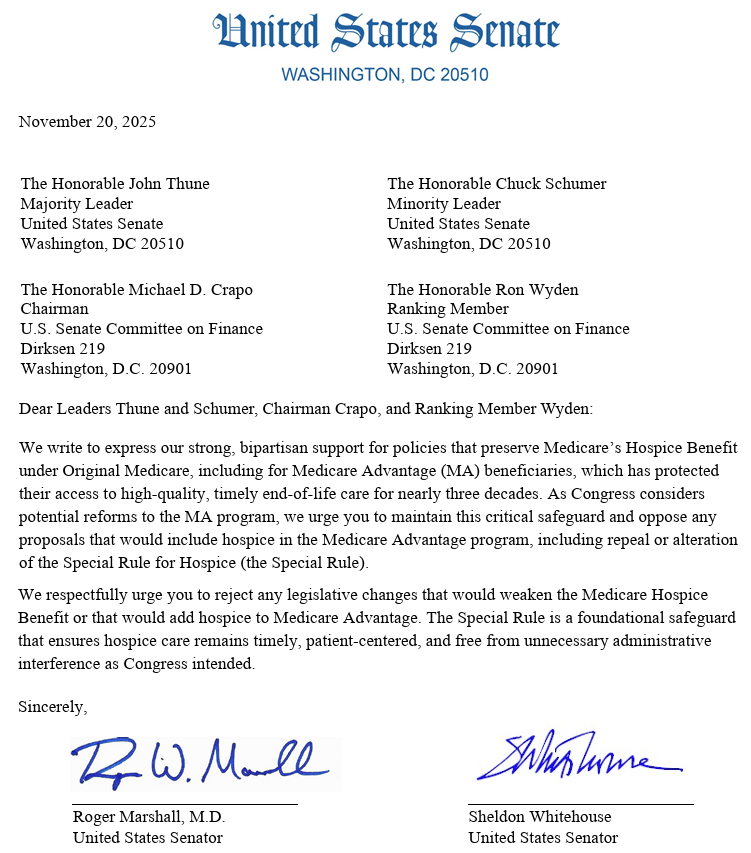
Alexandria, VA and Washington, D.C., November 24, 2025. On November 20, Senator Roger Marshall (R-KS) and Senator Sheldon Whitehouse (D-RI) sent a letter to Senate leadership expressing strong bipartisan support for policies that preserve the Medicare Hospice Benefit under Original Medicare, including for Medicare Advantage (MA) beneficiaries, which has protected their access to high-quality, timely end-of-life care for nearly three decades. 

Repeal Special Rule

As Congress considers potential reforms to the MA program, the letter urges Senate leadership to maintain this critical safeguard and oppose any proposals that would include hospice in the Medicare Advantage program, including repeal or alteration of the Special Rule for Hospice (the Special Rule), also known as hospice carve-in.  

Hopice in MA

Despite years of attempts from Congress, the Alliance strongly opposes efforts to integrate hospice into Medicare Advantage (MA). Past attempts have revealed challenges such as administrative burdens, difficulty creating networks, and delayed payments for claims. Bringing hospice under Medicare Advantage would undermine patient choice, adversely impact timely access to care, and fragment the hospice experience for patients and families at a highly vulnerable time.

View the full letter here. 

Leave Hospice Carve-In Out

Excerpt

“MA enrollees who elect hospice currently retain the freedom to choose any Medicare-certified hospice provider, free from network limitations or prior authorization requirements. More than half of hospice beneficiaries pass away within 14 days of election, making delays in care both harmful and unacceptable. Integrating the hospice benefit into MA plan design would jeopardize this access by layering additional managed care terms (or policies) on top of an already managed and coordinated benefit.” 

Marshall and Whitehouse

U.S. Senators

Your content goes here. Edit or remove this text inline or in the module Content settings. You can also style every aspect of this content in the module Design settings and even apply custom CSS to this text in the module Advanced settings.

“The Alliance thanks Sen. Marshall and Sen. Whitehouse for listening to the concerns of the care at home community and taking action to protect our nation’s most vulnerable patient population by defending the Hospice Benefit under original Medicare,” said Scott Levy, Chief Government Affairs Officer at the Alliance. “The Alliance will continue to lead on this important public policy priority for hospice providers nationwide by advocating to preserve this sacred promise established by Congress and kept on behalf of the American people for over four decades.” 

# # #

About the National Alliance for Care at Home

The National Alliance for Care at Home (the Alliance) is the leading authority in transforming care in the home. As an inclusive thought leader, advocate, educator, and convener, we serve as the unifying voice for providers and recipients of home care, home health, hospice, palliative care, and Medicaid home and community-based services throughout all stages of life. Learn more at www.AllianceForCareAtHome.org.  

© 2026. This press release originally appeared on the National Alliance for Care at Home Website and is published with permission. For additional information or for permission to print, please see press contact above.

What Can Providers Give to Patients, Part 5

by Elizabeth E. Hogue, Esq.

What Can Providers Give...

Recap

Providers, including marketers, are tempted to give patients and potential patients free items and services. While providers usually have good intentions, they must comply with applicable requirements. 

Part 1

As Part 1 of this series indicates, there are two applicable federal statutes: the Anti-Kickback Statute (AKS) and the Civil Monetary Penalties Law (CMPL). Part 1 also makes it clear that there are a number of exceptions. If providers meet the requirements of applicable exceptions, they can give patients and potential patients free items and services that would otherwise violate applicable requirements. 

Part 2

Part 2 describes an exception for items and services of nominal value with a retail value of no more than $15 per item or $75 in the aggregate per patient on an annual basis that may be given by providers to beneficiaries. Providers may not, however, give cash or cash equivalents.

Part 3

Part 3 describes the circumstances under which providers may give free items and services to patients with demonstrated financial need.

Part 4

Part 4 summarizes recent guidance from the Office of Inspector General (OIG) about giving incentives to promote vaccination against COVID-19.

Care & Services

According to the OIG, providers may also give patients free preventive care items or services. The definition of remuneration under the CMPL regulations excludes incentives given to patients/potential patients to promote the delivery of preventive care services so long as the delivery of such services is not directly or indirectly related to the provision of other services reimbursed in whole or in part by the Medicare Program or other state and federal healthcare programs. Preventive services include:

  • Prenatal services or postnatal well-baby visits, or specific clinical services described in the current U.S. Preventive Services Task Force’s Guide to Clinical Preventive Services
  • Services that are reimbursable in whole or in part by the Medicare Program, or other federal and state care programs

Incentives

However, incentives related to preventive services may not include:

  • Cash or instruments convertible to cash
  • Incentives of value that are disproportionally large in relationship to the value of the preventive care services in terms of either the value of the services or the future health care costs reasonably expected to be avoided as a result of preventive care
What Can Providers Give to Patients

Preventive

Any tie between provision of exempt covered preventive care services and covered services that are not preventive may, therefore, violate the CMPL and the AKS.

The OIG has stated that some free or discounted services may fit within the preventive care exception described above. These services may include free blood sugar screenings and cholesterol tests.

Anti-Kickback Exceptions

The AKS does not include an exception similar to the provisions of the CMPL described above. In commentary to Supplemental Compliance Guidance for Hospitals, however, the OIG said:

From an anti-kickback perspective, the chief concern is whether an arrangement to induce patients to obtain preventive care services is intended to induce other business payable by a Federal health program. Relevant factors in making this evaluation would include, but not be limited to: the nature and scope of the preventive care services; whether the preventive care services are tied direct or indirectly to the provision of other items or services and, if so, the nature and scope of the other services; the basis on which patients are selected to receive the free or discounted services; and whether the patient is able to afford the services.

Final Thoughts

Based upon the above, the OIG is unlikely to challenge the provision of free preventive services given to patients and potential patients, under either the CMPL or the AKS, so long as the above requirements are met.

# # #

Elizabeth E. Hogue, Esq.

Elizabeth Hogue is an attorney in private practice with extensive experience in health care. She represents clients across the U.S., including professional associations, managed care providers, hospitals, long-term care facilities, home health agencies, durable medical equipment companies, and hospices.

©2025 Elizabeth E. Hogue, Esq. All rights reserved.

No portion of this material may be reproduced in any form without the advance written permission of the author.

©2025 by The Rowan Report, Peoria, AZ. All rights reserved. 

Medicare Advantage Reform

by Kristin Rowan, Editor

Medicare Advantage Reform

Background

Traditional Medicare is available to any U.S. citizen over the age of 65 or with a qualifying disability. Part A covers hospital care, skilled nursing facility care, hospice care, and some medically necessary home health care while Part B covers doctor visits and outpatient care. Medicare is billed through and paid by the federal government.

Medicare Advantage (originally Medicare+Choice) is Medicare coverage offered by private insurance companies who are then reimbursed by the government. The goal was to create competition and lower costs. It has done neither. Medicare Advantage plans are supposed to provide all of the coverage from Parts A, B, & D except hospice care. That is still handled by traditional Medicare.

Hospice Carve-in Plan

Despite the epic failure of the recent hospice carve-in experiment, House representative Schweikert (R-AZ) introduced H.R. 3467 to reform the Medicare Advantage program and included a requirement for hospice care. The goal, according to Schweikert, is to eliminate waste and fraud and stop MA insurance companies from making billions in profits by upcoding. The solutions, outlined in H.R.3467, include requiring MA recipients to stay on the same plan for at least three years and permanently including the hospice benefit in MA plans.

Eight New Bills

On November 19, 2025, Representative Mark Pocan (D-WI), with the support of 12 other members of the House, introduced eight separate bills aimed at Medicare Advantage reform and strengthening traditional Medicare. The eight bills include:

1. Disincentives for delaying and denying lifesaving care due to prior authorization requirements
2. Automatic appeals for any denial of care
3. Visually and audibly disclosing delay and denial rates in advertising
4. Banning participation in MA for any company convicted of defrauding the government
5. Lowering MA reimbursement rates to at or below traditional Medicare rates
6. Limiting the number of MA plans a company can offer to 3 per year
7. Prohibiting MA from being the default option
8. Creating a website listing all doctors by plan

Commentary

In addition to the package cosponsors and six endorsing organizations, Rep Pocan received industry expert support for his bill package.

“Big Insurance has long pitched Medicare Advantage as a key tool to lowering health care costs and delivering better care, but like so much of their rhetoric, this is nothing but bold-faced lies. The truth is, Medicare Advantage is neither Medicare nor an advantage. And it certainly doesn’t exist to lower costs. It exists to help Big Insurance make sky-high profits and enrich shareholders. It is long past time Congress stepped in and protected patients. The legislative package Congressman Pocan is introducing is the most comprehensive plan ever introduced to rein in Medicare Advantage and protect patients. Congress should pass these bills without delay.”

Wendell Potter, President, The Center for Health and Democracy

“Medicare Advantage insurers profit from withholding medically necessary care, and can withhold care with near impunity. So, people enrolling in corporate MA plans are forced to gamble with their health and with their lives. They can’t avoid the bad actors. It’s time Congress protected older Americans and people with disabilities from bad actor Medicare Advantage insurers, as Congressman Pocan’s MA Bill package would do.”

– Diane Archer, President and Founder, Just Care

Rep. Pocan’s bills do not include the hospice carve-in and would leave hospice care under traditional Medicare. 

Faulty Logic?

Medicare Advantage plan payors have been accused of upcoding, fraud, overbilling, delays in care, and denials that circumvent the rule that MA must cover everything traditional Medicare does. It may be naive to assume that passing these bills will force unscrupulous companies to suddenly have integrity.

MA enrollees pay the standard Part B premium and might pay an additional MA premium depending on their income, geographic locations, and/or additional plan benefits. Rep. Pocan’s bill lowers what MA charges the government (aka tax payers) but does not address what the plans charge enrollees. If MA plans are required to lower reimbursement rates by 10%, for example, won’t they just increase premiums, deductibles, and copays or remove additional benefits? Sure, the government spends less, but out-of-pocket costs increase and quality of care drops.

The “Seniors Choice” bill limiting the number of plans to three is unclear in its direction. A 2019 rule removed the meaningful difference requirement for MA plans. This bill seeks to reinstate that requirement, but changes the term to “significantly different” in premiums, benefits, and cost-sharing. There are too many variables in health insurance to limit the choices to three. Three choices per company lessens the competitive need to keep prices low. 

Not so Hidden Agenda

Medicare Advantage reform is sorely needed. MA is largely fraudulent, misleading, and costly both in spending and health. Chipping away at some of these pieces is for the good of the enrollees on their surfaces. But dig just a little deeper and the goal is clear. 

Overwhelmingly, the organizations in support of this bill package are proponents of a single payer system. The prior authorizations disincentive is termination of the entire contract for the year. The disallowing participation bill includes all companies and individuals convicted of any crime, misdemeanor or greater, in any way connected to healthcare, all financial misconduct in or out of healthcare, and all acts of fraud, kickbacks, and misrepresentation of material fact. Any plan charging more than its traditional Medicare counterpart will be eliminated. Given these restrictions, it will not take long for every Medicare Advantage plan to be eliminated entirely.

 The recent government shutdown centered around the ACA subsidies that are set to expire at the end of the year. The elimination of those subsidies could push healthcare insurance premiums to a level that few can afford, furthering the need for a single payer plan.

Final Thoughts

The White House has promised a health care proposal with much speculation but no facts. The proposal has yet to be released. Congress is still negotiating the extension of Covid-era subsidy increases with only a few weeks remaining before they adjourn for the holidays. ACA participants are having to renew their health insurance without knowing what the final cost will be and many believe the number of participants will drop significantly, leaving millions uninsured. 

None of the proposed solutions will fix all the problems with healthcare. But, a temporary stay is better than losing access to healthcare altogether. This is an ongoing issue and The Rowan Report will continue to bring you the latest information as it becomes available.

# # #

Kristin Rowan, Editor

Kristin Rowan has been working at The Rowan Report since 2008. She is the owner and Editor-in-chief of The Rowan Report, the industry’s most trusted source for care at home news, and speaker on Artificial Intelligence and Lone Worker Safety and state and national conferences.

She also runs Girard Marketing Group, a multi-faceted boutique marketing firm specializing in content creation, social media management, and event marketing.  Connect with Kristin directly kristin@girardmarketinggroup.com or www.girardmarketinggroup.com

©2025 by The Rowan Report, Peoria, AZ. All rights reserved. This article originally appeared in The Rowan Report. One copy may be printed for personal use: further reproduction by permission only. editor@therowanreport.com


What Can Providers Give to Patients, Part 4

by Elizabeth E. Hogue, Esq.

What Can Providers Give to Patients...

...and COVID-19

On May 24, 2021, the Office of Inspector General (OIG) of the U.S. Department of Health and Human Services (HHS) issued another FAQ on the Application of Administrative Enforcement Authorities to Arrangements Directly Connected to the Coronavirus Disease:

Would the offer or provision of cash, cash-equivalent, or in-kind incentives or rewards to Federal health care program beneficiaries who receive COVID-19 vaccinations during the public health emergency violate the OIG’s administrative enforcement authorities?

Covid Vaccine Incentives

The OIG first addressed this question by acknowledging that a broad range of entities, including providers, are offering a wide variety of incentives and rewards to recipients who are vaccinated; such as food and beverages, cash, and tickets to concerts and sporting events. The OIG recognizes that widespread vaccine administration is crucial to the pandemic response and that incentives and rewards may promote broader access and increase the number of recipients.

A question of legality

The OIG also pointed out, however, that these rewards and incentives may violate the federal Anti-Kickback Statute (AKS) and the Civil Monetary Penalties Law (CMPL) governing beneficiary inducements.

An Exception to the Rule

The OIG then concluded that providers, in the limited context of the COVID-19 public health emergency, may give rewards or incentives to beneficiaries who receive either one or both doses of the vaccine because such incentives and rewards “would be sufficiently low risk under the Federal anti-kickback statute and Beneficiary Inducements CMP.” 

With Limitations

Providers must, however, meet the following requirements:

Providers Patients COVID
The incentive or reward must be furnished in connection with receipt of a required dose of COVID-19 vaccine, including either one or two doses depending on vaccine type.

The vaccine administered is authorized or approved by the Food and Drug Administration (FDA) as a vaccine for COVID-19 and is administered in compliance with all other applicable federal and state rules and regulations, including conditions for receipt of vaccine supplies from the federal government by providers.

Incentives or rewards are not tied to or contingent upon any other arrangement or agreement offering incentives or rewards between providers and beneficiaries.

Incentives or rewards are not conditioned on recipients’ past or anticipated future use of other items or services that are reimbursable in whole or in part by federal health care programs.

Incentives or rewards are provided during the COVID-19 public health emergency.

Does Not Apply

The OIG then pointed out that the AKS and CMPL relate to items and services for which payment may be made in whole or in part under a Federal health program. According to the OIG, it is unlikely that these statutes are implicated by incentive and rewards furnished to commercially insured or uninsured individuals.

Not Specific to Covid

Finally, the OIG concluded by saying that it would not express any opinion on the merits or utility of particular incentives or rewards to address the goal of encouraging vaccination. 

As long as the criteria above are met, providers may give incentives or rewards to beneficiaries in order to encourage them to be vaccinated.

This article is part 4 in the series. Read Part 1, Part 2, and Part 3.

# # #

Elizabeth E. Hogue, Esq.

Elizabeth Hogue is an attorney in private practice with extensive experience in health care. She represents clients across the U.S., including professional associations, managed care providers, hospitals, long-term care facilities, home health agencies, durable medical equipment companies, and hospices.

©2025 Elizabeth E. Hogue, Esq. All rights reserved.

No portion of this material may be reproduced in any form without the advance written permission of the author.

©2025 by The Rowan Report, Peoria, AZ. All rights reserved. 

Dr. Steve Landers: an Interview

by Kristin Rowan, Editor

Dr. Steve Landers

An Interview from the Alliance Annual Meeting

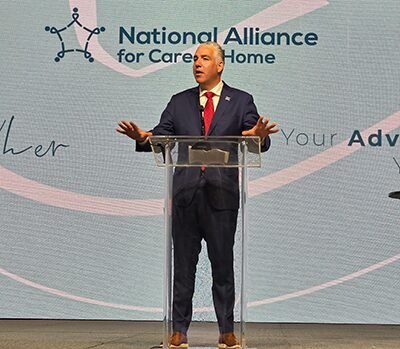
On the heels of the inaugural National Alliance for Care at Home Annual Meeting & Expo, I sat down with Alliance CEO Dr. Steve Landers to talk about his feelings on the event, the current state of the industry, and the future of the Alliance.

In His Own Words

The Rowan Report:

We’re just about at the end of the first annual meeting since the merger of NHPCO and NAHC. What are your thoughts on how the event was received?

Dr. Steve Landers:

Yeah, it’s been great. You know, we have, we’ve had great attendance, and the energy has been good, and we’ve got diverse participation from people all throughout the care at home community from all over the country, and I think people learned a lot and got to spend time with friends and colleagues and do business. I’m feeling good about it.

RR: I assume you’ve learned alot and we’ll see some changes next year. Where will we be in 2026?

Steve: We’ll be in Washington, D.C. next fall. Also, our summer financial summit is still on the agenda. So, we’ll be in Boston and we’re hoping to see as many people out as possible.

Alliance Annual Meeting Review Steve Landers

Alliance Outlook 2026

RR: And your new board members, who start in January, were announced earlier. Sounds like you have some great people incoming next year. What is the focus for the organization in 2026?

Steve:

We are continuing to position ourselves as strong advocates in Washington for the issues that our members are facing. The whole board and team will be very much dug in and committed to putting the best possible effort forward on the big things that our members are facing from an advocacy standpoint. Of course, we want to continue to strengthen the member programming and the educational offerings. We are going to try to build on our partnership with the research institute for home care to try and add more research activities to the to the programming.

There are some things that we’re still not sure about how next year is going to look, because on the public policy front, we still have some kind of pending issues that we’re hoping get ironed out in a positive way. Depending on how the year wraps up, we could be very much still in a bit of a firefight, whether that’s the Medicare Home Health payment system, face to face certification access for hospice and home health services, or depending on if any type of Medicare Advantage legislation comes up. So there’s still a lot unknown about how the early year looks from an advocacy standpoint, but definitely, you know, with the existing board members and new board members and our team will be leading the way on those fronts.

Medicare Home Health Proposal

RR:

There are a lot of unknowns right now with the shutdown, the hospice carve out, and other issues we’re not really seeing any movement on. Is there any one unknown that is more challenging than others?

Steve: I think the most front and center issue is the Medicare Home Health payment proposal, because it was a terrible, misguided proposal that’s going to hurt lots of people, probably cost lives, cost the system more money, and so that’s definitely so visible and acute because it’s right with us.

If we see any more movement on this issue of hospice and Medicare Advantage that will certainly become more of an acute issue. We’re already taking it very seriously and are very actively and aggressively trying to push back that bad idea. 

And, of course, the longer this government shutdown, the more harm there is with things like access to telehealth, so that’s high on our mind. There are a lot of other issues we’re concerned about with the future of Medicaid HCBS and the business environment for private duty home care as well. So, the list is long.

Advocacy

RR: Very long, indeed. During the opening keynote you mentioned a call for advocacy from everyone in attendance. Specifically, you mentioned presenting “one voice.” Are there current issues that has the industry divided?

Steve: I think we’re doing a good job of keeping people together. I think there’s always a risk when people get passionate and are wanting to solve problems. If we accidentally are publicly going in different directions, that’s not productive. I wouldn’t highlit any specifics, but I think, in general, the more we can come togehter on various issues because our goals are the same. None of us want to see care at home get cut back and over regulated. Everyone involved in these issues care about the same things. But, in Washington, when attention spans are very short, you only have so much political capital so we make sure we’re pushing for the same things in those advocacy efforts.

RR: Have you gotten any indication of where CMS is landing on the final payment rule? Last I heard, they had thousands of comments and feedback on the major cut.

Final Rule

CMS home health final rule

Steve: They have received an incredible amount of comments. here have been meetings at all levels of the administration on these issues. We have outlined all of the aspects of this, from the access challenges to how cutting back home health is only going to lead to lead to higher overall expenses. We’ve given them a clear outline of the methodological flaws that they made in doing their calculations and their budget neutrality calculations. We’ve been very clear as well on where they have likely baked in data from pockets of fraud that are creating disadvantages for legitimate care providers in the way that the rate system comes out, So they have everything that they should need to reset these payments to where they should be based on the law. But, it’s a scary moment because they made this proposal in the first place, and at some point, somebody thought it was a good idea.

Keep Fighting

RR: What is the next step if the cuts happen?

Steve: If we don’t get what we’re hoping for, which is a real reset of these methodologies, then, the amount of teamwork and intense advocacy that’s going to have to happen to try to get Congress to fix this mistake is going to be enormous. And every one of us is going to have to put in whatever we can. Because, letting ourselves fall off of this type of cliff, letting patients and families fall off this kind of cliff, is just… it’s not… we’re gonna have to fight it every every step of the way. It’s just not right.

Commentary

The interview paused here. It was barely perceptible and nearly impossible to describe on paper. The depth of emotion conveyed in Dr. Landers’ words was palpable, sincere, and honest. In these few seconds, I was given the gift of insight on how completely Dr. Landers commits to this cause and how strong are his convictions. It was a powerful moment that I hope you all have the opportunity to witness.

Home Health Stabilization Act

RR: Both you and your predecessor, Bill Dombi, have talked about how devastating these cuts will be. Estimates of 50% of home health agencies closing, reduced access to care, loss of jobs for caregivers, and especially devastating to the patients. What if this doesn’t change? Obviously, it’s going to take everybody working together. But what’s the first step? Is there a plan?

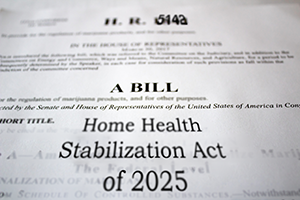
Steve: Oh, yeah, we’ve already been working with champions in Congress to introduce H.R. 5142 the Home Health Stabilization Act of 2025. If passed into law, would halt these cuts for 2026 and 2027 and allow time to work with Congress and the administration on more comprehensive, long term fix to this total mess that’s been developed by these flawed methods and give time to really work on comprehensive solutions to some of the fraud and abuse issues and potentially other reforms that could help. Now, anytime you’re trying to get an act of Congress passed, especially with a Congress that’s not open right now, with only so many days left in the legislative calendar, that’s no guarantee either, but that is the contingency that we’ve been developing.

Dr Steve Landers Interview

If they don’t fix their proposal, they’re going to march forward on January 1 with another set of cuts that are going to lead to more delays in care and more people getting referred and not getting care and more rural and high poverty communities not haveing access to care and more people going back to the hospital and costing the system more. There are life and death issues. Not just an inconvenience or a cost. People can die. It’s a big deal.

RR: I think the industry as a whole feels like CMS is only looking at the financial numbers and not the consequences of what theyre doing. There are real people who are being damaged by these decisions.

Steve: Yeah, the proposed rule did not seem to take these things into account and it was not a patient- or family-centered proposal. It’s not a final rule yet. Their final action is pending and they need to address those issues. They have a responsibility, I believe, as public servants. I believe there’s a moral obligation here to revisit what was done and get it right.

RR: And, we do have some advocates at the congressional level, correct?

Steve: Yeah, we’ve been working with members of Congress to get them to weigh in with the administration, to tell them “get your final rule right.” We have been working on a contigency that if the rule is not done correctly that Congress would force them through legislation to stop the cuts. We’re not there yet, but we could be any day now. We’ve done that work with Congress to make that progress. That amount of advocacy will require teamwork. This is one of the reasons I was trying to emphaze the importance of unity if we end up with a very short calendar and a really hard problem to solve. It’s going to be pretty intense.

RR: And we’ll be right there with you if that happens, saying “how can we help?” I know this is the most pressing issue right now, but is there anything else industry-wise that you’re looking forward to and excited about?

Future Outlook

Steve: You know, I think it’s been fun and exciting and in some ways inspiring to see this alliance community grow and build. Whether it’s all these new and innovative AI solutions that our members are getting excited about, how they can improve workflows and efficiences, or whether it’s the attention for the storytelling around the issues that our members care about on social media and earned media. There are a lot of reasons to be excited and enthusiastic about the future.

I think the AI advancements have been really exciting and interesting for the industry, because there’s so much that can be done. And certainly, regardless of how big the cuts are, any cuts are going to be difficult for home health, and especially on top of what we’ve already had, yeah, but, you know, you being able to use these AI solutions to kind of cut some of the costs and things and offset that is, is at least a silver lining in some of it, and improve the worker experience, maybe in ways that make it a little less burdensome, and you can maybe keep more people in the
workforce.

RR: Well, I want to congratulate you. You’ve made it through your firstfull year in thisposition. I think there was a sense of this event being the test, the “How did the two organizations really come together and produce this huge thing,” and, it seems likethe blending of the home health with the hospice has worked really. Attendance is high and the vibe seems to be very positive.

Steve: You know, there’s a test every day. We have to keep trying to serve our community, and it’s a journey. We’ve got a great board, and a great team. They’re focused on the mission. The team came together nicely after the merger. Now that it’s settling down, we’re just going to keep working towards a bright future. Just keep at it.

RR: I think you’ve handled it all really well and the success of this event is a testament to that, as well as the other education and advocacy you’ve accomplished in the last year. I appreciate you taking the time to talk to me today. Keep fighting the good fight. 

Steve: Absolutely. Thank you.

# # #

Kristin Rowan, Editor

Kristin Rowan has been working at The Rowan Report since 2008. She is the owner and Editor-in-chief of The Rowan Report, the industry’s most trusted source for care at home news, and speaker on Artificial Intelligence and Lone Worker Safety and state and national conferences.

She also runs Girard Marketing Group, a multi-faceted boutique marketing firm specializing in content creation, social media management, and event marketing.  Connect with Kristin directly kristin@girardmarketinggroup.com or www.girardmarketinggroup.com

©2025 by The Rowan Report, Peoria, AZ. All rights reserved. This article originally appeared in The Rowan Report. One copy may be printed for personal use: further reproduction by permission only. editor@therowanreport.com
 

National Alliance Annual Meeting: A Review

by Kristin Rowan, Editor

National Alliance for Care at Home

Annual Meeting and Expo

Was anyone else waiting with great anticipation to see the first annual meeting after the merging of NAHC and NHPCO? Or was it just me? I attended the Financial Summit over the summer and didn’t sense much of a difference from the Financial Management Conference from years past. But, I had a feeling the fall event would be different.

First Impressions

Registration started early. I arrived on Saturday to experience some of New Orleans and was able to register that afternoon.

Alliance Annual Meeting

On Sunday, a full snack spread was available before the keynote address. Coffee, chips, cookies, soda. I overheard several positive comments about the snacks and drinks on my way in. There was a feeling of excitement in the air and it was instantly noticeable that attendance was up from years past.

Opening Session

Aesthetically dynamic stage backdrop. Extra large stage that rarely, if ever, had more than four people on it at a time. Acoustics in the very large room garbled some of the presentations. 

Content for the opening session began with remarks from Louisiana Governor Jeff Landry. While somewhat political in nature, the address was uplifting and positive. Dr. Steve Landers, CEO of the Alliance closed the session with a brief industry update. 

Perspectives From Both Sides

Interviewing several attendees, the reviews of the meeting were mixed, but predictable. Past members of NHPCO felt the educational sessions were too home health focused while past members of NAHC felt there was too much Hospice content. 

Some attendees were “over” all the AI software while others were excited about where AI could help improve processes and cut expenses. For a more indepth look at the vendors, read our companion article from Editor Emeritus Tim Rowan as he highlights the companies tackling OASIS with AI.

The closing gala, hosted by National Hospice Foundation, a fundraiser reminiscent of NHPCO conferences but wholly foreign to NAHC members, sold out and the live and silent auctions gathered significant donations for the foundation. Attendees dressed to the nines for the event. Reviews following the evening were resoundingly positive. 

The Best of the Best

Overwhelmingly, attendees highlighted two key features of this year’s meeting that stood out above all else. 

The availability of snacks and drinks throughout the day was a welcome surprise. A variety of offerings were found outside the expo hall, outside breakout rooms, outside general session rooms, and even inside some breakout rooms. From before the opening keynote to just before the closing session, attendees never went hungry.

The coup de gras, as they say in New Orleans, was the keynote on Monday from the host of the Squeezed Podcast, Yvette Nicole Brown. Most known for her role as Shirley Bennett on Community, Yvette is a caregiver. She was the primary caregiver for her father for more than ten years as he battled Alzheimer’s. Yvette discussed how her role as a caregiver changed her, prompted her to start her podcast, and led her to champion sharing caregiver stories to strengthen organizational culture and support systems for caregivers. Her powerful story left many in tears and furthered the imperative call to advocacy echoed by the Alliance.

From the Alliance

Following the success of the inaugural annual event, the Alliance issued a press release and statement from Alliance CEO Steve Landers.

“This first annual meeting and expo as the Alliance showcased our strength as a unified organization. We were thrilled to bring together leaders in home health, hospice, and the breadth of care at home from across the nation to unite, learn, and share our commitment to creating a future where all Americans have access to high-quality, person-centered healthcare wherever they call home. We look forward to continuing to convene the care at home movement and work toward our shared purpose.”  

Dr. Steve Landers

CEO, National Alliance for Care at Home

The Rowan Report sat down with Dr. Landers just before the closing session. Read the interview here.

Final Thoughts

Members of NHPCO and NAHC saw noticeable differences from their past events. This was inevitable after the merger and not unexpected. As a whole, the event was organized, well-run, enjoyable, informational, and well-received. I’d say the Alliance had a successful first run and we look forward to continued improvements in years to come.

# # #

Kristin Rowan, Editor

Kristin Rowan has been working at The Rowan Report since 2008. She is the owner and Editor-in-chief of The Rowan Report, the industry’s most trusted source for care at home news, and speaker on Artificial Intelligence and Lone Worker Safety and state and national conferences.

She also runs Girard Marketing Group, a multi-faceted boutique marketing firm specializing in content creation, social media management, and event marketing.  Connect with Kristin directly kristin@girardmarketinggroup.com or www.girardmarketinggroup.com

©2025 by The Rowan Report, Peoria, AZ. All rights reserved. This article originally appeared in The Rowan Report. One copy may be printed for personal use: further reproduction by permission only. editor@therowanreport.com