OASIS, OASIS Everywhere!

by Tim Rowan, Editor Emeritus

OASIS, OASIS, Everywhere

At this year’s annual meeting of The National Alliance for Care at Home, one could not attend a general or breakout session or walk an aisle in the exhibit hall without hearing about artificial intelligence. After 27 years covering Home Health, Home Care, and Hospice technology, I have seen buzzwords come and go. Declared game-changers have evolved from Windows to the iPad, to smartphones, to telehealth, to Big Data, to the Internet itself.

Interestingly enough, the “game” never changed. Patients/clients, nurses/CNAs, claims, payroll, and A/R have always, and will always, keep owners, administrators, and managers sprinting. AI will bring massive changes, but not to these constants.

AI is a Supplement, not a Replacement

There is much concern, and a plethora of articles, about how easily AI can be abused, even with the most noble intentions. We have detected serious concern about a movement to allow AI to make clinical decisions. We concur that this is inappropriate. Advising clinical decisions, providing background on previous patients with similar symptoms, or quickly accumulating data on the history of a chronic condition, can benefit our patients and clients in ways no other technology has been able to do. Making clinical decisions is different in both kind and degree.

This is why we were impressed with the focus on supplementing over replacing that we witnessed in New Orleans.

Ambient Listening for OASIS

When WellSky acquired Kinnser, everyone wondered whether the Home Health EMR would improve or merely be maintained for its customer base. Longtime friend of The Rowan Report, and WellSky and former Fazzi consultant Cindy Campbell, RN, convinced us with her uncharacteristic effusiveness to take another look at the latest WellSky feature.

AI OASIS

How it works

During the OASIS visit, the nurse in the home logs into an app and places it between him/her and the patient. As the normal OASIS conversation takes place, the AI-enabled app not only hears but interprets every nuance of the chat. By the time the OASIS visit is over, the agency’s EMR has been fully populated. Every OASIS question has been answered, and every numerical rating field has been accurately completed.

Human touch

Wisely, WellSky allows no AI OASIS assessment to be saved or signed without review by a human. This is going to become standard practice as AI evolves, or at least it should be, the WellSky rep told us. Machine assistance is far removed from machine perfection. Nevertheless, she asserted, few changes are required by the reviewer, usually a QA nurse.

Beyond OASIS

In addition to streamlining the OASIS assessment visit, the new app gives voice reminders to each nurse of their daily and weekly schedule, and background information about each patient’s visit history, current condition, and goals.

But Wait, There's More

Our AI tour did not end at the WellSky booth. We lost count of the number of smaller companies that were demonstrating the exact same AI-assisted OASIS assessment. It was as though some unknown force ordered, “OK, everyone. It’s 2025. Roll out your Home Health AI functions.”

One of many

Roger is the name of one of the more evolved such apps, from the aptly named Roger Healthcare. We had interviewed co-founder Yunus Ansari several months ago and were impressed by the product’s progress since then. Like WellSky and the others, Roger claims 15-minute OASIS visits, 5-minutes routine visit notes, 2-minutes EMR syncing, and larger per-nurse patient caseloads without additional work time.

Where Do We Go From Here?

Clearly, AI is not a fad. It has already permeated Amazon, Facebook, and most gas and electric vehicles. In Home Health, Home Care, and Hospice, it promises to accelerate research, education, paperwork, and revenue cycle management. Here is the red line in the sand. When used to enhance the efficiency and working knowledge of a nurse, CNA, or non-medical caregiver, it will go a long way toward helping in-home care to keep up with budget cuts, reimbursement reductions, inflation, and nurse/caregiver shortages.

When used to replace the clinical expertise of physicians, nurses, CNAs, and even personal care assistants, it smacks of HAL, the renegade computer of 2001: A Space Odyssey. What we need to do as AI infiltrates more and more aspects of our lives, is constantly remind ourselves that it is only a tool, not a master.

# # #

Tim Rowan The Rowan Report
Tim Rowan is a 30-year home care technology consultant who co-founded and served as Editor and principal writer of this publication for 25 years. He continues to occasionally contribute news and analysis articles under The Rowan Report’s new ownership. He also continues to work part-time as a Home Care recruiting and retention consultant. More information: RowanResources.com
Tim@RowanResources.com

©2025 by The Rowan Report, Peoria, AZ. All rights reserved. This article originally appeared in The Rowan Report. One copy may be printed for personal use: further reproduction by permission only. editor@therowanreport.com


AI Eases Clinician Burnout

by Curantis Solutions

AI in Hospice and Palliative Care

Eases Clinician Burnout and Drives Retention

In hospice and palliative care, clinicians are your most valuable and most vulnerable resource. They’re the heart of care delivery, and often the largest expense line item on your budget. But today, many are walking a tightrope between compassion fatigue and after-hours documentation burnout. Hospice organizations can’t afford to lose them. And with AI-powered tools, you don’t have to.

Clinician burnout Is a crisis and a cost center

Hospice nurses and interdisciplinary team members are burning out at unsustainable rates. The emotional weight of their work is immense, but it’s the after-hours charting, documentation delays, and system inefficiencies that often push them over the edge. The cost of clinician turnover is staggering. Onboarding and training a new hospice nurse takes time, money, and trust, and patients feel the impact, too. 

AI bridges the gap without replacing the human touch

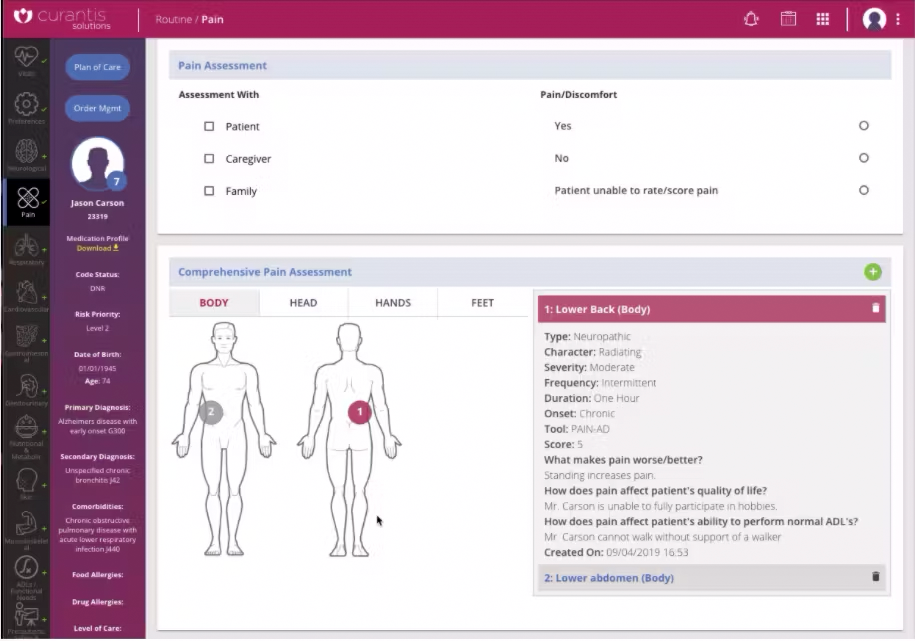
Curantis Solutions is leading the way with AI that lightens the load. Our embedded AI assistant, EVA, supports clinicians in real-time, reducing documentation friction and eliminating the need to chart late into the evening. 

How AI may help

  • Voice-to-text documentation
    • captures patient-specific details naturally, as they happen
  • Smart prompts and reminders
    • prevent missed data points and reduce rework
  • Less screen time after shifts
    • improves work-life balance and job satisfaction
  • Clinicians feel more supported and less likely to leave
AI in Hospice and Palliative Care Curantis Solutions

Retain the staff you've worked so hard to hire

When your staff hears that another organization doesn’t have modern tech or AI tools? They stay. Providing intuitive, hospice-specific tools isn’t just about efficiency. It’s about creating a culture that respects their time, honors their energy, and values their expertise. 

AI as a strategic investment in care and culture

Hospice leaders are being called to solve two problems at once:

  • Deliver exceptional, person-centered care
  • Do it with fewer resources and higher costs

AI-powered software like Curantis helps close this gap. By streamlining documentation and workflow, we help you preserve the well-being of your clinicians, which, in turn, protects your operations and your outcomes. 

Imagine this...

  • No more nurses charting late into the night
  • Fewer resignations and higher morale
  • Patients receiving care from clinicians who aren’t drained, but present and energized

# # #

Let's make clinician burnout a thing of the past

Explore how Curantis Solutions empowers your team and strengthens your bottom line. Contact us today to schedule a demo and see how we are making your software experience refreshingly simple with ChartBoost AI. 

Contact us today to see a demo and learn how we are making your software experience refreshingly simple. 

© 2025 This blog article originally appeared on the Curantis Solutions website and is reprinted with permission. For more information, please contact Curantis Solutions directly.

AI in Home Care

by Laurie Orlov, Founder, Aging and Health Technology Watch

The Future of AI in Home Care

New Research Report

Wed, 06/04/2025

PORT SAINT LUCIE, FL, UNITED STATES, June 4, 2025 /EINPresswire.com/ — The home care industry is facing a crisis. Driven by demographic shifts, longer life expectancy, and rising rates of chronic illness and cognitive decline, the demand for in-home personal care and home health care is surging. This will accelerate as the baby boomers age into their later years – in January, the oldest of the 76 million baby boomers will turn 80. At the same time, the care industries will face a critical shortage of all categories of care delivery, with millions of additional workers needed over the next decade. Against this backdrop, AI technology has emerged to help older adults in multiple ways. In a 2023 report, The Future of AI and Older Adults, AI was already able to produce insights about a person’s health needs and offer a chatbot to help with post-hospital care. In a subsequent 2023 report, AI and the Future of Care Work, it was apparent that AI could help generate an appropriate care plan and that an ‘AI Caregiver’ role was emerging to supplement in-person care delivery. In the 2024 report, The Future of AI in Senior Living and Care, AI was being used to analyze hospital discharge information to compare patient needs to nursing home capacity. 

Today there are many more initiatives and new possibilities for addressing multiple aspects of both private duty home care and home health operations, including assistance with recruiting and onboarding workers, using data to create and update care-related documents, and introducing AI agents that can be assigned to complete specific tasks. As current industry leaders note, AI tech is playing a role in care oversight and enabling the creating of hybrid models – an increasingly likely combination of in-person care supplemented with AI.

This report draws insights from experts across home care, home health care, plus software and device providers, and healthcare sectors to examine how AI is currently being used and suggest what lies ahead within the next five years.

The report can be found at this link: https://www.ageinplacetech.com/page/future-ai-home-care

# # #

Laurie Orlov The Future of AI in Home Care

Laurie M. Orlov, a tech industry veteran, writer, speaker, elder care advocate, is the founder of Aging and Health Technology Watch  market research, trends, blogs and reports that provide thought leadership, analysis and guidance about health and aging-related technologies and services that enable boomers and seniors to sustain and improve their quality of life. In her previous career, Laurie spent many years in the technology industry, including 9 years at analyst firm Forrester Research. She has spoken regularly and delivered keynote speeches at forums, industry consortia, conferences, and symposia, most recently on the business of technology for boomers and seniors. She advises large organizations as well as non-profits and entrepreneurs about trends and opportunities in the age-related technology market.  Her perspectives have been quoted in the Wall Street Journal, the New York Times, Vox, Senior Housing News, CNN Health, AARP Bulletin and Consumer Reports. She has a graduate certification in Geriatric Care Management from the University of Florida and a BA in Music from the University of Rochester. Laurie has provided testimony about technology at a Senate Aging Committee hearing and has consulted to AARP.  Advisory clients have included AARP, AOL, Argentum, Bose, Calix, CDW, Microsoft, Novartis, and Philips. Her reports include: The Market Overview Technology for Aging 2025The Future of AI in Senior Living and CareThe User Experience Needs An Upgrade 2024The Future of AI and Older and Older Adults 2023The Future of Care Work and Older Adults 2023The Future of Sensors and Older Adults 2022Beyond DIY: The Future of Smart Homes and Older Adults 2021, and The Future of Wearables and Older Adults 2021. Laurie has been named one of the Women Leaders in VoiceTop 50 Influencers in Aging by Next Avenue and one of the Women leading global innovation on AgeTech. 

©2025 by Aging and Health Technology Watch. All rights reserved. This introduction and link are printed with permission from the author. For more information or to request usage rights, please contact Laurie Orlov

Cracking the Code

by Siva Juturi, Automation Edge

How Home Health Agencies Can Boost Referral Conversion Rates

Referrals are the lifeblood of home health agencies. We’re not just talking about numbers but about connecting families with critical care. Our research shows that 94% of customers will recommend a satisfactory company.

Why Track Referrals?

Referrals:

  • Increase client acquisition efficiency
  • Boost customer loyalty and retention
  • Strengthen sales and revenue

Surprising Referral Sources

A Private Duty Benchmarking Study Notes:

  • 19.5% from current and former clients
  • 8.8% from hospital discharge planners
  • 7.1% from Medicare-certified home health agencies

The Catch

Generating referrals is only half the battle. Despite being a top source of new clients, referral conversions often encounter specific challenges that hinder their effectiveness.

Complications with Referral Conversions

Why converting referrals into paying clients can be tricky:

  • Delayed Response Time
    • Clients often reach out to multiple agencies. The first one to respond usually wins. Yet, it takes intake coordinators about 70 minutes to review a referral packet—plenty of time for potential clients to move on.
  • Misaligned Services
    • About 30% of referrals are rejected because the client’s needs don’t match the agency’s offerings, especially for specialized care.
  • Weak Referral Partnerships
    • Relationships with hospitals, discharge planners, or nursing facilities are gold, but if they’re not nurtured, the referrals dwindle—or worse, they’re not high-quality.

Strategies to Boost Referral Conversion Rate

  • Act Fast with Automation
    • Speed is everything. Implementing a rapid response system with AI-powered referral management can drastically reduce processing times and ensure accuracy. Tools that automate data extraction from referral sources mean fewer errors and quicker responses—clients notice when you’re prompt!
  • Understand Clients Thoroughly
    • Structured information gathering during the first interaction helps you truly understand a client’s needs. Personalizing care plans fosters trust and ensures your services match their expectations.
  • Empower Your Staff
Referral Conversion
    • Your team is the face of your agency. Equip them with training in empathy, effective communication, and problem-solving. Confident staff can address concerns, build rapport, and convert inquiries into long-term relationships.
  • Leverage AI for Communication
    • AI chatbots can handle initial queries, schedule consultations, and follow up with prospects 24/7, all in real-time. This keeps clients engaged, saves time for your team, and ensures no referral slips through the cracks.
  • Track, Ananlyze, and Improve
    • Real-time analytics give you insights into referral patterns, response times, and conversion rates. Use this data to refine your approach, eliminate bottlenecks, and focus on what works.

Final Thoughts

Improving referral conversions isn’t just about getting more leads; it’s about maximizing every opportunity. AI technology with a ready solution workflow can help boost conversion rates by 20%. The right AI solutions can be easy to implement, customized to your needs, and integrates with other business applications.

By acting quickly, communicating clearly, and personalizing your approach, you’ll build trust, grow your business, and help more families find the care they need.

Remember, even small changes can make a big difference. Start today by reviewing your referral process and implementing just one improvement—you’ll be amazed at the results!

# # #

Referral Conversion Rates Siva Juturi
Referral Conversions Rates Siva Juturi

Siva Juturi is Chief Customer Officer and EVP at AutomationEdge. With a passion for technology, he is a thought leader in AI and Automation, dedicated to solving home healthcare challenges. By employing AI and automation, he aims to make healthcare processes more efficient, enrich patient care cycles, and improve overall caregiver, patient & staff experience.

©2024 by The Rowan Report, Peoria, AZ. All rights reserved. This article originally appeared in Healthcare at Home: The Rowan Report. One copy may be printed for personal use: further reproduction by permission only. editor@therowanreport.com

ONSCREEN

FOR IMMEDIATE RELEASE

Contact:                           Michael Farino
New Era Communications
onscreen@newerapr.com
949-346-1984

ONSCREEN Simplifies Senior Care by Bringing Its “Joy” AI Companion to Android Tablets and iPads

A new era of care – ONSCREEN Joy is an AI companion that reduces social isolation, supports aging in place, and enhances quality of life

Las Vegas, Nevada – January 7, 2025 – ONSCREEN, Inc., a senior care technology innovator, today announced that it has expanded its innovative AI-based senior caregiving platform to include Android tablets and iPads. The new ONSCREEN Joy tablet app, is designed to enhance communication, companionship, and care for older adults. Unveiled at CES 2025, this new offering expands ONSCREEN’s mission to address social isolation and make care more accessible for seniors and their families.

Expanding “Joy” AI to Tablets

Building on the success and learnings of its TV-based Moment senior care platform, the ONSCREEN Joy app eliminates the requirement for a new hardware device, and brings ONSCREEN’s most important senior care features of the platform to Android tablets and iPads. This new app enables families to set up a senior care hub using devices they already own, often older generation devices that collect dust once the upgrade cycle comes around. By lowering the barriers to entry and leveraging existing hardware, ONSCREEN Joy enables more seniors and families to benefit from ONSCREEN’s broader caregiving platform.

Onscreen Joy AI

Key Features of ONSCREEN Joy

The app includes a wide range of capabilities designed to enhance the lives of seniors and their families:

  • “Joy” the Personal Companion: Offers engaging conversations, trivia, jokes, and creative activities like painting, bringing entertainment and stimulation to seniors.
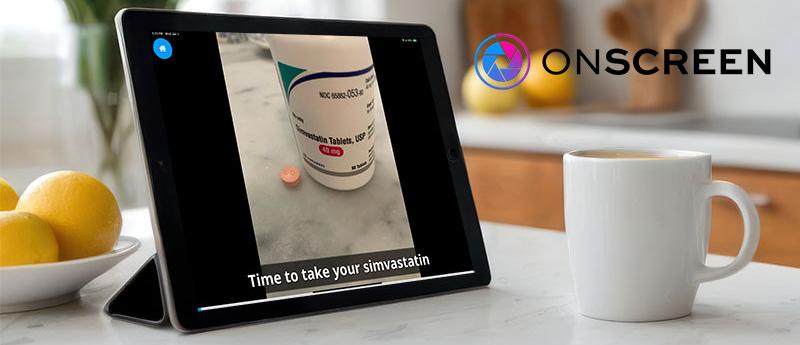
  • AI Wellness Check-Ins: Joy performs wellness check-ins in the form of friendly reminders for essential activities like taking medication, eating meals, drinking water, and engaging in physical activity.
  • Automatic Video Call Answering: Automatically connects seniors with trusted family members in their “Favorites” list, making communication seamless. Callers using both iOS and Android devices can easily connect with their older loved ones, overcoming the limitations of proprietary video calling systems tied to specific mobile operating systems (ie FaceTime).
  • Family Zoom Sessions: Allows seniors to join family Zoom calls without requiring any effort, ensuring they stay connected to larger family gatherings.
  • Simple Text, Photo and Video Messaging: Displays text messages, photos, and videos in an easy-to-read format, making it simple for seniors to engage with shared content.
  • Live Interactive Events: Provides access to live events and activities, enabling seniors to participate in engaging and interactive experiences from the comfort of their home, with no technical assistance required.
  • YouTube Content Sharing: Plays videos shared by family members directly on the tablet, offering a personalized entertainment experience.
  • Photo Gallery & Slideshow: Organizes shared photos into a dedicated gallery, creating a visual archive of cherished memories. Optionally, when the tablet is idle, photos of loved ones will be rotating through, effectively providing a convenient picture frame

Updates to the ONSCREEN Family App

In addition to launching the ONSCREEN Joy senior care tablet app, the company has rebranded its existing app for family members and caregivers as ONSCREEN Family. This app continues to provide an intuitive way for families to stay connected with their older loved ones through features like video calls, photo sharing, and real-time updates.

ONSCREEN Family works seamlessly with ONSCREEN Joy, creating a comprehensive solution that meets the needs of both seniors and their support networks. Additionally, ONSCREEN provides a web application for users that prefer to set up Routines on a larger screen, and gives family caregivers the ability to trends and outcomes resulting from Joy’s check-ins with the senior.

“Launching ONSCREEN Joy at CES 2025 is a significant step toward opening up the ONSCREEN ecosystem, and making the powerful capabilities of ONSCREEN available to more families that need them,” said Costin Tuculescu, CEO of ONSCREEN, Inc. “Our goal from day one has been to simplify technology so that seniors feel supported and engaged. By offering a tablet-based solution, we’re removing barriers and empowering families to use their existing devices to provide meaningful care.”

# # #

About ONSCREEN

ONSCREEN is dedicated to addressing the challenges of social isolation among older adults by removing technical barriers around connection, companionship and care. The company’s flagship product, Moment, has transformed senior care by leveraging the familiarity of the TV. Now, with the launch of ONSCREEN Joy, ONSCREEN continues to expand its impact, empowering families and enhancing the lives of seniors. Learn more at www.onscreeninc.com.

©2025 by The Rowan Report, Peoria, AZ. All rights reserved. This press release was submitted by New Era Communications on behalf of ONSCREEN and is printed with permission. For additional information or to request permission to print, please see contact information above.

Generative AI Comes to AlayaCare

by Kristin Rowan, Editor

Generative AI and Artificial Intelligence are taking the world, and the care at home industry, by storm. Not surprisingly, there are only a few companies that are doing AI well. We’ve started reviewing the best of of them. So far, each company doing AI well has a unique solution to a pain point in home care. No two companies are approaching or using AI the same way. This week, we’d like to re-introduce you to a company we’ve reviewed before that has a new Generative AI app launching soon.

History

Practically a household name in home care, AlayaCare is a 10-year-old software company that started as a mobile workforce platform. Like many of us, once Adrian Schauer, Co-Founder and CEO, spend some time in the care at home world, he was hooked. He shifted the focus of AlayaCare to the care at home space. With parents in their 80s, Adrian found a lack of inspiring software in the industry in Canada and he felt like that was an important problem to solve.

“Care workers are doing God’s work, and they are not getting the support they deserve,” says Schauer. In Canada, where AlayaCare started, agencies combine home health and supportive care. Because of this, the largest patient base on the AlayaCare platform is on the supportive care at home side, but they now operate within home health as well.  Since 2021, AlayaCare has added hospice to their network with the acquisition of Delta Health. 

AI Comes to AlayaCare

Through many iterations of the software, AlayaCare has advanced with new technological capabilities. Now, AlayaCare is embracing artificial intelligence; more specifically, Generative AI. Schauer explains that the purpose of their new AI technology is “to enable the type of care we want our loved ones to receive at home.” 

The new GenAI app was demoed in September of 2023 and is still in Beta testing. AlayaCare is anticipating an end-of-summer launch of the product.

Introducing...Layla

Layla is an in-app digital assistant, built on top of GenAI. It’s large language model allows the user to conversationally interact with the data in the system. It also includes a constrained internet search component. From the conversation, it can determine whether the user is seeking internal or external information.

Layla’s data exploration does more than just extracting data. The GenAi platform allows Layla to provide operational support around key metrics for employee retention.

Layla Generative AI AlayaCare

Agency Support

AlayaCare has determined some key factors in employee retention:

  • Utilization
  • Quality shifts
  • Qualified Hours
  • Recurrent shifts
  • Average weekly clients
  • Weekday hours vs weekend hours

Focusing on these factors, Layla provides improvements in onboarding, scripting information, data migration, and scheduler use of time.

Features

Visit Optimizer

AI generated, automated scheduler that takes into account route management, skill matching, daily hours, and schedule optimization to optimize care and reduce time from referral to first appointment.

The scheduling automation includes push notification capabilities to send schedule updates to clinicians in real time. As each week’s schedule is created, Layla can send a push notification to each clinician. It asks them to verify their availability and confirm the next week’s schedule.

Additionally, Layla considers environmental factors such as pets, neighborhoods, and other family members in the home.  According to AlayaCare users, the Visit Optimizer offers up to a 98% decrease in time required to fill visits, 35% improvement in visit fulfillment, and 35% improvement in data quality.

Notable

Notable transforms notes from patient visits, forms, and client records. Then, it uses AI to review, compile, categorize, and tag all the notes. 

From this information, Notable compiles an activity of daily living (ADL) for each client, including whether and why a task was completed. This information is also moved to the risk dashboard. The risk dashboard shows the whole population, the risk of that population, identifiable trends, risk level, and whether the risk has remained stable over time. All of this information is compiled into a single risk dashboard with customizable reports. 

Additional security measures for Notable include a grounded model to reduce the risk of AI hallucination and ensuring no PHI leaves the dashboard.

Employee Retention Dashboard

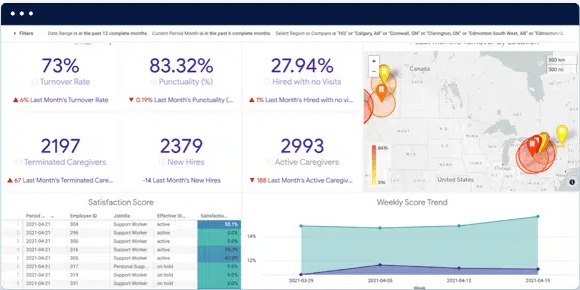
Several factors impact employee retention.  Among the top reasons for employee dissatisfaction are pay and benefits, inconsistent hours, and safety concerns. The current workforce shortage means keeping your best employees is more important than ever. With a quick snapshot of your employee satisfaction and engagement, you can address concerns earlier and improve turnover rates.

The employee retention dashboard highlights satisfaction scores, client capacity, scheduled hours, number of unique clients, overall turnover rates, turnovers by location, and more.

“Having a tool to predict employees who may be disengaged or dissatisfied prior to this happening is invaluable,” said Lee Grunberg, President & CEO, Integracare. “With the dashboard and algorithm behind it, we can see a caregivers’ satisfaction or engagement trend over time, and deploy preventative measures to reduce the likelihood that they’ll resign. It has empowered our coordinators to be much more retention-driven.”

On Deck for Layla

I spoke with Adrian Schauer, Co-founder and CEO of AlayaCare, during the online demo. “My passion project is…Layla. The people in your agency should be building relationships and making decisions. Anything else should be done by automation.” 

AlayaCare is currently in a high growth mode to build marketshare across the personal care and skilled sides of the marketing. Schauer’s goal is to elevate a level above their existing capabilities with home based care providers. This includes how payers are set up, how EVV is operating, lobbying, and advocacy. 

For Layla, AlayaCare is working on the GenAI capacity for chart completion by voice. Layla would use the conversational language model it already has to recognize and understand the conversation during a home visit and transcribe the conversation into notes, visit documentation, care plans, and codes.

Final Thoughts

As AI becomes more commonplace across care at home, we are scrutinizing AI platforms for safety, identity protection, accuracy, and ethical use. If you are looking for an AI solution for your business operations, we caution you to use discretion in your use of AI and thorougly vet the AI platform prior to adoption. We will continue to provide updates when Layla launches later this year. But, for now, it looks like we’ve found one more technology platform that is using AI the right way.

Kristin Rowan, Editor

Kristin Rowan has been working at Healthcare at Home: The Rowan Report since 2008. She has a master’s degree in business administration and marketing and runs Girard Marketing Group, a multi-faceted boutique marketing firm specializing in event planning, sales, and marketing strategy. She has recently taken on the role of Editor of The Rowan Report and will add her voice to current Home Care topics as well as marketing tips for home care agencies. Connect with Kristin directly kristin@girardmarketinggroup.com or www.girardmarketinggroup.com

©2024 by The Rowan Report, Peoria, AZ. All rights reserved. This article originally appeared in Healthcare at Home: The Rowan Report. One copy may be printed for personal use: further reproduction by permission only. editor@therowanreport.com
AI before AI

by Tom Herzog, COO of Netsmart

Navigating the Next Era of Tech-Enabled Healthcare

While the talk is about Artificial Intelligence, the immediate opportunity is Augmented Intelligence.

Some thoughts from Tom Herzog and Matthew Arnheiter 

We are living through one of the most exhilarating times in healthcare, a journey made possible by significant milestones over recent decades. As healthcare technologists deeply committed to the cause + communities we serve, we’re excited by the promise of the upcoming era of technological empowerment. This phase is set to showcase and expand upon the extensive work done in digitizing healthcare, highlighting the relentless pursuit of innovation that has characterized our field. In conversations with colleagues and clients, we have recognized the need to explore these developments as we progress collectively. Matthew and I thought a series of reflections on these conversations would be helpful for all of us, providing insights into technology’s transformative impact on healthcare and the critical initiatives currently underway. We envision this dialogue as a series of posts throughout the year, sparking discussion and reflection as we navigate forward.

Back to the Future

In 2015, we envisioned a future where the concept of navigation as we know it would be obsolete, advocating for a universal search that is nearly autonomous, informed by the known context specific to every role. By 2019, we were discussing workflow automation, using the example of Lane Departure Warning systems in automobiles as a metaphor for technology that enhances outcomes through precision responses. The pace at which these technologies are evolving is astounding, moving beyond mere speed of thought to how we can iterate at the speed of innovation itself. Before we achieve the aspirations of true Artificial Intelligence, we must start with Augmented Intelligence, which may very well be the most significant technological innovation in my lifetime.

The Gentle Guidance of Technology: Augmented Intelligence in Healthcare

Artificial Intelligence (AI) and Augmented Intelligence stand as beacon forces driving innovation forward in this fast-evolving technology landscape. Drawing an analogy to driver assistance systems in modern vehicles, we explore the nuanced differences between these concepts, simplifying their understanding and underscoring the distinct roles in enhancing human capabilities.

Artificial Intelligence: The Autonomous Navigator

Imagine AI as the driving force behind fully autonomous vehicles, adeptly navigating complex terrains without human intervention. This epitomizes the grand aspiration of AI: to emulate or even transcend human Intelligence in specific tasks, thus granting machines the ability to function independently. It’s a prospect that is as exhilarating as it is intimidating, reminiscent of scenarios depicted in futuristic films. Such advancements bring to light profound questions about the limits of technology and the ethical considerations it entails. While we marvel at the potential, apprehension about the unknown shadows our enthusiasm. As we venture into this era, it’s imperative that we tread thoughtfully, balancing our ambitions with caution, as we unlock new realms of possibilities. Together, we must navigate this journey towards outcomes that are not only innovative but also meaningful and ethically sound.

Augmented Intelligence: The Co-Pilot’s Nudge

Conversely, Augmented Intelligence mirrors the driver assistance systems in vehicles – providing “nudges” or guidance while ensuring the driver remains in control. These systems bolster safety and efficiency, complementing human Intelligence with technological support. This partnership epitomizes the collaborative synergy between technology and human skills for a safer and more efficient driving experience.

The American Medical Association (AMA) aligns with this vision, emphasizing Augmented Intelligence’s role in enhancing human Intelligence rather than replacing it. The AMA advocates for the use of AI in healthcare as a means to augment the capabilities of medical professionals, not to substitute their critical thinking or clinical judgment.

Augmented Intelligence in Healthcare: Enhancing the User’s Ability

Reflecting on the transition from conceptual frameworks to tangible applications, we’ve initiated the Augmented Intelligence family. These solutions are meticulously designed to support clinical, operational, and financial workflows across all healthcare roles. Aimed at simplifying user experiences, these tools provide the best available context and automate information for validation and use as needed. This initiative marks a significant step in harnessing the potential of augmented Intelligence, enabling transformative shifts in healthcare practices and outcomes.

Michelle Donelan MP, reflecting on the U.K.’s commitment to AI in healthcare, highlights the transformative impact of augmented Intelligence, “AI will revolutionize the way we live, including our healthcare system. That is why we’re backing the U.K.’s fantastic innovators to save lives by boosting the frontline of our NHS and tackling the major health challenges of our time”. Donelan’s statement emphasizes the government’s support for utilizing AI to enhance healthcare delivery and address pressing health issues.

Augmented Intelligence promises to extend the partnership between human capabilities and technological advancement to medical professionals. Vincent Liu, MD, from Kaiser Permanente, elucidates this synergy, stating,

There is a stage at which regulations can stifle some of the innovation [that AI might advance] … There is a role for providing a safe harbor [from certain regulations] so that we can use our best data to improve our patients’ care.

This perspective underscores the potential of augmented Intelligence to enrich patient care by integrating comprehensive data analysis within the regulatory framework.

From the inception of conversations at our annual user conferences in the early 2000s to the present, we’ve witnessed the evolving landscape of healthcare technology. The decades-long journey of healthcare digitization has set the stage for today’s advancements, where Artificial Intelligence and Augmented Intelligence solutions leverage data to significantly improve care and operational efficiency.

Navigating Ethical Considerations

The integration of Augmented Intelligence in healthcare navigates through a maze of ethical considerations. Upholding the sanctity of the caregiver-patient relationship, ensuring patient privacy, and addressing potential biases in AI algorithms are paramount. The objective is to leverage Augmented Intelligence in a manner that respects these ethical boundaries while enhancing patient benefits.

A Future of Collaborative Care

Looking ahead, the promise of healthcare augmented by Intelligence offers a landscape where clinicians are equipped with unprecedented tools and information. This era does not diminish the essence of human judgment or the significance of the human touch in medicine but serves as a potent ally to these irreplaceable elements of care.

A Journey of Human-Machine Collaboration

Augmented Intelligence in healthcare symbolizes the collaboration between human Intelligence and artificial capabilities. This collaboration is not about relinquishing control but about enriching human expertise to tackle modern healthcare challenges. As we continue to integrate this technology, it heralds a future where healthcare is more personalized, predictive, and precise. The path forward, illuminated by the gentle guidance of Augmented Intelligence, promises a realm of endless potential for improved health outcomes for all.

Our immediate focus is three-fold 1) providing the communities we serve with the benefits of  Augmented Intelligence, 2) ensuring we achieve Meaningful AI for every role, and 3) doing so through incremental progress so that AI now is a reality.

Final Thoughts

If you are reading this, you are likely one of the pioneers helping forge the path we are on today. If it were not for the initial efforts to digitize the ecosystem, we would not be talking about this today. Thank you for making this happen, for your perseverance and tenacity to find a way. Now we are at the transition from AI as a futuristic concept to its current role in shaping healthcare practices marks a remarkable chapter in the ongoing story of innovation in healthcare. It reaffirms the importance of digitization as the foundation upon which AI and other emerging technologies are built, enabling a future where healthcare is more informed, more empowered, and, ultimately, more human.

# # #

Augmented intelligence Tom HerzogTom Herzog is responsible for leading solution and technology strategies focused on person-centric design to optimize workflow, efficiencies and outcomes. His teams work in collaboration with both clients and partners to deliver comprehensive solutions for the human services and post-acute care communities.

Tom oversees multiple business units, including Netsmart consulting organization, solutions, development, engineering, technology, innovation, product development, IT, support, human resources, legal and operational functions.

Tom’s additional experience includes leading teams to automate systems and integrate financial, document management and information systems. He has been recognized for his ability to create innovative approaches and strategies that deliver results through vision and building strong teams.

Tom earned a bachelor’s degree in business management and human relations from Mid-America Nazarene University. He serves on the boards of the Overland Park Chamber of Commerce and the United Community Services of Johnson County.

Curantis Solutions Partners with Amazon HealthLake

by Kristin Rowan, Editor

Having a lot of data can help grow your business, streamline processes, improve efficiencies, and make your agency more profitable. But, if you don’t know how to use the data, or simply don’t have the time and man-power to analyze the data, then those hidden treasures waiting in all that data remain hidden. Understanding the value of that data, Curantis Solutions partners with Amazon HealthLake to help you harness it.

Curantis Solutions is a Texas based company delivering value to hospice and palliative care agencies. Their cloud-based management solutions help you increase operational and financial efficiencies while still offering well-coordinated and high quality patient care. The platform works to address two common pain points in our industry: siloed data and software systems that operate separate from each other. Curantis Solutions re-imagines workflows to reduce hours spent on tasks outside of direct patient care.

The Impetus for Change

New CMS regulations and the HL7 Fast Healthcare Interoperability Resources (FHIR) create standards that providers and health care plans must meet. This could help home health and hospice agencies with clinical data issues. FHIR imagines a unified EMR system for greater interoperability. Facing FHIR compliance, Curantis Solutions turned to AWS to help centralize their data. Using Amazon HealthLake, a fully managed FHIR service, Curantis was able to make their client data interoperable.

The Solution for Curantis Solutions

Using Amazon’s Working Backwards process, Curantis found a customer-centric solution. AWS helped Curantis work through:

  • Business objectives
  • A free, introductory program, “Gain Insights”
  • Cloud set-up and solution design

Curantis also implemented Amazon Kinesis to help collect, process, and analyze real-time data. All of Curantis’s data is now easily accessible, opening the door for AI, analytics, and business intelligence.

Curantis Solutions and Amazon HealthLake Data Processing and Analytics

Curantis Solutions Amazon HealthLake

Using Amazon, Curantis Solutions can build visual dashboards and reports. The visual reports help agency administrators understand and apply the data at a glance without spending hours analyzing the data points. The integration allows data analysis in almost real time. The Amazon suite of services aids Curantis in growth and enhanced data processing for their clients. It also allows Curantis to highlight powerful industry and patient data trends. These key indicators will help with critical decision making for continued high quality patient care.

    This new platform adds expanded abilities to meet customer needs:

    • Enhanced partner integrations
    • Diverse way to prensent a patient-focused view
    • The power to make predictions about a patient’s decline based upon chart data
    • The ability for customers and internal stakeholders to easily explore data


    About Curantis Solutions

    Curantis Solutions was born from a desire to put hospice and palliative care first. With a genuine culture of caring, our team is dedicated to creating a refreshingly simple software experience that utilizes emerging technology, smart design and a cloud-native/serverless architecture to create an experience that is congruent with the technology you utilize in your everyday life. It’s time for hospice and palliative care software to make life easier vs creating arduous workarounds and added frustration. It’s time you experience Curantis Solutions!

    About Amazon HealthLake

    AWS HealthLake is a HIPAA-eligible service offering healthcare companies a complete view of individual and patient population health data using FHIR (Fast Healthcare Interoperable Resources) API based transactions to securely store and transform their data into a queryable format at petabyte scale, and further analyze this data using machine learning (ML) models. Using the HealthLake FHIR-based APIs, healthcare organizations can easily import large volumes of health data, including medical reports or patient notes, from on-premises systems to a secure, compliant, and pay-as-you-go service in the cloud. HealthLake offers built-in natural language processing (NLP) models to help customers understand and extract meaningful medical information from a single copy of raw health data, such as medications, procedures, and diagnoses.

    Curantis Solutions Amazon HealthLake

    # # #

    Kristin Rowan, Editor
    Kristin Rowan, Editor

    Kristin Rowan has been working at Healthcare at Home: The Rowan Report since 2008. She has a master’s degree in business administration and marketing and runs Girard Marketing Group, a multi-faceted boutique marketing firm specializing in event planning, sales, and marketing strategy. She has recently taken on the role of Editor of The Rowan Report and will add her voice to current Home Care topics as well as marketing tips for home care agencies. Connect with Kristin directly kristin@girardmarketinggroup.com or www.girardmarketinggroup.com

    ©2024 by The Rowan Report, Peoria, AZ. All rights reserved. This article originally appeared in Healthcare at Home: The Rowan Report. One copy may be printed for personal use: further reproduction by permission only. editor@therowanreport.com

    Telehealth and AI in Home Care: An Interview with Dr. Pamela Ograbisz

    by Kristin Rowan, Editor
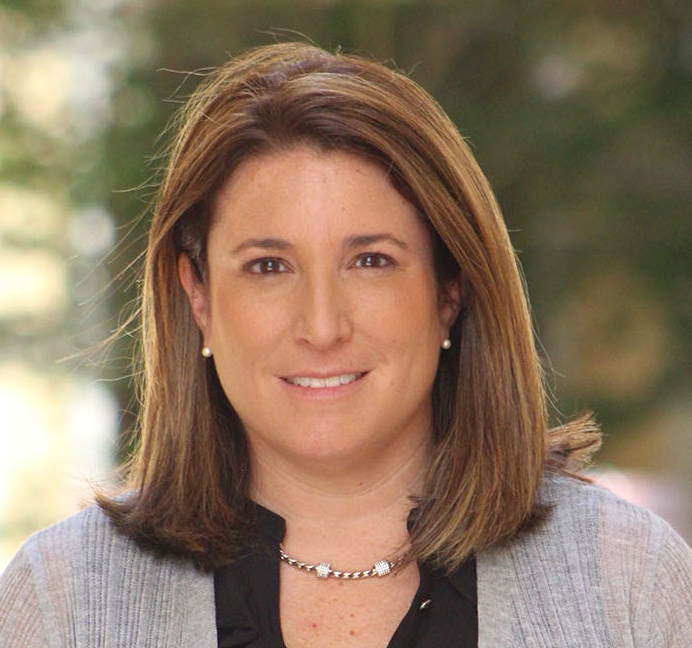
    Telehealth’s evolution includes the dramatic shift to at-home and hybrid healthcare models post COVID-19 as well telehealth’s role in program management and staffing. From telehealth’s earliest models to today’s automated systems, Telehealth and AI have future implications for care at home. I recently sat down for an interview with Dr. Pamela Ograbisz, a nurse practitioner with expertise in telehealth spanning almost two decades.
    Telehealth and AI

    The Rowan Report:

    First off, thank you for taking the time to talk with me today. Can you give our readers a brief introduction about you and your background?

    Dr. Pamela Ograbisz:

    I have been in telehealth for about 19 years now. I’ve been a nurse practitioner for 25 plus years. My specialty is cardiothoracic surgery and critical care. I have it was started out as a nurse in CT surgery, went back to school, became a nurse practitioner, then worked in CT also my entire career in critical care. We had an opportunity roughly 17 years ago when I was working in a cardiothoracic unit where we were connected by bridges and tunnels and water.

    RR:

    And, how did you come to be involved in telehealth?

    Ograbisz:

    We covered seven different sites and we weren’t able to get to all of our patients in a timely manner. We were struggling. We were trying to figure that out. A nurse reached out to us and was on a flip phone. She was taking photos and sending things and we were able to piece together a plan because of that. We literally all sat down that night after around and said, we need to do something like this. And we were attached to a medical school. And so we got them involved as well. And we built one of the first ICU bunkers in the classroom for telemedicine. And it was really sort of the beginning of something amazing. And I saw how well it worked. And I had the privilege of going around and building more of those programs.

    RR:

    And this eventually brought you to LocumTenens.com?

    Ograbisz:

    I was recruited by LocumTenens.com. When I first joined them, they had roughly 7% of their business was tele[health] and it was all behavioral health and they were really trying to expand their footprint. And of course, this was prior to COVID, we were still dealing with a lot of legislative issues and not everybody necessarily believed in it. It was still very scary for people and we were trying to sort of showcase what we could do. And so I came in and wrote a lot of policy and procedure and then COVID happened and we had to flip everything over it and we were poised to do so, which was fantastic.

    Telehealth and AI Locum Tenens

    So overnight we started turning on just loads of programs, 100% virtual. And then honestly, a lot of them never went back or they’ve come to a hybrid model. So now you can then convert those programs from traditional boots on ground all the time to more, you know, expandable, flexible models that have a hybrid option that includes telehealth.

    RR:

    Are you still operating the telehealth programs for LocumTenens.com?

    Ograbisz:

    My role now is I run LT Telehealth, which is a company inside of LocumTenens.com. We’re not a stand alone, but we do run all of the telehealth programs inside of the company. I also oversee all APP (advanced practice provider) relationships and how we’re growing that business and then our legislative arm.

    RR:

    LocumTenens.com is a full service staffing company, right? How are you finding the workforce shortage right now?

    Ograbisz:

    So, I would say that probably for a while, we commiserated with the health systems. But, filling the gaps from workforce shortage is our business.

    I will tell you this, I graduated school a long time ago when I got out, it didn’t matter if you were a doctor or a nurse practitioner or a PA, your goal was to join a practice. You wanted to become a partner and you wanted your name on that building and you wanted to own a piece of that building. Nobody was owned by the hospital groups. I felt like with the evolution of the electronic health record, everything changed. People were asked to do a whole lot more. All of a sudden it became a lot of boxes to check a lot of things to tick. You sat on more and more committees. It became more and more about the paperwork. And then of course, with the advent of EHRs, billing changed; CMS codes changed how you got paid. People started bucking the system. And so what we saw then honestly was a shift. Now people coming out [of college] are like, yeah, I’m not joining a practice or I’ve left my practice. This gives me a new creative way to be part of medicine with flexibility which no one ever promised you when you got out of school. Right? No one ever said, “You want to be a cardiothoracic surgeon? Work, life balance is for you!” No, right? 80 hour weeks and sleeping in the hospital. You signed up for it; you knew it. And now people have been given a glimpse of what it can be and what it could be. And so I think that the physician shortage 100% exists, but COVID forced the gig economy. And so what we’re seeing is people wanting to work on their own terms and 1099 contracting does that for them.

    RR:

    How are you seeing telehealth working in care at home?

    Ograbisz:

    So, we’ve been working on the medical hospital-at-home pieces trying to figure out how we can sort of fit into that model. We’ve seen a lot of really wonderful pilot programs come out of Mayo and Hopkins and what they’re doing. I think the biggest problem right now is they’re not reimbursed well. That is making it very hard for other systems that don’t have deep pockets like those two facilities to scale those programs to any kind of large extent. What we would say is we know that it’s better. If a patient is too ill to leave home, we can facilitate a visit with the doctor right from the house. We’ve found it is especially helpful in the oncology program we launched when a doctor has to deliver bad news. The pushback we got was the patients are not going to be able to adapt and get that kind of news through a screen. But the patients really proved that wrong. It was the patients who said, “If someone’s going to tell me that I have six months [to live], I don’t really want to hear that in a sterile, cold, doctor’s office. I really am much happier if I could be in my own environment and process that information.”

    RR:

    What is standing in the way of a robust telehealth system for hospitals, physician groups, and home health?

    Ograbisz:

    I mean, CMS obviously needs to catch up with the telehealth. They were doing it during COVID. We need to extend that so that those payments, as long as the coding is all there, those payments need to come through for telehealth. But when you combine it with home health and hospice, you have that in person touch point. So the whole visit then is reimbursable, which is why a lot of hospitals and physician groups are partnering with home health, hospice, and palliative care or organizations now because you get that in-person visit, but everything is sent back to the physician to oversee changes in care, oversee changes in medication. At home care and physician care combined, the reimbursement goes into place because you have that touch point there, a face-to-face visit. They can verbally and visually see everything that’s going on, but then it goes back to the physician and they can then also get reimbursed for that. So there’s a lot of that with telehealth that is crossing over. Home health and hospice agencies need to start using telehealth and they need to be partnering with the ACOs and they need to be partnering with physician groups and now they have to partner with payers, especially as we move to the value based system. They have to partner with them because there’s only a certain amount of money that each patient is going to get. Some of it’s going to go to the hospital, some of it’s going to go to the physician and some of it’s going to go to the home health company and if there’s no partnership then there’s no money. So, you know, they have to take on some of that risk, but telehealth is the way to do that.

    RR:

    We’ve been talking a lot the last year or so about the rapid advancements in AI. What we’re seeing is that AI is impacting interoperability, telehealth, direct patient care, and so much more. What do you see happening in health care with Ai?

    The Power of AI with SmartCare

    Ograbisz:

    Yeah, I think it’s a huge unknown. I think everyone’s afraid to commit. I think there’s more scary stuff than there is positive stuff. So right now, what we’re worried about is someone taking on my identity, somebody being able to give advice in my voice with my likeness and put that out somewhere. So I think when you talk to providers, they see more of the scary side and how are we going to control it? But then you look at the most amazing pieces which is I can use AI to help me form a better diagnosis, to cultivate more ideas for how to treat things for each how process and procedure, right? How do we go about garnering information, which is what I think AI will help us do better in the telehealth space. I think it will be interesting to see where all of the programmatic goes. I think more towards like holographs and literally like Star Trek lead people into rooms, you know, life size images where it’s not just we go from just a 2D flat screen to really look at 4D, you know, being able to really see and perhaps even with scans and patient monitoring and you can hold the scanner up and I can see your liver, who knows? I think the possibilities are endless. But I think right now in all honesty, I think it’s fear…until we figure out a little bit of the regulatory side of it.

    RR:

    You’re also working on advocacy for telehealth on state and national levels. Will you follow up with us on how the next round goes as far as extending the reimbursement for telehealth?

    Ograbisz:

    Absolutely! I’ve written a lot of pieces that I’ll share with you. We’re always happy to collaborate.

    RR:

    Thank you, again for your time. Your insights were wonderful.

    # # #

    Kristin Rowan, Editor
    Kristin Rowan, Editor
    Kristin Rowan has been working at Healthcare at Home: The Rowan Report since 2008. She has a master’s degree in business administration and marketing and runs Girard Marketing Group, a multi-faceted boutique marketing firm specializing in event planning, sales, and marketing strategy. She has recently taken on the role of Editor of The Rowan Report and will add her voice to current Home Care topics as well as marketing tips for home care agencies. Connect with Kristin directly kristin@girardmarketinggroup.com or www.girardmarketinggroup.com

    ©2024 by The Rowan Report, Peoria, AZ. All rights reserved. This article originally appeared in  Healthcare at Home: The Rowan Report. One copy may be printed for personal use: further reproduction by permission only.
    editor@therowanreport.com
    For more information on Locum Tenens visit: https://www.locumtenens.com/
    Telehealth and AI Dr. Pamela Ograbisz

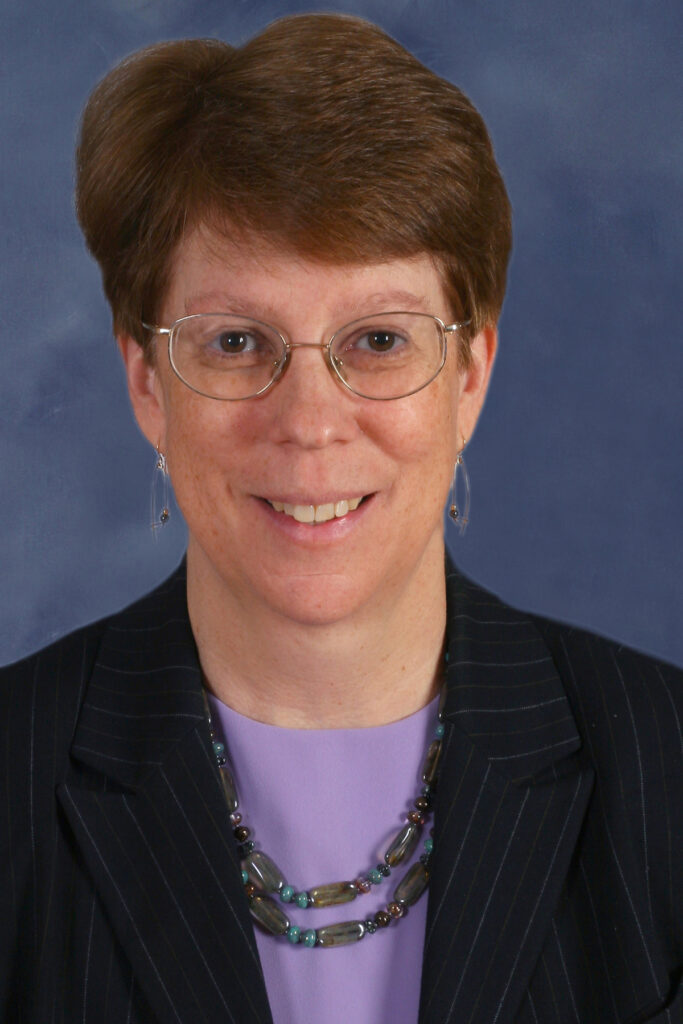
    Pamela Ograbisz

    Vice President of Clinical Operations

    Pamela Ograbisz, Associate Vice President of Telehealth for LocumTenens.com. With 20 years of experience in cardiothoracic surgery and internal medicine, she is passionate about delivering quality healthcare in a timely manner. Dr. Ograbisz is confident that telehealth programs are the key to improving health and the overall patient experience