What Can Providers Give to Patients, Pt 1

by Elizabeth E. Hogue, Esq.

Providers Kickbacks

Keeping it Clean

Providers, including marketers, are tempted to give patients free items and services. But be careful! These activities may violate laws prohibiting providers that participate in state and federal health programs from giving free items and services to patients. Private insurers often impose the same prohibitions. This means that private duty agencies are not exempt from these fraud and abuse prohibitions if they participate in any state healthcare programs, such as Medicaid or Medicaid waiver programs, or accept payments from private insurers.

Provider Prohibitions

The government generally prohibits providers from giving free items and services to patients because it is concerned that such activities may:

  • Result in overutilization of services
  • Produce decisions concerning care that are not objective
  • Increase costs to the Medicare and Medicaid Programs and other state and federal healthcare programs

Consequences of Provider Kickbacks

Provider Kickbacks
Providers who violate prohibitions on what may be given to patients face criminal fines, civil money penalties, suspension or exclusion from the Medicare and Medicaid Programs and other state and federal healthcare programs, and jail time.

There are two applicable federal statutes:

  • The anti-kickback statute (AKS)
  • The civil monetary penalties law (CMPL)

Exceptions

The federal government says that providers have violated the federal False Claims Statute if referrals are obtained in a way that violates the AKS and providers submit claims for services provided to patients who were referred in violation of the AKS. Providers generally violate the False Claims Statute if they submit claims or cost reports to the government that include untrue information. When providers submit claims, they, according to enforcers, also promise that referrals were not received in ways that are prohibited. If referrals are received inappropriately by violating the anti-kickback statute, for example, then the claims are “false.” Giving free items or services to patients may also violate a federal statute: the civil money penalties law.

Promotions and Marketing

The CMPL prohibits providers from offering to give or actually giving items or services to patients or potential patients that are likely to influence receipt of services from particular providers. This prohibition is especially relevant to marketing activities. It applies to both direct and indirect promotional activities.

State-Specific Laws

Providers must also comply with applicable laws in all of the states in which they do business. State laws vary, of course, from state to state. Many states have anti-kickback statutes that are similar to the federal statute described above. State licensure statutes for physicians, nurses, therapists, social workers, and other types of providers may also include prohibitions on giving free or discounted items or services to patients, especially when they may induce patients to receive potentially unnecessary services.

Final Thoughts

Although providers may have good intentions when they give free items or services to patients and potential patients, before they are acted upon such intentions must be subjected to consideration of the prohibitions described above.

This is part 1 of a two-part series. Look for part 2 next week.

# # #

Elizabeth E. Hogue, Esq.

Elizabeth Hogue is an attorney in private practice with extensive experience in health care. She represents clients across the U.S., including professional associations, managed care providers, hospitals, long-term care facilities, home health agencies, durable medical equipment companies, and hospices.

©2025 Elizabeth E. Hogue, Esq. All rights reserved.

No portion of this material may be reproduced in any form without the advance written permission of the author.

©2025 by The Rowan Report, Peoria, AZ. All rights reserved. 

MACPAC Rate Setting

FOR IMMEDIATE RELEASE

Contact:                                                                   Elyssa Katz
571-281-0220
communications@allianceforcareathome.org

MACPAC Rate Setting

The Alliance Expresses Concerns Regarding MACPAC Approach to HCBS Rate Setting

Alexandria, VA, and Washington, DC, September 18, 2025. The National Alliance for Care at Home (the Alliance) released the following statement in response to the Medicaid and CHIP Payment and Access Commission’s (MACPAC) discussion regarding home- and community-based services (HCBS) rate-setting held during today’s September MACPAC meeting.

MACPAC Rate Setting Quote

The Alliance appreciates MACPAC’s interest in addressing issues related to worker pay in HCBS. These workers should receive higher wages and benefits as they are the backbone of the long-term care system in our country. They are dedicated professionals who provide essential services that promote the community integration, independence, and positive health and social outcomes of older adults and people with disabilities.

Unfortunately, we are concerned about the draft recommendation MACPAC discussed during today’s meeting. Rather than seeking to address the root-cause of low worker wages, MACPAC’s recommendation instead focuses on collecting 

additional information that would further describe the issue. This approach increases administrative burden on states and providers without actually proposing solutions to this problem.

MACPAC Rate Setting Report

MACPAC’s report acknowledges that rate studies and wage data are insufficient to address chronically underfunded Medicaid HCBS programs. To create meaningful change, state administrations and state legislators must be held accountable to fund services at levels that enable improved wages for workers. Sixty years of Medicaid program history have demonstrated that such wholesale changes to state actions are only achieved through new and strengthened Federal requirements. We urge MACPAC and its Commissioners to be bold and recommend structural changes to Federal Medicaid law and regulations that mandate payment policies ensuring access to HCBS through livable wages for direct care workers. The Centers for Medicare & Medicaid Services (CMS) should be given the authority to require states to:

  • Perform comprehensive rate studies no less frequently than every five years that:
    • Use generally accepted accounting practices to develop a payment methodology that assures continued adequacy of each component of the rate model; and
    • Establish a rate model that includes individualized components for core provider cost drivers as well as a livable wage for workers.
  • Submit a copy of the rate review report and recommendations with any waiver renewal or state plan amendment and make the report publicly available on their website; and
  • Require states to justify any variance between the report recommendations and the actual established payment rates.

Further, CMS should be given the authority to disapprove rate methodologies that do not clearly account for all statutory and regulatory requirements of delivering services as well as demonstrating that the rates are sufficient to support a livable wage for workers.

Our members are committed to improving the lives and livelihoods of direct care workers because beneficiaries depend on them. We call on MACPAC to ensure that states and the federal government are equal partners in this critical endeavor.

MACPAC Rate Setting Quote The Alliance

# # #

About the National Alliance for Care at Home

The National Alliance for Care at Home (the Alliance) is the leading authority in transforming care in the home. As an inclusive thought leader, advocate, educator, and convener, we serve as the unifying voice for providers and recipients of home care, home health, hospice, palliative care, and Medicaid home and community-based services throughout all stages of life. Learn more at www.AllianceForCareAtHome.org.   

© 2025. This press release originally appeared on the National Alliance for Care at Home website and is reprinted here with permission. For more information or to request permissions, please see the contact information above.

Medicare Home Health Cuts: Survey Says

FOR IMMEDIATE RELEASE

Contact:                                                                       Elyssa Katz
571-281-0220
communications@allianceforcareathome.org  

70% of Americans Oppose Medicare Home Health Cuts, National Poll Finds

Alexandria VA, and Washington, DC, September 4, 2025– A new national poll by Fabrizio Ward, commissioned by the National Alliance for Care at Home (the Alliance), finds that seven in ten Americans oppose the Centers for Medicare & Medicaid Services’ (CMS) 2026 Medicare home health proposed rule, which would slash Medicare home health funding by an additional 9%, or $1.1 billion, next year. These cuts would put lifesaving home health care for millions of Americans at risk, particularly seniors and those with disabilities, while doing nothing to address fraud, waste, and abuse occurring in the home health payment system.

In one of the strongest bipartisan rebukes of Medicare home health cuts to date, the poll found overwhelming opposition across party lines. Large majorities of voters support targeting cost savings to eliminating waste and fraud rather than across-the-board cuts. Voters widely recognize that home health provides significant savings for taxpayers, that lack of access to home health due to recent cuts hurts Medicare patients, and that many more would be hurt if the proposed cuts go into effect.

CMS home health proposed rule

“The results send a crystal-clear message: Americans want more home-based care, not less, and preserving access to care is critical. Cutting home health doesn’t save money – it hurts patients, worsens outcomes, and costs taxpayers more in the long run.” 

Dr. Steve Landers

CEO, National Alliance for Care at Home

The poll reveals Americans see home health as essential to keeping patients safe at home, lowering costs, and easing pressure on already overburdened hospitals and emergency rooms.

Key findings:

  • 70% of all voters oppose Medicare cutting home health services by an additional 9% next year.
  • 91% of all voters believe it’s important that home health services be available when Medicare patients require extra medical support.
  • 55% of all voters support President Trump taking steps to reverse the proposed Medicare home health cuts and ordering a crackdown on fraud in the system.
  • 71% of all voters believe home care is the most affordable care option, compared to just 17% who believe hospital care is more affordable.
  • 73% of all voters say that cutting Medicare home health harms patients and legitimate providers while failing to stop the fraudulent operators that scam hundreds of millions of dollars from the program each year is a good reason to oppose the cuts.

“With more than one out of every two voters either on Medicare, or with a parent on Medicare, voters are clear that people want treatment at home if it’s an option and that home medical care is less expensive than care provided at hospitals and nursing homes. Voters also see the folly in across-the-board cuts that harm everyone rather than focusing efforts to root out known fraud in the home health system. Across the political spectrum voters oppose cuts and support redoubling efforts to fight fraud.”

Tony Fabrizio

Partner, Fabrizio Ward

“These numbers should give every lawmaker pause,” Dr. Landers cautioned. “Patients want to recover where they’re safest – at home. It’s time for Congress to protect what’s working and stop the home-care bleeding. Lawmakers have an opportunity to protect a program that saves lives, lowers costs, enjoys overwhelming bipartisan support, and reflects the clear will of the American people.”

The Alliance is urging Congress and CMS not to finalize the proposed payment cuts and to work with providers to revise their approach and strengthen, not weaken, access to home-based care.

A memo of the poll findings can be found here.

###

About the National Alliance for Care at Home

The National Alliance for Care at Home (the Alliance) is the leading authority in transforming care in the home. As an inclusive thought leader, advocate, educator, and convener, we serve as the unifying voice for providers and recipients of home care, home health, hospice, palliative care, and Medicaid home and community-based services throughout all stages of life. Learn more at www.AllianceForCareAtHome.org.

Medicare Advantage Excess Payments

by Kristin Rowan, Editor

Medicare Advantage Excess Payments

Investigational Study

Researchers from the Department of Health Services, Policy and Practice at Brown Universchool of Public Health and the Department of Geriatrics and Palliative Medicine at Icahn School of Medicine published an original investigative study on spending versus payments in Medicare Advantage under the hospice carve-out model.

Carve-out to VBID to Carve-out

In 2021, CMS started a Value-Based Insurance Design (VBID) to test the impact of adding hospice services to Medicare Advantage benefits. By December of 2024, CMS ended the program due to widespread upset. CMS returned to the hospice carve-out model. Under this model, when an MA beneficiary chooses hospice, any health care expenses related to the terminal illness is paid on a fee-for-service (FFS) basis. MA no longer receives inpatient and outpatient payments, but continues to receive premiu, and rebate payments.

Carve-out Hospice Benefit

Once an MA enrollee enrolls in hospice, MA is no longer responsible for payments. Under the carve-out model, hospice services are paid by Medicare. MA plans are still responsible for paying for services that are not related to hospice care. These services can include inpatient, outpatient, physician, skilled nursing facility, home health care, and prescription drug expenses. 

Medicare Advantage Spending and Payments

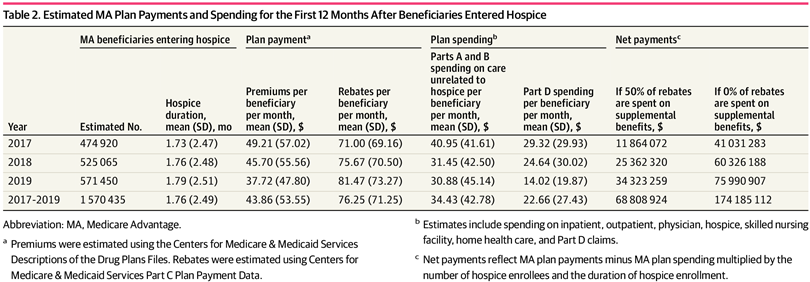
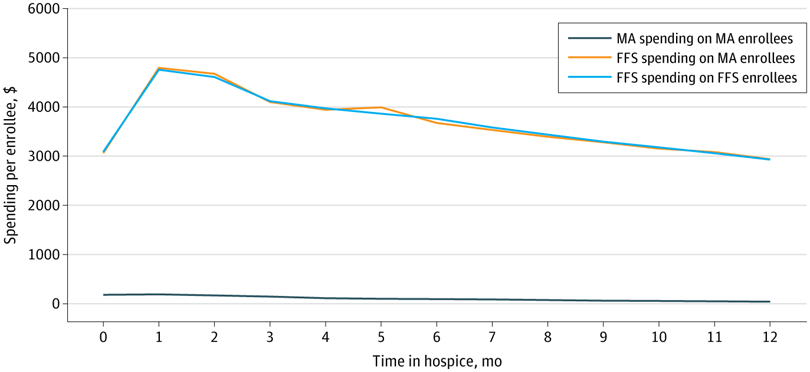
The study spanned 12 months and looked at 314,087 MA beneficiaries. In that period, 80.5% of enrollees had no spneding unrelated to their terminal illness. MA was not responsible for any healthcare related payments, but continued to receive $120 per enrollee per month. Estimated spending from MA on hospice enrollees was $57-70 per month. 

Medicare Advantage Excess Payments

In the 12 months following an enrollee electing hospice, MA plans netted $50-60 per month per enrollee. If half of the rebate payments received pay for supplemental benefits, MA receives excess payments to the tune of $68,808,924 over three years. If no rebate payments go toward supplemental benefits, MA receives $174,185,112 in excess payments over three years. The care a hospice enrollee receives uses the fee-for-service model. Medicare Advantage providers are seemingly paid on a fee-for-no-service model. 

Medicare Advantage plans do not currently report the actual amount of rebate payments used to pay supplemental benefits.

Study Conclusion

The researchers conclude that MA receives excess payments under the hospice carve-0ut model. They also note that there is no accountability for spending after hospice election from MA plans to CMS. The researchers suggest that CMS could require MA plans to report actual spending on supplemental services after hospice election and pay premiums and rebates only to cover the amount spent. 

I have a different recommendation….MA plans should not receive any additional premium payments or rebates following hospice election. MA plans should be required to report total payments and spending from enrollment date to election date. The balance, less the same 8% average margin of home and health and hospice agencies, should be used to pay for hospice services from election to passing. Any remaining balance after the patient’s passing should be returned to the beneficiary’s family.

# # #

Kristin Rowan, Editor

Kristin Rowan has been working at The Rowan Report since 2008. She is the owner and Editor-in-chief of The Rowan Report, the industry’s most trusted source for care at home news, and speaker on Artificial Intelligence and Lone Worker Safety and state and national conferences.

She also runs Girard Marketing Group, a multi-faceted boutique marketing firm specializing in content creation, social media management, and event marketing.  Connect with Kristin directly kristin@girardmarketinggroup.com or www.girardmarketinggroup.com

©2025 by The Rowan Report, Peoria, AZ. All rights reserved. This article originally appeared in The Rowan Report. One copy may be printed for personal use: further reproduction by permission only. editor@therowanreport.com

 

BREAKING NEWS: CMS Changes AHEAD

From cms.gov

CMS Changes AHEAD

CMS Announces Changes to Achieving Healthcare Efficiency through Accountable Design (AHEAD) Model to Improve Quality, Promote Transparency, and Decrease Costs

September 2, 2025

What's New

The CMS Innovation Center announced new policy and operational changes, as well as a new end date, to the Achieving Healthcare Efficiency through Accountable Design (AHEAD) Model to help states achieve their total cost of care (TCOC) targets, while advancing the Center’s commitment to promote choice and competition, increase prevention, empower patients, and protect taxpayer dollars.

Why it Matters

Participating states now have more tools to manage Medicare costs (designed to support sustainable growth) and improve quality of care and population health outcomes

What to Expect

Changes will be implemented across all cohorts beginning in January 2026. AHEAD’s end date for all cohorts is now December 31, 2035.

The Big Picture

Changes made to the model will help to advance the CMS Innovation Center’s strategic pillars of: 1) choice and competition, with states implementing at least two policies focused on promoting choice and competition in their health care markets and 2) prevention, with a new Population Health Accountability Plan focused on preventive care, including chronic disease prevention.

CMS Change AHEAD

Additional Details

CMS is also introducing payment reforms through AHEAD for patients with Original Medicare and establishing new transparency requirements around TCOC and primary care investment targets. For the first time ever, AHEAD will bring total cost of care accountability to all Original Medicare beneficiaries in AHEAD regions through geographic attribution of beneficiaries not attributed to other CMS accountable care organization programs. This novel framework will offer risk-bearing Geographic Entities additional tools and enhanced flexibilities to improve health outcomes and lower spending for their patients while receiving shared payments (or losses) through two-sided risk arrangements. In return, patients may receive additional beneficiary incentives while enjoying existing protections under the Original Medicare program.

Total Cost of Care Model

The AHEAD Model is a state total cost of care (TCOC) model that seeks to drive state and regional health care transformation and multi-payer alignment, with the goal of improving the total health of a state population and lowering costs. Under a TCOC approach, a participating state uses its authority to assume responsibility for managing health care quality and costs across all payers, including Medicare, Medicaid, and private coverage. States also assume responsibility for ensuring health providers in their state deliver high-quality care, improve population health, offer greater care coordination, and promote healthier living for all people participating in the model. The AHEAD Model provides participating states with funding and other tools to address rising health care costs and improve health outcomes.

More Information

# # #

©2025 Centers for Medicare & Medicaid Services. This announcement originally appeared on the CMS website here. For more information, please contact the CMS Innovation Center.

Medicare Prior Authorization

by Kristin Rowan, Editor

Medicare Prior Authorization

Wasteful and Inappropriate Service Reduction Model

The Centers for Medicare and Medicaid Services (CMS) is launching a pilot program in six states to combat what they deem to be unnecessary treatments. Dubbed the Wasteful and Inappropriate Service Reduction (WISeR) Model, the voluntary program will launch in New Jersey, Ohio, Oklahoma, Texas, Arizona, and Washington beginning January 1, 2026 and ending December 31, 2031. The program will use Artificial Intelligence (AI) and Machine Learning (ML) alongside human clinical review to “ensure timely and appropriate Medicare payment for select items and services.”

The Problem

According to CMS, health care waste harms patients and comprises 25% of healthcare spending. “Low-value” services provide little effectiveness, do not align with specific health conditions, and can lead to additional complications and more wasteful services.

Medicare Prior Authorization Solution

The new WISeR Model is designed to reduce unsupported care. Participating care providers will outsource authorization of a pre-selected list of services to reviewers using technology to “expedite and improve the review process.” These services are those that CMS designated as vulberable to fraud, waste, and abuse.

Reasoning

CMS suggests that the fee-for-service model used in traditional Medicare incentivizes unnecessary treatments, tests, and other care. According to CMS, these items provide little to no benefit for some patients. These include:

  • Skin and tissue substitutes
  • Electrical nerve stimulator implants for obstructive sleep apnea and incontinence
  • knee arthroscopy for knee osteoarthritis
  • Cervical fusion
  • Epidural steroid injections
  • Vertebral augmentation
  • Image-guided lumbar decompression
  • deep brain stimulation for Parkinson’s and essential tremor

Strategy and Outcomes

The WISeR Model is supposed to ensure patients get the most appropriate care for the best outcomes. It is also supposed to lower costs and administrative burden on providers. Patients are supposed to partner with their health care providers to decide on the most appropriate care plan. Eliminating “unnecessary” services and procedures is supposed to save taxpayer dollars and decrease fraud, waste, and abuse. Care providers are supposed to focus on providing care that has the most impact on the well-being of Medicare beneficiaries.

Editorial Comment

I am not a Medicare recipient, but I have many close friends and family who are. I am not a nurse or home health expert, but I am a patient and by my count, I have a PCP and 6 specialists that I see on a regular basis. However, I am now, or will be in the near future, in need of:

  • Electrical nerve stimulator
  • Cervical fusion
  • Steroid injections
  • Lumbar decompression

Personal Experiences

I am already at the mercy of my health insurance provider for pre-authorizations for everything that is not routine visits with my primary care provider. I know first-hand the hoops and red tape my provider(s) go through. Already this year, I have filed two requests to review denials, more than 10 rescheduled visits because my pre-authorization had not been received, and at least one interview that my PCP had to attend with an “expert” who had previously decided that my regularly scheduled follow-up cancer scan was unnecessary.

Predicted Results

Adding prior authorization approval requirements for care and treatment will delay beneficiaries from getting the care they need, prolong the pain they experience daily, and cost more in wasted time and money than it can possibly save in wasted procedures. I sincerely hope there are enough voluntary participants in this experiment to document the additional time, money, and resources required. I also hope these participants send regular surveys to their Medicare beneficiaries to ask whether they feel like getting pre-authorizations for routine procedures has made them feel like they are getting better care.

# # #

Kristin Rowan, Editor

Kristin Rowan has been working at The Rowan Report since 2008. She is the owner and Editor-in-chief of The Rowan Report, the industry’s most trusted source for care at home news, and speaker on Artificial Intelligence and Lone Worker Safety and state and national conferences.

She also runs Girard Marketing Group, a multi-faceted boutique marketing firm specializing in content creation, social media management, and event marketing.  Connect with Kristin directly kristin@girardmarketinggroup.com or www.girardmarketinggroup.com

©2025 by The Rowan Report, Peoria, AZ. All rights reserved. This article originally appeared in The Rowan Report. One copy may be printed for personal use: further reproduction by permission only. editor@therowanreport.com

 

OASIS-E2

OASIS-E2

by Kristin Rowan, Editor

OASIS-E2 Instruments and Change Table draft are available from The Centers for Medicare & Medicaid Services (CMS). They are available for download here. The draft proposes an off-cycle implementation date of April 1, 2026

Change Table

Changes include:
  • Transportation listing changed from A1250 to A1255
  • Hearing (B0200) and Vision (B1000) added to ROC
  • Sex (A0810) replaces Gender (M0069)
  • COVID vaccination up to date removed
  • Language (A1110) added to ROC
  • Minor changes to replace outdated item numbers with updated ones (ex: all instances of A1250 changed to A1255)
OASIS E2 Change Table

Change Timeline

The Changes are effective April 1, 2026. However, the changes are not final pending approval from the Office of Management and Budget (OMB). Agencies are able to use the draft form for training purposes, but should look for the final form that includes the OMB control number and expiration date.

Implications

OASIS accuracy is linked to PDGM payments and quality outcomes. Prepare early for the off-cycle April 1, 2026 changes to ensure a smooth transition to E2 requirements and continued reporting accuracy. 

Resources

Draft versions of the instruments are on the CMS website in a ZIP file. You can download the file here.

The PRA package, which includes four separate documents, is available for download here.

Submit comments to CMS about OASIS-E2 or any other item in the Home Health Prospective Payment System Rate Update for CY 2026 here and here.

Medicaid Enrollees Sent to ICE

by Kristin Rowan, Editor

UPDATE

The Rowan Report originally published this article on August 7, 2025. This update is as of August 15, 2025.

After HHS began providing access to personal data on Mediciad enrollees to the Department of Homeland Security (DHS), 20 states filed to sue the department for violating privacy laws. Shortly thereafter, CMS entered into a new agreement to give DHS daily access to view the same data.

Federal Judge Vince Chhabria of California ordered HHS to stop giving DHS access to personal information. The ruling grants a preliminary injunction, stopping HHS from sharing Medicaid data with ICE in the 20 states that participated in the lawsuit. The injunction will last until 14 days after the two agencies complete and submit a reason for the decision to share information. The reasoning must comply with the Administrative Procedure Act. The injunction can also end if litigation is concluded (a formal hearing and decision).

Chhabria noted that there is no formal law preventing government agencies from sharing information, he cited agency policy as his reasoning for the injunction. ICE has a well-publicized policy against using Medicaid data for immigration enforcement. Judge Chhabria wrote in his ruling:

“Given these policies, and given that the various players in the Medicaid system have relied on them, it was incumbent upon the agencies to carry out a reasoned decisionmaking process before changing them. The record in this case strongly suggests that no such process occurred.”

August 7, 2025

Associated Press Confirms

Enrollee Information Given to ICE

In a surprise announcement on July 17, 2025, investigative reporter Kimberly Kindy and reporter Amanda Seitz filed a report. They uncovered information confirming Medicaid enrollee information given to ICE from CMS. ICE will use this to find “aliens” across the country. The health and personal information disclosed includes home addresses, birth dates, Social Security numbers, and ethnicities.

Department of Homeland Security Responds

DHS Assistant Secretary Tricia McLauglin said, “…CMS and DHS are exploring an intitiative to ensure that illegal aliens are not receiving Medicaid benefits….”

DHS Spokesperson Andrew Nixon said, “With respect to the recent data sharing between CMS and DHS, HHS acted entirely within its legal authority—and in full compliance with all applicable laws….”

Opposing Viewpoints

Senator Adam Schiff (D-CA) said, “The massive transfer of the personal data of millions of Medicaid recipients should alarm every American. This massive violation of our privacy laws must be halted immediately. It will harm families across the nation and only cause more citizens to forego lifesaving access to health care.”

Similarly, CA Governor Gavin Newsom said, “This potential data transfer brought to our attention by the AP is extremely concerning, and if true, potentially unlawful….”

HHS and DHS Sued

State Attorneys General from 20 states, led by California Attorney General Rob Bonta have filed suit. They are suing the Department of Health and Human Services (HHS), the Department of Homeland Security (DHS), HHS Secretary Robert F. Kennedy Jr., and DHS Secretary Kristi Noem.

The Associated Press found a Medicaid internal memo and emails. Subsequently, the AP reported that Medicaid officials tried to stop the data transfer due to legal and ethical concerns. The objection was unsuccessful. CMS had 54 minutes to comply with an order coming from two advisors within Secretary Kennedy Jr’s camp.

Disclosure Focuses on Violation of Laws

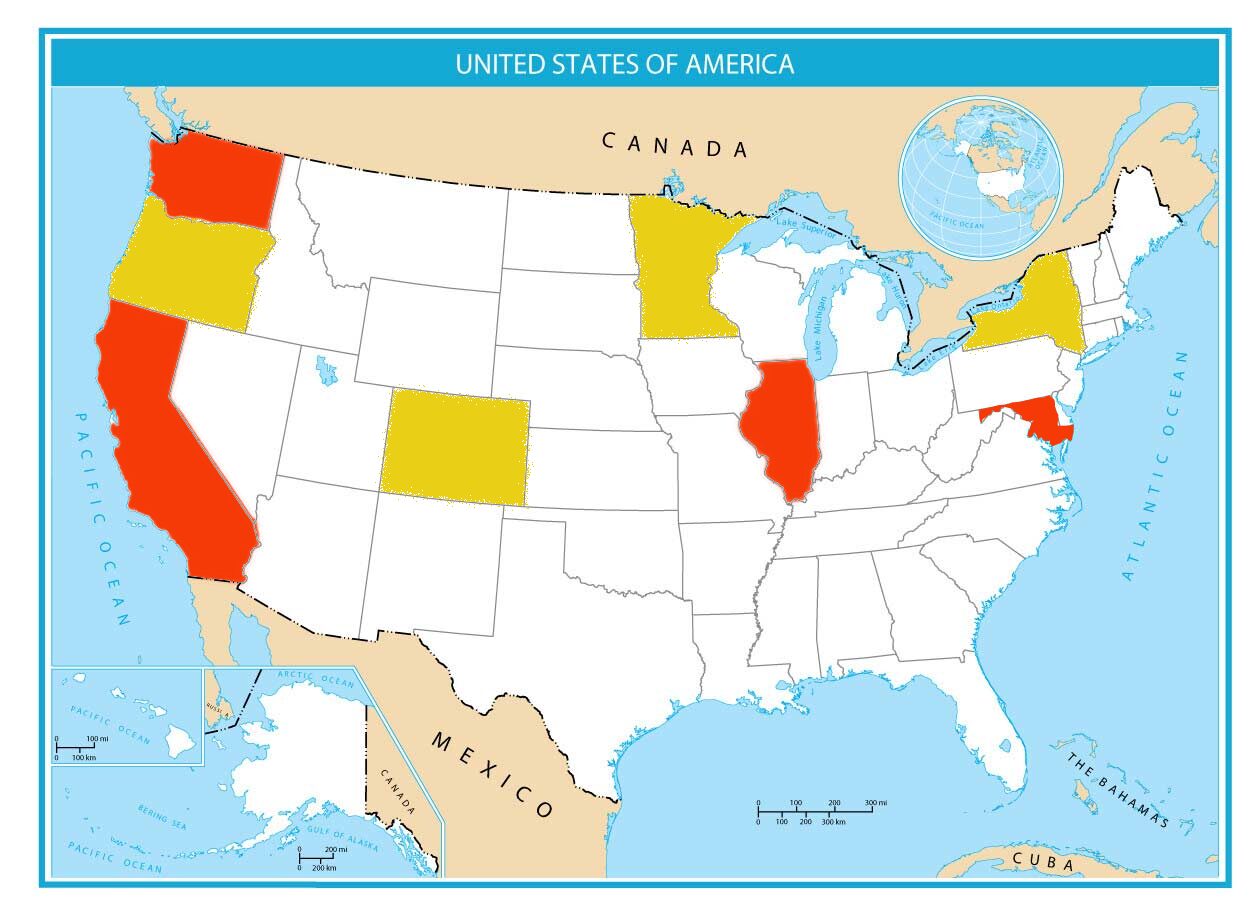
Current laws provide that states can create their own health plans, eligibility standards, and coverage, as long as the plan follows federal criteria. Medicaid laws also provide for emergency coverage for non-citizens. Seven states and D.C. started programs that offer full Medicaid coverage to non-citizens.

Four of the seven states, New York, Oregon, Minnesota, and Colorado, never submitted identifiable information about Medicaid recipients to CMS. The data shared with ICE came from the remaining three states; California, Illinois, & Washington State; and Washington D.C.

Map of U.S. States Compromised by CMS and DHS

The Allegation

The lawsuit was filed in the U.S. District Court for the Northern District of California. It alleges that the federal government is allowing the personal data of Medicaid recipients to be used for purposes unrelated to the Medicaid program.

Further, the coalition of states alleges that the disclosures violate several federal data privacy laws. These  include Health Insurance Portability and Accountability Act (HIPAA), Federal Information Security Modernization Act (FISMA), and the Privacy Act. 

Additionally, the Attorneys General state that the disclosures are contrary to the Social Security Act and a violation of the Spending Clause.

The lawsuit calls upon the court to bar CMS from sending additional PII to DHS and to bar DHS from using any of the information it has already received.

“In the seven decades since Congress enacted the Medicaid Act to provide medical assistance to vulnerable populations, federal law, policy, and practice has been clear: the personal healthcare data collected about beneficiaries of the program is confidential, to be shared only in certain narrow circumstances that benefit public health and the integrity of the Medicaid program itself.”

Attorneys General

Coalition of States

Final Thoughts

This lawsuit is the latest of many against the current administration. The Rowan Report will continue to update this and other stories impacting care at home as the lawsuits continue.

# # #

Kristin Rowan, Editor

Kristin Rowan has been working at The Rowan Report since 2008. She is the owner and Editor-in-chief of The Rowan Report, the industry’s most trusted source for care at home news, and speaker on Artificial Intelligence and Lone Worker Safety and state and national conferences.

She also runs Girard Marketing Group, a multi-faceted boutique marketing firm specializing in content creation, social media management, and event marketing.  Connect with Kristin directly kristin@girardmarketinggroup.com or www.girardmarketinggroup.com

©2025 by The Rowan Report, Peoria, AZ. All rights reserved. This article originally appeared in The Rowan Report. One copy may be printed for personal use: further reproduction by permission only. editor@therowanreport.com
 

Alliance Responds to Hospice Final Rule

by Kristin Rowan, Editor

The Alliance Responds to CMS Hospice Final Rule

CMS Issues FY 2026 Hospice Final Rule

On August 1, 2026, CMS issues the FY 2026 Hospice Wage Index and Payment Rate Update and Hospice Quality Reporting Programs Requirements Final Rule. Here are the high-level changes in this year’s final rule:

  • Rate Setting Changes
    • A 3.3% inpatient hospital market basket percentage increase
    • A 0.7% productivity adjustment (read decrease)
    • Statutory cap increases from $34,465.34 to $35,361.44
  • Hospice Care Admission
    • The physician member of the interdisciplinary group (IDG) may recommend admission to hospice care
  • Face-to-Face Attestation
    • Signature and date requirements restored
    • Eliminated requirement for attestation to be a separate and distinct document
    • Attestation requirement can be a section or addendum to recert form, or part of a signed and dated clinical note
  • Hospice Quality Reporting Program
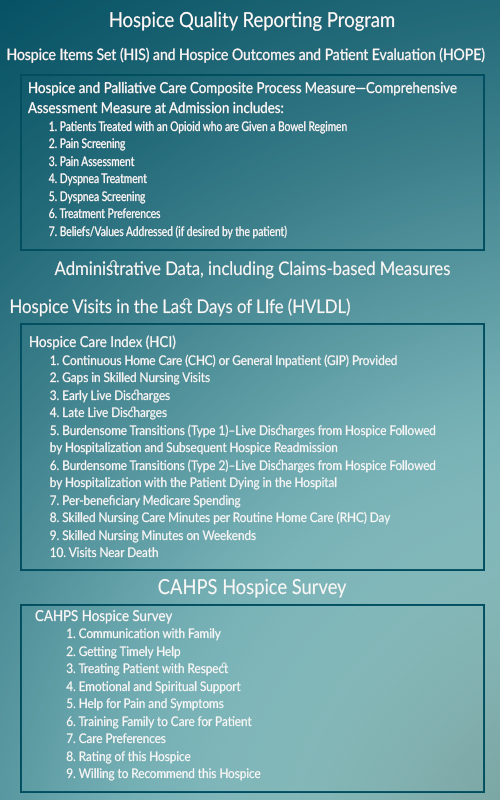
  • The HOPE tool will replace the HIS tool on October 1, 2025, despite comments to delay implementation
  • CMS published a HOPE Technical Information webpage ,an HQRP training library, and a Requirements and Best Practices webpage
  • CMS recognized the error in their HOPE burden calculations. The burden is 21.1% higher than initially reported. The difference will be “taken into consideration” in the next PRA package submission.
  • The separate reporting tool (QIES) and reports tool (CASPER) will sunset and iQIES will replace both tools.
FY 2026 Hospice Quality Reporting Program

National Alliance for Care at Home Statement

After CMS issued the final rule, the Alliance responds with a statement addressing the wage adjustment, HOPE tool implementation, and sttestation changes. Read the full press release here.

Wage Adjustment

The Alliance recognizes that the 2.6% wage update is higher than the proposed 2.4% adjustment issued earlier this year. However, The Alliance maintains its position that the update does not go far enough to offset the very high and very real operational costs that hospices across the country face.  

Regulatory Relief

Both the physician member of the IDG recommending hospice admission and the inclusion of a clinical note to serve as attestation of a face-to-face were welcome changes to hospice regulations. The Alliance thanked CMS for these changes.

HOPE Tool Implementation

The Alliance was among the many commenters to CMS about the October 1, 2025 implementation date for the HOPE tool. Alliance CEO Dr. Steve Landers had this to say:

Despite responsiveness in other areas, the Alliance is deeply disappointed that CMS did not heed recommendations and delay the October 1, 2025 implementation of the Hospice Outcomes and Patient Evaluation (HOPE) tool nor waive the timeliness completion requirement for HOPE record submission. We expect providers to face a burdensome transition and urge CMS to remain responsive to real-world challenges, offering flexibility as providers navigate the change.  

Dr. Steve Landers

CEO, National Alliance for Care at Home

The Alliance is committed to working with CMS to reduce spending and strengthen the Medicare hospice benefit. They also continue to support the CMS initiative to reduce fraud, waste, and abuse.

Final Thoughts

The Hospice Final Rule is not what we hoped for. The wage update was increase, but not by enough to make a real impact on the operational burden hospices face. CMS has provided technical training and education for the HOPE tool, but severely underestimated the financial burden connected to the transition. CMS continues to use outdated, incorrect, or faulty information in its calculations of wage rate updates and ignores the repeated comments from advocacy groups and hospice providers. 

# # #

Kristin Rowan, Editor

Kristin Rowan has been working at The Rowan Report since 2008. She is the owner and Editor-in-chief of The Rowan Report, the industry’s most trusted source for care at home news, and speaker on Artificial Intelligence and Lone Worker Safety and state and national conferences.

She also runs Girard Marketing Group, a multi-faceted boutique marketing firm specializing in content creation, social media management, and event marketing.  Connect with Kristin directly kristin@girardmarketinggroup.com or www.girardmarketinggroup.com

©2025 by The Rowan Report, Peoria, AZ. All rights reserved. This article originally appeared in The Rowan Report. One copy may be printed for personal use: further reproduction by permission only. editor@therowanreport.com
 

Tell CMS not to Kill Home Health

by Kristin Rowan, Editor

The Alliance to Care at Home:

CMS needs your comments

CMS needs your comments on the home health proposed rule for FY 2026. Advocacy is a cornerstone of the mission of The National Alliance for Care at Home. From The Hill to the home, The Alliance fights for the future of the industry. But, they can’t do it alone. 

Proposed Rule

The CMS proposed rule for FY 2026 has a net 6.4% decrease in payments to home health providers. Industry experts warn that this change will cause home health agencies to shutter their doors and it will leave many rural areas in a home health desert.

The Alliance Call to Action

At last week’s 2025 Financial Summit in Chicago, policy and industry experts provided ways to adjust how to write comments to CMS. According to Mary Carr, Vice President for Regulatory Affairs at National Alliance for Care at Home, it’s not enough for a few agencies and organizations to advocate for home health. Everyone has to submit comments about this. Carr says if done effectively, sending comments on proposed rules is one of the most powerful ways to stop these policy changes. The way you write your comment letters is important if you want them to have an impact.

Carr provided this guidance and tips on how to right an effective comment to CMS:

Remember that CMS is not looking for an agree/disagree statement

Provide good reasons for not keeping the proposed rule as is

Address very specific reasons why any part of the proposed rule is bad

Include the direct impact the proposal will have on your business, your staff, and your patients

Provide an alternative recommendation

Mention studies on how much less home health costs compared with SNFs and ALFs

Don’t let fear, anger, and anxiety detract from your message

Maintain professionalism and respect

Mention and thank CMS for any good aspects of the proposed rule

Include impact statements on reduction in services, delays to getting care, and areas that would be without any available home health care should the proposed rule stand

Mention the Other Side

No matter what side of the aisle you are usually on, we all must agree that care at home is an industry issue, not a Democrat or Republican issue. Hillary Loeffler, Vice President of policy and regulatory affairs at the Alliance, reluctantly mentions that the clawbacks, reductions, and methodology used to determine rates were put in place by the previous administration. 

“It’s a new administration. I hate to say it, but I’m going to say, ‘This methodology was created by the Biden administration, and the Trump administration needs to do something about this.’ So, hopefully they take a fresh look at it.”

Hillary Loeffler

Vice President of Policy and Regulatory Affairs, National Alliance for Care at Home

Loeffler also suggests going directly to Congress with comments and letters in addition to CMS. The recent trend of lowering reimbursement rates causing fewer visits, less coverage, and longer wait times is untenable and complete reform of the home health benefit at the federal level is needed to ensure its survival, added Loeffler.

Illogical Arguments

Whether you are publishing comments on the home health proposed rule or writing a letter to your senators and representatives, steer clear of logical fallacies. These errors in reasoning are easy to fall prey to when you have an emotional investment in the issue at hand.

Ad Hominem

The very common Ad Hominem fallicy happens when the argument moves from the problem to the person. Blaming your representative or accusing CMS of hating home health rather than focusing on the impact of the pay cut will weaken our standing.

Slippery Slope

This fallicy involves stretching the consequences of an action beyond reality. Cutting home health payment rates will decrease care and increase start-of-care delays. It will not cause homelessness, mass hysteria, or a small pox outbreak. 

Fallacy of Composition

If you’re familiar with standard contracts, you’ve read the clause that goes something like, “if any part of this contract is illegal, the rest is still intact.” The composition fallacy assumes that the whole of something matches its parts. The CMS proposed rule for FY 2026 has improvements, such as allowing physicians to do face-to-face appointments even if they are not the certifying physician. Don’t throw out the entire proposed rule. Rather focus on those parts that are clearly devastating to the industry.

Fallacy of Origin

Criticizing the rule based on its authors (CMS) as adversaries to care at home also negates the impact of our advocacy. CMS has been charged with maintaining government payments for health care in hospitals, physician groups, hospices, SNFs, and more. They have also been directed to cut costs, decrease spending, and maintain budget neutrality. The proposed rule is a death sentence for home health not because it came from CMS, but because of the flawed math. Address the calculations, the methodology, the assumption that care at home is more expensive than hospital or SNF care, and the number of people who will lose access to quality care.

CMS needs your comments now

Now that you know what issues to address and how to frame your argument, reach out. Contact CMS and your Congresspeople and submit your comments today. Comments are due by August 29th.

# # #

Kristin Rowan, Editor

Kristin Rowan has been working at The Rowan Report since 2008. She is the owner and Editor-in-chief of The Rowan Report, the industry’s most trusted source for care at home news, and speaker on Artificial Intelligence and Lone Worker Safety and state and national conferences.

She also runs Girard Marketing Group, a multi-faceted boutique marketing firm specializing in content creation, social media management, and event marketing.  Connect with Kristin directly kristin@girardmarketinggroup.com or www.girardmarketinggroup.com

©2025 by The Rowan Report, Peoria, AZ. All rights reserved. This article originally appeared in The Rowan Report. One copy may be printed for personal use: further reproduction by permission only. editor@therowanreport.com