BREAKING NEWS: Dr. Landers Steps Down

by Kristin Rowan, Editor

Dr. Landers Steps Down

National Association Announces Successor

Dr. Landers steps down from his role as CEO of the National Alliance for Care at Home (the Alliance). The Alliance published news of Dr. Landers’ resignation the morning of February 11, 2026. His successor will take the CEO role on February 17th and Dr. Landers will advise on the transition through May 10th.

Achievements

Dr. Landers’ tenure at the helm of the Association was short-lived, having served as CEO for just beyond the one year mark. He was the inaugural CEO of the Alliance, taking the role officially when the merger between NAHC and NHPCO was completed. In that time, Dr. Landers effectively led the merged associations, navigating the two organizations into a harmonious. team. 

Building Strength

During his tenure, Dr. Landers built a structure on which the Alliance will grow. He spurred that growth with the addition of COO Sherl Brand and Chief Government Affairs Officer Scott Levy. And he build reinforced the foundation of the industry by forging relationships with the Partnership for Quality Home Healthcare and the Research Institute for Home Care.

Standing Strong

Under Dr. Landers, the Alliance, with the support of industry leaders, advocacy groups, and organizations, aggressively and successfully fought against what would have been a disastrous 9% pay rate adjustment from CMS. The Alliance remains at the forefront of advocacy efforts, including meeting with Dr. Oz to help combat Medicare and Medicaid fraud.

In His Own Words

“Advancing home care and hospice should be amongst the highest public policy priorities for our country. I am deeply grateful and proud to have served as the inaugural CEO of the National Alliance for Care at Home and am eager to see all the great work I know is to come in the next chapter. I extend my deepest gratitude and admiration to the Alliance staff, Board of Directors, and all the amazing members of our community I have had the privilege of working with.”

Dr. Steve Landers

Inaugural CEO, National Alliance for Care at Home

New Leader

On february 17 2026, Jennifer Sheets will take the role of CEO at the Alliance. Sheets has worn multiple healthcare hats including intensive care nurse, hospital system CEO, merger & acquisition executive in private equity, senior clinical operations at Bayada, and AI technology founder. According to her LinkedIn statement, Sheets will remain at her role as Founder and CEO of her AI software company “throughout this transition.”

We have reached out to the Alliance to schedule an interview with Sheets.
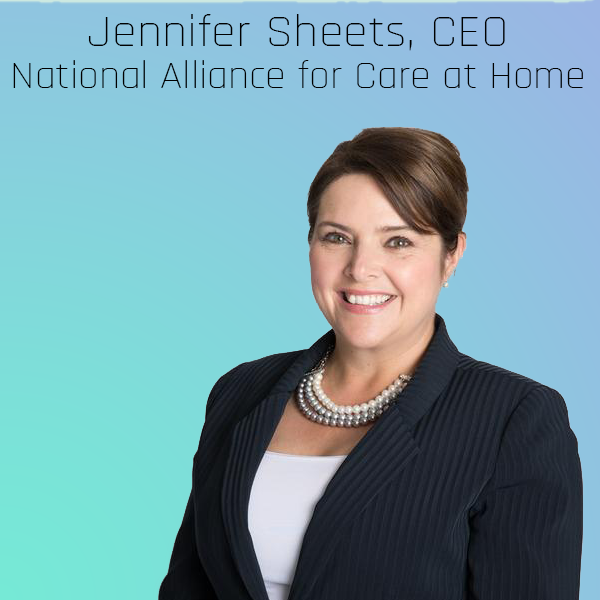
Jennifer Sheets, CEO, National Alliance for Care at Home

# # #

Kristin Rowan Editor The Rowan Report

Kristin Rowan is the owner and Editor-in-chief of The Rowan Report, the industry’s most trusted source for care at home news. She is also a sought-after speaker on Artificial Intelligence, Technology Adoption and Lone Worker Safety. She is available to speak at state and national conferences as well as software user-group meetings.

Kristin also runs Girard Marketing Group, a multi-faceted boutique marketing firm specializing in content creation, social media management, and event marketing. She works with care at home software providers to create dynamic content that increases conversions for direct e-mail, social media, and websites.  Connect with Kristin directly at kristin@girardmarketinggroup.com or www.girardmarketinggroup.com

©2026 by The Rowan Report, Peoria, AZ. All rights reserved. This article originally appeared in The Rowan Report. One copy may be printed for personal use: further reproduction by permission only. editor@therowanreport.com
 

Research Institute Joins Alliance

FOR IMMEDIATE RELEASE
August 20, 2025

Contact:                                                                   Elyssa Katz
571-281-0220
communications@allianceforcareathome.org

Research Institute for Home Care and National Alliance for Care at Home Ink Affiliation Agreement

Alexandria, VA and Washington, DC, August 20, 2025 – The Research Institute for Home Care (the Institute) and the National Alliance for Care at Home (the Alliance) have entered into an affiliation agreement to strengthen and expand research efforts while further unifying the care at home movement. The agreement is effective immediately. 

Research Institute for Home Care

Since its founding in 2008, originally as the Alliance for Home Health Quality & Innovation, the Institute has invested in research and education about home care and hospice and its ability to deliver quality, cost-effective, patient-centered care, demonstrating the value proposition for patients and the entire U.S. healthcare system. With this affiliation, the Institute will remain an independent research organization, continuing to pursue its mission of funding and promoting research to inform policy and identify best practices and care models that expand access to healthcare in the home. Its vision remains clear: promoting healthy patients and communities through home care research, education, quality, and innovation. 

Research Institute for Home Care

The Institute’s Board of Directors will continue to independently oversee its research agenda and initiatives. The Alliance will provide comprehensive management support for the Institute’s operations. At the launch of the affiliation, Dr. Steve Landers, CEO of the Alliance, will also serve as the President of the Institute. Jennifer Schiller, the former Executive Director of the Institute, has joined the Alliance leadership team and will continue to support Institute initiatives along with other Alliance leaders. Jennifer Sheets, Founder and CEO of Carezzi, will remain the Board Chairman of the Institute.   

The enhanced collaboration and amplification opportunities provided by this affiliation elevate and unify the care at home movement. Together, the strengthened Alliance and Institute leadership will continue to invest in and focus on critical home care and hospice industry research and data to inform effective policy, clinical practice, and underscore the value of home-based care. 

In Their Own Words

“We are thrilled to announce our affiliation with the Research Institute for Home Care. The Institute’s more than decade-long commitment to rigorous research perfectly complements our mission. This affiliation strengthens our ability to further demonstrate that care at home is the preferred choice for patients and families and the highest-value option for our healthcare system.” 

Dr. Steve Landers

CEO, National Alliance for Care at Home

“This is an important milestone for the Institute that will amplify our research impact while preserving our integrity and academic rigor. By joining forces with the Alliance, we ensure that evidence-based findings continue to inform policy and best practices that benefit patients, families, and the entire healthcare system.”

Jennifer Sheets

Chairman of the Board, Research Institute for Home Care

Director Agreement

The decision, reached by both organizations’ independent Boards of Directors, reflects the shared recognition that care at home is at a pivotal juncture. By combining the Alliance’s resources with the Institute’s research expertise, the partnership positions both organizations to influence policy, strengthen clinical practice, and advance innovation in care at home.  

“The timing of this affiliation reflects a shared recognition that care at home stands at a critical juncture. By bringing together the Alliance’s resources with the Institute’s research expertise, we are better positioned to navigate today’s complex healthcare landscape and drive meaningful policy change. This partnership represents a strategic investment in the future of home-based care that will benefit providers, patients, and policymakers alike,” said Ken Albert, Board Chair for the Alliance. 

# # #

About the National Alliance for Care at Home

The National Alliance for Care at Home (the Alliance) is the leading authority in transforming care in the home. As an inclusive thought leader, advocate, educator, and convener, we serve as the unifying voice for providers and recipients of home care, home health, hospice, palliative care, and Medicaid home and community-based services throughout all stages of life. Learn more at www.AllianceForCareAtHome.org.  

About the Research Institute for Home Care

The Research Institute for Home Care (the Institute) is a non-profit, national consortium of home care providers and organizations. The Institute invests in research and education about home care and its ability to deliver quality, cost-effect, patient-centered care across the care continuum. The Institute is committed to conducting and sponsoring research and initiatives that demonstrate and enhance the value proposition that home care has to offer patients and the entire U.S. healthcare system. 

More Rural Providers Say ‘No’ to MA

by Tim Rowan, Editor Emeritus

O

ne just does not know whom to believe anymore. This week, we were sent three opinions of the pros and cons of Medicare Advantage programs. One says they reduce costs and improve patient satisfaction for rural residents. Another says rural hospitals are turning away MA customers at a growing rate. The third says MA customers utilize healthcare services at a lower rate than traditional Medicare beneficiaries. Let’s take a look at each opinion.

The Pro

Better Medicare Alliance is a non-profit advocacy group that promotes Medicare Advantage. They describe themselves and the genesis of their recent report this way:

“Better Medicare Alliance engaged ATI Advisory to understand Medicare beneficiaries who live in rural areas and how they are served across Medicare Advantage and Fee-for-Service (FFS) Medicare. Understanding geographic differences in beneficiary experiences is important to both the Medicare Advantage and FFS Medicare program. This research can help policymakers and stakeholders identify opportunities to improve access to and quality of rural health care.”

That sounds good so far. Let’s look at their conclusions.

    • 30 percent fewer MA client live in rural areas compared to cities and suburbs
    • rural MA enrollees are more likely to be Black or LatinX but health needs are consistent across all rural demographics
    • satisfaction is the same between rural MA clients and traditional Medicare beneficiaries, though MA enrollees use preventive services more and outpatient services less
    • rural MA enrollees spend less in premiums and out of pocket costs than traditional Medicare beneficiaries

Rural Hospitals Tell a Different Story

Healthcare Uncovered, an online publication with a patient advocacy slant, describes BMA as “an active front group for the health insurance industry and perhaps the country’s greatest champion of Medicare Advantage plans.” and “with a well-stocked, industry-financed war chest to promote insurers’ premier product.”

Writing for Healthcare Uncovered, longtime healthcare journalist Trudy Lieberman added perspective to the BMA-sponsored report:

More places say no to medicare advantage

There was evidence last fall that Medicare Advantage was under attack when several hospitals announced they were reviewing their arrangements with Advantage plan sellers and were not accepting some or all plans. The CEO of the Brookings Hospital system in Brookings, South Dakota, told me, “The difference between original Medicare and Medicare Advantage is vast. Advantage plans pay less, don’t follow medical policy, coverage, billing, and payment rules and procedures, and they are always trying to figure out how to deny payment for services.”

In 2023, Becker’s Hospital Review began reporting on hospitals that were dropping some or all of their contracts with Advantage plans. The August 20, 2024 update indicates 18 more hospitals have or will drop MA plans this year. 

Ms. Lieberman went on to report that MA plans frequently limit in-plan physicians. When they eliminate a physician in a rural community, patients often must travel miles to reach an approved doctor.

“Another damning report, this one issued by the Nebraska Rural Health Association, also revealed the pitfalls of joining an Advantage plan. The report warned that Nebraskans with Advantage plans ‘have created such a financial burden for rural residents’ that when they get sick, those with Medicare Advantage coverage ‘represent the largest growing segment of charity care for Nebraska’s rural hospitals.’ I’d bet few if any seniors are told they may end up on charity care if they choose an Advantage plan.”

A hospital in 23,000-resident North Platte, Nebraska has stopped accepting all MA patients. CEO Ivan Mitchell told Ms. Lieberman that transfers to nursing home and Home Health are denied 13 percent of the time. “Hospital stays are 40 percent longer for MA patients. They are stuck in the hospital two or three days waiting for approval to be transferred, and we need those beds for sicker patients.”

RIHC logo

Home Health Weighs In

The Research Institute for Home Care awarded a grant to Tami M. Videon, PhD, and Robert J. Rosati, PhD, of the VNA Health Group, the honored Home Health not-for-profit in New Jersey. The researchers divided beneficiaries into three groups: Traditional Medicare, MA with a premium, and MA without a premium. Their findings resonated with the experiences of rural hospitals more than those of the MA advocacy group.

Research Findings

    • Traditional Medicare (TM) beneficiaries were more likely to utilize outpatient, inpatient, and home health care services than beneficiaries in Medicare Advantage (MA) plans, regardless of whether the plan had a monthly premium or not.
    • Beneficiaries who reported being in zero premium MA plans were substantially less likely to use dental, hearing, and vision services compared to other beneficiaries.
    • Rates of utilization of hearing and dental services were relatively similar for beneficiaries reporting they were in MA plans with a premium and those enrolled in TM. Access to vision services was greatest among beneficiaries reporting being in MA plans with a premium.

In their research briefing, the researchers stated:

“Consistent with the literature, this study found beneficiaries enrolled in MA  plans had lower utilization for services required to be covered by Medicare (outpatient visits, inpatient admission, and home health care use) than beneficiaries enrolled in TM. The observed lower rate of home health care utilization among MA beneficiaries may result from restrictions in inpatient care. However, prior research indicates when analyses are restricted to similar patient populations (a subset of diagnostic codes), MA beneficiaries are less likely to receive home health care than TM beneficiaries.”

Where Does the Money Go?

We have often reported on the lawsuits that various federal departments have lodged against the largest health insurance companies for their Medicare Advantage practices.  With their payments from the Medicare Trust Fund based on patient assessments, they have been caught exaggerating illnesses, adding chronic conditions that do not exist, and conducting periodic home visits to “update” their data on the health condition of their customers. These nurse visits to the home frequently “identify” serious health conditions that the person did not know they had, or in most cases did not have at all.

As a consequence of this practice, coupled with denying care that Traditional Medicare would have covered, the program has been determined by government audits to cost 119 percent of what Traditional Medicare costs. 

Final Thoughts

Should Home Health follow the lead of so many rural hospitals and begin to Just Say No? Our guess is that this will be a prominent topic at this October’s NAHC Conference in Tampa.

# # #

Tim Rowan, Editor Emeritus
Tim Rowan is a 30-year home care technology consultant who co-founded and served as Editor and principal writer of this publication for 25 years. He continues to occasionally contribute news and analysis articles under The Rowan Report’s new ownership. He also continues to work part-time as a Home Care recruiting and retention consultant. More information: RowanResources.com Tim@RowanResources.com ©2024 by The Rowan Report, Peoria, AZ. All rights reserved. This article originally appeared in Healthcare at Home: The Rowan Report. One copy may be printed for personal use: further reproduction by permission only. editor@therowanreport.com