AI in Home Care

Artificial Intelligence

by Laurie Orlov, Founder, Aging and Health Technology Watch

The Future of AI in Home Care

New Research Report

Wed, 06/04/2025

PORT SAINT LUCIE, FL, UNITED STATES, June 4, 2025 /EINPresswire.com/ — The home care industry is facing a crisis. Driven by demographic shifts, longer life expectancy, and rising rates of chronic illness and cognitive decline, the demand for in-home personal care and home health care is surging. This will accelerate as the baby boomers age into their later years – in January, the oldest of the 76 million baby boomers will turn 80. At the same time, the care industries will face a critical shortage of all categories of care delivery, with millions of additional workers needed over the next decade. Against this backdrop, AI technology has emerged to help older adults in multiple ways. In a 2023 report, The Future of AI and Older Adults, AI was already able to produce insights about a person’s health needs and offer a chatbot to help with post-hospital care. In a subsequent 2023 report, AI and the Future of Care Work, it was apparent that AI could help generate an appropriate care plan and that an ‘AI Caregiver’ role was emerging to supplement in-person care delivery. In the 2024 report, The Future of AI in Senior Living and Care, AI was being used to analyze hospital discharge information to compare patient needs to nursing home capacity. 

Today there are many more initiatives and new possibilities for addressing multiple aspects of both private duty home care and home health operations, including assistance with recruiting and onboarding workers, using data to create and update care-related documents, and introducing AI agents that can be assigned to complete specific tasks. As current industry leaders note, AI tech is playing a role in care oversight and enabling the creating of hybrid models – an increasingly likely combination of in-person care supplemented with AI.

This report draws insights from experts across home care, home health care, plus software and device providers, and healthcare sectors to examine how AI is currently being used and suggest what lies ahead within the next five years.

The report can be found at this link: https://www.ageinplacetech.com/page/future-ai-home-care

# # #

Laurie Orlov The Future of AI in Home Care

Laurie M. Orlov, a tech industry veteran, writer, speaker, elder care advocate, is the founder of Aging and Health Technology Watch  market research, trends, blogs and reports that provide thought leadership, analysis and guidance about health and aging-related technologies and services that enable boomers and seniors to sustain and improve their quality of life. In her previous career, Laurie spent many years in the technology industry, including 9 years at analyst firm Forrester Research. She has spoken regularly and delivered keynote speeches at forums, industry consortia, conferences, and symposia, most recently on the business of technology for boomers and seniors. She advises large organizations as well as non-profits and entrepreneurs about trends and opportunities in the age-related technology market.  Her perspectives have been quoted in the Wall Street Journal, the New York Times, Vox, Senior Housing News, CNN Health, AARP Bulletin and Consumer Reports. She has a graduate certification in Geriatric Care Management from the University of Florida and a BA in Music from the University of Rochester. Laurie has provided testimony about technology at a Senate Aging Committee hearing and has consulted to AARP.  Advisory clients have included AARP, AOL, Argentum, Bose, Calix, CDW, Microsoft, Novartis, and Philips. Her reports include: The Market Overview Technology for Aging 2025The Future of AI in Senior Living and CareThe User Experience Needs An Upgrade 2024The Future of AI and Older and Older Adults 2023The Future of Care Work and Older Adults 2023The Future of Sensors and Older Adults 2022Beyond DIY: The Future of Smart Homes and Older Adults 2021, and The Future of Wearables and Older Adults 2021. Laurie has been named one of the Women Leaders in VoiceTop 50 Influencers in Aging by Next Avenue and one of the Women leading global innovation on AgeTech. 

©2025 by Aging and Health Technology Watch. All rights reserved. This introduction and link are printed with permission from the author. For more information or to request usage rights, please contact Laurie Orlov

BREAKING NEWS: Intrepid USA Files Bankruptcy

Breaking News

by Kristin Rowan, Editor

*Editor’s note: This article has been updated to remove inaccurate information from the Intrepid USA website.

Intrepid USA Files Bankruptcy

Intrepid USA, once among the largest providers of home health and hospice services, files bankruptcy in Texas. With more than $90 million in revenue in 2023, Intrepid operated more than 60 home health and hospice locations in 17 states. The Chapter 7 filing leaves no road to recovery. Chapter 7 allows the company to liquidate assets and distribute the proceeds. According to the Texas Southern Bankruptcy Court, Intrepid USA filed a voluntary petition for Chapter 7 bankruptcy on May 29, 2025.

Troubled History Plagues Company

Intrepid USA has a troubled past that it seems may have caught up with them. The U.S. Department of Justice (DoJ) alleges that between 2016 and 2021, Intrepid home healthcare agencies engaged in fraud. In violation of the False Claims Act, Intrepid filed Medicare claims for patients who did not qualify for home health, services that were not medically necessary, services provided by untrained staff, and services that were never provided. In August, 2024, Intrepid agreed to pay $3.85 million to resolve the allegations. The allegations were brought to the DoJ by two former employees of Intrepid under whistleblower provisions.

This is not the first DoJ lawsuit against Intrepid USA. In 2006, when Intrepid owned 150 agencies across the country, the company entered into an $8 million settlement agreement to resolve similar allegations. The DoJ alleged that from 1997 to 2004 Intrepid violated the False Claims Act by billing Medicare and TRICARE for services not provided by a qualified person, failing to maintain complete documentation for its claims, and other violations of Medicare regulations. Additionally, the DoJ alleged that Intrepid, in 2002 and 2003, fraudulently billed Medicaid for home care services provided to patients who were hospitalized at the time of the supposed care.

Private Equity Backing

Sometime around Q3 of 2006, Intrepid USA received financial backing from Patriarch Partners, led by Lynn Tilton. In August of 2020, Patriarch filed a notice of removal with the Supreme Court of New York. In 2021, Intrepid announced it was gearing up for rapid growth fueled by new private equity investors. Then CEO John Kunysz indicated the infusion of capital would fund opportunities for growth through acquisition.

Divest, not Acquire

Despite the influx of capital and the plan to grow through acquisition, by 2024, Intrepid was selling its assets. In August of 2024, Humana acquired 30 Intrepid branch locations and rebranded them under the CenterWell Home Health brand. The sale was part of Patriarch Partners’s Zohar Funds bankruptcy case. In November of 2024, New Day Healthcare acquired Intrepid’s hospice locations in Missouri and Texas.

$0 Revenue; 0 Value

The bankruptcy filing shows that Intrepid USA had $90 million in revenue in 2023, $50 million in revenue in 2024, and $0 in revenue so far in 2025. Chapter 7 bankruptcy is usually supervised by the court, allowing the filing company to sell assets without having to use the revenue generated by the sale to pay off debts. Intrepid listed $1 to $10 million in assets and $88 million in debts at the time of the filing. 

Intrepid USA files bankruptcy
Intrepid USA Files Chapter 7 Bankruptcy

Who will take the loss?

The Intrepid USA website still lists 55 active home health and hospice locations in 11 states. However, 30 of those locations are now listed on the CenterWell website and at least 5 other locations were part of the sale to New Day Healthcare. It is unknown if Intrepid has any locations still in operation. The company did not respond to our request for a statement.

The website also has a list of partners and investors. The Rowan Report reached out to the partners with whom we are familiar for more information. We will provide updates from them once we reach them.

Final Thoughts

The recent divestiture of home health and hospice locations to New Day and CenterWell will hopefully minimize the number of patients who are losing their home health or hospice provider. Millions of dollars in future fraudulent claims will remain in the Medicare, TRICARE, and Medicaid coffers. Conversely, the partners and investors in Intrepid USA may face some loss. We will provide any important updates and comments from the impacted companies as available.

# # #

Kristin Rowan, Editor

Kristin Rowan has been working at The Rowan Report since 2008. She is the owner and Editor-in-chief of The Rowan Report, the industry’s most trusted source for care at home news, and speaker on Artificial Intelligence and Lone Worker Safety and state and national conferences.

She also runs Girard Marketing Group, a multi-faceted boutique marketing firm specializing in content creation, social media management, and event marketing.  Connect with Kristin directly kristin@girardmarketinggroup.com or www.girardmarketinggroup.com

©2025 by The Rowan Report, Peoria, AZ. All rights reserved. This article originally appeared in The Rowan Report. One copy may be printed for personal use: further reproduction by permission only. editor@therowanreport.com

 

Fraudsters Arrested, Oz Issues Warning

CMS

by Kristin Rowan, Editor

Fraudsters Arrested, Oz Issues Warning

Fraud in California

Fraudsters arrested in West Covina, CA this week were allegedly running a Medicare scheme. Authorities arrested hospice owner-operator Normita Sierra. They charged her with nine counts of health care fraud, one count of conspiracy, and four counts illegal remuneration (kick-backs) for health care referrals. The U.S. Attorney’s Office named co-conspirator Rowena Elegado. They also arrested her and charged her with one count of conspiracy and four counts of illegal remuneration for health care referrals.

Kickbacks

Sierra and Elegado worked together to pay marketers to recruit patients who did not have a hospice referral from their PCP and who were not terminally ill. Some of the kickbacks paid to marketers were as high as $1,300 per patient per month. After six months, the patients were referred out to Sierra’s home health company.

Medicare Claims

According to the U.S. Attorney’s Office, from 2018 to 2022, Sierra’s hospice agences submitted $4.8 million in fraudulent claims. Of those claims, Medicare paid approximately $3.8 million.

Dr. Oz Issues Warning

In a video statement, Dr. Oz explained how Medicare recipients are falling victim to scams. Sales people call, email, and even knock on your door, offering advice, free samples, and referrals. These marketers have one goal: get you sign a piece of paper. That paper signs you up for hospice care and agrees to allow a specific hospice agency to provide that care. The hospice agency then bills Medicare for services they never provide. Watch the video statement here.

HHS OIG Issues Consumer Alert

In a similar statement, HHS issued a consumer alert regarding DME companies. The alert warns that some DME companies are contacting Medicare beneficiaries. They claim to work for or on behalf of Medicare. Once they receive the patient’s Medicare number, they bill Medicare for unnecessary medical items. These items include urinary catheters, knee and back braces, orthotic braces, and prescription drugs, which may or may not ever be sent to the patient. HHS urges enrollees not to give their Medicare number to anyone. Further, they suggest regulary reviewing items charged to insurance, and refusing delivery of any medical supply not ordered by a physician.

Oz Issues Warning
Fraudsters Arrested

Combating Waste, Fraud, and Abuse

Dr. Oz and CMS have spoken numerous times about combatting the waste, fraud, and abuse withing the Medicare and Medicaid systems. Originally a strong proponent for Medicare Advantage, Oz has promised to audit MA after discovering the government pays more for MA than traditional Medicare. Oz also promised to reduce the amount of prior authorization requests needed before a patient gets services. Oz responded to the Republican-backed House bill requiring more oversight on Medicaid eligibility. Oz indicated that some Medicaid patients are enrolled in more than one state and that Medicaid is paying for able-bodied patients. The waste, fraud and abuse across Medicare and Medicaid is costing the government between $1 and $10 billion and Dr. Oz plans to find it and make significant changes to the management of the system.

A Cautionary Tale for Hospice Providers

You may be thinking, “What does this have to do with me?” Unfortunately, even the most scrupulous hospice agencies can fall prey to marketers running schemes. There are legitimate referral resources in the market who can help your agency get more referrals and more clients. There are also underhanded marketers who know how the system works. These predators will promise new referrals (for a fee) and then enroll uneligible patients without your knowledge. If you are working with or looking for a referral partner for your hospice agency, use one that is referred by someone you trust, and/or do a lot of research on the company history before working with anyone. Be especially wary of the ones who promise much more than what most referral companies offer.

# # #

Kristin Rowan, Editor

Kristin Rowan has been working at The Rowan Report since 2008. She is the owner and Editor-in-chief of The Rowan Report, the industry’s most trusted source for care at home news, and speaker on Artificial Intelligence and Lone Worker Safety and state and national conferences.

She also runs Girard Marketing Group, a multi-faceted boutique marketing firm specializing in content creation, social media management, and event marketing.  Connect with Kristin directly kristin@girardmarketinggroup.com or www.girardmarketinggroup.com

©2025 by The Rowan Report, Peoria, AZ. All rights reserved. This article originally appeared in The Rowan Report. One copy may be printed for personal use: further reproduction by permission only. editor@therowanreport.com


Delay HOPE Tool

Advocacy

by Kristin Rowan, Editor

Advocacy Groups to CMS:

Delay HOPE Tool Implementation

“Delay HOPE Tool Implementation,” say multiple hospice advocacy groups. LeadingAge, the National Alliance for Care at Home (The Alliance), and the National Partnership for Healthcare and Hospice Innovation (NPHI) are urging CMS to delay the transition from HIS to HOPE. The three groups sent a joint letter to Dr. Mehmet Oz, CMS Administrator, earlier this week.

“Our associations remain fully committed to the [Hospice Quality Reporting Program (HQRP)], including the payment penalties for non-compliance, and recognize the critical importance of accurate, timely data submission to inform the delivery of high-quality hospice care. However, we have serious concerns about the potential for successful implementation of the HOPE tool.”

LeadingAge, The Alliance, NPHI

Hospice Advocacy

The concerns over agency readiness to implement the new tool center on the new reporting platform. Hospice agencies state they don’t have all the necessary information to develop a workable tool for submission. Therefore, the agencies have asked CMS to delay the implementation of the HOPE tool. They have called on CMS to wait until six months after agencies have access to education, training, and final validation specifications.

Hospice Rule Penalty

The hospice program through CMS requires substantial reporting for payment. Hospices that do not submit the required 90% of records, they receive an annual payment penalty of 4%. Combined with lower than sustainable payment increases, the 4% penalty results in a lower reimbursement rate over prior years. The associations worry that the lack of information and education will lead to lower reporting. In turn, the lower reporting lowers reimbursement rates. For hospices that are already struggling to survive, the penalty is devastating. The letter to CMS asked to waive the timeliness requirement for two quarters after implementation.

HOPE Tool Lacks Validation

CMS will have a Validation Utility Tool that agencies will need to use in order to ensure their software can successfully submit their data. CMS has not released the tool and indicates they may not until sometime in September. The HOPE tool is scheduled for implementation in October. There is not enough time between release of the validity tool and implementation of the HOPE tool for proper testing.

Hospice Agencies Lack Validation

In addition to validating data submission, hospice agencies have to enroll in the new submission portal, iQUIES. Enrollment requires a privacy security official and other staff. Additionally, it requires an application to access the system, background checks, and other actions. Thus far, hospice agencies do not have access to begin this process and there is no indication of how long it will take. The associations are concerned that the process may also involve significant financial cost to hospice agencies.

Resources

CMS released the Hospice Outcomes and Patient Evaluation (HOPE) Guidance Manual v1.01, a 138 page PDF, available here. The manual includes links to other resources for hospice agencies. Namely, a webpage with information on HOPE Data Submission Specifications has a “final” version of data specs available for download. Additionally, there are links to the Main Page here and technical information and updates here. The document urges vendors to register to get updates and important announcements.

Final Thoughts

There is no information yet as to a response to the letter from CMS. Thus far, CMS is still planning on keeping the October 1, 2025 HOPE implementation date. We will continue to report on updates from CMS and the advocacy groups.

# # #

Kristin Rowan, Editor

Kristin Rowan has been working at The Rowan Report since 2008. She is the owner and Editor-in-chief of The Rowan Report, the industry’s most trusted source for care at home news, and speaker on Artificial Intelligence and Lone Worker Safety and state and national conferences.

She also runs Girard Marketing Group, a multi-faceted boutique marketing firm specializing in content creation, social media management, and event marketing.  Connect with Kristin directly kristin@girardmarketinggroup.com or www.girardmarketinggroup.com

©2025 by The Rowan Report, Peoria, AZ. All rights reserved. This article originally appeared in The Rowan Report. One copy may be printed for personal use: further reproduction by permission only. editor@therowanreport.com


Update is Not an Increase

Hospice

by Kristin Rowan, Editor

Updates to Hospice Rule

On April 11, 2025, the Centers for Medicare and Medicaid Services (CMS) issued their proposed rule for hospice rates, Conditions of Participation (CoPs) and face-t0-face encounter requirements for FY 2026. The proposed rule also includes a change in regulatory text for the Hospice Quality Reporting Program.

Following Executive Order 14192, an attempt to reduce the expense attached to following Federal regulations, CMS is seeking feedback on streamlining regulations and reducing expenses. The RFI to submit responses can be found here.

Payment Updates

The proposed update to the hospice payment rate yields a net increase of 2.4 percent. This change includes a 3.2 percent market basket increase based on the estimate cost increase for inpatient hospitalization. The 0.8 percent productivity adjustment offsets the market basket increase. The quality data penalty of 4 percent remains in place.

Market Basket Objections

Not for the first time, commentors on CMS proposed rules objected to the use of the hospital wage index in determining hospice pay rates. According to a report from the Federal Register, a few commenters on the FY 2025 payment update opposed using the IPPS wage index to determine the hospice wage index. According to the commenters, the hospital wage index uses cost report wage data that excludes hospice wage costs. The exclusion of hospice costs skews the accuracy of wage adjustments for hospice providers.

In response to the same proposed rule, MedPAC recommended that wage index policies be repealed and replaced by new Medicare wage index systems that use all-employer, occupation-level wage data; account for wage differences across geographical areas, and match wages in adjacent local areas. 

CMS Ignores Objections

Despite years of comments, objections, and suggestions to update the hospice wage index calculations using more accurate data, CMS continues to insist that using the pre-floor and pre-reclassified hospital wage index is the more appropriate for determining hospice payment rates. CMS states that this position is “longstanding and consistent with other Medicare payment systems.”

Productivity Adjustment

The productivity adjustment started with the Affordable Care Act. It’s stated purpose is to “reduce Medicare spending by recognizing that hospitals can improve their efficiency and productivity.” Average efficiency and productivity gains in all private non-farming businesses form the productivity adjustment.

The most recent document from CMS about the productivity adjustment comes from 2022, using data from 2019. The report shows that hospital growth falls far below the average growth of private non-farming businesses. Using two different methods of calculations, hospital growth falls between 0.2 and 0.3 percent. Non-farming business growth is 0.8 percent. 

Labor Productivity

CMS uses labor productivity as its measure for the productivity adjustment for Medicare hospitals and hospices. The estimate for labor productivity across all private non-farming businesses is 2.0 percent. The calculation for hospital labor productivity is 0.8 percent. This is the number used in this year’s productivity adjustment. Actual labor productivity growth in hospitals from 1993 to 2018 was 0.4 percent.

Quality Reporting Reduction

Hospices that do not submit the required quality data incur a payment reduction of 4 percent. This yields a 1.6 percent decrease over last year’s rates after factoring in the 2.4 percent increase. Quality data reporting includes the HIS tool, administrative data, and CAHPS hospice survey. The threshold to avoid the 4 percent reduction includes submitting at least 90 percent of HIS records within 30 days of an event date and ongoing monthly participation in CAHPS surveys.  The HOPE reporting tool replaces the HIS system beginning October 1, 2025. These requirements are not changing with the FY 2026 proposed rule, with the exception of the change from the HIS tool to the HOPE tool.

Comment from The Alliance

In last week’s newsletter, we summarized Dr. Steven Landers’s keynote address from the New England Home Care & Hospice Conference and Expo. Always passionate about care at home, and particularly about hospice, which he describes as “a national treasure,” Dr. Landers strongly stated that an “update is not an increase” when it doesn’t keep up with inflation and pay increases. 

Final Thoughts

Every year, CMS, MedPAC, and HHS make changes to hospice and home health payment rates based on faulty information that doesn’t account for the nature of the work or the person-centered requirements of the industry. Non-farming industries can increase efficiency and productivity in myriad ways that cut staff. We see it in grocery stores with the increasing number of self-checkout lines. We see it in restaurants with QR code menus, ordering kiosks, and payment kiosks. There is no substitute for one-on-one contact in a home setting for care at home, particularly in hospice. Nurses can’t take on enough more patients in a day to make a meaningful impact on efficiency and productivity without sacrificing quality of care.

AI for Efficiency and Productivity

I’ve been speaking for some time now on the advantages of using augmented and generative intelligence in care at home. As long as CMS continues to lower reimbursement rates using the collective productivity rates of impertinent industries, care at home has to embrace the technology that increases productivity and efficiency in the office and in the field. Talk to text, documentation, scheduling, onboarding, and data analytics are readily available through AI platforms and drastically reduce costs across departments.

You can read about some of the AI tools here. For more information or to engage our consulting services for AI adoption, contact me directly.

# # #

Kristin Rowan, Editor

Kristin Rowan has been working at The Rowan Report since 2008. She is the owner and Editor-in-chief of The Rowan Report, the industry’s most trusted source for care at home news, and speaker on Artificial Intelligence and Lone Worker Safety and state and national conferences.

She also runs Girard Marketing Group, a multi-faceted boutique marketing firm specializing in content creation, social media management, and event marketing.  Connect with Kristin directly kristin@girardmarketinggroup.com or www.girardmarketinggroup.com

©2025 by The Rowan Report, Peoria, AZ. All rights reserved. This article originally appeared in The Rowan Report. One copy may be printed for personal use: further reproduction by permission only. editor@therowanreport.com


That’s a No-No

Admin

by Elizabeth E. Hogue, Esq.

No-no # 1

“No-No” may seem like something you would say to a toddler, but there is a list of things agency owners do that they should not do. Many of these are things providers may not often consider. This article focuses on the use of private duty services by hospice and home health patients, and what hospices and home health agencies cannot do with regard to aide services.

Aide Services

Both home health and hospice services are usually intermittent and provided in patients’ homes.  Patients and their families may elect to utilize the services of private duty/home care companies for additional assistance. At the same time, hospice and home health patients may receive aide services from hospices and home health agencies. 

Conditions of Participation no-no

Conditions of Participation

According to Medicare Conditions of Participation (CoPs), hospice and home health aides can only provide personal care services, including bathing. Aides provided by private duty/home care companies may also provide personal care. Unlike aides provided by hospices and home health agencies, however, they can provide additional services; such as laundry, food preparation, light housekeeping, shopping, and running errands.

Private Duty Services

When patients use private duty services, they are often paying for these services out of their own pockets. Even if they have long-term care insurance, patients still bear the financial burden of paying for private duty services. Longterm care insurance often costs thousands of dollars that patients probably paid for themselves. Patients usually pay by the hour for these services. 

Private Duty Aide Services No-No

That's a No-No

Patients may, of course, utilize private duty/home care services to perform any of the services described above. It seems, however, that hospices routinely tell patients who have private duty/home care that they will not provide aide services because private duty/home care aides are able to provide personal care for patients.

Breaking it Down

Here is an example: A hospice admitted a bedridden patient with urinary and fecal incontinence. The patient and caregiver requested aide services from the hospice five days a week to bathe him. He paid for a few hours of private duty/home care services each day. The hospice refused to provide aide services five days a week to bathe him because he had private duty/home care services. No-no!

Compelled to Provide Care

ospices must provide aide services consistent with patients’ needs related to their terminal illnesses. In the example above, the patient clearly had a need for aide services five days a week. If patients and their caregivers state that they prefer to use private caregivers for personal care, then hospices must document the refusal of hospice aide services offered, consistent with applicable standards of care. Then hospices are not required to provide aide services.

Profiteering

When hospices deny aide services that are consistent with applicable standards of care and require patients and caregivers to use private duty/home care services, hospices are shifting the cost of aide services onto patients and their families. Patients and their families may have to pay for additional private duty/home care services to meet patients’ needs. The result for hospices is that they do not incur the costs of aide services, thereby increasing their profits at the expense of patients and their families. 

If hospice staff members who refuse to provide aide services to patients and require patients and their families to use private duty/home care services instead are compensated in any way based on the financial performance or profitability of the hospices, let’s hope they look good in orange jumpsuits!

Intent to Defraud

If the private duty/home care services are being paid for by any federal or state health care program; such as Medicaid, Medicaid waiver, VA, or TriCare; then both home health agencies and hospices have engaged in fraudulent conduct by shifting costs that they should have incurred onto other federal government programs. 

God forbid that the hospice also owns the company from which patients receive private duty/home care services! Then hospices are limiting their costs while profiting from patients and their families.

Dig Deep and Find Your No-No's

Now is the time for all home health agencies and hospices especially to audit patients’ records to make certain that all patients have been offered services that they are required to provide. If patients and their families choose to use private duty/home care aides instead, documentation must show that they were offered the services but chose to use private duty/home care aides.

No-No's Final Thoughts

The bottom line is that hospices and home health agencies must always provide services needed by patients.  Patients may choose to pay for services that are paid for by the Medicare hospice or home health benefits. Patients cannot be required to pay for services privately that hospices and home health agencies must provide. Unacceptable!

This article is the first in a series of “No-no” items for agency owners.

# # #

Elizabeth E. Hogue, Esq.

Elizabeth Hogue is an attorney in private practice with extensive experience in health care. She represents clients across the U.S., including professional associations, managed care providers, hospitals, long-term care facilities, home health agencies, durable medical equipment companies, and hospices.

©2025 Elizabeth E. Hogue, Esq. All rights reserved.

No portion of this material may be reproduced in any form without the advance written permission of the author.

©2025 by The Rowan Report, Peoria, AZ. All rights reserved. This article originally appeared in The Rowan Report. One copy may be printed for personal use: further reproduction by permission only. editor@therowanreport.com

HIS to HOPE

Admin

by Vicki Goodman, CRO at Curantis Solutions

HIS to HOPE Transition in Hospice Care

What You Need to Know

As a hospice nurse, I am excited to share pivotal news that will significantly impact our field starting October 1st. In case you have been living under a rock, we are transitioning from the Hospice Item Set (HIS) to the Hospice Outcomes and Patient Evaluation (HOPE). This change is not just a modification in terminology; it represents a transformative shift towards a more patient-centered and holistic approach to hospice care. In this article, we will explore what this transition entails, its benefits, and how it will affect our daily practices.

Understanding the Transition from HIS to HOPE

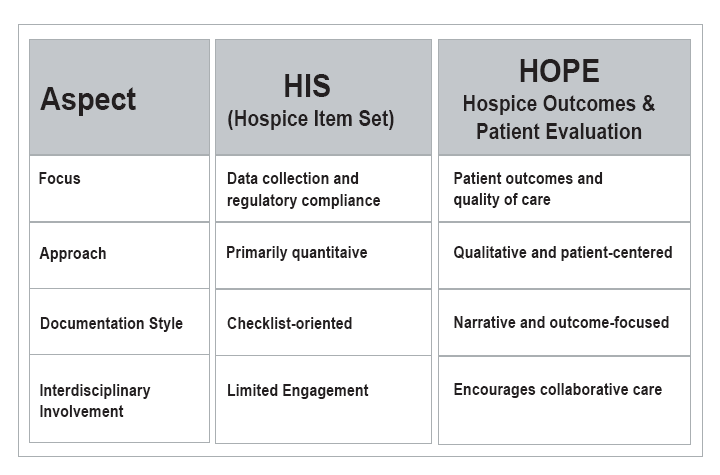
The move from HIS to HOPE signifies an essential evolution in our approach to patient care. While HIS primarily focused on data collection and compliance with regulations, HOPE emphasizes measuring patient outcomes, quality of care, and overall patient experience. This transition encourages us to engage more deeply with our patients and their families, ensuring that their unique needs and preferences are at the forefront of the care we provide.

What is HOPE?

HOPE stands for Hospice Outcomes and Patient Evaluation. This new framework highlights several core principles:

  • Patient-Centered Care
    • Focusing on individual patien needs and preferences
  • Quality of Care Assessment
    • Evaluation how well we meet those needs
  • Holistic Approach
    • Considering emotional, spiritual, and psychological factors in addition to physical health

Benefits of HOPE in Hospice Care

The adoption of the HOPE framework offers numerous advantages for both patients and healthcare providers:

  • Improved Patient Engagement
    • By prioritizing patient preferences, we can foster stronger relationships and enhance the overall care experience
  • Enhanced Quality of Care
    • Focused outcomes assessment allows us to identify areas for improvement and implement best practices
  • Recognition of Care Quality
    • HOPE enables us to demonstrate the effectiveness of our care, leading to greater recognition of our contributions in hospice settings

HIS to HOPE Key Differences

Understanding the distinctions between HIS and HOPE can help clarify the shift in our practices. Here are some key differences

HIS to HOPE Vicki Goodman Curantis Solutions

The Role of Hospice Nurses in the HOPE Framework

As hospice nurses, our role in implementing HOPE will require a significant mindset shift. Here’s how we can adapt our practice:

  • Engage With Patients and Families
    • Actively involve them in care planning and decision-making
  • Assess Holistically
    • Look beyond clinical data to include emotional and spiritual assessments
  • Collaborate with Interdisciplinary Teams
    • Work closely with all caregivers to ensure a comprehensive approach to patient care

By integrating these principles into our daily practice, we can enhance patient experiences and outcomes, ultimately providing the compassionate care that is the hallmark of hospice services.

Acknowledging Our Impact

As we transition to the HOPE framework, it’s essential to take a moment to give ourselves credit for the incredible work we already do. For most of us, patient-centered care has been at the heart of our practice long before HOPE was introduced. This new framework serves as validation, providing a structured approach to highlight the compassionate, individualized care we consistently offer.

Getting Prepared

The transition from HIS to HOPE marks an important chapter in the hospice care journey. Prepare for the transition with partners who understand the complexities and challenges that come with such significant changes. Specifically, work with a software and service company designed to ensure that your hospice team can seamlessly adapt to the HOPE framwork without sacrificing the quality of care. 

About Curantis Solutions

From comprehensive training to state-of-the-art data management systems, we provide everything needed to make this transition as smooth and effective as possible. With Curantis Solutions, you can be confident that no matter how the standards evolve, you will always be at the cutting edge, providing compassionate, patient-centered care. t Curantis, we understand the unique challenges faced by hospice and palliative care organizations. Our commitment to providing exceptional support ensures that you can focus on what matters most—delivering compassionate care to your patients. We pride ourselves on our quick response times, we deeply listen to our clients, and are easy to get ahold of when you need us. When partnering with Curantis Solutions, we guarantee we have support you can depend on.

# # #

Vicki Goodman
Vicki Goodman

Vicki Goodman, RN, BSN, MHA is an accomplished healthcare professional with a strong background in post-acute care, SaaS sales. With a proven track record of driving revenue growth, Vicki has successfully orchestrated sales strategies and marketing initiatives with over 30 years of experience in the home health and hospice EHR industry. Prior to joining Curantis Solutions, Vicki was VP, Enterprise Sales at Matrix Care.

She is an RN and BSN graduated of East Carolina University and received her MHA from University of North Carolina at Chapel Hill. She credits a lot of her success to collaborating with product and marketing teams creating an unstoppable engine. We are thrilled to have her join the Curantis Solutions family and look forward to the continued growth under her leadership.

©2024 by The Rowan Report, Peoria, AZ. All rights reserved. This article originally appeared in Healthcare at Home: The Rowan Report. One copy may be printed for personal use: further reproduction by permission only. editor@therowanreport.com

Humana Thyme Agreement

Clinical

by Kristin Rowan, Editor

Palliative Care for Medicare Advantage Members

Cancer is one of the highest leading causes of death in the United States, second only to heart disease. The challenges for cancer patients are not only physical, but emotional and financial as well. The consequences of these challenges are often devastating to the patient and their families. Providing additional care, support, and pharmaceutical interventions through value-based care can improve patient outcomes and reduce out-of-pocket costs.

Thyme Care

Thyme Care is a Nashville-based cancer treatment center that operates in seven states. The centers provide not just treatment, but cancer care navigation, designed to work within the value-based framework, keeping the patient at the center of care. Thyme Care includes an oncology care team, a patient app with multiple resources and 24/7 access to support. Patient surveys track symptoms and reduce barriers to care. This approach combines cancer treatment and palliative care for whole-person cancer care support.

Palliative Care

Palliative care works alongside medical care to improve the quality of life for the patient, addressing physical, emotional, and spirtual needs. Strictly speaking, it is not medical care, and not specifically covered by most insurance plans. The out-of-pocket costs for palliative care can be extremely high, making this kind of care an inaccessible amenity for most patients.

Humana Thyme Palliative

Value-Based Care

Value-based care reimburses care providers partially based on patient outcomes and patient satisfaction. Providers also share the financial risk of care with health insurance companies. Care providers who can both improve outcomes and patient satisfaction can be reimbursed more through health insurance plans, which can cover the costs of palliative care, even when it is not explicitly covered by the plan.

Humana

Humana is a payer with plans for Medicare, Medicaid, and Individual/Family beneficiaries. The Medicare Advantage value-based care plans allow Humana to disperse payments for covered services in partnership with care provider teams across a patient’s care journey. The better the outcome and satisfaction, the more Humana can pay a provider for care. Better outcomes often means reduced hospital visits, a longer time at home before requiring skilled nursing facilities, and lower costs.

Humana Thyme Palliative Care Collaboration

The recently announced partnership between payer and provider will give eligible patients access to palliative care support as part of the whole-person cancer care navigation provided by Thyme. Humana patients can also receive, as needed, 24/7 virtual care, medication guidance, symptom management, chronic condition management, community-based resources, financial assistance, transportation, food assistance, and/or access to stable housing.

Kristin Rowan, Editor

Kristin Rowan has been working at The Rowan Report since 2008. She is the owner and Editor-in-chief of The Rowan Report, the industry’s most trusted source for care at home news. She also has a master’s degree in business administration and marketing and runs Girard Marketing Group, a multi-faceted boutique marketing firm specializing in content creation, social media management, and event marketing.  Connect with Kristin directly kristin@girardmarketinggroup.com or www.girardmarketinggroup.com

©2025 by The Rowan Report, Peoria, AZ. All rights reserved. This article originally appeared in The Rowan Report. One copy may be printed for personal use: further reproduction by permission only. editor@therowanreport.com


Special Focus Program Ends

Advocacy

by Kristin Rowan, Editor

Special Focus Program Not Well Received

When the Hospice Special Focus Program (SFP) first appeared, the industry was told the program would help CMS identify and improve the performance of hospice providers that were struggling to meet quality standards. CMS developed the program to strenthen oversight, promote quality improvements, and ensure compliance for underperforming hospice agencies.

Soon after its inception and implementation in 2022, numerous concerns emerged. The National Alliance for Care at Home (then NAHC and NHPCO) voiced concerns over the program’s reliance on incomplete data as well as the potential for the program to unfairly targed providers in underserved communities.

Between February 2020 and January 2025, numerous state and national organizations have introduced Hospice Acts to Congress, given feedback to CMS on improvements to SFP, and filed lawsuits against the CMS.

Ramping Up the Opposition

In mid-2024, following the Council of States meeting, monthly opposition to the SFP became standard:

  • The McDermott Report highlighted significant flaws in the algorithm used for the program. Again, there was an objection over the use of incomplete and inconsistent data.
  • Bi-partisan Congress members sent a letter to CMS requesting revisions to SFP, criticizing outdated survey data and suggested that the quality metrics were inappropriately weighted.
  • Alliance CEO Steve Landers publicly criticized the implementation of SFP in his op-ed.
  • Representatives introduced Bill H.R. 10097 to delay SFP implementation, stating it would give CMS time to address the problems with the program and ensure fair application of standards for low-performing hospices without impacting quality programs.
  • The Texas Association for Home Care & Hospice; Indiana Association for Home & Hospice Care; Association for Home & Hospice Care of North Carolina; South Carolina Home Care & Hospice Association; and Houston Hospice filed a lawsuit challenging the SFP as unlawful and arbitrary.

CMS Backs Down

This week, CMS announced that it has paused the implementation of SFP for the calendar year 2025. The CMS statement say the pause will allow CMS to “further evaluate the program.” There is no mention of the opposition or the ongoing lawsuits.

The hospice special focus program page on the CMS website reads:

 Effective February 14, 2025, implementation of the Hospice Special Focus Program for CY 2025 has ceased so that CMS may further evaluate the program. Please contact QSOG_Hospice@cms.hhs.gov for policy questions.

All additional information about the program has been removed from the website page.

Special Focus Program gets First Positive Feedback

For the first time since 2020, industry leaders are applauding a CMS move regarding SFP. The move is halting the program altogether, but at least its positive feedback. 

“This decision is a positive move acknowledging that the current approach is not working as intended. The hospice community has long advocated for strong oversight and patient protections, but the SFP, as implemented, was deeply flawed, unlawful, and harmful to the very patients it was meant to protect.”

National Alliance for Care at Home

You can read the full statement from The Alliance in their press release.

Final Thoughts

It seems it is not often that CMS hears what the industry tells them. Reimbursement rates continue to drop, documentation is increasingly complex, and the industry has suffered from their misconceptions about what we need.  This time, at least, there was enough pressure and advocacy from Congress and from you, the people who are impacted daily by their decisions, to cause them to rethink this program. Keep up the good work and continue to advocate for yourself and for care at home. Perhaps this is not the last time CMS will listen.

# # #

Kristin Rowan, Editor

Kristin Rowan has been working at The Rowan Report since 2008. She is the owner and Editor-in-chief of The Rowan Report, the industry’s most trusted source for care at home news .She also has a master’s degree in business administration and marketing and runs Girard Marketing Group, a multi-faceted boutique marketing firm specializing in content creation, social media management, and event marketing.  Connect with Kristin directly kristin@girardmarketinggroup.com or www.girardmarketinggroup.com

©2025 by The Rowan Report, Peoria, AZ. All rights reserved. This article originally appeared in The Rowan Report. One copy may be printed for personal use: further reproduction by permission only. editor@therowanreport.com


Medicare Advantage Lowers Home Health Care Use

Hospice

by Kristin Rowan, Editor

End-of-Life Care in Medicare Advantage vs Traditional Medicare

Using research from CMS, researchers from Mt. Sinai in New York and Brown University in Rhode Island studied the data of adults aged 66 and older who passed away and had Medicare coverage in their final year of life. Included in the study were people potentially eligible for home health care and not in a nursing facility, hospital, or hospice care setting. Data from close to 1.8 million people was analyzed. The researchers identified whether the participants received home health care and how many days of end-of-life care they received.

Home Health Higher in Traditional Medicare

Of the nearly 1.8 million participants, the average age was 82. 51.5% were female and 36.5% were enrolled in Medicare Advantage. In the final year of life, home health care use was recorded at 37.5% for MA enrollees and 41.7% for traditional Medicare.

When the researchers looked at different demographic groups within the data sets, home health care usage was higher in traditional Medicare in most groups. However, among American Indian and Alaska Native groups, Medicare Advantage had a slightly higher rate of home health use at 37.9% compared with 37.1% in Traditional Medicare.

Conversely, in the Asian or Pacific Islander demographic, home health use rate was 32.6% in MA and 41.8% in TM. Similarly, the rate of use among the Hispanic group was 33% in MA and 44% in TM. Following a similar trend, in the non-Hispanic Black group home health usage in MA was 38.8% compared with 42.9% in TM. Likewise, among the non-Hispanic White group, home health use in MA was 37.9% versus 41.5% for TM. For those of unknown race, usage was 36.1% in MA compared with 40.1% in TM.

Days of Care Lower in Medicare Advantage

Home health users across all racial and ethnic demographic groups enrolled as Medicare Advantage beneficiaries had fewer days of care in home health than those enrolled in Traditional Medicare. The stand-out group in this part of the research was those of Hispanic descent, who averaged 81.9 days in home health care in Medicare Advantage compared with 111.9 days in Traditional Medicare.

Medicare Advantage Home Health Use

Implications

The researchers indicated some limitations in the study, namely that data was pulled from pre-covid patients because of the changes in home health during covid. The study should be repeated with post-covid data. One of the researchers received personal fees while serving as a senior advisor to CMS. Another received personal fees as a section editor for UpToDate. A third researcher reported receiving personal fees from Abt and UpToDate.

Despite these limitations, the implications of the study show that end-of-life care is not the same between Medicare and Medicare Advantage patients. Medicare Advantage is largely operating on a Value-Based Purchasing Model. The fewer services the beneficiary receives, the more money the primary doctor, hospital, and payer keep. It is not surprising, therefore, that MA patients get fewer services for less time. Patients who switch from Traditional Medicare to Medicare Advantage, especially if they are your patients, should be informed that they are still eligible for home health care and hospice care, but they may have to ask for it.

# # #

Kristin Rowan, Editor

Kristin Rowan has been working at The Rowan Report since 2008. She is the owner and Editor-in-chief of The Rowan Report, the industry’s most trusted source for care at home news .She also has a master’s degree in business administration and marketing and runs Girard Marketing Group, a multi-faceted boutique marketing firm specializing in content creation, social media management, and event marketing.  Connect with Kristin directly kristin@girardmarketinggroup.com or www.girardmarketinggroup.com

©2025 by The Rowan Report, Peoria, AZ. All rights reserved. This article originally appeared in The Rowan Report. One copy may be printed for personal use: further reproduction by permission only. editor@therowanreport.com


Good News for Veterans and Care at Home

Advocacy

by Kristin Rowan, Editor

Biden's Final Acts

With only a short number of days left in office, President Joe Biden has been making headlines. Not all of his final decisions have been met with absolute approval, but his latest one will make a difference for our veterans wanting Care at Home. On Thursday, January 3, 2025, President Biden signed into law the Senator Elizabeth Dole 21st Century Veterans Healthcare and Benefits Improvement Act.

The Dole Act

The Elizabeth Dole Act improves upon much of the benefits, programs, and services provided by the Department of Veterans Affairs (VA). Some of these changes include providing protections for care agreements between veterans and clinicians, modifications to educational assistance programs and benefits, expansion of the Native American Direct Loan program, increases per diem rates for veteran transitional housing, and various administrative and oversight tasks.

Elizabeth Dole Home Care Act

The Elizabeth Dole Home Care Act is a bill within the larger act specific to home- and community-based services (HCBS). The home care act aims to enhance veterans’ access to the Program of All-Inclusive Care for the Elderly (PACE) nationwide. The new law also allows the VA to increase funding for HCBS. Prior to this, the VA was able to allocate 65% of nursing home care to home care services.

Additionally, the home care bill will provide support and benefits to caregivers of some disabled veterans, start a pilot to provide non-medical supportive care at home to veterans with limited access to home health aides, and increase access to HCBS for Native American Veterans.

The Industry Responds

The National Alliance for Care at Home responded to the landmark legislation, specifically siting section 301 of the bill, known as Gerald’s Law. Gerald’s is so named for a Michigan veteran who was denied his non-service related burial and plot benefit after he died at home while under VA hospice care. Gerald’s Law requires the VA to provide a burial and funeral allowance for veterans who were receiving VA hospice care in a home or other setting outside a hospital or nursing home.

“We are deeply grateful for the bipartisan support of Gerald’s Law and its inclusion in the Dole Act. This legislation ensures that Veterans and their families can choose hospice care in the setting that best meets their needs without risking the loss of crucial burial benefits. We thank Senators Moran, Tester, and Hassan, Representatives Ciscomani, Bost, Brownley, and Takano, and many others for their leadership, as well as President Biden for signing this important bill into law.”

Dr. Steve Landers

CEO, The Alliance

HCAOA, Leading Age, National PACE Association (NPA), and many others joined the Alliance in applauding Biden for signing the bill into law. They noted that providing care at home and in the community improves the quality of life for veterans and their caregivers. HCBS also come at a much lower cost than hospital and institutional care. 

HCAOA said in a statement that the bill is “…a crucial victory for both veterans and their caregivers.” The President and CEO of NPA said the bill would dramatically increase options for veterans who want to age in place and that Congress can “…easily implement PACE for hundreds of thousands of additional seniors and their families.”

The VA has found that HCBS can delay or remove the need for nursing home or assisted living admission. Care at Home also reduces the risk of preventable rehospitalizations. 

Final Thoughts

Once again, it seems the world is “discovering” that which we have known for ages: Home based care is better, cheaper, and more effective than institutional care. In the last few years, doctors and hospitals have figured this out and implemented hospital at home care. Now, the VA has finally figured it out as well. When this law takes effect, we as an industry will breathe a collective sigh when our veterans see better outcomes, their caregivers are better supported, the cost for their care decreases, and especially when our veterans enjoy a better quality of life in their final days without sacrificing the benefits to which they are so richly entitled. 

One small step for veterans, one giant leap for Care at Home.

# # #

Kristin Rowan, Editor

Kristin Rowan has been working at The Rowan Report since 2008. She is the owner and Editor-in-chief of The Rowan Report, the industry’s most trusted source for care at home news .She also has a master’s degree in business administration and marketing and runs Girard Marketing Group, a multi-faceted boutique marketing firm specializing in content creation, social media management, and event marketing.  Connect with Kristin directly kristin@girardmarketinggroup.com or www.girardmarketinggroup.com

©2025 by The Rowan Report, Peoria, AZ. All rights reserved. This article originally appeared in The Rowan Report. One copy may be printed for personal use: further reproduction by permission only. editor@therowanreport.com


Meet the CMS Administrator Nominee

Admin

by Tim Rowan, Editor Emeritus

Mehmet Oz, MD, MBA is the CMS Administrator nominee in the new administration that assumes power on January 20. A popular TV personality and former gubernatorial candidate, the public side of Dr. Oz is well known, but the details of his life and his qualifications to head a $1.16 trillion government program less so. We reached out to the nominee’s PR firm on November 22 to request an interview but have not received a response. We gathered the following background information from his web site and other sources.

Heritage and Education

Mehmet Cengiz Öz was born on June 11, 1960 in Cleveland, Ohio, of Turkish immigrant parents. Raised in Wilmington, Delaware, he holds dual U.S. and Turkish citizenship and comes from healthcare roots. His father, Mustafa Oz, graduated at the top of his class at Cerrahpaşa Medical School in 1950 and moved to the United States to join the general residency program at Case Western Reserve University in Cleveland, where Mehmet was born. His mother, Suna Atabay, was the daughter of an Istanbul pharmacist.

Mehmet graduated with a biology degree from Harvard University in 1982. He earned an MD at the University of Pennsylvania School of Medicine and an MBA from Penn’s Wharton Business School in 1986. He completed his surgical training at NewYork-Presbyterian Hospital and served as a professor of surgery at Columbia University.

CMS Administrator Nominee Dr. Oz

Completing his general surgery residency and cardiothoracic fellowship at Columbia-Presbyterian Medical Center in New York City, Oz became an attending surgeon at NewYork-Presbyterian Hospital/Columbia University Medical Center in 1993. He was later appointed professor of surgery at Columbia University in 2001. An advocate for integrating alternative medicine with conventional practices, he co-founded the Cardiac Complementary Care Center in 1995.

During his time at New York-Presbyterian, Oz patented the Mitraclip, a small implantable clip that can be placed using a catheter to repair the heart’s mitral valve. Oz reported earning over $333,000 in royalties from that product in his 2022 disclosures.

Rise to Fame

Oz gained national attention through appearances on “The Oprah Winfrey Show.” Winfrey’s production company, Harpo Productions, and Sony Pictures produced the daytime syndicated program, “The Dr. Oz Show,” which debuted in 2009. It won 10 Emmy Awards during its run.

The program, which focused on health and wellness topics, aired until 2022, when he left it to run for the U.S. Senate in Pennsylvania, winning the Republican nomination and eventually losing to Democrat John Fetterman. Oz is also a prolific author, with eight of his books on the New York Times bestselling list. The Dr. Oz Show gained in popularity during its run but occasionally faced criticism for promoting unproven health products and practices.

Finances

Most of what can be learned about Oz’s personal finances comes from disclosures he made during his Senatorial campaign. He reported a salary of $2 million as host of The Dr. Oz Show and $7 million from his stake in Oz Media. He was also paid $268,000 as a guest host on Jeopardy in 2021. In addition to salaries, Oz and his wife, Lisa, reported investments in big tech, health care, private equity funds, and various real estate holdings.

Oz’s 2022 financial disclosures showed Amazon stock worth up to $25 million; Microsoft, Apple, and Alphabet (Google) stock, each valued up to $5 million, and Nvidia stock valued up to $1 million. He also owned stock in UnitedHealth Group worth up to $500,000, and in CVS Health (Aetna), valued at up to $100,000. They also owned shares in privately owned gas station and convenience store chain Wawa valued between $5 million and $25 million. His 2022 disclosures showed he earned $5 million in dividends from his investment in Wawa.

The Oz’s also reported a real estate portfolio that includes residential and investment properties in New Jersey, New York, Pennsylvania, Florida, Maine, and his parents’ native country, Turkey, each valued from $1 million to $25 million. His 2022 disclosures also showed an investment property in Palm Beach and a cattle farm in Okeechobee, Florida, worth up to $5 million each, and $500,000 worth of cattle.

In addition to these investments, Oz currently runs the non-profit organization HealthCorps, which trains teenagers to share the organization’s curriculum on mental health, physical health, and nutrition. He also serves as Global Advisor and Stakeholder at iHerb, a company that sells supplements, personal care, grocery, and beauty products.

CMS Administrator Nominee

What Kind of CMS Would Oz Create?

What we know of Dr. Oz’s opinions regarding Medicare and Medicaid we learned from his 2022 Pennsylvania campaign message. During that campaign, Oz was a vocal supporter of privatizing Medicare. In 2020, Oz co-wrote an opinion piece in Forbes, suggesting “an affordable 20% payroll tax” to fund a “Medicare Advantage For All” program that could replace private insurance.

His plan, co-authored with Steve Forbes, suggested a 20% payroll tax, half paid by the employer, which the government would use to purchase a Medicare Advantage plan for everyone. The proposal did not explain how this would replace private insurance as MA plans are administered by insurance companies. Of course, this was four years ago, before it was widely known that MA plans pad patient assessments and deny care at a higher rate than straight Medicare does.*

CMS Administrator Nominee Outlook

Uncertainties to keep watch over include the CMS Administrator’s supervision over Medicaid and negotiating Medicare drug prices. If confirmed by the Senate, Oz would have the power to approve states’ requests to change their Medicaid plans, such as adding work requirements for beneficiaries.

He will also oversee drug price negotiations. The Inflation Reduction Act gave CMS the power to negotiate with pharmaceutical marketers to reduce the price of popular medications for people covered by Medicare Part D. The first round of negotiations concluded in August, and the next slate of drugs up for negotiations will be announced in February.

In nominating Dr. Oz, the President-elect said Oz will “help cut waste and fraud.” Whether that goal or seeing to the health of the more than a third of Americans insured through CMS programs becomes Mehmet Oz’s priority should be the first question asked in his Senate confirmation hearings.

Statement from National Alliance for Care at Home

I congratulate Dr. Oz on his nomination for CMA Administrator, I believe it generally is a good thing for patient care when physicians engage in public service and public policy leadership. I am still learning about his priorities and approaches for CMS and am looking forward to speaking with him about the importance of a vibrant and growing care at home sector. Home care and hospice offers CMS the greatest win-win opportunity in American healthcare; people get the independence and dignity they want and deserve while the taxpayers and families save on the costs of unnecessary hospitalization and institutionalization.

Steve Landers, MD, MPH

Chief Executive Officer, National Alliance for Care at Home

# # #

Tim Rowan, Editor Emeritus

Tim Rowan is a 31-year home care technology consultant who co-founded and served as Editor and principal writer of this publication for 25 years. He continues to occasionally contribute news and analysis articles under The Rowan Report’s new ownership. He also continues to work part-time as a Home Care recruiting and retention consultant. More information: RowanResources.com
Tim@RowanResources.com

©2024 by The Rowan Report, Peoria, AZ. All rights reserved. This article originally appeared in Healthcare at Home: The Rowan Report. One copy may be printed for personal use: further reproduction by permission only. editor@therowanreport.com

Hospice Fraud Oversight

Admin

by Kristin Rowan, Editor

CMS Oversight in Fraud-Ridden States

In 2023, The Centers for Medicare and Medicaid Services (CMS) cited research suggesting that hospices profit from fraud far too often. CMS has identified cases of hospices certifying benficiaries who are not terminally ill, providing little to no services, and still billing CMS. Four states have had rapid growth in fraudulent hospices: Arizona, California, Nevada, and Texas.

Churn-and-Burn

Some of the registered hospices had non-operational addresses. This information led to an investigation that resulted in evidence of the fraud dubbed “Churn and Burn.” This scheme involves registering a new hospice and billing for services until there is an audit or the agency maxes out on yearly payments. Then, the hospice closes, keeps the money, registers for a new Medicare billing number, and starts all over again.

Program Integrity Strategy

As a result of  the findings of this research, CMS put more effort behing the hospice program integrity strategy to find and address fraudulent activity. Part of the strategy was unannounced visits to hospices nationwide. Hospices not active at listed addresses were deactivated and Medicare billing privileges were revoked. Of the more than 7,000 hospices visited, 400 had potential administrative action pending.

Enhanced Oversight

In the four states identified as having higher instances of fraud, CMS implemented a provisional period of enhanced oversight. During the provisional period, CMS conducted a medical review prior to payment for hospices in these states that have identified problems.

Nationwide Pilot Project

In addition to the provisional period for the four identified states, CMS started a pilot project to review hospice claims after a patient’s intitial 90 days of hospice care. This pilot project was not limited to the four states, but was implemented nationwide. CMS launched the program to help inform medical reviews in determining whether hospices are submitting claims for eligible patients.

Regulatory Changes

CMS also proposed some regulatory changes to combat hospice fraud. Some of these regulatory changes were initially suggested by hospice providers. The proposals include:

Hospice Fraud
    • Prohibiting the transfer of Medicare billing privileges of a new hospice for 36 months
    • Clarifying the definition of “Managing Employee” to include the administrator and medical director of a hospice
    • Implementing a Special Focus Program to increase oversight on poor-performing hospices that have ongoing health and safety deficiencies
    • Adding criminal background checks for owners when they initially enroll for Medicare billing privileges.

Prepayment Review Expanded

CMS has just announced that they will expand the prepayment review process in the four states beginning in September, 2024. Information from CMS is limited and states that prepayment review volume will start low to protect compliant hospices, but will increase if a hospice is found to be non-compliant. Consequences for non-compliance includes delays in payment, extended review, or additional administrative actions.

According to preliminary information we received from a hospice consultant, the expanded program puts all new hospices or hospices with ownership changes into prepayment review even if they have not had identified problems. 

We have reached out to both CMS and some of our expert hospice consultants to get more information and will update this story as information becomes available.

# # #

Kristin Rowan, Editor

Kristin Rowan has been working at Healthcare at Home: The Rowan Report since 2008. She has a master’s degree in business administration and marketing and runs Girard Marketing Group, a multi-faceted boutique marketing firm specializing in event planning, sales, and marketing strategy. She has recently taken on the role of Editor of The Rowan Report and will add her voice to current Home Care topics as well as marketing tips for home care agencies. Connect with Kristin directly kristin@girardmarketinggroup.com or www.girardmarketinggroup.com

©2024 by The Rowan Report, Peoria, AZ. All rights reserved. This article originally appeared in Healthcare at Home: The Rowan Report. One copy may be printed for personal use: further reproduction by permission only. editor@therowanreport.com

NAHC NHPCO Town Hall

Advocacy

by Kristin Rowan, Editor

The Alliance

On June 18, 2024, the National Association for Home Care & Hospice (NAHC) and the National Hospice and Palliative Care Organization (NHPCO) announced they had met in Washington D.C. to formally sign an affiliation agreement between the two organizations. After 18 months of meetings, conversations, and compromises, the two groups announced their “Alliance” would be the leading authority of the care at home community.

Bill Dombi Ken Albert Town Hall Alliance

During the opening keynote address at the NAHC Financial Management Conference in July, Bill Dombi, President of NAHC and interim President of The Alliance, and Kenneth Albert, Chair of the Transition Board of Directors overseeing the merger, spoke about the progress they have made.

Albert spoke of the thoughtful consideration the board and members of both organizations have put into this change. They are focusing on the biggest concerns of home health and hospice providers both now and in the future. The unification will create one voice as they advocate for home health and hospice in Washington D.C.

New Leadership

Albert and Dombi shared the stage at the NAHC Financial Management Conference about the ongoing search for a CEO of the new organization. According to Albert, there were some candidates who were very excited about the role, but whom the board did not feel there was a great fit. Contrarily, there were candidates the board eagerly wanted to move forward with who declined to continue the process. According to Dombi, the search has gone outside care at home as they look for the right fit from qualified candidates from multiple industries. Both agreed that they felt the search was close to over and they should have an announcement about the new CEO, and possibly the new name, sometime in August of this year.

New Resources

The conjoined organization promises more than just new leadership. Currently under construction is a new logo and website to encompass both groups. Dombi alluded to new resources for providers, training for quality care, and other tools for the industry. While the organization’s name and leadership are forthcoming, the website is projected to launch sometime in the spring of 2025. 

Operating as One

Since the announcement of the merger last year, and even before the deal was inked, NAHC and NHPCO have already been integrating. Dombi told The Rowan Report in a previous interview that the two groups have already been lobbying together, working on policy together, and integrating the management of the two associations. 

The Last NHPCO Conference and the First Alliance Conference

September, 2024 marks the final standalone event for the NHPCO. The 2024 NHPCO Annual Leadership Conference runs September 16-18, with a pre-conference September 14-15 in Denver, CO. The conference will have on-demand access until December 31, 2024. NAHC members will receive member rates to the NHPCO conference. 

The “2024 Home Care and Hospice Conference and Expo” will be the last conference held solely by NAHC, but we are seeing quite a few hospice companies on the exhibitor list and expect this to be a sneak peek at future conferences. The national conference is scheduled for October 20-24, 2024 in Tampa, Florida. This will also mark the final conference for Bill Dombi as President. Dombi announced earlier this year that he will retire at the end of 2024.

NAHC NHPCO Alliance Town Hall

Town Hall

With quite a few remaining unanswered questions about the future of the two organizations, NAHC and NHPCO hosted a virtual Town Hall on July 31, 2024. With more than 250 association members from both groups in attendance, Bill Dombi and Ben Marcantonio, interim-CEO for NHPCO, along with Kenneth Albert and Melinda Gruber, Vice Chair of the Transition Board of Directors.

Naming "The Alliance"

Albert mentioned that there has been some success using the term Alliance, but it is not a long term solution. The finalization of the name is awaiting some trademark issues to be ironed out and that announcement, which they had hoped to be able to make in July, is coming soon.

CEO Search Update

Gruber thanked the search committee and recruiting firm for their work on the CEO search. Gruber reiterated that they are nearing the final selection phase and after board approval, an announcement will be made. 

Website

Ben Marcantonio, current interim CEO of NHPCO and future CIO of The Alliance confirmed that the new website will allow access to both legacy websites (the current NAHC and NHPCO websites). The new website will have a preliminary version this fall with a fully completed version next spring.

Members of either organization will have full access to the preliminary version of the website this fall. Currently, members can only access information from their own organization, but Marcantonio stressed that if there is information you need, they can help you access it.

Integration

There are eleven committees working together to integrate the two associations. advocacy, programs, education, and HR are a few of these workgroups that each have two to three high priority goals that will most effectively bring about the integration of the two groups. Work plans are now in place to create significant integration by the end of the calendar year. 

Policy and Advocacy

Bill Dombi presented an updated on the joint policy and advocacy issues The Alliance is undertaking. “What stands out for the immediate term has been how the resources have been employed of the two legacy organizations under the banner of The Alliance, focusing on hospice and palliative care,” Dombi said, “In a matter of weeks we saw significant regulatory and legislative action taking place.”

Hospice

The Hospice Final Rule 2025 has undergone an intense review and indepth analysis by members of both teams. The rule will have “tremendous impact” under the Medicare hospice program.

According to Dombi, the two organizations have come together to jointly fund a research project for the Special Focus Program to understand the impact and targeting. Dombi is hopeful that U.S. Representative Earl Blumenauer’s (D-OR) discussion draft will serve as a stepping stone for Hospice reform.

Home Health

The ongoing battle in Congress against CMS is gaining momentum. Dombi said there is a “tremendous amount of support” in Congress to role back the authority of CMS to institute rate changes and rate cuts under the Patient Driven Groupings Model (PDGM). “We have gained a seat at the table, which really helps,” Dombi said. We are continuing with litigation challenging Medicare’s validity of the regulation which has set all these rate cuts in motion.

Medicaid Home and Community-Based Services

The Final Rule modified in a positive way the 80/20 requirement. “We agree with the intentions of improving the status of direct care workers who positively impact so many lives. But in the absence of additional funding, it’s very very difficult to support this rule,” Dombi said. The modification stepped back from the more “draconian” interpretation, but The Alliance is not yet satisfied with the result. There is talk of a joint lawsuit challenging the validity of that rule.

Private Duty

The Private Duty Home Care world, one of the less regulated in the industry, is gaining a lot of attention from Fair Labor Standards as well as Non-Compete Laws. There is currently a joining of forces around solutions that will help Private Duty in the workforce arena, more specifically the Credit for Caring Act, which is gaining some traction, and would offer some financial support for family members who are paying for home care services directly.

The Alliance Needs You

Bill Dombi’s final statement in the Town Hall meeting centered on advocacy. He called for everyone who was in attendance and every member of both legacy organizations to join the fight. Everyone needs to part of that team of advocacy.

Final Thoughts

There is much more news to come out of these to associations as we near the end of 2024, and still more through the first quarter of 2025. The Rowan Report expects additional announcements to be made at both the NHPCO and NAHC annual conferences and we will be there to update everyone on the progress and statements coming out of those two meetings. 

# # #

Kristin Rowan, Editor

Kristin Rowan has been working at Healthcare at Home: The Rowan Report since 2008. She has a master’s degree in business administration and marketing and runs Girard Marketing Group, a multi-faceted boutique marketing firm specializing in event planning, sales, and marketing strategy. She has recently taken on the role of Editor of The Rowan Report and will add her voice to current Home Care topics as well as marketing tips for home care agencies. Connect with Kristin directly kristin@girardmarketinggroup.com or www.girardmarketinggroup.com

©2024 by The Rowan Report, Peoria, AZ. All rights reserved. This article originally appeared in Healthcare at Home: The Rowan Report. One copy may be printed for personal use: further reproduction by permission only. editor@therowanreport.com

2025 Hospice Final Rule

CMS

by Kristin Rowan, Editor

2025 Hospice Final Rule Update

On July 30, 2024, CMS issued its final rule for the 2025 Hospice Final Rule Update (CMS-1810-F), with updates to HQRP and HOPE. The rule also finalizes a proposal to change the statistical area delineations. This will impact the hospice wage index. The rule includes clarifications on the hospice election statement and notice of election as well as clarifying language around hospice admission and certification of terminal illness.

Wage Decrease for Some Hospices Assigned to a New Area

The change in area delineations will have a negative impact on some hospices. They will see a decrease in payments based on their new area. However, CMS emphasizes that, regardless of the area change, the maximum change is a 5% decrease from the 2024 wage index, as there is a 5% cap on any decrease to the wage index. 

2025 Hospice Final Rule Routine Annual Rate Setting Changes

Just one month after proposing additional deduction to the home health payment rate, the 2025 hospice final rule increases the base rate by 2.9%. This is an aggregate of a 3.4% inpatient hospital increase and a 0.5% productivity decrease. The quality data reporting requirement remains. Hospices that do not submit quality data would still see a 4% decrease in payment rates, yielding an aggregate 1.1% decrease. The payment update also includes an aggregate cap of $34,465.34 per individual per year.

Hospice Quality Reporting Program (HQRP)

The new rule includes two new process measures to HQRP:

    • Timely Follow-up for Pain Impact
    • Timely Follow-up for Non-Pain Symptom Impact 

These two measures are expected to begin in 2028 and address hopsice care delivery documentation on whether a follow-up visit occurred with 48 hours of the first assessment. The measures include visits where there was an impact of moderate to severe symptoms, both with and without pain.

Adoption and Implementation of HOPE

Hospice Outcomes and Patient Evaluation (HOPE) will replace the current Hospice Item Set (HIS) structure. The gradual roll-out will begin in FY 2025 and will collect data at different time points throughout a hospice stay. In contrast, HIS only collected data at admission and discharge.

New or expanded categories of HOPE relative to HIS include:

Hospice Payment Rule 2025

Changes to CAHPS Survey

CMS conducted an experiment in 2021 surrounding the Hospice CAHPS Survey. Based on those results, the final rule will implement these change to the survey:

    • The addition of a web-mail mode (email invitation to a web survey, with mail follow-up to non-responders).
    • A shortened and simplified survey.
    • Modifications to survey administration protocols to include a pre-notification letter and extension of the field period from 42 to 49 days.
    • The addition of a new, two-item Care Preferences measure.
    • Revisions to the existing Hospice Team Communication measure and the existing Getting Hospice Care Training measure.
    • The removal of three nursing home items and additional survey items impacted by other proposed changes in this rule.

Hospice Special Focus Program (SFP)

The SFP allows CMS to monitor those hospices that are identified as poor performers based on quality indicators from the CAHPS surveys. Additional oversight from CMS will “enable continuous improvement” for those hospices identified. The four measures used to determine poor performance are Help for Pain and Symptoms, Getting Timely Help, Willingness to Recommend this Hospice, and Overall Rating of this Hospice.

According to CMS, the final rule includes changes to the Overall Rating of this Hospice measure. CMS states that these changes are not substantive and will not impact the SFP algorithm. “CMS adjusts measure scores for mode of survey administrations, so the introduction of a new mode should not impact measure scores.” 

NAHC previously submitted comments to CMS stating that some aspects of the Hospice Special Focus Program are flawed and need to be adjusted for accuracy and fairness. NAHC/NHPCO has created a research project to understand the impact and validity of the Hospice Special Focus Program.

2025 Hospice Final Rule Conditions of Participation and Payment Requirements

There are language discrepancies in existing hospice requirements for medical director and physician designee, physician member, and payment requirements for the certification of the terminal illness and admission to hospice care. Therefore, CMS is making technical changes to the CoPs by adding the physician mmever of the hospice IDG as someone who can review technical information and provide certification of life expectancy. 

# # #

Kristin Rowan, Editor

Kristin Rowan has been working at Healthcare at Home: The Rowan Report since 2008. She has a master’s degree in business administration and marketing and runs Girard Marketing Group, a multi-faceted boutique marketing firm specializing in event planning, sales, and marketing strategy. She has recently taken on the role of Editor of The Rowan Report and will add her voice to current Home Care topics as well as marketing tips for home care agencies. Connect with Kristin directly kristin@girardmarketinggroup.com or www.girardmarketinggroup.com

©2024 by The Rowan Report, Peoria, AZ. All rights reserved. This article originally appeared in Healthcare at Home: The Rowan Report. One copy may be printed for personal use: further reproduction by permission only. editor@therowanreport.com