AlayaCare to Work With Multi-State Provider

FOR IMMEDIATE RELEASE

Contact:                                     Steph Davidson

steph.davidson@alayacare.com

AlayaCare Selected as Agency Management Platform of Record by Premier Home Health Care

NEW YORK, NY – August 14, 2024 – AlayaCare, a global technology platform for home and community-based care, announced today that it has been chosen as the end-to-end Electronic Health Record (EHR) of choice by Premier Home Health Care Services, Inc., a comprehensive Licensed Home Care Services Agency (LHCSA) and home health care provider based in New York and serving clients across multiple states, including New York, New Jersey, Connecticut, Massachusetts, Florida, Illinois, and North Carolina. 

Premier, which provides high-quality care to over 15,000 people under service weekly, will be migrating its legacy EHR software to AlayaCare’s modern, cloud-based home care platform. This partnership is founded on AlayaCare’s support for multiple service lines to fuel Premier’s growth across its Medicaid skilled and personal care businesses, with the caregiver experience at the heart of it all. 

AlayaCare’s commitment to leveraging data and technology to optimize care delivery for caregivers and clients aligns with Premier’s focus on the employee experience. “Engaging and retaining our workforce is not just about numbers; it’s about nurturing a supportive environment where every caregiver feels valued and empowered,” said Dr. Marshalina Ramos, President and COO at Premier.  

With AlayaCare as its EHR partner, Premier will be able to utilize a modern technology stack to handle scale and to drive better care coordination using best practices in Artificial Intelligence (AI), advanced workflow automation capabilities, and an industry-leading open-API architecture to streamline administrative operations. AlayaCare will transform everything from intake and care plans through to compliance, scheduling, and eligibility monitoring, driving growth and improving experiences for both the care team and the client.  

“At Premier Home Health Care Services, we are dedicated to continuous innovation in our care delivery,” said Dr. Ramos. “Partnering with AlayaCare represents a significant step forward in our mission to revolutionize home-based care through advanced technology. By leveraging cutting-edge solutions and fostering ease of partnerships, we are poised to disrupt the market and set new standards in the quality and efficiency of care. This collaboration underscores our commitment to enhancing the caregiver experience and ensuring exceptional outcomes for our clients.” 

“We are thrilled to partner with Premier Home Health Care Services as their EHR of choice,” said Adrian Schauer, CEO and Founder of AlayaCare. “This collaboration is a testament to our shared vision of harnessing cutting-edge technology to revolutionize home-based care. By digitizing and modernizing care delivery, we ensure that caregivers are equipped with the tools they need to provide exceptional care, and clients receive the highest quality of care in the comfort of their homes. Together, we are not only improving operational efficiency but also transforming the very experience of care for both caregivers and clients.” 

# # #

About AlayaCare

AlayaCare is an end-to-end software platform for public, private, non-profit, and community home-based care organizations that manages the entire client lifecycle, including needs assessments, care plans, scheduling, visit and route optimization, and visit verification. Founded in 2014 and now with over 500 employees, AlayaCare combines traditional in-home and virtual care solutions that enable care providers to lower the cost of care and achieve better outcomes for their clients. For more information, visit: AlayaCare.com

About Premier Home Health Care Services, Inc.

Premier Home Health Care Services, Inc. is a clinician-run organization and a leading provider of personalized home health care, dedicated to improving the quality of life for individuals and families across multiple states. With a focus on compassionate care and innovation, Premier delivers tailored health care solutions that enhance patient outcomes in the comfort of their homes. 

Our comprehensive care management approach ensures that each client receives coordinated and continuous care, designed to meet their unique needs and support their overall well-being. As an Article 49 Care Management organization, Premier also assists health plans, providers, and individuals in navigating the complexities of the health care system, ensuring seamless access to the necessary services and support. 

Operating in New York, New Jersey, Massachusetts, Florida, Illinois, North Carolina, and Connecticut, Premier fosters a family-like environment for both clients and staff, offering union representation in New York to support our team members. 

© 2024 AlayaCare All Rights Reserved

NAHC NHPCO Town Hall

by Kristin Rowan, Editor

The Alliance

On June 18, 2024, the National Association for Home Care & Hospice (NAHC) and the National Hospice and Palliative Care Organization (NHPCO) announced they had met in Washington D.C. to formally sign an affiliation agreement between the two organizations. After 18 months of meetings, conversations, and compromises, the two groups announced their “Alliance” would be the leading authority of the care at home community.

Bill Dombi Ken Albert Town Hall Alliance

During the opening keynote address at the NAHC Financial Management Conference in July, Bill Dombi, President of NAHC and interim President of The Alliance, and Kenneth Albert, Chair of the Transition Board of Directors overseeing the merger, spoke about the progress they have made.

Albert spoke of the thoughtful consideration the board and members of both organizations have put into this change. They are focusing on the biggest concerns of home health and hospice providers both now and in the future. The unification will create one voice as they advocate for home health and hospice in Washington D.C.

New Leadership

Albert and Dombi shared the stage at the NAHC Financial Management Conference about the ongoing search for a CEO of the new organization. According to Albert, there were some candidates who were very excited about the role, but whom the board did not feel there was a great fit. Contrarily, there were candidates the board eagerly wanted to move forward with who declined to continue the process. According to Dombi, the search has gone outside care at home as they look for the right fit from qualified candidates from multiple industries. Both agreed that they felt the search was close to over and they should have an announcement about the new CEO, and possibly the new name, sometime in August of this year.

New Resources

The conjoined organization promises more than just new leadership. Currently under construction is a new logo and website to encompass both groups. Dombi alluded to new resources for providers, training for quality care, and other tools for the industry. While the organization’s name and leadership are forthcoming, the website is projected to launch sometime in the spring of 2025. 

Operating as One

Since the announcement of the merger last year, and even before the deal was inked, NAHC and NHPCO have already been integrating. Dombi told The Rowan Report in a previous interview that the two groups have already been lobbying together, working on policy together, and integrating the management of the two associations. 

The Last NHPCO Conference and the First Alliance Conference

September, 2024 marks the final standalone event for the NHPCO. The 2024 NHPCO Annual Leadership Conference runs September 16-18, with a pre-conference September 14-15 in Denver, CO. The conference will have on-demand access until December 31, 2024. NAHC members will receive member rates to the NHPCO conference. 

The “2024 Home Care and Hospice Conference and Expo” will be the last conference held solely by NAHC, but we are seeing quite a few hospice companies on the exhibitor list and expect this to be a sneak peek at future conferences. The national conference is scheduled for October 20-24, 2024 in Tampa, Florida. This will also mark the final conference for Bill Dombi as President. Dombi announced earlier this year that he will retire at the end of 2024.

NAHC NHPCO Alliance Town Hall

Town Hall

With quite a few remaining unanswered questions about the future of the two organizations, NAHC and NHPCO hosted a virtual Town Hall on July 31, 2024. With more than 250 association members from both groups in attendance, Bill Dombi and Ben Marcantonio, interim-CEO for NHPCO, along with Kenneth Albert and Melinda Gruber, Vice Chair of the Transition Board of Directors.

Naming "The Alliance"

Albert mentioned that there has been some success using the term Alliance, but it is not a long term solution. The finalization of the name is awaiting some trademark issues to be ironed out and that announcement, which they had hoped to be able to make in July, is coming soon.

CEO Search Update

Gruber thanked the search committee and recruiting firm for their work on the CEO search. Gruber reiterated that they are nearing the final selection phase and after board approval, an announcement will be made. 

Website

Ben Marcantonio, current interim CEO of NHPCO and future CIO of The Alliance confirmed that the new website will allow access to both legacy websites (the current NAHC and NHPCO websites). The new website will have a preliminary version this fall with a fully completed version next spring.

Members of either organization will have full access to the preliminary version of the website this fall. Currently, members can only access information from their own organization, but Marcantonio stressed that if there is information you need, they can help you access it.

Integration

There are eleven committees working together to integrate the two associations. advocacy, programs, education, and HR are a few of these workgroups that each have two to three high priority goals that will most effectively bring about the integration of the two groups. Work plans are now in place to create significant integration by the end of the calendar year. 

Policy and Advocacy

Bill Dombi presented an updated on the joint policy and advocacy issues The Alliance is undertaking. “What stands out for the immediate term has been how the resources have been employed of the two legacy organizations under the banner of The Alliance, focusing on hospice and palliative care,” Dombi said, “In a matter of weeks we saw significant regulatory and legislative action taking place.”

Hospice

The Hospice Final Rule 2025 has undergone an intense review and indepth analysis by members of both teams. The rule will have “tremendous impact” under the Medicare hospice program.

According to Dombi, the two organizations have come together to jointly fund a research project for the Special Focus Program to understand the impact and targeting. Dombi is hopeful that U.S. Representative Earl Blumenauer’s (D-OR) discussion draft will serve as a stepping stone for Hospice reform.

Home Health

The ongoing battle in Congress against CMS is gaining momentum. Dombi said there is a “tremendous amount of support” in Congress to role back the authority of CMS to institute rate changes and rate cuts under the Patient Driven Groupings Model (PDGM). “We have gained a seat at the table, which really helps,” Dombi said. We are continuing with litigation challenging Medicare’s validity of the regulation which has set all these rate cuts in motion.

Medicaid Home and Community-Based Services

The Final Rule modified in a positive way the 80/20 requirement. “We agree with the intentions of improving the status of direct care workers who positively impact so many lives. But in the absence of additional funding, it’s very very difficult to support this rule,” Dombi said. The modification stepped back from the more “draconian” interpretation, but The Alliance is not yet satisfied with the result. There is talk of a joint lawsuit challenging the validity of that rule.

Private Duty

The Private Duty Home Care world, one of the less regulated in the industry, is gaining a lot of attention from Fair Labor Standards as well as Non-Compete Laws. There is currently a joining of forces around solutions that will help Private Duty in the workforce arena, more specifically the Credit for Caring Act, which is gaining some traction, and would offer some financial support for family members who are paying for home care services directly.

The Alliance Needs You

Bill Dombi’s final statement in the Town Hall meeting centered on advocacy. He called for everyone who was in attendance and every member of both legacy organizations to join the fight. Everyone needs to part of that team of advocacy.

Final Thoughts

There is much more news to come out of these to associations as we near the end of 2024, and still more through the first quarter of 2025. The Rowan Report expects additional announcements to be made at both the NHPCO and NAHC annual conferences and we will be there to update everyone on the progress and statements coming out of those two meetings. 

# # #

Kristin Rowan, Editor

Kristin Rowan has been working at Healthcare at Home: The Rowan Report since 2008. She has a master’s degree in business administration and marketing and runs Girard Marketing Group, a multi-faceted boutique marketing firm specializing in event planning, sales, and marketing strategy. She has recently taken on the role of Editor of The Rowan Report and will add her voice to current Home Care topics as well as marketing tips for home care agencies. Connect with Kristin directly kristin@girardmarketinggroup.com or www.girardmarketinggroup.com

©2024 by The Rowan Report, Peoria, AZ. All rights reserved. This article originally appeared in Healthcare at Home: The Rowan Report. One copy may be printed for personal use: further reproduction by permission only. editor@therowanreport.com

2025 Hospice Final Rule

by Kristin Rowan, Editor

2025 Hospice Final Rule Update

On July 30, 2024, CMS issued its final rule for the 2025 Hospice Final Rule Update (CMS-1810-F), with updates to HQRP and HOPE. The rule also finalizes a proposal to change the statistical area delineations. This will impact the hospice wage index. The rule includes clarifications on the hospice election statement and notice of election as well as clarifying language around hospice admission and certification of terminal illness.

Wage Decrease for Some Hospices Assigned to a New Area

The change in area delineations will have a negative impact on some hospices. They will see a decrease in payments based on their new area. However, CMS emphasizes that, regardless of the area change, the maximum change is a 5% decrease from the 2024 wage index, as there is a 5% cap on any decrease to the wage index. 

2025 Hospice Final Rule Routine Annual Rate Setting Changes

Just one month after proposing additional deduction to the home health payment rate, the 2025 hospice final rule increases the base rate by 2.9%. This is an aggregate of a 3.4% inpatient hospital increase and a 0.5% productivity decrease. The quality data reporting requirement remains. Hospices that do not submit quality data would still see a 4% decrease in payment rates, yielding an aggregate 1.1% decrease. The payment update also includes an aggregate cap of $34,465.34 per individual per year.

Hospice Quality Reporting Program (HQRP)

The new rule includes two new process measures to HQRP:

    • Timely Follow-up for Pain Impact
    • Timely Follow-up for Non-Pain Symptom Impact 

These two measures are expected to begin in 2028 and address hopsice care delivery documentation on whether a follow-up visit occurred with 48 hours of the first assessment. The measures include visits where there was an impact of moderate to severe symptoms, both with and without pain.

Adoption and Implementation of HOPE

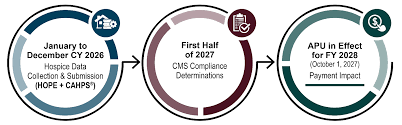
Hospice Outcomes and Patient Evaluation (HOPE) will replace the current Hospice Item Set (HIS) structure. The gradual roll-out will begin in FY 2025 and will collect data at different time points throughout a hospice stay. In contrast, HIS only collected data at admission and discharge.

New or expanded categories of HOPE relative to HIS include:

Hospice Payment Rule 2025

Changes to CAHPS Survey

CMS conducted an experiment in 2021 surrounding the Hospice CAHPS Survey. Based on those results, the final rule will implement these change to the survey:

    • The addition of a web-mail mode (email invitation to a web survey, with mail follow-up to non-responders).
    • A shortened and simplified survey.
    • Modifications to survey administration protocols to include a pre-notification letter and extension of the field period from 42 to 49 days.
    • The addition of a new, two-item Care Preferences measure.
    • Revisions to the existing Hospice Team Communication measure and the existing Getting Hospice Care Training measure.
    • The removal of three nursing home items and additional survey items impacted by other proposed changes in this rule.

Hospice Special Focus Program (SFP)

The SFP allows CMS to monitor those hospices that are identified as poor performers based on quality indicators from the CAHPS surveys. Additional oversight from CMS will “enable continuous improvement” for those hospices identified. The four measures used to determine poor performance are Help for Pain and Symptoms, Getting Timely Help, Willingness to Recommend this Hospice, and Overall Rating of this Hospice.

According to CMS, the final rule includes changes to the Overall Rating of this Hospice measure. CMS states that these changes are not substantive and will not impact the SFP algorithm. “CMS adjusts measure scores for mode of survey administrations, so the introduction of a new mode should not impact measure scores.” 

NAHC previously submitted comments to CMS stating that some aspects of the Hospice Special Focus Program are flawed and need to be adjusted for accuracy and fairness. NAHC/NHPCO has created a research project to understand the impact and validity of the Hospice Special Focus Program.

2025 Hospice Final Rule Conditions of Participation and Payment Requirements

There are language discrepancies in existing hospice requirements for medical director and physician designee, physician member, and payment requirements for the certification of the terminal illness and admission to hospice care. Therefore, CMS is making technical changes to the CoPs by adding the physician mmever of the hospice IDG as someone who can review technical information and provide certification of life expectancy. 

# # #

Kristin Rowan, Editor

Kristin Rowan has been working at Healthcare at Home: The Rowan Report since 2008. She has a master’s degree in business administration and marketing and runs Girard Marketing Group, a multi-faceted boutique marketing firm specializing in event planning, sales, and marketing strategy. She has recently taken on the role of Editor of The Rowan Report and will add her voice to current Home Care topics as well as marketing tips for home care agencies. Connect with Kristin directly kristin@girardmarketinggroup.com or www.girardmarketinggroup.com

©2024 by The Rowan Report, Peoria, AZ. All rights reserved. This article originally appeared in Healthcare at Home: The Rowan Report. One copy may be printed for personal use: further reproduction by permission only. editor@therowanreport.com

MA Past, Present, and Possible Future: Nothing Good to Report

by Tim Rowan, Editor Emeritus

Past

For at least the last five years, every Home Health conference this reporter has attended has featured at least one keynote speaker or expert panelist complaining about sparse and shrinking payments from Medicare Advantage plans. As thousands of seasonal TV ads convince more and more Medicare beneficiaries to enroll in what insurance company executive-turned-whistleblower Wendell Potter called “neither Medicare nor an advantage,” the calls from Home Health executives to turn away MA members, following the lead of many hospitals, have grown louder and more frequent.

Originally designed to extend the lifespan of the Medicare Trust Fund by bringing managed care practices to the federal healthcare program for seniors and disabled, Medicare Advantage has failed to do so. As long ago as 2021, an exposé by Fred Schulte in Kaiser Family Foundation Health News found that MA costs to taxpayers began to explode in 2018 and today equal 119 percent of what traditional Medicare should cost. We looked at more recent studies and found similar reports.

From the Experts

Referencing a study by Richard Kronick, a former federal health policy researcher and a professor at the University of California-San Diego, Schulte said, “his analysis of newly released Medicare Advantage billing data estimates that Medicare overpaid the private health plans by more than $106 billion from 2010 through 2019 because of the way the private plans charge for sicker patients. A third of that overpayment occurred in 2018 and 2019.”

Since Kronick’s 2021 report, more beneficiaries have opted in to Medicare Advantage. So far, just over half have switched from straight Medicare, with or without a supplement, and that number may reach 100 percent if those who profit most from the option have their way.

Present

In recent months, we have investigated and reported on the insurance industry’s practice of exaggerating MA member health conditions and denying care that traditional Medicare would have covered, collecting from both ends of the CMS trough. We have also mentioned several federal and state lawsuits piling up against insurance companies for both of those practices. One of our sources, The Center for Economic and Policy Research, said this in the Executive Summary of its detailed, September 2023 study:

Profiting at the Expense of Seniors: The Financialization of Home Health Care

“The nonpartisan Medicare Payment Advisory Commission (MedPAC) estimates that upcoding by MA plans that make enrollees appear to be sicker than they are costs CMS 106 percent of what traditional Medicare costs; adding in the quality bonus payments brings it to 108 percent. MA plans also enroll healthier Medicare beneficiaries, increasing their operating surplus by another 11 percent, making the payments to MA plans 19 percent higher than the payments to traditional Medicare. 

CMS’s announced goal for traditional Medicare beneficiaries is to move all of them to Accountable Care Organizations, which use the valued-based payment model, or other similar care arrangements, by 2030. CMS’s leading model to accomplish this shift is ACO REACH — a gentler, kinder version of the Trump administration’s backdoor enrollment of traditional Medicare beneficiaries in a capitated payment model.”

The Center for Economic Policy Research

Future

Past Present Future Medicare Advantage

Depending on results in the unpredictable world of politics later this year, CMS may or may not see its shift to value-based ACO models come to fruition. Kaiser News‘ Schulte examined the Heritage Foundation’s “Project 2025,” the conservative think tank’s blueprint for any possible future Republican administration, and found an entire section on the Department of Health and Human Services.

Within its “Mandate for Leadership,” the authors identify Medicare and Medicaid as “the principal drivers of our $31 trillion national debt.” While admitting that Medicare and Medicaid “help many,” the authors assert that the programs “operate as runaway entitlements that stifle medical innovation, encourage fraud, and impede cost containment, in addition to which their fiscal future is in peril.”

Rebuttal

Commenting on the Heritage Foundation’s claim, researcher Sonali Kolhatkar, writing for “OtherWords.org,” counters that this opinion is often used to justify ending social programs, but actual CMS data indicates that per person Medicare spending has plateaued for more than a decade and represents one of the greatest reductions to the federal debt. Even with 10,000 to 11,000 Boomers reaching Medicare eligibility every day, total per beneficiary expenditures have stopped climbing, hovering around $12,000 per year since 2010. Before reaching that 2010 plateau, per beneficiary spending had steadily risen from $2,000 at the program’s 1965 inception.

Medicare Advantage for All

Project 2025 proposes making Medicare Advantage the default enrollment option rather than a choice beneficiaries can opt into. With 100 percent of seniors on MA plans, already historic insurance profits will skyrocket further. But will Medicare beneficiaries benefit as well?

The Center for Economic and Policy Research cites multiple lawsuits that have proven eight of the ten largest MA plans routinely add chronic conditions – some non-existent – to patient assessments at enrollment…or later. We reported recently that UnitedHealth Group, operator of the largest MA plan, recently began sending nurses into homes to search for additional health conditions that would raise company payments from the trust fund. The report we quoted included evidence that these home visit upcodes do not lead to any treatments. The Center added that MA’s “heavily restricted networks damage one’s choice of provider along with introducing dangerous delays and denials of necessary care.”

As we have mentioned before, Medicare Advantage is neither Medicare nor an Advantage.

Medicaid also Attacked

Project 2025 also proposes restrictions on Medicaid eligibility by imposing work requirements. The blueprint sees the program for low-income Americans as a  “cumbersome, complicated, and unaffordable burden on nearly every state.” Their plan includes bringing private insurance companies in to “manage” care.

A June, 2024 report by the Center on Budget and Policy Priorities concluded that the ACA’s expansion of Medicaid helped millions of Americans who would otherwise be uninsured, and that its enabling and encouragement of preventive care actually saved money in state budgets. Last month’s report asserted “the people who gained coverage have grown healthier and more financially secure, while long-standing racial inequities in health outcomes, coverage, and access to care have shrunk.”

Project 2025 authors make no mention of a KFF News report from April 2023 that said most Medicaid-eligible people are already working. Nor does it take into account a Government Accountability Office report to Congress October 2020 and again in 2023 that determined that hourly wages in many large companies are low enough to keep even full-time workers eligible for Medicaid and SNAP. Walmart and McDonalds, to name two, land in the top five in almost every state for having Medicaid-eligible workers.

EVEN THE WALL STREET JOURNAL IS CRITICAL

Under the front page Headline “Medicare paid $50 billion to insurers for untreated ills,” a detailed WSJ investigation highlighted a number of findings, including:

  • “The questionable diagnoses included some for potentially deadly illnesses, such as AIDS, for which patients received no subsequent care, and for conditions people couldn’t possibly have, the analysis showed. Often, neither the patients nor their doctors had any idea.”
  • “Instead of saving taxpayers money, Medicare Advantage has added tens of billions of dollars in costs, researchers and some government officials have said.”
  • “Medicare Advantage has cost the government an extra $591 billion over the past 18 years, compared with what Medicare would have cost without the help of the private plans, according to a March report of the Medicare Payment Advisory Commission, or MedPAC, a nonpartisan agency that advises Congress. Adjusted for inflation, that amounts to $4,300 per U.S. tax filer.”
  • “The Journal reviewed the Medicare data under an agreement with the federal government. The data doesn’t include patients’ names, but covers details of doctor visits, hospital stays, prescriptions and other care.”
People voting

Now it is in the Hands of Voters

Home Health, Hospice, and Home Care owners, management, and workers will be voting in November. Consideration of what four years under a Project 2025-friendly administration will mean to businesses dependent on Medicare and Medicare will weigh heavily on their minds as they enter their polling booths.

# # #

Tim Rowan, Editor Emeritus

Tim Rowan is a 30-year home care technology consultant who co-founded and served as Editor and principal writer of this publication for 25 years. He continues to occasionally contribute news and analysis articles under The Rowan Report’s new ownership. He also continues to work part-time as a Home Care recruiting and retention consultant. More information: RowanResources.com
Tim@RowanResources.com

©2024 by The Rowan Report, Peoria, AZ. All rights reserved. This article originally appeared in Healthcare at Home: The Rowan Report.homecaretechreport.com One copy may be printed for personal use: further reproduction by permission only. editor@homecaretechreport.com

Federal Regulations for Adult Protective Services

by Elizabeth E. Hogue, Esq.

Dept of Health & Human Services Final Rule

On May 7, 2024, the U.S. Department of Health and Human Services (HHS) issued a final rule establishing the first federal regulations for Adult Protective Services (APS). The regulations took effect on June 7, 2024. The entire rule is at https://acl.gov/apsrule.

One goal of the new regulations is to promote high quality APS that better meet the needs of adults who experience or are at risk of maltreatment and self-neglect. Another goal is to improve consistency in services among the states. 

APS services have historically been funded by state and local governments. There has been wide variation in APS services and practices between and even within states. New regulations, along with recent funding from HHS to state APS programs, now make it possible to improve consistency.

Adult Protective Services

The APS final rule:

    • Establishes a set of national minimum standards for the operation of APS programs that all state APS systems meet
    • Requires APS systems to ensure that planning and delivery of all services respect the fundamental right of adults to make their own life choices and that services are driven by the person receiving them
    • Establishes stronger protections for clients subject to, or at risk of, guardianship. Specifically, APS must consider guardianship only when there are not alternatives.
    • Requires responses within 24 hours of screening cases that are life-threatening or likely to cause irreparable harm or significant loss of income, assets, or resources
    • Requires APS to provide at least two ways, at least one of which must be online, to report maltreatment or self-neglect 24 hours per day, seven days per week
    • Requires robust conflict of interest policies to support ethical APS practice
    • Establishes definitions for key APS terms to improve information sharing, data collection, and program standardization
    • Promotes coordination and collaboration with state Medicaid agencies, long-term care ombudsmen, tribal APS, law enforcement, and other partners.

The Need for Adult Protective Services

Adult Protective Services

HHS points out that at least one in ten older adults who live in communities experience some form of maltreatment each year.

All providers have been involved in situations in which adult protective services are needed. Case managers/discharge planners in hospitals and long-term care facilities are especially likely to encounter and to be expected to assist with situations involving APS.

Providers of services to patients in their homes; including home health agencies, hospices, home medical equipment (HME) companies, and home care or private duty companies; are on the “front lines” with regard to identifying situations in which APS is needed. At least anecdotally, however, providers have received very little assistance and support from APS in situations of abuse and neglect.

Hopefully, providers can look forward to greater assistance in view of enhanced funding and standards.

# # #

Elizabeth E. Hogue, Esq.

Elizabeth Hogue is an attorney in private practice with extensive experience in health care. She represents clients across the U.S., including professional associations, managed care providers, hospitals, long-term care facilities, home health agencies, durable medical equipment companies, and hospices.

©2024 Elizabeth E. Hogue, Esq. All rights reserved.

No portion of this material may be reproduced in any form without the advance written permission of the author.

Axxess Announces Agile 2025

FOR IMMEDIATE RELEASE

Contact:                 Johnathan Eaves
(903) 445-6969
jeaves@axxess.com

Axxess 2025 AGILE Conference to be held May 5-7 in Dallas

DALLAS, July 18, 2024 – Axxess, the leading global technology innovator for healthcare at home, today announced the 2025 Axxess Growth, Innovation and Leadership Experience (AGILE) will be held May 5–7 at the Fairmont hotel in downtown Dallas.

Each year several hundred care at home thought leaders, industry providers and partners attend AGILE to learn and share insights to help build the future of healthcare at home. The conference also features valuable networking opportunities and educational sessions on topics at the leading edge of care at home. Clinicians earn much needed continuing education units toward their license renewal.

“AGILE is the must-attend event for anyone involved in care at home,” said John Olajide, Founder and CEO of Axxess. “We are excited about the future of care in the home and believe AGILE 2025 will play a crucial role in advancing our industry by fostering innovation and bringing our community together to learn and grow. Next year’s conference will feature thought-provoking keynote speakers, informative breakout sessions and interactive workshops, all focused on the latest trends, technologies and best practices. I know that AGILE 2025 will inspire and equip attendees with the knowledge they need to provide exceptional care and drive positive change in the care at home industry.”

Attendees can also learn about new solutions and practical applications of the insights shared during sessions by visiting an exhibit showcase featuring the latest products and services from leading care at home solution vendors. More than 50 organizations sponsored the 2024 AGILE conference.

Registration for AGILE 2025 will open in the fall of 2024. For more information, visit the AGILE conference website.

# # #

About Axxess

Axxess is the leading global technology innovator for healthcare at home, focused on solving the most complex industry challenges. Trusted by more than 9,000 organizations that serve more than 5 million patients worldwide, Axxess offers a complete suite of easy-to-use software solutions that empower home health, home care, hospice, and palliative providers to make healthcare at home human again. Multiple independent certifications have confirmed that Axxess has the most secure and industry-compliant software available for providers. The company’s collaborative culture focused on innovation and excellence is recognized nationally as a “Best Place to Work.”

©2024 Axxess All rights reserved

Axxess to Offer Cybersecurity to Clients

FOR IMMEDIATE RELEASE

Contact:                Christine Shein

(214) 435-6731

cstein@axxess.com

Axxess Partners With Security Compliance Associates to Offer Comprehensive Cybersecurity Services to Clients

DALLAS, July 11, 2024 – Axxess, the leading global technology innovator for healthcare at home, and Security Compliance Associates (SCA), a leading provider of comprehensive cybersecurity solutions, have partnered to offer Axxess clients tailored, cost-effective cybersecurity services.

Through this collaboration, Axxess clients have access to a robust suite of cybersecurity services offered by SCA, including penetration testing, risk assessments and cyber regulatory compliance. These services are specifically designed to address the unique challenges faced by the home healthcare industry, ensuring sensitive patient data remains protected against the evolving landscape of cyberthreats.

“Our partnership with Security Compliance Associates complements our industry-leading secure software solutions, providing our clients with additional specialized cybersecurity services,” said Chris Taylor, senior vice president of channel partnerships at Axxess. “By leveraging SCA’s expertise in healthcare cybersecurity, we are enhancing our clients’ ability to safeguard sensitive data, ensuring they can deliver exceptional care with utmost confidence in their operational security.”

SCA’s services will help Axxess clients navigate the complexities of cybersecurity compliance, safeguard patient information and enhance their overall security posture. This partnership comes at a critical time when the importance of robust cybersecurity measures in the healthcare sector is increasingly paramount.

“Security Compliance Associates is very excited to partner with Axxess to provide a full range of cybersecurity and compliance services to the home healthcare industry,” said Jim Brahm, CEO of Security Compliance Associates. “With the alarming and detrimental cyberattacks specifically targeting the healthcare industry causing significant business interruption, the time is now to proactively protect your practice and stay in compliance with the state and federal security and privacy laws.”

  # # #

About Axxess

Axxess is the leading global technology innovator for healthcare at home, focused on solving the most complex industry challenges. Trusted by more than 9,000 organizations that serve more than 5 million patients worldwide, Axxess offers a complete suite of easy-to-use software solutions that empower home health, home care, hospice, and palliative providers to make healthcare in the home human again. Multiple independent certifications have confirmed that Axxess has the most secure and industry-compliant software available for providers. The company’s collaborative culture focused on innovation and excellence is recognized nationally as a “Best Place to Work.”

About Security Compliance Associates

Security Compliance Associates (SCA) specializes in providing tailored cybersecurity solutions that help healthcare organizations meet stringent regulatory requirements from HIPAA and HITRUST. Their services include penetration testing, risk assessments, cyber regulatory compliance and more, ensuring sensitive patient data remains secure.

©2024 Axxess. All rights reserved.

Payer or Competitor?

by Tim Rowan, Editor Emeritus

UnitedHealth Making Home Health Visits

Payer or Competitor…that is the question. According to a report in the Wall Street Journal, and questioned by the insurance industry’s lobbying arm, AHIP, UnitedHealth Group has increased its revenue from the Medicare Trust Fund by $50 billion by “finding” additional health issues during home visits to its MA customers.

In a July 16 investor call, CEO Andrew Witty said UnitedHealth clinicians made more than 2.5 million home health visits to UnitedHealthcare MA members in 2023. Following these visits to more than 500,000 seniors, UnitedHealth upgraded over 300,000 of them to higher payment levels by uncovering health conditions the individual seniors did not know they had.

The WSJ investigation found that between 2018 and 2021, insurers received $50 billion for diagnoses they added to members’ charts. Many of these diagnoses were “questionable,” according to that investigation.

Questionable Visits

Uncover versus Discover United Health

Though a UnitedHealth spokesperson called the analysis “inaccurate and biased,” former UnitedHealth employees told the Journal home visits are often used to add diagnoses. Clinicians say they use software during visits that offer suggestions as to what illnesses a patient might have.

CEO Witty maintained in the investor call that the practice is good for seniors. “UnitedHealth clinicians discovered more than 3 million gaps in care through home visits in 2023,” he reported, “and 75% of patients receive follow-up care in a clinic within 90 days of a home visit.” 

He added that the United home visit program “helps patients live healthier lives and saves taxpayers money,” concluding. “…Medicare Advantage makes programs and results like this possible.” 

The Journal concluded with the finding that few of these upgraded seniors are ever seen by a physician for their newly discovered health conditions. 

# # #

Tim Rowan, Editor Emeritus

Tim Rowan is a 30-year home care technology consultant who co-founded and served as Editor and principal writer of this publication for 25 years. He continues to occasionally contribute news and analysis articles under The Rowan Report’s new ownership. He also continues to work part-time as a Home Care recruiting and retention consultant. More information: RowanResources.com
Tim@RowanResources.com

©2024 by The Rowan Report, Peoria, AZ. All rights reserved. This article originally appeared in Healthcare at Home: The Rowan Report. One copy may be printed for personal use: further reproduction by permission only. editor@therowanreport.com

HIPAA Violations

by Elizabeth E. Hogue, Esq.

Mom Needs More Fiber?

Imagine that a celebrity receives care where you work and curiosity gets the better of you, or someone you know is admitted and you would love to know the details. It’s oh so very tempting! So, you access records of care provided to patients that you have no legitimate need to view. The HIPAA police are on it! Because let’s not forget that the HIPAA Privacy Rule is a criminal statute.

An emergency room physician, for example, pled guilty to illegally obtaining the personal health information of multiple individuals. He was convicted of one count of wrongfully obtaining individually identifiable health information under false pretenses. The physician received a resident physician license and participated in an emergency medicine residency program at a university hospital. He worked in the emergency room of two hospitals in the university system.

The doctor used his access as a resident physician to the hospitals’ electronic health record to access the records of two patients without their knowledge or consent. He was never the patients’ physician. The patients were not receiving care in the emergency rooms where the doctor worked at the time he accessed the records.

HIPAA Violations Oops

The doctor also admitted that he sent a photograph to someone else of one of the patients wearing a hospital gown in which the patient’s rectum was hanging out of the patient’s body. And now for the “best” part: the doctor also admitted that he falsely wrote in a letter that he sent the picture of the patient with a prolapsed rectum to his mother to remind her of the importance of fiber intake! 

Do you remember the comedian, Flip Wilson, who repeatedly claimed that the devil made him do it? When it comes to accessing patients’ medical records in violation of HIPAA, you must “put the devil behind you!” Protecting patients’ private health information is serious business – serious criminal business. Be vigilant! 

By the same token, providers must also always remember that the HIPAA Privacy Rule isn’t just about protecting health information; it’s also about giving appropriate access to it. In the zeal to protect information, it anecdotally seems that practitioners have lost sight of the fact that access to information is at least as important as protection of information. In fact, the Office for Civil Rights, the federal enforcer of HIPAA violations, has focused on denial of access in enforcement actions for the past several years. 

Remember that, however tempting the information you would like to have may be, temptation pales in comparison to jail time!

# # #

Elizabeth E. Hogue, Esq.

Elizabeth Hogue is an attorney in private practice with extensive experience in health care. She represents clients across the U.S., including professional associations, managed care providers, hospitals, long-term care facilities, home health agencies, durable medical equipment companies, and hospices.

©2024 Elizabeth E. Hogue, Esq. All rights reserved.

No portion of this material may be reproduced in any form without the advance written permission of the author.

Chevron Deference Derailed

by Kristin Rowan, Editor

Chevron Deference

“A government agency must conform to any clear legislative statements when interpreting and applying a law, but courts will give the agency deference in ambiguous situations as long as its interpretation is reasonable.”

This statement followed the unanimous (minus the three who did not take part in the decision) U.S. Supreme Court decision in the Chevron U.S.A., Inc. v. National Resources Defense Council. The case is known for establishing the extent to which a federal court should defer to a government agency’s interpretation of an ambiguous statement when constructing statutes.

Breaking Down Chevron Deference

For those of you who don’t have a law degree, here’s what that means:

  • When a statutory term (required by law) is not explicitly defined and explained by Congress, there is room for interpretation
  • When a government agency interprets that statutory term, the interpretation may come under question
  • As long as the interpretation is not arbitrary (random), capricious (impulsive or unpredictable), or contrary to the statute (opposite the intent when put into practice), federal courts should give more weight to the government agency’s interpretation than to any other interpretation

Implications

At the time, the Supreme Court argued that if Congress leaves a term open to interpretation, it is either stated openness to interpretation, or an implied openness to interpretation. If a statute is implicity open, the intent of Congress is to allow a government agency to create provisions and regulations from that statute as they see fit. 

No one foresaw the impact this ruling would have on commerce and regulation in the U.S. To date, the Chevron Doctrine has been cited nearly 18,000 times in federal court decisions. The application of a statute based on agency interpretation could no longer be questioned or changed by judicial review.

Chevron Deference in Home Health

Since the advent of the PDGM model, CMS has calculated payment rates based on its interpretation of budget neutrality. The National Association for Home Care and Hospice has disputed the validity of both the interpretation of budget neutrality and the formulas used to calculate it.

Last year’s 2024 CMS Proposed Rule cut payment rates even further with a 2.890% Budget Neutrality permanent payment rate adjustment and a temporary rate adjustment to account for alleged overpayments from 2020-2022.

The lawsuit filed against CMS in response to the 2024 Final Rule was dismissed. NAHC began pursuing an administrative review with CMS. However, CMS has already stated that their final position is that budget neutrality has been calculated within the law. 

NAHC Comment: 2023 CMS Rule

“That proposal also fails logically in that it puts care access in severe jeopardy in applying a budget neutrality reconciliation methodology that takes PDGM-induced behavior changes to assess what otherwise would have been expended by Medicare in the absence of PDGM. In doing so, CMS fully fails to meet its obligation to ensure that the transition to a new payment model is budget neutral.”

  1. NAHC Comment Source

Chevron Deference Repealed

In a landmark ruling on Friday, June 28. 2024, the Supreme Court removed the power of federal agencies to interpret laws and ruled that the courts should rely on their own intrepretation of ambiguous laws. Justice Elena Kagan, who dissented the ruling, predicts this change “will cause a massive shock to the legal system.”

Chief Justice John Roberts explained in his opinion that the Chevron Deference is inconsistent with the Administrative Procedure Act (APA). The APA is a federal law which contains instructions for courts to review actions by federal agencies. According to Roberts, the APA directs courts to decide legal questions using their own judgment. Therefore, he noted, agency interpretations of statutes are not entitled to deference. “…it remains the responsibility of the court to decide whether the law means what the agency says,” concluded Roberts.

NAHC to Refile Lawsuit after Chevron Deference Repeal

2024 Final Rule

In April, 2024, the lawsuit filed against CMS regarding the methodology for calculating budget neutrality was dismissed. Now, NAHC can refile the lawsuit and force CMS to justify its decision to enact repeated reimbursement cuts for home health.

In an interview on Wednesday, Bill Dombi told The Rowan Report, “This improves the chances of success for our lawsuit. CMS is going to have to support their regulatory interpretations going forward. Congress is going to have to offer more detail in its legislative language, leaving less to being open to interpretation.” Regarding the PDGM lawsuit, CMS argued that the law was clear and the agency’s interpretation was valid. The overturning of Chevron Deference allows the possibility of arguing that CMS’s interpretation of the law is flawed. 

80/20 Rule

Dombi also explained that the Ensuring Access to Medicaid Services rule, also known as the 80/20 rule, was “drawn out of a whole cloth.” Previously, there were limited avenues available to challenge this rule. The repeal of Chevron Deference significantly improves the ability to challenge the 80/20 rule. The argument now, Dombi told The Rowan Report, is “Does CMS even have the authority to do this?”

More to Come

The Rowan Report anticipates more news coming out of Washington D.C. and the NAHC office regarding the 2024 pay cuts and the 80/20 rule. We will provide ongoing updates and information as it becomes available.

# # #

Kristin Rowan, Editor

Kristin Rowan has been working at Healthcare at Home: The Rowan Report since 2008. She has a master’s degree in business administration and marketing and runs Girard Marketing Group, a multi-faceted boutique marketing firm specializing in event planning, sales, and marketing strategy. She has recently taken on the role of Editor of The Rowan Report and will add her voice to current Home Care topics as well as marketing tips for home care agencies. Connect with Kristin directly kristin@girardmarketinggroup.com or www.girardmarketinggroup.com

©2024 by The Rowan Report, Peoria, AZ. All rights reserved. This article originally appeared in Healthcare at Home: The Rowan Report. One copy may be printed for personal use: further reproduction by permission only. editor@therowanreport.com