Workplace Violence in Home Health

by Kristin Rowan, Editor

Workplace Violence and Policy Impact

Study of home health workers

A group of researchers from the University of Cincinnati, Ohio published a recent study¹ on the frequency and reporting procedures of workplace violence (WPV) in home healthcare. The study specifically addressed WPV in home healthcare, stating limited understanding of WPV in the home care setting. Most existing studies on WPV were hospital-based.

Frequency of Workplace Violence

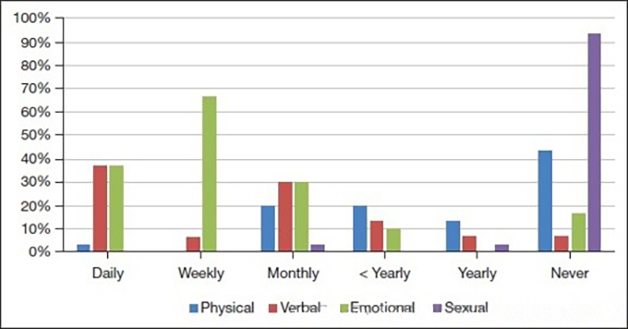
Of the home health care workers (HHCW) surveyed, almost 37% responded that they experience both verbal and emotional violence in the workplace daily. More than 80% reported experiencing verbal aggression at some point. Physical violence is less prominent. 20% of respondants said they experience physical violence monthly. However, 56.6% said they have experienced physical violence at some point in their current agency. 76.6% of the time, the perpetrators of the violence are the patients of the HHCW.
Workplace Violence

Fig. 1 Frequency of occurrence of physical, verbal, emotional, and sexual abuse as a function of time: daily, weekly, monthly, <yearly, yearly, and never.

Reporting Workplace Violence

All of the study participants indicated they had knowledge of workplace violence reporting procedures in their agencies, but 26.7% were unsure if the policies are contained in the employee handbook. 46.7% were uncertain as to whether the agency offered WPV or de-escalation training and 66% said prevention and de-escalation training was not mandatory. Unfortunately, 40% said their management did not encourage reporting and 33% said they were not comfortable approaching management about WPV. Despite the frequency of WPV among the respondents, none of the participants reported these incidents to management

Thoughts

According to this, and other research studies on workplace violence in home healthcare, the problem is prevalent and persistent. Most HHCWs have experienced some sort of aggression, violence, or abuse in the course of performing their jobs. Of those who have, most do not report the incidents to management. Most HHCWs have not been trained in prevention or de-escalation. Even with training, HHCWs need a way to get immediate help. Unfortunately, most do not have an emergency alert system on their person during home visits.

    Solution

    Care at Home agencies, including non-medical supportive care, home health, hospice, and any other lone workers who are visiting patients in their homes, need safety policies and procedures. Agencies must include the same in the employee handbook, explain during orientation, and make available to HHCWs digitally. 

      Policies and procedures should include:

      • A safety committee comprised of management, back office staff, and field workers
      • A clearly written policy regarding physical, emotional, verbal, and sexual abuse
        • Against a patient or their family/friends by a HHCW
        • Against a HHCW by a patient or their family/friends
        • Against a HHCW by a colleague or manager
        • Against a HHCW by the environment in which they work (i.e. aggressive pets, weapons, cigarette smoking indoors, etc.)
      • A digital reporting system that employees can use without having to approach management individually
      • A clearly written policy on the management response to violence reporting
      • A clearly written policy forbidding any retaliation or discrimination against a reporting employee
      • Required research about new patients including
        • Background/History of violence and/or mental instability
        • Neighborhood safety rating
        • Family members likely to be in the home and their history of violence and/or mental instability

      Additional Tools for HHCWs

      • Training in
        • Violence prevention
        • De-escalation
        • Situational Awareness
        • Self-defense
      • A mandatory, GPS-enabled, multi-function safety device and platform to proactively manage caregiver safety and respond to incidents
      • Optional escort service for new patients
      • Mandatory escort service for new patients with a history of violence, mental issues, or incarceration

      Workplace violence against HHCWs is not “if,” but “when.” It is the responsibility of the agencies to lower the risk, lower the percentage of “whens,” and encourage reporting. If you’re not sure how to begin, hire a consultant to help you build your safety committee and write your policies. It doesn’t matter how you start implementing safety protocols, as long as you follow through and protect your employees.

      # # #

      Kristin Rowan, Editor, The Rowan Report
      Kristin Rowan, Editor

      Kristin Rowan has been working at The Rowan Report since 2008. She is the owner and Editor-in-chief of The Rowan Report, the industry’s most trusted source for care at home news, and speaker on Artificial Intelligence and Lone Worker Safety and state and national conferences.

      She also runs Girard Marketing Group, a multi-faceted boutique marketing firm specializing in content creation, social media management, and event marketing.  Connect with Kristin directly kristin@girardmarketinggroup.com or www.girardmarketinggroup.com

      ©2025 by The Rowan Report, Peoria, AZ. All rights reserved. This article originally appeared in The Rowan Report. One copy may be printed for personal use: further reproduction by permission only. editor@therowanreport.com


      1. Obariase, E.; Bellacov, R.; Gillespie, G.; Davis, K. (2025). Assessing Workplace Violence and Policy Impact: A Cross-sectional Study of Home Healthcare Workers. Home Healthcare Now, 43(3), 150-156. doi: 10.1097/NHH.0000000000001345


      The Alliance Responds

      by Kristin Rowan, Editor

      The Alliance Responds to CMS Hospice Update

      The Alliance responds to CMS-1835-P, the FY 2026 Hospice Wage Index, Conditions of Participation, and Quality Reporting Program Requirements updates. On June 10, 2025, in a 25 page letter to Dr. Mehemet Oz, CEO for The National Alliance for Care at Home Steve Landers, MD, MPH lays out the constraints and financial burdens hospice agencies will face if these updates are enacted. 

      Payment Rate Update

      Increase Less than Inflation

      In the rule for FY 2026, CMS proposes a 3.2 percent market basket increase and a .8 percent productivity decrease, yielding a 2.4 percent increase overall. According to the letter, inflation has raised medical care prices by 3.1 percent, leaving a shortfall of .7 percent. Hospices are also plagued by the same workforce shortage the rest of the medical industry faces. Workforce shortages result in fewer qualified people than there are available positions, which drives wages up. BLS data indicates the wage increase for 2025 was 4.4%. The Alliance argues that the 2.4% net increase falls well short of the actual expense increase.

      Faulty Data

      In a recent article, we outlined the process that CMS uses to determine the market basket update. The Alliance echos our information, showing the market basket forecast is well below actual increases. The Alliance further argues that the shortfall compounds, leaving the base rate increasingly smaller with each forecast. The current estimate is a 4.9% pay rate gap. CMS contends there is no way to adjust for forecast errors. The Alliance has a simple solution: manually adjust the payment rate every year when the finalized number are above the forecasted numbers BEFORE adding the next year’s payment rate increase.

      Likewise, The Alliance concurs with The Rowan Report sentiment that productivity cannot increase in hospice like it does in less labor-intensive sectors. Landers also mentions the failure to consider travel costs, the wage differences in rural areas, and the lack of reclassification options in hospice care.

      Payment Rate Recommendations

      As any well-drafted response should, The Alliance provides actionable recommendations in each section. For payment rate updates, The Alliance recommends:

      • We recommend CMS examine closely more recent data and increase final payment rates for FY 2026.
      • We urge CMS to explore all available avenues to address the forecast error shortfall, such as through a one-time adjustment.
      • We encourage CMS to collaborate with stakeholders to address the shortcomings of relying upon hospital data to determine hospice payment rates, and ways to achieve parity across provider types with respect to geographic area wage adjustments.

      HIS to HOPE Transition

      Also addressed in the letter is opposition to the timeline of the HIS to HOPE transition. The Alliance restates much of what was in the joint letter to CMS urging the delay of the HOPE tool adoption. That letter was a joint venture between The National Alliance for Care at Home (The Alliance), LeadingAge, and the National Partnership for Healthcare and Hospice Innovation (NPHI).

      The consequence of adverse outcomes cannot be understated. The risk of negative financial consequences for hospice providers is
      largely dependent this year on the success of two transitions—iQIES and HOPE— neither of which are within their control.

      Steve Landers, MD, MPH

      CEO, National Alliance for Care at Home

      HOPE Transition Recommendations

      • Considering the volatility inherent in a reporting transition of this magnitude and the lack of clear information provided to date, we respectfully request CMS waive the HOPE timeliness submission requirement for two calendar quarters post implementation.
      • We further respectfully request that CMS delay the HOPE implementation date until at least six months after CMS education and training, beyond that which is introductory and that is scheduled for spring/summer 2025, the final validation utility tool specifications are available and the application for iQIES access has been opened for hospices.

      Digital and Future Hospice Measurements

      Among the digital hospice measurements is an interoperability measurement. The Alliance supports interoperability and data exchange across medical care entities, but stresses to CMS that many hospices do not have digital EHR systems, cannot afford to maintain such systems, and have not received the federal financial support necessary to meet this objective.

      The Alliance also objects, not in theory, but in practical application, to the nutrition measure noted in future hospice measures. Nutrition for a hospice patient is vastly different than for other patients and should be implemented as a process measure, rather than having specific goals for food intake and nutrition.

      Similarly, the well-being measure is not designed for hospice care. In other sectors of healthcare, well-being incorporates measures for mental, social and physical health and focuses on curative plans. Hospice care focuses on person-centered care, emphasizing the desires of the patient as they are balanced against religious, cultural, and personal beliefs. The well-being measure must be curated to fit hospice care.

      The Alliance - Conclusion

      The Alliance values CMS’s ongoing commitment to enhancing hospice care quality,
      ensuring program integrity, and improving patient outcomes. We appreciate your
      consideration of our comments and look forward to ongoing dialogue to achieve these
      shared objectives.

      The Rowan Report - Conclusion

      The Alliance has, as always, done an exemplary job at explaining the industry position on the CMS rule. Likewise, it has outlined each step CMS should take to view the updates through a hospice lens rather than a hospital lens. We commend and support The Alliance statement and position. As this is an ongoing topic until the final rule is implemented, we will continue to provide updates as they become available. 

      If you are a member of The Alliance, you can read the full 25 page letter here.

      # # #

      Kristin Rowan, Editor
      Kristin Rowan, Editor

      Kristin Rowan has been working at The Rowan Report since 2008. She is the owner and Editor-in-chief of The Rowan Report, the industry’s most trusted source for care at home news, and speaker on Artificial Intelligence and Lone Worker Safety and state and national conferences.

      She also runs Girard Marketing Group, a multi-faceted boutique marketing firm specializing in content creation, social media management, and event marketing.  Connect with Kristin directly kristin@girardmarketinggroup.com or www.girardmarketinggroup.com

      ©2025 by The Rowan Report, Peoria, AZ. All rights reserved. This article originally appeared in The Rowan Report. One copy may be printed for personal use: further reproduction by permission only. editor@therowanreport.com


      Painting Pictures

      by Elizabeth E. Hogue, Esq.

      "Painting Pictures" of Patients

      Painting Pictures in clinical documentation to achieve positive audit results. As the fight against “fraud, abuse and waste” continues, responding to audits has become an ongoing burden for many providers. Providers have repeatedly been urged to “paint a picture” of patients in clinical documentation in order to help achieve positive results. “Painting a picture” of the patient, however, may have become more difficult as the use of electronic health records (EHRs) has increased. That is, it’s difficult to adequately describe patients’ conditions when there are so many boxes to check and blanks to fill in.

      Copy, Paste, Repeat

      When it comes to narrative descriptions of patients’ conditions, it is extremely tempting to “copy and paste,” “cut and paste” and/or “copy forward” previous documentation in the EHR. The copy and paste feature allows users to use the content of another entry and to select information from an original or previous source to reproduce in another location. The copy forward capability replicates all or some information from a previous note to a current note, while the cut and paste feature removes documentation from the original location and places it in another location. In addition to the obvious potential problems for quality of care related to the use of these functions, auditors are understandably skeptical of documentation that repeats itself throughout patients’ medical records.

      Painting Pictures of Fraud

      Auditors are especially likely to deny claims that include documentation that was obviously copied using the above functions, when the information copied “sticks out like a sore thumb.” If hospice staff document, for example, that “the patient eats a lot of Mexican food” over and over in clinicians’ visit notes, auditors are understandably skeptical about whether services were necessary for a hospice patient who seems to have a continuous robust appetite or whether services were, in fact, rendered.

      How to Paint the Picture

      What does it mean to “paint a picture?” If a home health patient needs wound care or injections of medications, for example, the “picture” must account for why patients or their caregivers are not performing these activities themselves. Clinicians need to describe the following in a “picture” of the patient:

      • Does the patient live alone or have caregivers?
      • Why can’t patients do wound care or self-inject medications
      • Why can’t caregivers perform these activities?
      • What attempts did clinicians make to assist patients and caregivers to provide wound care and injections?
      • Why were these attempts unsuccessful?
      • What attempts were made to find other caregivers – either paid or voluntary – who might provide these types of care?
      • What were the results of these attempts to find other caregivers?
      • Despite the initial inability of patients and caregivers to render this care themselves, what efforts did clinicians make to help ensure that they became able to do so?
      Painting Pictures

      Get the Picture?

      It’s difficult, if not impossible, to paint the above picture using only the boxes and blanks of forms in EHRs. More is needed if providers are serious about positive audit results.

      # # #

      Elizabeth E. Hogue, Esq.
      Elizabeth E. Hogue, Esq.

      Elizabeth Hogue is an attorney in private practice with extensive experience in health care. She represents clients across the U.S., including professional associations, managed care providers, hospitals, long-term care facilities, home health agencies, durable medical equipment companies, and hospices.

      ©2025 Elizabeth E. Hogue, Esq. All rights reserved.

      No portion of this material may be reproduced in any form without the advance written permission of the author.

      ©2025 by The Rowan Report, Peoria, AZ. All rights reserved. This article originally appeared in The Rowan Report. One copy may be printed for personal use: further reproduction by permission only. editor@therowanreport.com

      AI in Home Care

      by Laurie Orlov, Founder, Aging and Health Technology Watch

      The Future of AI in Home Care

      New Research Report

      Wed, 06/04/2025

      PORT SAINT LUCIE, FL, UNITED STATES, June 4, 2025 /EINPresswire.com/ — The home care industry is facing a crisis. Driven by demographic shifts, longer life expectancy, and rising rates of chronic illness and cognitive decline, the demand for in-home personal care and home health care is surging. This will accelerate as the baby boomers age into their later years – in January, the oldest of the 76 million baby boomers will turn 80. At the same time, the care industries will face a critical shortage of all categories of care delivery, with millions of additional workers needed over the next decade. Against this backdrop, AI technology has emerged to help older adults in multiple ways. In a 2023 report, The Future of AI and Older Adults, AI was already able to produce insights about a person’s health needs and offer a chatbot to help with post-hospital care. In a subsequent 2023 report, AI and the Future of Care Work, it was apparent that AI could help generate an appropriate care plan and that an ‘AI Caregiver’ role was emerging to supplement in-person care delivery. In the 2024 report, The Future of AI in Senior Living and Care, AI was being used to analyze hospital discharge information to compare patient needs to nursing home capacity. 

      Today there are many more initiatives and new possibilities for addressing multiple aspects of both private duty home care and home health operations, including assistance with recruiting and onboarding workers, using data to create and update care-related documents, and introducing AI agents that can be assigned to complete specific tasks. As current industry leaders note, AI tech is playing a role in care oversight and enabling the creating of hybrid models – an increasingly likely combination of in-person care supplemented with AI.

      This report draws insights from experts across home care, home health care, plus software and device providers, and healthcare sectors to examine how AI is currently being used and suggest what lies ahead within the next five years.

      The report can be found at this link: https://www.ageinplacetech.com/page/future-ai-home-care

      # # #

      Laurie Orlov The Future of AI in Home Care
      Laurie Orlov The Future of AI in Home Care

      Laurie M. Orlov, a tech industry veteran, writer, speaker, elder care advocate, is the founder of Aging and Health Technology Watch  market research, trends, blogs and reports that provide thought leadership, analysis and guidance about health and aging-related technologies and services that enable boomers and seniors to sustain and improve their quality of life. In her previous career, Laurie spent many years in the technology industry, including 9 years at analyst firm Forrester Research. She has spoken regularly and delivered keynote speeches at forums, industry consortia, conferences, and symposia, most recently on the business of technology for boomers and seniors. She advises large organizations as well as non-profits and entrepreneurs about trends and opportunities in the age-related technology market.  Her perspectives have been quoted in the Wall Street Journal, the New York Times, Vox, Senior Housing News, CNN Health, AARP Bulletin and Consumer Reports. She has a graduate certification in Geriatric Care Management from the University of Florida and a BA in Music from the University of Rochester. Laurie has provided testimony about technology at a Senate Aging Committee hearing and has consulted to AARP.  Advisory clients have included AARP, AOL, Argentum, Bose, Calix, CDW, Microsoft, Novartis, and Philips. Her reports include: The Market Overview Technology for Aging 2025The Future of AI in Senior Living and CareThe User Experience Needs An Upgrade 2024The Future of AI and Older and Older Adults 2023The Future of Care Work and Older Adults 2023The Future of Sensors and Older Adults 2022Beyond DIY: The Future of Smart Homes and Older Adults 2021, and The Future of Wearables and Older Adults 2021. Laurie has been named one of the Women Leaders in VoiceTop 50 Influencers in Aging by Next Avenue and one of the Women leading global innovation on AgeTech. 

      ©2025 by Aging and Health Technology Watch. All rights reserved. This introduction and link are printed with permission from the author. For more information or to request usage rights, please contact Laurie Orlov

      UnitedHealth Bribes Nurses

      United Health Bribery Update

      In the weeks since the below article revealed allegations against UnitedHealth, members of Congress are calling for action. At least one US Senator and two Representatives are engaged in the allegations. Senator Wyden (D-OR) announced that his office is launching its own investigation. Senator Hawley (R-MO), who is on the investigations subcommittee said it was “alarming to hear these serious allegations. I look forward to securing justice for patients, policyholders, and whistleblowers alike who’ve been harmed by insurance companies.” Other Senators expressed similar sentiments.

      “If these allegations are true, UnitedHealth must be held responsible for their gross abuse of patients. Patients should always come before profits.”

      Buddy Carter

      Chair of the House subcommittee on health, U.S. Representative, (R-GA)

      Three U.S. Representatives, coming from both sides of the aisle, are calling on the DoJ to investigate. A letter to the DoJ reads:

      “The Guardian’s findings reveal the need for a wide-ranging investigation by the Department of Justice into years, if not decades, of potential waste, fraud, and abuse at UnitedHealth.”

      Here is another take on the breaking news story, published by whistlebloweraid.org

      The Guardian has uncovered some truly disturbing information about UnitedHealth Group. As the investigation and reporting belongs to them, I have reprinted the first part of the article here. Read the full article here.

      by George Joseph, The Guardian
      Wed May 21, 2025

      Revealed: UnitedHealth secretly paid nursing homes to reduce hospital transfers

      A Guardian investigation finds insurer quietly paid facilities that helped it gain Medicare enrollees and reduce hospitalizations. Whistleblowers allege harm to residents

      UnitedHealth Group, the nation’s largest healthcare conglomerate, has secretly paid nursing homes thousands in bonuses to help slash hospital transfers for ailing residents – part of a series of cost-cutting tactics that has saved the company millions, but at times risked residents’ health, a Guardian investigation has found.

      UnitedHealth paid nursing homes

      Those secret bonuses have been paid out as part of a UnitedHealth program that stations the company’s own medical teams in nursing homes and pushes them to cut care expenses for residents covered by the insurance giant.

      In several cases identified by the Guardian, nursing home residents who needed immediate hospital care under the program failed to receive it, after interventions from UnitedHealth staffers. At least one lived with permanent brain damage following his delayed transfer, according to a confidential nursing home incident log, recordings and photo evidence.

      “No one is truly investigating when a patient suffers harm. Absolutely no one,” said one current UnitedHealth nurse practitioner who recently filed a congressional complaint about the nursing home program. “These incidents are hidden, downplayed and minimized. The sense is: ‘Well, they’re medically frail, and no one lives for ever.’”

      Confidential Investigation

      The Guardian’s investigation is based on thousands of confidential corporate and patient records obtained through sources, public records requests and court files, interviews with more than 20 current and former UnitedHealth and nursing home employees, and two whistleblower declarations submitted to Congress this month through the non-profit legal group Whistleblower Aid.

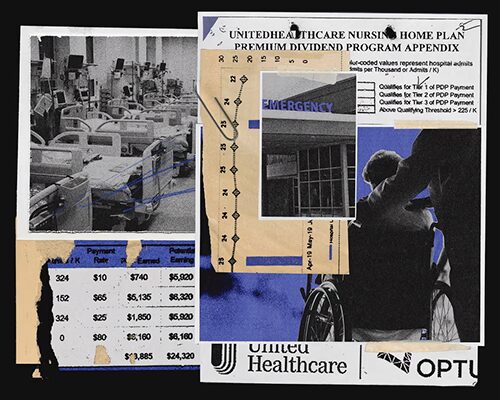
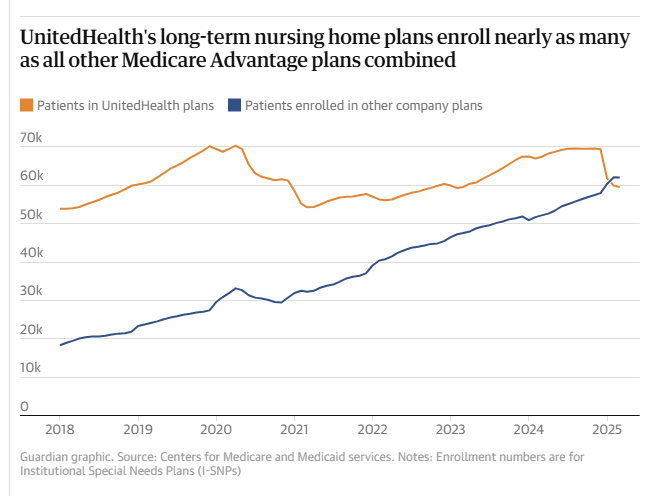
      The documents and sources provide a never-before-seen window into the company’s successful effort to insert itself into the day-to-day operations of nearly 2,000 nursing homes in small towns and urban commercial strips across the nation – an approach which has helped UnitedHealth secure a vast stream of federal dollars from Medicare Advantage plans that cover more than 55,000 long-term nursing home residents.

      UnitedHealth Responds

      UnitedHealth said the suggestion that its employees have prevented hospital transfers “is verifiably false”. It said its bonus payments to nursing homes help prevent unnecessary hospitalizations that are costly and dangerous to patients and that its partnerships with nursing homes improve health outcomes.

      Long-Term Profit

      UnitedHealth Profit over Patients

      Under Medicare Advantage, insurers collect lump sums from the federal government to cover seniors’ care. But the less insurers spend on care, the more they have for potential profit – an opportunity that UnitedHealth higher-ups have systematically sought to exploit when it comes to long-term nursing home residents.

      To reduce residents’ hospital visits, UnitedHealth has offered nursing homes an array of financial sweeteners that sounded more like they came from stockbrokers than medical professionals.

      Seven Years of Bribery and Threats

      Over the past seven years, the company has shelled out “Premium Dividend” and “Shared Savings” payments that boosted nursing homes’ bottom lines. Through its “Quality and Shared Risk” program, UnitedHealth offered an even bigger cut to nursing homes that drove down medical spending, but threatened to claw back money from those that didn’t, according to former employees and internal corporate documents.

      “You gain profitability by denying care, and when profitability suffers for the shareholders, that’s when people get crazy and do things that are not appropriate.”

      Anonymous

      Former National Executive, United Health

      # # #

      © 2025 This article is reprinted from The Guardian. The full article can be accessed here. For more information or for permission to reprint, please contact The Guardian directly.

      BREAKING NEWS: Intrepid USA Files Bankruptcy

      by Kristin Rowan, Editor

      *Editor’s note: This article has been updated to remove inaccurate information from the Intrepid USA website.

      Intrepid USA Files Bankruptcy

      Intrepid USA, once among the largest providers of home health and hospice services, files bankruptcy in Texas. With more than $90 million in revenue in 2023, Intrepid operated more than 60 home health and hospice locations in 17 states. The Chapter 7 filing leaves no road to recovery. Chapter 7 allows the company to liquidate assets and distribute the proceeds. According to the Texas Southern Bankruptcy Court, Intrepid USA filed a voluntary petition for Chapter 7 bankruptcy on May 29, 2025.

      Troubled History Plagues Company

      Intrepid USA has a troubled past that it seems may have caught up with them. The U.S. Department of Justice (DoJ) alleges that between 2016 and 2021, Intrepid home healthcare agencies engaged in fraud. In violation of the False Claims Act, Intrepid filed Medicare claims for patients who did not qualify for home health, services that were not medically necessary, services provided by untrained staff, and services that were never provided. In August, 2024, Intrepid agreed to pay $3.85 million to resolve the allegations. The allegations were brought to the DoJ by two former employees of Intrepid under whistleblower provisions.

      This is not the first DoJ lawsuit against Intrepid USA. In 2006, when Intrepid owned 150 agencies across the country, the company entered into an $8 million settlement agreement to resolve similar allegations. The DoJ alleged that from 1997 to 2004 Intrepid violated the False Claims Act by billing Medicare and TRICARE for services not provided by a qualified person, failing to maintain complete documentation for its claims, and other violations of Medicare regulations. Additionally, the DoJ alleged that Intrepid, in 2002 and 2003, fraudulently billed Medicaid for home care services provided to patients who were hospitalized at the time of the supposed care.

      Private Equity Backing

      Sometime around Q3 of 2006, Intrepid USA received financial backing from Patriarch Partners, led by Lynn Tilton. In August of 2020, Patriarch filed a notice of removal with the Supreme Court of New York. In 2021, Intrepid announced it was gearing up for rapid growth fueled by new private equity investors. Then CEO John Kunysz indicated the infusion of capital would fund opportunities for growth through acquisition.

      Divest, not Acquire

      Despite the influx of capital and the plan to grow through acquisition, by 2024, Intrepid was selling its assets. In August of 2024, Humana acquired 30 Intrepid branch locations and rebranded them under the CenterWell Home Health brand. The sale was part of Patriarch Partners’s Zohar Funds bankruptcy case. In November of 2024, New Day Healthcare acquired Intrepid’s hospice locations in Missouri and Texas.

      $0 Revenue; 0 Value

      The bankruptcy filing shows that Intrepid USA had $90 million in revenue in 2023, $50 million in revenue in 2024, and $0 in revenue so far in 2025. Chapter 7 bankruptcy is usually supervised by the court, allowing the filing company to sell assets without having to use the revenue generated by the sale to pay off debts. Intrepid listed $1 to $10 million in assets and $88 million in debts at the time of the filing. 

      Intrepid USA files bankruptcy
      Intrepid USA Files Chapter 7 Bankruptcy

      Who will take the loss?

      The Intrepid USA website still lists 55 active home health and hospice locations in 11 states. However, 30 of those locations are now listed on the CenterWell website and at least 5 other locations were part of the sale to New Day Healthcare. It is unknown if Intrepid has any locations still in operation. The company did not respond to our request for a statement.

      The website also has a list of partners and investors. The Rowan Report reached out to the partners with whom we are familiar for more information. We will provide updates from them once we reach them.

      Final Thoughts

      The recent divestiture of home health and hospice locations to New Day and CenterWell will hopefully minimize the number of patients who are losing their home health or hospice provider. Millions of dollars in future fraudulent claims will remain in the Medicare, TRICARE, and Medicaid coffers. Conversely, the partners and investors in Intrepid USA may face some loss. We will provide any important updates and comments from the impacted companies as available.

      # # #

      Kristin Rowan, Editor
      Kristin Rowan, Editor

      Kristin Rowan has been working at The Rowan Report since 2008. She is the owner and Editor-in-chief of The Rowan Report, the industry’s most trusted source for care at home news, and speaker on Artificial Intelligence and Lone Worker Safety and state and national conferences.

      She also runs Girard Marketing Group, a multi-faceted boutique marketing firm specializing in content creation, social media management, and event marketing.  Connect with Kristin directly kristin@girardmarketinggroup.com or www.girardmarketinggroup.com

      ©2025 by The Rowan Report, Peoria, AZ. All rights reserved. This article originally appeared in The Rowan Report. One copy may be printed for personal use: further reproduction by permission only. editor@therowanreport.com


      Fraudsters Arrested, Oz Issues Warning

      by Kristin Rowan, Editor

      Fraudsters Arrested, Oz Issues Warning

      Fraud in California

      Fraudsters arrested in West Covina, CA this week were allegedly running a Medicare scheme. Authorities arrested hospice owner-operator Normita Sierra. They charged her with nine counts of health care fraud, one count of conspiracy, and four counts illegal remuneration (kick-backs) for health care referrals. The U.S. Attorney’s Office named co-conspirator Rowena Elegado. They also arrested her and charged her with one count of conspiracy and four counts of illegal remuneration for health care referrals.

      Kickbacks

      Sierra and Elegado worked together to pay marketers to recruit patients who did not have a hospice referral from their PCP and who were not terminally ill. Some of the kickbacks paid to marketers were as high as $1,300 per patient per month. After six months, the patients were referred out to Sierra’s home health company.

      Medicare Claims

      According to the U.S. Attorney’s Office, from 2018 to 2022, Sierra’s hospice agences submitted $4.8 million in fraudulent claims. Of those claims, Medicare paid approximately $3.8 million.

      Dr. Oz Issues Warning

      In a video statement, Dr. Oz explained how Medicare recipients are falling victim to scams. Sales people call, email, and even knock on your door, offering advice, free samples, and referrals. These marketers have one goal: get you sign a piece of paper. That paper signs you up for hospice care and agrees to allow a specific hospice agency to provide that care. The hospice agency then bills Medicare for services they never provide. Watch the video statement here.

      HHS OIG Issues Consumer Alert

      In a similar statement, HHS issued a consumer alert regarding DME companies. The alert warns that some DME companies are contacting Medicare beneficiaries. They claim to work for or on behalf of Medicare. Once they receive the patient’s Medicare number, they bill Medicare for unnecessary medical items. These items include urinary catheters, knee and back braces, orthotic braces, and prescription drugs, which may or may not ever be sent to the patient. HHS urges enrollees not to give their Medicare number to anyone. Further, they suggest regulary reviewing items charged to insurance, and refusing delivery of any medical supply not ordered by a physician.

      Oz Issues Warning
      Fraudsters Arrested

      Combating Waste, Fraud, and Abuse

      Dr. Oz and CMS have spoken numerous times about combatting the waste, fraud, and abuse withing the Medicare and Medicaid systems. Originally a strong proponent for Medicare Advantage, Oz has promised to audit MA after discovering the government pays more for MA than traditional Medicare. Oz also promised to reduce the amount of prior authorization requests needed before a patient gets services. Oz responded to the Republican-backed House bill requiring more oversight on Medicaid eligibility. Oz indicated that some Medicaid patients are enrolled in more than one state and that Medicaid is paying for able-bodied patients. The waste, fraud and abuse across Medicare and Medicaid is costing the government between $1 and $10 billion and Dr. Oz plans to find it and make significant changes to the management of the system.

      A Cautionary Tale for Hospice Providers

      You may be thinking, “What does this have to do with me?” Unfortunately, even the most scrupulous hospice agencies can fall prey to marketers running schemes. There are legitimate referral resources in the market who can help your agency get more referrals and more clients. There are also underhanded marketers who know how the system works. These predators will promise new referrals (for a fee) and then enroll uneligible patients without your knowledge. If you are working with or looking for a referral partner for your hospice agency, use one that is referred by someone you trust, and/or do a lot of research on the company history before working with anyone. Be especially wary of the ones who promise much more than what most referral companies offer.

      # # #

      Kristin Rowan, Editor
      Kristin Rowan, Editor

      Kristin Rowan has been working at The Rowan Report since 2008. She is the owner and Editor-in-chief of The Rowan Report, the industry’s most trusted source for care at home news, and speaker on Artificial Intelligence and Lone Worker Safety and state and national conferences.

      She also runs Girard Marketing Group, a multi-faceted boutique marketing firm specializing in content creation, social media management, and event marketing.  Connect with Kristin directly kristin@girardmarketinggroup.com or www.girardmarketinggroup.com

      ©2025 by The Rowan Report, Peoria, AZ. All rights reserved. This article originally appeared in The Rowan Report. One copy may be printed for personal use: further reproduction by permission only. editor@therowanreport.com


      Delay HOPE Tool

      by Kristin Rowan, Editor

      Advocacy Groups to CMS:

      Delay HOPE Tool Implementation

      “Delay HOPE Tool Implementation,” say multiple hospice advocacy groups. LeadingAge, the National Alliance for Care at Home (The Alliance), and the National Partnership for Healthcare and Hospice Innovation (NPHI) are urging CMS to delay the transition from HIS to HOPE. The three groups sent a joint letter to Dr. Mehmet Oz, CMS Administrator, earlier this week.

      “Our associations remain fully committed to the [Hospice Quality Reporting Program (HQRP)], including the payment penalties for non-compliance, and recognize the critical importance of accurate, timely data submission to inform the delivery of high-quality hospice care. However, we have serious concerns about the potential for successful implementation of the HOPE tool.”

      LeadingAge, The Alliance, NPHI

      Hospice Advocacy

      The concerns over agency readiness to implement the new tool center on the new reporting platform. Hospice agencies state they don’t have all the necessary information to develop a workable tool for submission. Therefore, the agencies have asked CMS to delay the implementation of the HOPE tool. They have called on CMS to wait until six months after agencies have access to education, training, and final validation specifications.

      Hospice Rule Penalty

      The hospice program through CMS requires substantial reporting for payment. Hospices that do not submit the required 90% of records, they receive an annual payment penalty of 4%. Combined with lower than sustainable payment increases, the 4% penalty results in a lower reimbursement rate over prior years. The associations worry that the lack of information and education will lead to lower reporting. In turn, the lower reporting lowers reimbursement rates. For hospices that are already struggling to survive, the penalty is devastating. The letter to CMS asked to waive the timeliness requirement for two quarters after implementation.

      HOPE Tool Lacks Validation

      CMS will have a Validation Utility Tool that agencies will need to use in order to ensure their software can successfully submit their data. CMS has not released the tool and indicates they may not until sometime in September. The HOPE tool is scheduled for implementation in October. There is not enough time between release of the validity tool and implementation of the HOPE tool for proper testing.

      Hospice Agencies Lack Validation

      In addition to validating data submission, hospice agencies have to enroll in the new submission portal, iQUIES. Enrollment requires a privacy security official and other staff. Additionally, it requires an application to access the system, background checks, and other actions. Thus far, hospice agencies do not have access to begin this process and there is no indication of how long it will take. The associations are concerned that the process may also involve significant financial cost to hospice agencies.

      Resources

      CMS released the Hospice Outcomes and Patient Evaluation (HOPE) Guidance Manual v1.01, a 138 page PDF, available here. The manual includes links to other resources for hospice agencies. Namely, a webpage with information on HOPE Data Submission Specifications has a “final” version of data specs available for download. Additionally, there are links to the Main Page here and technical information and updates here. The document urges vendors to register to get updates and important announcements.

      Final Thoughts

      There is no information yet as to a response to the letter from CMS. Thus far, CMS is still planning on keeping the October 1, 2025 HOPE implementation date. We will continue to report on updates from CMS and the advocacy groups.

      # # #

      Kristin Rowan, Editor
      Kristin Rowan, Editor

      Kristin Rowan has been working at The Rowan Report since 2008. She is the owner and Editor-in-chief of The Rowan Report, the industry’s most trusted source for care at home news, and speaker on Artificial Intelligence and Lone Worker Safety and state and national conferences.

      She also runs Girard Marketing Group, a multi-faceted boutique marketing firm specializing in content creation, social media management, and event marketing.  Connect with Kristin directly kristin@girardmarketinggroup.com or www.girardmarketinggroup.com

      ©2025 by The Rowan Report, Peoria, AZ. All rights reserved. This article originally appeared in The Rowan Report. One copy may be printed for personal use: further reproduction by permission only. editor@therowanreport.com


      Patient Data Access

      by Kristin Rowan, Editor

      Access to Patient Data

      Tighter than Fort Knox

      Access to patient data has always been tricky, even for the patient. Every doctor’s office, hospital, urgent care center, home health agency, and nursing facility uses their own system to house medical records. With concerns over HIPAA violations, that data is secured, sometimes in several ways simultaneously. A breach in that system could spell big trouble for the medical agency and the software company that provided it. Even in the age of electronic medical records, it is difficult to access those records without proof of identity, a signature in triplicate, and an oath punishable by death that you are allowed access to the information. (Okay, I may be exaggerating on that last one just a bit.)

      3rd Party Access

      Even more difficult than accessing patient data as the patient or the patient’s doctor or caregiver is accessing the data as a service provider:

      • Consultants who help agencies with operational efficiency, documentation, software implementation, etc.
      • QAPI advisors who help with reporting and training
      • Data analytics companies who interpret information and provide meaning behind numbers.

      Who Owns the Data?

      One of the big questions in these cases is who owns the data. Each party seems to claim some ownership. Medical agencies believe they own the data because the information doesn’t exist without inputing it during a patient visit. Electronic medical records claim ownership based on housing the information in the system they created, designed, and built. I, along with many others I assume, believe the data belongs to the patient. It is being used by the medical agency to perform services and housed by the software company much like a storage facility. But, the information should travel with the patient. 

      It's a Bot!

      Skilled nursing facilities and other providers often hire data analytics companies to help assess their business. One such company, Real Time, provides data analytics services using facility and patient data. Real Time accesses this data using log-in credentials provided by the facilities. Due to the volume of data and the time it takes to sift through a robust EHR system, Real Time uses bots to comb through the system and download the necessary information. 

      Roadblock

      This system works well for analytics companies and consultants to access more data quickly and provide faster, more thorough answers to their clients. The system doesn’t work well when the software housing the data enables CAPTCHA on its log-in page. CAPTCHA is specifically designed to keep bots out. In 2022, PointClickCare started using CAPTCHA on users they thought were bots. In 2023, PointClickCare used images so indecipherable that even humans couldn’t solve.

      Request Denied

      Real Time was losing access to its accounts. Agencies were losing the data analytics they contracted to receive. Real Time and PointClickCare entered discussion to provide access to the data. Real Time alleges that the solutions PointClickCare agreed to would only allow access to 30% of the data needed. Additional negotiations ended without an agreement. It seems PointClickCare ended the negotiations.

      Fight for Your Right to...Data

      In January of 2024, Real Time sued PointClickCare claiming unfair competition and tortious interference, among others. A district court issued an injunction to stop PointClickCare from using indecipherable CAPTCHA images and from deactivating Real Time’s accounts. PointClickCare appealed the decision to the Fourth Circuit.

      Interpreting the Law

      The Fourth Circuit upheld the district court ruling. The significance in the ruling is that the court interpreted some previously ambiguous language in the Cures Act exceptions to the information blocking rules. Specifically, the court interpreted the phrase “cannot reach agreeable terms” to mean that both parties attempt to reach an agreement in “good faith” using “reasonable” and “genuine” effort. The court also stated that the parties must have “articulable reasons why the parties cannot come to an agreement.” While this may seem like a minor ruling, the impact of the interpretation of the exceptions could reach much farther than this law suit.

      I Object!

      PointClickCare requested a rehearing after the Fourth Circuit decision. The American Hospital Assocition and Electronic Health Record Association filed briefs supporting PointClickCare in the lawsuit and in the petition for a rehearing. On April 23, 2025, The US Court of Appeals for the Fourth Circuit denied the petition for review. 

      Paving the Way for Interoperability

      The Fourth Circuit decision upholds the final rule from HHS implementing the Cures Act disincentives for information blocking. This decision and the denial of the petition for en banc review could have widespread implications. EHR companies must use the same access rules for every user. No more tricky images to stump consultants. No limiting access to 30% of the data.

      The use of artificial intelligence-based software that can access EHR data without standard API connectivity could be the next step. Without needing permission to access and download data, switching software companies becomes easier. Sharing patient data with other medical providers is now a simple task. A patient could access their medical records with a single log-in.

      Final Thoughts

      I anticipate this will not be a decision that is accepted easily. I see more objections, lawsuits, and arguments from the AHA, the EHRA, and individual software providers and consultants. The decision has the potential to reach into other industries. AI will continue to evolve in ways we haven’t even anticipated. This certainly will not solve the issues of access to data or interoperability, but it’s a good first step.

      Read the related articles on interoperability from Netsmart. Part 1 | Part 2

      # # #

      Kristin Rowan, Editor
      Kristin Rowan, Editor

      Kristin Rowan has been working at The Rowan Report since 2008. She is the owner and Editor-in-chief of The Rowan Report, the industry’s most trusted source for care at home news, and speaker on Artificial Intelligence and Lone Worker Safety and state and national conferences.

      She also runs Girard Marketing Group, a multi-faceted boutique marketing firm specializing in content creation, social media management, and event marketing.  Connect with Kristin directly kristin@girardmarketinggroup.com or www.girardmarketinggroup.com

      ©2025 by The Rowan Report, Peoria, AZ. All rights reserved. This article originally appeared in The Rowan Report. One copy may be printed for personal use: further reproduction by permission only. editor@therowanreport.com


      Medicare Advantage Audits

      by Kristin Rowan, Editor

      CMS Strategy for Medicare Advantage Audits

      Last week, The Centers for Medicare and Medicaid Services (CMS) rolled out a new, aggressive strategy to enhance and accelerate Medicare Advantage Audits under RADV. CMS will audit all eligible MA contracts in all newly initiated audits. The strategy will also invest additional resources to complete the audits for each payment year (PY) 2018 to 2024.

      Falling Behind

      CMS is several years behind in completing audits. In fact, the last payment year with any significant recovery was from PY 2007. Completed audits from 2011 to 2013 recovered 5%-8% in overpayments. Federal estimates put current overpayments at $17 billion annually. MedPAC‘s estimate is significantly higher at $43 billion annually.

      “We are committed to crushing fraud, waste and abuse across all federal healthcare programs. While the Administration values the work that Medicare Advantage plans do, it is time CMS faithfully executes its duty to audit these plans and ensure they are billing the government accurately for the coverage they provide to Medicare patients.”

      Dr. Mehmet Oz

      Administrator, CMS

      The Plan to Manage Medicare Advantage Audits

      According to a press release from CMS, the plan is to complete all outstanding audits from PY 2018 to 2024 by early 2026. Here are key elements from the plan:

      • Enhanced Technology: CMS will deploy advanced systems to efficiently review medical records and flag unsupported diagnoses.
      • Workforce Expansion: CMS will increase its team of medical coders from 40 to approximately 2,000 by September 1, 2025. These coders will manually verify flagged diagnoses to ensure accuracy.
      • Increased Audit Volume: By leveraging technology, CMS will be able to increase its audits from ~60 MA plans a year to all eligible MA plans each year in all newly initiated audits (approximately 550 MA plans).  CMS will also be able to increase from auditing 35 records per health plan per year to between 35 and 200 records per health plan per year in all newly initiated audits based on the size of the health plan.  This will help ensure CMS’s audit findings are more reliable and can be appropriately extrapolated as allowed under the RADV final rule

      CMS will also reportedly work with the Department of Health and Human Services Office of Inspector General (HHS-OIG) to recover uncollected payments identified in past audits. 

      Impact of Medicare Advantage Audits on Providers

      If CMS is able to audit as many plans and records as they are anticipating, Medicare Advantage payers could be looking at significant overpayments. CMS will aggressively seek repayment. When MA payers lose money, they tend to pass that loss on to providers and patients. We could see MA plans cutting benefits, denying procedures, and other cost-saving measures.

      Providers who are aware of the unsupported diagnoses or who profited from them may be on the hook for overpayments. Law firm Ropes and Gray suggests that “[MA] plans should…minimize historical risk by correcting or deleting unsupported diagnoses for any time periods for which they are still able to do so.”

      I suggest not using this particular law firm. I also suggest checking your payer contracts for clawback and indemnification clauses. When applicable, negotiate new and renewal contracts very carefully.

      Medicare Advantage payers will push back on these audits, file lawsuits, and challenge how CMS is conducting audits. MA payers have historically denied treatments and medications that would be covered under traditional Medicare plans. They go to great lengths to avoid paying for services patients did receive. I’m certain they won’t be happy paying back money for services they never received.

      CMS indicates it will start the new audit plan immediately. We will continue watching for updates through the end of the year to see if CMS reaches their goal. Of course, we will continue to report on changes at CMS and with Medicare Advantage payers as they happen.

      # # #

      Kristin Rowan, Editor
      Kristin Rowan, Editor

      Kristin Rowan has been working at The Rowan Report since 2008. She is the owner and Editor-in-chief of The Rowan Report, the industry’s most trusted source for care at home news, and speaker on Artificial Intelligence and Lone Worker Safety and state and national conferences.

      She also runs Girard Marketing Group, a multi-faceted boutique marketing firm specializing in content creation, social media management, and event marketing.  Connect with Kristin directly kristin@girardmarketinggroup.com or www.girardmarketinggroup.com

      ©2025 by The Rowan Report, Peoria, AZ. All rights reserved. This article originally appeared in The Rowan Report. One copy may be printed for personal use: further reproduction by permission only. editor@therowanreport.com