ATA Partners with West Health Institute

ATA West Health<br />
FOR IMMEDIATE RELEASE

CONTACT:


Gina Cella
gcella@americantelemed.org
t: 781-799-3137

AMERICAN TELEMEDICINE ASSOCIATION JOINS WEST HEALTH INSTITUTE’S COLLABORATIVE FOR TELEHEALTH AND AGING

WASHINGTON, DC, JUNE 11, 2024 – The American Telemedicine Association (ATA) today announced it has joined the Collaborative for Telehealth and Aging (C4TA), an initiative led by the West Health Institute (WHI). The ATA will serve as an Advisor to the C4TA, which is committed to accelerating the adoption of telehealth to meet the needs of seniors. WHI is a non-profit medical research organization dedicated to lowering healthcare costs and engaged in applied medical research and improving healthcare delivery for older Americans.

“The ATA has long been a proponent of using telehealth and virtual care technologies to better care for our aging population, not just to live longer, but to live better, to support our caregivers and improve our healthcare system to benefit all stages of life,” said Ann Mond Johnson, CEO, the ATA. “We are pleased to join the C4TA to accelerate the adoption of telehealth to meet the needs of seniors and enable individuals to remain vital, engaged and independent through their later years, and create a better health system for everyone.”

C4TA was established in 2021 by West Health, the University of Virginia, and the Mid-Atlantic Telehealth Resource Center to gather experts from health systems, academic institutions, member organizations, and non-profit foundations focused on aging to develop and provide guidelines implementation tools for using telehealth with older adults.

“We are proud to welcome the American Telemedicine Association among the more than 35 national organizations joining our mission to enhance telehealth services for older adults,” says Dr. Zia Agha, Chief Medical Officer of West Health Institute. “Together, alongside experts in geriatrics, telehealth, and patient advocacy, collaborative members have established vital principles and guidelines to ensure equitable, accessible, and integrated remote care options. This collaboration underscores our shared commitment to improving the well-being of older adults across the nation.”

The ATA’s Healthy Aging Collaborative is a member forum focused on identifying and pursuing opportunities to make an impact on the daily life of our aging population through policy guidance and the use of technologies to ease the burden of communications, social isolation, and whole person care management. The ATA Healthy Aging Collaborative hosts quarterly webinars, providing insights and education for the broader community. The group recently published a report, Leveraging Telehealth to Support Caregivers and Those They Care For.

About the ATA

As the only organization completely focused on advancing telehealth, the American Telemedicine Association is committed to ensuring that everyone has access to safe, affordable, and appropriate care when and where they need it, enabling the system to do more good for more people. The ATA represents a broad and inclusive member network of leading healthcare delivery systems, academic institutions, technology solution providers and payers, as well as partner organizations and alliances, working to advance industry adoption of telehealth, promote responsible policy, advocate for government and market normalization, and provide education and resources to help integrate virtual care into emerging value-based delivery models.

#  #  #
Curantis Solutions Partners with Amazon HealthLake

by Kristin Rowan, Editor

Having a lot of data can help grow your business, streamline processes, improve efficiencies, and make your agency more profitable. But, if you don’t know how to use the data, or simply don’t have the time and man-power to analyze the data, then those hidden treasures waiting in all that data remain hidden. Understanding the value of that data, Curantis Solutions partners with Amazon HealthLake to help you harness it.

Curantis Solutions is a Texas based company delivering value to hospice and palliative care agencies. Their cloud-based management solutions help you increase operational and financial efficiencies while still offering well-coordinated and high quality patient care. The platform works to address two common pain points in our industry: siloed data and software systems that operate separate from each other. Curantis Solutions re-imagines workflows to reduce hours spent on tasks outside of direct patient care.

The Impetus for Change

New CMS regulations and the HL7 Fast Healthcare Interoperability Resources (FHIR) create standards that providers and health care plans must meet. This could help home health and hospice agencies with clinical data issues. FHIR imagines a unified EMR system for greater interoperability. Facing FHIR compliance, Curantis Solutions turned to AWS to help centralize their data. Using Amazon HealthLake, a fully managed FHIR service, Curantis was able to make their client data interoperable.

The Solution for Curantis Solutions

Using Amazon’s Working Backwards process, Curantis found a customer-centric solution. AWS helped Curantis work through:

  • Business objectives
  • A free, introductory program, “Gain Insights”
  • Cloud set-up and solution design

Curantis also implemented Amazon Kinesis to help collect, process, and analyze real-time data. All of Curantis’s data is now easily accessible, opening the door for AI, analytics, and business intelligence.

Curantis Solutions and Amazon HealthLake Data Processing and Analytics

Curantis Solutions Amazon HealthLake

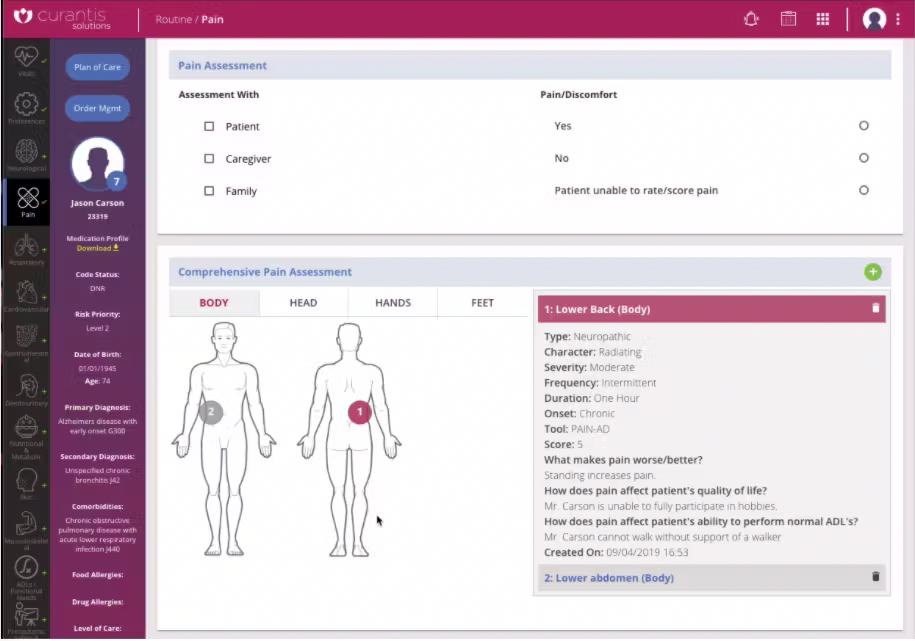
Using Amazon, Curantis Solutions can build visual dashboards and reports. The visual reports help agency administrators understand and apply the data at a glance without spending hours analyzing the data points. The integration allows data analysis in almost real time. The Amazon suite of services aids Curantis in growth and enhanced data processing for their clients. It also allows Curantis to highlight powerful industry and patient data trends. These key indicators will help with critical decision making for continued high quality patient care.

    This new platform adds expanded abilities to meet customer needs:

    • Enhanced partner integrations
    • Diverse way to prensent a patient-focused view
    • The power to make predictions about a patient’s decline based upon chart data
    • The ability for customers and internal stakeholders to easily explore data


    About Curantis Solutions

    Curantis Solutions was born from a desire to put hospice and palliative care first. With a genuine culture of caring, our team is dedicated to creating a refreshingly simple software experience that utilizes emerging technology, smart design and a cloud-native/serverless architecture to create an experience that is congruent with the technology you utilize in your everyday life. It’s time for hospice and palliative care software to make life easier vs creating arduous workarounds and added frustration. It’s time you experience Curantis Solutions!

    About Amazon HealthLake

    AWS HealthLake is a HIPAA-eligible service offering healthcare companies a complete view of individual and patient population health data using FHIR (Fast Healthcare Interoperable Resources) API based transactions to securely store and transform their data into a queryable format at petabyte scale, and further analyze this data using machine learning (ML) models. Using the HealthLake FHIR-based APIs, healthcare organizations can easily import large volumes of health data, including medical reports or patient notes, from on-premises systems to a secure, compliant, and pay-as-you-go service in the cloud. HealthLake offers built-in natural language processing (NLP) models to help customers understand and extract meaningful medical information from a single copy of raw health data, such as medications, procedures, and diagnoses.

    Curantis Solutions Amazon HealthLake

    # # #

    Kristin Rowan, Editor
    Kristin Rowan, Editor

    Kristin Rowan has been working at Healthcare at Home: The Rowan Report since 2008. She has a master’s degree in business administration and marketing and runs Girard Marketing Group, a multi-faceted boutique marketing firm specializing in event planning, sales, and marketing strategy. She has recently taken on the role of Editor of The Rowan Report and will add her voice to current Home Care topics as well as marketing tips for home care agencies. Connect with Kristin directly kristin@girardmarketinggroup.com or www.girardmarketinggroup.com

    ©2024 by The Rowan Report, Peoria, AZ. All rights reserved. This article originally appeared in Healthcare at Home: The Rowan Report. One copy may be printed for personal use: further reproduction by permission only. editor@therowanreport.com

    NLRB Targets Non-Compete Agreements

    by Elizabeth E. Hogue, Esq.

    The National Labor Relations Board (NLRB) has now joined the Federal Trade Commission (FTC) and some state legislatures to target non-compete agreements. The general counsel for the NLRB argued in a recent memo that non-compete agreements violate the National Labor Relations Act because they interfere with employees’ right to engage in protected concerted activity. Two recent actions by the Board provide more information about efforts of the NLRB to limit use of non-compete agreements.

    Juvly Aesthetics Non-Compete Agreement Settlement

    In February of 2024, the regional office of the Board in Cincinnati approved a settlement agreement between Juvly Aesthetics and three former employees. The Board claimed that Juvly, an operator of medical clinics, violated the rights of employees through the use of confidentiality, non-disparagement, non-competition, non-solicitation and requirements to repay training expenses under certain conditions. 

    According to the NLRB, Juvly prohibited employees from discussing their rates of pay. The Company also required some employees to sign a non-compete agreement that was in effect for a period of twenty-four months for any competing medical practice within twenty miles of any location of the Company.

    Juvly agreed to a settlement agreement that required:

    • Payment of back pay to some employees
    • Termination of unlawful policies and procedures
    • Release of employees from unlawful agreements
    • Posting of all of requirements of the settlement agreements for review by employees
    Non-compete agreements juvly aesthetics<br />

    NLRB Division of Advice

    non-compete agreements

    In December, the NLRB Division of Advice issued guidance that evaluated the legality of these issues:

    • Customer non-solicitation provisions do not violate the Act because they only prevent employees from soliciting existing customers for one year so that employees are likely not barred from other employment opportunities for more than one year.
    • Confidentiality agreements do not violate the Act because they prohibit only disclosure of trade secrets, marketing plans, customer lists, and other proprietary information, as opposed to information that could involve employee activity regulated by the Act, such as wage information. 
    • Provisions requiring the return of company property do not violate the Act.

    Providers are now clearly operating in an environment that prohibits employers from restricting employee activities that were fair game in the past. The specifics of efforts to limit the actions of employers remain unclear, but will likely be “fleshed out” in enforcement actions.

    ©2024 Elizabeth E. Hogue, Esq. All rights reserved.

    No portion of this material may be reproduced in any form without the advance written permission of the author.

    ©2024 by The Rowan Report, Peoria, AZ. All rights reserved. This article appeared in Healthcare at Home: The Rowan Report. Reproduction by permission only.

    editor@therowanreport.com

    The Future of NAHC: An Interview with Bill Dombi

    by Kristin Rowan, Editor

    NAHC President Bill Dombi announced at last week’s CAHSAH annual meeting and expo that he would end his tenure at NAHC and retire at the end of 2024. We reached had an interview with Dombi on Thursday, May 23rd. He said he was not prepared to speak yet about his upcoming retirement, but we should hear more about that soon.

    In the meantime, he provided additional details from his session at CAHSAH. We also discussed updates on the lawsuit against CMS and the status of the merger between NAHC and NHPCO. Tim’s article from last week talks about Dombi’s progress with Senator Wyland.

    Ongoing Litigation

    When we last spoke with Bill, he told us about the lawsuits filed against CMS. The suit claims that the budget-neutral calculations were based on faulty data and outdated software. These calculations determined the reimbursement rate reductions. Dombi explained the process for those lawsuits.

    “The first round of the battle is around whether the court has the power to hear the case either at all or at that point in time. The courts are littered with litigation that have been dismissed on jurisdictional grounds,” Dombi offered. The court dismissed the lawsuit and the case is now closed. The Department of Justice (DoJ) attacked jurisdiction to get the case dismissed. Most concerning, according to Dombi, was the DoJ’s question of whether the statute passed by Congress precluded any litigation. If the courts had found in their favor, they would have dismissed the lawsuit no further suits could be filed. Luckily, that argument didn’t hold. The second attack was whether NAHC had expedited administrative review, which is the argument that caused the dismissal. Now, they have to establish that it would be futile to get CMS to agree to expedited judicial review.

    Next Steps

    In light of the dismissal, NAHC had to decide whether to appeal the ruling, exhaust the expedited review step with CMS, or both. Ultimately, they decided not to appeal and is pursing the review with CMS. This process could take up to 6 months, according to Dombi. Although they are pursuing the review, CMS has already stated that their final position is that the budget neutrality has been calculated within the law. Dombi feels the review is futile because CMS is not going to change their position. Now, they just have to prove the futility.

    Two-Step Approach

    Advocacy from NAHC, NHPCO, and other individuals and organizations was always intended to be a two-pronged effort: Litigation and Congress. The two do not interfere with each other. Even though the court dismissed the litigation suit in favor of judicial review, the approach in Congress continues. Of Senator Wyland, Dombi said, “A year ago at this time, his view was that home health agencies needed no relief. Now, he’s indicated a willingness to find a way to help home health agencies and recognizes that the cuts have been harmful to home health agencies and others that provide care.” According to Dombi, it was the personal stories and individual provider information that was crucial in swaying Wyland. The organizations continue to meet with other members of Congress to persuade them in the same way.

    Dombi Provides Merger Update

    Last year, NAHC and NHPCO announced they would join forces and merge into a new, as yet to be named, organization. That merger is still moving forward, but there are a lot of odds and ends to tie up. Dombi told us, “Nothing is final, final, but I don’t see anything but tailwinds moving forward.” The two organizations are still hoping for a July 1, 2024 launch of the organization. There is an active, open search for a new CEO to actively run both organizations as one. According to Dombi, no one has been slated for that position yet, so they may end up launching before there is a CEO in place.

    The two organizations have already started integrating. They have lobbied together and they have worked on policy together. Additionally, they are integrating the association management system and building a website. “We feel confident enough that it’s going to reach the finish line that we’re investing time and money in these elements,” Dombi said. The two organizations can continue to operate together without a CEO, but there are a lot of decisions that need to be made that won’t be made until after there is a CEO.

    After the Merger

    Once the merger is complete and the two organizations operate under a new name with a new CEO, Dombi and his counterpart Bill Marcantonio of NHPCO will stay on for some time. Dombi will take the title President Emeritus and Council to the organization and Marcantonio will become the Chief Integration Officer. The new name of the organization has not been announced. Dombi says a lot of things are tied together, from an action standpoint, and it’s better to announce all of those details together along with the new name.

    Reflections From Bill Dombi

    When asked what was next for him after the merger is completed and he moves to retirement, Dombi reflected on his career:


    “I’m proud of what I’ve accomplished in my life, but I’m more proud of what the people I work with I have accomplished. It’s not the first time we’ve tried to merge the two organizations, but this time, we had all the right ingredients and I’m proud of that. I live with the confidence that my constituency is up to the challenge. Every time they get kicked back, they’re right back at it.

    To see where we are today compared to the 70s, we are so many light years ahead of where we were then. I mean, we’re talking about a hospital level of care at home. That was part of the dream. The fore-runners of healthcare at home truly believed those things were possible. The problems that caused the workforce shortage are multi-faceted, so the solutions are multi-pronged.”

    Bill Dombi Spring Tour
    We will continue following the story of both the lawsuits and the merger and update you as soon as there is more information.
    Kristin Rowan, Editor
    Kristin Rowan, Editor
    Kristin Rowan has been working at Healthcare at Home: The Rowan Report since 2008. She has a master’s degree in business administration and marketing and runs Girard Marketing Group, a multi-faceted boutique marketing firm specializing in event planning, sales, and marketing strategy. She has recently taken on the role of Editor of The Rowan Report and will add her voice to current Home Care topics as well as marketing tips for home care agencies. Connect with Kristin directly kristin@girardmarketinggroup.com or www.girardmarketinggroup.com

    ©2024 by The Rowan Report, Peoria, AZ. All rights reserved. This article originally appeared in Healthcare at Home: The Rowan Report. One copy may be printed for personal use: further reproduction by permission only.
    editor@therowanreport.com

    Bill Dombi Spring Tour has two Major Announcements

    by Tim Rowan, Editor Emeritus

    Bill Dombi Spring Tour

    For the last time, NAHC President Bill Dombi is spending another Spring on airplanes. It is state association meeting season, and the Bill Dombi Spring Tour has been bringing his regular Capitol Hill update from coast to coast, this time adding the announcement that he will retire at the end of the year.

    After 40 years with NAHC, the lengthy standing ovation Californians gave him at the end of his Tuesday speech was well-deserved.

    Advocacy and Change

    Bill’s core message has not changed, though the details of his ongoing battle to force CMS to take HHAs and Hospices more seriously has its 2024-2025 nuances. “Letting Congress know that you are an important healthcare sector, and clearly the most popular sector, is not NAHC’s job alone. Every one of you has power. Use it. Make your voices heard.”

    Meetings with the Senate Finance Committee

    To illustrate the point, he related a story about his recent visit to Portland to meet with the Chair of the Senate Finance Committee, Ron Wyland (D-OR).

    “Senator Wyden has been one of the major roadblocks to Medicare agencies getting fair payment rates. I went to see him with a group of agency owners and workers to describe the hardships the current and planned pay rate cuts will impose, and to explain the exact problems with the dumb formula CMS is using to calculate those pay rates.

    “The Senator said, ‘But MedPAC says you make too much money and rates should be cut. Were they wrong? Or has something changed?’

    Reaching Agreement…Almost

    “Both, the group and I harmonized. One by one, each agency representative told him about the growing demand of an aging population, the difficulty hiring staff with the salaries our low pay rates allow them to pay, and a full litany of all the problems with Medicare Advantage.

    “By the end of our meeting, we hadn’t turned him 180 degrees, but I could see he was beginning to turn.”Later, Dombi added, he met with Senator Debbie Stabenow (D-MI), who is not only a member of the same Finance Committee but the fourth in line in the Senate pecking order. She offered to have a conversation with her colleague, and that turned Senator Wyden the rest of the way toward changing his position 180 degrees.

    You Can Make a Difference

    “If you think you as an individual owner have no power in Sacramento, Congress, or the White House,” Dombi concluded, “think again.”

    See sidebar for the complete list of Finance Committee members. Everyone has power, but if you are a voter in one of their states, you have an even more powerful voice.

    The Bill Dombi Spring Tour will continue throughout the year until his retirement. Join Dombi at the 2024 Financial Management Conference & Expo in Las Vegas, July 21-23 and at the 2024 Home Care and Hospice Conference and Expo in Tampa, October 20-22.

    Bill Dombi Senator Wyden

    Senator Ron Wyland (D-OR)

    SENATE FINANCE COMMITTEE MEMBERS

    Chair: Ron Wyland (D-OR)
    Ranking Member: Mike Crapo (R-ID)
    Debbie Stabenow (D-MI)
    Chuck Grassley (R-IA)
    Maria Cantwell (D-WA)
    John Cornyn (R-TX)
    Robert Menendez (D-NJ)
    John Thune (R-SD)
    Thomas Carper (D-DE)D-
    Tim Scott (R-SC)
    Benjamin Cardin (D-MD)
    Bill Cassidy (R-LA)
    Sherrod Brown (D-OH)
    James Lankford (R-OK)
    Michael Bennet (D-CO)
    Steve Daines (R-MT)
    Bob Casey (D-PA)
    Todd Young (R-IN)
    Mark Warner (D-VA)
    John Barrasso (R-WY)
    Sheldon Whitehouse (D-RI)
    Ron Johnson (R-WI)
    Maggie Hassan (D-NH)
    Thom Tillis (R-NC)
    Catherine Cortez Masto (D-NV)
    Marsha Blackburn (R-TN)
    Elizabeth Warren (D-MA)

    # # #

    Tim Rowan, Editor Emeritus

    Tim Rowan is a 30-year home care technology consultant who co-founded and served as Editor and principal writer of this publication for 25 years. He continues to occasionally contribute news and analysis articles under The Rowan Report’s new ownership. He also continues to work part-time as a Home Care recruiting and retention consultant. More information: RowanResources.com
    Tim@RowanResources.com

    ©2024 by The Rowan Report, Peoria, AZ. All rights reserved. This article originally appeared in Healthcare at Home: The Rowan Report.homecaretechreport.com One copy may be printed for personal use: further reproduction by permission only. editor@homecaretechreport.com

    Product Review: Home Care Worker Safety

    by Kristin Rowan, Editor

    If you haven’t been following our recent reports, you may have missed last week’s article on the Home Care Worker Safety Bill that was passed in Connecticut. You may also have missed the article reporting that OSHA levied fines against Elara Caring, the home health agency where Joyce Grayson worked. If you did, take a minute to go back and read those updates. Changes are coming to home health and home care.

    We’ve been reporting on these important updates as we believe new regulations on Home Care Worker Safety will be coming nationwide. If OSHA can penalize a home health agency for failing to protect the safety of an employee, then protecting the safety of an employee is required, by default.

    Home Care Worker Safety Industry

    We’ve been meeting with and researching about home care worker safety since the first article about Joyce Grayson. There are several on the market as stand-alone equipment and/or SaaS services. Many existing SaaS companies are adding GPS tracking, visit check-in/check-out, and other safety and risk items to their suite of services as well.


    Background

    AJ Leahy had a close friend who was attacked on a college campus. First responders were called, but they didn’t have his exact location. The extra time it took responders to reach him contributed to his death. AJ concluded that the current emergency system is dangerous and broken.  AJ didn’t want anyone else to have the same experience. Thus, he created POM (Peace of Mind) Safe Company.

    AJ soon realized that the length of time it takes first responders to reach a victim is only part of the problem. He sought to create a system that would not only connect you with the help you need, but deter and de-escalate violence. After all, AJ surmised, the best outcome is not for first responders to reach you, but for first responders not being needed in the first place.

    Home Care Worker Safety AJ Leahy
    Home Care Worker Safety POM 3 Fob<br />

    Home Care Worker Safety in the “POM” of Your Hand

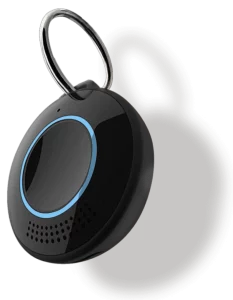
    POM safe is a portable, two-way communication safety device paired with an app that bypasses the need to use your phone to call 911. Using a series of taps, the POM Safe device can deter and de-escalate violence and dispatch the appropriate help.  The POM 3 (pictured left) is a wearable fob with a 10-day battery life between charges and is connected to your mobile data or WIFI connection through a cell phone. The POM Mobile (pictured below) device carries its own SIM card and remains independent of a cell phone.

    Emergency Response

    POM Safe has built-in, two-way communication that connects a home care worker to a dispatcher. Even if the clinician can’t speak, the dispatcher can hear the situation and deploy appropriate actions. When the two-way communication is activated, the device send a GPS signal along with profile information directly to the dispatcher. When needed, the dispatcher contacts emergency response services to arrive at the precise location.

    Beyond Emergency Response

    Reaction addresses the need for intervention after an act of violence has occurred. Proaction attempts to remove the need for the intervention at all. The proactive safety features of the POM Safe device include:

    • Fake phone call
      • Press a button on the device and your phone rings
      • Answering the call tells a would-be attacker that someone knows where you are and who you are with
    • Check on Me
      • Use the POM Safe device to start a timer
      • If you don’t confirm your safety within that time, help is alerted
    • Appointment Sync
      • POM Safe integrates with your scheduling and appointment data
      • Your precise location is sent to dispatchers and emergency responders
    • One-Tap Text
      • With one tap, a pre-written text is sent to alert dispatcher of your need for help
      • GPS location is sent with the text
    Home Care Worker Safety POM Device
    Home Care Worker Safety 360 Network

    Home Care Worker Safety Network

    One of the requirements in the Home Care Worker Safety Bill passed in Connecticut is to provide your clinicians with information about the neighborhood of each client. Crime rate, safety, registered offenders (coming soon), and other safety information about the neighborhood aid in the overall risk assessment of the client.

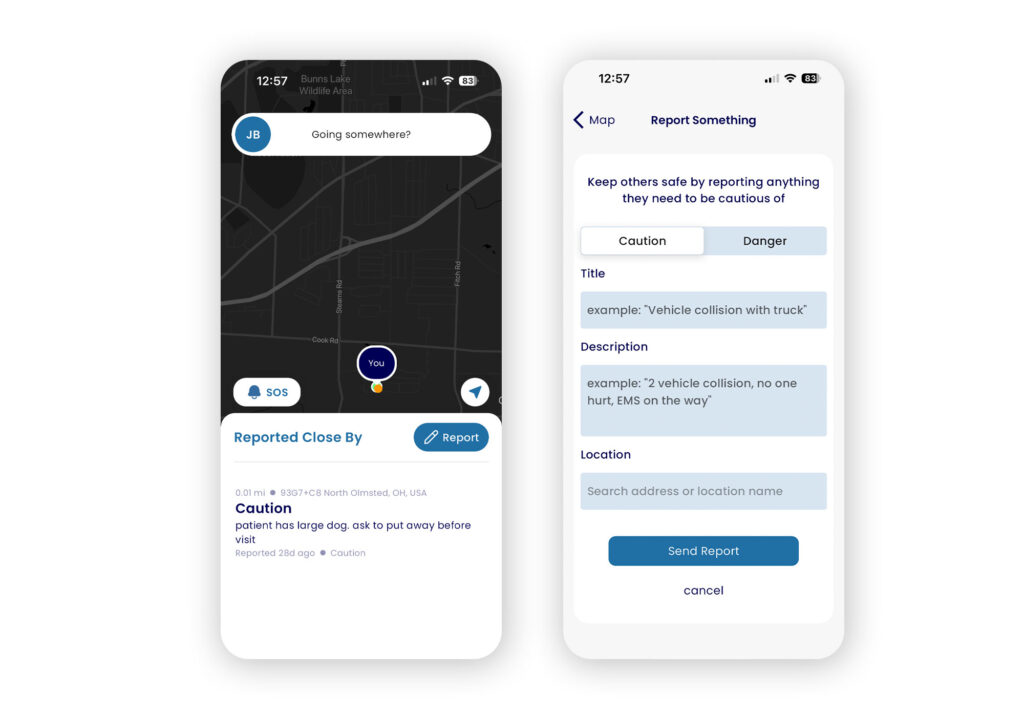
    The POM mobile app includes the “360 Safety Network”, combining a crowdsourced alert system with third-party safety data. Your clinicians can also report additional safety concerns and receive real-time notifications if a new alert flags their location.

    Customizable Programming

    Each home health and home care agency will have their own protocols, emergency contacts, and preferences for home care worker safety. When you adopt the POM Safe system, devices are customized and programmed to your agency’s specifications. You can set the “Check on me” timer for shorter or longer visits. GPS settings can be turned off at custom set times so you’re not tracking your clinicians in their off hours. Your clinicians can add their own family members to their connections and you can allow them to custom set what each button-click type will do.

    Organizational Monitoring

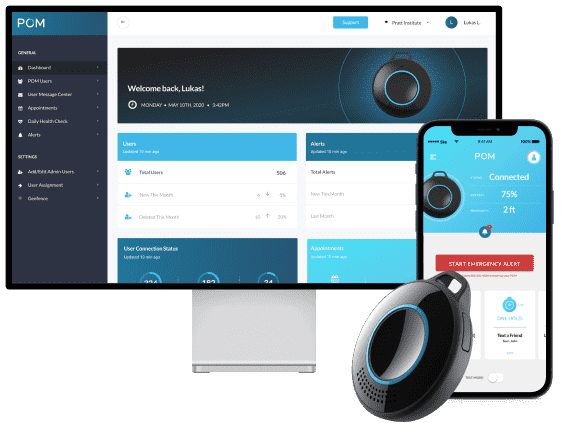
    POM Safe links to a safety dashboard for the agency. At a glance, you can see all of your users, alerts, and appointments. It also includes a user message center, customizable user assignments, daily health check, and more.

    Home Care Worker Safety App and Portal

    Final Thoughts

    Whether you contact POM Safe or another safety device company, it is imperative that you implement a safety program in your organization. This should include a committee, de-escalation training, self-protection training, employee assistance programs for mental health support, and a wearable/personal safety device that is GPS-enabled and connected to emergency response systems.

    # # # 

    Kristin Rowan, Editor
    Kristin Rowan, Editor

    Kristin Rowan has been working at Healthcare at Home: The Rowan Report since 2008. She has a master’s degree in business administration and marketing and runs Girard Marketing Group, a multi-faceted boutique marketing firm specializing in event planning, sales, and marketing strategy. She has recently taken on the role of Editor of The Rowan Report and will add her voice to current Home Care topics as well as marketing tips for home care agencies. Connect with Kristin directly kristin@girardmarketinggroup.com or www.girardmarketinggroup.com

    ©2024 by The Rowan Report, Peoria, AZ. All rights reserved. This article originally appeared in Healthcare at Home: The Rowan Report. One copy may be printed for personal use: further reproduction by permission only. editor@therowanreport.com

    Constant Therapy and Elara Caring form Partnership

    By Kristin Rowan, Editor

    Care at home has expanded in the last twenty years to include care that was previously received in hospitals, SNFs, and therapy centers. As care at home is increasingly recognized as a more cost efficient way to provide care with better outcomes and lower rehospitalization rates, we can expect more services to be offered in the home. We recently received report of one such expansion with the announcement that Constant Therapy and Elara Caring have partnered to offer speech-language and cognitive therapy support in the home.

    About Constant Therapy

    Led by Founder & CEO Veera Anantha, PhD, Constant Therapy offers an AI-driven platform for speech-language and cognitive therapy. The recommended dose of these types of therapy is high. With fewer therapists available, most patients aren’t receiving the recommended frequency of patient care.

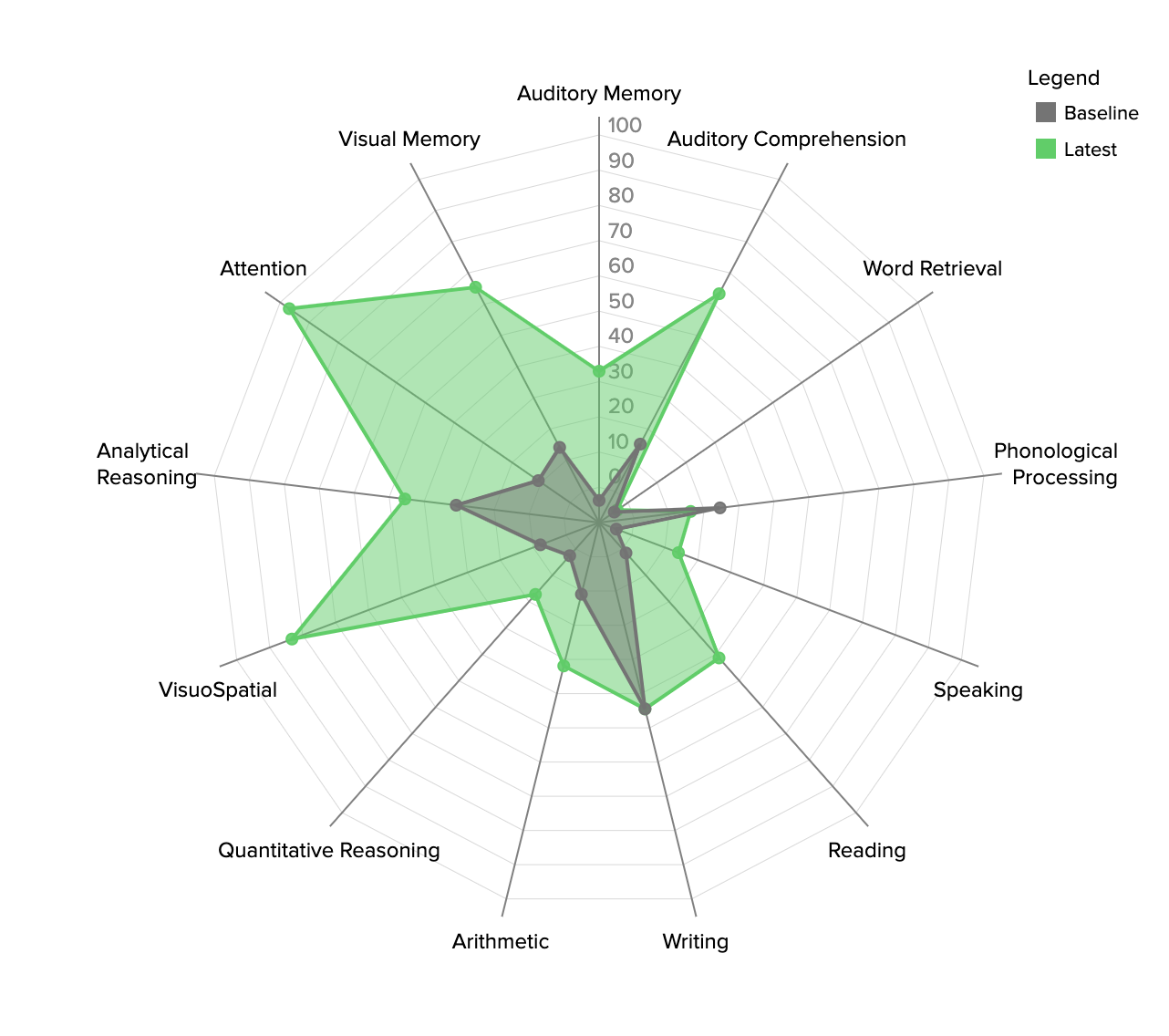
    Constant Therapy decreases the number of needed in-home visits using a digital program with 500,000 customizable exercises. The app also provides insights into patient performance and improvements. The AI tracks accuracy and speed over time and naturally progresses the patient based on that performance.

    Constant Therapy Brain Mapping

    Delivery of Care

    Constant Therapy is a personal assistant for the therapist to provide more care to more patients. It also has a time saving component. Constant Therapy automates all of the documentation and home exercise programs a therapist has to keep up with, in addition to providing updates to physicians.

    Mobile App

    The patient app can include family members who can log in to track their loved one’s progress. The app also includes RPM to track whether the patient is adhering to the homework assignment. The app tracks how long the patient spends on a task, how many tasks are completed, and progress over time. Additionally, the therapist app can link multiple clinicians, caregivers, physicians, and hospitals to increase continuity of care.

    Direct and Indirect Care Sessions

    During a care session, Constant Therapy acts as a digital workbook. The workbook is used to standardize delivery of care and objectively measure progress. Outside of direct care appointments, the app acts as a homework tool for the patients. It provides assignments for continued progress when the therapist is not present.

    About Elara Caring

    Elara Caring is a home health agency that operates in 17 states and has 200 locations. They offer skilled home health, hospice, personal care services, behavioral health, and palliative care.  Elara’s mission is to expand home care access by embracing the industry’s most innovative technologies and models. They strive to hire compassionate people who believe in taking care of their patients, clients, care providers, and each other.

    From the Source


    Mark Salley

    VP of Innovation and Rehabilitation at Elara Caring said, “Since our inception, Elara Caring has utilized patient data insights – more than 120M data points annually, in fact – to drive our strategic decisions that improve quality care and patient outcomes.  This has brought us to Constant Therapy. They have similar values and a shared goal to incorporate data into their evidenced-based, treatment platform. With Constant Therapy, our patients are seeing quicker recovery of speech, cognitive function, and language deficits following healthcare incidents including stroke, TBI, dementia, and more. We are excited to start this new chapter in close partnership with Constant Therapy. This will be a gamechanger for our patients and clinicians.”

    Noah Poskanzer

    Director of National Accounts at Constant Therapy said, “Part of being a home health clinician is to set the patient up to be as successful at home as possible. Not just in the U.S., but around the world, the number of people trained to provide therapy are [sic] going down but the number of people needing therapy is going up. Constant Therapy is providing patients with additional therapy when therapists are not present in the home with their patients.”

    Constant Therapy Pilot Program

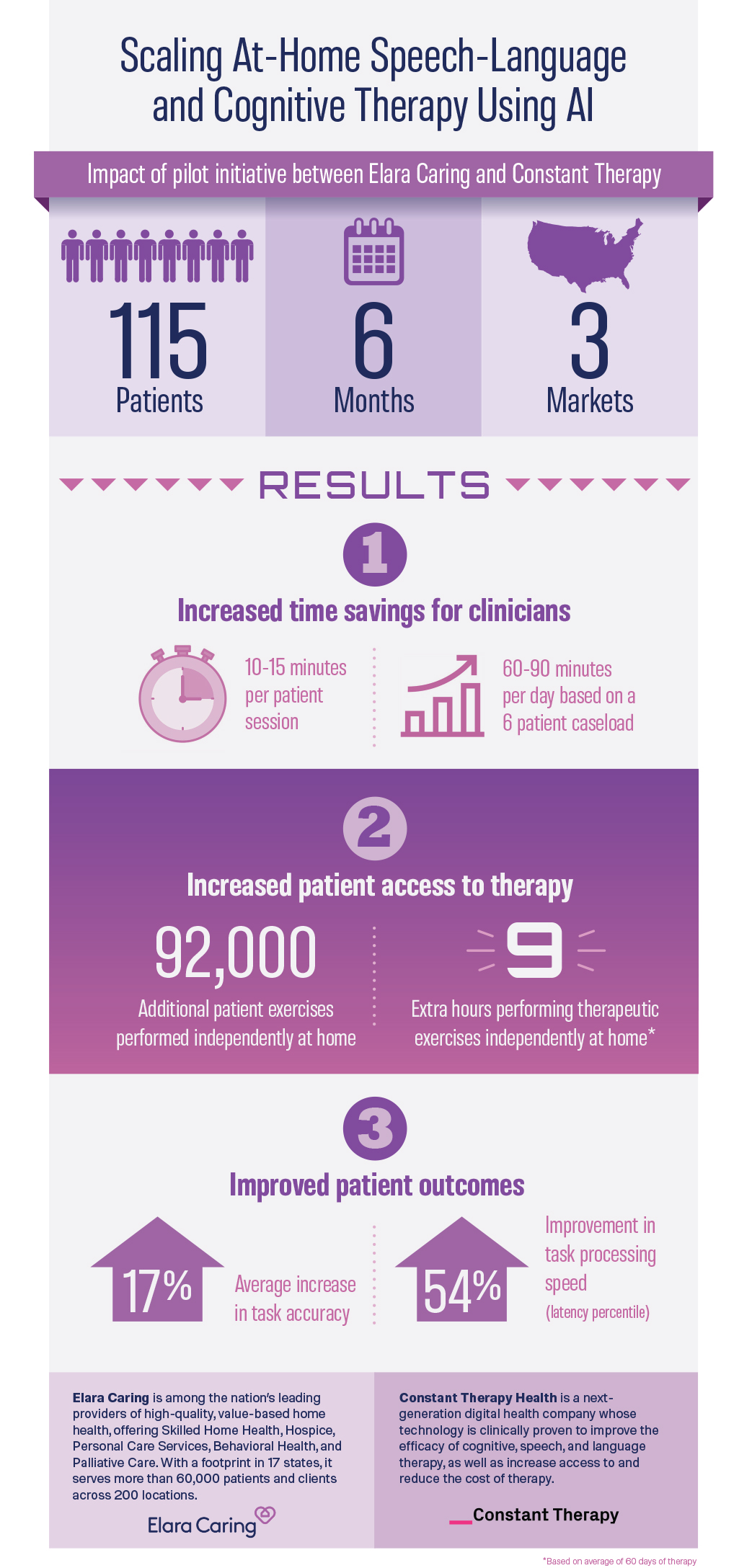
    Prior to the full-scale partnership, Constant Therapy and Elara Caring launched a pilot program in June of 2023 with 115 patients across three markets. The results of that pilot program include:

    Constant Therapy and Elara Caring Outcomes<br />
    • Increased Time Savings
      • 10-15 minutes per patient session
      • 60-90 minutes per day for a clinician with a six-patient caseload
    • Increase Patient Access
      • 115 patients performed 92,000 additional exercises independently at home
    • Improved Patient Outcomes*
      • 17% average increase in task accuracy
      • 54% improvement in task processing speed (latency percentile)*

    *Patient outcomes calculated using Constant Therapy task performance

    As Constant Therapy expands to include more agencies and more patients, they expect to continue to see improved patient outcomes, better access to care, and the ability to serve more patients. We will continue monitoring their progress.

    # # #

    Kristin Rowan, Editor
    Kristin Rowan, Editor

    Kristin Rowan has been working at Healthcare at Home: The Rowan Report since 2008. She has a master’s degree in business administration and marketing and runs Girard Marketing Group, a multi-faceted boutique marketing firm specializing in event planning, sales, and marketing strategy. She has recently taken on the role of Editor of The Rowan Report and will add her voice to current Home Care topics as well as marketing tips for home care agencies. Connect with Kristin directly kristin@girardmarketinggroup.com or www.girardmarketinggroup.com

    ©2024 by The Rowan Report, Peoria, AZ. All rights reserved. This article originally appeared in Healthcare at Home: The Rowan Report. One copy may be printed for personal use: further reproduction by permission only. editor@therowanreport.com


    Constant Therapy Veera Anantha<br />

    Veera Anantha, PhD, is the Founder and CEO of Constant Therapy. Veera is a hands-on technology executive and business leader with a passion to bring positive change through the power of data and AI. He created Constant Therapy, an award-winning mobile app that uses artificial intelligence to help tens of thousands of people living with neurological conditions regain essential life skills.Veera also successfully built a number of innovative products at other startups, including at a company acquired by Apple that developed the world’s fastest digital signal processor.

    He began his career as a Lead Engineer at Motorola developing mobile software and hardware products, and later, as Vice President of Engineering at a startup acquired by Motorola, developed software products that are now used worldwide to manage wireless networks. Veera has six technology patents and recently won TiE Boston’s Entrepreneur of the Year Award. He is an expert mentor at MassChallenge HealthTech and Insight Data Sciences, is a Charter Member of TiE Boston, and is a guest lecturer for Entrepreneurship at Questrom School of Business. Veera holds a PhD in electrical and computer engineering and a master of science degree in physics from Northwestern University, as well as a bachelor’s degree from the Indian Institute of Technology in Bombay. 

    Mark Salley, Vice President of Innovation and Rehabilitation Solutions at Elara Caring, has been a Physical Therapist

    since 1995 and has worked in the homecare sector since 2003. His journey has been marked by his commitment to integrating data into the decision-making processes, revolutionizing the approach to clinical and operational challenges at Elara Caring.

    Throughout his 25-year career, Mark has focused on enhancing patient care. His early years as a Physical Therapist lend to his understanding of the intricacies of healthcare delivery, particularly within the homecare landscape. Transitioning into leadership roles, Mark recognized the transformative power of data in shaping the future of healthcare, and at Elara Caring, he is spearheading initiatives that leverage data-driven insights to drive meaningful change.

    Elara Caring Mark Salley

    Navigating the Home Care Revolution

    by Kristin Rowan, Editor

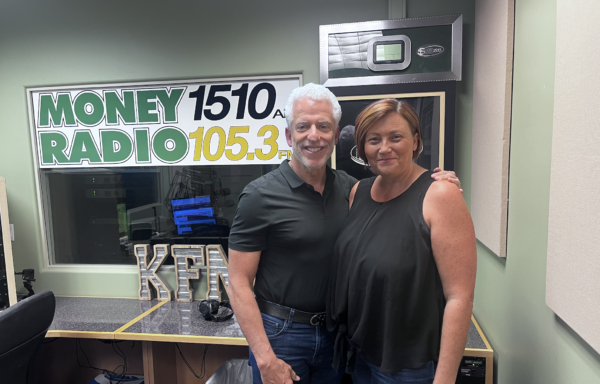
    I was honored to have been a guest on Health Futures – Taking Stock in You Radio Show on Money Radio 1510 AM discussing navigating the home care revolution. Health Futures is hosted by HomeCare expert Bob Roth, owner of Cypress HomeCare Solutions. Cypress just celebrate its 30th anniversary last week and is the recipient of a Grant to Innovate within Medicaid in partnership with PocketRN and is the 2013 & 2018 winner of the BBB Torch Awards for Ethics. You can listen to the full radio show here. Below is the blog based on the show, written by the CEO of Strait Talk PR, Lauren Strait.


    Home Care Revolution bob roth kristin rowan
    Home Care Revolution bob roth kristin rowan

    by Lauren Strait, CEO Strait Talk PR

    The Aging Population Tsunami

    By 2050, the 85-year-old population in the United States is expected to quadruple. As this massive demographic shift unfolds, the already strained home care industry will face unprecedented challenges in meeting the escalating demand for quality care services.

    Bob Roth, Managing Partner of Cypress HomeCare Solutions, recently had Kristin Rowan, of The Rowan Report on the radio show and podcast to discuss this trend and everything a consumer needs to know about the homecare industry and how it will affect them.

    A Trusted Voice Amid Industry Upheaval

    In the latest episode of “Health Futures, Taking Stock in You” hosted by Bob Roth of Cypress Homecare Solutions, Kristin Rowan, Owner and Editor of The Rowan Report, offered insights into how her publication is guiding the industry through this seismic transition.

    The Rowan Report’s Unbiased Expertise

    What began as a print magazine reviewing home health technology has evolved into a comprehensive digital hub covering regulatory updates, workforce solutions, marketing strategies, and groundbreaking innovations. Rowan emphasized the publication’s commitment to neutrality when evaluating new products and services.

    “We do our best to remain as neutral as possible…that’s one of the things that Tim [her father and the founder] established early on in his relationships with tech providers.”

    Empowering a Strained Workforce

    With a redesigned website offering robust search capabilities, The Rowan Report curates resources to help agencies streamline operations and alleviate administrative burdens on overstretched staff. “The solution is not more people because they’re just not there,” Rowan stated. “But the solution is collaboration to better utilize the people that you have.”

    The publication explores leveraging AI, voice technologies, automated claims processing, and outsourcing to reduce paperwork and maximize efficiency, enabling care professionals to concentrate on frontline patient care.

    Preparing for the Age Wave

    As the population ages, The Rowan Report recognizes the need to educate professionals and families on navigating the complexities of long-term care. By convening experts, the publication covers crucial topics like choosing providers, understanding Medicare/Medicaid, and planning for future care needs.

    An Indispensable Industry Guide

    With over 25 years of experience, The Rowan Report stands as an indispensable guide for the home care industry as it braces for the challenges and opportunities of an aging America. Access their insights at www.therowanreport.com.

    # # # 

    Bob Roth is Managing Partner of Cypress HomeCare Solutions. He assisted in creating Cypress HomeCare Solutions with his family in 1994. Bob brings the depth and breadth of his nearly 36 years of consumer products, health care and technology experience to the home care trade. Over the years, Bob has received a number of awards. These include the January 2014 CEO of the Month and finalist for the 2015 Phoenix Business Journal’s Healthcare Heroes award. Cypress won the Better Business Bureau’s Business Ethics award in 2013 and 2018.

    In March 2017, Arizona Governor Bob Ducey appointed Bob to the Governor’s Advisory Council on Aging. This was the first time in the Council’s 40 years that a home care/home health care agency owner/manager has served on the Council. Nationally, Bob serves on the Board of Directors for the Home Care Association of America (HCAOA). Locally, he serves on the Board of Directors for DUET Partners in Aging. Additionally, he is on the ambassador committee for Aging 2.0 – Phoenix Chapter. On September 11, 2019 Bob won the Home Health Care News Future Leader Award. The award recognizes up-and-coming leaders elevating the home health industry. When he’s not working, Bob enjoys spending time with his wife Susie, their three daughters, and playing golf, tennis, hiking and walking with Ruby and Lacey, our pet therapy dogs.

    Bob Roth
    Bob Roth

    Bob Roth is Managing Partner of Cypress HomeCare Solutions. He assisted in creating Cypress HomeCare Solutions with his family in 1994. Bob brings the depth and breadth of his nearly 36 years of consumer products, health care and technology experience to the home care trade. Over the years, Bob has received a number of awards. These include the January 2014 CEO of the Month and finalist for the 2015 Phoenix Business Journal’s Healthcare Heroes award. Cypress won the Better Business Bureau’s Business Ethics award in 2013 and 2018.

    In March 2017, Arizona Governor Bob Ducey appointed Bob to the Governor’s Advisory Council on Aging. This was the first time in the Council’s 40 years that a home care/home health care agency owner/manager has served on the Council. Nationally, Bob serves on the Board of Directors for the Home Care Association of America (HCAOA). Locally, he serves on the Board of Directors for DUET Partners in Aging. Additionally, he is on the ambassador committee for Aging 2.0 – Phoenix Chapter. On September 11, 2019 Bob won the Home Health Care News Future Leader Award. The award recognizes up-and-coming leaders elevating the home health industry. When he’s not working, Bob enjoys spending time with his wife Susie, their three daughters, and playing golf, tennis, hiking and walking with Ruby and Lacey, our pet therapy dogs.

    Kristin Rowan, Editor
    Kristin Rowan, Editor
    Kristin Rowan has been working at Healthcare at Home: The Rowan Report since 2008. She has a master’s degree in business administration and marketing and runs Girard Marketing Group, a multi-faceted boutique marketing firm specializing in event planning, sales, and marketing strategy. She has recently taken on the role of Editor of The Rowan Report and will add her voice to current Home Care topics as well as marketing tips for home care agencies. Connect with Kristin directly kristin@girardmarketinggroup.com or www.girardmarketinggroup.com

    ©2024 by The Rowan Report, Peoria, AZ. All rights reserved. This article originally appeared in Healthcare at Home: The Rowan Report. One copy may be printed for personal use: further reproduction by permission only. editor@therowanreport.com

    Connecticut Senate and House Pass Home Care Worker Safety Bill

    by Kristin Rowan, Editor

    Last week, we reported on the proposed Bill in the Connecticut Senate and House to provide additional precautions for home care worker safety. In wake of the Elara Caring at Fault Joyce Grayson Home Care Worker Safety Joyce Grayson murder during a home health visit, leadership in Connecticut aimed to safeguard home health and home health aide workers and collect risk assessment data on the same.

    On May 6, 2024, CT legislature passed bills in both the Senate and House of Representatives. Instead of the proposed bills that we reported on previously, both branches added amendments to previous bills. The bills include provisions for cyberattack readiness, child safety, and other items not related to care in the home.

    First Stage of Home Care Worker Safety

    Some of the provisions in the final bill are effective July 1, 2024. As we previously reported, hospice agencies are currently exempt from these provisions and the CT legislature will address hospice agencies in their next session.

    On and after July 1, 2024

    The Commissioner shall increase the fee payable to a home health care or home health aide agency that provides escorts for safety purposes to staff conducting a home visit to cover the costs of providing such escorts.

    The Commission of Public Health will establish and administer a home care staff safety grant program to provide grants to home health and home health aide agencies for staff safety technology, including, but not limited to :

    1. A mobile application for staff to access safety information about a client
    2. A method for staff to communicate with either local police or other staff in the event of an emergency
    3. A global positioning system-enabled, wearable device that allows staff to contact local police
    Effective July 1, 2024

    The sum of one million dollars is appropriated to the Department of Public Health for the the fiscal year ending June 30, 2025, to establish and administer the aforementioned grant program.

    The Commissioner of Public Health and the Commission on Community Gun Violence Intervention and Prevention, will develop or find educational material about gun safety practices and provide such to primary care providers to give to patients who are 18 years of age or older.

    Second Stage of Home Care Worker Safety

    Some of the provisions in the final bill are effective October 1, 2024. Home health and home health aide agencies have five months to comply with these measures.

    Effective October 1, 2024, home health and home health aide agency must collect and provide to assigned workers information about:

    The client, including as applicable;

    1. psychiatric history
    2. history of violence
    3. history of substance use
    4. history of domestic abuse
    5. current infections, if any, and treatment received
    6. whether diagnoses or symptoms have remained stable over time
    Home Care Worker Safety
    Other persons present or anticipated to be present at the location of care including, if known to the agency:

    1. name and relationship to client
    2. psychiatric history
    3. history of violence or domestic abuse
    4. criminal record
    5. history of substance use

    Location where employee will provide services including, if know to the agency:

    1. the crime rate for the municipality in which employee will provide services
    2. the presence of any hazardous materials, including, but not limited to used syringes
    3. the presence of firearms or other weapons
    4. the status and of the fire alarm system
    5. the presence of any safety hazards, including, but not limited to, electrical hazards
    By October 1, 2024, each home health and home health aide agency must:

    Provide staff training consistent with the health and safety training curriculum for home care workers, including but not limited to:

    1. Training to recognize hazards commonly encountered in home care workplaces
    2. Applying practical solutions to manage risks and improve safety

    Conduct monthly safety assessments with each staff member and

    Provide staff with a mechanism to perform safety checks, which may include, but need not be limited to:

    1. A mobile application that allows staff to access safety information about the client
    2. A means of communicating with local police or other staff in the event of an emergency
    3. A global positioning system-enabled, wearable device that allows staff to contact local police by pressing a button or through another mechanism
    Effective October 1, 2024

    Each home health and home health aide agency shall, in a manner prescribed by the Commissioner of Public Health:

    1. Report each instance of verbal abuse that is perceived as a threat or danger to the staff
    2. Report each instance of physical, sexual, or any other abuse by a client against a staff member

    Third Stage of Home Care Worker Safety

    No later than January 1, 2025

    Beginning January 1, 2025 and annually therafter, the commissioner shall report to the joint standing committee:

    1. The number of reports of violence and abuse received
    2. The actions taken to ensure the safety of the staff member about whom the report was made
    Effective January 1, 2025

    Each individual health insurance policy shall provide coverage for escorts for the safety of home health care agency or home health aide agency staff

    The joint standing committee of the General Assembly will convene a working group to study staff safety issues affecting home health and home health aide agencies, including but not limited to the following members:

    1. Three employees of a home health care or home health aide agency
    2. Two representatives of a home health care or home health aide agency
    3. One representative of a collective bargaining unit representing home health care or home health aide agency employees
    4. One representative of a mobile crisis response services provider
    5. One representative of an assertive community treatment team
    6. One representative of a police department; and
    7. One representative of an association of hospitals in the state

    Implications

    As we mentioned before, these regulations will become mandates across the country soon. OSHA has found the home care agency in Connecticut at fault for failing to implement safety procedures and precautions in the death of Joyce Grayson. The nurse’s family is suing the home health agency for wrongful death. Connecticut has established a protocol for safety measures, committees, reporting, and grant programs to implement immediate safety procedures across home health and home health aide agencies in the state. Before these provisions are passed on a national level, and before you have to tell the family of one of your staff that they aren’t coming home…


    We urge you to:
    1. Create a safety committee within your agency
    2. Invest in training on de-escalation, workplace violence prevention, and self-defense
    3. Research and invest in a GPS-enabled emergency alert system for your staff. We recommend POM Safe and Katana Safety
    4. Insist on background information on all clients and others living in the home upon intake and BEFORE the first home visit
    5. Create a safe and comfortable way for your staff to report verbal abuse, violence, or uneasiness from any in-home visit
    6. Invest in escort and/or paired visits for high-risk clients, first-time clients, or any other situation that warrants it

    We will continue to follow this story and provide updates as we receive them.

    # # #

    Kristin Rowan, Editor
    Kristin Rowan, Editor

    Kristin Rowan has been working at Healthcare at Home: The Rowan Report since 2008. She has a master’s degree in business administration and marketing and runs Girard Marketing Group, a multi-faceted boutique marketing firm specializing in event planning, sales, and marketing strategy. She has recently taken on the role of Editor of The Rowan Report and will add her voice to current Home Care topics as well as marketing tips for home care agencies. Connect with Kristin directly kristin@girardmarketinggroup.com or www.girardmarketinggroup.com

    ©2024 by The Rowan Report, Peoria, AZ. All rights reserved. This article originally appeared in Healthcare at Home: The Rowan Report. One copy may be printed for personal use: further reproduction by permission only. editor@therowanreport.com

    House Ways and Mean Unanimously Extends Telehealth Flexibilities

    FOR IMMEDIATE RELEASE

    ATA ACTION APPLAUDS HOUSE WAYS AND MEANS COMMITTEE FOR UNANIMOUSLY ADVANCING A TWO-YEAR EXTENSION OF MANY CRITICAL TELEHEALTH FLEXIBILITIES

    WASHINGTON, DC, MAY 8, 2024 – ATA Action, an affiliated trade organization of the American Telemedicine Association (ATA), applauds the House Ways and Means Committee for their proactive approach in unanimously advancing a two-year telehealth extension. This extension will maintain many of the current Medicare telehealth flexibilities through the end of calendar year 2026, demonstrating the Committee’s commitment to telehealth.

    “While we prefer Medicare telehealth flexibilities be made permanent, we understand the dynamics and applaud the Committee for a two-year extension of many of the critical flexibilities without arbitrary and unnecessary guardrails such as in-person requirements,” said Kyle Zebley, Senior Vice President, Public Policy, the ATA and Executive Director, ATA Action. “This is a clear sign that our bipartisan telehealth supporters are at work, determined not to leave the American people without access to safe, effective, quality healthcare where and when they need it. But this is not over yet. There will be additional markups and other committees need to weigh in, as we continue to push for telehealth permanency.”

    Specifically, ATA Action is supportive of the bill extending the following telehealth provisions:

    • Geographic and originating-site waivers
    • Ability for Federally Qualified Health Centers (FQHCs) and Rural Health Clinics (RHCs) to continue to furnish telehealth services
    • Expanded list of eligible Medicare providers, allowing Physical Therapists, Occupational Therapists, Speech Language Pathologies, and Audiologists to render telehealth services
    • Ability to offer audio-only services
    • Repeal of telemental health in-person requirement
    • Preservation of the Acute Hospital Care at Home Program through CY2029

    “We hope this action by the Ways and Means Committee will push Congress to enact this legislation soon to provide certainty for patients and providers across the country and allow U.S. healthcare systems enough time to implement appropriate virtual tools, technologies, programs, and processes moving forward,” Zebley added. “We support additional telehealth priorities that have not yet been acted upon, including the remote prescribing of controlled substances, which were not included in the legislative proposal. We believe, if left omitted, this would lead to a tremendous gap in care.”

    “ATA Action is available as a resource and looks forward to continuing to work with Congress to ensure that the appropriate telehealth policies are implemented in a timely manner without arbitrary and unnecessary barriers to care such as in-person, brick and mortar, or geographic requirements,” Zebley said.

    About ATA Action

    ATA Action recognizes that telehealth and virtual care have the potential to transform the healthcare delivery system by improving patient outcomes, enhancing the safety and effectiveness of care, addressing health disparities, and reducing costs. ATA Action is a registered 501c6 entity and an affiliated trade organization of the American Telemedicine Association (ATA).

    #  #  #

    CONTACT:

    Gina Cella
    gcella@americantelemed.org
    t: 781-799-3137

    © The Rowan Report. For information on publishing this or any other press release, please contact editor@therowanreport.com